

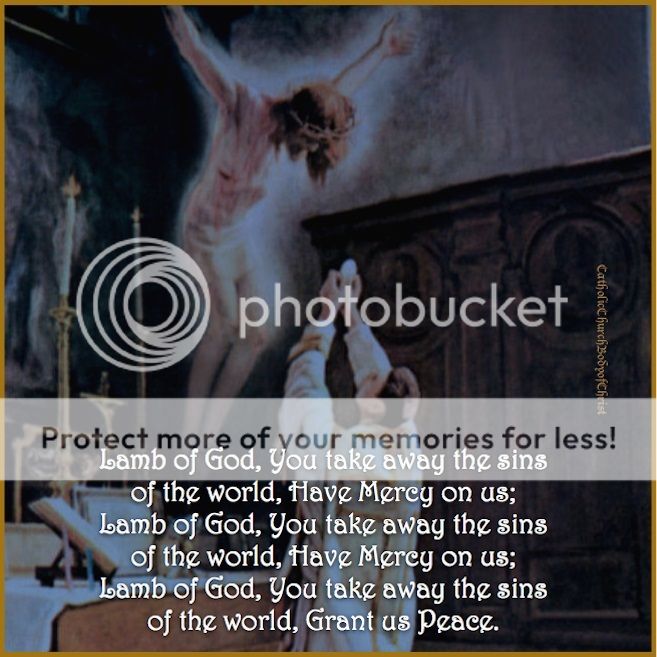
This post has been edited by khool: Feb 21 2016, 10:09 PM
LYN Catholic Fellowship V01 (Group), For Catholics (Roman or Eastern)
|
|
 Feb 21 2016, 10:05 PM Feb 21 2016, 10:05 PM
|
 
Junior Member
225 posts Joined: Mar 2008  
|
Amen!
This post has been edited by khool: Feb 21 2016, 10:09 PM |
|
|
|
|
|
Feb 21 2016, 10:19 PM
|
|
Junior Member
225 posts Joined: Mar 2008
|
Sacrament of Confirmation ...
|
|
|
Feb 23 2016, 07:29 AM
|
|
Junior Member
225 posts Joined: Mar 2008
|
Why did Jesus fold the linen burial cloth after His resurrection?
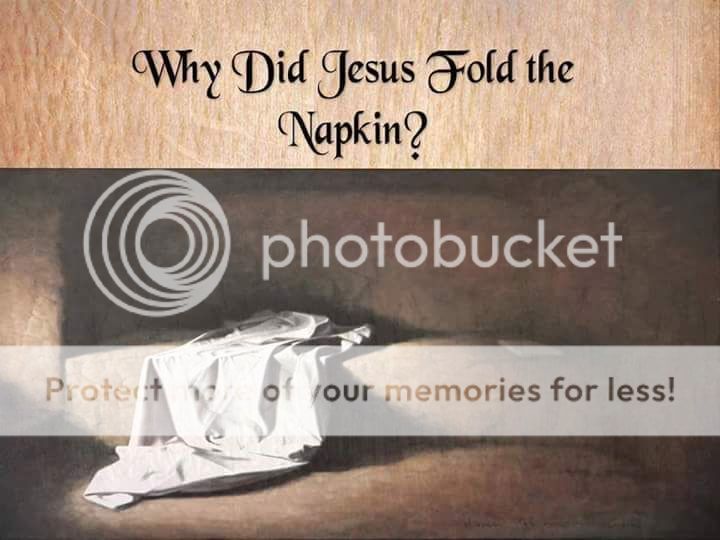 I never noticed this...SOOOO GLAD I TOOK THE TIME TO READ THIS! The Gospel of John (20:7) tells us that the napkin, which was placed over the face of Jesus, was not just thrown aside like the grave clothes. The Bible takes an entire verse to tell us that the napkin was neatly folded, and was placed separate from the grave clothes. Early Sunday morning, while it was still dark, Mary Magdalene came to the tomb and found that the stone had been rolled away from the entrance. She ran and found Simon Peter and the other disciple, the one whom Jesus loved. She said, 'They have taken the Lord's body out of the tomb, and I don't know where they have put him!' Peter and the other disciple ran to the tomb to see.. The other disciple outran Peter and got there first. He stooped and looked in and saw the linen cloth lying there, but he didn't go in. Then Simon Peter arrived and went inside. He also noticed the linen wrappings lying there, while the cloth that had covered Jesus' head was folded up and lying to the side. Was that important? Absolutely! Is it really significant? Yes! In order to understand the significance of the folded napkin, you have to understand a little bit about Hebrew tradition of that day. The folded napkin had to do with the Master and Servant, and every Jewish boy knew this tradition. When the servant set the dinner table for the master, he made sure that it was exactly the way the master wanted it.. The table was furnished perfectly, and then the servant would wait, just out of sight, until the master had finished eating, and the servant would not dare touch that table, until the master was finished. Now, if the master were done eating, he would rise from the table, wipe his fingers, his mouth, and clean his beard, and would wad up that napkin and toss it onto the table. The servant would then know to clear the table. For in those days, the wadded napkin meant, 'I'm done'. But if the master got up from the table, and folded his napkin, and laid it beside his plate, the servant would not dare touch the table, because........... The folded napkin meant, 'I'm coming back!' HE'S COMING BACK!!!! God bless!  Source: https://www.facebook.com/WeAreCatholics/pho...4558028/?type=3 |
|
|
Feb 23 2016, 07:36 AM
|
|
Junior Member
225 posts Joined: Mar 2008
|
WE WALK BY FAITH NOT BY SIGHT. O YOU FOOLISH GALATIANS WHOM BEFORE YOUR VERY EYES CHRIST IS PORTRAYED AS CRUCIFIED AMONG YOU.
But you are come to mount Sion, and to the city of the living God, the heavenly Jerusalem, and to the company of many thousands of angels, And to the church of the firstborn, who are written in the heavens, and to God the judge of all, and to the spirits of the just made perfect, And to Jesus the mediator of the new testament, and to the sprinkling of blood which speaketh better than that of Abel. See that you refuse him not that speaketh. For if they escaped not who refused him that spoke upon the earth, much more shall not we, that turn away from him that speaketh to us from heaven. Whose voice then moved the earth; but now he promiseth, saying: Yet once more, and I will move not only the earth, but heaven also. And in that he saith, Yet once more, he signifieth the translation of the moveable things as made, that those things may remain which are immoveable. Therefore receiving an immoveable kingdom, we have grace; whereby let us serve, pleasing God, with fear and reverence. For our God is a consuming fire. 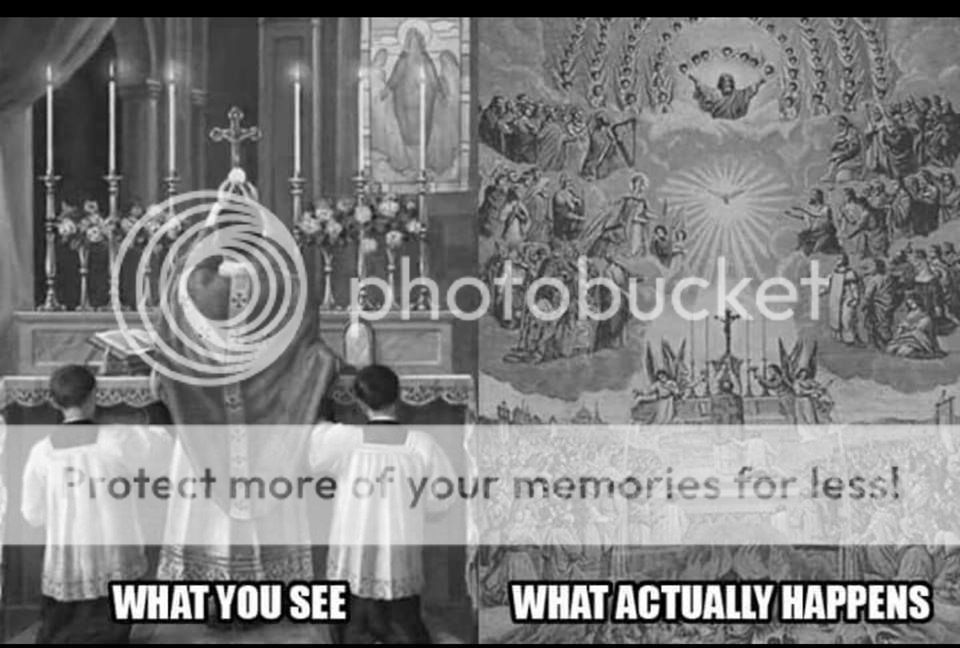 |
|
|
Feb 25 2016, 01:15 AM
|

Senior Member
3,576 posts Joined: Apr 2006
|
Unity of the Church
148. At no time has the Christian Church, whether it be regarded as one or many, possessed complete unity. When you speak like that you show that you are thinking the Christian Church to consist of all the Churches in the world which profess to be Christian. If that were right, no one could deny your contention. Also, far from defending the Christian Church, could it rightly be understood in such a way, I would abandon it and join with you in pointing out its fallacies. But all the conflicting Churches claiming to be Christian cannot rightly be regarded as constituting the one Christian Church. The unity of Christ's Church cannot be that of a mere aggregate of different Churches lumped together like a heap of stones. Its unity is essentially an organic unity. The one true Church is undivided in itself, and divided from all substitute Churches. 149. The Roman Catholic Church is not undivided in itself. You have to admit that there is an immense difference between the Catholicism in some European and in South American countries, and that of the English-speaking world. The Catholic Church does not deny such differences. She denies that they concern the essential things of the Christian religion. Consisting of people belonging to all nations, she knows that each nation will have its own special racial characteristics which are bound to color its religious as well as its social customs. And whilst she demands essential unity she does not demand uniformity in secondary and external manifestations of religion. I lived for some years in Italy, and I can assure you that in very many things, even religiously, their ways were not my ways and never will be my ways. On the other hand, my ways in equally many things would have no appeal for them. There is no reason why such differences should not exist, and no reason why we should either condemn or adopt the ways of others just because they are the ways of others. Essentially and constitutionally, however, all Catholics the world over form one united Catholic Church. 150. The New Testament does not require such unity. The Book of Revelation opens with letters to the seven Churches of Asia. The "seven Churches of Asia" consisted of groups of Christians at Ephesus, Smyrna, Pergamos, Thyatira, Sardis, Philadelphia and Laodicea all towns in Asia Minor. These were not independent Churches, but local communities belonging to one and the same Catholic Church. Christ established only one Church and bade it go and teach all nations. The Post Office is one Government Department, but it is represented by local post offices in different towns and suburbs. In dealing with local post offices you are dealing with the Post Office itself. So the seven Churches of Asia Minor were local foundations of one and the same Catholic Church. The New Testament knows nothing of separate Churches recognizing no common authority and not united with one another. 151. There were many different and independent Churches in early Christian times, one at Antioch, one at Jerusalem, one at Constantinople, one at Rome, one at Alexandria; and in later times, in England and Scotland and so on with other localities. They were not independent Churches. Christ intended one Church only, extending its activities to all places and peoples. He said* "I will build My Church," not "My Churches." His teaching leaves no room for independent Churches. Non-Catholic Churches set up independently of the Catholic Church, whether to suit some individual's personal religious preferences or to suit the national aspirations of a given people are quite opposed to the will of Christ and not part of His Church. 152. Did not the Great Western Schism disprove the unity of the Catholic Church? No. What is known as the "Great Western Schism" lasted from 1378 till 1417. It was not strictly a schism at all. During that period besides the lawful Pope, there were two others who unlawfully proclaimed themselves Popes, each having a following convinced that his claims were right. By 1417 things were straightened out, and one lawful Pope was acknowledged by all. The unity of the Church as a Church was no more affected by this than the unity of the Kingdom of England was affected by the fact that at various times there were Pretenders to the Throne with followers convinced of their rightful claims. 153. Where was unity then? However confused Catholics might have been as to which was the true Pope, all admitted the truth of the one Catholic Church, all acknowledged Papal authority, and all agreed that there could be but one true Pope. They held no schismatical principles, and were not schismatics. 154. How do you explain such confusion? It is explained by the liability of the human judgment to arrive at wrong conclusions, above all when people are not familiar with all the facts of the case. In quite good faith people can support wrong causes. The essential unity of the Catholic Church is not affected by the fact that all Catholics are not individually infallible in such matters. 155. The Great Western Schism must have permanently injured the Church. It did not. It was but a transitory historical episode; and as I have said was not really a schism at all. The confusion was ended by the Council of Constance in 1417 when the lawful Pope Gregory XII resigned, the two Pretenders were declared not lawful Popes at all, and Pope Martin V was elected and acknowledged by everybody as the one true Pope. Over five hundred years have elapsed since then without any recurrence of such confusion. 156. An Anglican Bishop tells me that the Christian Church is rent by schism and is divided even now. That is impossible. There can be no real schism in the Church. There can only be schism from the Church. Christ, who warned us that a kingdom divided against itself cannot stand, took good care that His Church would ever retain its essential unity. Take an analogy from the relationships between England and the United States. The Pilgrim Fathers went to America and founded an English colony there. But eventually the colonists repudiated the authority of the British Throne, declared their independence, and became a new nation, the United States of America, ceasing to be part of the British Empire. Your Anglican Bishop belongs to a Church which in a somewhat similar way ceased to belong to the Catholic Church to which it previously belonged. Pope Gregory the Great sent missionaries to England to establish the Church the only Church those missionaries knew, the Catholic Church in that country. Nearly a thousand years later Henry VIII, with the British Parliament, repudiated the authority of the Pope which all Englishmen had till then acknowledged and which all Catholics in France, Germany, Spain and other countries continued to acknowledge. Henry's new Church of England was no more part of the Church previously acknowledged than the United States of America, after the Declaration of Independence, was part of the British nation. 157. I cannot feel that one united Church throughout the world is really necessary. Ephesians, IV, 3, warns us to keep the unity of the spirit in the bond of peace. Surely if we can keep unity of spirit we can forget the rest. "Unity of spirit" is not the unity of the spirit of which St. Paul speaks. He is speaking of unity in one Church, given by the Holy Spirit. It is not enough to have a unity of spirit in the sense of Christian respect and courtesy for one another whilst remaining in actual fact members of separated Churches. We must, of course, keep that respect and courtesy for one another; or get it if we haven't got it already. But more than that is needed. After the very words you quote, St. Paul tells us that we are to be "one body" and he wrote to the Corinthians: "Let there be no schisms amongst you"; I Cor., I, 10, that is, no divisions of one from another. As the Holy Spirit is one, so the Church must be one; and all should make sure of being in the unity of Christ's Church under the guidance of the Holy Spirit. That is why the Catholic Church is insistent on unity, refusing to accept the idea that different denominations are lawful. Unity is a sign of the true Church, and it is found in the Catholic Church. Source: Radio Replies   |
|
|
Feb 25 2016, 11:02 AM
|
|
Junior Member
225 posts Joined: Mar 2008
|
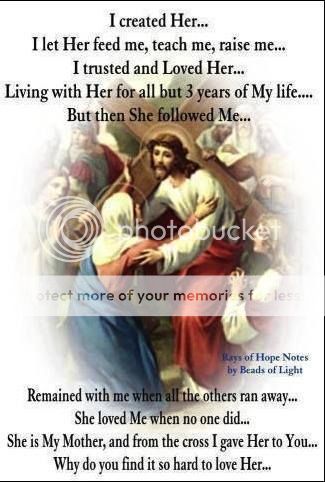
Immutable truth, no matter what anybody says ...
 |
|
|
|
|
|
Feb 25 2016, 11:22 AM
|

Junior Member
51 posts Joined: Sep 2010
|
yeeck
No offend intend but is that a need to segregate? |
|
|
Feb 25 2016, 12:18 PM
|
|
Senior Member
3,576 posts Joined: Apr 2006
|
QUOTE(Blindspot61 @ Feb 25 2016, 11:22 AM) yeeck Can you elaborate further on your question?No offend intend but is that a need to segregate?  |
|
|
Feb 25 2016, 12:24 PM
|
|
Junior Member
51 posts Joined: Sep 2010
|
QUOTE(yeeck @ Feb 25 2016, 12:18 PM) Can you elaborate further on your question? What I mean is can't it be just Christian Christian. Not Catholic christian or Protestant christian or Methodist christian.Just ask out of curiosity. No offend.  |
|
|
Feb 25 2016, 12:25 PM
|
|
Senior Member
3,576 posts Joined: Apr 2006
|
Catholic Tradition:
Life in the Spirit Catholic Tradition often seems odd to those outside the Catholic Church. People assume it's something that we just... "made up." Sacred Tradition comes from Christ. It's the full, living gift of Christ to the Apostles, faithfully handed down through each generation. It is through Tradition that the Holy Spirit makes the Risen Lord present among us, offering us the very same saving Word and Sacraments that he gave to the Apostles! Understanding Catholic Tradition is essential to understanding the Catholic Church and the Catholic Christian faith. Tradition is "handed down" The word "tradition" actually means handing down something to another person. Scripture testifies to this meaning of Catholic Tradition as the normal mode of transmitting the Faith: "So then, brethren, stand firm and hold to the traditions which you were taught by us, either by word of mouth or by letter." (2 Thess 2:15) "For I received from the Lord what I also handed on to you...." (1 Cor 11:23) "For I handed on to you as of first importance what I also received...." (1 Cor 15:3) "...I know whom I have believed [i.e., Jesus], and I am sure that he is able to guard until that Day what has been entrusted to me. Follow the pattern of the sound words which you have heard from me, in the faith and love which are in Christ Jesus; guard the truth that has been entrusted to you by the Holy Spirit who dwells within us." (2 Tim 1:11-14) "You then, my son, be strong in the grace that is in Christ Jesus, and what you have heard from me before many witnesses entrust to faithful men who will be able to teach others also." (2 Tim 2:1-2) "...I found it necessary to write appealing to you to contend for the faith which was once for all delivered to the saints." (Jude 1:3) This is the most basic meaning of Catholic Tradition: it is the true Faith itself, given to the Apostles by Christ and faithfully transmitted to each new generation. (Catechism, 77-78) We often write Tradition, with a capital 'T', to mean Sacred Tradition. This Catholic Tradition is different from those traditions (small 't') that are merely customs, and which are not part of Divine Revelation. The Apostolic source of Catholic Tradition The Second Vatican Council ("Vatican II") wrote an important document called "On Divine Revelation" (Dei Verbum in Latin). It's quite readable, and contains definitive teaching on the full meaning of Catholic Tradition. The Council notes the importance of seeing that Catholic Tradition is firmly rooted in the Apostles: it is Christ's whole gift to them, and to us. The Council writes: In His gracious goodness, God has seen to it that what He had revealed for the salvation of all nations would abide perpetually in its full integrity and be handed on to all generations. Therefore Christ the Lord in whom the full revelation of the supreme God is brought to completion..., commissioned the Apostles to preach to all men that Gospel which is the source of all saving truth and moral teaching, and to impart to them heavenly gifts. (Dei Verbum, 7) It is specifically this "commissioning of the Apostles" that is fulfilled in the handing on of Catholic Tradition. The Apostles dedicated themselves to this mission, and they appointed other faithful men to succeed them and carry on their work. That same passage of Dei Verbum continues: This commission was faithfully fulfilled by the Apostles who, by their oral preaching, by example, and by observances handed on what they had received from the lips of Christ, from living with Him, and from what He did, or what they had learned through the prompting of the Holy Spirit. The commission was fulfilled, too, by those Apostles and apostolic men who under the inspiration of the same Holy Spirit committed the message of salvation to writing. (Dei Verbum, 7) Catholic Tradition and Scripture Many Protestants believe that Catholics look to Tradition instead of Scripture. Not at all! Catholic Tradition stands with Scripture in forming the one single deposit of the Faith. For Catholics, Sacred Tradition is not in opposition to Scripture: they compliment and confirm one another. Vatican II's Dei Verbum speaks of "a close connection and communication between sacred tradition and Sacred Scripture": "both of them... [flow] from the same divine wellspring." It says that "Sacred Scripture is the word of God inasmuch as it is consigned to writing under the inspiration of the divine Spirit, while sacred tradition takes the word of God entrusted by Christ the Lord and the Holy Spirit to the Apostles, and hands it on to their successors in its full purity." The Church, "led by the light of the Spirit of truth, ...may in proclaiming it preserve this word of God faithfully, explain it, and make it more widely known." (Dei Verbum, 9) This statement reveals another key aspect of Catholic Tradition: it is linked to the active work of the Holy Spirit. The living experience of Christ Through the Spirit Pope Benedict XVI gave a beautiful catechesis on Catholic Tradition in late April, 2006. He says that we miss the profound meaning of Catholic Tradition if we see it only as the handing on of a static Revelation. More than that, it is the active, continuous work of the Holy Spirit in our particular time: it makes real and tangible "the active presence of the Lord Jesus in his people, realized by the Holy Spirit". Seeing Catholic Tradition as the active presence of Christ through the work of the Spirit is precisely what accomplishes the "transmission of the goods of salvation" to us: Thanks to Tradition, guaranteed by the ministry of the apostles and their successors, the water of life that flowed from the side of Christ and his saving blood comes to the women and men of all times. In this way, Tradition is the permanent presence of the Savior who comes to meet, redeem and sanctify us in the Spirit through the ministry of his Church for the glory of the Father. This reality of the divine action of the Holy Spirit within the Church is essential to understanding Catholic Tradition. It is what makes Sacred Tradition something far different than mere human traditions. Through that same action of the Spirit, Catholic Tradition incorporates us into the Communion of the Saints. It ensures the connection "between the experience of the apostolic faith, lived in the original community of the disciples, and the present experience of Christ in his Church." The Pope concludes: Tradition is the living river that unites us to the origins, the living river in which the origins are always present, the great river that leads us to the port of eternity. In this living river, the word of the Lord...: "And behold, I am with you always, until the end of the age", is fulfilled again (Matthew 28:20). Through Catholic Tradition, the Holy Spirit works to bring the grace and truth of Christ into our own lives. It's real. And it's living right now in the Catholic Church! "And the Word became flesh and dwelt among us." (John 1:14) Source: BeginningCatholic.com |
|
|
Feb 25 2016, 12:26 PM
|
|
Senior Member
3,576 posts Joined: Apr 2006
|
Scripture and Tradition
Protestants claim the Bible is the only rule of faith, meaning that it contains all of the material one needs for theology and that this material is sufficiently clear that one does not need apostolic tradition or the Church’s magisterium (teaching authority) to help one understand it. In the Protestant view, the whole of Christian truth is found within the Bible’s pages. Anything extraneous to the Bible is simply non-authoritative, unnecessary, or wrong—and may well hinder one in coming to God. Catholics, on the other hand, recognize that the Bible does not endorse this view and that, in fact, it is repudiated in Scripture. The true "rule of faith"—as expressed in the Bible itself—is Scripture plus apostolic tradition, as manifested in the living teaching authority of the Catholic Church, to which were entrusted the oral teachings of Jesus and the apostles, along with the authority to interpret Scripture correctly. In the Second Vatican Council’s document on divine revelation, Dei Verbum (Latin: "The Word of God"), the relationship between Tradition and Scripture is explained: "Hence there exists a close connection and communication between sacred Tradition and sacred Scripture. For both of them, flowing from the same divine wellspring, in a certain way merge into a unity and tend toward the same end. For sacred Scripture is the word of God inasmuch as it is consigned to writing under the inspiration of the divine Spirit. To the successors of the apostles, sacred Tradition hands on in its full purity God’s word, which was entrusted to the apostles by Christ the Lord and the Holy Spirit. "Thus, by the light of the Spirit of truth, these successors can in their preaching preserve this word of God faithfully, explain it, and make it more widely known. Consequently it is not from sacred Scripture alone that the Church draws her certainty about everything which has been revealed. Therefore both sacred Tradition and sacred Scripture are to be accepted and venerated with the same devotion and reverence." But Evangelical and Fundamentalist Protestants, who place their confidence in Martin Luther’s theory of sola scriptura (Latin: "Scripture alone"), will usually argue for their position by citing a couple of key verses. The first is this: "These are written that you may believe that Jesus is the Christ, the Son of God, and that believing you may have life in his name" (John 20:31). The other is this: "All Scripture is inspired by God and profitable for teaching, for reproof, for correction, and for training in righteousness; so that the man of God may be equipped, prepared for every good work" (2 Timothy 3:16–17). According to these Protestants, these verses demonstrate the reality of sola scriptura (the "Bible only" theory). Not so, reply Catholics. First, the verse from John refers to the things written in that book (read it with John 20:30, the verse immediately before it to see the context of the statement in question). If this verse proved anything, it would not prove the theory of sola scriptura but that the Gospel of John is sufficient. Second, the verse from John’s Gospel tells us only that the Bible was composed so we can be helped to believe Jesus is the Messiah. It does not say the Bible is all we need for salvation, much less that the Bible is all we need for theology; nor does it say the Bible is even necessary to believe in Christ. After all, the earliest Christians had no New Testament to which they could appeal; they learned from oral, rather than written, instruction. Until relatively recent times, the Bible was inaccessible to most people, either because they could not read or because the printing press had not been invented. All these people learned from oral instruction, passed down, generation to generation, by the Church. Much the same can be said about 2 Timothy 3:16-17. To say that all inspired writing "has its uses" is one thing; to say that only inspired writing need be followed is something else. Besides, there is a telling argument against claims of Evangelical and Fundamentalist Protestants. John Henry Newman explained it in an 1884 essay entitled "Inspiration in its Relation to Revelation." Newman’s argument He wrote: "It is quite evident that this passage furnishes no argument whatever that the sacred Scripture, without Tradition, is the sole rule of faith; for, although sacred Scripture is profitable for these four ends, still it is not said to be sufficient. The Apostle [Paul] requires the aid of Tradition (2 Thess. 2:15). Moreover, the Apostle here refers to the scriptures which Timothy was taught in his infancy. "Now, a good part of the New Testament was not written in his boyhood: Some of the Catholic epistles were not written even when Paul wrote this, and none of the books of the New Testament were then placed on the canon of the Scripture books. He refers, then, to the scriptures of the Old Testament, and, if the argument from this passage proved anything, it would prove too much, viz., that the scriptures of the New Testament were not necessary for a rule of faith." Furthermore, Protestants typically read 2 Timothy 3:16-17 out of context. When read in the context of the surrounding passages, one discovers that Paul’s reference to Scripture is only part of his exhortation that Timothy take as his guide Tradition and Scripture. The two verses immediately before it state: "But as for you, continue in what you have learned and have firmly believed, knowing from whom you learned it, and how from childhood you have been acquainted with the sacred writings which are able to instruct you for salvation through faith in Christ Jesus" (2 Tim. 3:14–15). Paul tells Timothy to continue in what he has learned for two reasons: first, because he knows from whom he has learned it—Paul himself—and second, because he has been educated in the scriptures. The first of these is a direct appeal to apostolic tradition, the oral teaching which the apostle Paul had given Timothy. So Protestants must take 2 Timothy 3:16-17 out of context to arrive at the theory of sola scriptura. But when the passage is read in context, it becomes clear that it is teaching the importance of apostolic tradition! The Bible denies that it is sufficient as the complete rule of faith. Paul says that much Christian teaching is to be found in the tradition which is handed down by word of mouth (2 Tim. 2:2). He instructs us to "stand firm and hold to the traditions which you were taught by us, either by word of mouth or by letter" (2 Thess. 2:15). This oral teaching was accepted by Christians, just as they accepted the written teaching that came to them later. Jesus told his disciples: "He who hears you hears me, and he who rejects you rejects me" (Luke 10:16). The Church, in the persons of the apostles, was given the authority to teach by Christ; the Church would be his representative. He commissioned them, saying, "Go therefore and make disciples of all nations" (Matt. 28:19). And how was this to be done? By preaching, by oral instruction: "So faith comes from what is heard, and what is heard comes by the preaching of Christ" (Rom. 10:17). The Church would always be the living teacher. It is a mistake to limit "Christ’s word" to the written word only or to suggest that all his teachings were reduced to writing. The Bible nowhere supports either notion. Further, it is clear that the oral teaching of Christ would last until the end of time. "’But the word of the Lord abides for ever.’ That word is the good news which was preached to you" (1 Pet. 1:25). Note that the word has been "preached"—that is, communicated orally. This would endure. It would not be supplanted by a written record like the Bible (supplemented, yes, but not supplanted), and would continue to have its own authority. This is made clear when the apostle Paul tells Timothy: "[W]hat you have heard from me before many witnesses entrust to faithful men who will be able to teach others also" (2 Tim. 2:2). Here we see the first few links in the chain of apostolic tradition that has been passed down intact from the apostles to our own day. Paul instructed Timothy to pass on the oral teachings (traditions) that he had received from the apostle. He was to give these to men who would be able to teach others, thus perpetuating the chain. Paul gave this instruction not long before his death (2 Tim. 4:6–8), as a reminder to Timothy of how he should conduct his ministry. What is Tradition? In this discussion it is important to keep in mind what the Catholic Church means by tradition. The term does not refer to legends or mythological accounts, nor does it encompass transitory customs or practices which may change, as circumstances warrant, such as styles of priestly dress, particular forms of devotion to saints, or even liturgical rubrics. Sacred or apostolic tradition consists of the teachings that the apostles passed on orally through their preaching. These teachings largely (perhaps entirely) overlap with those contained in Scripture, but the mode of their transmission is different. They have been handed down and entrusted to the Churchs. It is necessary that Christians believe in and follow this tradition as well as the Bible (Luke 10:16). The truth of the faith has been given primarily to the leaders of the Church (Eph. 3:5), who, with Christ, form the foundation of the Church (Eph. 2:20). The Church has been guided by the Holy Spirit, who protects this teaching from corruption (John 14:25-26, 16:13). Handing on the faith Paul illustrated what tradition is: "For I delivered to you as of first importance what I also received, that Christ died for our sins in accordance with the scriptures. . . . Whether then it was I or they, so we preach and so you believed" (1 Cor. 15:3,11). The apostle praised those who followed Tradition: "I commend you because you remember me in everything and maintain the traditions even as I have delivered them to you" (1 Cor. 11:2). The first Christians "devoted themselves to the apostles’ teaching" (Acts 2:42) long before there was a New Testament. From the very beginning, the fullness of Christian teaching was found in the Church as the living embodiment of Christ, not in a book. The teaching Church, with its oral, apostolic tradition, was authoritative. Paul himself gives a quotation from Jesus that was handed down orally to him: "It is more blessed to give than to receive" (Acts 20:35). This saying is not recorded in the Gospels and must have been passed on to Paul. Indeed, even the Gospels themselves are oral tradition which has been written down (Luke 1:1–4). What’s more, Paul does not quote Jesus only. He also quotes from early Christian hymns, as in Ephesians 5:14. These and other things have been given to Christians "through the Lord Jesus" (1 Thess. 4:2). Fundamentalists say Jesus condemned tradition. They note that Jesus said, "And why do you transgress the commandment of God for the sake of your tradition?" (Matt. 15:3). Paul warned, "See to it that no one makes a prey of you by philosophy and empty deceit, according to human tradition, according to the elemental spirits of the universe, and not according to Christ" (Col. 2:8). But these verses merely condemn erroneous human traditions, not truths which were handed down orally and entrusted to the Church by the apostles. These latter truths are part of what is known as apostolic tradition, which is to be distinguished from human traditions or customs. "Commandments of men" Consider Matthew 15:6–9, which Fundamentalists and Evangelicals often use to defend their position: "So by these traditions of yours you have made God’s laws ineffectual. You hypocrites, it was a true prophecy that Isaiah made of you, when he said, ‘This people does me honor with its lips, but its heart is far from me. Their worship is in vain, for the doctrines they teach are the commandments of men.’" Look closely at what Jesus said. He was not condemning all traditions. He condemned only those that made God’s word void. In this case, it was a matter of the Pharisees feigning the dedication of their goods to the Temple so they could avoid using them to support their aged parents. By doing this, they dodged the commandment to "Honor your father and your mother" (Ex. 20:12). Elsewhere, Jesus instructed his followers to abide by traditions that are not contrary to God’s commandments. "The scribes and the Pharisees sit on Moses’ seat; so practice and observe whatever they tell you, but not what they do; for they preach, but do not practice" (Matt. 23:2–3). What Fundamentalists and Evangelicals often do, unfortunately, is see the word "tradition" in Matthew 15:3 or Colossians 2:8 or elsewhere and conclude that anything termed a "tradition" is to be rejected. They forget that the term is used in a different sense, as in 1 Corinthians 11:2 and 2 Thessalonians 2:15, to describe what should be believed. Jesus did not condemn all traditions; he condemned only erroneous traditions, whether doctrines or practices, that undermined Christian truths. The rest, as the apostles taught, were to be obeyed. Paul commanded the Thessalonians to adhere to all the traditions he had given them, whether oral or written. The indefectible Church The task is to determine what constitutes authentic tradition. How can we know which traditions are apostolic and which are merely human? The answer is the same as how we know which scriptures are apostolic and which are merely human—by listening to the magisterium or teaching authority of Christ’s Church. Without the Catholic Church’s teaching authority, we would not know with certainty which purported books of Scripture are authentic. If the Church revealed to us the canon of Scripture, it can also reveal to us the "canon of Tradition" by establishing which traditions have been passed down from the apostles. After all, Christ promised that the gates of hell would not prevail against the Church (Matt. 16:18) and the New Testament itself declares the Church to be "the pillar and foundation of the truth" (1 Tim. 3:15). NIHIL OBSTAT: I have concluded that the materials presented in this work are free of doctrinal or moral errors. Bernadeane Carr, STL, Censor Librorum, August 10, 2004 IMPRIMATUR: In accord with 1983 CIC 827 permission to publish this work is hereby granted. +Robert H. Brom, Bishop of San Diego, August 10, 2004 |
|
|
Feb 25 2016, 02:15 PM
|
|
Junior Member
225 posts Joined: Mar 2008
|
So are you Christian or Catholic?
Let's break it down. A Christian is "one who professes belief in the teachings of Jesus Christ" (Thank You Merriam Webster). If you've ever heard a Catholic talk about their faith, I think it's safe to say that they've mentioned Jesus. As Catholics, we believe in God and we believe that he sent his only Son, Jesus Christ, to die for us. We profess this belief through our actions and literally through our words as we recite the Nicene's Creed (adopted by a number of Christian denominations) every Mass. So to answer your question, "Am I Christian or am I Catholic?" Yes. |
|
|
Feb 25 2016, 06:47 PM
|

Junior Member
366 posts Joined: Mar 2011
|
Catholic from St Michael's parish Ipoh reporting
|
|
|
|
|
|
Feb 25 2016, 09:56 PM
|
|
Junior Member
225 posts Joined: Mar 2008
|
QUOTE(zororo @ Feb 25 2016, 06:47 PM) Catholic from St Michael's parish Ipoh reporting Welcome!!! GBU!! |
|
|
Feb 25 2016, 10:18 PM
|

Senior Member
627 posts Joined: Jun 2009
|
When was the term Christian started?
|
|
|
Feb 26 2016, 10:08 AM
|
|
Senior Member
3,576 posts Joined: Apr 2006
|
QUOTE(shioks @ Feb 25 2016, 10:18 PM) When was the term Christian started? It was during this year in which Barnabas and Saul are at Antioch that the disciples were first called "Christians".As for "Catholic", from Wikipedia: The earliest recorded evidence of the use of the term "Catholic Church" is the Letter to the Smyrnaeans that Ignatius of Antioch wrote in about 107 to Christians in Smyrna. Exhorting Christians to remain closely united with their bishop, he wrote: "Wherever the bishop shall appear, there let the multitude [of the people] also be; even as, wherever Jesus Christ is, there is the Catholic Church."[11][12][13] Of the meaning for Ignatius of this phrase J.H. Srawley wrote: This is the earliest occurrence in Christian literature of the phrase 'the Catholic Church' (ἡ καθολικὴ ἐκκλησία). The original sense of the word is 'universal'. Thus Justin Martyr (Dial. 82) speaks of the 'universal or general resurrection', using the words ἡ καθολικὴ ἀνάστασις. Similarly here the Church universal is contrasted with the particular Church of Smyrna. Ignatius means by the Catholic Church 'the aggregate of all the Christian congregations' (Swete, Apostles Creed, p. 76). So too the letter of the Church of Smyrna is addressed to all the congregations of the Holy Catholic Church in every place. And this primitive sense of 'universal' the word has never lost, although in the latter part of the second century it began to receive the secondary sense of 'orthodox' as opposed to 'heretical'. Thus it is used in an early Canon of Scripture, the Muratorian fragment (circa 170 A.D.), which refers to certain heretical writings as 'not received in the Catholic Church'. So too Cyril of Jerusalem, in the fourth century, says that the Church is called Catholic not only 'because it is spread throughout the world', but also 'because it teaches completely and without defect all the doctrines which ought to come to the knowledge of men'. This secondary sense arose out of the original meaning because Catholics claimed to teach the whole truth, and to represent the whole Church, while heresy arose out of the exaggeration of some one truth and was essentially partial and local.[14][15] By Catholic Church Ignatius designated the universal church. Ignatius considered that certain heretics of his time, who disavowed that Jesus was a material being who actually suffered and died, saying instead that "he only seemed to suffer" (Smyrnaeans, 2), were not really Christians.[16] |
|
|
Feb 26 2016, 05:02 PM
|
|
Junior Member
225 posts Joined: Mar 2008
|
Enter through the narrow gate for wide is the gate that leads to destruction.
Once saved always saved is a very very very wide gate. Irenaeus disciple of Poly Carp who was a disciple of John the apostle. Christ did not abrogate the natural precepts of the law, but rather fulfilled and extended them. He removed the yoke and bondage of the old law, so that mankind, being now set free, might serve God with that trustful piety which becomes sons. 1. And that the Lord did not abrogate the natural [precepts] of the law, by which man is justified, which also those who were justified by faith, and who pleased God, did observe previous to the giving of the law, but that He extended and fulfilled them, is shown from His words. For, He remarks, it has been said to them of old time, Do not commit adultery. But I say unto you, That every one who has looked upon a woman to lust after her, has committed adultery with her already in his heart. Matthew 5:27-28 And again: It has been said, You shall not kill. But I say unto you, Every one who is angry with his brother without a cause, shall be in danger of the judgment. Matthew 5:21-22 And, It has been said, You shall not forswear yourself. But I say unto you, Swear not at all; but let your conversation be, Yea, yea, and Nay, nay. Matthew 5:33, etc. And other statements of a like nature. For all these do not contain or imply an opposition to and an overturning of the [precepts] of the past, as Marcion's followers do strenuously maintain; but [they exhibit] a fulfilling and an extension of them, as He does Himself declare: Unless your righteousness shall exceed that of the scribes and Pharisees, you shall not enter into the kingdom of heaven. Matthew 5:20 For what meant the excess referred to? In the first place, [we must] believe not only in the Father, but also in His Son now revealed; for He it is who leads man into fellowship and unity with God. In the next place, [we must] not only say, but we must do; for they said, but did not. And [we must] not only abstain from evil deeds, but even from the desires after them. Now He did not teach us these things as being opposed to the law, but as fulfilling the law, and implanting in us the varied righteousness of the law. That would have been contrary to the law, if He had commanded His disciples to do anything which the law had prohibited. But this which He did command— namely, not only to abstain from things forbidden by the law, but even from longing after them— is not contrary to [the law], as I have remarked, neither is it the utterance of one destroying the law, but of one fulfilling, extending, and affording greater scope to it. 2. For the law, since it was laid down for those in bondage, used to instruct the soul by means of those corporeal objects which were of an external nature, drawing it, as by a bond, to obey its commandments, that man might learn to serve God. But the Word set free the soul, and taught that through it the body should be willingly purified. Which having been accomplished, it followed as of course, that the bonds of slavery should be removed, to which man had now become accustomed, and that he should follow God without fetters: moreover, that the laws of liberty should be extended, and subjection to the king increased, so that no one who is converted should appear unworthy to Him who set him free, but that the piety and obedience due to the Master of the household should be equally rendered both by servants and children; while the children possess greater confidence [than the servants], inasmuch as the working of liberty is greater and more glorious than that obedience which is rendered in [a state of] slavery. 3. And for this reason did the Lord, instead of that [commandment], You shall not commit adultery, forbid even concupiscence; and instead of that which runs thus, You shall not kill, He prohibited anger; and instead of the law enjoining the giving of tithes, [He told us] to share Matthew 19:21 all our possessions with the poor; and not to love our neighbours only, but even our enemies; and not merely to be liberal givers and bestowers, but even that we should present a gratuitous gift to those who take away our goods. For to him that takes away your coat, He says, give to him your cloak also; and from him that takes away your goods, ask them not again; and as you would that men should do unto you, do unto them: Luke 6:29-31 so that we may not grieve as those who are unwilling to be defrauded, but may rejoice as those who have given willingly, and as rather conferring a favour upon our neighbours than yielding to necessity. And if any one, He says, shall compel you [to go] a mile, go with him two; Matthew 5:41 so that you may not follow him as a slave, but may as a free man go before him, showing yourself in all things kindly disposed and useful to your neighbour, not regarding their evil intentions, but performing your kind offices, assimilating yourself to the Father, who makes His sun to rise upon the evil and the good, and sends rain upon the just and unjust. Matthew 5:45 Now all these [precepts], as I have already observed, were not [the injunctions] of one doing away with the law, but of one fulfilling, extending, and widening it among us; just as if one should say, that the more extensive operation of liberty implies that a more complete subjection and affection towards our Liberator had been implanted within us. For He did not set us free for this purpose, that we should depart from Him (no one, indeed, while placed out of reach of the Lord's benefits, has power to procure for himself the means of salvation), but that the more we receive His grace, the more we should love Him. Now the more we have loved Him, the more glory shall we receive from Him, when we are continually in the presence of the Father. 4. Inasmuch, then, as all natural precepts are common to us and to them (the Jews), they had in them indeed the beginning and origin; but in us they have received growth and completion. For to yield assent to God, and to follow His Word, and to love Him above all, and one's neighbour as one's self (now man is neighbour to man), and to abstain from every evil deed, and all other things of a like nature which are common to both [covenants], do reveal one and the same God. But this is our Lord, the Word of God, who in the first instance certainly drew slaves to God, but afterwards He set those free who were subject to Him, as He does Himself declare to His disciples: I will not now call you servants, for the servant knows not what his lord does; but I have called you friends, for all things which I have heard from My Father I have made known. John 15:15 For in that which He says, I will not now call you servants, He indicates in the most marked manner that it was Himself who did originally appoint for men that bondage with respect to God through the law, and then afterwards conferred upon them freedom. And in that He says, For the servant knows not what his lord does, He points out, by means of His own advent, the ignorance of a people in a servile condition. But when He terms His disciples the friends of God, He plainly declares Himself to be the Word of God, whom Abraham also followed voluntarily and under no compulsion (sine vinculis), because of the noble nature of his faith, and so became the friend of God. James 2:23 But the Word of God did not accept of the friendship of Abraham, as though He stood in need of it, for He was perfect from the beginning (Before Abraham was, He says, I am John 8:58), but that He in His goodness might bestow eternal life upon Abraham himself, inasmuch as the friendship of God imparts immortality to those who embrace it |
|
|
Feb 29 2016, 12:39 PM
|
|
Senior Member
3,576 posts Joined: Apr 2006
|
Readings for the 3rd Sunday of Lent:
Brethren, Be ye followers of God, as most dear children: and walk in love, as Christ also hath loved us and hath delivered Himself for us, an oblation and a sacrifice to God for an odor of sweetness. But fornication, and all uncleanness or covetousness, let it not so much as be named among you, as becometh saints: or obscenity, or foolish talking, or scurrility, which is to no purpose: but rather giving of thanks. For know you this, and undersatnd, that no fornicator, or unclean, or covetous person, which is a serving of idols, hath inheritance in the kingdom of Christ and of God. Let no man deceive you with vain words: for because of these things cometh the anger of God upon the children of unbelief. Be ye not therefore partakers with them. For you were heretofore darkness: but now light in the Lord. Walk then as children of the light: for the fruit of the light is in all goodness, and justice, and truth. Ephesians 5:1-9 At that time Jesus was casting out a devil, and the same was dumb. And when He had cast out the devil, the dumb spoke, and the multitudes were in admiration by it. But some of them said: He casteth out devils by Beelzebub, the prince of devils. And others, tempting, asked of Him a sign from heaven. But He, seeing their thoughts, said to them: Every kingdom divided against itself shall be brought to desolation, and house upon house shall fall. And if Satan also be divided against himself, how shall his kingdom stand? because you say that through Beelzebub I cast out devils. Now if I cast out devils by Beelzebub, by whom do your children cast them out? But if I by the finger of God cast out devils; doubtless the kingdom of God is come upon you. When a strong man armed keepeth his court, those things are in peace which he possesseth. But if a stronger than he is come upon him and overcome him, he will take away all his armor wherein he trusted, and will distribute his spoils. He that is not with Me, is against Me: and he that gathereth not with Me scattereth. When the unclean spirit is gone out of a man, he walketh through places without water, seeking rest: and not finding, he saith: I will return into my house whence I came out. And when he is come, he findeth it swept and garnished. Then he goeth and taketh with him seven other spirits more wicked than himself, and entering in they dwell there. And the last state of that man becomes worse than the first. And it came to pass, as He spoke these things, a certain woman from the crowd, lifting up her voice, said to Him: Blessed is the womb that bore Thee, and the paps that gave Thee suck. But He said: Yea, rather, blessed are they that hear the word of God and keep it. Luke 11:14-28 |
|
|
Feb 29 2016, 05:13 PM
|
|
Junior Member
225 posts Joined: Mar 2008
|
Third Sunday of Lent
Lectionary: 30 (Ordinary Form) Reading 1 - Ex 3:1-8a, 13-15 Moses was tending the flock of his father-in-law Jethro, the priest of Midian. Leading the flock across the desert, he came to Horeb, the mountain of God. There an angel of the LORD appeared to Moses in fire flaming out of a bush. As he looked on, he was surprised to see that the bush, though on fire, was not consumed. So Moses decided, “I must go over to look at this remarkable sight, and see why the bush is not burned.” When the LORD saw him coming over to look at it more closely, God called out to him from the bush, “Moses! Moses!” He answered, “Here I am.” God said, “Come no nearer! Remove the sandals from your feet, for the place where you stand is holy ground. I am the God of your fathers,” he continued, “the God of Abraham, the God of Isaac, the God of Jacob.” Moses hid his face, for he was afraid to look at God. But the LORD said, “I have witnessed the affliction of my people in Egypt and have heard their cry of complaint against their slave drivers, so I know well what they are suffering. Therefore I have come down to rescue them from the hands of the Egyptians and lead them out of that land into a good and spacious land, a land flowing with milk and honey.” Moses said to God, “But when I go to the Israelites and say to them, ‘The God of your fathers has sent me to you,’ if they ask me, ‘What is his name?’ what am I to tell them?” God replied, “I am who am.” Then he added, “This is what you shall tell the Israelites: I AM sent me to you.” God spoke further to Moses, “Thus shall you say to the Israelites: The LORD, the God of your fathers, the God of Abraham, the God of Isaac, the God of Jacob, has sent me to you. “This is my name forever; thus am I to be remembered through all generations.” Responsorial Psalm - Ps 103: 1-2, 3-4, 6-7, 8, 11 R. (8a) The Lord is kind and merciful. Bless the LORD, O my soul; and all my being, bless his holy name. Bless the LORD, O my soul, and forget not all his benefits. R. The Lord is kind and merciful. He pardons all your iniquities, heals all your ills, He redeems your life from destruction, crowns you with kindness and compassion. R. The Lord is kind and merciful. The LORD secures justice and the rights of all the oppressed. He has made known his ways to Moses, and his deeds to the children of Israel. R. The Lord is kind and merciful. Merciful and gracious is the LORD, slow to anger and abounding in kindness. For as the heavens are high above the earth, so surpassing is his kindness toward those who fear him. R. The Lord is kind and merciful. Reading 2 - 1 Cor 10:1-6, 10-12 I do not want you to be unaware, brothers and sisters, that our ancestors were all under the cloud and all passed through the sea, and all of them were baptized into Moses in the cloud and in the sea. All ate the same spiritual food, and all drank the same spiritual drink, for they drank from a spiritual rock that followed them, and the rock was the Christ. Yet God was not pleased with most of them, for they were struck down in the desert. These things happened as examples for us, so that we might not desire evil things, as they did. Do not grumble as some of them did, and suffered death by the destroyer. These things happened to them as an example, and they have been written down as a warning to us, upon whom the end of the ages has come. Therefore, whoever thinks he is standing secure should take care not to fall. Verse Before the Gospel - Mt 4:17 Repent, says the Lord; the kingdom of heaven is at hand. Gospel - Lk 13:1-9 Some people told Jesus about the Galileans whose blood Pilate had mingled with the blood of their sacrifices. Jesus said to them in reply, “Do you think that because these Galileans suffered in this way they were greater sinners than all other Galileans? By no means! But I tell you, if you do not repent, you will all perish as they did! Or those eighteen people who were killed when the tower at Siloam fell on them—do you think they were more guilty than everyone else who lived in Jerusalem? By no means! But I tell you, if you do not repent, you will all perish as they did!” And he told them this parable: “There once was a person who had a fig tree planted in his orchard, and when he came in search of fruit on it but found none, he said to the gardener, ‘For three years now I have come in search of fruit on this fig tree but have found none. So cut it down. Why should it exhaust the soil?’ He said to him in reply, ‘Sir, leave it for this year also, and I shall cultivate the ground around it and fertilize it; it may bear fruit in the future. If not you can cut it down.’” |
|
|
Feb 29 2016, 05:19 PM
|
|
Senior Member
3,576 posts Joined: Apr 2006
|
How Do We Know It’s the True Church?
Twelve Things to Look For By: Fr. Dwight Longenecker  My conversion to the Catholic faith began in the world of Protestant fundamentalism. After being brought up in an independent Bible church, I attended the fundamentalist Bob Jones University. While there I became an Anglican; later, I went to England to become an Anglican priest. My pilgrimage of faith came to a crisis in the early 1990s as the Anglican Church struggled over the question of the ordination of women. By instinct I was against the innovation, but I wanted to be positive and affirm new ideas rather than reject them just because they were new. I decided to put my prejudices to one side and listen as openly as possible to both sides of the debate. As I listened I realized that from a human point of view, both the people in favor of women’s ordination and those against it had some good arguments. Both sides argued from Scripture, tradition, and reason. Both sides argued from practicality, compassion and justice. Both sides honestly considered their arguments to be persuasive. Furthermore, both sides were composed of prayerful, church-going, sincere Christians who genuinely believed the Holy Spirit was directing them. How could both be right? From a human point of view, both arguments could be sustained. This led me to a real consideration of the question of authority in the Church. I realized that the divisions over women’s ordination in the Anglican Church were no different, in essence, than every other debate that has divided the thousands of Protestant denominations. Some groups split over women’s ordination; others split over whether women should wear hats to church. Some split over doctrinal issues; others split over moral issues. Whatever the issue and whatever the split, the basic problem is one of authority. If Christians have a sincere disagreement, who decides? Wobbly Three-Legged Stool Evangelical Protestants say the Bible decides, but this begs the question when the two warring parties agree that the Bible is the final authority. They eventually split because they can’t agree about what the Bible actually teaches. I had moved away from the Protestant understanding that Scripture is the only authority, and as an Anglican, believed that authority rested in Scripture, tradition, and reason. Anglicans call this the "three-legged stool." By turning to Scripture, tradition, and human reason they hope to have a secure teaching authority. I came to realize, however, that this solution also begs the question. Just as we have to ask the Protestant who believes in sola scriptura, "Whose interpretation of Scripture?," we have to ask the Anglican, "Whose reason and whose tradition?" In the debate over women’s ordination (and now in the debate over homosexuality), both sides appeal to human reason, Scripture and tradition, and they come up with wildly different conclusions. In the end, the Anglican appeal to a three-legged stool relies on individual interpretation, just as the Protestant appeals to sola scriptura. The three-legged stool turns out to be a theological pogo stick. A Son of Benedict Speaks About this time I had a conversation with the Abbot of Quarr Abbey (a Catholic Benedictine monastery on the Isle of Wight). He listened to my situation with compassion and interest. I explained that I did not want to deny women’s ordination. I wanted to affirm all things that were good, and I could see some good arguments in favor of women’s ordination. He admired this desire to affirm all things but he said something that set me thinking further: Sometimes we have to deny some lesser good in order to affirm the greater good. I think you have to deny women’s ordination in order to affirm the apostolic ministry. If the apostolic authority says no to women’s ordination, then to affirm the greater good of apostolic authority you will have to deny the lesser good of women’s ordination. Because if we deny the greater good, then eventually we will lose the lesser good as well. He hit the nail on the head. His words led me to explore the basis for authority in the Catholic Church. I already had read and pretty much accepted the Scriptural support for the Petrine ministry in the Church. I also had come to understand and value the four-fold marks of the True Church—that it is "One, Holy, Catholic and Apostolic." As I studied and pondered the matter further, however, I saw twelve other traits of the church’s authority. These twelve traits—in six paired sets—helped me to understand how comprehensive and complete the Catholic claims of authority are. I came to realize that other churches and ecclesial bodies might claim some of the traits, but only the Catholic Church demonstrated all twelve fully. It Is Rooted in History . . . What are the twelve traits of authority, and how do they work? We have to ask what a group of Christians who were deliberating a difficult matter would need to make their decision. First of all, it seems clear that their decision would have to be made from a historical perspective. It was not good enough to decide complex moral, social, or doctrinal issues based on popularity polls or yesterday’s newspaper. To decide difficult questions, a valid authority has to be historical. By this I mean not only does it has to have an understanding of history, but itself must be rooted in history. In addition, the authority has to show a real continuity with the historical experience of Christianity. The churches that have existed for four or five hundred years can demonstrate this to a degree, but only the Catholic (and Eastern Orthodox) Church has a living link with history that goes back to Roman times—and then, through Judaism, back to the beginning of human history. . . . and Adaptable The historical link is essential, but on its own is not sufficient. Historical authority has to be balanced with the ability to be up to date. An authority that is only historical becomes ossified. It never changes. An authority that cannot be up to date is not only rooted in history, it is bound by history. A valid authority structure needs to be flexible and adaptable. Christians face complex modern moral and doctrinal dilemmas. A valid authority system draws on the wisdom of the past to rule properly on the questions of the present. It Is Objective . . . A third quality of a valid authority system is that it needs to be objective. By this I mean it needs to be independent of any one person’s or group’s agenda, ideology, philosophy or self-interest. A valid authority transcends all political, economic, and cultural pressures. The objective quality of this authority system also allows it to make decisions that are unpopular or that go against the spirit of the times and majority opinion. An objective authority is based on certain universal basic assumptions, immutable principles, and observable and undeniable premises. From these objective criteria the valid authority system builds its teaching. . . . and Flexible For the authority to be valid, however, it cannot rely on abstract principles and objective criteria alone. The valid authority is suitably subjective in applying objective principles. In other words, it understands that the complexities of real life and the pastoral exigencies of helping real people demand a flexible, practical, and down-to-earth application. The Catholic authority system does just that. Throughout the Code of Canon Law, for example, we are reminded that the law is there to serve the people of God in their quest for salvation. Individual Christians, or particular Christian groups, often fall into one side of this pair or the other. The rigorists or legalists want everything to be objective and "black and white" all the time, while the liberals or sentimentalists want every decision to be relative, open-ended, and flexible according to the pastoral needs. Only the Catholic system can hold the two in tension, because only the Catholic system has an infallible authority which can keep the two sides balanced. It Is Universal . . . An authority that can speak to all situations can only do so if it comes from a universal source. This source of authority needs to be universal not only geographically, but also chronologically. In other words, it transcends national agendas and limitations, but it also transcends the cultural trends and intellectual fashions of any particular time. Every church or ecclesial structure other than the Catholic Church is limited, either by its historical foundations or by its cultural and national identity. For example, the Eastern Orthodox find it very hard to transcend their national identity, while the churches of the Reformed tradition struggle to transcend the particular cultural issues that surround their foundation. The national, cultural, and chronological identities of other ecclesial bodies limit their ability to speak with a universal voice. When they do move away from their foundations they usually find themselves at sea amidst the fashions and trends of the present day. They also find that they lose their distinctive identities when they drift from their foundations. A universal authority system, on the other hand, transcends both chronological and geographical limitations. . . . and Local However, this universal authority needs to be applied in a particular and local way. An authority that is only universal remains vague, abstract, and disincarnate. For a universal authority system to be valid, it also must be expressed locally. Catholicism speaks with a universal voice, but it is also as local as St. Patrick’s Church and Fr. Magee on the corner of Chestnut Street. Not only does the universal Church have a local outlet, but that outlet has a certain autonomy which allows it to be flexible in its application of the universal authority. Catholicism travels well, and because of the universal authority structure, it can allow far more varieties of enculturation at the local level than churches which are more bound by the time and place of their foundations. It Is Intellectually Challenging . . . The fourth pair of characteristics that demonstrate the validity of the Catholic authority system include its intellectual satisfaction and its accessibility. If an authority system is to speak to the complexities of the human situation, then it must be able to hold its own with the philosophical and intellectual experts in every field of human endeavor. What other ecclesial system can marshal experts from every area of human expertise to speak authoritatively in matters of faith and morals? Time and again, the Catholic Church has been able to speak with authority about the spiritual dimension of economics, ethics, politics, diplomacy, the arts, and philosophy. This authority must not only be able to hold its own with the intellectual experts in all fields, but it must be intellectually satisfying and coherent within itself. A unified and complete intellectual system must be able to explain the world as it is. Furthermore, this intellectual system must continually develop and be re-expressed—always interpreting ageless truth in a way that is accessible for the age in which it lives. This intellectual system must be an integral and vital part of the religion, while also being large enough to self-criticize. Only the Catholic faith has such an all-encompassing, impressive system of teaching. . . . and Accessible to the Uneducated Nonetheless, while the authority system must be intellectually top notch, the religious system must also be accessible to peasants and the illiterate. A religious system that is only intellectual or appeals merely to the literate can speak only for the intellectuals and literate. Some denominations appeal to the simple and unlearned, but have trouble keeping the top minds. Others appeal to the educated elite, but lose the masses. Catholicism, on the other hand, is a religion of the greatest minds of history and the religion of ignorant peasants. It is a religion that is complex enough for St. Thomas Aquinas and simple enough for St. Joseph Cupertino. It has room at the manger for both the magi and the shepherds. It Is Visible . . . As a Protestant I was taught that the Church was invisible. That is, it consisted of all people everywhere who believed in Jesus, and that the true members of the Church were known to God alone. This is true, but there is more to it than that. Invisibility and visibility make up the fifth paired set of characteristics that mark the truly authoritative church. The Church is made up of all people everywhere who trust in Christ. However, this characteristic alone is not satisfactory because human beings locked in the visible plane of reality also demand that the Church be visible. Even those who believe only in the invisible church belong to a particular church which they attend every Sunday. Those who believe only in the invisible church must conclude that the church they go to doesn’t really matter. . . . and Invisible The Catholic system of authority recognizes both the invisible dimension of the Church and the visible. The Church is greater than what we can observe, but the church we observe is also greater than we think. The invisible Church subsists in the Catholic Church, and while you may not be able to identify the extent of the invisible Church, you can with certainty point to the Catholic Church and say, "There is the Body of Christ." A few small Protestant denominations claim that their visible church is the true church, but their claims are ludicrous because they have none of the other twelve traits of true authority. Because it has all these traits, only the Catholic Church can claim to be the living, historical embodiment of the Body of Christ on earth. It is Both Human and Divine Finally, for the church to speak with authority it must be both human and divine. An authority that speaks only with a divine voice lacks the authenticity that comes with human experience. So Islam and Mormonism, which are both based on a book supposedly dictated by angels, are unsatisfactory because their authority is supernaturally imposed on the human condition. On the other hand, a religion that is purely a construct of the human condition is merely a system of good works, religious techniques, or good ideas. Christian Science or Unitarianism, for example, is developed from human understandings and natural goodness. As such, both lack a supernatural voice of authority. The Judeo-Christian story, however, is both human and divine. The voice of authority is always expressed through human experience and human history. Divine inspiration in the Judeo-Christian tradition is God’s word spoken through human words. This incarnated form of authority finds its fulfillment in Jesus Christ, who hands on his totally incarnated authority to Peter and his successors. Built upon the Rock Some Churches may exercise some of the twelve traits, but only the Catholic Church is able to field all twelve as a foundation for decision-making. When the Catholic Church pronounces on any difficult question, the response is historical, but up to date. It is based on objective principles but applies to specific needs. The Church’s authority transcends space and time, but it is relevant to a particular place and time. The response will be intellectually profound, but expressed in a way that is simple enough for anyone to apply. Finally, it will express truths that are embedded in the human experience, but spring from divine inspiration. This authority works infallibly through the active ministry of the whole Church. The Catechism of the Catholic Church says that it is Christ who is infallible, and he grants a measure of his infallibility to his body, the Church. That infallibility is worked out through these twelve traits, but it is expressed most majestically and fully through Christ’s minister of infallibility: one person—the Rock on which the Church is built, Peter and his successors. Source: http://www.catholic.com/magazine/articles/...the-true-church |
|
Topic ClosedOptions
|
| Change to: |  0.0402sec 0.0402sec
 0.42 0.42
 6 queries 6 queries
 GZIP Disabled GZIP Disabled
Time is now: 5th December 2025 - 08:00 PM |
 Quote
Quote