Welcome Guest ( Log In | Register )

29 Pages « < 4 5 6 7 8 > » Bottom

Outline · [ Standard ] · Linear+

 Ask a Mathematical Physicist

views
     
TSCritical_Fallacy
post Dec 13 2013, 04:21 PM

∫nnộvisεr
Group Icon
VIP
3,713 posts

Joined: Nov 2011
From: Torino
QUOTE(K-o-E @ Dec 13 2013, 04:05 PM)
holy smokes...the stuffs you guys wrote are like alien to me. Good work extending the knowledge. Perhaps if my kids need tutorial, i can point to this thread. Anybody tutoring secondary students?
How about if I start a new thread on Numerical Methods for Buying-LOW-&-selling-HIGH stock? Maybe it won't be so alien to you then. sweat.gif
TSCritical_Fallacy
post Dec 13 2013, 07:39 PM

∫nnộvisεr
Group Icon
VIP
3,713 posts

Joined: Nov 2011
From: Torino
Hi maximR & RED-HAIR-SHANKS,

Don’t let your brain rust! This is fun and predictably IRRATIONAL. laugh.gif

user posted image
TSCritical_Fallacy
post Dec 13 2013, 09:46 PM

∫nnộvisεr
Group Icon
VIP
3,713 posts

Joined: Nov 2011
From: Torino
QUOTE(v1n0d @ Dec 13 2013, 09:20 PM)
Does anyone know if LYN accepts TeX commands? It would be a lot easier to put forward stuff with the proper formatting.
A very good suggestion. Preparing the tutorial notes in MSWord, convert to picture, resize, touch-up and upload are very inconvenient. Therefore, I second that! thumbup.gif

As you can see, I typed the following equation using LaTeX commands.

e^{i\pi} + 1 = 0

Can anyone identify the most compact equation in all of mathematics? sweat.gif

Find out the answer in http://www.codecogs.com/latex/eqneditor.php wink.gif
TSCritical_Fallacy
post Dec 13 2013, 10:01 PM

∫nnộvisεr
Group Icon
VIP
3,713 posts

Joined: Nov 2011
From: Torino
QUOTE(maximR @ Dec 13 2013, 09:54 PM)
Yes , an equation which combines i , pi , e , 1 and 0 !  smile.gif Very beautiful equation .
Can you name that beautiful equation? laugh.gif

QUOTE(RED-HAIR-SHANKS @ Dec 13 2013, 09:55 PM)
Hmmm hmm.gif I kinda fathom the question, but I have no idea on how to show that it's rational or not. A very tricky one I'd say.... unsure.gif
Hint: See Post #226 on Page 12. icon_idea.gif
TSCritical_Fallacy
post Dec 13 2013, 11:39 PM

∫nnộvisεr
Group Icon
VIP
3,713 posts

Joined: Nov 2011
From: Torino
QUOTE(RED-HAIR-SHANKS @ Dec 13 2013, 11:18 PM)
I'm sorry, my bad. What I want to point out was that, do we only need to show just one example/proof to imply that the statement is true or false?

Like in the case of a^b, and that both a and b is irrational(suppose that both a and b is √2). And that if we multiply (a^b)^√2, we will get 2, which is rational.

But on the other hand, if a=√2, and that b=√3, the results will surely be irrational. Now, doesn't both examples contradict each other? So, how does one tell or pick one of these examples that will proof that the statement is true?
I'm back! Wow, what a fruitful discussion... laugh.gif

In logic, accordingly, the statement “There exist irrational numbers a and b such that a^b is rational” means “At least one, but not all cases, where two irrational numbers a and b will produce a rational value of a^b.icon_idea.gif

This post has been edited by Critical_Fallacy: Dec 13 2013, 11:39 PM
TSCritical_Fallacy
post Dec 14 2013, 01:00 AM

∫nnộvisεr
Group Icon
VIP
3,713 posts

Joined: Nov 2011
From: Torino
QUOTE(maximR @ Dec 13 2013, 10:15 PM)
Call me a nerd, but this is much more exciting than a lot of things I've seen !
QUOTE(v1n0d @ Dec 13 2013, 10:15 PM)
The solution makes use of the Gelfond-Schneider theorem. smile.gif
Correct, but what happens when a≠b?
QUOTE(RED-HAIR-SHANKS @ Dec 13 2013, 10:52 PM)
But, if in the case of √2*√3, I don't think the result is rational. Correct me if I'm wrong though.
Appreciate v1n0d's efforts in guiding both of you. notworthy.gif

The whole idea is to develop your HOTS, even without the knowledge of Gelfond-Schneider Theorem.

The simplest irrational number we know is √2. So, in the simplest form, we have user posted image.

However, we do not know whether user posted image is rational or irrational. Thus, we have two cases here.

CASE 1: If user posted image is rational, then it is self-evident that the theorem is correct because both a and b are irrational from the beginning.

CASE 2: If user posted image is irrational, then we can reassign user posted image and raise it to the power of user posted image, so that user posted image, that is obviously rational, which in turn proves the theorem is correct.

CONCLUSION: Therefore, whichever the case is, we can deduce that the theorem is readily in a position to be validated, even when a ≠ b, or having two distinct irrational numbers, e.g. user posted image.

P.S.: Gelfond-Schneider Theorem only tells you that user posted image is irrational.

This post has been edited by Critical_Fallacy: Dec 14 2013, 01:16 AM
TSCritical_Fallacy
post Dec 14 2013, 01:39 AM

∫nnộvisεr
Group Icon
VIP
3,713 posts

Joined: Nov 2011
From: Torino
QUOTE(maximR @ Dec 13 2013, 10:04 PM)
Euler’s Identity, as Sal Khan of KhanAcademy put it, 'If this doesn't blow your mind , you have no emotion.', in his long derivation of this identity. I think it involves some series but I can't recall. blush.gif
The most compact equation in all of mathematics is surely Euler’s Identity, or user posted image.

In this equation, the five fundamental constants coming from four major branches of classical mathematics – arithmetic (0, 1), algebra (i), geometry (π) , and analysis (e) , – are connected by the three most important mathematics operations – addition, multiplication, and exponentiation – into two non-vanishing terms.

Some of my Tutorial followers (in Complex numbers) are probably aware that Euler’s Identity is but one of the consequences of the miraculous Euler formula user posted image, because when user posted image, user posted image, user posted image, it follows that user posted image.

This post has been edited by Critical_Fallacy: Dec 14 2013, 01:39 AM
TSCritical_Fallacy
post Dec 16 2013, 06:01 PM

∫nnộvisεr
Group Icon
VIP
3,713 posts

Joined: Nov 2011
From: Torino
Hi ailing tan, RED-HAIR-SHANKS & maximR, this is my 6th Critical Tutorial on Differentiation. Learning differentiation is a prerequisite for Maclaurin Series and Taylor Series. In addition, if you master differentiation, learning integration will be a lot easier because you will be dealing with the antiderivatives of the functions. However, please take note that hyperbolic functions and parametric equations are not covered in this tutorial.

Prerequisites: SPM Differentiation, Geometry Coordinates, Trigonometry

Part 1 :: Derivative of a Function, Constant rule, Power rule user posted image, Sum Rule
» Click to show Spoiler - click again to hide... «

Part 2 :: Difference Rule, Derivative of user posted image, Product Rule
» Click to show Spoiler - click again to hide... «

Part 3 :: Quotient Rule, Chain Rule, Derivative of user posted image
» Click to show Spoiler - click again to hide... «

Part 4 :: Derivatives for user posted image and user posted image
» Click to show Spoiler - click again to hide... «

Part 5 :: Implicit Differentiation
» Click to show Spoiler - click again to hide... «

Continue to Post #307
TSCritical_Fallacy
post Dec 16 2013, 06:01 PM

∫nnộvisεr
Group Icon
VIP
3,713 posts

Joined: Nov 2011
From: Torino
ailing tan, RED-HAIR-SHANKS & maximR,

Part 6 :: Applications of Implicit Differentiation
» Click to show Spoiler - click again to hide... «

Part 7 :: Derivative of an Inverse Function, Derivatives of Inverse Trigonometric Functions
» Click to show Spoiler - click again to hide... «

Part 8 :: Derivative of user posted image and user posted image, Logarithmic Differentiation
» Click to show Spoiler - click again to hide... «

Part 9 :: More examples on differentiation, Newton-Raphson method
» Click to show Spoiler - click again to hide... «

Part 10 :: Applications of Newton-Raphson method
» Click to show Spoiler - click again to hide... «

Pre-print version: Attached File  Tutorial_6_Differentiation.pdf ( 284.54k ) Number of downloads: 11

TSCritical_Fallacy
post Dec 18 2013, 12:19 AM

∫nnộvisεr
Group Icon
VIP
3,713 posts

Joined: Nov 2011
From: Torino
QUOTE(Intermission @ Dec 16 2013, 11:04 PM)
Suppose 30 bottles of bottled water were randomly chosen from a batch, and the measurement of the actual volume of water in the bottle was done by 2 scientists who took 10 bottles and 20 bottles respectively, who later decided to share their data. Assume that they have measured the volume the same way with the same degree of precision. They end up having the same Variance, but slightly different means.
30 bottles are randomly selected from a single batch.

The data from 10 and 20 measurements are obtained from the same batch (parent population).

Batch production occurs when many similar items are produced together in which small batches of product are made one at a time. Say there are 5 batches in daily production. Suppose that 30 bottles of bottled water are randomly selected in each of the five batches. We usually perform a single test called analysis of variance, for the hypothesis “all five population means are equal” for QA/QC purposes. icon_idea.gif

QUOTE(Intermission @ Dec 16 2013, 11:04 PM)
How many "samples" are there? 1? or 2? What happens if we apply weighted average to calculate the mean of 30 bottles? Is this something related to pooled variance? If they end up with the same mean in the first place, would this be considered as one sample?
Have you asked mumeichan? sweat.gif
TSCritical_Fallacy
post Dec 18 2013, 10:41 AM

∫nnộvisεr
Group Icon
VIP
3,713 posts

Joined: Nov 2011
From: Torino
QUOTE(maximR @ Dec 15 2013, 09:35 PM)
I'm more geared towards Physics at the moment. This might change, that's why I'm keeping my options open.
Here is the Applied Physics based ACME network: icon_idea.gif
user posted image

Aerospace Engineering :: Aerodynamics, Aeroelasticity, Aerothermodynamics, Aerospace Structures, Flight Mechanics, Aircraft Stability & Control, Aircraft Design, Aircraft Fuel Systems, Air-breathing Propulsion, Avionics, Orbital Mechanics, Finite Element Analysis using Abaqus, Computational Fluid Dynamics using ANSYS, 3D CAD Design using CATIA

Civil Engineering :: Engineering Mechanics (Statics), Solid Mechanics, Materials Science, Structural Analysis & Design, Soil Mechanics, Fluid Mechanics, Hydraulics, Reinforced Concrete Design, Geotechnical Engineering, Environmental Engineering, Transportation Engineering, Water Resources Engineering, Construction Machinery, Computer-Aided Engineering Design using AutoCAD

Mechanical Engineering :: Engineering Mechanics (Statics & Dynamics), Mechanics of Materials, Materials Science, Thermodynamics, Tribology, Design of Machine Elements, Manufacturing Technology, Piston Machines, Pressure Vessels, Heat Exchangers, Turbomachinery, Computer-Aided Engineering Design using AutoCAD & Solidworks

Electrical Engineering :: RLC Circuits, AC Circuits, Filter Circuits, Three-Phase Circuits, Logic Circuits, Diodes, Transistors, Operational Amplifiers, Magnetic Circuits & Transformers, Applied Electromagnetics, DC Motors, AC Motors, Signal Processing, Communication Systems, Power Systems, Microelectronics, Intelligent Control Systems, Modeling, Simulation, Analysis, Design & Optimization of Systems using MATLAB & Simulink

TSCritical_Fallacy
post Dec 18 2013, 01:30 PM

∫nnộvisεr
Group Icon
VIP
3,713 posts

Joined: Nov 2011
From: Torino
QUOTE(RED-HAIR-SHANKS @ Dec 18 2013, 01:14 PM)
Can anybody help me to find the inverse matrices of user posted image by using the elementary row operation (ERO)? hmm.gif

I too found out that I had a hard time changing the above matrices (A|I) to (I|B), and especially when it comes to changing all of the entries in it into 0, except for the part in the leading diagonal.

Thanks in advance.
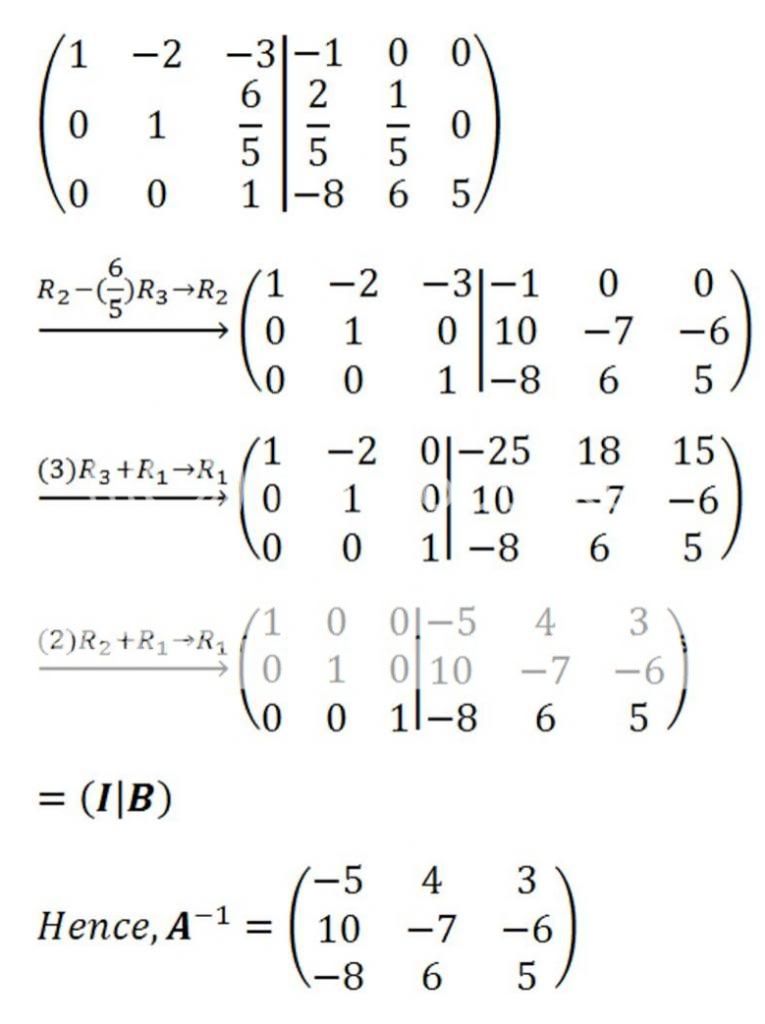
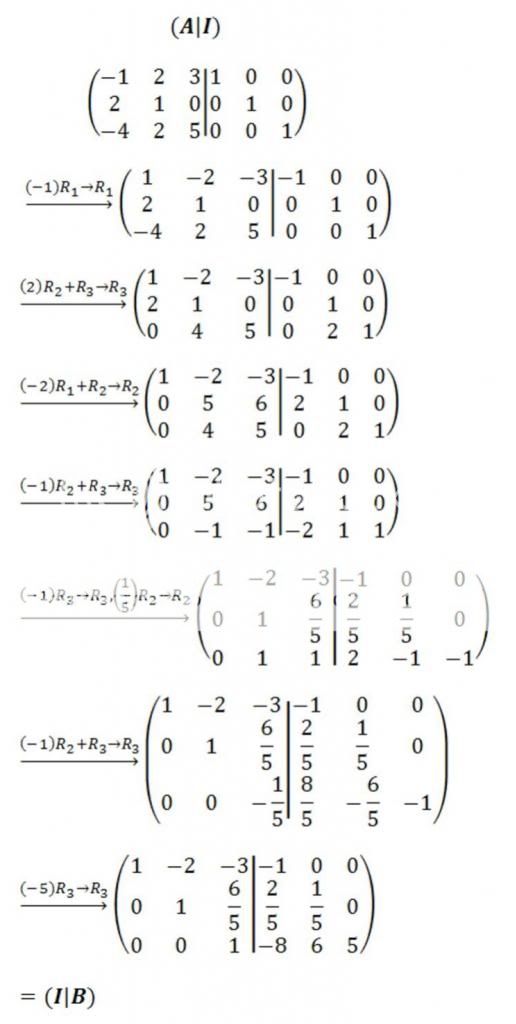
Because two elements of the matrix come with desired values, user posted image, only a maximum of seven (ERO) operations are required to get user posted image. In fact, ERO is nothing simpler than the basic arithmetic operations + − × ÷. By the way, ERO is NOT a formula, but an algorithm, meaning a process or set of rules to be followed in calculations. icon_idea.gif
Could you post your workings here? sweat.gif

This post has been edited by Critical_Fallacy: Dec 18 2013, 01:36 PM
TSCritical_Fallacy
post Dec 18 2013, 09:43 PM

∫nnộvisεr
Group Icon
VIP
3,713 posts

Joined: Nov 2011
From: Torino
QUOTE(RED-HAIR-SHANKS @ Dec 18 2013, 07:15 PM)
user posted image
QUOTE(RED-HAIR-SHANKS @ Dec 18 2013, 09:15 PM)
user posted image
Like I promised, you need only seven ERO steps to find the matrix inverse. In real exam, you don't have the luxury of time to write many steps and matrices. You need to learn how to use an algorithm to perform the optimum ERO steps. The idea behind the algorithm is NORMALIZE to 1 and EMPTY to 0. Keep practicing to familiarize with the algorithm. Most textbooks do not tell you how to perform ERO efficiently. icon_idea.gif

user posted image
TSCritical_Fallacy
post Dec 18 2013, 10:26 PM

∫nnộvisεr
Group Icon
VIP
3,713 posts

Joined: Nov 2011
From: Torino
QUOTE(RED-HAIR-SHANKS @ Dec 18 2013, 10:01 PM)
My book showed the procedure that in order to find the inverse of the matrices given, we would first have to obtain a 1 in the uppermost position in the leading diagonal, and convert all entries below the 1 into 0. Next, we obtain the 1 in the middle position of the leading diagonal, followed by obtaining the 0 under it. Lastly, after we get the 1 in the lowest position of the leading diagonal, we're ought to obtain 0 from all the other entries above the 1 in the leading diagonal.
Most textbooks wouldn't tell you how to make the entries 1 or 0. I discovered the method when I understand the concept behind ERO and Gauss Elimination procedure.

We called the diagonal elements a11, a22 and a33 pivot elements where they are normalized to 1. The easiest way to normalize the diagonal elements is to divide the element by itself. This is the reason you see the entire row is divided by the diagonal element. You cannot normalize all three diagonal elements at the same time. You must normalize one diagonal element and then empty the subsequent entries in the same COLUMN of the normalized element. For example, if a11 is normalized to 1, then subsequent entries in the same Column 1, a21 and a31 must emptied to 0. Only then, you can normalize the second diagonal element, either a22 or a33.

Here is my Gauss Elimination algorithm:

user posted image

This post has been edited by Critical_Fallacy: Dec 18 2013, 10:29 PM
TSCritical_Fallacy
post Dec 18 2013, 10:35 PM

∫nnộvisεr
Group Icon
VIP
3,713 posts

Joined: Nov 2011
From: Torino
QUOTE(iAdor3 Naz @ Dec 18 2013, 07:32 PM)
Oh wait.. so in this thread we can ask anything involving maths huh?.. particularly for me calculus.. excited smile.gif^^

does anyone have any link to study for chapter 16. Vector Calculus ? .. i can't understand the book explanation 
Vector Calculus is an advanced topic of Calculus. You can refer to Paul's Online Math Notes :: Calculus III.

More advanced topic is Fractional Calculus. sweat.gif
TSCritical_Fallacy
post Dec 18 2013, 10:41 PM

∫nnộvisεr
Group Icon
VIP
3,713 posts

Joined: Nov 2011
From: Torino
QUOTE(iAdor3 Naz @ Dec 18 2013, 10:37 PM)
Multivariable calculus right?  cry.gif  .. I am now revising chapter 15 and 16. For my exam this friday ..

doh.gif  doh.gif Won't be able to cover everything.. Just aiming for a pass  tongue.gif . Thanks for the link btw and sorry for the double post guys!
Go to your library and borrow Larson & Edwards' Calculus, Stewart Calculus, and Thomas' Calculus.

Vector Calculus also covered in Engineering Mathematics, by K.A. Stroud, which is Learner-friendly. icon_idea.gif

This post has been edited by Critical_Fallacy: Dec 18 2013, 10:43 PM
TSCritical_Fallacy
post Dec 18 2013, 10:55 PM

∫nnộvisεr
Group Icon
VIP
3,713 posts

Joined: Nov 2011
From: Torino
QUOTE(Flame Haze @ Dec 18 2013, 10:13 PM)
Since everyone has been talking in alien language which I don't understand  rclxub.gif , here's a question in simple English for you guys.  biggrin.gif

user posted image
Oh Shana-chan, I miss you! blush.gif Although the problem contains many linguistic confusions, it can decoupled by linearizing "John" as "J" and "Me" as "M", and then write the governing algebraic equations. icon_idea.gif
TSCritical_Fallacy
post Dec 19 2013, 09:04 AM

∫nnộvisεr
Group Icon
VIP
3,713 posts

Joined: Nov 2011
From: Torino
QUOTE(iAdor3 Naz @ Dec 19 2013, 12:48 AM)
Everytime I see this kind of question, the first thing come to my mind is integration by parts..
Any other easy way to solve this?  unsure.gif  unsure.gif
user posted image
This is integration by parts: user posted image.

The bad news is that user posted image has no antiderivative, when you separate them by parts. The good news is that there is an easy way, called "integration by substitution"! Always check the relationship between u and v, before resorting to integration by parts. icon_idea.gif

user posted image
TSCritical_Fallacy
post Dec 19 2013, 09:37 AM

∫nnộvisεr
Group Icon
VIP
3,713 posts

Joined: Nov 2011
From: Torino
QUOTE(RED-HAIR-SHANKS @ Dec 18 2013, 07:53 PM)
By the way, I concurrently found out that in order to reduce an augmented matrix form into row-echelon form, we need to initiate the Gaussian Elimination method.
I know you've heard it a thousand times before. But it's true - hard work pays off. If you want to be good, you have to practice, practice, practice. If you don't love something, then don't do it. Moreover, you can't hire someone to practice for you.

Therefore, solve the following linear algebraic equations using Gauss Elimination algorithm in Post #342. icon_rolleyes.gif

user posted image
TSCritical_Fallacy
post Dec 19 2013, 03:30 PM

∫nnộvisεr
Group Icon
VIP
3,713 posts

Joined: Nov 2011
From: Torino
QUOTE(RED-HAIR-SHANKS @ Dec 19 2013, 12:54 PM)
Simplify them? hmm.gif Wait, you mean, before I convert those linear equations to augmented matrix, I should have just simplify the respective coefficient, like dividing the first and second linear equation with 3 and 2 respectively?
QUOTE(crazywing26 @ Dec 19 2013, 12:56 PM)
Yup biggrin.gif even if you have written in augmented matrix, you still can "simplify" it using ERO biggrin.gif
Whether Shanks simplifies Rows 1 & 2 or not, it doesn't really matter, because the ultimate objective is to normalize all diagonal elements. It does not change the fact that Shanks still can reduce the augmented matrix to row echelon form within the minimum 6 STEPS in Gauss Elimination of a 3-by-3 matrix. before performing the back-substitution. icon_rolleyes.gif

29 Pages « < 4 5 6 7 8 > » Top
 

Change to:
| Lo-Fi Version
0.0581sec    1.12    7 queries    GZIP Disabled
Time is now: 19th December 2025 - 05:25 PM