Welcome Guest ( Log In | Register )

29 Pages « < 2 3 4 5 6 > » Bottom

Outline · [ Standard ] · Linear+

 Ask a Mathematical Physicist

views
     
TSCritical_Fallacy
post Dec 3 2013, 12:21 AM

∫nnộvisεr
Group Icon
VIP
3,713 posts

Joined: Nov 2011
From: Torino
QUOTE(crazywing26 @ Dec 2 2013, 06:06 PM)
This is what I thought of as part of the working. And please excuse my ugly handwriting tongue.gif
Thank you for guiding SHANKS. I can read them and they are not unlovely. blush.gif

By the way, do you know what is the reasonable average weight of a hot air balloon occupant? icon_question.gif
TSCritical_Fallacy
post Dec 3 2013, 09:23 AM

∫nnộvisεr
Group Icon
VIP
3,713 posts

Joined: Nov 2011
From: Torino
QUOTE(delsoo @ Dec 2 2013, 05:22 PM)
yea it's stpm differentation..
so it should be del v /del x ? am i correct? rolleyes.gif
Here are the dy/dx rules that enable us to calculate with relative ease the derivatives of polynomials, rational functions, algebraic functions, exponential and logarithmic functions, and trigonometric and inverse trigonometric functions. You can then use these rules to solve STPM problems involving rates of change and the approximation of functions. icon_idea.gif

user posted image
TSCritical_Fallacy
post Dec 3 2013, 02:29 PM

∫nnộvisεr
Group Icon
VIP
3,713 posts

Joined: Nov 2011
From: Torino
QUOTE(boo-boomer @ Dec 3 2013, 09:56 AM)
The only thing I find it confusing is that how does that information (volume and temperature) would be able to calculate the number of passengers onboard. Do I need assume or create assumptions?
Do as crazywing26 advises. Your task is to find the lifting capacity and divide by the reasonable average weight of a hot air balloon occupant (assume 100 kg/pax) to determine the number of passengers it can lift. Now calculate it and show to me if you really understand! icon_rolleyes.gif

Using ideal gas law, PV = mRT ... where

P is the standard atmosphere pressure, 101 325 Pa
V is the volume of heated dry air (SI unit m³), 3,000 m³ (same as the volume of the envelope)
m is the dry air mass (SI unit kg) contained inside the envelope,
R is the specific gas constant of dry air, 287.058 J /kg /K
T is the thermodynamic temperature of the heated dry air (SI unit K), 100 °C.

Because m/V = ρ is the density of the heated dry air, the gas equation can be rewritten as

P = ρRT ... where you need to solving for ρ ... ρ = P/(RT)

According to Archimedes' principle, the buoyancy is an upward force exerted by a fluid (ambient air) that opposes the weight of an immersed object (dry air). Therefore, the buoyant force, B↑ = weight of displaced ambient air.

B↑ = Wa = Mg = ϱVg

F↓ = Wd = mg = ρVg

According to ISA (International Standard Atmosphere), ambient air has a density of approximately ϱ = 1.225 kg/m³. According to the Bureau International de Poids et Mesures, International Systems of Units (SI), the Earth's standard acceleration due to gravity is, g = 9.80665 m/s².

Here Newton's 2nd Law comes in: If ϱ > ρ, then the buoyant force (B↑) is greater than weight of the heated dry air (F↓), and the Net buoyant force (N↑) will cause the hot air balloon to be lifted off the ground.

user posted image

Net buoyant force, N↑ = B↑ − F↓ = ϱVg − ρVg = (ϱ− ρ)Vg

Lifting Capacity, L = N↑ / g

The number of passengers (n) the hot air balloon can lift is given by

n = INT(L / 100) − 1

where INT(x) means to retain only the integer portion of x, without rounding, i.e., INT(9.876) = 9.

This post has been edited by Critical_Fallacy: Dec 3 2013, 03:35 PM
TSCritical_Fallacy
post Dec 3 2013, 09:49 PM

∫nnộvisεr
Group Icon
VIP
3,713 posts

Joined: Nov 2011
From: Torino
QUOTE(boo-boomer @ Dec 3 2013, 05:56 PM)
Thanks very much for your help, Critical_Fallacy. Based on your data, the answer is 7 occupants. smile.gif

Oh wait, why the formula INT(x)-1..you have to minus one from the INT(x) ?
Caught you! tongue.gif You must be forgetful of a passenger is defined as a traveler on a public or private conveyance other than the driver, pilot, crew. Because only one pilot is required to operate the balloon, therefore you need to minus one from the INT(x). In real exam, you have to clarity this. The number of occupants = no. of passengers + 1 pilot. icon_idea.gif

user posted image
TSCritical_Fallacy
post Dec 3 2013, 10:40 PM

∫nnộvisεr
Group Icon
VIP
3,713 posts

Joined: Nov 2011
From: Torino
QUOTE(RED-HAIR-SHANKS @ Dec 2 2013, 07:20 PM)
This will be the most important lesson I've learned today and it'll be an eye-opener for me, thank you for your help.
The following is another good lesson for you, because the problem has the same structure but the method is exactly the opposite of what you learned the other day!! icon_idea.gif

Can you notice what is wrong with the following ”proof” of the inequality “½(a + b) ≥ √(ab)”? sweat.gif

(a + b) / 2 ≥ √(ab)

Square both sides:

(a + b)² / 4 ≥ ab

Expand LHS numerator and multiply both sides by 4:

a² + 2ab + b² ≥ 4ab

Rearranging the inequality

a² − 2ab + b² ≥ 0

Factor LHS:

(a − b)² ≥ 0

Because the last inequality is true, therefore

(a + b) / 2 ≥ √(ab) ... is proven.

This post has been edited by Critical_Fallacy: Dec 3 2013, 10:42 PM
TSCritical_Fallacy
post Dec 4 2013, 08:00 AM

∫nnộvisεr
Group Icon
VIP
3,713 posts

Joined: Nov 2011
From: Torino
QUOTE(RED-HAIR-SHANKS @ Dec 4 2013, 04:48 AM)
Please do correct any of my steps in my workings if there's anything erroneous, and please do post any other workings that you know of. Thanks.
QUOTE(ystiang @ Dec 4 2013, 06:43 AM)
Your working don't have any error. Essentially you can verify your answer with calculator.
Your method is exactly the same as the solution in Example 6 (Part 2 of Complex Numbers tutorial). In fact, this is an useful algebraic manipulation skill called factorization, which you probably had forgotten since Form 2 or 3. Well, if the question is worth 5 marks, I'd probably give 4.5 due to the following comment. Only half-mark was deducted because the second line suggests you knew what you were doing. sweat.gif

user posted image

This post has been edited by Critical_Fallacy: Dec 4 2013, 09:41 AM
TSCritical_Fallacy
post Dec 4 2013, 12:44 PM

∫nnộvisεr
Group Icon
VIP
3,713 posts

Joined: Nov 2011
From: Torino
QUOTE(crazywing26 @ Dec 3 2013, 11:03 PM)
Noticed something. But I'm working on my presentation, or more like persuading tongue.gif the power of 2n, n = 1, 2, 3,… has interesting outcomes brows.gif
QUOTE(RED-HAIR-SHANKS @ Dec 4 2013, 12:33 AM)
The more harder it gets, the more intriguing it is for me. But now, I'm in a stalemate.
The question was flawed from the beginning, because the inequality to be proved is false for, say, negative a and b, and it is not defined when one of the numbers a, b is positive and one negative. All of the implications in our chain are true, but the fact that we deduced a true inequality “(a − b)² ≥ 0” from the one to be proved “½(a + b) ≥ √(ab)” has nothing to do with proving that inequality. Well, almost nothing. This chain can serve as analysis, which can help find a proof, but the proof must be a chain of implications, which starts with the inequality known to be true and ends with the required inequality.

user posted image

To polish your Form 2 Algebraic Manipulation Skills, perhaps you should learn how to tackle the next problem. Let me know if you need a hint on the special product... sweat.gif

user posted image

This post has been edited by Critical_Fallacy: Dec 4 2013, 12:44 PM
TSCritical_Fallacy
post Dec 5 2013, 12:02 AM

∫nnộvisεr
Group Icon
VIP
3,713 posts

Joined: Nov 2011
From: Torino
QUOTE(maximR @ Dec 4 2013, 07:01 PM)
I think I'll start with where I left off.
Great! thumbup.gif Welcome back!

QUOTE(RED-HAIR-SHANKS @ Dec 4 2013, 07:05 PM)
Here it is, am I correct?
Correct! I'm sure your algebraic manipulation skills improve a lot after some rigorous training in these few days. Whether you are preparing for A-level Pure Math or STPM Math T or Foundation Mathematics, this is probably the best time to learn complementary materials to SPM Add Math to strengthen your foundations. Since both of you have already had some basic knowledge in Sequences and Series from SPM Add Math, then you should be able to:

1. find the nth-term of the sequence defined by either an explicit formula and a recursive formula
2. use the formula “a + (n−1)d” for the nth term, and for the sum of the first n terms of an arithmetic series
3. use the formula “ar^(n−1)” for the nth term, and for the sum of the first n terms of a geometric series
4. use the method of differences “S(n) − S(m−1)” to find the nth partial sum of a series from mth term
5. use the formula for the sum of an infinite geometric series S(∞) = a / (1−r)

Perhaps, you should pick up where you left off.

6. manipulate series of powers of the natural numbers
7. determine the limiting values of arithmetic, geometric series, and indeterminate forms
8. apply various convergence tests to infinite series
9. distinguish between absolute and conditional convergence of a geometric series
10. use binomial expansions in approximations

I think it's time to introduce the Sigma Notation (Σ). Given a sequence “a1, a2, a3,..., an,...” we can write the sum of the first n terms using summation notation, or sigma (Σ) notation.

user posted image

That was easy enough. laugh.gif Now let's look at this one. A formula for the sum of squares can be determined, but the proof is rather a little complicated and, in fact, the method is different from what you have learned to derive the formulas for the sum of the first n terms of the arithmetic and geometric series. To establish the result for the sum of the first n terms of the series 1² + 2² + 3² + 4² + ... + n², you'll need to manipulate the Algebraic identity of (n + 1)³. Can you show how to get it? sweat.gif

user posted image

This post has been edited by Critical_Fallacy: Dec 5 2013, 12:21 AM
TSCritical_Fallacy
post Dec 5 2013, 06:51 PM

∫nnộvisεr
Group Icon
VIP
3,713 posts

Joined: Nov 2011
From: Torino
QUOTE(RED-HAIR-SHANKS @ Dec 5 2013, 04:32 PM)
I'm not quite sure about this, but here it is:
» Click to show Spoiler - click again to hide... «
Brilliant! thumbup.gif Your algebraic manipulation skills are getting good. Just remember that the sum of cubes of the natural numbers Σ(r³) can also be found in much the same way, but using (n + 1)^4. So far, we have been concerned with a finite number of terms of a given series. When you are dealing with the sum of infinite number of terms of a series, you must be careful about the steps you take. Before we proceed further, let's fill the knowledge gap about Sequence.

user posted image

A series in which the sum (Sn) of n terms of the series tends to a definite value as n → ∞, is called a convergent series. If Sn does not tend to a definite value as n → ∞, the series is said to be divergent. Now, it's time to put your manipulation skills you learned from SPM to test, before I introduce new things. icon_idea.gif

user posted image
TSCritical_Fallacy
post Dec 6 2013, 02:02 AM

∫nnộvisεr
Group Icon
VIP
3,713 posts

Joined: Nov 2011
From: Torino
QUOTE(dividebyzero @ Dec 1 2013, 12:01 AM)
I'm still on my way to solve cos 4θ. Wish me luck.
Since the problem is related to Sequence & Series, and in fact, a hybrid of Series + Complex Numbers, so I decided to put up the solution here for reference. icon_rolleyes.gif Please note that the problem can also be solved in Polar form r∠θ. I prefer exponential form because I'm more familiar with the Laws of Indices than the Trigonometric identities. sweat.gif

user posted image
TSCritical_Fallacy
post Dec 6 2013, 11:52 PM

∫nnộvisεr
Group Icon
VIP
3,713 posts

Joined: Nov 2011
From: Torino
QUOTE(RED-HAIR-SHANKS @ Dec 6 2013, 03:52 PM)
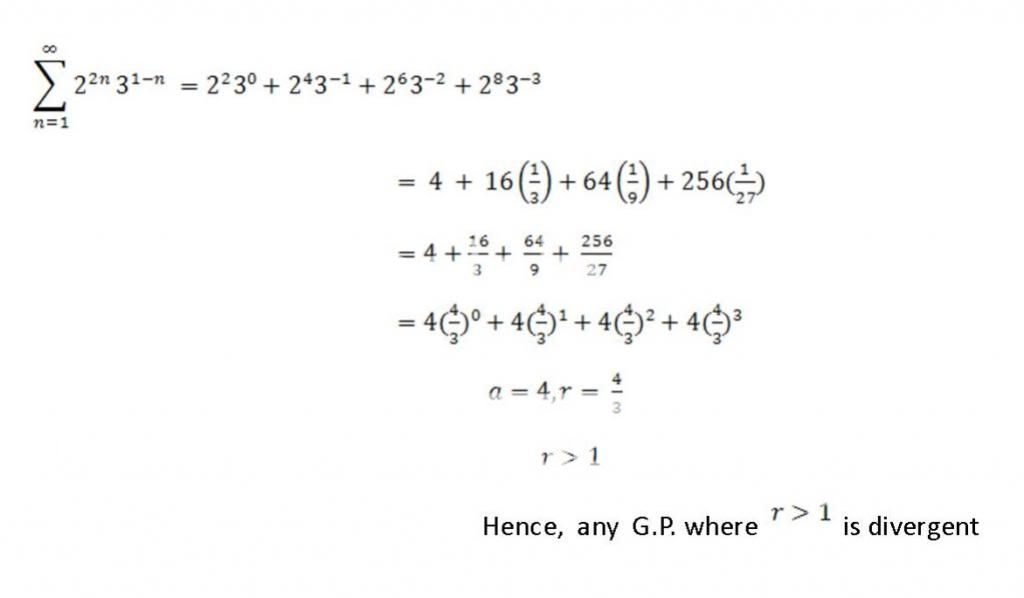
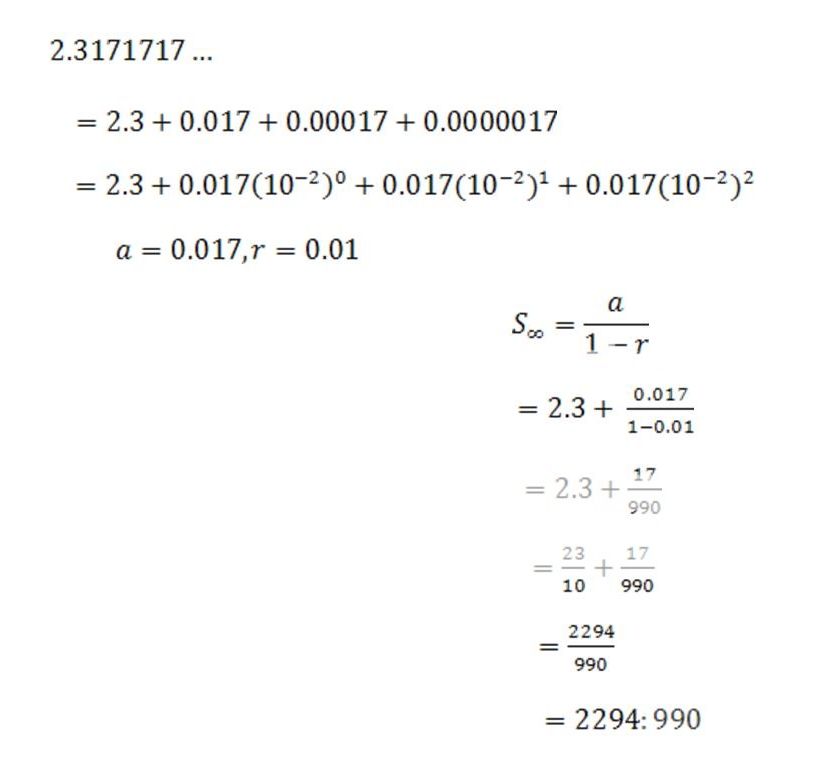
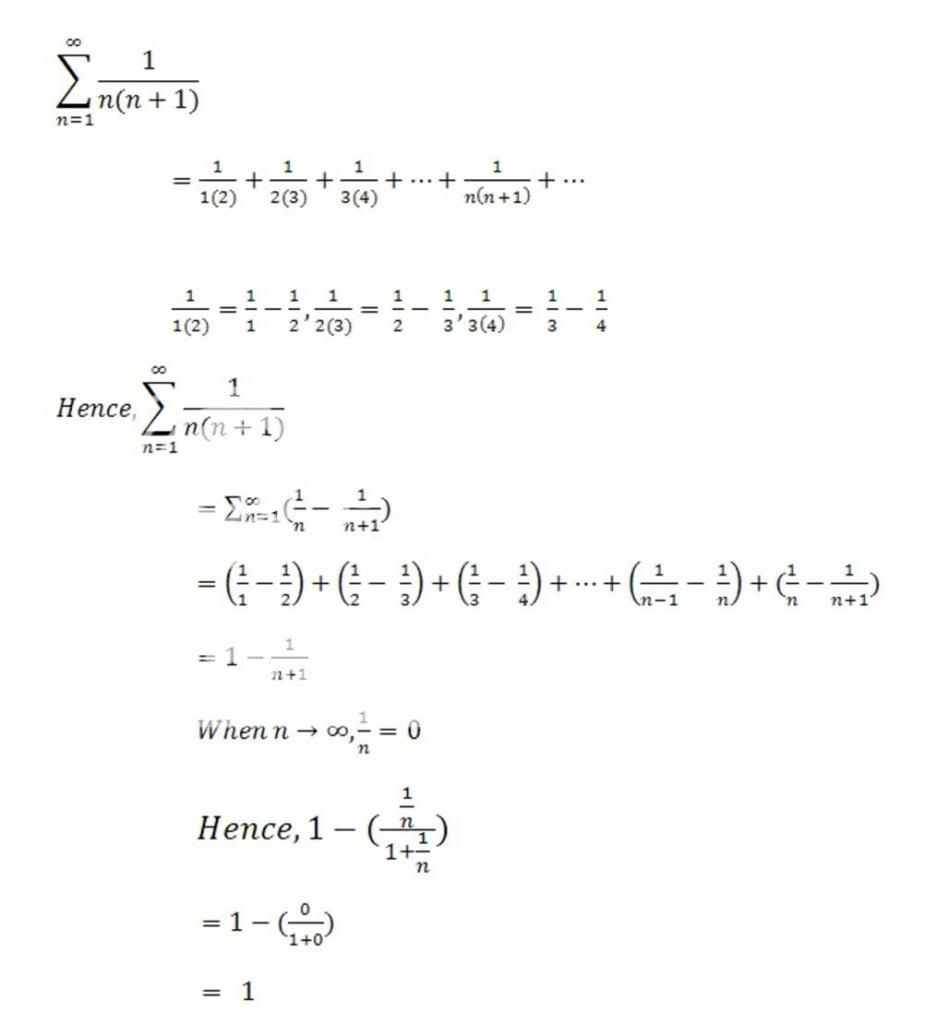
Here they are, but this time I might make lots of errs, so please don't go too hard on me smile.gif . And while we're on it, can you please guide me and explain to me on how should I prove that it is convergent for the series in Q3, and divergent for the series in Q4? unsure.gif Thanks in advance smile.gif
» Click to show Spoiler - click again to hide... «
Fabulous! Your answers are acceptable. Result of Q2 can be simplified. Here are my workings or hints. icon_rolleyes.gif Put your belt on. The Convergence Test tutorial is coming! sweat.gif

user posted image
TSCritical_Fallacy
post Dec 7 2013, 12:28 AM

∫nnộvisεr
Group Icon
VIP
3,713 posts

Joined: Nov 2011
From: Torino
Hi ailing tan, RED-HAIR-SHANKS & maximR, this is my fourth Critical Tutorial on Sequences & Series :: Convergence Tests. It does not only provide the perfect complement to SPM Sequences & Series, but also prepares you to the next level of “all-purpose” and beautiful series called, Binomial Series, Taylor Series, and Maclaurin Series. icon_idea.gif

In SPM Add Math, you have already learned how to manipulate arithmetic and geometric series with a finite number of terms. When we are dealing with the sum of an infinite number of terms, we know they are infinite series. We can make use of infinite series only when they are convergent. Therefore, it is necessary to have some means of testing whether or not a give series is, in fact, convergent.

There are various kinds of convergence tests available. The tests in this tutorial are some of the most useful tests that are suitable to evaluate A-level/STPM problems. However, the Integral Test and Raabe's Test are not covered in this tutorial. In fact, Raabe’s test may often give conclusive result when the d’Alembert’s Ratio Test fails. Further treatment on these test maybe found on Wikipedia or Wolfram MathWorld. icon_idea.gif

Prerequisites: SPM Sequences & Series

Part 1 :: Term Test and Series Comparison Test
» Click to show Spoiler - click again to hide... «

Part 2 :: Limit Comparison Test and d’Alembert’s Test
» Click to show Spoiler - click again to hide... «

Part 3 :: Alternating Series and Absolute Convergence
» Click to show Spoiler - click again to hide... «

Part 4 :: Ratio Test and Root Test
» Click to show Spoiler - click again to hide... «

Pre-print version: Attached File  Tutorial_4_Convergence_Tests.pdf ( 253.37k ) Number of downloads: 14

TSCritical_Fallacy
post Dec 7 2013, 01:05 AM

∫nnộvisεr
Group Icon
VIP
3,713 posts

Joined: Nov 2011
From: Torino
QUOTE(delsoo @ Dec 6 2013, 07:15 PM)
hi, can you pls explain that current entering a junction in a circuit is equal to zero ....the lower statement (circle part states that current entering a junction is positive..... both statement are contrary to each other...
Ohm’s law by itself is not sufficient to analyze circuits. However, when it is coupled with Kirchhoff’s two laws, we have a sufficient, powerful set of tools for analyzing a large variety of electric circuits. These laws are formally known as Kirchhoff’s current law (KCL) and Kirchhoff’s voltage law (KVL).

Kirchhoff’s first law, the current law (KCL), is based on the law of conservation of charge (something like Newton's 3rd law), which states that the algebraic sum of currents entering a node (or a closed boundary) is zero. Mathematically, KCL implies that

[n=1, N] Σ(i_n) = 0

where N is the number of branches connected to the node and i_n is the nth current entering (or leaving) the node. By this law, currents entering a node may be regarded as positive, while currents leaving the node may be taken as negative. Referring to Fig 20.27, there 3 branches connected to the node B, and so there are 3 currents.

user posted image

currents entering node B are i1 and i2, and so we assign them as “positive” currents with respect to B.

current leaving node B is i3 only, and thus we assign it as “negative” current with respect to B.

Applying Kirchhoff’s current law, we have the “algebraic sum [+]” of “assigned” currents

[n=1, 3] Σ(i_n) = 0

(+i1) [+] (+i2) [+] (−i3) = 0 ... If you have mastered KCL, you can simply write i1 + i2 − i3 = 0.

Rearranging the equation, we have

i1 + i2 = i3

This post has been edited by Critical_Fallacy: Dec 7 2013, 01:07 AM
TSCritical_Fallacy
post Dec 7 2013, 02:04 AM

∫nnộvisεr
Group Icon
VIP
3,713 posts

Joined: Nov 2011
From: Torino
QUOTE(delsoo @ Dec 6 2013, 07:18 PM)
in this case how do we know that the potential difference across R3 =40V ....?
Maybe if you study about the electric circuit graphically, you will understand the method of analysis better. icon_idea.gif

user posted image
TSCritical_Fallacy
post Dec 8 2013, 07:46 PM

∫nnộvisεr
Group Icon
VIP
3,713 posts

Joined: Nov 2011
From: Torino
QUOTE(RED-HAIR-SHANKS @ Dec 7 2013, 11:30 PM)
So, I will really appreciate it if you can aid me in Q3 smile.gif And, I must say that I haven't completely grasp on the Limit Comparison Test and the Series Comparison Test, so I still need some time for these 2.
Sorry, there is a typo in Q4. We now have several ways of testing a series for convergence or divergence; the problem is to decide which test to use on which series. There are no hard and fast rules about which test to apply to a given series, but it is not wise to apply a list of the tests in a specific order until one finally works. That would be a waste of time and effort. In testing many series, we usually find a suitable comparison series by keeping only the highest powers in the numerator and denominator. Here you may find the following general advice of some use:

Strategy for Testing Series ::
---------------------------------------
1. If the series is of the form Σ{1/(n^p)}, it is a p-series, which we know to be convergent if p > 1 and divergent if p ≤ 1. See Example 1 of the Tutorial #4.

2. If the series has the form Σ{ar^(n−1)} or Σ{ar^n}, it is a geometric series, which converges if |r| < 1 and diverges if |r| ≥ 1. Some preliminary algebraic manipulation may be required to bring the series into this form.

3. If you can intuitively see that lim {an} > 0, as n → ∞, then the Term Test should be used for checking the Divergence.

4. If the series is of the form Σ{(−1)^(n−1)*bn} or Σ{(−1)^n*bn}, then the Alternating Series Test is an obvious possibility.

5. Series that involve factorials or other products (including a constant raised to the nth power) are often conveniently tested using the Ratio Test.

6. If {an} is of the form {(bn)^n}, then the Root Test may be useful.

7. If {an} = f(n) where [1,∞] ∫ f(x) dx can be easily evaluated, then the Integral Test is effective (assuming the hypotheses of this test are satisfied).

user posted image

user posted image

user posted image

user posted image
TSCritical_Fallacy
post Dec 8 2013, 07:47 PM

∫nnộvisεr
Group Icon
VIP
3,713 posts

Joined: Nov 2011
From: Torino
Hi ailing tan, RED-HAIR-SHANKS & maximR, here is the Solutions for the Test Exercise in Tutorial #4 Sequences & Series :: Convergence Tests. Again, there are no hard and fast rules about which test to apply to a given series, as long as you can prove the test conditions are reasonably satisfied. Remember to check out the Solution for Q4. icon_rolleyes.gif

Part 1 :: Solutions for Q1, Q2, Q3
» Click to show Spoiler - click again to hide... «

Part 2 :: Solutions for Q4, Q5, Q6
» Click to show Spoiler - click again to hide... «

Pre-print version: Attached File  Solutions_for_TE_4.pdf ( 186.02k ) Number of downloads: 7

TSCritical_Fallacy
post Dec 8 2013, 07:47 PM

∫nnộvisεr
Group Icon
VIP
3,713 posts

Joined: Nov 2011
From: Torino
Hi ailing tan, RED-HAIR-SHANKS & maximR, this is my 5th Critical Tutorial on Binomial Series. An important exponential function e(x) will be introduced. Before we move on to Maclaurin Series and Taylor Series, you'll need to do some revision on the Differentiation Rules. icon_idea.gif

Prerequisites: SPM Sequences & Series, and Permutations & Combinations

Part 1 :: Revision on Factorials and Combinations, Binomial expansions
» Click to show Spoiler - click again to hide... «

Part 2 :: The general term of the binomial expansion, The exponential function, e^x
» Click to show Spoiler - click again to hide... «

Pre-print version: Attached File  Tutorial_5_Binomial_Series.pdf ( 202.5k ) Number of downloads: 8

TSCritical_Fallacy
post Dec 9 2013, 11:43 AM

∫nnộvisεr
Group Icon
VIP
3,713 posts

Joined: Nov 2011
From: Torino
QUOTE(delsoo @ Dec 9 2013, 10:24 AM)
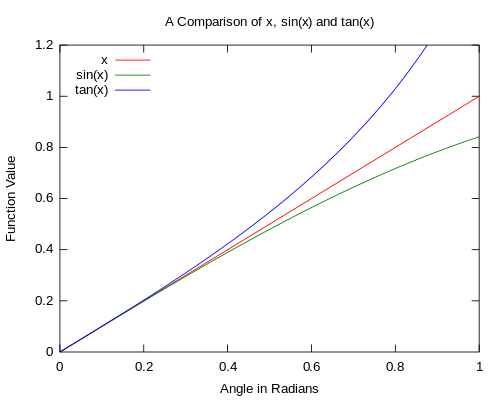
Hi if tetha is very small then sine tetha = tan tetha??
This is the subject of Small-angle approximation.

And we don't really use the equal sign. sweat.gif

tan θ ≈ sin θ ≈ θ as θ → 0

The easiest way to prove it is to apply L'Hôpital's rule, which will be covered in my Critical Tutorial #7. nod.gif

user posted image
TSCritical_Fallacy
post Dec 9 2013, 12:51 PM

∫nnộvisεr
Group Icon
VIP
3,713 posts

Joined: Nov 2011
From: Torino
QUOTE(delsoo @ Dec 9 2013, 11:40 AM)
Hi can you pls explain why l equals to N(2A plus 2B)...THANKS IN ADVANCE!
This is a geometry problem. If you study Electrical Engineering, you will learn the construction and mechanics of a typical galvanometer. the galvanometer is the main component in analog meters for measuring current and voltage. Many analog meters are still in use, although digital meters, which operate on a different principle, are currently more common.

One type, called the D’Arsonval galvanometer, consists of a coil of wire mounted so that it is free to rotate on a pivot in a magnetic field provided by a permanent magnet. The deflection of a needle attached to the coil is proportional to the current in the galvanometer. Once the instrument is properly calibrated, it can be used in conjunction with other circuit elements to measure either currents or potential differences.

In this diagram, you can clearly see a long, thin loop of wire is wrapped around a metallic core in a rectangular manner with four right angles (90°). We can express the resistance of a uniform block of material (in this case, a block of coil of wire) along the length L as

R = ρL / A

where the length L is the entire length or Perimeter of the rectangular coil of wire with dimension 2 cm × 2 cm × 50 turns. A rectangle has four sides with opposite sides being congruent. The formula for finding the perimeter is Side A + Side B + Side A + Side B. This could also be stated as

2*Side A + 2*Side B ... or ... 2*(Side A + Side B)

user posted image
TSCritical_Fallacy
post Dec 9 2013, 01:12 PM

∫nnộvisεr
Group Icon
VIP
3,713 posts

Joined: Nov 2011
From: Torino
QUOTE(delsoo @ Dec 9 2013, 01:01 PM)
what do u mean by  Critical Tutorial #7....? i'm trying to understand your notes on post#202...
Disregard the first two paragraphs in Post #202. In your problem, you need to find the length L and Area A to determine the resistance of the coil. To make things straightforward, you have to understand and visualize the construction of the coil, so that you can determine the formula needed to calculate the length L.

Because the coil of wire is wrapped into a rectangular shape, therefore you apply the perimeter formula of a rectangle. If there are 50 turns, that means there are 50 rectangular coils, and so you multiply the uniform perimeter of the rectangular coil by 50. Got it? icon_idea.gif

29 Pages « < 2 3 4 5 6 > » Top
 

Change to:
| Lo-Fi Version
0.0772sec    0.88    7 queries    GZIP Disabled
Time is now: 19th December 2025 - 05:45 AM