Welcome Guest ( Log In | Register )

29 Pages « < 6 7 8 9 10 > » Bottom

Outline · [ Standard ] · Linear+

 Ask a Mathematical Physicist

views
     
TSCritical_Fallacy
post Dec 24 2013, 01:10 AM

∫nnộvisεr
Group Icon
VIP
3,713 posts

Joined: Nov 2011
From: Torino
QUOTE(delsoo @ Dec 24 2013, 01:07 AM)
sorry i used to used to use 1/4pi e .... btw the rest are correct?
It's your preference. To answer the rest, please concentrate on reading my post CLOSELY. sweat.gif

As mentioned in previous post. There is a mistake in (1), which is affecting (3) and (4).

(1) Find the electric potential at the point β (far right) due to a positively charged particle user posted image, separated by a distance user posted image.

You can substitute the positively charged particle user posted image = 5q and the negatively charged particle user posted image = -3q, as in your original problem in Post #396.

This post has been edited by Critical_Fallacy: Dec 24 2013, 01:18 AM
TSCritical_Fallacy
post Dec 24 2013, 01:19 AM

∫nnộvisεr
Group Icon
VIP
3,713 posts

Joined: Nov 2011
From: Torino
QUOTE(delsoo @ Dec 24 2013, 01:18 AM)
so the ans for 1 should be q+/4(pi)9e)(r of A ) ?
Doesn't this figure tell you the whole story clearly? sweat.gif

user posted image
TSCritical_Fallacy
post Dec 24 2013, 01:24 AM

∫nnộvisεr
Group Icon
VIP
3,713 posts

Joined: Nov 2011
From: Torino
QUOTE(delsoo @ Dec 24 2013, 01:21 AM)
rclxms.gif , thanks again  for spending your time to answer my doubts
When solving physics problem, you cannot rush. Read carefully and understand what are required by the questions. They are your mini tasks, sub-problems that you need to tackle. icon_idea.gif
TSCritical_Fallacy
post Dec 24 2013, 10:04 AM

∫nnộvisεr
Group Icon
VIP
3,713 posts

Joined: Nov 2011
From: Torino
QUOTE(crazywing26 @ Dec 24 2013, 09:12 AM)
Looks tough but its not. In fact, its quite easy.
Its actually 1+2+3+…+n biggrin.gif So the sum of the series is n(n+1)/2.

Oh. Flame Haze has answered this question XD
Easy is GOOD! thumbup.gif Try the next one. wink.gif
TSCritical_Fallacy
post Dec 24 2013, 10:05 AM

∫nnộvisεr
Group Icon
VIP
3,713 posts

Joined: Nov 2011
From: Torino
Hi Flame Haze, RED-HAIR-SHANKS, maximR, crazywing26 and iChronicles,

What a year it's been. This is 2013 end-of-year question. tongue.gif

Evaluate user posted image.

P.S. If you can tackle the previous problem, you can tackle this one too. icon_rolleyes.gif
TSCritical_Fallacy
post Dec 24 2013, 01:37 PM

∫nnộvisεr
Group Icon
VIP
3,713 posts

Joined: Nov 2011
From: Torino
QUOTE(maximR @ Dec 24 2013, 12:04 PM)
I see something here . Does it involve factorising using difference between two squares , 3+6+11+15 ... , and -1 ?
You have a sharp mind! wink.gif

QUOTE(RED-HAIR-SHANKS @ Dec 24 2013, 01:10 PM)
Then, we find the sum of the nth term, Sn.
Sn=n/2(2a+(n-1)d)
=(1006/2)(-6+(1005)(-4))
=-2025078
Very close! sweat.gif

user posted image

QUOTE(crazywing26 @ Dec 24 2013, 12:38 PM)
Am I right?
BINGO! thumbup.gif But I've given you a gentle clue! Remember the last series? icon_idea.gif

user posted image
user posted image
user posted image

This post has been edited by Critical_Fallacy: Dec 24 2013, 01:38 PM
TSCritical_Fallacy
post Dec 24 2013, 11:17 PM

∫nnộvisεr
Group Icon
VIP
3,713 posts

Joined: Nov 2011
From: Torino
QUOTE(maximR @ Dec 24 2013, 01:46 PM)
I'm glad I had the idea . smile.gif
QUOTE(RED-HAIR-SHANKS @ Dec 24 2013, 03:19 PM)
Hold on a second, you mean I can straight away sum it up to 2013² already? blink.gif 
This is the full solution by applying the special factorization user posted image: icon_rolleyes.gif

user posted image

user posted image

user posted image

user posted image

user posted image
TSCritical_Fallacy
post Dec 25 2013, 01:00 AM

∫nnộvisεr
Group Icon
VIP
3,713 posts

Joined: Nov 2011
From: Torino
Hi Flame Haze, RED-HAIR-SHANKS, maximR, crazywing26 and iChronicles,

OK! Here is the real deal. This is STPM/A-level question, but if you had been following my tutorial faithfully from the beginning, or if you passed your 1st-term Pure Math exam with flying colors, this one is probably peanut to you! sweat.gif

Find the sum user posted image.
TSCritical_Fallacy
post Dec 25 2013, 08:26 AM

∫nnộvisεr
Group Icon
VIP
3,713 posts

Joined: Nov 2011
From: Torino
QUOTE(Flame Haze @ Dec 25 2013, 01:54 AM)
49.49?  sweat.gif
QUOTE(studyboy @ Dec 25 2013, 02:57 AM)
You are correct!  biggrin.gif
So, my hypothesis on passing the Pure Math exam with flying colors has a good degree of trueness. sweat.gif
TSCritical_Fallacy
post Dec 25 2013, 08:31 AM

∫nnộvisεr
Group Icon
VIP
3,713 posts

Joined: Nov 2011
From: Torino
QUOTE(Flame Haze @ Dec 25 2013, 01:54 AM)
P.S I think my notations are a little bit misleading, by sum from 3 to 99, I mean the sum of odd numbers only, 3, 5, 7, 9....99
QUOTE(iChronicles @ Dec 25 2013, 07:21 AM)
So, is there a proper way of writing the summation of 3 to 99 in odd number pattern?
The proper way of using the sigma notation in this question is probably:

user posted image

In real exam, depending on the marks allocation, Flame Haze probably lose ½ to 1 mark. sweat.gif
TSCritical_Fallacy
post Dec 25 2013, 08:55 AM

∫nnộvisεr
Group Icon
VIP
3,713 posts

Joined: Nov 2011
From: Torino
QUOTE(RED-HAIR-SHANKS @ Dec 25 2013, 04:31 AM)
Wow, this is very complex for me. Been sitting down and was perusing all of the available notes that I have, yet I'm unable to make any progress. Try to dig up some more methods/info that I can identify to solve this question.
This question is in fact, a hybrid of series and partial fraction to test your skills. icon_idea.gif

Polynomial 101:

(1) For a rational function (two polynomial functions in quotient form), if the numerator is larger than the denominator, you can perform a polynomial long division (or a compact method called Synthetic Division).

(2) If the denominator of the remainder from the division can be factorized into irreducible polynomials, you can do a partial fraction decomposition on the remainder.
TSCritical_Fallacy
post Dec 25 2013, 04:52 PM

∫nnộvisεr
Group Icon
VIP
3,713 posts

Joined: Nov 2011
From: Torino
QUOTE(v1n0d @ Dec 25 2013, 10:50 AM)
For the geometric series user posted image, obtain the smallest value of user posted image if the difference between the sum of the first user posted image terms and the sum of the first user posted image terms is less than user posted image.
The question can be solved algebraically using knowledge learned from SPM Progressions, Indices and Logarithms.

user posted image

which can be rearranged to give

user posted image.

By letting

user posted image,

we need find integer n which satisfies

user posted image

Using a graphing software, one can evaluate

user posted image
TSCritical_Fallacy
post Dec 25 2013, 05:23 PM

∫nnộvisεr
Group Icon
VIP
3,713 posts

Joined: Nov 2011
From: Torino
Hi Flame Haze, RED-HAIR-SHANKS, maximR, crazywing26 and studyboy,

The purpose of these exercises is to train your problem-solving skill to be adaptive to searching viable mathematical methods from 360°, primarily Arithmetic, Algebra, Polynomials, Graphs, and Linear equations. It does not limit to the formulas you learned in Sequences & Series.

After simplification, the value of

user posted image

is a proper fraction in its lowest form, which is related to Gauss' famous number. Find the difference of its denominator and numerator. sweat.gif
TSCritical_Fallacy
post Dec 26 2013, 10:34 AM

∫nnộvisεr
Group Icon
VIP
3,713 posts

Joined: Nov 2011
From: Torino
QUOTE(studyboy @ Dec 26 2013, 12:54 AM)
However,  how would one prove this by induction? Did you do it by induction Flame Haze?
Flame Haze-san was able to grasp the nature of series and rational functions. With enough training, one should be able to see this pattern:

user posted image

Since it is a rational function, you can do a partial fraction decomposition! icon_rolleyes.gif
TSCritical_Fallacy
post Dec 26 2013, 11:03 AM

∫nnộvisεr
Group Icon
VIP
3,713 posts

Joined: Nov 2011
From: Torino
QUOTE(ystiang @ Dec 25 2013, 05:37 PM)
A standard way to solve this type of problem in STPM, taking the logarithm at both sides:
I remember I did this kind of question in my SPM. And v1n0d is right. Under normal exam circumstances, one may not be able to plot a smooth curve for evaluation because graphing calculators are usually not allowed. Technically, it is possible to sketch by computing n = 1, 2, 3, 4, ... and then link up the dots. But it is impractical because one does not know the root, Depending on the convergence of the series, the root can occur at n = 25 or at n = 50. Usually the questions are single-variable problems and most of them have closed-form solutions.

My purpose of showing the graphical solution (without spilling out the algebraic solution sweat.gif), as mentioned by studyboy, is to create the awareness in students that we can model a function and analyze it better by understanding the behaviors of the function f(x) at -∞ < x < ∞ domain. In analyzing dynamic systems in Biology, Chemistry, Physics, the graphs tell us many useful information for design purposes, such as the system response (shape), resiliency (boundedness), stability (convergence), optimality (max performance / min resources), etc.
TSCritical_Fallacy
post Dec 26 2013, 11:29 AM

∫nnộvisεr
Group Icon
VIP
3,713 posts

Joined: Nov 2011
From: Torino
QUOTE(delsoo @ Dec 25 2013, 05:40 PM)
Hi it's a chemistry question here?? Which bond.is.stronger?? Ionic bond.or.ionic bond.with covalent characteristics?
What happen to the "dots"? unsure.gif I don't have a textbook with me. What kind of formations are written in your Chemistry textbook about the Ionic Bonding and Covalent Bonding? Perhaps you can tell me! wink.gif
TSCritical_Fallacy
post Dec 26 2013, 04:29 PM

∫nnộvisεr
Group Icon
VIP
3,713 posts

Joined: Nov 2011
From: Torino
Hi Flame Haze, RED-HAIR-SHANKS, maximR, crazywing26 and studyboy,

I've updated Post #1 with Calculators. icon_rolleyes.gif

Scientific Calculator
user posted image

Graphing Calculator
user posted image

Programmable Calculator
user posted image

Equations and Systems Solver
user posted image

Symbolic Differentiation and Integration
user posted image
TSCritical_Fallacy
post Dec 26 2013, 10:33 PM

∫nnộvisεr
Group Icon
VIP
3,713 posts

Joined: Nov 2011
From: Torino
QUOTE(RED-HAIR-SHANKS @ Dec 26 2013, 06:41 PM)
But, I too found out that there is another alternative way to solve the determinant of a 3 x 3 matrix, that is by using Sarrus' Rule. It's the sum of the multiplication of entries in every arrow to the right(blue colour) minus the sum of multiplication of entries in every arrow to the left(red colour).
user posted image
The diagonal scheme of expanding the determinants or “Sarrus' rule” is generally CORRECT ONLY for determinants of second- (2×2 matrix) and third-orders (3×3 matrix). For determinants of higher order, you must pay attention to the formal definition of determinants. icon_idea.gif

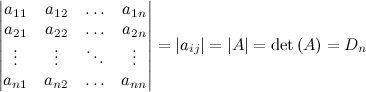
In discussing a general nth order determinant, it is convenient to use the double-subscript notation. The determinant itself is denoted by a variety of symbols. The following notations are all equivalent:

user posted image

The value of a nth order determinant is given by this formal equation:

user posted image

where user posted image is the Levi-Civita symbol. The properties characterized by the Levi-Civita symbol are defined as follows:

user posted image

An easy way to determine whether a given permutation is even or odd is to write out the normal order and write the permutation directly below it. Then connect corresponding numbers in these two arrangements with line segments, and count the number of intersections between pairs of these lines. If the number of intersections is even, then the given permutation is even. If the number of intersections is odd, then the permutation is odd. For example, to find the permutation (2, 3, 4, 1), we write out the normal order and permutation in the diagram.

user posted image

There are three intersections. Therefore the permutation is odd and the Levi-Civita value is −1. Let's do an example to find the determinant of a 3×3 matrix.

user posted image

This post has been edited by Critical_Fallacy: Dec 26 2013, 10:40 PM
TSCritical_Fallacy
post Dec 26 2013, 11:19 PM

∫nnộvisεr
Group Icon
VIP
3,713 posts

Joined: Nov 2011
From: Torino
QUOTE(RED-HAIR-SHANKS @ Dec 26 2013, 07:22 PM)
Thanks for your advice. Somehow, I'm more incline to straight away use the Sarrus' Rule rather than the standard method. But, both works well for me though. The only thing I'm dreaded at is the marking scheme for my workings in STPM.
If you are worried on the marking scheme, here is a surefire way to compute the determinant of a 3×3 matrix:

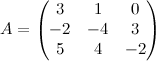
Let user posted image. Find det(A) by cofactor expansion.

SOLUTION:

Step 1: Pick a row or a column which contains 0's in the entries. In this case, I'd pick either Row 1 or Column 3 because a13 = 0. Say we pick Row 1, then:

user posted image

Step 2: Compute the determinant using the built-in [MAT] function in your scientific calculator CASIO fx-570, and then write the value:

user posted image
TSCritical_Fallacy
post Dec 27 2013, 09:09 AM

∫nnộvisεr
Group Icon
VIP
3,713 posts

Joined: Nov 2011
From: Torino
QUOTE(danny88888 @ Dec 27 2013, 12:01 AM)
To find determinant of 4x4 matrices would it be very tedious then?
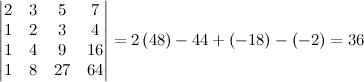
Finding the determinant of a 4×4 matrix is still manageable:

user posted image

Now, using CASIO fx-570, compute the determinants of the 4 cofactors:

user posted image

QUOTE(studyboy @ Dec 27 2013, 12:06 AM)
I remember I had to do this for 5 times 5 matrix once in my undergraduate exams.  cry.gif
Finding the determinant of a true 5×5 matrix without 0 entries is a real painstakingly tedious job. shakehead.gif There are FIVE 4×4 cofactors. To find the determinant of each cofactor, you have to compute FOUR determinants of the 3×3 minor cofactors (see above example). Therefore, FIVE (5) × FOUR (4) = TWENTY (20) computations! shocking.gif

29 Pages « < 6 7 8 9 10 > » Top
 

Change to:
| Lo-Fi Version
0.0816sec    0.27    7 queries    GZIP Disabled
Time is now: 21st December 2025 - 12:54 AM