guess many user wish they are staying in penang,.. LOL,...
even though saw many Celcom Teritory Signboard along many places, but feel like actually is Maxis teritory,
yeah, upload speed need just a little higher, and lower the ping a bit, u will easily get grade A,..
I think upload speed need increase a little. I see your ping time 69ms still can grade A. so 61ms should be no problem. the pin time very no constant, some time get 26ms, some time get 41ms. my upload speed 3.68mb already max. cannot up again.
I think upload speed need increase a little. I see your ping time 69ms still can grade A. so 61ms should be no problem. the pin time very no constant, some time get 26ms, some time get 41ms. my upload speed 3.68mb already max. cannot up again.
i use huawei E398 tweak 33tx power, flash newer firmware and use QPST set to lock down UMTS2100 band only,.
now I use iphone 5 use usb connect to PC test the speed. feel that iphone 5 speed more stable than my sierra usb modem.
if u use router, just set MTU -> 576 ,
if u use direct plug in , just use Dial up / RAS ( dont use Window Mobile Broadband Connection or the Dashboard Connection
as Dial up / RAS original MTU is 576 as well,..
Packet size, often referred to as MTU (Maximum Transmission Unit) is the greatest amount of data that can be transferred in one physical frame on the network. For Ethernet, the MTU is 1500 bytes, for PPPoE 1492, dial-up connections often use 576.
Each transmission unit consists of header and actual data. The actual data is referred to as MSS (Maximum Segment Size), which defines the largest segment of TCP data that can be transmitted. Essentially, MTU=MSS + TCP & IP headers.
It is obvious then that smaller packets will be transmitted faster, simply because of the throughput limitation of the line. It's however somewhat moot point in large transfers, all that's illustrated above is the fact that transferring more data takes more time
» Click to show Spoiler - click again to hide... «
if u use direct plug in , just use Dial up / RAS ( dont use Window Mobile Broadband Connection or the Dashboard Connection
as Dial up / RAS original MTU is 576 as well,.. Packet size, often referred to as MTU (Maximum Transmission Unit) is the greatest amount of data that can be transferred in one physical frame on the network. For Ethernet, the MTU is 1500 bytes, for PPPoE 1492, dial-up connections often use 576.
Each transmission unit consists of header and actual data. The actual data is referred to as MSS (Maximum Segment Size), which defines the largest segment of TCP data that can be transmitted. Essentially, MTU=MSS + TCP & IP headers. It is obvious then that smaller packets will be transmitted faster, simply because of the throughput limitation of the line. It's however somewhat moot point in large transfers, all that's illustrated above is the fact that transferring more data takes more time
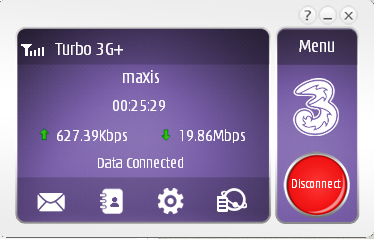
Added on December 28, 2012, 4:18 amafter tweak E398 and the MTU to 576
here's the most stable result
This is a great findings.
Now at graveyard shift, my webpages loading is super fast like never before.
My starting download on IDM is just mind blowing, it's like when you press "Resume Download" it'll straight jump to 1.5Mb/s instead of increasing from 200kb/s > 600kb/s > 1.5Mb/s.
Gonna try if it's really works on peak hours tomorrow.
But seriously, I really feel the difference.
Thanks, bro.
This post has been edited by rifle_m16: Dec 28 2012, 05:46 AM
if u use direct plug in , just use Dial up / RAS ( dont use Window Mobile Broadband Connection or the Dashboard Connection
as Dial up / RAS original MTU is 576 as well,.. Packet size, often referred to as MTU (Maximum Transmission Unit) is the greatest amount of data that can be transferred in one physical frame on the network. For Ethernet, the MTU is 1500 bytes, for PPPoE 1492, dial-up connections often use 576.
Each transmission unit consists of header and actual data. The actual data is referred to as MSS (Maximum Segment Size), which defines the largest segment of TCP data that can be transmitted. Essentially, MTU=MSS + TCP & IP headers. It is obvious then that smaller packets will be transmitted faster, simply because of the throughput limitation of the line. It's however somewhat moot point in large transfers, all that's illustrated above is the fact that transferring more data takes more time


 Dec 27 2012, 10:51 PM


 Quote
Quote








 0.0291sec
 0.74
0.74
 6 queries
 GZIP Disabled