Welcome Guest ( Log In | Register )

23 Pages « < 4 5 6 7 8 > » Bottom

Outline · [ Standard ] · Linear+

 Fundamentals of Overclocking, NEWBIES PLS READ THIS BEFORE POSTING

views
     
akachester
post Mar 25 2007, 03:24 PM

Its Life. Live with it!
*******
Senior Member
7,689 posts

Joined: Jul 2005
From: The Land of No Return


Need some guide here guys...

I always have an idea that OCing is about pushing your hardware to a higher point whereby it would be able to perform something faster..

Ok, here is the confusion for me.When i OC my processor (keep in mind that i am a noob in this), all i do is always pushing the Mhz to a higher number (by default is 200Mhz).Which means, the higher i push, the higher Ghz of proc speed i am going to get...For example, pushing it to 250Mhz..

Now, the problem is, i have seen people doing something rather different.They not only push the Mhz higher, they also push the multiplier to a lower level.Assuming the original is 9x multiplier and 200Mhz resulting in 1.8Ghz, i have seen people doing something like pushing the Mhz to 300 and lowering the multiplier to 6x which in the end, also resulting in 1.8Ghz...

Wat i wanted to know is, what difference actually does it make in doing that way?Is there alot of difference if compared to the original setting (9x, 200Mhz)?And what about comparing it with just pushing the Mhz higher (9x, 250Mhz = 2.25Ghz)?Thanks alot for clarifying my doubts here...

This post has been edited by akachester: Mar 25 2007, 03:25 PM
ktek
post Mar 25 2007, 08:15 PM

小喇叭
********
All Stars
13,214 posts

Joined: Jul 2006
for memory bandwidth , i think .
xixo_12
post Apr 13 2007, 08:10 PM

i!Retired!i
*******
Senior Member
7,318 posts

Joined: Nov 2006
From: Pulau Sipadan

how to adjust the ram timing.. noob bout this.. some kind of motherboarddidnt spport high vdimm..let says ,i want to use high perfomances ram.. need high vdimm. but my mobo didnt support.. how r?? i dun understand bout (e.g 2-2-2-10)
and like that la... what it stand for??

i'm not the oc people

This post has been edited by xixo_12: Apr 13 2007, 08:17 PM
Amedion
post Apr 13 2007, 08:20 PM

It's a bird! No, it's a plane! No, it's star
*******
Senior Member
3,377 posts

Joined: Jul 2005
From: Klang


QUOTE(xixo_12 @ Apr 13 2007, 08:10 PM)
how to adjust the ram timing.. noob bout this.. some kind of motherboarddidnt spport high vdimm..let says ,i want to use high perfomances ram.. need high vdimm. but my mobo didnt support.. how r?? i dun understand bout (e.g 2-2-2-10)
and like that la... what it stand for??

i'm not the oc people
*
What motherboard u using?
xixo_12
post Apr 13 2007, 08:22 PM

i!Retired!i
*******
Senior Member
7,318 posts

Joined: Nov 2006
From: Pulau Sipadan

QUOTE(Amedion @ Apr 13 2007, 08:20 PM)
What motherboard u using?
*
msi k9nu neo.. i wanted to use xms2 corsair.. i heard default setting to high.. how to low it back so it will suitable for my system??
Amedion
post Apr 13 2007, 08:24 PM

It's a bird! No, it's a plane! No, it's star
*******
Senior Member
3,377 posts

Joined: Jul 2005
From: Klang


http://www.andrew.cmu.edu/user/fma/P4tweakRAM2.htm

I'm not very good at OCing but all i know about RAM timing is :-

- The lower ( Tight ) the better ur performance
- If want more frequency then have to sacrifice timing. Set it higher ( more relax / loosen )
- Have to push more vdimm to RAM in order to get low timing so it will be more stable ( Generate more heat also )
- Tight timing and high frequency will surely boost ur performance but will become more unstable. Try to balance it but people prefer frequency over timing

This post has been edited by Amedion: Apr 13 2007, 08:28 PM
FcukChick
post Apr 23 2007, 04:49 AM

Getting Started
**
Junior Member
204 posts

Joined: Mar 2006


hey sifu sifu here sorry for being noob but i google here and there also i can't find a way to OC.
maybe because my bios is different from others and one more thing is i cant enable dual channel.
my mobo on the box is named pm8m-v

can anyone teach me how to OC here or got link to it if can pls show me smile.gif
thank u rclxms.gif rclxms.gif

icon_question.gif icon_question.gif

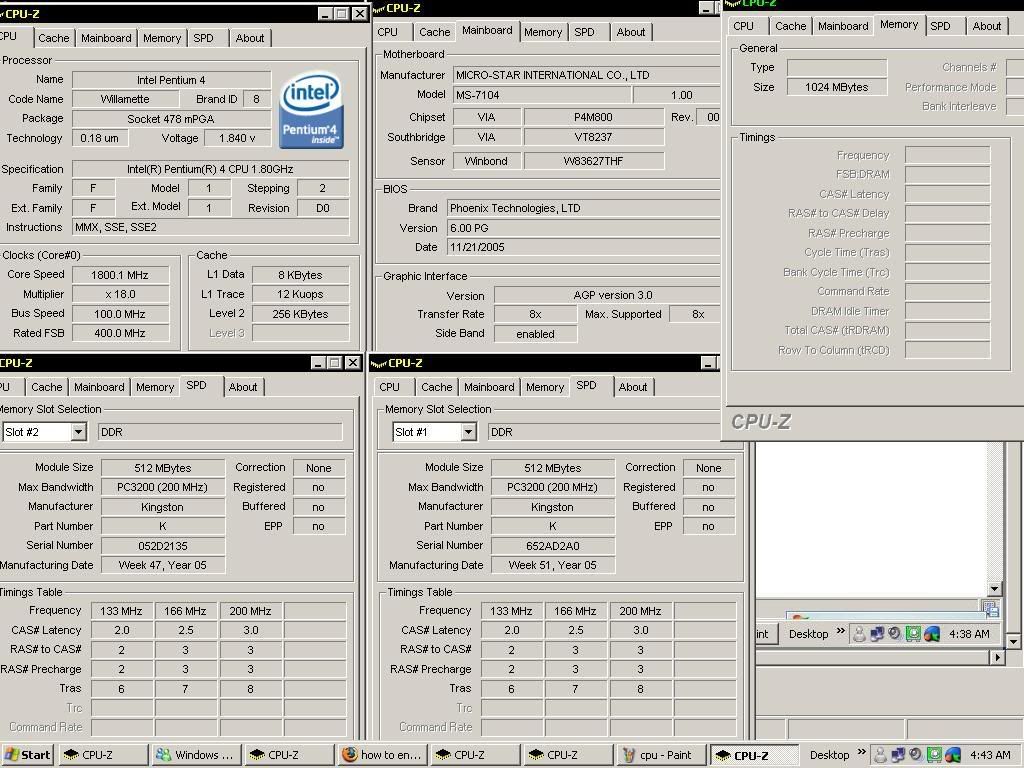
here is my detail of my comp

user posted image
kmarc
post May 16 2007, 02:13 PM

The future is here - Cryptocurrencies!
Group Icon
Elite
14,576 posts

Joined: May 2006
From: Sarawak


Basic overclock guide for 939/AM2 - Overclocking (OC) in windows!!
Dual & Single-core!

Facts about this guide:
---For beginners (not meant for serious overclockers)
---One of MANY methods to OC (by no means the best way)
---No need multiple reboots (OC done in windows)
---If something goes wrong, just reboot computer and all settings will be as normal
---OC for CPU only (no RAM OC, maybe another guide?? whistling.gif )
---OC at your own risk (It is WELL-KNOWN that OC can damage your computer)

Example rig:
3800+ X2 939 (Multiplier 10x, HTT multiplier 5x, FSB 200, vcore 1.35v)

Things to ensure before OC
1) Your SATA harddisk is connected to a locked SATA port
----- e.g. for K8N Neo2, SATA 1 & 2 ports are unlocked. Have to connect to SATA 3/4. If not, you'll get corrupted windows!!!
2) You have a good CPU cooler (not stock cooler!)
3) A good PSU
3) Know how to reset bios

Things to do in bios
1) Lock your AGP to 67 Mhz (PCI-E need locking at 100Mhz)
--- Note : In PCI-E, Nvidia & ATI cards may need different Mhz for locking - nvidia @ 101 Mhz, ATI @ 105 Mhz (need confirmation!)
2) Disable all the following:
--- Cool & Quiet
--- Spread spectrum
--- Any auto-overclocking features
3) Use a ram divider (instead of 200Mhz, select 133Mhz or lower)
4) Set the HTT to 3x (HTT x FSB should never be more than 1000 Mhz)

Settings at default
1) FSB at 200 Mhz (will be increased in windows)
2) Multiplier at 10x
3) Vcore at 1.35v

Software that you need (Hyperlinks soon....)
1) CPU-Z Click here
2) Orthos (for stress dual-core CPUs) Click here
3) Clockgen Click here
4) Core temp (newest version can cause random reboots!) Click here

OC in windows (This is where the fun begins!!!)
1) Run CPU-Z, ensure
-----core speed is 2000 Mhz
-----voltage (vcore) around 1.35v
-----HT link <1000 Mhz (should be at 600Mhz)
-----Memory frequency <200Mhz (should be at 133Mhz)

2) Run Core Temp
-----Check TCaseMax (for 3800+ it is 67'c)(That's the maximum core temperature!)
-----Important : Not recommended to reach near this temp during OC

3) Run Clockgen (this is where the OC starts!!!)
-----Select "Clocks", then "Get values"
-----HTT should come out at 200Mhz
-----DO NOT touch the AGP settings!!!
-----Increase HTT to 205 Mhz
-----Click "Set values" - current CPU speed should be 2050 Mhz

4) Once CPU speed increased, run Orthos (make sure it is set to "Small FFTs - stress CPU")
-----if no error after 15 min, stop orthos
-----increase HTT by 5 Mhz (to 210 Mhz (CPU speed to 2100 Mhz))
-----rerun orthos for another 15 minutes

Note : No need to reboot yet!

5) Repeat steps 4 until Orthos fails (has error). Once error occurs:
-----Reduce HTT by 5 Mhz
-----Run Orthos, if no failure, stress CPU for 6-12 hours (for "rock stable" CPUs, recommended to stress for at least 24 hours)
-----If Orthos still failed during prolonged stressing, reduce another 5 Mhz and rerun orthos

6) Once CPU stable, this is roughly your max CPU OC (note down the HTT frequency)
-----e.g. Max CPU OC : HTT 250 (250 x 10 = 2500 Mhz)
-----reboot
-----set HTT to 250 in bios
-----reboot and see whether you can boot into windows
-----if can, run some benchmarking programs to make sure everything is stable e.g. 3DMark
-----if cannot boot into windows, then the OC is not stable, reduce HTT by 5 Mhz & reboot, if possible, then run benchmarking programs

Important : Always keep an eye on core temperature when OC!!!

Regarding CPU Vcore
For X2, Vcore can usually be kept at stock
If need more OC, can increase Vcore but not recommended to increase more than 0.05-0.10v (unless you have good coolers and you are a hardcore overclocker!)

Example
-----For 3800+ X2, can usually keep at stock Vcore 1.35v
-----If want more OC, can increase Vcore to 1.40-1.45v

Returning other parameters to near normal
RAM - your RAMs may be running at a lower speed
-----if your HTT is at 230, then you have OC you HTT up by 30 (230-200=30)
-----your RAMs will be running at 163Mhz (Original 133Mhz + 30 = 163 Mhz)
-----So, the RAMs are not running at the stock speed of 200Mhz
-----In this case, you can change the RAM divider in BIOS to 166Mhz
-----So, 166+30 = 196Mhz (which is closer to 200Mhz)

Note : If your RAMs can run at 230 Mhz, then you can set the RAM divider to 1:1 (200 Mhz)

HTT - HTT may be running at lower speed
-----if your HTT is 230, then your mobo is running at 230 x 3 (multiplier) = 690Mhz
-----you can change the HTT multiplier to 4x
-----So, your HTT will be running at 230 x 4 = 960 Mhz (which is closer to 1000 Mhz)

Single-core 939 - Differences in OC
Basically the same, except that you need to use Stress Prime 2004 instead of Orthos
----Stress Prime 2004 is the single-core version (both created by the same author)
----Download here

AM2/DDR2 - Differences in OC
Overclocking AM2 CPU is also basically the same.
Just that AM2 uses DDR2.
For DDR2, you need to see your rated DDR2-RAM and reduce it a step or two (Just like when you reduce your DDR400 from 200 Mhz to 133Mhz)

Rated DDR2----------Reduce to (in bios)
DDR2-800-------------667 @ 533 Mhz
DDR2-667-------------533 @ 400 Mhz

Basically, you don't want to overclock your RAMs above the rated value (unless you know your RAMs can be overclocked!)

Example
If HTT is 230 Mhz, the DDR2-800 (which was dropped down to 667 Mhz) will be running at 727Mhz (667 x 30 x 2), which is still below 800Mhz.

Remember : This thread is about overclocking the CPU. NOT the RAMs.

Fine-tuning your OC (If you really want to squeeze ever MHz out of your CPU!!!)
Once CPU stable, you can squeeze more Mhz by increasing you HTT by 1 Mhz interval instead of 5 Mhz.
e.g. HTT 240 Mhz --> 241 Mhz --> 242 Mhz
After each increase, orthos until stable
This way, you'll know your max CPU speed to the last 1 Mhz!!!

Fine-tuning your OC (whether to OC from windows or BIOS)
Coming soon!

_____________________________________________________________________


If anybody has any suggestions/corrections, please inform me. Thx!
I will update this guide if new info is available.

This post has been edited by kmarc: May 18 2007, 09:27 PM

LittleLinnet
post May 17 2007, 09:07 PM

Iophobia
*******
Senior Member
3,593 posts

Joined: Feb 2005
From: ***Penang***
Overclock by using divider cant get huge performance gain IIRC.
Someone might correct me if i am wrong in this.


kmarc
post May 17 2007, 09:39 PM

The future is here - Cryptocurrencies!
Group Icon
Elite
14,576 posts

Joined: May 2006
From: Sarawak


QUOTE(LittleLinnet @ May 17 2007, 09:07 PM)
Overclock by using divider cant get huge performance gain IIRC.
Someone might correct me if i am wrong in this.
*
Why post are you referring too? Is the the RAM overclock or CPU overclock?
LittleLinnet
post May 18 2007, 02:15 AM

Iophobia
*******
Senior Member
3,593 posts

Joined: Feb 2005
From: ***Penang***
QUOTE(kmarc @ May 17 2007, 09:39 PM)
Why post are you referring too? Is the the RAM overclock or CPU overclock?
*
referring to the post above my post which is your post tongue.gif
overclock using divider mainly focus on CPU overclock.
But then, it is still the only way to get most out of your processors since if the rams cant keep up with the FSB.


This post has been edited by LittleLinnet: May 18 2007, 02:16 AM
kmarc
post May 18 2007, 06:38 AM

The future is here - Cryptocurrencies!
Group Icon
Elite
14,576 posts

Joined: May 2006
From: Sarawak


QUOTE(LittleLinnet @ May 18 2007, 02:15 AM)
referring to the post above my post which is your post tongue.gif
overclock using divider mainly focus on CPU overclock.
But then, it is still the only way to get most out of your processors since if the rams cant keep up with the FSB.
*
Errr..... pls look at the guide again. It is clearly stated that the guide was on CPU overclocking and NOT ram overclocking! tongue.gif


LittleLinnet
post May 18 2007, 02:10 PM

Iophobia
*******
Senior Member
3,593 posts

Joined: Feb 2005
From: ***Penang***
QUOTE(kmarc @ May 18 2007, 06:38 AM)
Errr..... pls look at the guide again. It is clearly stated that the guide was on CPU overclocking and NOT ram overclocking!  tongue.gif
*
I know, that's why I said, you might not getting huge performance gain compared to 1:1 since the RAM is not running syn with FSB. Which is, at other ratio other than 1:1.
Basically, CPU overclocking will be involving RAM overclocking because the FSB is running 1:1 with RAM.
Since it is using divider, RAM speed is slower than FSB thus slower bandwidth.
kmarc
post May 18 2007, 02:28 PM

The future is here - Cryptocurrencies!
Group Icon
Elite
14,576 posts

Joined: May 2006
From: Sarawak


QUOTE(LittleLinnet @ May 18 2007, 02:10 PM)
I know, that's why I said, you might not getting huge performance gain compared to 1:1 since the RAM is not running syn with FSB. Which is, at other ratio other than 1:1.
Basically, CPU overclocking will be involving RAM overclocking because the FSB is running 1:1 with RAM.
Since it is using divider, RAM speed is slower than FSB thus slower bandwidth.
*
OIC, sorry for misunderstanding you.

Ya, it's true. Definitely in overclocking, it is preferable for the RAM to run in sync with the CPU (i.e. 1:1). However, in some cases, the RAM may not be able to reach the Mhz of the CPU, and thus the role of RAM divider. This is especially true in X2, where a lot of them are great overclockers and can be overclocked by 40-50 Mhz on the HTT/FSB (e.g. 250 Mhz on HTT). Many beginner's rig only have value ram and most of them can't even go 5-10 Mhz above baseline!!! (i.e. 205-210 Mhz).

Hmmm..... maybe I should come up with a beginner's guide to RAM overclocking.... hmm.gif whistling.gif whistling.gif
LittleLinnet
post May 18 2007, 10:05 PM

Iophobia
*******
Senior Member
3,593 posts

Joined: Feb 2005
From: ***Penang***
QUOTE(kmarc @ May 18 2007, 02:28 PM)
OIC, sorry for misunderstanding you.

Ya, it's true. Definitely in overclocking, it is preferable for the RAM to run in sync with the CPU (i.e. 1:1). However, in some cases, the RAM may not be able to reach the Mhz of the CPU, and thus the role of RAM divider. This is especially true in X2, where a lot of them are great overclockers and can be overclocked by 40-50 Mhz on the HTT/FSB (e.g. 250 Mhz on HTT). Many beginner's rig only have value ram and most of them can't even go 5-10 Mhz above baseline!!! (i.e. 205-210 Mhz).

Hmmm..... maybe I should come up with a beginner's guide to RAM overclocking....  hmm.gif  whistling.gif  whistling.gif
*
but still really dont know the the difference also.
Like @ 4:5 HTT 250MHz, RAM 200MHz vs 1:1 HTT 210MHz, RAM 210MHz
Bandwidth or processing speed? Tough choice XD

kmarc
post May 18 2007, 11:28 PM

The future is here - Cryptocurrencies!
Group Icon
Elite
14,576 posts

Joined: May 2006
From: Sarawak


QUOTE(LittleLinnet @ May 18 2007, 10:05 PM)
but still really dont know the the difference also.
Like @ 4:5 HTT 250MHz, RAM 200MHz vs 1:1 HTT 210MHz, RAM 210MHz
Bandwidth or processing speed? Tough choice XD
*
Of course the 4:5 HTT 250Mhz, RAM 200Mhz! The amount of CPU speed is more as compared to the amount of bandwidth that you gain from 200Mhz to 210Mhz!

There's a lot of review of the impact of higher CPU speed or higher RAM bandwidth.... Now, let's see whether I can find those review..... sweat.gif
sherdil
post May 19 2007, 01:23 AM

Knowledge the key to Heaven
******
Senior Member
1,571 posts

Joined: Jan 2003
From: Somewhere between Past and Present.
QUOTE(kmarc @ May 18 2007, 11:28 PM)
Of course the 4:5 HTT 250Mhz, RAM 200Mhz! The amount of CPU speed is more as compared to the amount of bandwidth that you gain from 200Mhz to 210Mhz!

There's a lot of review of the impact of higher CPU speed or higher RAM bandwidth.... Now, let's see whether I can find those review.....  sweat.gif
*
Anyways you have done a good amount of
work by explaining the basics..thanks..

Cheers

kmarc
post May 20 2007, 09:09 PM

The future is here - Cryptocurrencies!
Group Icon
Elite
14,576 posts

Joined: May 2006
From: Sarawak


Advance overclocking - BIOS OC but windows running C&Q!

Recent polls indicate that many of our forumers overclock their rig 24/7 but the computer is either idling or only doing minimal work e.g. BT, surfing

This is a disadvantage as you are:
1) Using more electricity, thus more $$$
2) Unnecessarily stressing your rig, thus shorter lifespan
3) Bad for environment
4) errr... anything else?

Facts about this guide
- Overclock 24/7 in BIOS (C&Q disabled) but able to run C&Q in windows!
- For advance overclockers, as this method can DAMAGE your rig if you don't know what you're doing!!!
- If any happens, can just reboot and your settings back to original BIOS OC
- For AMD systems (I don't have Intel CPU, sorry)
- Do it at your OWN risk
- You DO NOT have to use this feature if you don't want to

Example of what this guide will teach you to do:
System (will use my specs for this guide):
AMD X2 4200+
----- Stock : 2.2 Ghz (200x11), 1.35v
----- BIOS OC @ 2530 Mhz (230x11), 1.35v (Stock Vcore)
----- DDR400 ram (OC at 230 Mhz)
In windows
If no need OC, can run the rig as normal (with C&Q!):
---Load : Stock clock 2.2 Ghz, 1.35v
---Idle : 1.0 Ghz, 1.1v
If need OC, can:
---Turn off C&Q (in windows without reboot!)
--- Set to OC settings : 2530 Mhz (in windows without reboot!)

Programs that you need:
1) Rightmark CPU clock (RMCC)- very useful and powerful program, be careful when using it!!!
2) CPU-Z
3) A64info
4) Orthos
5) Clockgen

Note : You can also use other programs/apps if you know how to.

Before you start :
1) Know your stock CPU speed & Vcore- both at idle and load (under C&Q)
2) RAM speed at OC
3) Rig already OC in BIOS

Let's get started!!!
1) Launch all the apps stated above

2) In windows, set windows power scheme to RMclock power management (See Figure 1 below)

3) In Clockgen
-----Set HTT back to 200 Mhz (Stock clock : 200x11 = 2.2 Ghz)
Important : Reason to set back to stock speed: Not recommended to run C&Q + OC

4) In RMCC (there's many ways to set this up)
-----Select Profiles tab- choose AC Power Profile : Performance on Demand (see Figure 2)
-----Uncheck Index 0 (FID 4x) (As 4200+ x2 has 5x as the lowest CPU multiplier)
-----Check the rest : Index 1 to 7 + Auto-adjust intermediate VIDs
-----Make sure that in Index 1 - VID = 1.100v
-----Make sure that in Index 7 - VID = 1.350v
-----Click apply
-----Select Profiles>Performance on Demand tab (see figure 3)
-----Check "Use P-State Transitions (PST)"
-----Make sure all Index 1-7 is checked
-----Click apply (and voila!!! You have C&Q running!!!!)

5) Fine-tuning Vcore (to make sure Vcore is correctly set)
-----Look at your Vcore in CPU-z at idle (1.0 Ghz, 1.1v) and load (2.2 Ghz, 1.35v)
-----Use orthos to load the CPU
-----If your Vcore is not similar, you can adjust it in RMCC
-----In RMCC>Profiles tab - AC power profile : Performance on Demand
-----Click on Index 1 (for idle) or Index 7(for load) to adjust the Vcore (VID select) (either upwards or downwards depending on the discrepancy shown in CPU-Z)
--------Example: CPU-Z shows Vcore idle 1.075v (normal 1.1v) and load 1.37v (1.35v)
----------So for Index 1 - increase VID select from 1.100v to 1.125v (increases 0.025v)
----------So for index 7 - decrease VID select from 1.350v to 1.325v (decreases 0.025v)
-----Click apply
-----Recheck CPU-Z to ensure correct Vcore at idle and load

And there you have it! You computer is running C&Q function!!!
BUT, not yet finished......

6) Setting Maximum Performance
-----In RMCC>Profiles>Maximal Performance
-----Check "Use P-State Transitions (PST)
-----Check only Index 7
-----Make sure all other index 1-6 is unchecked
-----Click apply

7) So now, if you want C&Q function - select Performance on Demand in Profiles>AC power profiles

8) If you want full overclocked PC as in BIOS, select Maximal performance
-----Then use clockgen to increase HTT to you previous overclocked HTT (i.e. 230 Mhz in this rig)

Important - Please READ:
Return your HTT to normal before you enable the C&Q feature
Switch off C&Q first before increasing HTT to OC settings
----If not, your computer might hang or reboot!!!
If you want to switch off your rig or reboot, switch RMCC back to maximal performance (i.e. C&Q off!!!) - if not, during the boot process, your system might hang while booting into windows when RMCC is loaded and C&Q kicks in!!!
-----Just in case you reboot with C&Q function on, just set the BIOS to normal, boot to windows and select back the default "Maximum Performance"

RAM adjustment
Coming soon!

Command line interface/short-cuts
Coming soon! (If I can find them!)

What if OC vcore higher?
Coming soon!

Advance RMCC features/settings
Coming soon!

Other settings
You can actually try different settings in RMCC, like limiting your rig to idle mode only!!!
You can also do it the other way - BIOS normal, windows C&Q or windows overclocked!

Is it possible to use C&Q features when OCing
Generally not recommended
However, if required, can still use C&Q features!! Coming soon

Lastly
I think I have the steps correct. If there is anything wrong with the guide, pls inform me.
Any advices or suggestions, kindly inform me also.

To be continued/updated.....

This post has been edited by kmarc: May 22 2007, 09:19 PM


Attached thumbnail(s)
Attached Image Attached Image Attached Image
emilz
post May 20 2007, 11:13 PM

Regular
******
Senior Member
1,377 posts

Joined: Jan 2003
From: Nothing special


Rightmark CPU clock (RMCC)- very useful and powerful program, be careful when using it!!!
y need to be careful when using it
e-jump
post May 20 2007, 11:28 PM

┐( ¯3¯)┌
*******
Senior Member
4,784 posts

Joined: Sep 2004
From: MY


QUOTE(emilz @ May 20 2007, 11:13 PM)
Rightmark CPU clock (RMCC)- very useful and powerful program, be careful when using it!!!
y need to be careful when using it
*
because you dont want to set ur vcore too low for idle or you wont even boot into os, or hang the in os due due lack of juice (idle mode)

This post has been edited by e-jump: May 20 2007, 11:29 PM

23 Pages « < 4 5 6 7 8 > » Top
 

Change to:
| Lo-Fi Version
0.0303sec    1.08    6 queries    GZIP Disabled
Time is now: 17th December 2025 - 02:42 PM