Welcome Guest ( Log In | Register )

Bump Topic Topic Closed RSS Feed
125 Pages « < 43 44 45 46 47 > » Bottom

Outline · [ Standard ] · Linear+

 Military Thread V27

views
     
KLthinker91
post Oct 17 2019, 02:37 PM

Getting Started
**
Junior Member
227 posts

Joined: Feb 2019
From: Cherasboy
QUOTE(MilitaryMadness @ Oct 17 2019, 02:19 PM)
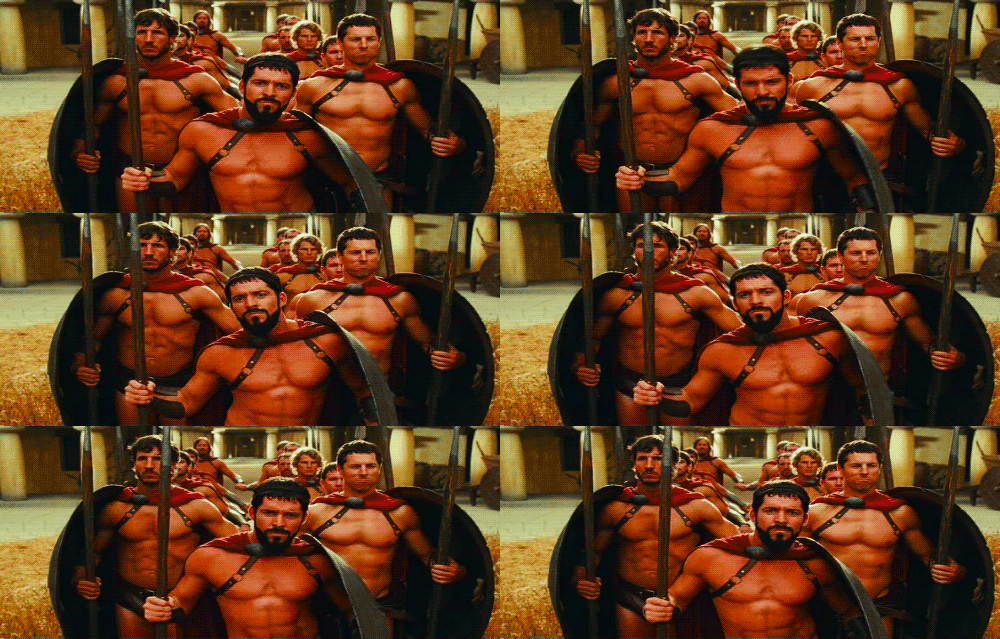
So sad that modern history only remembers the 300 Spartans, but neglects the 10,000 other forces from other Greek city-states who also helped defend the pass earlier during the battle.

Even the last stand depicted after the defenders were surrounded should have shown 700 Thespians and 400 Thebans who stayed even when Leonidas ordered all other forces to leave. Heck even non-hoplite Spartan light troops who also stayed and died numbered nearly 1000 already. But noooo only the 300 are celebrated.

I blame that on the movie. Obvious Spartan propaganda. laugh.gif
*
it's really ghey propaganda brows.gif

user posted image

my guess is that the Spartans contributed so much to the battle, and the allies are mainly light infantry

even long afterward into Roman times, the heavy infantry Roman legionary was considered the most important and decisive soldier on the battlefield

and later on it was knights... and then tanks...
KLthinker91
post Oct 17 2019, 02:55 PM

Getting Started
**
Junior Member
227 posts

Joined: Feb 2019
From: Cherasboy
BTW. Cool video

https://www.reddit.com/r/malaysia/comments/...nouver_by_pdrm/
MilitaryMadness
post Oct 17 2019, 03:23 PM

Regular
******
Senior Member
1,302 posts

Joined: Oct 2010
From: Over your shoulder


QUOTE(KLthinker91 @ Oct 17 2019, 02:37 PM)
it's really ghey propaganda brows.gif

my guess is that the Spartans contributed so much to the battle, and the allies are mainly light infantry

even long afterward into Roman times, the heavy infantry Roman legionary was considered the most important and decisive soldier on the battlefield

and later on it was knights... and then tanks...
*
Actually the numbers I said earlier (400 Thespians and 700 Thebans) are those of hoplite heavy infantry. Most historians can't really say how many light troops were present. Light troops such as skirmishers or archers are usually absent from historical accounts in ancient times. If a number is given it is usually of the Hoplites only.

But it was noted that ancient Greek armies usually went on their campaigns with each Hoplite bringing 3-4 personal servants and retainers who also acted as light troops and skirmishers during the fighting itself.

This, together with any volunteer non-citizen Spartans who either are equipped as light troops or in support roles (only full citizens can be equipped as Hoplites), the total number of soldiers from Sparta itself would probably be around 2000 already.

But of course, keep worshipping the 300 Spartan (Hoplites). laugh.gif


KLthinker91
post Oct 17 2019, 03:35 PM

Getting Started
**
Junior Member
227 posts

Joined: Feb 2019
From: Cherasboy
QUOTE(MilitaryMadness @ Oct 17 2019, 03:23 PM)
Actually the numbers I said earlier (400 Thespians and 700 Thebans) are those of hoplite heavy infantry. Most historians can't really say how many light troops were present. Light troops such as skirmishers or archers are usually absent from historical accounts in ancient times. If a number is given it is usually of the Hoplites only.

But it was noted that ancient Greek armies usually went on their campaigns with each Hoplite bringing 3-4 personal servants and retainers who also acted as light troops and skirmishers during the fighting itself.

This, together with any volunteer non-citizen Spartans who either are equipped as light troops or in support roles (only full citizens can be equipped as Hoplites), the total number of soldiers from Sparta itself would probably be around 2000 already.

But of course, keep worshipping the 300 Spartan (Hoplites). laugh.gif
*
depends on the sources, and really we have very few sources actually

and the Spartan hoplites were glorified not just for their martial skill, but also for their fight to the death
MilitaryMadness
post Oct 17 2019, 04:06 PM

Regular
******
Senior Member
1,302 posts

Joined: Oct 2010
From: Over your shoulder


QUOTE(KLthinker91 @ Oct 17 2019, 03:35 PM)
depends on the sources, and really we have very few sources actually

and the Spartan hoplites were glorified not just for their martial skill, but also for their fight to the death
*
In contrast, due to Spartans being so famous, more study is done on their society and thus we know more about them than many other city-states.

Spartans had so much time to practice military skills because all the work was done by Helot serfs. The Spartan hoplites were the type of citizens that was known as the 'leisure class'. They literally had no work to do because all of economic and agricultural work was done by Helots and they only have to reap the profits.

Besides raw military skill, the practice of all citizens having to live together in barracks until the age of 60 also fostered brotherhood, cooperation and solidarity among the Spartan hoplites (arguably far more important than raw military skill). This is in contrast to other city-states whose citizen hoplites are derived from all walks of life and usually had very little idea of military skill & tactics other than standing in a line, covering yourself with a shield and try to stab the enemy with your spear.

Also the great wealth gained by citizens from the work of the Helots also made Sparta able to afford excellent, uniform equipment and armor unseen in Greece at the time. Other city-states' Hoplites most of the time use a hodgepodge of armor and equipment usually passed down the family. Often the sight of Sparta's uniform, well drilled army is enough to intimidate and convince opponents to come to terms and avoid fighting.

Lastly, regarding fighting to the death, ancient Greek warfare is very much harsh and pitiless. The concept of 'prisoner-of-war' was pretty much non-existent. A defeated army can expect to be massacred to the last man, so there were not much to be gained by running away. The majority of losses during a hoplite battle occurs when the opposing line breaks and those running away are cut down by pursuing light troops.

In many cases, making a last stand to the death is preferable than trying to run away and end up getting killed by a peasant skirmisher. There are very many cases of ancient Greek armies fighting to the death, not just Spartans, as the usually the alternative is not only possibly being cut down during the rout, but even if one survives he can expect to be shamed and ostracized as a coward from his peers at home.


KLthinker91
post Oct 17 2019, 04:30 PM

Getting Started
**
Junior Member
227 posts

Joined: Feb 2019
From: Cherasboy
QUOTE(MilitaryMadness @ Oct 17 2019, 04:06 PM)
In contrast, due to Spartans being so famous, more study is done on their society and thus we know more about them than many other city-states.

Spartans had so much time to practice military skills because all the work was done by Helot serfs. The Spartan hoplites were the type of citizens that was known as the 'leisure class'. They literally had no work to do because all of economic and agricultural work was done by Helots and they only have to reap the profits.

Besides raw military skill, the practice of all citizens having to live together in barracks until the age of 60 also fostered brotherhood, cooperation and solidarity among the Spartan hoplites (arguably far more important than raw military skill). This is in contrast to other city-states whose citizen hoplites are derived from all walks of life and usually had very little idea of military skill & tactics other than standing in a line, covering yourself with a shield and try to stab the enemy with your spear.

Also the great wealth gained by citizens from the work of the Helots also made Sparta able to afford excellent, uniform equipment and armor unseen in Greece at the time. Other city-states' Hoplites most of the time use a hodgepodge of armor and equipment usually passed down the family. Often the sight of Sparta's uniform, well drilled army is enough to intimidate and convince opponents to come to terms and avoid fighting.

Lastly, regarding fighting to the death, ancient Greek warfare is very much harsh and pitiless. The concept of 'prisoner-of-war' was pretty much non-existent. A defeated army can expect to be massacred to the last man, so there were not much to be gained by running away. The majority of losses during a hoplite battle occurs when the opposing line breaks and those running away are cut down by pursuing light troops.

In many cases, making a last stand to the death is preferable than trying to run away and end up getting killed by a peasant skirmisher. There are very many cases of ancient Greek armies fighting to the death, not just Spartans, as the usually the alternative is not only possibly being cut down during the rout, but even if one survives he can expect to be shamed and ostracized as a coward from his peers at home.
*
Not really

We have very few sources. All of what we know about Thermopylae comes from Herodotus, and only a handful of other authors. That's not a lot of people.

Spartans were not "leisure class". They were almost full time soldiers, and trained harder and longer than the soldiers of other civilisations and other Greeks. This specialisation is the core of what gave them military dominance... but only on land.

Their wealth is more likely due to being more successful in wars and thus having more political power to dictate reparations and dominate trade. (Much like any superpower.) However the Spartan system - or rather, what we know of it, see again point 1 about few sources - is quite extreme and unsustainable, leading eventually to their downfall.

Actually ancient Greek warfare between city-states was not harsh and more ritualistic, moreso than many other ancient and medieval wars. The Greeks had a certain sense of brotherhood amongst the warring city-states. Once there was a clear winner, they would allow the defeated army to retreat, and then dictate terms. On the losing side, they generally expected to honour the terms and accept the defeat, even if only temporarily.

Last stands to the death were remarkable enough that certain states including the Spartans were noted for it, but weren't common.

Thermopylae in a way marked the turning point from this kind of "frenemy" warfare because they were fighting an existential threat for the first time. After that war became more brutal, and tactics changed accordingly.
Lampuajaib
post Oct 17 2019, 06:41 PM

New Member
*
Junior Member
0 posts

Joined: Aug 2019
QUOTE(Fat & Fluffy @ Oct 17 2019, 11:17 AM)
5 most successful military operations in history

Napoleon at Jena. The Vietnamese at Dien Bien Phu. Washington's withdrawal from Long Island. What makes a military operation so perfectly complete that you can almost hear Shang Tsung himself say "Flawless Victory" in the back of your mind? A few criteria for the title of "successful" come to mind.

For one, it can't be an overwhelming win between two countries, one being vastly superior to the other. Sure, the United States completely crushed Grenada but who gives a sh*t? So the odds need to be close to evenly matched. Secondly, a pyrrhic victory isn't exactly what anyone would call a "success." Yes, the British won at Bunker Hill, but they lost half of their men doing it. Also, if luck was critical to the outcome, that's not planning. The British at Dunkirk planned only to get a tenth of those men off the beaches. Finally, there needs to be some kind of military necessity, so Putin's "Little Green Men" don't count.

1. The Six-Day War: Israel vs. Everybody.

Okay, so maybe not everyone, just its aggressive Arab neighbors. In 1967, Israel was still very much the underdog in the Middle East. But living in a tough neighborhood means you need to grow a thicker skin and maybe learn how to fight dirty. Few events have gone into the creation of modern-day Israel as we know it like the Six-Day War. In the days before the war, as tensions mounted, Israel warned Egypt not to close off the Straits of Tiran to Israeli ships. Egypt did it anyway. So Israel launched a massive air campaign, destroying the Egyptian Air Force on the ground. When Jordan and Syria entered the war, they got their asses handed to them by an IDF with unchallenged air supremacy.

As the name suggests, the war lasted all of six days, with Israel taking the West Bank from Jordan, the Golan Heights from Syria, and the Gaza Strip and the Sinai Peninsula from Egypt.

2. Operation August Storm: USSR vs. Imperial Japan

Sure it took almost the entirety of World War II to get Japan and Russia, virtual neighbors, to start fighting each other, but once they did, Stalin came through like the most clutch of clutch players. After curb-stomping the Nazi war machine, the Red Army was ready to get some vengeance for the Russo-Japanese War that embarrassed them so much before World War I. In order to bring a quick end to the Pacific War, the U.S. needed to ensure the Japanese forces outside of the home islands surrendered with the rest of Japan – and there were some 800,000 Japanese troops on the Chinese mainland, just waiting to kill Allied forces. What to do?

How about sending 1.5 million joint force Red Army troops fresh from wiping the floor with the Wehrmacht to encircle them along with 28,000 artillery pieces, 5,000 tanks, and 3,700 aircraft? That's what happened on Aug. 9, 1945, when the Soviets split the Japanese Army in two and dismantled it over a period of days. By Aug. 22, the deed was done, and World War II was over.

3. The Iliad: Horsing Around

I know I'm going way back into antiquity with this one, but it must have been great if people are still warning each other about Greeks bearing gifts. The level of deception, planning, and discipline it must have taken an ancient army to pull this off is incredible. After constructing the infamous Trojan Horse, the Greeks had to move their ships out of the horizon to make the Trojans believe they'd actually fled from their invasion. Then the Greeks inside the horse had to remain completely silent and cool for as long as it took for the Trojans to pull them into the city and for night to fall. The rest of the Greek Army had to land all over again, regroup, and be completely silent as thousands of them approached a sleeping city.

4. Desert Storm: Iraq vs. Everybody

How Iraq came to invade tiny Kuwait is pretty easy to figure out. A miscommunication between Saddam Hussein and U.S. ambassador April Glaspie left the Iraqi dictator believing the United States gave him the go-ahead to invade his neighbor. Boy was he wrong. In a logistical miracle that would make Eisenhower proud, in just a few weeks, the United States and its coalition partners somehow moved all the manpower and materiel necessary to defend Saudi Arabia while liberating Kuwait and trouncing the Iraqi Army while taking minimal losses.

Like the biblical story of the flood, the U.S. flooded Iraq with smart bombs for 40 days and 40 nights. After taking a pounding that might as well have been branded by Brazzers, the Iraqi Army withdrew in a ground war that lasted about 100 hours.

5. Operation Overlord: D-Day

Everyone knew that an invasion of Western Europe was coming, especially the Nazis. But Hitler's problem was how to prepare for it. What's so amazing about the planning for Overlord wasn't just the sheer logistical mastery required – Ike had to think of everything from bullets to food, along with the temporary harbors to move that equipment onto the beach, not to mention planning for a supply line when he didn't know how long it would be from one day to the next. What is so marvelous about D-Day is all the preparation and planning that also went into fooling the Nazis about where the invasion would hit.

Operation Quicksilver, the plan to build the Ghost Army of inflatable tanks and other gear, all commanded by legendary General George S. Patton. The plan to deceive the Nazis using a corpse thrown from an airplane with "secret plans" on his person, called Operation Mincemeat. It all came together so that on June 6, 1944, the largest amphibious landing to date, along with the largest airborne operation to date could combine with resistance movements and secret intelligence operations to free Europe from the evil grasp of an insane dictator and save an entire race of people.
*
Sun Tzu said the best strategy of war is defeat the enemy without war. FATHU MAKKAH was winning the war without war.

This post has been edited by Lampuajaib: Oct 18 2019, 02:26 AM
MilitaryMadness
post Oct 18 2019, 08:40 AM

Regular
******
Senior Member
1,302 posts

Joined: Oct 2010
From: Over your shoulder


QUOTE(KLthinker91 @ Oct 17 2019, 04:30 PM)
Not really

We have very few sources. All of what we know about Thermopylae comes from Herodotus, and only a handful of other authors. That's not a lot of people.

Spartans were not "leisure class". They were almost full time soldiers, and trained harder and longer than the soldiers of other civilisations and other Greeks. This specialisation is the core of what gave them military dominance... but only on land.

Their wealth is more likely due to being more successful in wars and thus having more political power to dictate reparations and dominate trade. (Much like any superpower.) However the Spartan system - or rather, what we know of it, see again point 1 about few sources - is quite extreme and unsustainable, leading eventually to their downfall.

Actually ancient Greek warfare between city-states was not harsh and more ritualistic, moreso than many other ancient and medieval wars. The Greeks had a certain sense of brotherhood amongst the warring city-states. Once there was a clear winner, they would allow the defeated army to retreat, and then dictate terms. On the losing side, they generally expected to honour the terms and accept the defeat, even if only temporarily.

Last stands to the death were remarkable enough that certain states including the Spartans were noted for it, but weren't common.

Thermopylae in a way marked the turning point from this kind of "frenemy" warfare because they were fighting an existential threat for the first time. After that war became more brutal, and tactics changed accordingly.
*
This is very much the popular culture depiction of Spartans.

For one thing, many other later historians studied Spartan history and culture starting from Roman times up to the 19th century. So it was better well known than most other Greek city-states. These historians regard Sparta as the perfect embodiment of civilization, a militarily strong and independent state. Sparta was the subject of fascination in its own day, as well as in Western culture following the revival of classical learning. There is even a term for this: "Laconism" or "Laconophilia".

Secondly, there was no such thing as 'full time soldiers' during the period. Sparta, as of all of Greece, relied on a civilian militia as a military force. However due to certain factors Sparta was able to gain an early advantage over other city-states.

1) The caste system practiced by Sparta in which citizen Spartans are forbidden to engage in commerce or manual labor created a large 'leisure class' which had free time to pursue its own aims, without having be occupied by long work hours. However Spartans still managed the city and did administrative jobs, working as clerks, civil servants and magistrates. This also made them able to coherently train themselves in warfare compared to other city-states, where the citizen hoplites were usually drawn from all classes and had practically no formal military training. The freedom from work also gave the Spartan citizen Hoplites the ability to campaign nearly all-year round, while other city-states needed to disband their forces each harvest season or risk economic disaster from unharvested crops. This is a huge advantage.

2) Sparta had a large number of citizens able to be equipped as Hoplites due to all citizens being a leisure class. During its peak in around 500 bc, Sparta could field around 8,000 citizen Hoplites from a population of around 50,000. Although Athens may have a population of around 500,000-600,000 at the same period, the majority of the population are not citizens and full Athenian citizens only numbered around 5,000. It should be noted that in Ancient Greece, only full citizens have the privilege to serve as Hoplites. Again, this combined with the fact that without the obligation to disband the Spartan army for harvest season and able to campaign all year round gave the Spartans a huge advantage in conflict against its rivals.

However, the Spartan caste system eventually precipitated the Spartan's decline downfall.

1) Only the families and descendents of the original founders of Sparta can be a Spartan citizen, and thus a Spartan Hoplite. The rigid military training caused Spartan citizens to marry late (men could only marry from the age of 30) and have few children, keeping the population low. There are also many laws that could demote a Spartan citizen into a lower class resident, such as if a citizen is unable to pay their contribution to their own barrack's mess. However, to keep lower class Perekoi and Helots from gaining citizenship, there are virtually no laws that could reinstate a demoted citizen, so a demotion is usually permanent for a citizen.

2) Spartan citizens, as leisure-class landowners, made their wealth through their lands. A citizen is entitled to 50% of the profits from the Perikoi and Helot working a citizen's own lands. In the early period, where everyone had a decently-sized land, they made a lot of wealth that afforded better equipment and armor. However, as time went by these plots of lands keep getting fragmented by splitting it to a citizen's sons when he died (daughters don't get inheritance). Thus the income of the land to each landowner keeps fragmenting and shrinking with each generation. Thus Sparta became poorer with each generation.

3) Many of the Spartans' militaristic culture is derived from the need to oppress the Helot class and prevent a Helot uprising. The helots are state-owned serfs that worked a Spartan citizens' land permanently. However, due the low population numbers of Spartan citizens, the number of Helots keep growing as they had no restrictions of family life compared to the citizens. In time, the imbalance of citizens and Helots grew to a dangerous degree and revolts became much more common.


KLthinker91
post Oct 18 2019, 11:41 AM

Getting Started
**
Junior Member
227 posts

Joined: Feb 2019
From: Cherasboy
QUOTE(MilitaryMadness @ Oct 18 2019, 08:40 AM)
This is very much the popular culture depiction of Spartans.
In what way?
QUOTE
For one thing, many other later historians studied Spartan history and culture starting from Roman times up to the 19th century. So it was better well known than most other Greek city-states.
The Spartans dont exist in the 19th century. So there is a lack of primary sources describing them, other than the few ancient writers, and we don't really know how accurate they are.

Of course this is the same problem for many historical civilisations.
QUOTE
Secondly, there was no such thing as 'full time soldiers' during the period. Sparta, as of all of Greece, relied on a civilian militia as a military force. However

That's why I said, almost

Later on during the Greek wars post-Thermopylae, the other states adopted small standing armies too.

QUOTE
1) The caste system

Yes, we all know this

But you describe them as a "leisure class". I wouldn't.
QUOTE
However, the Spartan caste system eventually precipitated the Spartan's decline downfall.
*
Yes, we know this too

But we basically only have 1 or 2 key sources for Spartan society. So really, if you want to challenge the "popular view", then you are left with very little alternative views.
MilitaryMadness
post Oct 18 2019, 12:23 PM

Regular
******
Senior Member
1,302 posts

Joined: Oct 2010
From: Over your shoulder


QUOTE(KLthinker91 @ Oct 18 2019, 11:41 AM)
But we basically only have 1 or 2 key sources for Spartan society. So really, if you want to challenge the "popular view", then you are left with very little alternative views.
*
Most of our sources for the Spartan culture are written by outsiders, as Sparta's culture does not lend itself to the development of an academic culture. Some are written by critics and some are written by admirers. Thus exaggerations and propaganda will be a part of the narrative.

However, if you are curious in 'alternative views' on the Spartans. Try and go through these and tell me what you think :

sos

sos

KLthinker91
post Oct 18 2019, 01:13 PM

Getting Started
**
Junior Member
227 posts

Joined: Feb 2019
From: Cherasboy
QUOTE(MilitaryMadness @ Oct 18 2019, 12:23 PM)
Most of our sources for the Spartan culture are written by outsiders, as Sparta's culture does not lend itself to the development of an academic culture. Some are written by critics and some are written by admirers. Thus exaggerations and propaganda will be a part of the narrative.

However, if you are curious in 'alternative views' on the Spartans. Try and go through these and tell me what you think :

sos

sos
*
Yes, that is what I mean when I say we have a limited number of primary sources to draw from.

I can get that book, I'll put it on my reading list icon_rolleyes.gif
MilitaryMadness
post Oct 18 2019, 03:46 PM

Regular
******
Senior Member
1,302 posts

Joined: Oct 2010
From: Over your shoulder


QUOTE(KLthinker91 @ Oct 18 2019, 01:13 PM)
Yes, that is what I mean when I say we have a limited number of primary sources to draw from.

I can get that book, I'll put it on my reading list  icon_rolleyes.gif
*
Here's another good discussion on the supposed invincibility of the Spartans

sos

KLthinker91
post Oct 18 2019, 05:53 PM

Getting Started
**
Junior Member
227 posts

Joined: Feb 2019
From: Cherasboy
QUOTE(MilitaryMadness @ Oct 18 2019, 03:46 PM)
Here's another good discussion on the supposed invincibility of the Spartans

sos
*
Yeah I read it. I think it's an exercise in demolishing strawmen.

A lot of time, effort and words is spent trying to debunk the Zack Snyder 300 image of Spartans. But that's Hollywood. Nobody with the mildest lasting interest in actual Greek history thinks anything serious about that movie.

The writer in fact invariably re-establishes the reasons to admire the Spartans in part 2 of the comments:

1) they were fitter than most other Greeks, which by itself would already have been a key military advantage

2) the State had a stronger influence on Spartans' upbringing than most other Greeks and created a strong esprit de corps

3) they had certain innovations in warfare which made them a significant power in Greek politics for some time

4) for Greeks, their women were well-educated, fit, probably above average in beauty, and desirable

By the way, if you look around you, you'll notice some people have truly taken these lessons to heart, and they also are considered formidable opponents in current world affairs.
azriel
post Oct 18 2019, 08:10 PM

New Member
*
Newbie
4 posts

Joined: Jan 2012
QUOTE
ADEX 2019: Lockheed Martin progresses F-35 offset projects in South Korea

Jon Grevatt, Seoul - Jane's Defence Industry
17 October 2019

Key Points

• US corporation engages with local industry on KFX technology transfers
• South Korean firms also expanding involvement in F-35 component sustainment

Lockheed Martin is in the process of fulfilling its expansive defence offset obligations linked to the US government's sale of F-35 Lightning II fighter aircraft to the Republic of Korea Air Force (RoKAF).

Steve Over, director of F-35 international business development at Lockheed Martin, told Jane's on 17 October that offset projects to provide a military communications satellite solution and technology transfers to support the development of South Korea's next-generation KFX fighter aircraft are currently under way. South Korea agreed to procure 40 F-35s in September 2014 for about USD7 billion.

Speaking at the 2019 Seoul International Aerospace and Defense Exhibition (ADEX), Over said that the RoKAF's F-35 procurement programme "had very specific [offset] requirements, resulting in a couple of rather large projects for us in Korea".

He added, "A military communications satellite was one of their requirements…. We [also] had a requirement to satisfy some amount of technology transfers associated with KFX, which we are in the process of fulfilling right now. That work is progressing well."

Over confirmed that in supporting the technology transfers Lockheed Martin is collaborating with Korea Aerospace Industries (KAI), the prime contractor on the KFX.

Jane's has previously reported that South Korea's offset requirement on the F-35 programme included the provision of a military communications satellite, which will be fully owned and operated by the government. Offset covers the provision of the satellite, launching, orbit positioning, and technical training to operate the satellite.

In addition, the United States has granted approvals to support Lockheed Martin's transfer to South Korea of 21 technology suites to support the KFX. These suites include flight control technologies, avionics, system integration, materials, and unspecified weaponry.


https://www.janes.com/article/92019/adex-20...-in-south-korea

This post has been edited by azriel: Oct 18 2019, 08:10 PM
azriel
post Oct 19 2019, 09:48 AM

New Member
*
Newbie
4 posts

Joined: Jan 2012
Model of GDLS Mobile Protected Firepower (MPF).


This post has been edited by azriel: Oct 19 2019, 09:49 AM
zacky chan
post Oct 19 2019, 11:16 AM

New Member
*
Newbie
11 posts

Joined: Jun 2018


QUOTE
AUSA 2019: Saab and Boeing announce Ground-Launched Small Diameter Bomb is ready for production

Saab and Boeing announced at the 2019 Association of the United States Army (AUSA) exposition - held in Washington, DC, on 14-16 October - that their jointly developed Ground-Launched Small Diameter Bomb (GLSDB) is ready for production.

The announcement follows the latest test firing of the system at the Andøya Test Center in Andenes, Norway, on 26 September. Saab reported in a 14 October press release that the objective of the firing was to hit a pre-determined target in the sea 130 km away and that the test firing was successful. The flight time was 14 minutes, with an impact angle of 70°.

Saab said the GLSDB was test fired from a custom-made, fully autonomous, 6.1 m container, but that the launcher-independent system can also use an M26 launcher such as HIMARS, the M270, the South Korean Chun-Mu, and naval platforms.

The GLSDB is highly accurate over long ranges and can fly complex trajectories and manoeuvres to strike targets that cannot be hit by conventional direct and indirect fire systems, according to Saab. The system has a range of 150 km and is capable of conducting 360-degree reverse slope engagements and defeating both soft and hardened targets, the Swedish company said.
https://www.janes.com/article/91978/ausa-20...-for-production
azriel
post Oct 19 2019, 11:36 AM

New Member
*
Newbie
4 posts

Joined: Jan 2012
Indonesia Coast Guard (Bakamla) commissioned 3 new locally designed and built 80 meters OPV. Total cost of all 3 vessel around USD 42.8 million. Credit to Metro Batam.

user posted image

https://nasional.tempo.co/read/1261405/baka...jaga-perbatasan

Lampuajaib
post Oct 19 2019, 12:41 PM

New Member
*
Junior Member
0 posts

Joined: Aug 2019
QUOTE(azriel @ Oct 19 2019, 11:36 AM)
Indonesia Coast Guard (Bakamla) commissioned 3 new locally designed and built 80 meters OPV. Total cost of all 3 vessel around USD 42.8 million. Credit to Metro Batam.

user posted image

https://nasional.tempo.co/read/1261405/baka...jaga-perbatasan
*
The same class as MMEA Damen opv 1800 built by THHE Destini. SG built also 80 metres OPV but operates by RSN with more fire power.
azriel
post Oct 19 2019, 06:05 PM

New Member
*
Newbie
4 posts

Joined: Jan 2012
First Steel Cutting Ceremony of Indonesian Navy 8th & 9th LST at PT Bandar Abadi Shipyard in Batam. Credit to Batampos.

user posted image

https://batampos.co.id/2019/10/18/kapal-pen...duksi-di-batam/
azriel
post Oct 19 2019, 06:10 PM

New Member
*
Newbie
4 posts

Joined: Jan 2012
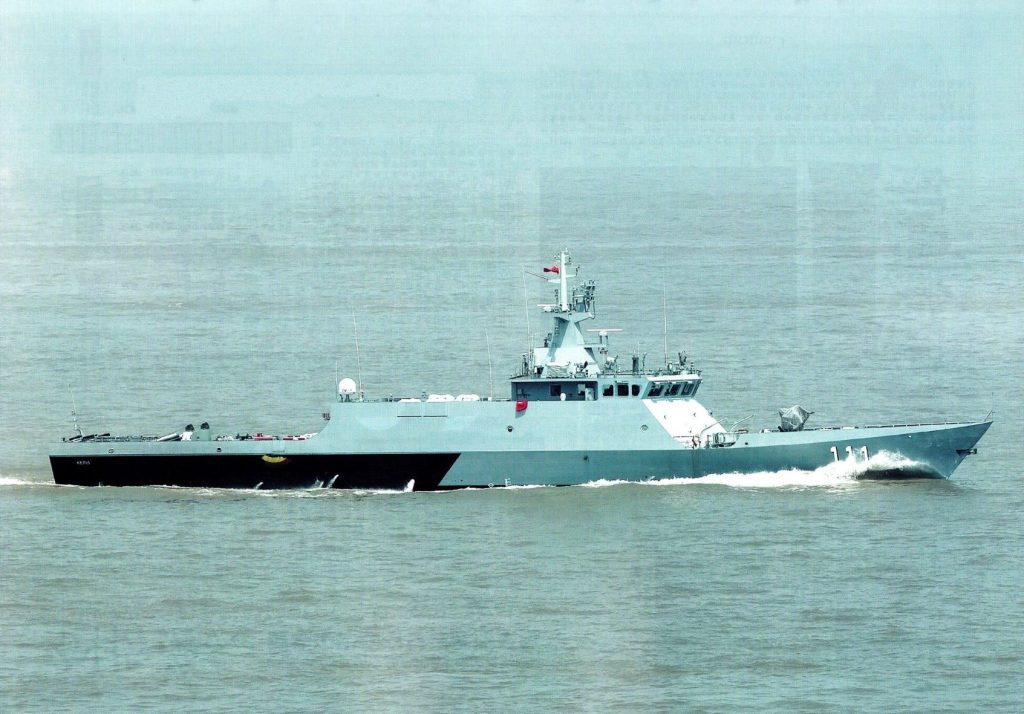
PCU LMS Keris on sea trial. Photo by Loongnaval.

user posted image

http://www.malaysiandefence.com/keris-on-sea-trials/

125 Pages « < 43 44 45 46 47 > » Top
Topic ClosedOptions
 

Change to:
| Lo-Fi Version
0.0550sec    0.70    6 queries    GZIP Disabled
Time is now: 17th December 2025 - 06:03 AM