

 Feb 3 2021, 04:50 PM


QUOTE(alexei @ Jan 31 2021, 11:51 PM)
My experience is still growing, but limited to 2 MF battery that I have used with unsatisfactory duration. First one being RAMCAR stock battery, 2 years over (float voltage 10.5~10.8V, suspect plate short), followed by a Calcium MF oversized (75D vs 55D) which died within 2 years (float voltage 10.8V, suspect plate short).
Similar to SleeplessEyes, I have opted instead for traditional wet battery. However, I am currently undersizing the battery (46D vs 55D). I do not perform top up charging on the battery. I think charging a battery to 100% is preparation for storage. For daily (cyclic use) we should use the constant voltage constant current charging scheme, not the bulk/absorption/float scheme like smart chargers do.
To be honest, a lot of guessing based on what I've read. In your case, with the float voltage dropping to 12.1~12.2V after charging suggests the battery has been overcharged, and one of the cells is damaged. Reason for this is likely cell imbalance, where one of the cell is fully charged first. When this happens, the resistance of that cell will be high, and it will take on more voltage when from the charger. Compared to other cells that are not fully charged, they take on less voltage, while passing the current to the fully charged cell. The CTEK supplies maximum 5A, so the charging energy is converted to heat at the healthy cell, and instead kills it. AGM and Gel are very sensitive to overcharging. So, while the battery is connected to the charger, it appears to charge the battery but in fact it is killing the healthy cell, and eventually killing the battery as a whole.
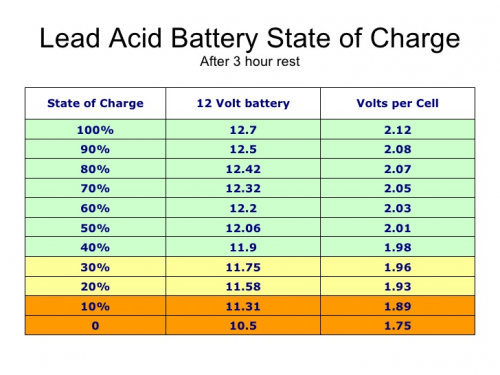
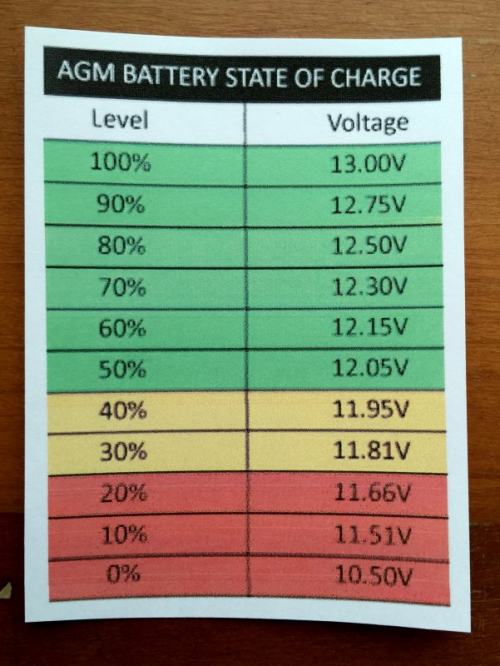
To answer your question, find a way to measure overnight battery voltage and keep an eye on it every morning. That is what matters the most to understand the state of your battery. See below. When you notice a sudden reduced of state of discharge, please perform a top up charging.
Lead acid:
AGM:

hmmm....Similar to SleeplessEyes, I have opted instead for traditional wet battery. However, I am currently undersizing the battery (46D vs 55D). I do not perform top up charging on the battery. I think charging a battery to 100% is preparation for storage. For daily (cyclic use) we should use the constant voltage constant current charging scheme, not the bulk/absorption/float scheme like smart chargers do.
To be honest, a lot of guessing based on what I've read. In your case, with the float voltage dropping to 12.1~12.2V after charging suggests the battery has been overcharged, and one of the cells is damaged. Reason for this is likely cell imbalance, where one of the cell is fully charged first. When this happens, the resistance of that cell will be high, and it will take on more voltage when from the charger. Compared to other cells that are not fully charged, they take on less voltage, while passing the current to the fully charged cell. The CTEK supplies maximum 5A, so the charging energy is converted to heat at the healthy cell, and instead kills it. AGM and Gel are very sensitive to overcharging. So, while the battery is connected to the charger, it appears to charge the battery but in fact it is killing the healthy cell, and eventually killing the battery as a whole.
To answer your question, find a way to measure overnight battery voltage and keep an eye on it every morning. That is what matters the most to understand the state of your battery. See below. When you notice a sudden reduced of state of discharge, please perform a top up charging.
Lead acid:
AGM:
interesting pointers to consider
i'll reduce the charging to maybe quarterly (or longer) instead of monthly.
thanks you again

This post has been edited by wkc5657: Feb 3 2021, 04:50 PM
 Quote
Quote
 ), Q85 has way higher than 600A for CCA if SOH if 100%. Maybe the batt shop guy didn't use the correct battery size during tests?

 0.0240sec
 0.30
0.30
 7 queries
 GZIP Disabled