

QUOTE(zamorin @ Jul 23 2018, 02:54 PM)
Not according to science.

so according to science, what is darkness?LYN Catholic Fellowship V02 (Group), For Catholics (Roman or Eastern)
|
|
 Jul 23 2018, 02:55 PM Jul 23 2018, 02:55 PM
|
 
Junior Member
906 posts Joined: Jun 2005  
|
QUOTE(zamorin @ Jul 23 2018, 02:54 PM) Not according to science. so according to science, what is darkness? |
|
|
|
|
|
Jul 23 2018, 02:56 PM
|

Senior Member
6,775 posts Joined: Aug 2011 From: Malaysia Darul Harapan
|
QUOTE(desmond2020 @ Jul 23 2018, 02:53 PM) interesting I see you have had similar encounters with 'Unknown Warrior", like me do you think darkness is a state lack of light or a condition that filled up with darkness particle?  This post has been edited by zamorin: Jul 23 2018, 02:58 PM |
|
|
Jul 23 2018, 02:59 PM
|

Senior Member
3,576 posts Joined: Apr 2006
|
QUOTE(zamorin @ Jul 23 2018, 02:47 PM) That's even more absurd. I did not say humanity represent evil, that was a quote from Haledoch. That's why I said you should read carefully before firing away aimlessly.First you say: Humanity represent evil. Now you say: Human nature is inherently good You are blatantly contradicting yourself. If god cannot create something/anything (including evil), then he is not omnipotent as the religions claim. I am not trying to insult you but pointing out the errors. Apologies if it hurts you. Don't take it personally, it's easy to do so when it comes to religion. This post has been edited by yeeck: Jul 23 2018, 02:59 PM |
|
|
Jul 23 2018, 03:02 PM
|
|
Senior Member
6,775 posts Joined: Aug 2011 From: Malaysia Darul Harapan
|
QUOTE(desmond2020 @ Jul 23 2018, 02:55 PM) so according to science, what is darkness? This is the scientific explanation:Darkness, the polar opposite to brightness, is understood as a lack of illumination or an absence of visible light. Human vision is unable to distinguish color in conditions of either high brightness or darkness.[1] In conditions with insufficient light levels, color perception ranges from achromatic to ultimately black. The emotional response to darkness has generated metaphorical usages of the term in many cultures. From: https://en.wikipedia.org/wiki/Darkness |
|
|
Jul 23 2018, 03:04 PM
|
|
Senior Member
6,775 posts Joined: Aug 2011 From: Malaysia Darul Harapan
|
QUOTE(yeeck @ Jul 23 2018, 02:59 PM) I did not say humanity represent evil, that was a quote from Haledoch. That's why I said you should read carefully before firing away aimlessly. Like I said earlier, when there are so many spins, sometimes it's hard to distinguish who is spinning what.I admit I should read carefully but firing away aimlessly is what you are doing. |
|
|
Jul 23 2018, 03:06 PM
|
|
Senior Member
3,576 posts Joined: Apr 2006
|
You probably have one at your house—perhaps a drawer or a shelf in the hall closet. It’s that not-so-secret place where we save things we’re really not sure what to do with. For one reason or another we keep hanging onto that stuff forgetting we have it until we accidently stumble upon it while looking for something else.
Unfortunately, we manage to do the same sort of thing with our lives as well. We shuffle the odds and ends of our lives—the things we’re not sure what to do with, the things we want to forget on purpose, the things we feel have no purpose—we shuffle all of it into that place, some dark, obscure corner of the soul. And there it stays, because we’re really not sure what to make of it all. Perhaps that’s where our story can be of help. Lazarus and his sisters Mary and Martha were intimate friends with Jesus. He liked to visit their home in Bethany on occasion. So, it comes as no surprise that when Lazarus’ health takes a turn for the worse, the sisters send for Jesus. When He finally arrives at the tomb, Lazarus, who has been dead for four days, is brought back to life. Jesus is the giver of life. The story raises a few questions for me about what it means for Jesus to give life to us. The first question is regarding Jesus’ command to those gathered that they remove the stone. I wonder why Jesus would need anyone to take away the stone from Lazarus’ grave. He could have done it himself. But he chose not to. But here’s the point: God does his greatest work with our cooperation, with our involvement, with our participation. Our God is one who has chosen to work with creation; He commands and then we obey. God doesn’t expect us just to believe in miracles; he wants us to be miracles. Think back to the story of the Exodus. Surely God could have freed Israel from bondage in Egypt without any help at all. But God chose to use Moses to get the job done by leading his people out of slavery and into the “Land of Milk and Honey.” But of course, before Moses became a great leader, God had to deal with Moses and all his reservations and objections. God told Moses in a sense, roll away the stone and let what you’ve buried come out, for I will bring it to life. Having something to hope for helps us to live more abundantly. The second question relates to what really happens when the stone is rolled away? For one thing, it lets in light that has been blocked out. It’s amazing what comes into view when light shines upon it. God can work with the things we have given up on. Take note that when it got right down to it, even Mary and Martha weren’t sure what Jesus could do with old, dead Lazarus as Martha reminds Jesus, “He’s been dead four days.” Maybe we’re not sure what God can do with our old, dead hopes. History is ripe with stories of people whose gifts matured late in their lives. Rolling away the stone can also shed light on our talents and abilities we’ve tucked away in the closet thinking they’re of little use to anyone else. You recall in the parable of the talents that a man was going away so he entrusted some talents to his employees. Each received a talent in keeping with his abilities—one received five, another two, and the last, one. The first two invested their talents and put them to good use, and as a result got a return on their investment. The third, however, buried his and got no return at all. How many of us are like the third employee? We minimize what we have been given, thinking it of little or no value. Or maybe we leave it to others to pick up the slack, making something of what they have while we bury what we have. Each of us is gifted as no one else is. Some are obvious, displayed and utilized in the market place. Others are behind-the-scenes gifts—the gifts of love, faith, encouragement. Some have the gift of help and simply do good to others. Take away the stone! Own up to what God has given each of us. Shine light on them and let God call them forth and see what he can do with them. This is the answer to those who teach that all you need to is just believe and do nothing. Not to God, He wants you to cooperate. |
|
|
|
|
|
Jul 23 2018, 03:11 PM
|
|
Senior Member
6,775 posts Joined: Aug 2011 From: Malaysia Darul Harapan
|
Jul 23 2018, 04:20 PM |
|
|
|
|
|
Jul 24 2018, 06:16 PM
|
|
Senior Member
6,775 posts Joined: Aug 2011 From: Malaysia Darul Harapan
|
a member can delete ur posts?
|
|
|
Jul 24 2018, 06:38 PM
|

Senior Member
4,118 posts Joined: Feb 2010
|
May I know what kinda prays for healing?
|
|
|
Jul 25 2018, 09:36 AM
|

Junior Member
225 posts Joined: Mar 2008
|
 |
|
|
Jul 25 2018, 12:09 PM
|
|
Senior Member
6,775 posts Joined: Aug 2011 From: Malaysia Darul Harapan
|
Does anyone know what percentage of Malaysians are Catholics and what percentage are Protestants? Are there any banned Christian sects in Malaysia like there are banned sects of Islam, i.e:- Shiaa?
This post has been edited by zamorin: Jul 25 2018, 12:09 PM |
|
|
Jul 25 2018, 12:23 PM
|
|
Senior Member
3,576 posts Joined: Apr 2006
|
LatAm debunks persistent myth about anti-Christian persecution
John L. Allen Jr.Jul 20, 2018  Friends and family carry the coffin with the body of Jose Esteban Sevilla Medina, who died after he was shot in the chest at a barricade during an attack by the police and paramilitary forces, in Masaya, Nicaragua, Monday, July 16, 2018. (Credit: AP Photo/Cristobal Venegas.) News Analysis Recent developments in the Central American nations of Nicaragua and Venezuela both offer not only sobering indications about the direction of those societies, but also a thorough debunking of one of the most persistent myths about anti-Christian persecution in the early 21st century. Since the subject first arose as a matter of political and media chatter in the 1990s, conversation about anti-Christian persecution has gone through several phases of denial. The first was that there was such a thing at all, fueled by suspicion in some cultural and media circles that “anti-Christian persecution” had been ginned up by conservative Western Christians looking to win sympathy for socially unpopular positions on matters such as homosexuality and women. After the rise of ISIS in Iraq and Syria that position became unsustainable, and most people were willing to recognize that Christians are being persecuted today at the hands of Islamic radicalism in various parts of the Middle East. More recently, news of a possible breakthrough in Vatican-China relations has refocused attention on the fact that there is a persecuted, underground church in China, and that it’s not just radical Muslims who sometimes see Christianity as a threat. The remaining type of denial, and one that’s proven surprisingly enduring, is that Christians are at risk of persecution only where they’re a minority. In largely Christian societies, or so the myth goes, individual Christians ought to be safe - and if they’re not, whatever they’re suffering isn’t really “religious” persecution. Even a moment’s reflection, however, is enough to demonstrate that it’s not just places where Christians are a minority that form the front lines of this war, and it never has been. The Center for the Study of Global Christianity estimates that of the seventy million Christians who have been martyred since the time of Christ, forty-five million died in the twentieth century alone. By far the largest concentration was in the Soviet Union, with as many as twenty-five million killed inside Russia and an additional eight million in Ukraine. Both Russia and Ukraine are profoundly Christian societies and have been for centuries, even during the period in which they were governed by officially atheistic regimes. Many of the most celebrated martyrs of the late twentieth century came in Latin America, among Christians who resisted the police states of the region. A reminder of that history will come in October, when Pope Francis officially canonizes Archbishop Oscar Romero of El Salvador, who was shot to death while saying Mass in 1980 for his advocacy of the poor and victims of human rights abuses. Other examples of these “majority martyrs” include American Sister Dorothy Stang, the great “martyr of the Amazon” in overwhelmingly Catholic Brazil, and Maria Elizabeth Macías Castro, a leader in the Scalabrinian lay movement and a popular blogger, beheaded in Mexico in 2011 for exposing the activities of a drug cartel. Today, Latin America is once more in the forefront of exposing the “only a minority” myth, due to literal violence in Nicaragua and mounting political and legal harassment in Venezuela. Yesterday, Crux’s Inés San Martín offered a chilling tick-tock of recent attacks on Church personnel or sites in Nicaragua, where forces loyal to Sandinista President Daniel Ortega and his wife, Vice President Rosario Murillo, are increasingly inclined to see Catholic clergy and activits as the enemy. RELATED: Nicaragua’s bishops to pray for exorcism amid Ortega crackdown On Tuesday, according to the auxiliary bishop of Managua, the country’s capital, the neighborhood of Monimbo in the southeast city of Masaya was under attack. He said gunfire reached the parish of St. Mary Magdalene, where a Catholic priest was seeking refuge. On Saturday, the Divine Mercy Church in Managua was under siege for 16 hours. It had become a refuge for students who, while protesting at a nearby university, were attacked by pro-government forces. Pictures posted to social media showed the church had been pockmarked by bullets. On Sunday, the car of a bishop was shot at as he was on his way to the northern city of Nindiri, where he had hoped to stop an attack by the military. He wasn’t wounded, but the tires and windows of the car were destroyed. On the same day, the house of a priest in Masaya was ransacked by the police. Belongings were taken with no explanation given. On Monday, a center of the papal charity Caritas was set aflame in the northern city of Sébaco. On July 9, a cardinal, a bishop and the papal representative were among clergy from Managua attacked as they attempted to protect St. Sebastian Basilica in the nearby city of Diriamba from a pro-government mob. In Venezuela, meanwhile, the country’s bishops emerged undaunted from their July 7-11 general assembly, calling the government of President Nicolás Maduro no more than a “de facto regime” due to its failures to respect both the national constitution and also the “highest principles of the dignity of the people.” RELATED: Facing crises inside and out, Latin America’s Church is hands-on While so far there have been few incidents of violent attacks on Catholic targets, in January Maduro called on prosecutors to charge two Catholic bishops with “hate crimes” for delivering homilies in which they denounced widening hunger and corruption. The hate crimes statute he invoked, by the way, had been adopted by a legislature the bishops have denounced as illegitimate, and the law has been denounced by human rights groups as a tool for clamping down on political opposition. No formal charges against the bishops ensued, but it was a clear signal the government is watching. One of the prelates, Archbishop Antonio López Castillo of Barquisimeto, later said he’d received a phone call of support from Pope Francis. Nicaragua and Venezuela, needless to say, are both heavily Catholic societies in which the Church long has occupied a dominant position. They both happen to be in Latin America, but there are plenty of examples elsewhere. In the overwhelmingly Catholic Philippines on Thursday, for instance, a 71-year-old Australian nun was ordered to be deported due to her participation in protests against a brutally violent anti-drug crackdown launched by President Rodrigo Duterte. Across the country, Catholic activists have been targeted by pro-Duterte forces. What recent developments confirm is that anywhere Christians profess their faith openly, anywhere they take controversial stands in favor of social justice and human rights on the basis of their convictions, they are exposed to danger. Indeed, martyrdom is at least as likely where Christians are in the majority, for the simple reason that it’s more probable that the activists and voices of conscience who stir opposition will be Christians. Put differently, the core truth of Christian life remains as true in the 21st century as it was in the first: The Gospel is always disruptive, so anyone who takes it seriously and is willing to put his or her life on the line for it isn’t likely to have guarantees of safety, no matter where they live. |
|
|
Jul 25 2018, 12:27 PM
|
|
Senior Member
6,775 posts Joined: Aug 2011 From: Malaysia Darul Harapan
|
Who do you think was responsible for killing those Catholic nuns in Nicaragua? Those women were the nicest people on earth and the atrocities committed against them has little equal. Your article above has left out who really was to blame. I fight/protest/expose/debate these monsters daily.
This post has been edited by zamorin: Jul 25 2018, 12:30 PM |
|
|
|
|
|
Jul 26 2018, 05:18 PM
|
|
Senior Member
3,576 posts Joined: Apr 2006
|
THE "GOOD WINE" OF THE WEDDING AT CANA: WHAT'S "WINE ON THE LEES"? IS THE BIBLE ANTI-ALCOHOL?
SCOTT SMITH JULY 04, 2018 Why does the steward at the Wedding at Cana praise the "good wine"? Did you know this fulfilled a Messianic prophesy from Isaiah? And from Moses? Is the Bible against drinking alcohol? Is the wine at the Wedding at Cana non-alcoholic, as some Protestants argue? Ever heard of "wine on the lees" or aging wine "sur lie"? This is where your Catholic knowledge can inform your wine knowledge and vice-versa. Jesus turns the water to wine at the Wedding at Cana, right? This is his first public miracle and will be connected to his "last miracle" before his death on the Cross. We remember Jesus turning the water into wine, but what comes after? THE WEDDING AT CANA: THE TESTING OF THE WINE There was a very significant scene after Jesus turned the water into wine. Do you remember the testing of the wine at the Wedding at Cana? The steward of the feast says something to the bride-groom, i.e. the groom. What does he say? 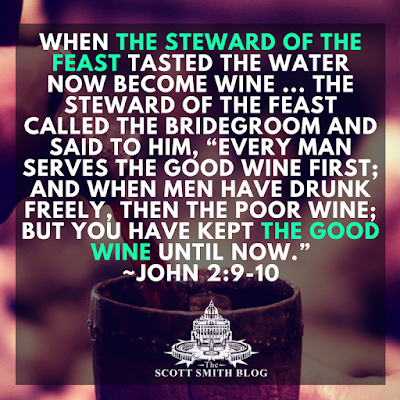 The Steward says, as seen above, "Every man serves the good wine first; and when men have drunk freely, then the poor wine; but you have kept the good wine until now." After the Steward of the Feast says this, something strange happens. What's the next line of the Gospel? 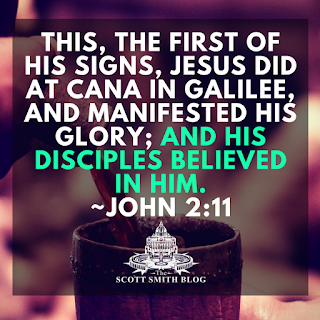 This may not appear strange. Jesus just turned water into wine - why wouldn't his disciples start believing in him, right? But why? There is more going on here than just water turning into wine. JESUS IS THE NEW MOSES First off, Jesus' miracle shows he is the New Moses. What was Moses' first "public" miracle? That is, what was the first of the plagues of Egypt?  The first plague of Egypt was the turning of the Nile into blood. It wasn't just the water of the Nile that Moses turned into blood, it was all the water in Egypt. Even the water in the stone jars, such as those at the Wedding at Cana! Jesus adds a twist to the turning of water into blood. He first turns it into wine, then blood. When does Jesus turn wine into blood, his blood? This might seem obvious. The Last Supper, right? Yes, but Jesus does this throughout his final celebration of the Passover. He also drinks wine on the Cross which, at his death, becomes the blood that pours forth from his side. This is one reason the disciples are struck by Jesus' actions. He is proving himself to be the New Moses. The Messiah was prophesied to be a prophet "like unto" Moses, and Jesus is doing just that. But there's more ... BUT THAT'S NOT ALL! JESUS ALSO FULFILLS ISAIAH'S PROPHESY At Isaiah 25, Isaiah prophesies about the coming Messiah. The Messiah will destroy death ("swallow up death for ever") and forgive sins (take away "the reproach of his people"). But how will the Messiah do this? What will the Messiah use to do this? 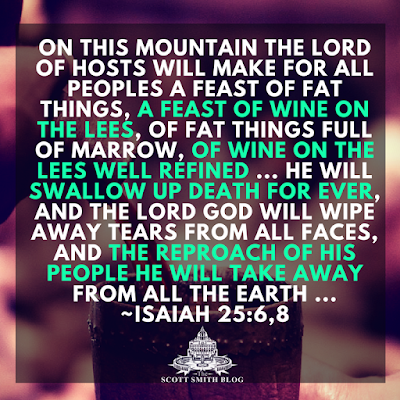 Note: This is from the Revised Standard Version Catholic Edition (RSV-CE) translation. With WINE! The Messiah will do this with a feast of wine! But not just any wine ... The finest and most refined of wines. It will be a feast of "wine on the lees." Isaiah prophesies that the Lord will deliver His people from oppression with a "a feast of fat things, a feast of wine on the lees, of fat things full of marrow, of wine on the lees well refined." Basically, God promises the best of the best of the best wine. Jesus delivers on that promise at the Wedding at Cana. This is the meaning of the steward's words! This is why the disciples are so moved. They were well aware of Isaiah's prophesy. Of course, Jesus will out-do himself at the Last Supper and on the Cross when he gives us his own blood as this wine. What better wine could there be, than wine which is God, Himself? That's no mere symbol! BUT WHAT ARE "LEES"? WINEMAKING SIDENOTE Are you still wondering what "lees" are? Lees are bits of yeast from grape skins that settle at the bottom of a wine vat. There's a bit of extra taste to be gained from aging wine "sur lie" or "on the lees" with the lees settling at the bottom of the wine vat. The lees are then filtered out of the "choice wine" thus created. 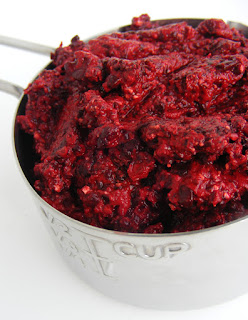 Lees from red wine Interestingly, the lees are bits of dead yeast - isn't it interesting that death will flavor this new wine, when it is Christ's death which ultimately provides the new wine? And what did Isaiah say? The Messiah "will swallow up death forever" with this wine. You see ... every detail of Scripture is important! APOLOGETIC NOTE: NON-ALCOHOLIC WINE? IS THE BIBLE AGAINST DRINKING ALCOHOL? It should be noted: many Protestants are anti-alcohol and attempt to interpret the wine used in the Bible as unfermented wine, i.e. non-alcoholic grape juice. This isn't just false; it's crazy. For one, the lees were involved in producing the alcohol in the wine. What are they doing there if the wine isn't alcoholic? The alcohol in wine is produced through the process of fermentation. Yeast is the agent of fermentation. The lees are bits of fermented yeast and the grape skins the yeast grew on. Clearly, this is fermented grape juice - and not just that, extra-fermented. The lees were kept in to get that last bit of flavor and fermentation. Jesus can't be against the drinking of alcoholic wine if he just made the wedding party, who had already been drinking for days, six full stone jars of wine - that's about 600 hundred more bottles of wine! LAST POINT: SO WHY DOES THE STEWARD TALK ABOUT SAVING THE "GOOD WINE" UNTIL THE LAST? This is a reference to the wine of the Old Covenant versus the wine of the New Covenant. This tells us about God's plan of salvation. The greatest of all comes, not at the beginning, but at the end. The greatest of all is Jesus, not the prophets and patriarchs who preceded him. It is Jesus' own wine, his own blood, which is the "good wine" that is saved for last.  |
|
|
Jul 31 2018, 12:40 PM
|
|
Junior Member
225 posts Joined: Mar 2008
|
 |
|
|
Aug 2 2018, 06:19 PM
|
|
Senior Member
3,576 posts Joined: Apr 2006
|
Modernism as a Thought Crime
Plato said that God is thought thinking thought. As Father Leonard Feeney wrote, this is about as close as a philosopher can get to the knowledge of the Holy Trinity with his unaided intellect, and it is a loose approximation at best, for the Trinity is unknowable without the benefit of revelation. But Plato’s insight is remarkable, for God is the primordial Intellect, the uncreated Mind, without Whom there could be no knowledge, no thought. As man was created to God’s image and likeness, he is capable of knowledge and of thought, even of that highly systematized thought we call “science.” But our knowing faculty was created for something much greater still, and that is the knowledge of the Triune God that we have thanks to the excellent knowledge of Jesus Christ Our Lord. That knowledge, begun by Faith in this life — where it is also perfected by the gifts of understanding and knowledge — terminates in the Beatific Vision in Heaven. The knowledge that we have by Faith is both divine and human. Brother Francis puts it this way: The body of Catholic doctrine is something both divine and human, and as such is a faithful image of the God-Man. As divine, it rests on the highest authority. As human, it is adapted to our manner and employs all our powers; it is preserved largely by human methods and is defended by human weapons. The idea that the Faith is both divine and human like Jesus Christ Himself is not an orignal one, but it is a subject of meditation that promises much fruit. The Second Person of the Divine Trinity is the one Word uttered by the Father, His perfect and adequate self-expression. When He was clothed in our flesh He showed us in a human way how to be divine, becoming both the exemplar and the efficient cause of that human divinization we know to be divine adoption by grace. While remaining God’s internal and eternal Word, He became at the moment of the Incarnation that Word translated into human utterance. And that Word taught: “In these days [God] hath spoken to us by his Son” (Heb. 1:2). And the words of the Word (the verba verbi) are true, with a divine guarantee. Hence the blasphemy of the Modernist notions of dogma. Pope Saint Pius X distilled Modernism to three essential parts: (1) a philosophical agnosticism that denies man’s ability to know reality as it is; (2) belief in a “vital immanence” whereby man has an innate religious sense that is a highly subjective, intuitive, and aprioristic notion of God and moral truth; this more fundamental religious knowledge finds its expression in the “secondary formulas” we call doctrines, but such doctrines are not perfect expressions of the vital immanence; and (3) a radical evolution of dogma. To learn more of this, and how Modernism is dependent on the philosophy of Kant, the liberal Protestant “baptism” of Kant by Schleiermacher, and the evolutionism of Hegel, please see What did St. Pius X mean when he called Modernism “the synthesis of all heresies”? Needless to say, these heretical notions are still with us, albeit in an attenuated and nuanced form. Implicit in the Modernist heresy is the older error of indifferentism. Since religious doctrines are mere approximations of what is immanent in me, all religions are more-or-less true and more-or-less false. Whichever one most closely approximates my own subjective religious sense becomes “my truth.” Sound familiar? “You have your truth, I have mine” is the vulgar popularization of this heresy, and it shocks us that some folks can actually say it with a straight face. Thus, man is free to believe whatever religion he wants, another essentially liberal error, and one condemned earlier by Blessed Pope Pius IX. No, man is free to accept and profess only the true religion, and in so doing, he becomes truly free. “You shall know the truth, and the truth shall make you free” (John 8:32), said Truth Incarnate. The first hearers of that divine utterance were offended by the implication that they were not free since they were the sons of Abraham and had never been slaves to any man. Our Lord gave them this rejoinder: “whosoever committeth sin, is the servant of sin … [but] If therefore the son shall make you free, you shall be free indeed,” and He invited them to believe in Him (for Faith in Him is necessary for this freedom!), but they preferred to take up stones to stone Him, showing just how enslaved they were at that moment. Perhaps some of them converted later, I do not know. The whole fascinating exchange is found in John 8. Having prayed for His Apostles in the Garden, just before His agony and arrest, Jesus commissioned them to preach His truth after the Resurrection: And Jesus coming, spoke to them, saying: All power is given to me in heaven and in earth. Going therefore, teach ye all nations; baptizing them in the name of the Father, and of the Son, and of the Holy Ghost. Teaching them to observe all things whatsoever I have commanded you: and behold I am with you all days, even to the consummation of the world. (Matt. 28:18-20) Note that, in giving these mere creatures of His their teaching mission, Our Lord invokes His own power. This should indicate to us just how reliable is the transmission of Christian truth from that day to this. But for the Biblical Modernist, even this promise is not reliable. What, then, is? Nothing, except perhaps this sad man’s innate sense of religion, for which no doctrinal formulae are adequate. Oh, but he is so cocksure of his conclusions in the domain of Biblical Science! Hypocrite! Our Catholic dogmatic formulae are reliable because the Infallible Magisterium of the Catholic Church is the beneficiary of that promise to the Apostles of “all power” given to the Man-God, which no doubt includes the promise of the Holy Ghost. The Catholic Church is, after all, Christ’s own Mystical Body, and the Holy Ghost is the soul of that Body. Living as we are in a day when scandal piles atop of scandal, so that the faithful are barraged with examples of crass moral filth by the upper echelons of the sacred hierarchy, we must hold fast to these truths and live accordingly. For, it is in questioning Catholic Faith and Morals, and jettisoning tradition, that the clergy begin to become perverts. After all, their sacred vocation is founded on these very things. Let us strive, then, to become saints, loving and living Catholic tradition, and God will surely bless the Church with priests after His own Sacred Heart. In the Immaculate Heart of Mary, Brother André Marie, M.I.C.M. |
|
|
Aug 7 2018, 12:47 PM
|
|
Senior Member
3,576 posts Joined: Apr 2006
|
Catholic at Last: From Eastern Orthodox to the One True Faith
Stefanie Nicholas  When I was invited to write this piece for OnePeterFive, Steve Skojec wanted to know why I was becoming Catholic now. After all, I was obviously a conservative. An outspoken counter-jihad activist. A vehement defender of the existence of only two sexes. Hardly the sort of person with a high tolerance for the progressivism and relativism embedded within so much of the modern Catholic culture. On top of that, I was baptized Greek Orthodox. I was catechized Greek Orthodox. Four hundred-plus-year-old liturgy or bust! I come from an incense-scented Byzantine world that would be horrified to see what passes for liturgy in so much of our aching, suffering, post-Vatican II (I find Belloc’s “knavish imbecility” comments somewhat comforting in such times) Holy Mother Church. Why did I make my way to Catholicism instead of reverting to my Orthodox roots? I left Orthodoxy and ran off for years to act (in varying degrees) like a pagan, a Buddhist, a Muslim, an atheist, a Protestant, a Jew. Yet for all the running I did from Orthodoxy, I never could quite outrun orthodoxy. I never lost the certainty in my heart that the Truth, one truth that was right and all others wrong, must be out there, and that if I looked for it long enough, I would find it. Instead, I found sin, confusion, and a life that brought me much pain. The Truth, fortunately, found me. Anyone who knows my personality at all would think I must have “read my way” into Catholicism. Many recent converts I have seen – particularly former Protestants who share my penchant for study – have taken that path across the Tiber. But this was not the road to Rome in my case, to my astonishment. Catholicism was the one faith I had never considered, intellectually or otherwise. If anyone had told me even seven months ago that I would be converting to Catholicism soon – let alone dedicating so much of my life to learning and talking about the faith! – I would have looked at him as if he had just informed me that Muhammad was actually a women’s rights activist. My journey to Catholicism will be a constant reminder in my heart that I myself am nothing – anything I achieve and any gifts I posses in order to do so belong entirely to the Lord. The simplest explanation for my conversion? God showed me people – broken, sinning, imperfect people – who embodied 1 Peter 3:15, people who had a hope in them that ripped the scales from my eyes despite me. I had to know the reason for why I gazed upon them and felt a stirring in my soul – a memory and a promise of new birth, all at once. In other words? They possessed the light of Christ, and I knew I had to seek what they reflected. I walked by my parish a hundred times and never thought I’d be walking in there for the first time around the start of Lent, realizing I was home, realizing I was crying, and having no explanation for why I was there at all except that God had told me to show up. My son was baptized and I was received into the Church on March 31, 2018, at the stunning Easter Vigil Mass. I will cherish that day for the rest of my life. My life today holds a joy that I have never experienced before – even as by the standards of the world it has become more difficult since my conversion. I live at all times as part of one universal Church, and it is the wild expanse of the Summa Theologiae, the history of the saints, the depth of theological speculation, the history, the art, the music. Everything, for the Church has touched the world in every sphere. The Church is space to let my indefatigable curiosity roam for what seems like forever. And yet, it is also beautiful constraint. Sometimes, the Church is simply my Father’s house. My parish, very modern, very Novus Ordo, is not where I would choose to attend but clearly where the Lord wants me in this season of my life. This is my Father’s house, where I try to be respectful, where sometimes my two-year-old makes too much noise and I’m reminded to ask Mary to help me mother better, where sometimes I kneel quietly in deep prayer and sometimes I feel as if my amazing little boy and I are a detriment to everyone’s peace, but where always I receive the simple ordinary “anything” that is made everything by the power of God: the Bread that is Life. I am a Catholic because the Catholic Church is Christianity as spoken of in the Acts of the Apostles. Not some weak, hazy concept of Christianity like what so many cling to today, but something tangible and solid and unwavering. Even when, at times, it seems hard to know where exactly to hold on in this difficult age of the Church, I trust in the same Savior who brought me home to keep my soul safe. I see the pain of so many Catholics today, people who have kept this treasure alive long enough for me to find it at the eleventh hour. Long enough for me to show up and think I could possibly make a difference, could possibly hold a place of useful service within the Church Militant. I see a longing toward the Eastern Orthodox, with their reverence and their indifference to the concerns of Protestants and modernists on liturgical matters, among other things. I am profoundly thankful for being made Orthodox from the cradle. It made my journey to Rome so very gentle and quick compared to many converts, for in many ways, I feel more like a revert due to the closeness of our faiths. For me, guitars at Mass was always bizarre. I could sense the crisis within the Church from day one, and as much as it has made me a little more hawk-eyed than many a convert, I’m thankful for my ability to see easily why reverence matters to zeal. I love our Orthodox brothers and sisters – most of all, my father, whose prayers, along with those of my now deceased Yiayia and Papou, almost certainly availed much in saving my soul. I love the Orthodox – so I study the Great Schism that I live every day in miniature with care, to be ready to defend Rome whenever called upon in my day-to-day life. Someday, I pray that our separated brethren will flock to us in droves, and it would be an immeasurable joy to my heart to be used by the Spirit to help even one come home. St. Ignatius of Antioch had this to say. It spoke to me. Make no mistake, my brothers, if anyone joins a schismatic he will not inherit God’s Kingdom. If anyone walks in the way of heresy, he is out of sympathy with the Passion. Be careful, then, to observe a single Eucharist. For there is one flesh of our Lord, Jesus Christ, and one cup of his blood that makes us one, and one altar, just as there is one bishop along with the presbytery and the deacons, my fellow slaves. In that way whatever you do is in line with God’s will. The Orthodox have much to teach us about liturgy and tradition. However, they are still obligated (even by their own idea of the papal “primacy of honor”) to be in communion with the See of Peter, the Rock. Without this, they can never be the true Church. A house divided cannot stand. The Orthodox rejection of doctrinal development is precisely why they have directly changed doctrine. I do not, and cannot, worship God within a body that chooses to change His commandments. The Orthodox have changed in doctrine. This is simply a fact of history. Their most blatant change is, ironically enough, the one thing I feared most when I was called home: the orthodox, Catholic teaching on divorce and “remarriage.” I realized that if I became Catholic and could not get a declaration of nullity, I would have to spend the rest of my life as a single mother – no small thing to consider at 26 years old. In Orthodoxy, divorce and remarriage falls within the realm of “oikonomia” (household economy). In practice, the Orthodox today believe that bishops have the authority to bless their flock to act in a way that is contradictory to the direct words of Christ and call it pastoral care. This seems particularly stunning in light of the common modern Orthodox claim that they do not require the visible universal head of the pope, for Christ alone is their Head, and yet they can’t even seem to obey Him when His words are at their most plain. What God has stitched together, let no man separate. Be that one man and one woman – or one Christ and one Bride. I also found the Catholic teaching on birth control, the fact that we are the single Christian institution on this Earth which continues to regard contraception as intrinsically evil, incredibly convicting compared to yet another case of Orthodox “oikonomia.” Orthodoxy is, in a sense, the easy way out of the morass we find ourselves in as Catholics in a post-Catholic world. It’s a church with a more elastic ecclesiology, where we don’t have to place our trust and obedience at the feet of a chair that so many times in our history was filled by a corrupt and broken man. (Now, in many ways, I see that things are much worse.) It’s tempting. It really, truly is. And yet, Proverbs 3:5-6 echoes in my head often. “Trust in the Lord with all your heart, and do not lean on your own understanding. In all your ways acknowledge him, and he will make straight your paths.” The more I deepen my study of Catholic and Orthodox ecclesiology – and particularly the Four Marks of the Church – the more I am certain that I am in the steadfast ship that will carry me home from my exile. And yet, study is not the main reason for this trust I feel. It’s something beyond that. It’s a supernatural certainty unlike anything I’ve ever experienced. The kind of internal anchoring of joy that I rarely can explain without having to simply say “trust me” – a frightening thing when I am talking to non-Catholics about the fate of their souls. For who am I that anyone should trust my words? However, despite my total unworthiness of your trust, I hope you will trust God working in me and pray for me that my life will be worthy of being called a good example. Pray for me that my faith will encourage Catholics looking east to hold fast in the storm. The Lord has done great things for me, and holy is His Name. The greatest thing the Lord has given me is an unshakable feeling of assurance that I am in the One True Church – though feeling is not even the right word. This is a knowing. It’s the kind of knowing I’ve experienced only one time before my conversion – when I gave birth to my son and I knew that motherhood is the greatest miracle on Earth, except perhaps the Eucharist. I had to be Catholic – the one Church on the entire planet that has held fast to the commands of our Savior, in dogma if not always in adherence. As human and broken as our current holy father may be, he sits on the same Seat of Saint Peter that has kept the universal Church from heresy since the time of Christ and the Apostles. The pinnacle of our faith is the Eucharist – one Eucharist. I have to believe that what I see in the Church today is not an end of days, but the beginning of a new age. It is an age of chastisement, perhaps, and certainly an age where we witness the Passion of the Church herself, but an age where it is exciting to be a Catholic. It is an age of new birth, with all the birthing pains expected. If we fight our continuing battle against the principalities and powers by first taking up our spiritual arms, we will not fail. Our enemy is not even the most evil people within or outside Holy Mother Church. Our enemy is Satan. I know it’s clichéd to say these things. I know you’re tired. I’m tired, too. But this is a conversion we must all pray for – to remember in our hearts, in all we do and say, that we have a promise that no other Church on this planet has nor ever will have. A promise that has never – in 2,000 years – been broken. Christ does not lie, and the Holy Spirit will not allow for anything that would make Christ a liar. All I know is that for the first time in my life, I gave my little fiat – and God moved mountains for me. What more will he do for the tide of faithful believers rising in the Church today? Never limit Him. We’ve already won. |
|
|
Aug 7 2018, 04:45 PM
|

Junior Member
350 posts Joined: Sep 2008 From: tyrsflgiugiug
|
QUOTE(desmond2020 @ Jul 23 2018, 02:55 PM) so according to science, what is darkness? absence of light. |
|
|
Aug 7 2018, 04:46 PM
|
|
Junior Member
350 posts Joined: Sep 2008 From: tyrsflgiugiug
|
QUOTE(khool @ Jul 31 2018, 12:40 PM) |
|
|
Aug 7 2018, 04:47 PM
|
|
Junior Member
350 posts Joined: Sep 2008 From: tyrsflgiugiug
|
QUOTE(judehow @ Jul 24 2018, 06:38 PM) May I know what kinda prays for healing? Mass and Charismatic healing session |
| Change to: |  0.0225sec 0.0225sec
 0.53 0.53
 6 queries 6 queries
 GZIP Disabled GZIP Disabled
Time is now: 5th December 2025 - 09:35 AM |
 Quote
Quote