https://www.investors.com/how-to-invest/inv...ow-volume-sell/Even the best stocks eventually start to waver and break down. It's a law of the market. So, recognizing those signals is crucial in learning how to invest with consistent success.
Don't focus simply on buying. Learn how to keep your hard-earned gains in a hot stock and sell at the right time.
Indeed, mastering IBD's more than two dozen sell rules will help you succeed over the long term in the stock market.
Some of those signs are as obvious as a hammer to the head, like a gap down on earnings.
When To Sell Stocks: Watch For Weak ReboundsOthers are more subtle, like a low-volume rebound after a sharp break. Normally, multiple sell signals coincide, giving investors both upside and downside reasons to sell a stock and lock in profits.
Let's take a look at Ambarella (AMBA) in the summer of 2015. The system-on-a-chip designer made a big move due to its relationship with GoPro (GPRO). GoPro, the hyped camera-on-a-stick maker, went public at a 24 IPO price and quickly ran up to 98.47. But that lofty valuation was quickly shattered. At one point, GoPro plummeted to an all-time low of 4.42 in April 2018, 95% off that all-time high.
Ambarella broke out above a 33.91 buy point in a cup with handle on Aug. 29, 2014 (please see a historical chart at MarketSmith). From there, the stock did a solid job of maintaining its 10-week line — a key support level.
The week ended Feb. 13, 2015, saw the stock close significantly below its 10-week line for the first time since the breakout. But volume was just slightly above average. When you see a severe break below the 10-week line in volume that jumps 40% above average, it's time to sell.
Three months later, the stock went into a climax top, allowing investors to lock in a big gain, while the stock was still advancing.
On June 22, shares plunged nearly 21% (1) to 94.36 in huge turnover. Short-seller firm Citron Research published a report calling its stock appreciation "ridiculous."
Investors couldn't be blamed for selling some shares that day given it was the stock's biggest one-day point break since the start of the move — a defense-type sell signal.
Low-Volume Rebound After Sharp BreakOver the next month, the stock would slowly rebound back to new highs.
The price action was positive, but volume was clearly telling a different tale.Only one day, July 23, showed a significant increase in volume vs. the 50-day average (2), but it was a stalling action. That day, shares rallied as much as 5.5% to hit a new high at 129.19, but closed with a meek 0.4% gain. Institutions anxiously unloaded their positions.
For Ambarella holders, this lack of volume on the rebound was a clear sign that institutions were no longer interested in buying large quantities of shares at higher price levels.
Two months later, the stock was cut in half.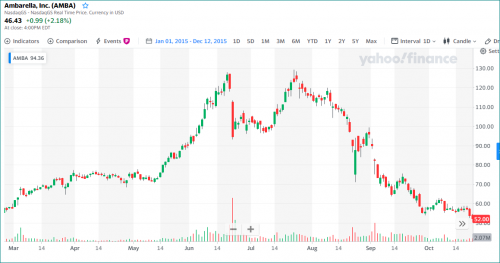


 Aug 12 2020, 05:10 PM


 Quote
Quote








 0.0345sec
 0.37
0.37
 6 queries
 GZIP Disabled