QUOTE(chrisoys @ May 3 2007, 10:17 AM)
Don't really know how to use

I think Nikon can do the same thing also
Teaching on Old Dog New tricks
Text Copyright and Photography Copyright Arthur Morris(C)On a crisp fall afternoon, dozens of Sanderlings scurried frenetically in search of sand fleas and other tasty invertebrates that live in the wet sand along the deserted beach at the very edge of the Atlantic Ocean at Stone Harbor Point, New Jersey. Occasionally, they would stop for a few seconds to preen or simply to stare at the crashing waves.
I was seated (with a wet butt) behind my Gitzo 1548 Carbon Fiber tripod, working with the Canon EF 600mm f/4.0L super-telephoto lens and a Canon EOS 3 camera body. The EF 1.4X teleconverter yielded the 840mm-f/5.6 combination that is my everyday bird photography rig. Before I came to realize the many benefits of Custom Function 4 (CF4), available on all mid-range and high-end Canon EOS camera bodies, I would have faced the following dilemma: Should I work in AI Servo mode so that I could easily track the moving birds, or switch to One-Shot mode so that I could focus on a momentarily still Sanderling, recompose, and make the image?
By opting to utilize Custom Function 4, I had the best of both worlds. When activated, CF 4 transfers autofocus operation from the shutter button to the exposure lock button, the left of the two small buttons on the top right of the camera back. With autofocus set to AI Servo mode (for moving subjects), I simply activated autofocus with my right thumb to track a running or a foraging bird, or tapped the button once to focus on the eye of a stationary bird. In the latter instance, I would quickly recompose and make the image by fully depressing the shutter button. I was able to enjoy the benefits of both AI Servo AF and One-Shot AF without having to toggle back and forth (by pressing the AF button and turning the main dial). In addition, when photographing static subjects, I did not have to keep the shutter button depressed halfway as is customary when working in One-Shot AF mode.
When a Royal Tern flew by, it was a simple matter to frame the shot and activate AI Servo autofocus with my right thumb. To boot, I was able to pre-focus manually before engaging AF. This allows the photographer to drastically reduce the time of initial focus acquisition, and is especially helpful when attempting to do flight photography with the 600mm-lens/2X teleconverter combination. (Focus manually until the bird is relatively sharp, then engage AF by depressing the exposure lock button; thus, the system does not have to struggle to "see" the subject.)
Referring to the use of Custom Function 4 in "The Art of Bird Photography; The Complete Guide to Professional Field Techniques," I wrote, " Many photographers rave about this function, but I do not." And in public lectures and seminars I expressed disdain for CF 4 by stating that those attempting to use it would surely wind up on a psychiatristâeuro(tm)s couch. (I felt that they would become extremely confused when attempting to activate AF--is it the shutter button, or is it the exposure lock button? Is it the index finger, or is it the thumb?) But oh, how wrong I was. Today, when photographing perched birds or those on the ground, I activate CF-4 so that I am always ready to make either static portraits or images of the birds in motion.
For in-flight only photography situations, such as those that often arise at Bosque Del Apache NWR, Socorro, NM, or at the Venice Rookery, South Venice, FL, I find it easiest to set CF 4 to the default setting (0) so that autofocus is activated in the traditional manner, by depressing the shutter button halfway. Additionally, I am often afield with a big telephoto lens and one of Canonâeuro(tm)s lightweight, hand-holdable flight lenses, either the EF 300mm f/4 L IS, the EF 100-400mm f/4.5-5.6L IS, or the "toy lens,âeuro the EF 400mm f/5.6L. (FYI, the latter is still the worldâeuro(tm)s best for photographing birds in flight.) When I carry one of these lenses on a shoulder strap, mounted on a lightweight EOS A2 camera body, I always set CF 4 to the default setting, as these lenses are used almost exclusively to photograph birds in flight or in action. Thus, I simply depress the shutter button to activate AF. The body on my big tripod mounted super-telephoto is, however, set with CF-4 activated, as this lens is used primarily to make portraits of birds at rest. In reality, I do not have any problem switching between shutter button AF activation and exposure lock button AF activation as the shooting situation demands. And, I have not, as I once predicted--needed to undergo psychotherapy.
Though the owners of the newest Canon Super Telephoto Image Stabilizer Lenses have full time manual focus available, (hey--the folks at Canon Japan sometimes do read my product critiques!), they will still benefit from activating CF 4 when photographing perched or standing birds. They will then--as described previously--have the option of working in either AI Servo AF, or, effectively, in One-Shot AF, without having to keep the shutter button depressed halfway. To attain One-shot AF while utilizing CF 4, simply tap the exposure lock button to focus on the birdâeuro(tm)s eye, then release the button, recompose, and shoot. As I said, the best of both worlds.
With EOS A2, Elan II, and 1N bodies, activate Custom Function 4 by toggling from CF 4-0 to CF 4-1. EOS 3 users may wish to note that there are two ways to activate CF-4, either by choosing CF 4-1, or CF 4-3. The former locks the exposure when the shutter button is depressed halfway after focus has been set, the latter yields real time exposure. I almost always choose the latter so that I need not keep the shutter button depressed to hold the exposure when photographing static subjects.
To Chuck Westfall, Canon technical representative, who has suggested for years that I give CF 4 a try, I say, "You were right. I was wrong, big time wrong. I wish I that I had listened to you sooner." I guess that you can teach an old dog new tricks.



 Jan 20 2007, 01:27 PM, updated 19y ago


 Quote
Quote








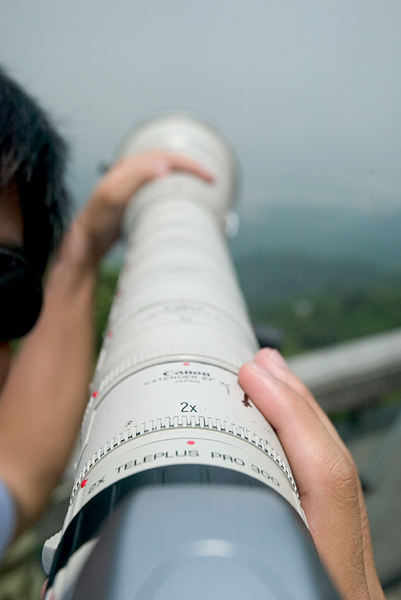


 I'm going to a jungle soon...


 no hard feelings about the joke yea!













 I thought should be quite wan


 ..400D and 350D price differnt Rm400 only...




 Can i ask a question??? ISO use for what??? higher ISO is better right???
 0.1661sec
 0.31
0.31
 6 queries
 GZIP Disabled