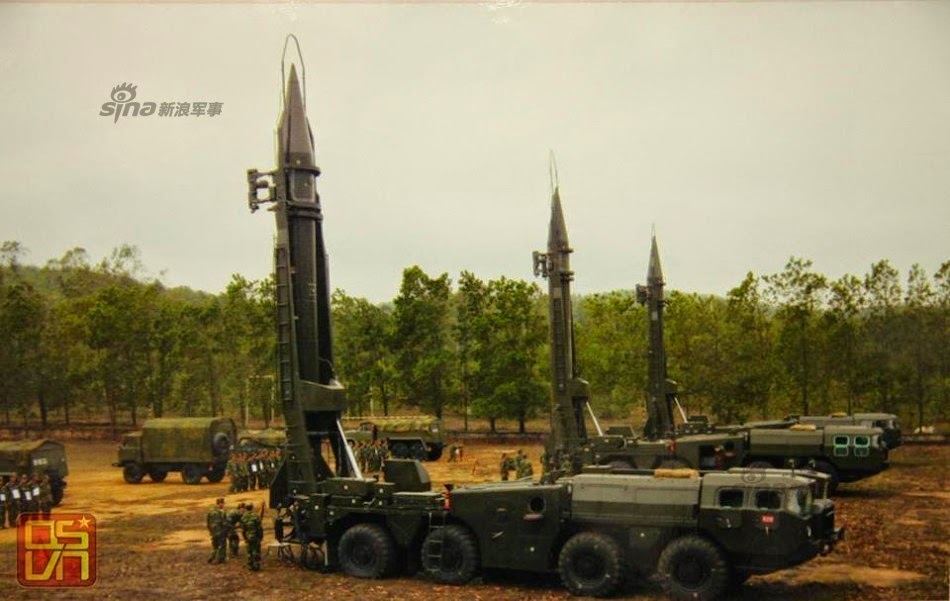
R-17 VTO (NATO: SS-1e Scud-D) Tactical ballistic missile Vietnamese army missile technicians service a Scud-D missile
The R-17 VTO (SS-1e Scud-D) project was an attempt to enhance the accuracy of the original R-11 Scud and R-17 Scud-B missiles. The Central Scientific Research Institute for Automation and Hydraulics (TsNIAAG) in Moscow began work on the project in 1968, but the first test launch was conducted only in September 1979. Development continued through the 1980s until the system was accepted into initial service as the 9K720 Aerofon in 1989.
However, by this time, more advanced weapons were already in use, such as the OTR-21 Tochka (SS-21 Scarab) and the R-400 Oka (SS-23 Spider), and the Scud-D was not acquired by the Soviet armed forces. Instead it was proposed for export as an upgrade for Scud-B users, in the 1990s.
Unlike previous Scud versions, the 9K720 had a warhead that separated from the missile's body, which increased its ballistic properties and terminal velocity. This made it theoretically much more difficult to intercept even with anti-ballistic missiles as the detached spent rocket body (which would disintegrate on reentry) can also act as a basic decoy for the smaller warhead.
Much more importantly,the missile was fitted with its own terminal guidance computer system, which made it much more accurate than its predecessor's inertial guidance systems. Combined with a TV camera fitted in the nose, the system uses a terrain-mapping computer that could compare the target area with data from an onboard digital library. In this way, it was claimed the missile is able to attain a Circular Error Probability (CEP) of less than 50 m.
Other improvements from its predecessors was an improved thrust-vectoring rocket engine and fuel system which used a semi-liquid gelled kerosene and nitric acid fuel/oxidizer mixture which increased the missile's range by almost 500 km. The use of nitric acid as an oxidizer also meant the missile fueling procedure is simplified, as the nitric acid is stable enough to be storable inside the missile itself unlike the more volatile liquid oxygen, which need to be fueled only prior to launch together with the rocket fuel. This dramatically cut the countdown protocol and the missile readiness to launch is reduced to only 30 minutes, compared to more than 90 minutes for the original Scud missile.
The Scud-D can be equipped either with a 5 to 80kt nuclear warhead, a thickened VX chemical agent warhead, a 2,000lbs convential HE warhead, a HE-FRAG warhead or a cluster munition dispenser. Only a few countries have upgraded their Scud arsenals to the Scud-D standard, among them Algeria, Armenia and Vietnam.
This post has been edited by MilitaryMadness: Jun 11 2015, 01:00 PM 

 Military Thread V17
  Jun 10 2015, 12:38 AM


 Quote
Quote














 0.0310sec
 0.56
0.56
 6 queries
 GZIP Disabled