

QUOTE(prophetjul @ Dec 25 2015, 11:04 PM)
Kindly answer. Can't be looking for posts posted a while back

Should be in the first page, go and look at it rather than have me repeatedly post the same thing over and over again.LYN Catholic Fellowship V01 (Group), For Catholics (Roman or Eastern)
|
|
 Dec 26 2015, 08:30 PM Dec 26 2015, 08:30 PM
|
 
Senior Member
3,576 posts Joined: Apr 2006  
|
QUOTE(prophetjul @ Dec 25 2015, 11:04 PM) Kindly answer. Can't be looking for posts posted a while back Should be in the first page, go and look at it rather than have me repeatedly post the same thing over and over again. |
|
|
|
|
|
Dec 26 2015, 08:35 PM
|
|
Senior Member
3,576 posts Joined: Apr 2006
|
QUOTE(prophetjul @ Dec 26 2015, 08:12 AM) Pope Francis assures atheists: You don’t have to believe in God to go to heaven Take those quotes from secular media with a pinch of salt and read the whole context of what he actually said. Enough to say that even if the Pope said those things, as long as it is not compatible with infallible teaching of the Church, the Pope can be wrong. Again we have touched on the topic of papal infallibility in the earlier pages.In comments likely to enhance his progressive reputation, Pope Francis has written a long, open letter to the founder of La Repubblica newspaper, Eugenio Scalfari, stating that non-believers would be forgiven by God if they followed their consciences. Responding to a list of questions published in the paper by Mr Scalfari, who is not a Roman Catholic, Francis wrote: “You ask me if the God of the Christians forgives those who don’t believe and who don’t seek the faith. I start by saying – and this is the fundamental thing – that God’s mercy has no limits if you go to him with a sincere and contrite heart. The issue for those who do not believe in God is to obey their conscience. “Sin, even for those who have no faith, exists when people disobey their conscience.” Robert Mickens, the Vatican correspondent for the Catholic journal The Tablet, said the pontiff’s comments were further evidence of his attempts to shake off the Catholic Church’s fusty image, reinforced by his extremely conservative predecessor Benedict XVI. “Francis is a still a conservative,” said Mr Mickens. “But what this is all about is him seeking to have a more meaningful dialogue with the world.” In a welcoming response to the letter, Mr Scalfari said the Pope’s comments were “further evidence of his ability and desire to overcome barriers in dialogue with all”. In July, Francis signalled a more progressive attitude on sexuality, asking: “If someone is gay and is looking for the Lord, who am I to judge him?” http://www.independent.co.uk/news/world/eu...en-8810062.html Jesus said: "I am the way, the Truth and the Life. No one goes to the father but through me" - John 14:6 16 For God so loved the world, that he gave his only begotten Son, that whosoever believeth in him should not perish , but have everlasting life. 17 For God sent not his Son into the world to condemn the world; but that the world through him might be saved . 18 He that believeth on him is not condemned : but he that believeth not is condemned already, because he hath not believed in the name of the only begotten Son of God. 19 And this is the condemnation, that light is come into the world, and men loved darkness rather than light, because their deeds were evil. - John 3 |
|
|
Dec 27 2015, 10:54 PM
|

Junior Member
110 posts Joined: Sep 2012
|
Jesus said: "I am the way, the Truth and the Life. No one goes to the father but through me" - John 14:6 16 For God so loved the world, that he gave his only begotten Son, that whosoever believeth in him should not perish , but have everlasting life. 17 For God sent not his Son into the world to condemn the world; but that the world through him might be saved . 18 He that believeth on him is not condemned : but he that believeth not is condemned already, because he hath not believed in the name of the only begotten Son of God. 19 And this is the condemnation, that light is come into the world, and men loved darkness rather than light, because their deeds were evil. - John 3 [/quote] Well quoted, Prophetjul! It is indeed an essential requisite for all who know Jesus to believe in Him. I guess that is why learning and teaching about Jesus and evangelization is so important. One will have to first have to have heard of Him, then know Him. And know Him correctly before believing in Him. However this raises a concern that whole swathes of people and communities will be automatically be disqualified from any chance of salvation for despite the best of Evangelical efforts, it would be impossible to all people to have heard of Him, let alone know Him, then to know Him correctly and then to believe in Him. This may include some of the following: - - Very rural communities with no access to outside information - uneducated folk - those living in areas where religion or Christianity is banned? - people who have understood wrong depictions or misinterpretations of Jesus? - babies? What, in your opinion, will God do to these people, Prophetjul? |
|
|
Dec 30 2015, 01:03 PM
|

Junior Member
225 posts Joined: Mar 2008
|
The Contemporary Denial of Reality
Anthony Esolen Prudence, writes Josef Pieper in The Christian View of Man, is the root of all the natural virtues, and there is an obvious reason why. It is the virtue of seeing reality as it is. There can be no true virtue without it, because the virtues are to be exercised among imperfect human beings, not among angels or demons or brutes, and in the world before us, not in a never-land of the fantasies or nightmares of ideology. It may be that all of the mad errors of the last hundred years have risen from one first and terrible error: that of refusing to honor reality, including human reality, as it is. In generations past, if you did not honor reality, you paid for it swiftly and severely. Try to plant strawberries in a desert, or fig trees in a swamp, and your belly will tell you that you have been a fool, even if your mind is stubborn and slow to admit it. Send your women out with the oxen and the plow, the cross-cut saw and the mattock, while your boys do the laundry and the mending, and the very stones will testify to your stupidity. But our wealth and sophisticated technology are a great buffer between us and those stones. We can seem to ourselves, for a while, to get away with ignoring the real. Not that we actually do get away with it. Ideologies treat man as if he could be pressed into any shape, like molten plastic poured into a form. Stalin tried his hand at the human extruding machine, ignoring the ordinary farmer’s love for the land to which he and his forebears had given their sweat and their souls. The result was to turn one of the great breadbaskets of the world, the Ukraine, into barrens, while six million people died—not before some of them had sunk below the beast and eaten their own dead. Mao tried his hand at the human extruding machine, ignoring the ordinary man’s piety towards his ancestors and their ways, and the result was a mass destruction of culture, and sixty million people dead. These are flagrant sinners against God and the reality he made. But the murderer of only one man is a murderer all the same, and more pleasant or vacuous sinners against reality are still sinners and still work harm. In the aggregate they can destroy every bit as much as Stalin and Mao did. Abortion of course is one obvious example of a refusal to look at reality. The child-making act has as its natural and foreseeable end the making of a child. We do know this, just as we know that men should revere their parents and grandparents, and that people who have lived on a tract of land for a hundred years love it and will tend it more carefully than a cadre of bureaucrats could ever imagine. We simply pretend that we do not know it. We pretend that when a man and a woman do the child-making thing, and they make a child, it can strike them as an utter surprise, a bolt from the blue. If you are walking beside a row of high-rise row houses, and you are struck by a piano falling from a great height, that is a surprise, that is an unnerving accident. Not the other. But, having stiffed the real and embraced a fantasy, here the ideology of sexual liberation, having played at being husband and wife without being husband and wife, we claim all at once to be Surprised by Baby, Dismayed by Baby, Utterly Undone by Baby, and, hence, we want Baby out of the way. To have it out of the way, we have to plunge ourselves even deeper into the unreal. We have to pretend that the baby is not human, when we know, of course, that it is, and that it is not alive, when we know that if it were dead, it would be called a miscarriage, and no moral problem would arise. We have to cleave our minds in half to have our lives of license whole. So it is that Planned Parenthood, which has never helped any woman to become a parent, sells as human body parts the members of the human beings they have killed under the fiction that they were not human at all, calling it “medical care” when nothing is remediated. So also the Pill, destructive of the common good and (like all synthetic growth hormones) deleterious to the health of the women who use it, is called “medical care,” when no disease is cured, and no limb or organ is restored to its normal and natural function; rather, its purpose is to thwart the natural function of the reproductive system, even at the cost of the woman’s health. It is thus not like an inoculation to protect you against a communicable disease. It is like deliberately putting a joint out of socket. Lest that comparison seem outrageous, we now witness people who cannot live with the reality of their own bodies, but must have a limb amputated; they cannot be happy with two arms or two legs, but will only feel really fulfilled when they must stump around on a prosthesis, or have people wheel them about on a chair. Others, unhappy with the face God made them—an ordinary human face—must make of themselves another, not with cosmetics, but with what might be called chaotics, boring large holes into the cheek, implanting fiberglass cat whiskers under the nose, studding their jaws with rows of metal teeth, and so forth. Leo really is a lion, you see. A man who is weary of the reality of being a man and a father can become a woman and a small child merely by pretending to be so, and dressing accordingly, perhaps taking advantage of the nipping and tucking of plastic surgery. A woman who is weary with the reality of being a woman can become a man by having a doctor pin the tail on the donkey. A lonely boy can become a girl—presto!—by mere insistence, and everyone has to play along. People who live atop the citadel of reality can shake their heads and smile at their opponents. They have reality under their feet and round about them and over their heads. Reality is fresh air, bracing and healthy. People who live in the dream world of ideology can never smile at their opponents. One ironical jest is a dire threat. That is because they have built their house on something slighter than sand—airy nothing. Stalin could not bear reality, and so when Russian soldiers returned home, after seeing too much of the West with their own eyes, they had to be sent to the gulags. When I was an undergraduate at Princeton, one of my classmates delivered flyers to the doors of the dormitories, featuring too much reality—the reality of torn-apart or salt-burned babies. Had it been possible, the undergraduates would have sent him to the gulags too. If you are a professor at most of our Institutions of Higher Dreaming, and you say, “Not all the pretending in the world can actually make a man into a woman,” you are exposing yourself to gunshot. Even our nation’s judges, who ought to know something about prudence, have entered the dance, and now insist that justice itself requires us to repudiate what is real, and ratify the fantastical notion that a man can mate with another man, despite the obvious facts of physiology, and despite the manifest harm that the Sexual Nutcracker Suite has already done to marriage and the common good. Woe to the nation governed by a lie. Jesus, says Saint John, did not put too much trust in men, because he knew what was in their hearts. Jesus is the ultimate realist. He knows all of our evasions. You say, “We must divorce, because,” and you give a reason that will pass muster for Rabbi Hillel or Rabbi Shammai. Jesus is not buying. You say, “I am self-sufficient, because my granaries are full, and my annuities are making me fifteen percent a year,” but Jesus says that you are a fool, and that your life will be required of you tonight. You say, “I am right with God, because I give so much of my living to the poor,” but Jesus says that your right hand and your left hand are gabbling proudly to one another all the time. You say that the people must be protected, but Jesus knows that you want the truth-teller out of the way. You say that you are looking for signs, but signs are all around you and you refuse to see them. You say that you love the poor, but you sure do manage to keep them out of your sight and smell. You say that you are following the specter of Vatican II, which you cannot possibly identify, but you ignore the documents of the council fathers, which are right in front of your eyes. You say that you love the Church, but it is a Church of your dreams, and not the one here and now, the one you despise and want cleared out, to prepare the way for the Dictatorship of the Laity—a dictatorship inevitably managed by people like yourselves. You say that you are all for love, and you turn a cold shoulder to young people who want to do what is right, to marry and to have children after the ordinary way of nature. You even say that you love Jesus, but you have riddled the gospels with escape-holes, so that Jesus himself is not the man who said what he said and did what he did, but a Dream-Jesus, a specter, a Jesus of the subjunctive mood, who would say and do this or that, contradicting what he actually did say and do when he walked the earth, if he were alive now. Thus is Jesus demoted from Master to a protagonist in a fiction; and you are his author. Unreal, unreal. In some ways, it is easier to swing your sword at a monster of flesh and blood than at a monster of the imagination. The monster of flesh and blood provides real resistance to nerve your arms. The monster of the imagination doesn’t. It is now here, now there, now this, now that, flickering in and out of existence, like the incoherent course of a dream. But we must do what we must do. And maybe the best way to fight the unreal is also the sweetest and most restorative way—to take joy in the real. Real men, real women, real children; real intercourse of the sexes; real worship, real penitence, real gratitude; real care for the poor; real acknowledgment of the teachings of Jesus, real embrace of the Holy Scriptures; real cherishing of the permanent things; real song, real poetry, real beauty; real honor of the Mother of God; real falling down in adoration of the Son of God, who was really born as an infant boy, in the real village of Bethlehem, two thousand years ago. Source: http://www.crisismagazine.com/2015/the-con...nial-of-reality |
|
|
Dec 31 2015, 12:37 PM
|
|
Senior Member
3,576 posts Joined: Apr 2006
|
15 Beware of false prophets, who come to you in the clothing of sheep, but inwardly they are ravening wolves.
16 By their fruits you shall know them. Do men gather grapes of thorns, or figs of thistles? 17 Even so every good tree bringeth forth good fruit, and the evil tree bringeth forth evil fruit. 18 A good tree cannot bring forth evil fruit, neither can an evil tree bring forth good fruit. 19 Every tree that bringeth not forth good fruit, shall be cut down, and shall be cast into the fire. 20 Wherefore by their fruits you shall know them. Matthew 7:15-20 |
|
|
Dec 31 2015, 01:53 PM
|
|
Junior Member
225 posts Joined: Mar 2008
|
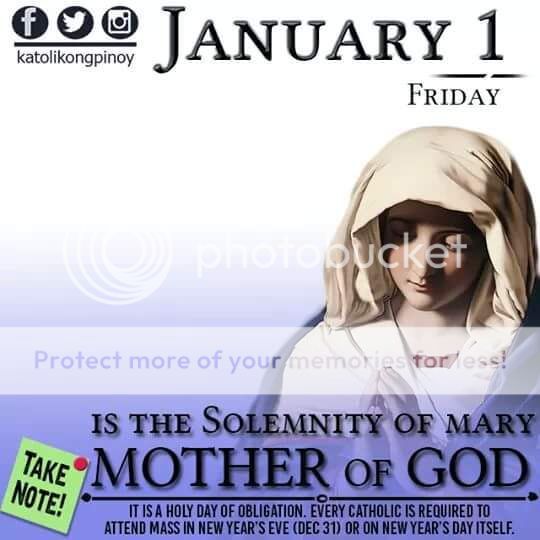
Tomorrow is a feast day, but not a day of obligation. Unless you happen to live in the American continent!
  |
|
|
|
|
|
Dec 31 2015, 10:31 PM
|
|
Senior Member
3,576 posts Joined: Apr 2006
|
QUOTE(khool @ Dec 31 2015, 01:53 PM) Tomorrow is a feast day, but not a day of obligation. Unless you happen to live in the American continent! That poster from the Philippines, right? Yeah it is a day of obligation in the Philippines too. This post has been edited by yeeck: Dec 31 2015, 10:31 PM |
|
|
Dec 31 2015, 11:41 PM
|
|
Senior Member
3,576 posts Joined: Apr 2006
|
Today, 31 December, you can gain a plenary indulgence by reciting the Te Deum. A plenary indulgence is gained for reciting the Te Deum on the last day of the year. On other days of the year, the indulgence is partial. You can recite it in Latin or the vernacular.
Tomorrow, 1 January, you can gain a plenary indulgence by reciting the prayer Veni, Creator Spiritus. On other days, the indulgence is partial. All plenary indulgences apply under the usual conditions, i.e. Confession, Holy Communion, prayers for the Pope's intentions. We praise thee, O God : we acknowledge thee to be the Lord. All the earth doth worship thee : the Father everlasting. To thee all Angels cry aloud : the Heavens, and all the Powers therein. To thee Cherubim and Seraphim : continually do cry, Holy, Holy, Holy : Lord God of Sabaoth; Heaven and earth are full of the Majesty of thy glory. The glorious company of the Apostles : praise thee. The goodly fellowship of the Prophets : praise thee. The noble army of Martyrs : praise thee. The holy Church throughout all the world : doth acknowledge thee The Father : of an infinite Majesty; Thine honourable, true : and only Son; Also the Holy Ghost : the Comforter. Thou art the King of Glory : O Christ. Thou art the everlasting Son : of the Father. When thou tookest upon thee to deliver man: thou didst not abhor the Virgin's womb. When thou hadst overcome the sharpness of death : thou didst open the Kingdom of Heaven to all believers. Thou sittest at the right hand of God : in the glory of the Father. We believe that thou shalt come : to be our Judge. We therefore pray thee, help thy servants : whom thou hast redeemed with thy precious blood. Make them to be numbered with thy Saints : in glory everlasting. [added later, mainly from Psalm verses:] O Lord, save thy people :and bless thine heritage. Govern them : and lift them up for ever. Day by day : we magnify thee; And we worship thy Name : ever world without end. Vouchsafe, O Lord : to keep us this day without sin. O Lord, have mercy upon us : have mercy upon us. O Lord, let thy mercy lighten upon us :as our trust is in thee. O Lord, in thee have I trusted : let me never be confounded. 1. Come, Holy Spirit, Creator blest, and in our souls take up Thy rest; come with Thy grace and heavenly aid to fill the hearts which Thou has made. 2. O Comforter, to Thee we cry, O heavenly gift of God Most High, O fount of life and fire of love, and sweet anointing from above. 3. Thou in Thy sevenfold gifts are known; Thou, finger of God's hand we own; Thou, promise of the Father, Thou Who dost the tongue with power imbue. 4. Kindle our sense from above, and make our hearts overflow with love; with patience firm and virtue high the weakness of our flesh supply. 5. Far from us drive the foe we dread, and grant us Thy peace instead; so shall we not, with Thee for guide, turn from the path of life aside. 6. Oh, may Thy grace on us bestow the Father and the Son to know; and Thee, through endless times confessed, of both the eternal Spirit blest. 7. Now to the Father and the Son, Who rose from death, be glory given, with Thou, O Holy Comforter, henceforth by all in earth and heaven. Amen. This post has been edited by yeeck: Dec 31 2015, 11:41 PM |
|
|
Dec 31 2015, 11:50 PM
|
|
Senior Member
3,576 posts Joined: Apr 2006
|
The Day the Church Altered Time
By Matthew E. Bunson 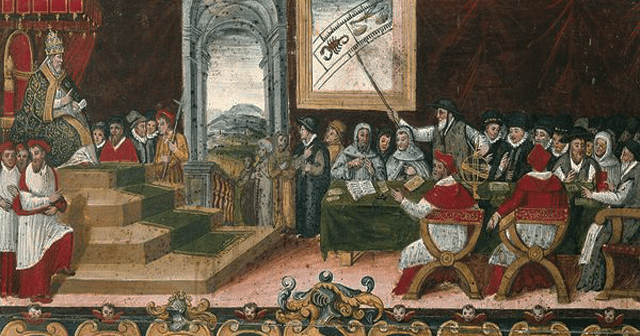 On the night of October 4, 1582, the citizens of Spain and its colonies, Portugal, Poland, and most of Italy went to bed and woke up 10 days later. The peculiar event was not some medieval miracle but was, in fact, an effort by the Church to bring about a badly needed change to time. Having decreed months before that a reform of the calendar was essential for the good of Western civilization, Pope Gregory XIII (r. 1572–1585) implemented a new calendar on the night of October 4. The next day, part of the massive fix of the Julian calendar, was not counted as October 5 but October 15, 1582. The calendar reform proved one of the most important and impressive accomplishments for the progress of Europe in the whole of the Renaissance. For critics of the Church, the 16th century is a seeming treasury of embarrassments for Catholics—from the so-called “bad popes,” to the Inquisition, to the Protestant Reformation. But the crown jewel for criticism, of course, is Galileo and his supposed persecution by an obscurantist, tyrannical, and unenlightened papacy. Lost in much of the rhetoric surrounding Galileo, however, was the immense accomplishment of Pope Gregory XIII in bringing desperately needed changes to the calendar. The problem has always been the fact that a year cannot contain neatly organized days or months. Put simply, the interval between successive vernal equinoxes (every 365.2424 days) is approximately 11 minutes less than 365 1/4 days. At the same time, the synodic period of the moon (i.e., the time between each full moon or new moon) is around 29 1/2 days, so that 12 months add up to only about 354 days. A calendar that incorporates both the movements of the sun and moon thus becomes quite a challenge, and people of many civilizations have certainly given it their best shot. Ancients’ Days The most influential, not to mention widely adopted, effort to solve the dilemma was the Julian calendar, introduced by Julius Caesar in 45 B.C. to replace the longstanding Roman calendar that had grown hopelessly inaccurate by the use of the lunar year and the intercalary month. His idea, with a little help from Sosigenes, an Alexandrine astronomer, was to create a solar calendar with months of fixed lengths. Rather than try to introduce a gentle change, Caesar instituted what became called the “year of confusion” by adding 90 days to the year to realign the months of the Roman calendar with the seasons. The first Julian year commenced with January 1, 46 B.C. and the 708th year from the foundation of the city. The result was that the average length of the Julian calendar year was 365.25 days. To account as best it could for the subtle but important deviations in the passage of time, every fourth year included an intercalary day to maintain synchrony between the calendar year and the tropical year. Caesar organized the first, third, fifth, seventh, ninth, and eleventh months (i.e., January, March, May, July, September, and November) to have 31 days, and the other months 30, excepting February, which in common years should have only 29 days, but every fourth year 30 days. To keep himself even with his illustrious predecessor, Emperor Augustus added an extra day to August to have as many days as July—which had been named after the first Caesar. So, a day was taken from February and given to August; to prevent three months straight of 31 days, September and November were reduced to 30 days, and October and December were assigned 31. The additional day every fourth year was added to February, the shortest month. In modern calendars, of course, the intercalary day is still added to February, but as the 29th. Time Shifts The Julian calendar remained in use throughout the entire history of the Roman Empire. The Church naturally adopted it in the development of the liturgical calendar. Easter was placed on the first Sunday after the first full moon after the vernal (spring) equinox. Obviously, then, the calculation of the equinox assumed considerable and understandable importance. If the equinox was wrong, then Easter was celebrated on the wrong day and the placement of most of the other observances—such as the starts of Lent and Pentecost—would also be in error. As the Julian calendar was far from perfect, errors did indeed begin to creep into the keeping of time. Because of the inherent imprecision of the calendar, the calculated year was too long by 11 minutes and 14 seconds. The problem only grew worse with each passing year as the equinox slipped backwards one full day on the calendar every 130 years. For example, at the time of its introduction, the Julian calendar placed the equinox on March 25. By the time of the Council of Nicea in 325, the equinox had fallen back to March 21. By 1500, the equinox had shifted by 10 days. The 10 days were of increasing importance also to navigation and agriculture, causing severe problems for sailors, merchants, and farmers whose livelihood depended upon precise measurements of time and the seasons. At the same time, throughout the Middle Ages, the use of the Julian calendar brought with it many local variations and peculiarities that are the constant source of frustration to historians. For example, many medieval ecclesiastical records, financial transactions, and the counting of dates from the feast days of saints did not adhere to the standard Julian calendar but reflected local adjustments. Not surprisingly, confusion was the result. The Church Saves Time The Church was aware of the inaccuracy, and by the end of the 15th century there was widespread agreement among Church leaders that not celebrating Easter on the right day—the most important and most solemn event on the calendar—was a scandal. Pope Sixtus IV (r. 1471-1484) made the first effort to reform the calendar, hiring the astronomer Johann Müller who, unfortunately, was murdered soon after. As the work of other astronomers could not gain universal acceptance owing to problems of competing national interests and varying opinions, the Church remained the best chance of promulgating a definitive solution to a growing crisis. Pope St. Pius V introduced a new breviary in 1568 and missal in 1570 in keeping with the mandate of the Council of Trent, and both of the new texts included adjustments to the lunar tables and the leap-year system. The problem of Easter, however remained, as did the basic difficulties with the Julian calendar. In 1563, the Council of Trent had approved a plan in principle to restore the date of the vernal equinox to that of 325 and to install the needed changes to the calendar to make the calculation of Easter more accurate. Italian astronomer and doctor Luigi Lilius proposed a solution in his ambitious work Compendium novae rationis restituendi kalendarium (Compendium of the New Plan for the Restoration of the Calendar). He suggested a slow, 10-day correction to amend the temporal drift since Nicaea and a more careful application of the leap day. Lilius died in 1576, but his brother presented his theories to the one person who could something about them—the pope. Cardinal Ugo Buoncompagni had been elected Pope Gregory XIII on May 13, 1572 as successor to Pope Pius, and he was determined to fix things once and for all. Happily receiving the manuscript, the pope appointed a commission to investigate solutions. He placed at its head a Jesuit mathematician and astronomer named Christoph Clavius. The basic ideas of Lilius were adopted, but Clavius preferred that any correction should take place in one sweeping move rather than a gradual implementation. The commission’s recommendations were then presented to the pope and were promulgated by the pontiff in the papal bull Inter Gravissimus, signed on February 24, 1582. Like Julius Caesar before him, the pope agreed that small adjustments were no longer viable. Instead, he decreed that Clavius’ approach should be followed: 10 days would be removed from the calendar. So October 4 was followed by October 15. With one act, the vernal equinox of 1583 and those that followed would occur around March 20, a date much closer to that of the Council of Nicaea. To overcome the challenge of losing one day every 130 years, the new calendar omitted three leap years every 400 years, so that century years were leap years only when divisible by 400. Using this method, 1600 and 2000 were leap years but 1700, 1800 and 1900 were not. Technically, the pope could not decree that nations and kingdoms adopt the new calendar, but its value was noted immediately in repairing centuries of inaccuracy on the part of the Julian calendar. The new calendar was first inaugurated in Spain, Portugal, Spanish colonies in the New World, the Polish-Lithuanian Commonwealth, and most of Italy. The Holy Roman Empire followed, and then the rest of the Catholic world. France deployed the new calendar in December 1582. Stuck in the Past Had the reform occurred a century before, of course, it would have been much easier to implement across all of what was then a united Christendom. As it was, in a post-Reformation Europe, the new computations were greeted with suspicion in the lands that were no longer Catholic. Protestant Germany adopted the calendar slowly. Prussia accepted it in 1610, while the rest of the Protestant states decreed it only in 1700. The English, especially during the reign of Queen Elizabeth I (r. 1558-1603), rejected any thought of adopting a calendar created under the name of a pope and remained long suspicious that this was some Catholic plot. Consequently, even as anti-Catholic bigots in the English Isles lampooned the popes as enemies of progress, they were 10 days behind everyone else in Western Europe for over 150 years. And after the leap year of 1700, they were 11 days behind. The English compounded the dating dilemma further by celebrating New Year not on January 1 but according to the older custom of March 25 to April 1. As the American colonies adhered to the English system, they shared in the temporal displacement. Americans now celebrate the birth of George Washington on February 22, 1732, according to the Gregorian calendar. However, according to the English reckoning, he was born on February 11, 1731-32. The people who continued celebrating New Year’s Day between March 25 and April 1 were lampooned as “Fools” giving us the origins of April Fool’s Day on April 1. Acknowledging at last that the continued use of the Julian calendar and celebrating New Year on March 25 were “attended with divers inconveniences,” the British Parliament passed the Calendar (New Style) Act in 1750. The New Year would begin on January 1 rather than March 25 and time would be counted according to the Gregorian calendar. The act went into effect on September 2, 1752, and the next day was decreed as September 14, 1752. Russia and the Eastern Orthodox Churches rejected the new calendar and continued to use the Julian calendar in their calculations for Easter. The Gregorian calendar was accepted as the civic calendar in Russia only after the Russian Revolution in 1917. The Eastern Orthodox continue to use a revised Julian calendar, with the exception of the Finnish Orthodox Church, which adopted the Gregorian calendar. The Gregorian calendar is the most widely used calendar in the world today and has fulfilled well the.aspirations of Pope Gregory XIII. And so, the same Church that was supposedly the obstacle to progress and science gave to the world a reliable means of counting the days that has withstood the test of time itself. Article source: http://www.catholic.com/magazine/articles/...ch-altered-time This post has been edited by yeeck: Dec 31 2015, 11:51 PM |
|
|
Jan 1 2016, 02:55 PM
|
|
Senior Member
3,576 posts Joined: Apr 2006
|
Titus 2:11-15
Beloved: The grace of God our Saviour hath appeared to all men: Instructing us, that, denying ungodliness and worldly desires, we should live soberly and justly and godly in this world, looking for the blessed hope and coming of the glory of the great God and our Saviour Jesus Christ. Who gave himself for us, that he might redeem us from all iniquity and might cleanse to himself a people acceptable, a pursuer of good works. These things speak and exhort and rebuke with all authority. Let no man despise thee. |
|
|
Jan 1 2016, 03:02 PM
|
|
Senior Member
3,576 posts Joined: Apr 2006
|
“Do not look forward to what may happen tomorrow. The same Everlasting Father, who takes care of you today, will take care of you tomorrow. He will either shield you from suffering, or give you unfailing strength to bear it. Be at peace then, and put aside all anxious thoughts and imaginations.”
--Saint Francis de Sales |
|
|
Jan 2 2016, 02:00 PM
|
|
Junior Member
225 posts Joined: Mar 2008
|
QUOTE(yeeck @ Dec 31 2015, 10:31 PM) That poster from the Philippines, right? Yeah it is a day of obligation in the Philippines too. Oh yes, from an FB friend of mine who is Filipino. I went for Mass on 1st Jan anyways. Enjoyed it!  |
|
|
Jan 4 2016, 05:41 PM
|
|
Junior Member
225 posts Joined: Mar 2008
|
The Only Person Ever Pre-Announced
ARCHBISHOP FULTON J. SHEEN To each claimant that he is a messenger sent from God, reason says, "What record was there before you were born that you were coming?"  History is full of men who have claimed that they came from God, or that they were gods, or that they bore messages from God — Buddha, Mohammed, Confucius, Christ, Lao-tze, and thousands of others, right down to the person who founded a new religion this very day. Each of them has a right to be heard and considered. But as a yardstick external to and outside of whatever is to be measured is needed, so there must be some permanent tests available to all men, all civilizations, and all ages, by which they can decide whether any one of these claimants, or all of them, are justified in their claims. These tests are of two kinds: reason and history. Reason, because everyone has it, even those without faith; history, because everyone lives in it and should know something about it. Reason dictates that if any one of these men actually came from God, the least thing that God could do to support His claim would be to pre-announce His coming. Automobile manufacturers tell their customers when to expect a new model. If God sent anyone from Himself, or if He came Himself with a vitally important message for all men, it would seem reasonable that He would first let men know when His messenger was coming, where He would be born, where He would live, the doctrine He would teach, the enemies He would make, the program He would adopt for the future, and the manner of His death. By the extent to which the messenger conformed with these announcements, one could judge the validity of his claims. Reason further assures us that if God did not do this, then there would be nothing to prevent any impostor from appearing in history and saying, "I come from God," or "An angel appeared to me in the desert and gave me this message." In such cases there would be no objective, historical way of testing the messenger. We would have only his word for it, and of course he could be wrong. If a visitor came from a foreign country to Washington and said he was a diplomat, the government would ask him for his passport and other documents testifying that he represented a certain government. His papers would have to antedate his coming. If such proofs of identity are asked from delegates of other countries, reason certainly ought to do so with messengers who claim to have come from God. To each claimant reason says, "What record was there before you were born that you were coming?" With this test one can evaluate the claimants. (And at this preliminary stage, Christ is no greater than the others.) Socrates had no one to foretell his birth. Buddha had no one to pre-announce him and his message or tell the day when he would sit under the tree. Confucius did not have the name of his mother and his birthplace recorded, nor were they given to men centuries before he arrived so that when he did come, men would know he was a messenger from God. But, with Christ it was different. Because of the Old Testament prophecies, His coming was not unexpected. There were no predictions about Buddha, Confucius, Lao-tze, Mohammed, or anyone else; but there were predictions about Christ. Others just came and said, "Here I am, believe me." They were, therefore, only men among men and not the Divine in the human. Christ alone stepped out of that line saying, "Search the writings of the Jewish people and the related history of the Babylonians, Persians, Greeks, and Romans." (For the moment, pagan writings and even the Old Testament may be regarded only as historical documents, not as inspired works.) It is true that the prophecies of the Old Testament can be best understood in the light of their fulfillment. The language of prophecy does not have the exactness of mathematics. Yet if one searches out the various Messianic currents in the Old Testament, and compares the resulting picture with the life and work of Christ, can one doubt that the ancient predictions point to Jesus and the kingdom which he established? God's promise to the patriarchs that through them all the nations of the earth would be blessed; the prediction that the tribe of Juda would be supreme among the other Hebrew tribes until the coming of Him Whom all nations would obey; the strange yet undeniable fact that in the Bible of the Alexandrian Jews, the Septuagint, one finds clearly predicted the virgin birth of the Messias; the prophecy of Isaias 53 about the patient sufferer, the Servant of the Lord, who will lay down his life as a guilt-offering for his people's offenses; the perspectives of the glorious, everlasting kingdom of the House of David — in whom but Christ have these prophecies found their fulfillment? From an historical point of view alone, here is uniqueness which sets Christ apart from all other founders of world religions. And once the fulfillment of these prophecies did historically take place in the person of Christ, not only did all prophecies cease in Israel, but there was discontinuance of sacrifices when the true Paschal Lamb was sacrificed. Turn to pagan testimony. Tacitus, speaking for the ancient Romans, says, "People were generally persuaded in the faith of the ancient prophecies, that the East was to prevail, and that from Judea was to come the Master and Ruler of the world." Suetonius, in his account of the life of Vespasian, recounts the Roman tradition thus, "It was an old and constant belief throughout the East, that by indubitably certain prophecies, the Jews were to attain the highest power." China had the same expectation; but because it was on the other side of the world, it believed that the great Wise Man would be born in the West. The Annals of the Celestial Empire contain the statement: In the 24th year of Tchao-Wang of the dynasty of the Tcheou, on the 8th day of the 4th moon, a light appeared in the Southwest which illumined the king's palace. The monarch, struck by its splendor, interrogated the sages. They showed him books in which this prodigy signified the appearance of the great Saint of the West whose religion was to be introduced into their country. The Greeks expected Him, for Aeschylus in his Prometheus six centuries before His coming, wrote, "Look not for any end, moreover, to this curse until God appears, to accept upon His Head the pangs of thy own sins vicarious." How did the Magi of the East know of His coming? Probably from the many prophecies circulated through the world by the Jews as well as through the prophecy made to the Gentiles by Daniel centuries before His birth. Cicero, after recounting the sayings of the ancient oracles and the Sibyls about a "King whom we must recognize to be saved," asked in expectation, "To what man and to what period of time do these predictions point?" The Fourth Eclogue of Virgil recounted the same ancient tradition and spoke of "a chaste woman, smiling on her infant boy, with whom the iron age would pass away." Suetonius quoted a contemporary author to the effect that the Romans were so fearful about a king who would rule the world that they ordered all children born that year to be killed — an order that was not fulfilled, except by Herod. Not only were the Jews expecting the birth of a Great King, a Wise Man and a Savior, but Plato and Socrates also spoke of the Logos and of the Universal Wise Man "yet to come." Confucius spoke of "the Saint" the Sibyls, of a "Universal King" the Greek dramatist, of a savior and redeemer to unloose man from the "primal eldest curse." All these were on the Gentile side of the expectation. What separates Christ from all men is that first He was expected; even the Gentiles had a longing for a deliverer, or redeemer. This fact alone distinguishes Him from all other religious leaders. A second distinguishing fact is that once He appeared, He struck history with such impact that He split it in two, dividing it into two periods: one before His coming, the other after it. Buddha did not do this, nor any of the great Indian philosophers. Even those who deny God must date their attacks upon Him, A.D. so and so, or so many years after His coming. A third fact separating Him from all the others is this: every other person who ever came into this world came into it to live. He came into it to die. Death was a stumbling block to Socrates — it interrupted his teaching. But to Christ, death was the goal and fulfillment of His life, the gold that He was seeking. Few of His words or actions are intelligible without reference to His Cross. He presented Himself as a Savior rather than merely as a Teacher. It meant nothing to teach men to be good unless He also gave them the power to be good, after rescuing them from the frustration of guilt. The story of every human life begins with birth and ends with death. In the Person of Christ, however, it was His death that was first and His life that was last. The scripture describes Him as "the Lamb slain as it were, from the beginning of the world." He was slain in intention by the first sin and rebellion against God. It was not so much that His birth cast a shadow on His life and thus led to His death; it was rather that the Cross was first, and cast its shadow back to His birth. His has been the only life in the world that was ever lived backward. As the flower in the crannied wall tells the poet of nature, and as the atom is the miniature of the solar system, so too, His birth tells the mystery of the gibbet. He went from the known to the known, from the reason of His coming manifested by His name "Jesus" or "Savior" to the fulfillment of His coming, namely, His death on the Cross. John gives us His eternal prehistory; Matthew, His temporal prehistory, by way of His genealogy. It is significant how much His temporal ancestry was connected with sinners and foreigners! These blots on the escutcheon of His human lineage suggest a pity for the sinful and for the strangers to the Covenant. Both these aspects of His compassion would later on be hurled against Him as accusations: "He is a friend of sinners" "He is a Samaritan." But the shadow of a stained past foretells His future love for the stained. Born of a woman, He was a man and could be one with all humanity; born of a Virgin, who was overshadowed by the Spirit and "full of grace," He would also be outside that current of sin which infected all men. Source: http://www.catholiceducation.org/en/contro...-announced.html |
|
|
|
|
|
Jan 4 2016, 09:53 PM
|
|
Senior Member
3,576 posts Joined: Apr 2006
|
|
|
|
Jan 4 2016, 10:05 PM
|
|
Junior Member
225 posts Joined: Mar 2008
|
QUOTE(yeeck @ Jan 4 2016, 09:53 PM) Was he indoors or outdoors when it occurred? |
|
|
Jan 5 2016, 01:36 AM
|
|
Senior Member
3,576 posts Joined: Apr 2006
|
QUOTE(khool @ Jan 4 2016, 10:05 PM) Was he indoors or outdoors when it occurred? Most probably outdoors. |
|
|
Jan 5 2016, 10:48 AM
|
|
Junior Member
225 posts Joined: Mar 2008
|
QUOTE(yeeck @ Jan 5 2016, 01:36 AM) Most probably outdoors. Yeah, most probably, but no mention made in the article. It would be quite a feat to be struck by lightning while indoors though. |
|
|
Jan 5 2016, 11:11 AM
|
|
Junior Member
225 posts Joined: Mar 2008
|
Nicholas of Cusa, a Medieval Man for Modern Times
Stephen Beale  He sought a better understanding of Islam. He pushed for reunion with the Greek Orthodox Church. He was an erstwhile Church reformer. And he was a scientist and mathematician. Nicholas of Cusa can sound very modern—modern, mind you, not in the technical sense of modernism, but in the very generic sense of someone who lives in modern times. But, for all that, Nicholas of Cusa was also the consummate medievalist. He was a canon lawyer and, despite his earlier conciliarism, become a fierce advocate of the papacy. Later in life, he ran the papal states as vicar for the pope. His homilies breathe out the distinctly rich air of medieval devotion. And Cusanus—his Latin name—could sound thoroughly Thomistic in his theological thought. In a life that spanned the first two thirds of the 1400s, Nicholas of Cusa bridged two eras. He was born in 1401, a little over a century after the last real crusade and less than a century after the death of Dante. He died in 1464, about half a century before the Protestant Reformation, which definitely shut the door on the Middle Ages. He lived in times of turbulence. The Black Death had ravaged Europe in the mid-1300s, triggering an economic, political, and spiritual crisis. Then the Hundred Years War gnawed away at the already frayed nerves of panic-stricken continent. The Church was a mess too. The Great Western Schism divided the Church from 1378 to 1418. At the height of the crisis, there were three men claiming to be pope. Even the saints were split. St. Catherine of Siena was for Urban, whose line of succession was eventually affirmed as the true one. But another great saint, St. Vincent Ferrer, sided with one of the antipopes, Clement. With the papacy—the institutional backbone of Europe since the fall of Rome—in total disarray, conciliarism, which wants the Church as governed by council rather than the pope, seized the continent like a fever. This was also the time of forerunners of the Protestant heretics like John Wycliffe and Jan Hus. Meanwhile, the great city of Constantinople fell to the Turks in 1453. With the end of the Byzantine Empire, the Greek Orthodox Church lost much of its power. Nicholas of Cusa lived through all this. He was, to quote a prominent nineteenth and early twentieth century American jurist, a man who ‘shared in the action and passion of his time.’ At the Council of Basel, beginning in 1431, he negotiated with the followers of Hus in an effort to keep them in the Catholic fold. He was part of a delegation that hashed out a short-lived reunion with the Greek Orthodox in 1439. And, at a time when reform seemed all the rage, he embraced true spiritual reform. He studied Latin, Greek, and Hebrew and knew the classics. He was a canon lawyer, theologian, administrator and also a scientists, mathematician, and philosopher. In other words, Nicholas of Cusa was very much a man of the Renaissance, which was blossoming during his lifetime as well. There was much turmoil and chaos in his time. But Nicholas of Cusa, like the Church he served, was not tossed about in the waves of change. He remained anchored in his deep faith and devotion to God. It’s evident in more than a dozen works of deep theology and philosophy, with titles like On the Hidden God and On Learned Ignorance. And that’s not counting his many homilies. His theology is strikingly creative—not just because of the new ideas that he put forth, but because these new ideas inhabited what was very much a traditional theological framework. For example, Nicholas spoke of Christ in new ways, calling Him the ‘maximum man’ and ‘Absolute Obedience’—terms that would have warmed the hearts of twentieth century theologians like Hans Urs von Balthasar and Karl Rahner. But he also remained thoroughly rooted in the classic theology of the Church, using phrases like ‘hypostatic union’ in talking about the two natures of Christ, whereas Balthasar and Rahner would try to move away from such terminology. Nicholas also blended mysticism and math in absolutely fascinating ways. For example, there is his concept of the coincidence of opposites. This is best illustrated through geometry. Let’s start with a straight line. We could do two things with this. We could stretch it out to infinity. Or we could connect the ends and create a circle. The line is infinite, the circle is finite. In fact, in math class back in school we learned the formulas for calculating the length of the circumference and the area of the circle. But we can’t do the same for the line. Because it stretches out to infinity, we can’t measure its length. And there is no fixed area encompassed by the line. So the line and the circle are opposites in the sense that one is infinite and the other is finite. But Nicholas of Cusa believed that it was possible for these two opposites to coincide. He said that it was possible to imagine a giant circle so large that its circumference would start to look like an infinitely long line. As improbable as this may seem, it can be illustrated from our everyday world. Earth is a circle in three dimensions—a sphere. But what do you see when you walk out to the beach? The curvature of the earth looks very much like a straight line—what we call the horizon. Nicholas called this meeting of the infinite and finite the coincidence of opposites. And it became a way he thought of God’s being. Nicholas of Cusa scholar Erich Meuthen explains it this way: “[God’s] infinity is more than the greatest; it is maximum and minimum at the same time. This is the highest possible form of knowing that we can attain, namely the analogous recognition of knowing that we do not know, and this lifts us beyond the boundary of the conceivable.” In our own time, some scientists, in uncovering the wonder of the natural world, have been led to search for the Wonder behind it all. A fine example of this is the 2004 book The Fire in the Equations: Science Religion and Search For God. Of course, Nicholas did not need math to bring Him to the faith—he already believed in God. But his use of math to better understand God seems very much modern. And these are but just two of many examples of the lively mingling of the medieval and modern the mind of Nicholas of Cusa. For Catholics today, Nicholas recommends himself as fresh voice of insight from the past. Ever wonder how a medieval Catholic would respond to the challenges of our time? Chances are you will find an answer in Nicholas. Of course, this is not to say that we could not find answers to what ails us in other great minds of the Middle Ages, like Aquinas, Bonaventure, and Dante. But, unlike them, Nicholas is distinctive in that he is seems to be asking the same questions that we are. What is the relationship of Christianity to other religions? What about between the Church and other professing Christians? What is the best way to reform the Church? Nicholas wrestled with these issues, much as we do today. Beyond that, his works are a treasure of creative yet thoroughly traditional theology and spiritual reflection that—outside a small circle of theologians and historians—is waiting to be discovered by the laity. That said, much of Nicholas’ writing is not necessarily easy going for layman and student alike. On the upside, most of his major works are readily accessible in English and are even available online for free. Some good starting points are listed below. His last series of sermons are here and here. The three books of his classic On Learned Ignorance are here, here, and here. On the Hidden God is here. On Seeking God is here. And The Vision of God is here. Also, his thoughts on Islam are here, here, and here and his reaction to the fall of Constantinople is here. Source: http://catholicexchange.com/nicholas-of-cu..._eid=6396f20ec0 |
|
|
Jan 6 2016, 12:46 AM
|
|
Senior Member
3,576 posts Joined: Apr 2006
|
Happy Feast of the Epiphany!
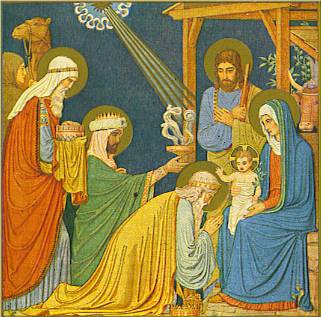 At today's Mass, there will be a blessing of gold, frankincense, myrrh, Epiphany Water, and, after Communion, a blessing of chalk. Bring small special items of gold to have with you during the Mass, and they will be blessed if they are exposed as you sit in your pew with them (wedding rings, rosaries, an heirloom piece of gold jewelry, for example). When Mass is over, you will take some of the blessed chalk, frankincense, myrrh, and Epiphany Water home with you, so it's good to bring a container to transport Holy Water and one to put some grains of incense and a piece of chalk into. When you get home, sprinkle some Epiphany water (otherwise and afterwards used as regular Holy Water) in the rooms of your house to protect it and bring blessings. This Holy Water recalls the waters of the Jordan, and is a visible reminder of Christ's Divinity, of Jesus's revealing Himself as God at His Baptism, when were heard the words from the Father: "This is My beloved Son, in Whom I am well pleased." This rite of blessing the home -- led by a priest, if possible, or the father of the house if no priest is available -- goes like this: Upon entering the house: Priest/Father: Peace be to this house. All: And to all who dwell herein. Priest: From the east came the Magi to Bethlehem to adore the Lord; and opening their treasures they offered precious gifts: gold for the great King, incense for the true God, and myrrh in symbol of His burial. During the Magnificat, the room is sprinkled with holy water and incensed. All: My soul doth magnify the Lord, and my spirit hath rejoiced in God my Savior. For He hath regarded the humility of His handmaiden. For behold, from henceforth all generations shall call me blessed. For He that is mighty hath done great things to me, and holy is His Name. And His Mercy is from generation unto generations upon them that fear Him. He hath shewed might in His arm, He hath scattered the proud in the conceit of their heart. He hath put down the mighty from their seat, and hath exalted the humble. He hath filled the hungry with good things, and the rich He hath sent empty away. He hath received Israel, His servant, being mindful of His mercy. As He spoke to our Fathers, Abraham and His seed forever. After this is completed: All: From the east came the Magi to Bethlehem to adore the Lord; and opening their treasures they offered precious gifts: gold for the great King, incense for the true God, and myrrh in symbol of His burial. Priest: Our Father Who art in Heaven, hallowed be Thy Name. Thy Kingdom come, Thy will be done on earth as it is in Heaven. Give us this day our daily bread, and forgive us our trespasses as we forgive those who trespass against us. And lead and lead us not into temptation, All: But deliver us from evil. Priest: All they from Saba shall come All: Bringing gold and frankincense. Priest: O Lord, hear my prayer. All: And let my cry come unto Thee. Priest: Let us pray. O God, who by the guidance of a star didst on this day manifest Thine only-begotten Son to the Gentiles, mercifully grant that we who know Thee by faith may also attain the vision of Thy glorious majesty. Through Christ our Lord. All: Amen. Priest: Be enlightened, be enlightened, O Jerusalem, for thy light is come, and the glory of the Lord is risen upon thee-- Jesus Christ born of the Virgin Mary. All: And the Gentiles shall walk in thy light and kings in the splendor of thy rising, and the glory of the Lord has risen upon thee. Priest: Let us pray. Bless, O Lord God almighty, this home, that in it there may be health, purity, the strength of victory, humility, goodness and mercy, the fulfillment of Thy law, the thanksgiving to God the Father and to the Son and to the Holy Spirit. And may this blessing remain upon this home and upon all who dwell herein. Through Christ our Lord. All: Amen. After the prayers of the blessing are recited, walk through the house and bless each room by sprinkling with Epiphany water and incensing it. Take the blessed chalk and first write the initials of the three Wise Men, connected with Crosses, over the inside of your front door (on the lintel, if possible). Then write the year, breaking up the numbers and the year so that they fall on both sides of the initials. It should look like this, for ex.: 20 + C+M+B + 16 with the "20 "being the millennium and century, the "C" standing for the first Wise Man, Caspar, the "M" standing for Melchior, the "B" standing for Balthasar, and the "16" standing for the decade and year. It is also popularly believed that the Kings' initials also stand for "Christus mansionem benedicat" ("Christ bless this house"). |
|
|
Jan 6 2016, 01:15 AM
|
|
Senior Member
3,576 posts Joined: Apr 2006
|
Should we “keep all the Jewish customs and Mosaic Laws”?
The very fact that Catholics should ask such question shows that modern catechism is not taught properly! Now you need to know that the Church teaches that in the Old Testament laws, there are three kinds: The moral laws (e.g. the Ten Commandments), which are not only all in force in the New Testament, but even raised to a higher requirement of holiness: re-read the whole chapter 5 of St Matthew (very beautiful!); The ceremonial laws: dealing with the “sacraments” of the Old Testament, such as circumcision, ritual sacrifices in the Temple of Jerusalem, washings, culinary laws (no pork…): these laws has a FIGURATIVE value (e.g. circumcision signifies baptism; all the Sacrifices of the Old Testament signify the perfect Sacrifice of our Lord Jesus Christ on the Cross, culinary laws signify spiritual purity…); these laws are explicitly terminated once they are replaced by the New Sacraments, the Sacraments of the New Law, of the New Testament. Many passages of the New Testament itself are explicit on this: see for instance: “Behold, I Paul tell you, that if you be circumcised, Christ shall profit you nothing” (Gal. 5:2). Or concerning eating pork…: “There is nothing from without a man that entering into him, can defile him. But the things which come from a man, those are they that defile a man” (Mk. 7:15). “For every creature of God is good, and nothing to be rejected that is received with thanksgiving:” (1 Tim. 4:4). The third kind of laws is the judiciary laws, i.e. laws enacting penalties for crimes. They keep an indicative value of what is a crime and the gravity thereof: for instance laws imposing the penalty of death for crimes are indication that these are mortal sins (e.g. idolatry, adultery, blasphemy, homosexual acts…) It does not mean that the same penalty should be inflicted in the new testament (this is clear in the case of the woman taken in adultery in John 8:4…), yet it does indicate that it is a very grievous sin. Mercy does require penance and a true conversion: “go and SIN NO MORE!” |
|
Topic ClosedOptions
|
| Change to: |  0.0368sec 0.0368sec
 0.44 0.44
 6 queries 6 queries
 GZIP Disabled GZIP Disabled
Time is now: 4th December 2025 - 10:06 AM |
 Quote
Quote