

Just curious any catholic from Penang island here?
LYN Catholic Fellowship V01 (Group), For Catholics (Roman or Eastern)
LYN Catholic Fellowship V01 (Group), For Catholics (Roman or Eastern)
|
|
 Jul 31 2015, 05:26 PM Jul 31 2015, 05:26 PM
|
 
Junior Member
8 posts Joined: Jan 2015 
|
Just curious any catholic from Penang island here?
|
|
|
|
|
|
Jul 31 2015, 05:33 PM
|

Senior Member
3,573 posts Joined: Apr 2006 
|
QUOTE(jiansheng12 @ Jul 31 2015, 05:26 PM) Just curious any catholic from Penang island here? I know of many from IC Pulau Tikus. Which parish? This post has been edited by yeeck: Jul 31 2015, 05:34 PM |
|
|
Aug 1 2015, 12:53 PM
Show posts by this member only | IPv6 | Post
#523
|

Junior Member
225 posts Joined: Mar 2008
|
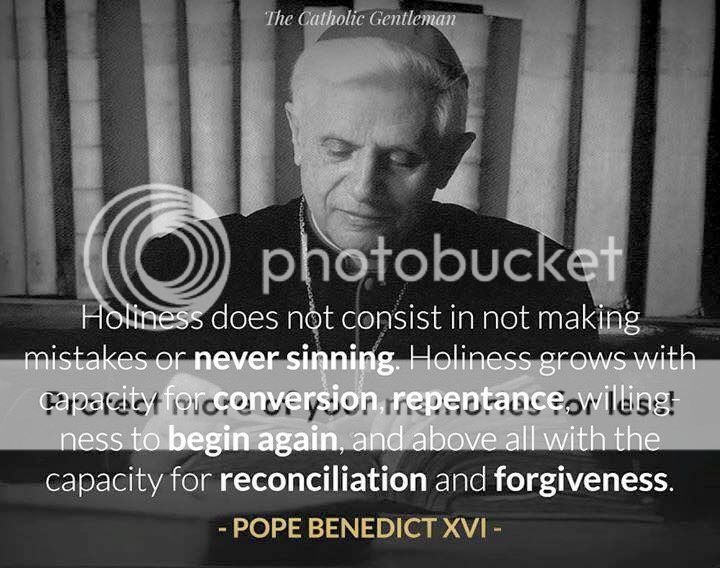
Amen!
 |
|
|
Aug 1 2015, 03:32 PM
Show posts by this member only | IPv6 | Post
#524
|

Junior Member
145 posts Joined: Jan 2008
|
QUOTE(khool @ Aug 1 2015, 12:53 PM) Amen! Holiness, an attribute of God's nature, is by definition what separates God from everything else. God alone is holy (Rev. 15:4). Thus, when we are sanctified, that is, when we are made holy (Eph. 1:4; Col. 1:22), we participate in that which sets God apart from everything else - His holiness. This participation is our deification.  But if thou dost not believe the prophets, but supposest both the men and the fire a myth, the Lord Himself shall speak to thee, “who being in the form of God, thought it not robbery, to be equal with God, but humbled Himself,” [Phil. 2:6-7]—He, the merciful God, exerting Himself to save man. And now the Word Himself clearly speaks to thee, shaming thy unbelief; yea, I say, the Word of God became man, that thou mayest learn from a man how man may become God. (Protreptikos 2) And thou shalt possess an immortal body, even one placed beyond the possibility of corruption, just like the soul. And thou shalt receive the kingdom of heaven, thou who, whilst thou didst sojourn in this life, didst know the Celestial King. And thou shalt be a companion of the Deity, and a co-heir with Christ, no longer enslaved by lusts or passions, and never again wasted by disease. For thou hast become God....And provided thou obeyest His solemn injunctions, and becomest a faithful follower of Him Who is good, thou shalt resemble Him, inasmuch as thou shalt have honour conferred upon thee by Him. For the Deity, (by condescension,) does not diminish aught of the dignity of His divine perfection; having made thee even God unto His glory! (Refutation of All Heresies, Bk. X, ch. 30) Athanasius : "For He was made man that we might be made God" (De Incarnatione 54:3)." "Therefore He was not man, and then became God, but He was God, and then became man, and that to deify us." (Four Discourses against the Arians, Discourse I, sec. 39) For therefore the union was of this kind, that He might unite what is man by nature to Him who is in the nature of the Godhead, and his salvation and deification might be sure. (Four Discourses against the Arians, Discourse II, sec. 70)  Cheers! |
|
|
Aug 1 2015, 05:59 PM
Show posts by this member only | IPv6 | Post
#525
|
|
Junior Member
225 posts Joined: Mar 2008
|
Eighteenth Sunday in Ordinary Time
Lectionary: 113 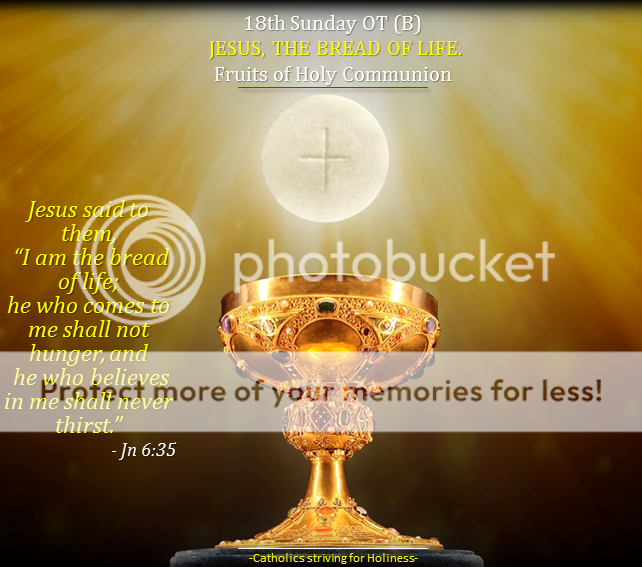 Reading 1 (Ex 16:2-4, 12-15) The whole Israelite community grumbled against Moses and Aaron. The Israelites said to them, “Would that we had died at the LORD’s hand in the land of Egypt, as we sat by our fleshpots and ate our fill of bread! But you had to lead us into this desert to make the whole community die of famine!” Then the LORD said to Moses, “I will now rain down bread from heaven for you. Each day the people are to go out and gather their daily portion; thus will I test them, to see whether they follow my instructions or not. “I have heard the grumbling of the Israelites. Tell them: In the evening twilight you shall eat flesh, and in the morning you shall have your fill of bread, so that you may know that I, the LORD, am your God.” In the evening quail came up and covered the camp. In the morning a dew lay all about the camp, and when the dew evaporated, there on the surface of the desert were fine flakes like hoarfrost on the ground. On seeing it, the Israelites asked one another, “What is this?” for they did not know what it was. But Moses told them, “This is the bread that the LORD has given you to eat.” Responsorial Psalm (Ps 78:3-4, 23-24, 25, 54) R. (24b) The Lord gave them bread from heaven. What we have heard and know, and what our fathers have declared to us, We will declare to the generation to come the glorious deeds of the LORD and his strength and the wonders that he wrought. R. The Lord gave them bread from heaven. He commanded the skies above and opened the doors of heaven; he rained manna upon them for food and gave them heavenly bread. R. The Lord gave them bread from heaven. Man ate the bread of angels, food he sent them in abundance. And he brought them to his holy land, to the mountains his right hand had won. R. The Lord gave them bread from heaven. Reading 2 (Eph 4:17, 20-24) Brothers and sisters: I declare and testify in the Lord that you must no longer live as the Gentiles do, in the futility of their minds; that is not how you learned Christ, assuming that you have heard of him and were taught in him, as truth is in Jesus, that you should put away the old self of your former way of life, corrupted through deceitful desires, and be renewed in the spirit of your minds, and put on the new self, created in God’s way in righteousness and holiness of truth. Alleluia (Mt 4:4b) R. Alleluia, alleluia. One does not live on bread alone, but by every word that comes forth from the mouth of God. R. Alleluia, alleluia. Gospel (Jn 6:24-35) When the crowd saw that neither Jesus nor his disciples were there, they themselves got into boats and came to Capernaum looking for Jesus. And when they found him across the sea they said to him, “Rabbi, when did you get here?” Jesus answered them and said, “Amen, amen, I say to you, you are looking for me not because you saw signs but because you ate the loaves and were filled. Do not work for food that perishes but for the food that endures for eternal life, which the Son of Man will give you. For on him the Father, God, has set his seal.” So they said to him, “What can we do to accomplish the works of God?” Jesus answered and said to them, “This is the work of God, that you believe in the one he sent.” So they said to him, “What sign can you do, that we may see and believe in you? What can you do? Our ancestors ate manna in the desert, as it is written: He gave them bread from heaven to eat.” So Jesus said to them, “Amen, amen, I say to you, it was not Moses who gave the bread from heaven; my Father gives you the true bread from heaven. For the bread of God is that which comes down from heaven and gives life to the world.” So they said to him, “Sir, give us this bread always.” Jesus said to them, “I am the bread of life; whoever comes to me will never hunger, and whoever believes in me will never thirst.” |
|
|
Aug 2 2015, 01:03 AM
|
|
Senior Member
3,573 posts Joined: Apr 2006
|
Indulgence of the Portiuncula
From 1 August Noon until 2 August Midnight, one can gain the Indulgence of the Portiuncula obtained from the Pope by Saint Francis of Assisi for his chapel and extended later to the whole world. To receive the plenary indulgence, one must recite the Credo and Pater Noster - under the usual conditions for obtaining a plenary indulgence - in any parish church, cathedral or minor basilica |
|
|
|
|
|
Aug 2 2015, 07:45 AM
Show posts by this member only | IPv6 | Post
#527
|
|
Junior Member
225 posts Joined: Mar 2008
|
QUOTE(yeeck @ Aug 2 2015, 01:03 AM) Indulgence of the Portiuncula All plenary indulgences?From 1 August Noon until 2 August Midnight, one can gain the Indulgence of the Portiuncula obtained from the Pope by Saint Francis of Assisi for his chapel and extended later to the whole world. To receive the plenary indulgence, one must recite the Credo and Pater Noster - under the usual conditions for obtaining a plenary indulgence - in any parish church, cathedral or minor basilica |
|
|
Aug 2 2015, 09:56 PM
|
|
Junior Member
8 posts Joined: Jan 2015
|
QUOTE(yeeck @ Jul 31 2015, 05:33 PM) I know of many from IC Pulau Tikus. Which parish? Hi Yeeck, I use to go IC church for mass on Sunday evening.I was baptize in Holy Spirit church and serving there. Just curios you are from which parish ? |
|
|
Aug 2 2015, 10:40 PM
|
|
Senior Member
3,573 posts Joined: Apr 2006
|
QUOTE(jiansheng12 @ Aug 2 2015, 09:56 PM) Hi Yeeck, I use to go IC church for mass on Sunday evening. I'm not from Penang..lol.I was baptize in Holy Spirit church and serving there. Just curios you are from which parish ? |
|
|
Aug 2 2015, 10:47 PM
|
|
Senior Member
3,573 posts Joined: Apr 2006
|
St. Dismas
 All that we know with any authority about this saint is what we have from Sacred Scripture and Sacred Tradition. Tradition tells us that his name was Dismas and that he was the good thief who was crucified next to Jesus on Good Friday. There is a story, which is not substantiated and considered myth, which comes from the Arabic Gospel of the Infancy. The story is that the two thieves who ended up on each side of Christ at His crucifixion actually had a run-in with the Holy Family when Jesus was just an infant. In this story, the thieves held up Mary and Joseph as they were fleeing to Egypt with the infant Jesus to escape Herod’s soldiers. Apparently Dismas bribed the other thief, named Gestas, with forty drachmas to not harm the Holy Family. At this point in the tale, the Infant Jesus predicted that the thieves would be crucified with Him in Jerusalem and that Dismas would accompany Him to Paradise. Again, this story is not substantiated and is considered myth. The only valid information we have on Dismas is the account in the Gospels. This account is from Saint Luke’s Gospel: Two others also, who were criminals, were led away to be put to death with Him. And when they came to the place, which is called The Skull, there they crucified Him and the criminals, one on the right and one on the left. And Jesus said, “Father, forgive them; for they know not what they do.” And they cast lots to divide His garments. And the people stood by, watching; but the rulers scoffed at Him, saying, “He saved others; let Him save Himself, if He is the Christ of God, His Chosen One!” The soldiers also mocked Him, coming up and offering Him vinegar, and saying, “If you are the King of the Jews, save yourself!” There was also an inscription over Him, “This is the King of the Jews.” One of the criminals who was hanged railed at him, saying, “Are you not the Christ? Save yourself and us!” But the other rebuked him, saying “Do you not fear God, since you are under the same sentence of condemnation? And we indeed justly; for we are receiving the due reward of our deeds; but this man has done nothing wrong.” And he said, “Jesus, remember me when you come into Your kingly power.” And He said to him, “Truly, I say to you, today you will be with Me in Paradise” (Luke 23:32-43). Questions frequently arise from this Scripture verse concerning Dismas. One usually posed from non-Catholics is that the good thief (Dismas) was taken to heaven and was apparently not baptized, surmising that this must mean baptism is not necessary for salvation. Another question concerns good works. If this man apparently lived a life of sin and was being crucified for his sins, thereby not able to do anything good before his death, how is it he could go straight to heaven? In response to these questions, the Catholic Church teaches that in cases where there is no baptism of water, there may be a baptism of desire. This can occur in situations where there is no opportunity for baptism. Vatican II documents and the Catechism of the Catholic Church state: “Those who through no fault of their own, do not know the Gospel of Christ or His Church, but nevertheless seek God with a sincere heart, and, moved by grace, try in their actions to do His will as they know it through the dictates of their conscience — those too may achieve eternal salvation.” Dismas certainly proved by his words to Jesus and to the other thief on the cross that he fit the criteria and received baptism of desire. Secondly, according to Scripture, (1 Peter 3:19-20 and Ephesians 4:8-10) and the Nicene Creed, Jesus descended into Hades, which is also known as Sheol (or the place of the dead, where both the righteous and unrighteous went) between Good Friday and Easter Sunday. So if He descended into the abode of the dead and preached to the prisoners (1 Peter 3:19) then He didn’t go straight to heaven. The Paradise he spoke of to Dismas was Hades or Sheol, which we might call Purgatory. It wasn’t heaven, but a place or state of being where the dead would be before they could go to heaven. Furthermore, Scripture states that Jesus didn’t actually ascend into heaven until forty days after His resurrection (Acts 1:3, 9-11; John 20:17). Remember Jesus’ words to Mary Magdalene when she saw Him outside the tomb on Easter Sunday: “Do not hold Me for I have not yet ascended to the Father” (Luke 20:17). So when Jesus said to Dismas, “This day you will be with Me in Paradise,” He must have meant that Dismas would first go with Him to Paradise (Sheol) to preach to those there, before taking the righteous to heaven. Lessons Some feel that it is not “fair” that Dismas was a criminal who not only was apparently not baptized but also had lived a life of sin and then in his last minutes of life on earth was saved. They feel that it doesn’t seem right that someone could lead their whole life in sin and then be saved at the “last minute” whereby they have striven all their lives to be good and righteous. Recall the parable of our Lord in Matthew’s Gospel about the householder who went out to hire laborers to work in his vineyard. In this parable the master (who symbolizes God) hired some workers early in the morning to work in his vineyard. Around noon he hired more laborers and then at the last hour of daylight, he hired more laborers. At the end of the day, he called them all together to pay them their wages. When all received the same wage, those who had been hired in the morning and worked all day protested that they should be paid more than those who had been hired at the end of the day and only worked for an hour. The master replied, “Am I not allowed to do what I choose with what belongs to me? Or do you begrudge my generosity? So the last will be first, and the first last.” Prayer Lord Jesus, help us to be merciful as You are merciful. Let us see that all are Your children and remember that we are not to judge. When we look on one such as Dismas, let us see an opportunity to offer hope and salvation. Let us witness the good news of salvation to the sinner and never judge anyone as unworthy or hopeless. Just as Dismas repented at the last moments of his life on earth, let us see that this is great hope for all and grant that we never grow weary in our efforts to bring the light of salvation to all. Amen. |
|
|
Aug 3 2015, 01:15 AM
|
|
Junior Member
8 posts Joined: Jan 2015
|
QUOTE(yeeck @ Aug 2 2015, 10:40 PM) I'm not from Penang..lol. do you have facebook or something ?Where you from yea ? |
|
|
Aug 3 2015, 09:51 AM
|
|
Junior Member
225 posts Joined: Mar 2008
|
QUOTE(jiansheng12 @ Aug 2 2015, 09:56 PM) Hi Yeeck, I use to go IC church for mass on Sunday evening. I was born in Penang, but live in Selangor ... hahahahaha! I was baptize in Holy Spirit church and serving there. Just curios you are from which parish ?  IC Church is very nice, and the priest there gives good homilies |
|
|
Aug 3 2015, 10:06 AM
|
|
Junior Member
225 posts Joined: Mar 2008
|
Bible Translations Guide
At Catholic Answers we are often asked which Bible version a person should choose. This is an important question about which Catholics need to be informed. Some have been given very little help about how to pick a Bible translation, but keeping in mind a few tips will make the decision much easier. There are two general philosophies translators use when they do their work: formal or complete equivalence and dynamic equivalence. Formal equivalence translations try to give as literal a translation of the original text as possible. Translators using this philosophy try to stick close to the originals, even preserving much of the original word order. Literal translations are an excellent resource for serious Bible study. Sometimes the meaning of a verse depends on subtle cues in the text; these cues are only preserved by literal translations. The disadvantage of literal translations is that they are harder to read because more Hebrew and Greek style intrudes into the English text. Compare the following renderings of Leviticus 18:6-10 from the New American Standard Bible (NAS—a literal translation) and the New International Version (NIV—a dynamic translation): The NAS reads: "None of you shall approach any blood relative of his to uncover nakedness. . . . You shall not uncover the nakedness of your father’s wife; it is your father’s nakedness. The nakedness of your sister, either your father’s daughter or your mother’s daughter, whether born at home or born outside, their nakedness you shall not uncover. The nakedness of your son’s daughter or your daughter’s daughter, their nakedness you shall not uncover; for their nakedness is yours." The NIV reads: "No one is to approach any close relative to have sexual relations. . . . Do not have sexual relations with your father’s wife; that would dishonor your father. Do not have sexual relations with your sister, either your father’s daughter or your mother’s daughter, whether she was born in the same home or elsewhere. Do not have sexual relations with your son’s daughter or your daughter’s daughter; that would dishonor you." Because literal translations can be difficult to read, many have produced more readable Bibles using the dynamic equivalence philosophy. According to this view, it does not matter whether the grammar and word order of the original is preserved in English so long as the meaning of the text is preserved. This frees up the translator to use better English style and word choice, producing more readable translations. In the above example, the dynamic equivalence translators were free to use the more readable expression "have sexual relations with" instead of being forced to reproduce the Hebrew idiom "uncover the nakedness of." The disadvantage of dynamic translation is that there is a price to pay for readability. Dynamic translations lose precision because they omit subtle cues to the meaning of a passage that only literal translations preserve. They also run a greater risk of reading the translators’ doctrinal views into the text because of the greater liberty in how to render it. For example, dynamic Protestant translations, such as the NIV, tend to translate the Greek word ergon and its derivatives as "work" when it reinforces Protestant doctrine but as something else (such as "deeds" or "doing") when it would serve Catholic doctrine. The NIV renders Romans 4:2 "If, in fact, Abraham was justified by works (ergon), he had something to boast about—but not before God." This passage is used to support the Protestant doctrine of salvation by faith alone. But the NIV translates the erg- derivatives in Romans 2:6-7 differently: "God ‘will give to each person according to what he has done (erga).’ To those who by persistence in doing (ergou) good seek glory, honor and immortality, he will give eternal life." If the erg- derivatives were translated consistently as "work" then it would be clear that the passage says God will judge "every person according to his works" and will give eternal life to those who seek immortality "by persistence in working good"—statements that support the Catholic view of salvation. Even when there is no doctrinal agenda involved, it is difficult to do word studies in dynamic translations because of inconsistency in how words are rendered. Beyond this, the intent of the sacred author can be obscured. Finding a Balance Both literal and dynamic equivalence philosophies can be carried to extremes. One translation that carries literalism to a ludicrous extreme is the Concordant Version, which was translated by a man who had studied Greek and Hebrew for only a short time. He made a one-to-one rendering in which each word in the ancient originals was translated by one (and only one) word in English. This led to numerous absurdities. For example, compare how the Concordant Version of Genesis 1:20 compares with the NIV: "And saying is God, ‘Roaming is the water with the roaming, living soul, and the flyer is flying over the earth on the face of the atmosphere of the heavens’" (Concordant Version). "And God said, ‘Let the water teem with living creatures, and let birds fly above the earth across the expanse of the sky’" (NIV). At the other extreme from absurdly literal translations are absurdly dynamic ones, such as the Cotton-Patch Version (CPV). This was translated from Greek in the 1960s by a man named Clarence Jordan, who decided not only to replace ancient ways of speaking with modern ones (like most dynamic translations) but to replace items of ancient culture with items of modern ones. Compare the NIV rendering of Matthew 9:16-17 with what is found in the CPV: "No one sews a patch of unshrunk cloth on an old garment, for the patch will pull away from the garment, making the tear worse. Neither do men pour new wine into old wineskins. If they do, the skins will burst, the wine will run out and the wineskins will be ruined. No, they pour new wine into new wineskins, and both are preserved" (NIV). "Nobody ever uses new, unshrunk material to patch a dress that’s been washed. For in shrinking, it will pull the old material and make a tear. Nor do people put new tubes in old, bald tires. If they do, the tires will blow out, and the tubes will be ruined and the tires will be torn up. But they put new tubes in new tires and both give good mileage" (CPV). Between the extremes of the Concordant Version and the Cotton-Patch Version is a spectrum of respectable translations that strike different balances between literal and dynamic equivalence. Toward the literal end of the spectrum are translations such as the King James Version (KJV), the New King James Version (NKJV), the New American Standard (NAS), and the Douay-Rheims Version. Next come slightly less literal translations, such as the Revised Standard Version (RSV), and the Confraternity Version. Then there are mostly dynamic translations such as the New International Version (NIV) and the New American Bible (NAB). And finally, toward the very dynamic end of the spectrum are translations such as the New Jerusalem Bible (NJB), the New English Bible (NEB), the Revised English Bible (REB), the Contemporary English Version (CEV), and the "Good News Bible," whose translation is called Today’s English Version (TEV). One translation that is hard to place on the spectrum is the New Revised Standard Version (NRSV). The basic text of the NRSV is rendered literally, following the RSV, but it uses "gender inclusive language," which tries to translate the original text into a modern "gender neutral" cultural equivalent. When you read the NRSV you will often encounter "friends," "beloved," and "brothers and sisters," and then see a footnote stating "Gk brothers." The NRSV also shows a preference for using "God" and "Christ" when the original text says "he." There is also a host of minor versions, most of which are dynamic equivalence translations. These include well-known ones, such as the Moffat, Philips, and Knox translations, and also unique, specialty versions such as the Jewish New Testament (JNT, translated by David Stern), which renders New Testament names and expressions with the Hebrew, Aramaic, or Yiddish equivalents. Finally, there are a selection of paraphrases, which are not translations based on the original languages but are paraphrased versions of English translations. These tend toward the extreme dynamic end of the spectrum. The best known is the Living Bible (TLB), also known as "The Book." The basic question you need to ask when selecting a Bible version is the purpose you are pursuing. If you simply want a Bible for ordinary reading, a moderate or dynamic version would suffice. This would enable you to read more of the text quickly and comprehend its basic meaning, though it would not give you the details of its meaning, and you would have to watch out more for the translators’ doctrinal views coloring the text. What is the Best Bible? If you intend to do serious Bible study, a literal translation is what you want. This will enable you to catch more of the detailed implications of the text, but at the price of readability. You have to worry less about the translators’ views coloring the text, though even very literal translations are not free from this entirely. A second question you will need to ask yourself is whether you want an old or a modern translation. Older versions, such as the King James and the Douay-Rheims, can sound more dignified, authoritative, and inspiring. But they are much harder to read and understand because English has changed in the almost four hundred years since they were done. One down side to using certain modern translations is that they do not use the traditional renderings of certain passages and phrases, and the reader may find this annoying. The "Good News Bible" or TEV is especially known for non-traditional renderings. For example, "the abomination of desolation" referred to in the book of Daniel and the Gospels is called "the awful horror," and the ark of the covenant is known as "the covenant box." Some Protestants will tell you that the only acceptable version of the Bible is the King James. This position is known as King James-onlyism. Its advocates often make jokes such as, "If the King James Version was good enough for the apostle Paul, it is good enough for me," or, "My King James Version corrects your Greek text." They commonly claim that the King James is based on the only perfect set of manuscripts we have (a false claim; there is no perfect set of manuscripts; and the ones used for the KJV were compiled by a Catholic, Erasmus), that it is the only translation that avoids modern, liberal renderings, and that its translators were extremely saintly and scholarly men. Since the King James is also known as "the Authorized Version" (AV), its advocates sometimes argue that it is the only version to ever have been "authorized." To this one may point out that it was only authorized in the Anglican church, which now uses other translations. For a still-in print critique of King James-onlyism, see D. A. Carson, The King James Version Debate, A Plea for Realism (Grand Rapids: Baker, 1979). As amusing as King James-onlyism may sound, some people take it very seriously. There is even a Catholic equivalent, which we might call "Douay-Rheims-onlyism." The Douay-Rheims version, which predates the King James by a few years, (the complete KJV was published in 1611, but the complete Douay-Rheims in 1609) was the standard Bible for English-speaking Catholics until the twentieth century. What many advocates of both King James-onlyism and Douay-Rheims-onlyism do not know is that neither Bible is the original issued in the 1600s. Over the last three centuries, numerous minor changes (for example, of spelling and grammar) have been made in the King James, with the result that most versions of the KJV currently on the market are significantly different from the original. This has led one publisher to recently re-issue the 1611 King James Version Bible. The Douay-Rheims currently on the market is also not the original, 1609 version. It is technically called the "Douay-Challoner" version because it is a revision of the Douay-Rheims done in the mid-eighteenth century by Bishop Richard Challoner. He also consulted early Greek and Hebrew manuscripts, meaning that the Douay Bible currently on the market is not simply a translation of the Vulgate (which many of its advocates do not realize). For most the question of whether to use an old or a modern translation is not so pointed, and once a decision has been reached on this question it is possible to select a particular Bible version with relative ease. We recommend staying away from translations with unconventional renderings, such as the TEV, and suggest using the Revised Standard Version- Catholic Edition. This is a Church-approved version of the RSV that has a few, minor changes in the New Testament. It has been reissued by Ignatius Press under the title The Ignatius Bible (available from Catholic Answers in bothhardcover and paperback formats). In the end, there may not be a need to select only one translation of the Bible to use. There is no reason why a Catholic cannot collect several versions of the Bible, aware of the strengths and weaknesses of each. It is often possible to get a better sense of what is being said in a passage by comparing several different translations. So, which Bible is the best? Perhaps the best answer is this: The one you’ll read. NIHIL OBSTAT: I have concluded that the materials presented in this work are free of doctrinal or moral errors. Bernadeane Carr, STL, Censor Librorum, August 10, 2004 IMPRIMATUR: In accord with 1983 CIC 827 permission to publish this work is hereby granted. +Robert H. Brom, Bishop of San Diego, August 10, 2004 Source: http://www.catholic.com/tracts/bible-translations-guide |
|
|
|
|
|
Aug 6 2015, 01:54 AM
|
|
Senior Member
3,573 posts Joined: Apr 2006
|
How one skeptical scientist came to believe the Shroud of Turin
 Rome, Italy, Aug 4, 2015 / 04:01 am (CNA/EWTN News).- The Shroud of Turin has different meanings for many people: some see it as an object of veneration, others a forgery, still others a medieval curiosity. For one Jewish scientist, however, the evidence has led him to see it as a meeting point between science and faith. “The Shroud challenges (many people's core beliefs) because there's a strong implication that there is something beyond the basic science going on here,” Barrie Schwortz, one of the leading scientific experts on the Shroud of Turin, told CNA. Admitting that he did not know whether there was something beyond science at play, he added: “That's not what convinced me: it was the science that convinced me.” The Shroud of Turin is among the most well-known relics believed to be connected with Christ's Passion. Venerated for centuries by Christians as the burial shroud of Jesus, it has been subject to intense scientific study to ascertain its authenticity, and the origins of the image. The image on the 14 feet long, three-and-a-half feet wide cloth is stained with the postmortem image of a man – front and back – who has been brutally tortured and crucified. Schwortz, now a retired technical photographer and frequent lecturer on the shroud, was a member of the 1978 Shroud of Turin Research Project which brought prestigious scientists together to examine the ancient artifact. As a non-practicing Jew at the time, he was hesitant to be part of the team and skeptical as to the shroud's authenticity – presuming it was nothing more than an elaborate painting. Nonetheless, he was intrigued by the scientific questions raised by the image. Despite his reservations, Schwortz recounts being persuaded to remain on the project by a fellow scientist on the team – a NASA imaging specialist, and a Catholic – who jokingly told him: “You don't think God wouldn't want one of his chosen people on our team?” And Schwortz soon encountered one of the great mysteries of the image that still entrances its examiners to this day. He explained that a specific instrument used for the project was designed for evaluating x-rays, which allowed the lights and darks of an image to be vertically stretched into space, based on the lights and darks proportionately. For a normal photograph, the result would be a distorted image: with the shroud, however, the natural, 3-D relief of a human form came through. This means “there’s a correlation between image density – lights and darks on the image – and cloth to body distance.” “The only way that can happen is by some interaction between cloth and body,” he said. “It can’t be projected. It’s not a photograph – photographs don’t have that kind of information, artworks don’t.” This evidence led him to believe that the image on the shroud was produced in a way that exceeds the capacities even of modern technology. “There's no way a medieval forger would have had the knowledge to create something like this, and to do so with a method that we can't figure out today – the most image-oriented era of human history.” “Think about it: in your pocket, you have a camera, and a computer, connected to each other in one little device,” he said. “The shroud has become one of the most studied artifacts in human history itself, and modern science doesn’t have an explanation for how those chemical and physical properties can be made.” While the image on the Shroud of Turin was the most convincing evidence for him, he said it was only a fraction of all the scientific data which points to it being real. “Really, it's an accumulation of thousands of little tiny bits of evidence that, when put together, are overwhelming in favor of its authenticity.” Despite the evidence, many skeptics question the evidence without having seen the facts. For this reason, Schwortz launched the website www.shroud.com, which serves as a resource for the scientific data on the Shroud. Nonetheless, he said, there are many who still question the evidence, many believing it is nothing more than an elaborate medieval painting. “I think the reason skeptics deny the science is, if they accept any of that, their core beliefs have been dramatically challenged, and they would have to go back and reconfigure who they are and what they believe in,” he said. “It’s much easier to reject it out of hand, and not worry about it. That way they don’t have to confront their own beliefs.” “I think some people would rather ignore it than be challenged.” Schwortz emphasized that the science points to the Shroud being the burial cloth belonging to a man, buried according to the Jewish tradition after having been crucified in a way consistent with the Gospel. However, he said it is not proof of the resurrection – and this is where faith comes in. “It’s a pre-resurrection image, because if it were a post-resurrection image, it would be a living man – not a dead man,” he said, adding that science is unable to test for the sort of images that would be produced by a human body rising from the dead. “The Shroud is a test of faith, not a test of science. There comes a point with the Shroud where the science stops, and people have to decide for themselves.” “The answer to faith isn’t going to be a piece of cloth. But, perhaps, the answer to faith is in the eyes and hearts of those who look upon it.” When it comes to testifying to this meeting point between faith and science, Schwortz is in a unique position: he has never converted to Christianity, but remains a practicing Jew. And this, he says, makes his witness as a scientist all the more credible. “I think I serve God better this way, in my involvement in the Shroud, by being the last person in the world people would expect to be lecturing on what is, effectively, the ultimate Christian relic.” “I think God in his infinite wisdom knew better than I did, and he put me there for a reason.” Source: http://www.catholicnewsagency.com/news/how...of-turin-19617/ |
|
|
Aug 7 2015, 12:46 AM
|
|
Senior Member
3,573 posts Joined: Apr 2006
|
|
|
|
Aug 7 2015, 01:50 PM
|
|
Junior Member
225 posts Joined: Mar 2008
|
The thoughts of a pro-choice woman, one who gave rise to Planned Parenthood. Pray that we do not see the likes of her ever again ...
BIRTH CONTROL OR ABORTION? By Margaret Sanger Family limitation will be practiced. No law has yet been framed that can prevent it. The church has been powerless and the champions of wornout moral creeds find themselves trying in vain to force all women to become mothers against their wills. Abundant evidence of the futility of seeking to impose involuntary motherhood upon women is found in the size of the families of the rich, of the well-to-do and of the wage workers of larger earning capacity. The women of these classes long ago refused to be mere brood animals–-usually they prefer to be voluntary mothers, determining for themselves the number of children they shall have and when they shall have them. Family limitation for them is an accomplished fact. It is also an accomplished fact with many of the wives of the less highly paid workers. But with the latter, as well as with some of their more fortunate sisters, family limitation takes a far more drastic and too often a terribly dangerous course. The awakened woman of today will not bear unwanted children. She will not bear more children than she can care for. And if she is denied the knowledge of the safe, harmless, scientific methods of Birth Control, she limits her family by means of abortion. In the very nature of the case, it is impossible to get accurate figures upon the number of abortions performed annually in the United States. It is often said, however, that one in five pregnancies end in abortion. One estimate is that 150,000 occur in the United States each year and that 25,000 women die of the effects of such operations in every twelve months. Dr. William J. Robinson asserts that there are 1,000,000 abortions every year in this country and adds that the estimate is conservative. He quotes Justice John Proctor Clark as saying that there are at least 100,000 in the same length of time in New York City alone. Dr. Max Hirsch, a famous authority quotes an opinion that there are 2,000,000 abortions in the United States every year! "I believe" declares Dr. Hirsch, "that I may say without exaggeration that absolutely spontaneous or unprovoked abortions are extremely rare, that a vast majority--I should estimate it at 80 per cent--have a criminal origin." "Our examinations have informed us that the largest number of abortions are performed on married women. This fact brings us to the conclusion that contraceptive measures among the upper classes and the practice of abortion among the lower class, are the real means employed to regulate the number of offspring." The question, then, is not whether family limitation should be practised. It is being practised; it has long been practised and it will always be practised. The question now is whether it is to be attained by normal, scientific Birth Control methods or by the abnormal, often dangerous, surgical operation. That is the question which the church, the state, the moralist and most of all, the woman herself, must face. The knowledge of Birth Control methods may for a time be denied to the woman of the working class, but those who are responsible for denying it to her, and she herself, should understand clearly the dangers to which she is exposed by the dark age laws which force her into the hands of the abortionist. To understand the more clearly what these dangers are, and to realize the more fully how much better it would be to avoid them, it is first necessary that women should know something of the processes of conception, the prevention of which frees them of all risk of having to resort to abortion. In every woman's ovaries there are imbedded millions of ovules or eggs. They are there in every female at birth and as the girl grows into womanhood, these ovules or eggs develop also. At a certain period or age, the ripest ovule leaves the nest or ovary and comes on down one of the tubes into the womb and passes out of the body. When this takes place, it is said that the girl is at the age of puberty, for the ovule is now ready for fertilization (or conception) by the male sperm. About the same time that the ovule is ripening or developing, the womb is preparing to receive the fertilized ovum by a reinforced blood supply brought to its lining. To this lining the ovum will cling and gather its nourishment after fertilization takes place. If fertilization (conception) does not take place, the ovum passes on out of the body and the uterus throws off its surplus blood supply. This is called the menstrual period and occurs once a month or about every twenty-eight days. In the male sexual organs, there are glands (testes) which secrete a fluid called the semen. In the semen is the lifegiving principle, the sperm. When intercourse takes place (if no preventative is used) the semen is deposited in the woman's vagina. The ovule is not in the vagina, but is in the womb, further up, in safety, or perhaps in the tube on its way to the womb. As steel is attracted to the magnet, the sperm of the male starts on its way to seek the ovum. Several of these sperm cells start, but only one enters the ovum and is absorbed into it. This process is called fertilization, conception or impregnation. If no children are desired, the meeting of the male sperm and the ovum must be prevented. When scientific means are used to prevent this meeting, and thereby to limit families, one is said to practise Birth Control. But if preventive means are not used and the sperm meets the ovum and development thus begins, any attempt at removing it or stopping its further growth is called abortion. There is no doubt that women are apt to look upon abortion as of little consequence and to treat it accordingly. An abortion is as important a matter as a confinement and requires as much attention as the birth of a child at its full term. "The immediate dangers of abortion," says Dr. J. Clifton Edgar, in his book "The Practice of Obstetrics," "are hemhorrage, retention of an adherent placenta, sepsis, tetanus, perforation of the uterus. They also cause sterility, anemia, malignant diseases, displacements, neurosis, and endometritis." In plain, everyday language, in an abortion there is always a very serious risk to the health and often to the life of the patient. It is only the women of wealth who can afford to give an abortion proper care and treatment both at the time of the operation and afterwards. These women often escape any serious consequences from its occurrence. The women whose incomes are limited and who must continue at work before they have recovered from the effects of an abortion are the great army of sufferers. It is among such that the deaths due to abortion usually ensue. It is these, too, who are most often forced to resort to such operations. If death does not result, the woman who has undergone an abortion is not therefore safe. The womb may not return to its natural size but remain large and heavy, tending to fall away from its natural position. Abortion often leaves the uterus in a condition to conceive easily again and unless prevention is strictly followed another pregnancy will surely occur. Frequent abortions tend to cause barrenness and serious, painful pelvic ailments. These and other conditions arising from such operations are quite likely to ruin a woman's general health. While there are cases where even the law recognizes an abortion as justifiable if recommended by a physician, I assert that the hundreds of thousands of abortions performed in America each year are a disgrace to civilization. I also assert that the responsibility for these abortions and the illness, misery and deaths that come in their train lies at the door of a government whose authority has been stretched beyond the limits of the people's intention and which, in its puritanical blindness, insists upon suffering and death from ignorance, rather than life and happiness from knowledge and prevention. It needs no assertion of mine to call attention to the grim fact that the laws prohibiting the imparting of information concerning the preventing of conception are responsible for tens of thousands of deaths each year in this country and an untold amount of sickness and sorrow. The suffering and the death of these women is squarely upon the heads of the lawmakers and the puritanical, masculine-minded persons, who insist upon retaining the abominable legal restrictions. Try as they will they cannot escape the truth, nor hide it under the cloak of stupid hypocrisy. If the laws against imparting knowledge of scientific Birth Control were repealed, the 1,000,000 or 2,000,000 women who undergo abortions in the United States each year would escape the agony of the surgeon's instruments and the long trail of disease, suffering and death which so often follows. "He who would combat abortion" says Dr. Hirsch, "and at the same time combat contraceptive measures may be likened to the person who would fight contagious diseases and forbid disinfection. For contraceptive measures are important weapons in the fight against abortion. "America has a law since 1873 *** which prohibits by criminal statute, the distribution and regulation of contraceptive measures. It follows, therefore *** that America stands at the head of all nations in the huge number of abortions." There is the case in a nutshell. Family limitation will always be practised as it is now being practised–-either by Birth Control or by abortion. We know that. The one means health and happiness–-a stronger, better race. The other means disease, suffering, death. When all is said and done, it is not the advocates of Birth Control, but the bitter, unthinkable conditions brought about by the blindness of church, state and society that puts up to all three the question: Birth Control or Abortion–-which shall it be? Source: https://www.nyu.edu/projects/sanger/webedit...rDoc=232534.xml This post has been edited by khool: Aug 7 2015, 01:51 PM |
|
|
Aug 8 2015, 04:52 PM
Show posts by this member only | IPv6 | Post
#537
|
|
Junior Member
225 posts Joined: Mar 2008
|
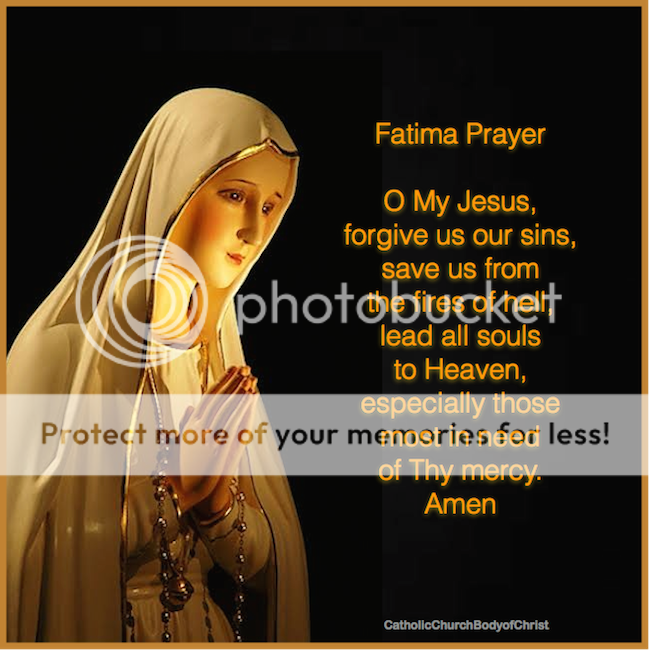
Blessed Saturday to all Catholics!
  |
|
|
Aug 8 2015, 08:47 PM
|
|
Senior Member
3,573 posts Joined: Apr 2006
|
 |
|
|
Aug 8 2015, 09:07 PM
|
|
Senior Member
3,573 posts Joined: Apr 2006
|
WHY THE DEVIL HATES THE BLESSED VIRGIN SO MUCH (AND WHY YOU SHOULD LOVE HER)
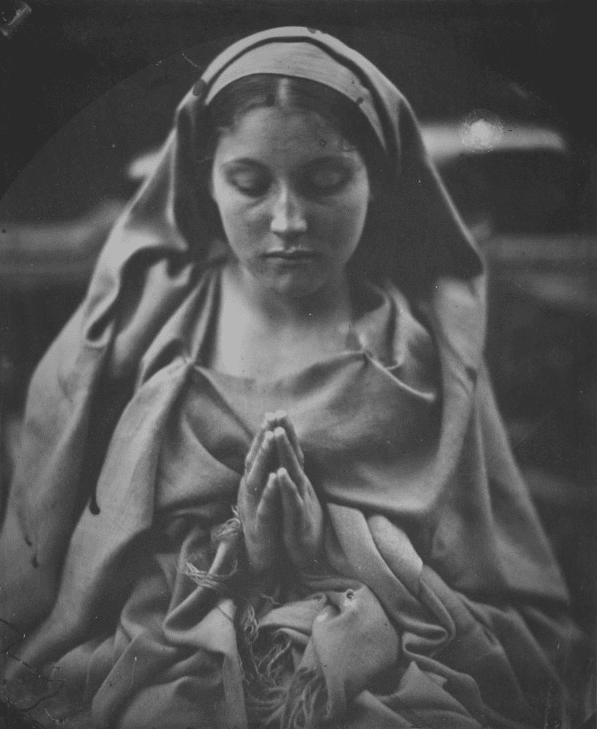 Satan hates the Blessed Virgin Mary. In fact, he has been doing everything in his power to discourage devotion to her and instill hatred for her for two millennia. Have you ever noticed that it is Marian dogmas and devotions that stir the strongest reactions in those who reject the Church? Even some good Catholics are embarrassed by devotion to our Lady, and they feel we should not be too extreme in our veneration of her. Perhaps you, too, have wondered why the Church holds the Immaculate Virgin in such high regard. Perhaps you have wonder why God has chosen to use her in the work of redemption. Today, I’d like to take a look at why the devil hates the Blessed Mother so much, and why we should be her devoted knights. SHE WILL CRUSH YOUR HEAD The scene is the garden of Eden. The characters are God, the serpent, Adam, and Eve. The devil is smirking in triumph. He has just deceived Eve, and through her, Adam. Oh, he is proud of himself. You can almost feel the demonic pride in destruction, for he has successfully marred God’s handiwork of creation, and dragged human beings—for whom God has a special love—into death and misery. God has appeared on the scene to clean up the mess, declaring the tragic curse that has arisen from sin, but also to proclaim the protoevangelium, the first hint at the Gospel and the devil’s doom. God starts by addressing Satan, telling him he is going to eat dirt for the rest of his days. Then he reveals something that makes Satan cringe in horror—his ultimate defeat will come at the hands of a woman. And I will establish a feud between thee and the woman, between thy offspring and hers; she is to crush thy head, while thou dost lie in ambush at her heels (Genesis 3:15, Knox) Now, scholars argue about whether or not the pronoun is masculine or feminine in the sentence, “She is to crush thy head”—that is, whether it refers to the Virgin Mary or Jesus Christ. But I’m going to let you in on a little secret: it doesn’t matter. You see, Jesus is going to crush Satan through Mary. She is the instrument Jesus is going to wield when he destroys his ancient enemy. With that in mind, it is just as legitimate to say, “he will crush your head” as it is to say, “she will crush your head.” It’s kind of like telling an armed assailant, “One more step and I will shoot you” and “One more step and my .44 magnum will blow you away.” They are both true statements. So why does being defeated by Mary pain the devil so much? Why does God want to use Mary to defeat Satan? I’ll explain. “HE HAS PUT DOWN THE MIGHTY FROM THEIR SEAT…” The devil hates, I mean he loathes the fact that his ultimate defeat will come at the hands of a lowly handmaiden. In a way, his proud heart could handle being defeated by God himself because he’s almighty and omnipotent. But being crushed by a little Lady from Nazareth? The thought is absolutely humiliating. It drives him crazy. For if there is one thing the most proud creature in all of creation hates, it is being humiliated. Satan finds his defeat by the Virgin Mary humiliating because she is a woman, and women are the weaker sex (1 Peter 3:7), and he despises weakness. He loves nothing more than to see women abused, degraded, and objectified. Not to mention that our Blessed Lady is a human, and Satan hates humans because we have bodies, and he is a pure spirit that thinks bodies are disgusting. But there’s another, more profound reason Satan hates being defeated by Mary: She is his replacement in heaven. You see, Lucifer was originally God’s finest achievement. He was more beautiful, more powerful than all the other creatures that God has made. And as we all know, it went to his head. He was so gorgeous, so mighty that he really thought he could be better than God. The defining marks of Satan are pride and envy of the Almighty. And what are the defining characteristics of our Lady? First and foremost, she is supremely humble. In fact, she is the most humble creature that has ever existed. For every ounce of pride the devil has, Mary has twice as much humility. For every drop of hate-filled and bitter envy in Satan’s black heart, Mary’s heart is filled with twice as much praise, worship, and love. For every bit of warped and destructive depravity in the devil’s soul, Mary’s heart is filled with more purity and fruitfulness. And by grace, God has made her the most exquisite and most glorious creature in all the universe—the title the devil used to claim. In every way, the Immaculate is Satan’s polar opposite. In every way, she is his replacement, and he knows it. This Divine exchange of Mary for Satan is revealed in our Lady’s hymn of praise, the Magnificat. My soul magnifies the Lord; my spirit has found joy in God, who is my Saviour, because he has looked graciously upon the lowliness of his handmaid. Behold, from this day forward all generations will count me blessed; because he who is mighty, he whose name is holy, has wrought for me his wonders. He has mercy upon those who fear him, from generation to generation; he has done valiantly with the strength of his arm, driving the proud astray in the conceit of their hearts; he has put down the mighty from their seat, and exalted the lowly; he has filled the hungry with good things, and sent the rich away empty-handed. He has protected his servant Israel, keeping his merciful design in remembrance, according to the promise which he made to our forefathers, Abraham and his posterity for evermore. In the Magnificat, we see the role of Mary in salvation summarized beautifully: Mary’s humility- “he has looked graciously on the lowliness of his handmaid” God’s marvelous work of grace in her: “Because he who is mighty, he who name is holy, has wrought for me his wonders” God’s casting out of Satan: “Driving the proud astray in the conceit of their hearts, he has put down the mighty from their seat” His exalting of Mary in Satan’s place: “He has…exalted the lowly.” Worst of all for Satan, his replacement in heaven is none other than the mother of the Eternal Word, Jesus Christ, whose passion and death redeemed the very humanity he has worked so hard to destroy. Her Yes to God undid the disobedience of Eve, paving the way for the saving work of the New Adam. The very weakness of Eve that Satan so scorned was replaced by the humble obedience of Mary, an obedience to the will of God that has made her powerful beyond limits. This is the Divine plan for the defeat of his enemy. This is Satan’s humiliation and his doom. HASTA LA VISTA, SATAN In case you didn’t realize it, Satan hates you. His bitter envy inspires him to destroy God’s creation, to drag it down into the abyss of hell. He would love nothing more for you—image bearer of God—to join in him in the eternal flames of the lake of fire, for misery loves company. But fear not. The ancient serpent is powerless against the Immaculate Virgin, for in God’s plan, she is the instrument that Jesus will use to humiliate and demolish him. Do you want to crush the head of the devil in your life? Do you want to make it safely through trials, temptations, and storms to our eternal Home? The answer is simple: Call on Mary. Love her, be her devoted servant. Be her knight, her defender, her apostle. Consecrate yourself to her totally and completely—for nothing that belongs to her will be lost. As St. John Damascene said so beautifully, “To be devoted to thee, O holy Virgin, is an arm of salvation which God gives to those whom He wishes to save.” Satan is on a rampage, wreaking as much havoc as he possibly can—because he knows his time is running out. He is afraid and he is angry, for he knows that one day very soon, he will be crushed by the Woman who makes his heart quake, the woman who “looks forth like the dawn, fair as the moon, bright as the sun, terrible as an army with banners” (Song of Solomon 6:10). — Prayer Majestic Queen of Heaven and Mistress of the Angels, thou didst receive from God the power and commission to crush the head of Satan; wherefore we humbly beseech thee, send forth the legions of heaven, that, under thy command, they may seek out all evil spirits, engage them everywhere in battle, curb their insolence, and hurl them back into the pit of hell. “Who is like unto God?” O good and tender Mother, thou shalt ever be our hope and the object of our love. O Mother of God, send forth the holy Angels to defend me and drive far from me the cruel foe. Holy Angels and Archangels, defend us and keep us. Source: http://www.catholicgentleman.net/2015/01/d...rgin-much-love/ |
|
|
Aug 8 2015, 10:38 PM
Show posts by this member only | IPv6 | Post
#540
|
|
Junior Member
225 posts Joined: Mar 2008
|
Nineteenth Sunday in Ordinary Time
Lectionary: 116 Reading 1 (1 Kgs 19:4-8) Elijah went a day’s journey into the desert, until he came to a broom tree and sat beneath it. He prayed for death saying: “This is enough, O LORD! Take my life, for I am no better than my fathers.” He lay down and fell asleep under the broom tree, but then an angel touched him and ordered him to get up and eat. Elijah looked and there at his head was a hearth cake and a jug of water. After he ate and drank, he lay down again, but the angel of the LORD came back a second time, touched him, and ordered, “Get up and eat, else the journey will be too long for you!” He got up, ate, and drank; then strengthened by that food, he walked forty days and forty nights to the mountain of God, Horeb. Responsorial Psalm (Ps 34:2-3, 4-5, 6-7, 8-9) R. Taste and see the goodness of the Lord. I will bless the LORD at all times; his praise shall be ever in my mouth. Let my soul glory in the LORD; the lowly will hear me and be glad. R. Taste and see the goodness of the Lord. Glorify the LORD with me, Let us together extol his name. I sought the LORD, and he answered me And delivered me from all my fears. R. Taste and see the goodness of the Lord. Look to him that you may be radiant with joy. And your faces may not blush with shame. When the afflicted man called out, the LORD heard, And from all his distress he saved him. R. Taste and see the goodness of the Lord. The angel of the LORD encamps around those who fear him and delivers them. Taste and see how good the LORD is; blessed the man who takes refuge in him. R. Taste and see the goodness of the Lord. Reading 2 (Eph 4:30—5:2) Brothers and sisters: Do not grieve the Holy Spirit of God, with which you were sealed for the day of redemption. All bitterness, fury, anger, shouting, and reviling must be removed from you, along with all malice. And be kind to one another, compassionate, forgiving one another as God has forgiven you in Christ. So be imitators of God, as beloved children, and live in love, as Christ loved us and handed himself over for us as a sacrificial offering to God for a fragrant aroma. Alleluia (Jn 6:51) R. Alleluia, alleluia. I am the living bread that came down from heaven, says the Lord; whoever eats this bread will live forever. R. Alleluia, alleluia. Gospel (Jn 6:41-51) The Jews murmured about Jesus because he said, “I am the bread that came down from heaven, ” and they said, “Is this not Jesus, the son of Joseph? Do we not know his father and mother? Then how can he say, ‘I have come down from heaven’?” Jesus answered and said to them, “Stop murmuring among yourselves. No one can come to me unless the Father who sent me draw him, and I will raise him on the last day. It is written in the prophets: They shall all be taught by God. Everyone who listens to my Father and learns from him comes to me. Not that anyone has seen the Father except the one who is from God; he has seen the Father. Amen, amen, I say to you, whoever believes has eternal life. I am the bread of life. Your ancestors ate the manna in the desert, but they died; this is the bread that comes down from heaven so that one may eat it and not die. I am the living bread that came down from heaven; whoever eats this bread will live forever; and the bread that I will give is my flesh for the life of the world.” Source: http://www.usccb.org/bible/readings/080915.cfm Blessed Sunday!  |
|
Topic ClosedOptions
|
| Change to: |  0.0347sec 0.0347sec
 0.27 0.27
 6 queries 6 queries
 GZIP Disabled GZIP Disabled
Time is now: 2nd December 2025 - 01:42 AM |
 Quote
Quote