Welcome Guest ( Log In | Register )

Bump Topic Topic Closed RSS Feed
134 Pages « < 27 28 29 30 31 > » Bottom

Outline · [ Standard ] · Linear+

 LYN Catholic Fellowship V01 (Group), For Catholics (Roman or Eastern)

views
     
jiansheng12
post Aug 21 2015, 11:50 PM

New Member
*
Junior Member
8 posts

Joined: Jan 2015
hey ... anyone interested to join camp on December ?
A camp that open to all post confirmation that well held in St Anne organize by Callback group.

Venue: St Anne Church
Date : 11DEC to 13DEC
TSyeeck
post Aug 22 2015, 06:33 PM

Look at all my stars!!
*******
Senior Member
3,573 posts

Joined: Apr 2006


Lovely rendition of a Marian hymn


TSyeeck
post Aug 22 2015, 10:27 PM

Look at all my stars!!
*******
Senior Member
3,573 posts

Joined: Apr 2006


khool
post Aug 23 2015, 10:11 AM

Getting Started
**
Junior Member
225 posts

Joined: Mar 2008


user posted image
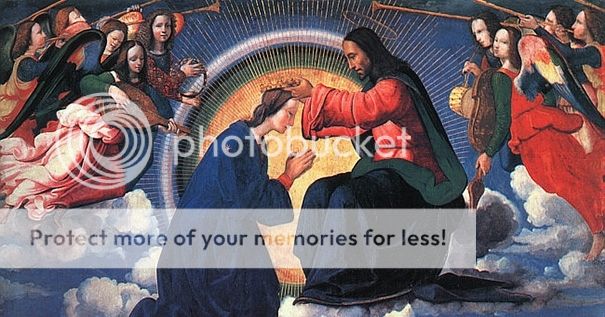
Ridolfo Ghirlandaio, "The Coronation of the Virgin with Six Saints" (1504)

On this Feast of the Queenship of Mary, perhaps we can re-crown Mary as our heavenly Queen, offering her the honor she deserves and recommitting ourselves to her as her royal subjects. Is there a church or Marian shrine near you? Why not stop in for a quick visit and greet your Queen? Make up a private crowning prayer and symbolically place the golden crown upon Mary’s holy head. You can even do this in the shrine of your heart. Jesus dwells there, and wherever he is, Mary is.
In return, Mary will give you gifts in abundance because it is her special day, and because you are special to her. You are not only her royal subject, but also you are her royal child and she cherishes you as such.
The gifts you receive may not be what you expect, but they will be exactly the ones God wants you to have, through Mary’s royal hands.

Source: http://www.ncregister.com/blog/mfenelon/ma...ominion-is-vast

TSyeeck
post Aug 23 2015, 11:01 PM

Look at all my stars!!
*******
Senior Member
3,573 posts

Joined: Apr 2006


QUOTE(Ishin Shishi @ Aug 23 2015, 06:10 PM)
What are the fundamental differences between Protestantism and Catholicism, apart from the extra apocrypha books for Catholics? I heard that the position of Virgin Mary as saint is one dissimilarity too.

Also, what's the view of Catholics regarding the Inquisition?

Thank you in advance.
*
http://www.dts.edu/hendrickscenter/blog/7-...-rosario-mikel/


This post has been edited by yeeck: Aug 23 2015, 11:21 PM
TSyeeck
post Aug 24 2015, 12:45 AM

Look at all my stars!!
*******
Senior Member
3,573 posts

Joined: Apr 2006


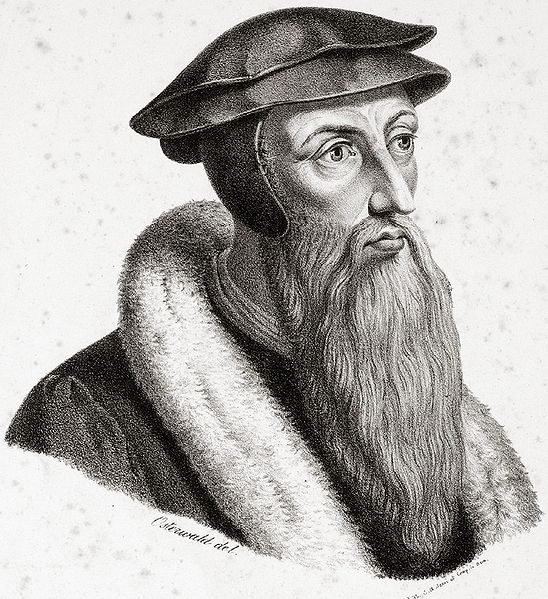
Top 15 “Catholic” Beliefs of John Calvin

by Dave Armstrong

user posted image

It’s usually thought that, among the founders of Protestantism, Martin Luther was the most (relatively) “Catholic” and “traditional.” That is true; however, it may surprise many to know how many traditional (literally or substantially Catholic) beliefs that John Calvin also retained. He was probably even more influential on the history of subsequent Protestantism than Luther was. The following quotes were all taken (save #2 and #1) from his quintessential work, Institutions of the Christian Religion (translated by Henry Beveridge for the Calvin Translation Society in 1845, from the 1559 edition in Latin; reprinted by Wm. B. Eerdmans Publishing Co.: Grand Rapids, Michigan, 1995; available online).
I don’t intend to imply that Calvin agrees with Catholics in every jot and tittle of all the following categories. What is agreed-upon is what is actually stated in these particular comments, which may sometimes be a part of a doctrine or practice. Two parties can agree, for example, on the basic fundamentals of a question, and then go on to differ on more minute particulars that each feels are a logical extension of the premises.

All the citations below were included in the extensive, 66-page compilation at the end of my book, Biblical Catholic Answers for John Calvin. I have a much more extensive list of 50 “Catholic” Calvin beliefs; see also my web page on John Calvin.
* * * * *

15. Calvin thought that the Church had the power of excommunication: “[T]he Church binds him whom she excommunicates, not by plunging him into eternal ruin and despair, but condemning his life and manners, and admonishing him, that, unless he repent, he is condemned.” (Institutes, IV, 11:2)

14. Calvin believed that there was no salvation outside the Church: “beyond the pale of the Church no forgiveness of sins, no salvation, can be hoped for, . . .” (IV, 1:4)

13. Calvin thought weekly Holy Communion was the minimum frequency: “[T]he sacrament might be celebrated in the most becoming manner, if it were dispensed to the Church very frequently, at least once a-week.” (IV, 17:43)

12. Calvin believed in the primacy of St. Peter, as leader of the apostles: “ There is no senate without a consul, no bench of judges without a president or chancellor, no college without a provost, no company without a master. Thus there would be no absurdity were we to confess that the apostles had conferred such a primacy on Peter.” (IV, 6:8)

11. Calvin accepted the primacy of the Roman Church in early Christian history: “I deny not that the early Christians uniformly give high honour to the Roman Church, and speak of it with reverence. . . . pious and holy bishops, when driven from their sees, often betook themselves to Rome as an asylum or haven. . . . It therefore added very great authority to the Roman Church, that . . . [it] adhered more firmly to the doctrine once delivered, . . .” (IV, 6:16)

10. Calvin believed in the indefectibility of the Church: “I always hold that the truth does not perish in the Church . . .” (IV, 9:13)

9. Calvin utterly detested denominations and sectarianism: “Hence the Church is called Catholic or Universal (August. Ep. 48), for two or three cannot be invented without dividing Christ; and this is impossible. All the elect of God are so joined together in Christ, that as they depend on one head, . . .” (IV, 1:2)

8. Calvin thought that sacraments produce real, beneficial effects in us: “They, by sealing it to us, sustain, nourish, confirm, and increase our faith.” (IV, 14:7) / “That sacred communion of flesh and blood by which Christ transfuses his life into us, just as if it penetrated our bones and marrow, . . .” (IV, 17:10)

7. Calvin taught that there was such a thing as a holy, sacred place: “. . . as if it were not in the power of God in a manner to descend to us, that he may be near to us, and yet neither change his place nor affect us by earthly means, but rather, . . . raise us aloft to his own heavenly glory, . . .” (IV, 1:5)

6. Calvin believed that human beings could be distributors or mediators of salvation: “In short, in several passages he [St. Paul] . . . attributes to himself the province of bestowing salvation (1 Cor. 3:9).” (IV, 1:6)

5. Calvin accepted the notion of baptismal regeneration: “. . . forgiveness, which at our first regeneration we receive by baptism alone . . . we are washed from our sins by the blood of Christ.” (IV, 15:4)

4. Calvin approved of bodily mortification as a spiritually beneficial practice: “In like manner, therefore, as persons accused were anciently wont, . . . to humble themselves suppliantly with long beard, dishevelled hair, and coarse garments, . . . the assembly, and weeping and fasting, and the like, undoubtedly belong, in an equal degree, to our age, whenever the condition of our affairs so requires.” (IV, 12:17)

3. Calvin believed that there was a profound causal connection between Holy Eucharist and salvation: “Nay, the very flesh in which he resides he makes vivifying to us, that by partaking of it we may feed for immortality. . . . by this food believers are reared to eternal life.” (IV, 17:8) / “[T]he true and substantial communication of the body and blood of the Lord, . . . are received not by the imagination or intellect merely, but are enjoyed in reality as the food of eternal life.” (IV, 17:19) / “[I]t not only gives our minds undoubted assurance of eternal life, but also secures the immortality of our flesh, . . .” (IV, 17:32)

2. Calvin held that contraception was gravely sinful: “I will contend myself with briefly mentioning this, as far as the sense of shame allows to discuss it. It is a horrible thing to pour out seed besides the intercourse of man and woman. Deliberately avoiding the intercourse, so that the seed drops on the ground, is double horrible. For this means that one quenches the hope of his family, and kills the son, which could be expected, before he is born. This wickedness is now as severely as is possible condemned by the Spirit, through Moses, that Onan, as it were, through a violent and untimely birth, tore away the seed of his brother out the womb, and as cruel as shamefully has thrown on the earth. Moreover he thus has, as much as was in his power, tried to destroy a part of the human race. When a woman in some way drives away the seed out the womb, through aids, then this is rightly seen as an unforgivable crime. Onan was guilty of a similar crime, by defiling the earth with his seed, so that Tamar would not receive a future inheritor.” (Commentary on Genesis [38:10], translated by John King)

1. Calvin accepted the traditional Catholic and scriptural belief of the perpetual virginity of Mary: “[On Matthew 1:25:] The inference he [Helvidius] drew from it was, that Mary remained a virgin no longer than till her first birth, and that afterwards she had other children by her husband . . . No just and well-grounded inference can be drawn from these words . . . as to what took place after the birth of Christ. He is called ‘first-born’; but it is for the sole purpose of informing us that he was born of a virgin . . . What took place afterwards the historian does not inform us . . . No man will obstinately keep up the argument, except from an extreme fondness for disputation.” (Harmony of Matthew, Mark & Luke, Geneva, 1562, Vol. I, p. 107; from Calvin’s Commentaries, translated by William Pringle, Grand Rapids, Michigan: Eerdmans, 1949) / “[O]ur Lord Jesus Christ is called the first-born. This is not because there was a second or a third, but because the gospel writer is paying regard to the precedence.” (Sermon on Matthew 1:22-25, published in 1562 in the shorthand notes of Denys Ragueneau; cited in Max Thurian, Mary: Mother of All Christians, translated by Nevill B. Cryer, New York: Herder & Herder, 1963, pp. 39-40)
[see much more on this question of Calvin's view on the perpetual virginity of Mary; a view which is confirmed by several Calvin scholars]

Source: http://www.patheos.com/blogs/davearmstrong...ohn-calvin.html

This post has been edited by yeeck: Aug 24 2015, 12:46 AM
khool
post Aug 24 2015, 01:45 PM

Getting Started
**
Junior Member
225 posts

Joined: Mar 2008


QUOTE(Ishin Shishi @ Aug 23 2015, 06:10 PM)
What are the fundamental differences between Protestantism and Catholicism, apart from the extra apocrypha books for Catholics? I heard that the position of Virgin Mary as saint is one dissimilarity too.

Also, what's the view of Catholics regarding the Inquisition?

Thank you in advance.
*
First off ...

The Inquisition

Sooner or later, any discussion of apologetics with Fundamentalists will address the Inquisition. To non-Catholics it is a scandal; to Catholics, an embarrassment; to both, a confusion. It is a handy stick for Catholic-bashing, simply because most Catholics seem at a loss for a sensible reply. This tract will set the record straight.

There have actually been several different inquisitions. The first was established in 1184 in southern France as a response to the Catharist heresy. This was known as the Medieval Inquisition, and it was phased out as Catharism disappeared.

Quite separate was the Roman Inquisition, begun in 1542. It was the least active and most benign of the three variations.

Separate again was the infamous Spanish Inquisition, started in 1478, a state institution used to identify conversos—Jews and Moors (Muslims) who pretended to convert to Christianity for purposes of political or social advantage and secretly practiced their former religion. More importantly, its job was also to clear the good names of many people who were falsely accused of being heretics. It was the Spanish Inquisition that, at least in the popular imagination, had the worst record of fulfilling these duties.

The various inquisitions stretched through the better part of a millennia, and can collectively be called "the Inquisition."

The Main Sources

Fundamentalists writing about the Inquisition rely on books by Henry C. Lea (1825–1909) and G. G. Coulton (1858–1947). Each man got most of the facts right, and each made progress in basic research, so proper credit should not be denied them. The problem is that they did not weigh facts well, because they harbored fierce animosity toward the Church—animosity that had little to do with the Inquisition itself.

The contrary problem has not been unknown. A few Catholic writers, particularly those less interested in digging for truth than in diffusing a criticism of the Church, have glossed over incontrovertible facts and tried to whitewash the Inquisition. This is as much a disservice to the truth as an exaggeration of the Inquisition’s bad points. These well-intentioned, but misguided, apologists are, in one respect, much like Lea, Coulton, and contemporary Fundamentalist writers. They fear, while the others hope, that the facts about the Inquisition might prove the illegitimacy of the Catholic Church.

Don’t Fear the Facts

But the facts fail to do that. The Church has nothing to fear from the truth. No account of foolishness, misguided zeal, or cruelty by Catholics can undo the divine foundation of the Church, though, admittedly, these things are stumbling blocks to Catholics and non-Catholics alike.

What must be g.asped is that the Church contains within itself all sorts of sinners and knaves, and some of them obtain positions of responsibility. Paul and Christ himself warned us that there would be a few ravenous wolves among Church leaders (Acts 20:29; Matt. 7:15).

Fundamentalists suffer from the mistaken notion that the Church includes only the elect. For them, sinners are outside the doors. Locate sinners, and you locate another place where the Church is not.

Thinking that Fundamentalists might have a point in their attacks on the Inquisition, Catholics tend to be defensive. This is the wrong attitude; rather, we should learn what really happened, understand events in light of the times, and then explain to anti-Catholics why the sorry tale does not prove what they think it proves.

Phony Statistics

Many Fundamentalists believe, for instance, that more people died under the Inquisition than in any war or plague; but in this they rely on phony "statistics" generated by one-upmanship among anti-Catholics, each of whom, it seems, tries to come up with the largest number of casualties.

But trying to straighten out such historical confusions can take one only so far. As Ronald Knox put it, we should be cautious, "lest we should wander interminably in a wilderness of comparative atrocity statistics." In fact, no one knows exactly how many people perished through the various Inquisitions. We can determine for certain, though, one thing about numbers given by Fundamentalists: They are far too large. One book popular with Fundamentalists claims that 95 million people died under the Inquisition.

The figure is so grotesquely off that one immediately doubts the writer’s sanity, or at least his g.asp of demographics. Not until modern times did the population of those countries where the Inquisitions existed approach 95 million.

Inquisitions did not exist in Northern Europe, Eastern Europe, Scandinavia, or England, being confined mainly to southern France, Italy, Spain, and a few parts of the Holy Roman Empire. The Inquisition could not have killed that many people because those parts of Europe did not have that many people to kill!

Furthermore, the plague, which killed a third of Europe’s population, is credited by historians with major changes in the social structure. The Inquisition is credited with few—precisely because the number of its victims was comparitively small. In fact, recent studies indicate that at most there were only a few thousand capital sentences carried out for heresy in Spain, and these were over the course of several centuries.

What’s the Point?

Ultimately, it may be a waste of time arguing about statistics. Instead, ask Fundamentalists just what they think the existence of the Inquisition demonstrates. They would not bring it up in the first place unless they thought it proves something about the Catholic Church. And what is that something? That Catholics are sinners? Guilty as charged. That at times people in positions of authority have used poor judgment? Ditto. That otherwise good Catholics, afire with zeal, sometimes lose their balance? All true, but such charges could be made even if the Inquisition had never existed and perhaps could be made of some Fundamentalists.

Fundamentalist writers claim the existence of the Inquisition proves the Catholic Church could not be the Church founded by our Lord. They use the Inquisition as a good—perhaps their best—bad example. They think this shows that the Catholic Church is illegitimate. At first blush it might seem so, but there is only so much mileage in a ploy like that; most people see at once that the argument is weak. One reason Fundamentalists talk about the Inquisition is that they take it as a personal attack, imagining it was established to eliminate (yes, you guessed it) the Fundamentalists themselves.

Not "Bible Christians"

They identify themselves with the Catharists (also known as the Albigensians), or perhaps it is better to say they identify the Catharists with themselves. They think the Catharists were twelfth-century Fundamentalists and that Catholics did to them what they would do to Fundamentalists today if they had the political strength they once had.

This is a fantasy. Fundamentalist writers take one point—that Catharists used a vernacular version of the Bible—and conclude from it that these people were "Bible Christians." In fact, theirs was a curious religion that apparently (no one knows for certain) came to France from what is now Bulgaria. Catharism was a blend of Gnosticism, which claimed to have access to a secret source of religious knowledge, and of Manichaeism, which said matter is evil. The Catharists believed in two gods: the "good" God of the New Testament, who sent Jesus to save our souls from being trapped in matter; and the "evil" God of the Old Testament, who created the material world in the first place. The Catharists’ beliefs entailed serious—truly civilization-destroying—social consequences.

Marriage was scorned because it legitimized sexual relations, which Catharists identified as the Original Sin. But fornication was permitted because it was temporary, secret, and was not generally approved of; while marriage was permanent, open, and publicly sanctioned.

The ramifications of such theories are not hard to imagine. In addition, ritualistic suicide was encouraged (those who would not take their own lives were frequently "helped" along), and Catharists refused to take oaths, which, in a feudal society, meant they opposed all governmental authority. Thus, Catharism was both a moral and a political danger.

Even Lea, so strongly opposed to the Catholic Church, admitted: "The cause of orthodoxy was the cause of progress and civilization. Had Catharism become dominant, or even had it been allowed to exist on equal terms, its influence could not have failed to become disastrous." Whatever else might be said about Catharism, it was certainly not the same as modern Fundamentalism, and Fundamentalist sympathy for this destructive belief system is sadly misplaced.

The Real Point

Many discussions about the Inquisition get bogged down in numbers and many Catholics fail to understand what Fundamentalists are really driving at. As a result, Catholics restrict themselves to secondary matters. Instead, they should force the Fundamentalists to say explicitly what they are trying to prove.

However, there is a certain utility—though a decidedly limited one—in demonstrating that the kinds and degrees of punishments inflicted by the Spanish Inquisition were similar to (actually, even lighter than) those meted out by secular courts. It is equally true that, despite what we consider the Spanish Inquisition’s lamentable procedures, many people preferred to have their cases tried by ecclesiastical courts because the secular courts had even fewer safeguards. In fact, historians have found records of people b.aspheming in secular courts of the period so they could have their case transferred to an ecclesiastical court, where they would get a better hearing.

The crucial thing for Catholics, once they have obtained some appreciation of the history of the Inquisition, is to explain how such an institution could have been associated with a divinely established Church and why it is not proper to conclude, from the existence of the Inquisition, that the Catholic Church is not the Church of Christ. This is the real point at issue, and this is where any discussion should focus.

To that end, it is helpful to point out that it is easy to see how those who led the Inquisitions could think their actions were justified. The Bible itself records instances where God commanded that formal, legal inquiries—that is, inquisitions—be carried out to expose secret believers in false religions. In Deuteronomy 17:2–5 God said: "If there is found among you, within any of your towns which the Lord your God gives you, a man or woman who does what is evil in the sight of the Lord your God, in transgressing his covenant, and has gone and served other gods and worshiped them, or the sun or the moon or any of the host of heaven, which I have forbidden, and it is told you and you hear of it; then you shall inquire diligently [note that phrase: "inquire diligently"], and if it is true and certain that such an abominable thing has been done in Israel, then you shall bring forth to your gates that man or woman who has done this evil thing, and you shall stone that man or woman to death with stones."

It is clear that there were some Israelites who posed as believers in and keepers of the covenant with Yahweh, while inwardly they did not believe and secretly practiced false religions, and even tried to spread them (cf. Deut. 13:6–11). To protect the kingdom from such hidden heresy, these secret practitioners of false religions had to be rooted out and expelled from the community. This directive from the Lord applied even to whole cities that turned away from the true religion (Deut. 13:12–18). Like Israel, medieval Europe was a society of Christian kingdoms that were formally consecrated to the Lord Jesus Christ. It is therefore quite understandable that these Catholics would read their Bibles and conclude that for the good of their Christian society they, like the Israelites before them, "must purge the evil from the midst of you" (Deut. 13:5, 17:7, 12). Paul repeats this principle in 1 Corinthians 5:13.

These same texts were interpreted similarly by the first Protestants, who also tried to root out and punish those they regarded as heretics. Luther and Calvin both endorsed the right of the state to protect society by purging false religion. In fact, Calvin not only banished from Geneva those who did not share his views, he permitted and in some cases ordered others to be executed for "heresy" (e.g. Jacques Gouet, tortured and beheaded in 1547; and Michael Servetus, burned at the stake in 1553). In England and Ireland, Reformers engaged in their own ruthless inquisitions and executions. Conservative estimates indicate that thousands of English and Irish Catholics were put to death—many by being hanged, drawn, and quartered—for practicing the Catholic faith and refusing to become Protestant. An even greater number were forced to flee to the Continent for their safety. We point this out to show that the situation was a two-way street; and both sides easily understood the Bible to require the use of penal sanctions to root out false religion from Christian society.

The fact that the Protestant Reformers also created inquisitions to root out Catholics and others who did not fall into line with the doctrines of the local Protestant sect shows that the existence of an inquisition does not prove that a movement is not of God. Protestants cannot make this claim against Catholics without having it backfire on themselves. Neither can Catholics make such a charge against Protestants. The truth of a particular system of belief must be decided on other grounds.


NIHIL OBSTAT: I have concluded that the materials
presented in this work are free of doctrinal or moral errors.
Bernadeane Carr, STL, Censor Librorum, August 10, 2004


IMPRIMATUR: In accord with 1983 CIC 827
permission to publish this work is hereby granted.
+Robert H. Brom, Bishop of San Diego, August 10, 2004


Source: http://www.catholic.com/tracts/the-inquisition

khool
post Aug 24 2015, 01:50 PM

Getting Started
**
Junior Member
225 posts

Joined: Mar 2008


QUOTE(Ishin Shishi @ Aug 23 2015, 06:10 PM)
What are the fundamental differences between Protestantism and Catholicism, apart from the extra apocrypha books for Catholics? I heard that the position of Virgin Mary as saint is one dissimilarity too.

Also, what's the view of Catholics regarding the Inquisition?

Thank you in advance.
*
Next,

Mother Mary

Fundamentalists are sometimes horrified when the Virgin Mary is referred to as the Mother of God. However, their reaction often rests upon a misapprehension of not only what this particular title of Mary signifies but also who Jesus was, and what their own theological forebears, the Protestant Reformers, had to say regarding this doctrine.

A woman is a man’s mother either if she carried him in her womb or if she was the woman contributing half of his genetic matter or both. Mary was the mother of Jesus in both of these senses; because she not only carried Jesus in her womb but also supplied all of the genetic matter for his human body, since it was through her—not Joseph—that Jesus "was descended from David according to the flesh" (Rom. 1:3).

Since Mary is Jesus’ mother, it must be concluded that she is also the Mother of God: If Mary is the mother of Jesus, and if Jesus is God, then Mary is the Mother of God. There is no way out of this logical syllogism, the valid form of which has been recognized by classical logicians since before the time of Christ.

Although Mary is the Mother of God, she is not his mother in the sense that she is older than God or the source of her Son’s divinity, for she is neither. Rather, we say that she is the Mother of God in the sense that she carried in her womb a divine person—Jesus Christ, God "in the flesh" (2 John 7, cf. John 1:14)—and in the sense that she contributed the genetic matter to the human form God took in Jesus Christ.

To avoid this conclusion, Fundamentalists often assert that Mary did not carry God in her womb, but only carried Christ’s human nature. This assertion reinvents a heresy from the fifth century known as Nestorianism, which runs aground on the fact that a mother does not merely carry the human nature of her child in her womb. Rather, she carries the person of her child. Women do not give birth to human natures; they give birth to persons. Mary thus carried and gave birth to the person of Jesus Christ, and the person she gave birth to was God.

The Nestorian claim that Mary did not give birth to the unified person of Jesus Christ attempts to separate Christ’s human nature from his divine nature, creating two separate and distinctpersons—one divine and one human—united in a loose affiliation. It is therefore a Christological heresy, which even the Protestant Reformers recognized. Both Martin Luther and John Calvin insisted on Mary’s divine maternity. In fact, it even appears that Nestorius himself may not have believed the heresy named after him. Further, the "Nestorian" church has now signed a joint declaration on Christology with the Catholic Church and recognizes Mary’s divine maternity, just as other Christians do.

Since denying that Mary is God’s mother implies doubt about Jesus’ divinity, it is clear why Christians (until recent times) have been unanimous in proclaiming Mary as Mother of God.

The Church Fathers, of course, agreed, and the following passages witness to their lively recognition of the sacred truth and great gift of divine maternity that was bestowed upon Mary, the humble handmaid of the Lord.

Et al ...

NIHIL OBSTAT: I have concluded that the materials
presented in this work are free of doctrinal or moral errors.
Bernadeane Carr, STL, Censor Librorum, August 10, 2004


IMPRIMATUR: In accord with 1983 CIC 827
permission to publish this work is hereby granted.
+Robert H. Brom, Bishop of San Diego, August 10, 2004


Source: http://www.catholic.com/tracts/mary-mother-of-god

khool
post Aug 26 2015, 12:53 PM

Getting Started
**
Junior Member
225 posts

Joined: Mar 2008


Little Li – China’s Precious Girl Martyr of the Eucharist

Every now and then, great people walk the earth; people who make a powerful contribution to humanity. These people come from all walks of life and, quite often, they reveal that their real gift was inspired by an experience they had of someone else, whose words or heroic deeds touched them so profoundly that their lives took on a direction they may not otherwise have chosen.

Such a person was the late great American Bishop, Archbishop Fulton Sheen, who is now on the way to becoming a saint of the Catholic Church. For the entire sixty years of his priesthood, Archbishop Sheen never failed to make a daily holy hour before Jesus in the Blessed Sacrament. His life, particularly his programme “Life is Worth Living” that featured on American Television each week, touched the lives of over thirty million Americans – Catholics, protestants and even many of those who professed to no Faith at all.

The Archbishop had been deeply inspired by the story of two heroic young girls, both of whom had a deep and profound love for Jesus in the Eucharist. One of these young girls is St.Therese of Lisieux, known as the Little Flower, whose story is told under Young Saints of the Eucharist on this website. Bishop Sheen wrote lovingly about Therese in a book called “A Treasured Love Story,” in which he refers to the little Chinese girl martyr.

When the Archbishop was interviewed on national television a few months before his death, he was asked: “ Bishop Sheen, you have inspired millions of people all over the world. Who inspired you? Was it a Pope?”

The answer took many by surprise. Bishop Sheen responded that it was not a Pope, a cardinal, another bishop, or even a priest or a nun. “The one who inspired me was a little Chinese girl.” Just imagine, a little girl whose love for Jesus in the Eucharist so impressed him, that Archbishop Sheen, when he was only a seminarian (that is, training to be a priest), promised God he would make a holy hour of prayer before Jesus in the Blessed Sacrament every day of his life.

The story of this brave little girl, Li, brings us back to the early 1950’s, to Communist China where God was not allowed to be mentioned and people who practised their belief in Him were either imprisoned, tortured or killed by the ruling political class who were all communists. Sr. Emmanuel wrote beautifully about her in the story she penned “The Amazing Story of Little Li,” in her book The Hidden Child, and here, slightly adapted is her account of what happened. Also included is some information from other translations, inserted to help understand the background to the martyrdom of Little Li.


The Tiny Steps of a Child

In a parochial school, children diligently recited their prayers. Their teacher, Sr. Euphrasia was pleased because two months ago, many of the children had received their First Holy Communion, and took it very seriously; from the bottom of their hearts. The children were used to eating rice morning, noon and evening so little 10 year old Li asked her why Jesus didn’t say “Give us this day our daily rice?” Sister smiled but she understood why this was difficult for them.

“Well, it’s that ‘bread’ means ‘Eucharist,’” answered Sister Euphrasia. She explained that we need rice for the body, but that in asking for daily bread we are really asking for Holy Communion . This is the food for the soul and this bread is the Bread of Life.

In May 1953, when Li made her First Communion, she had asked Jesus in her heart: “always give me that daily bread so that my soul can live and be healthy!” Since then Li, received Holy Communion every day, but she was aware that the Communists who didn’t believe in God would not like this and they could stop the Mass at any time. She asked Jesus to make sure this would never happen.

It did happen however!

She would never forget the day these men entered the classroom and screamed at the children demanding that they hand over any holy objects they had. The terrified children gave up their carefully hand-painted pictures of Jesus, Mary and the Saints. Then in a fit of anger, their Inspector pulled the Crucifix off the wall, threw it down on the ground and trampled on it screaming: “The New China will not tolerate these grotesque superstitions!”

Little Li, who loved her picture of the Good Shepherd so much, attempted to hide it in her blouse. It was the special image given to her for her First Holy Communion. But, a loud slap on her cheek sent her crashing to the floor. The Inspector called Li’s father and humiliated him before the children.

That same day, the police made a sweep of the village, and crammed all the inhabitants into the tiny Church. The Inspector ridiculed their beliefs and he told them they were tricked into believing that God is present in the tabernacle. The people watched with disbelief, as with a thundering voice, he ordered the soldiers to fire at the tabernacle. All together the people began to pray intensely because their Jesus was in the tabernacle.

In front of all them, he grabbed the ciborium and threw all the Sacred Hosts onto the tile floor. Stunned, the faithful turned their gaze away from this awful man and the sacrilegious act he had just carried out, all the time trying to hold back their tears. Little Li froze in horror.

Her innocent and righteous little heart bled for the Sacred Hosts strewn all over the ground. “Isn’t anyone going to help Jesus?” she wondered in amazement. The Captain continued his tirade of insults, interrupting his blasphemy only to let out his horrible laughter. Li wept silently.

“Now get out!” the inspector yelled. “And woe to anyone who returns to this den of superstition! He’ll answer to me!” Before they left, the Communists locked the priest in the large coal bunker in the church, where a small opening helped him to see through to the sanctuary where the Hosts lay strewn on the floor.

The church quickly emptied. When the communists left however, they did not pay any attention to the small girl who remained praying in the Church. It was Little Li. As well as Li, there were the angels who are always present around Jesus in the Blessed Sacrament to adore Him, and also there was Father Luke who observed, through the opening in his bunker, a beautiful, well dressed woman come into the church. She approached the little girl and comforted her, asking her if she would like to leave now with her. Li was very glad to do so and she broke into tears before they both left.

One month previously, foreseeing the takeover of the village, the parishioners had asked Father Luke, their priest from the Foreign Missions, to be careful. The soldiers appeared to have forgotten all about him when they left.

There was little the priest could do. However, feeling very upset at what had happened, there was still one thing he could do. He sank into prayers of atonement for the sacrileges committed against Jesus and suffered because he was not able to come to Jesus’ defence.

He prayed in anguish. “Stop this sacrilege! Lord Jesus!” Father hardly noticed the length of time he spent imprisoned. However, he did notice the arrival on the next day of the little girl who very silently came into the Church. Slowly, she made her way into the sanctuary and it was then that Father Luke saw her. He trembled: she could be killed at any moment! Unable to communicate with her, he could only watch and beg all the saints in Heaven to protect this child. He observed as she bowed for a moment and adored in silence, just as she had been taught to do in school.

Little Li stayed with Jesus in adoration for one whole hour, knowing that she was supposed to prepare her heart before receiving Him. Her hands joined together, she whispered a prayer to her Jesus who was so mistreated and abandoned. Father Luke never took his eyes off the young girl, and he continued to observe her as she lowered herself down on her knees, bent over, and with her tongue, took up one of the Hosts. She then remained there on her knees, eyes closed and in deep joy at having her Heavenly Friend within her.

Each second seemed an eternity to Father Luke. If only he could speak to her! However, his fear was gone when the young girl, with a gentle spring in her step, left the Church quietly and unnoticed.

Meanwhile, the Communists searched the entire village to rid it of anything holy, and this type of purging was going on right throughout the “New China.” The villagers stayed quietly and in fear in their bamboo homes and were terrified to venture out. Yet, every morning, Little Li slipped away to find her Living Bread in the church. Like on the first day, she repeated the same routine of spending one holy hour in adoration of her Friend Jesus. As before, she then took up one Host with her tongue and disappeared quietly. Father Luke, concerned for her safety, couldn’t understand why she didn’t take more than one. He knew exactly how many Hosts had been in the ciborium: there were thirty- two of them and surely she would be seen if she came in each of those days?

But, Li didn’t do that, as Sister had taught the children they could have only one Host per day and they were never to touch it except with the tongue. The little girl kept to all she had been taught because she knew just how precious the Host was: it was Jesus Himself really and truly present in it.

Father Luke was relieved when the last day came around. Today, Little Li would consume the last Host – her special Friend. At daybreak, she entered the church as usual and drew near to the altar. She knelt to the ground to pray very close to Jesus in the Sacred Host. Father Luke had to stifle a cry when a soldier suddenly appeared at the church door and aimed his gun at her. A single shot was heard, followed by laughter. The child immediately collapsed. Father Luke thought she was dead, but no! Grief stricken, he watched her struggle to crawl over to where the Host was, and could hardly believe his eyes when, in obvious pain, she put her tongue over the Sacred Host to receive her Jesus for the last time. She then drew her last breath and died: a true martyr’s death.

For a moment, the soldier simply looked as if trying to make sense of the terrible thing he just did. Then, he turned and rushed out of the church. However, it left the priest in a state of shock, but he knew what he must do next. The soldier returned and he released Father Luke and told him he was free to go. Without any hesitation, he rushed to the sanctuary to see the lifeless body of the little girl. As he knelt beside her, the soldier approached him and, by now saddened at what he saw he had done to a small child, said: “Sir, if in every town there was such a little girl, no soldier would ever fight for the Communists!”

Fortunately, Father Luke just had enough time to give little Li a decent burial. As he left the cemetery and walked along the road, a man approached and invited him into his car. He dropped him off at the border. The priest escaped death and was now free and, that is the very reason we know about the story of this beautiful young Chinese girl martyr today.

Little Li was dead, but not before she had ensured that Jesus would not be further desecrated. Though gone from this world, her memory still lives on as it did in the person of Archbishop Sheen, and in the countless millions of people worldwide that he, through her story, encouraged to pray a holy hour as often as possible before the Blessed Sacrament.

Archbishop Fulton Sheen knew that Little Li understood perfectly that he Blessed Sacrament is Jesus, Light of the world and the joy of all hearts. O how He longs for people to treat Him with respect and to pay due reverence to Him in the tabernacle when we go into our churches.


Material source:

1. Karl Maria Harrer: Die schonsten Eucharistischen Wunder, quoted in www.americaneedsfatima.ord/Articles/the-little-girl-who=inspired-fulton-sheens-holy-hour
1. Sister Emmanuel: The Amazing Story of Little Li taken from The Hidden Child of Medjugorje


Source: http://www.myfirstholycommunion.com/portfo...view/little-li/

khool
post Aug 26 2015, 12:57 PM

Getting Started
**
Junior Member
225 posts

Joined: Mar 2008


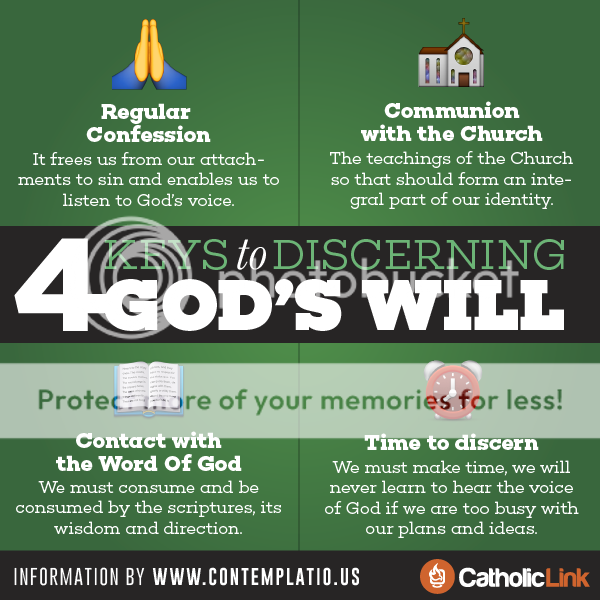
Having a hard time discovering God's Will? These 4 tips might help you rclxms.gif
Can you think of another one?

user posted image

To read more: http://www.contemplatio.us/4-keys-to-discerning-gods-will/

de1929
post Aug 26 2015, 01:34 PM

Regular
******
Senior Member
1,920 posts

Joined: Jan 2009


QUOTE(khool @ Aug 26 2015, 12:53 PM)
Little Li – China’s Precious Girl Martyr of the Eucharist
...
*
Appreciate the story. Just wanna share, does not mean to be boastful (except boast in CHRIST).

As i born and grew in christian family, there was some "mild" degree of persecution but not to spill my blood. Rejection, isolation, threaten from non-believer was quite common.

Well i don't have the crown of martyr if i died today, perhaps most of the crowns are "invest in people" related biggrin.gif ; if you know what i mean...

Good story.
khool
post Aug 26 2015, 09:04 PM

Getting Started
**
Junior Member
225 posts

Joined: Mar 2008


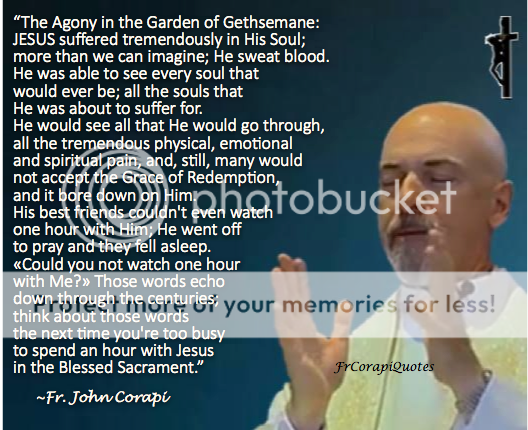
Words to ponder before contemplating on missing Mass ...

user posted image

khool
post Aug 26 2015, 09:05 PM

Getting Started
**
Junior Member
225 posts

Joined: Mar 2008


user posted image

TSyeeck
post Aug 27 2015, 01:58 AM

Look at all my stars!!
*******
Senior Member
3,573 posts

Joined: Apr 2006


Obama Punishes Kansas for De-Funding Planned Parenthood by Cutting Its Medicaid Funding
khool
post Aug 27 2015, 08:16 AM

Getting Started
**
Junior Member
225 posts

Joined: Mar 2008


QUOTE(yeeck @ Aug 27 2015, 01:58 AM)
Wonder when they plan to revoke the Church's tax exemption status too?
de1929
post Aug 27 2015, 09:38 AM

Regular
******
Senior Member
1,920 posts

Joined: Jan 2009


QUOTE(khool @ Aug 27 2015, 08:16 AM)
Wonder when they plan to revoke the Church's tax exemption status too?
*
ah, do you mean the 501c3 ?
khool
post Aug 27 2015, 11:07 AM

Getting Started
**
Junior Member
225 posts

Joined: Mar 2008


QUOTE(de1929 @ Aug 27 2015, 09:38 AM)
ah, do you mean the 501c3 ?
*
just idle musing
khool
post Aug 27 2015, 01:52 PM

Getting Started
**
Junior Member
225 posts

Joined: Mar 2008


HHS Hiatus
The Little Sisters of the Poor don't have to cooperate with evil — yet
by Ryan Fitzgerald • August 26, 2015

DENVER, August 26, 2015 (ChurchMilitant.com) -

The Little Sisters of the Poor, a group of women religious battling the U.S. government over its right to religious freedom, will not have to cooperate with contraception coverage for its employees while the Supreme Court considers its case.

The 10th Circuit U.S. Court of Appeals decided last month that the Little Sisters must sign off on free third-party coverage of contraceptives, sterilizations and abortifacients for their employees. This is required by the Health and Human Services' contraception mandate.

Doing so, however, would violate their consciences as well as Catholic moral principles.

The Supreme Court has allowed closely held, for-profit companies to be exempted from the law, but the Tenth Circuit court wouldn't let non-profits have the same exemption. It ruled that non-profits, because they have an option for third-party accommodations that for-profits don't, aren't substantially burdened in their religious exercise by the mandate.

"Although we recognize and respect the sincerity of plaintiffs' beliefs and arguments," the federal appeals court stated weeks ago, "we conclude the accommodation scheme ... does not substantially burden their religious exercise."

"The accommodation relieves plaintiffs from complying with the mandate and guarantees they will not have to provide, pay for, or facilitate contraceptive coverage," argued the judges.

But the Sisters would nevertheless have to facilitate contraceptive coverage by signing the U.S. Department of Labor's EBSA Form 700, which simply hands over permission to the government to find a coverage provider.

Thus, Sister Loraine Marie Maguire, Mother Provincial of the Little Sisters, said after the decision, "As Little Sisters of the Poor, we simply cannot choose between our care for the elderly poor and our faith."

Friday, the Little Sisters won a temporary injunction on the court ruling while they appeal to the nation's highest court. This means they won't have to comply with the mandate or pay fines as they await a final decision.

Source: http://www.churchmilitant.com/news/article...-little-sisters

khool
post Aug 29 2015, 04:57 PM

Getting Started
**
Junior Member
225 posts

Joined: Mar 2008


Guess who? ... brows.gif

user posted image

khool
post Sep 3 2015, 02:47 PM

Getting Started
**
Junior Member
225 posts

Joined: Mar 2008


user posted image


134 Pages « < 27 28 29 30 31 > » Top
Topic ClosedOptions
 

Change to:
| Lo-Fi Version
0.0374sec    0.38    6 queries    GZIP Disabled
Time is now: 3rd December 2025 - 07:22 AM