Welcome Guest ( Log In | Register )

Bump Topic Topic Closed RSS Feed
134 Pages « < 24 25 26 27 28 > » Bottom

Outline · [ Standard ] · Linear+

 LYN Catholic Fellowship V01 (Group), For Catholics (Roman or Eastern)

views
     
TSyeeck
post Jul 21 2015, 04:12 PM

Look at all my stars!!
*******
Senior Member
3,573 posts

Joined: Apr 2006


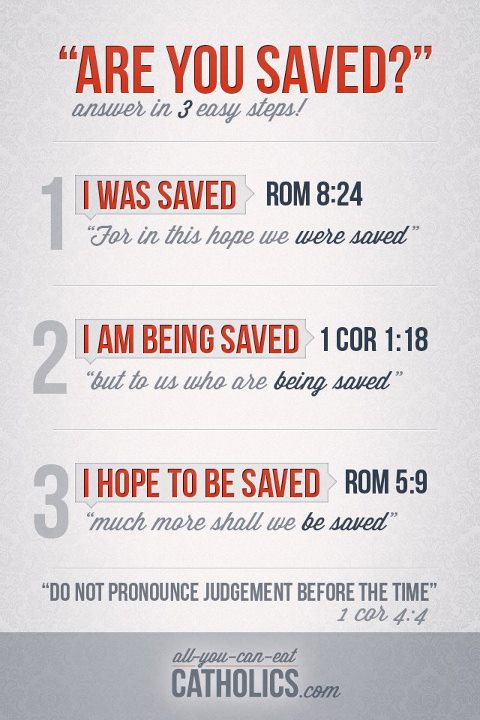
"Are You Saved?" If Only!
By: Tim Staples

"Do you know you’re saved so that if you were to die right now, heaven would be absolutely certain for you?" This "all-important" question is designed to bait Catholics into an ambush. When I speak at conferences around the country, I often ask the attendees how many have been asked that question by a Fundamentalist or Evangelical: Usually, over half of my Catholic audience raises a hand.

If the Catholic responds as any good Catholic would by declaring he cannot—apart from a special revelation from God—have metaphysical (or absolute) certainty concerning his salvation, the Protestant then springs his biblical trap, 1 John 5:13: "I write this to you who believe in the name of the Son of God, that you may know that you have eternal life." Next he tells the Catholic that if he will but "confess with [his] lips that Jesus is Lord and believe in [his] heart that God raised him from the dead, [he] will be saved" (Rom 10:9-10). All we need do is confess Jesus as Lord, and salvation is assured. We can know it with certainty. Salvation is guaranteed regardless of anything we may do or not do in the future. What a deal!

The Catholic Two-Step Response

Step One: The Greek word for knowledge (Gk. eideitei) in 1 John 5:13 does not necessarily equate to absolute certainty. We use the verb know the same way in English. For example, I may say I know I am going to get an A on my Greek exam tomorrow. Does that mean I have metaphysical certainty of this? Not at all. What I mean and what the verb know can be used to indicate is that I have confidence that I will get an A on my test tomorrow because I have studied the material thoroughly and I know it well.

The context of 1 John makes it abundantly clear that this is how "knowledge" is being used in 1 John 5:13. In the next two verses, John draws a parallel between the certainty we have concerning our salvation and the certainty we have when we petition God in prayer: "And this is the confidence which we have in him, that if we ask anything according to his will he hears us. And if we know that he hears us in whatever we ask, we know that we have obtained the requests made of him."

Does this mean we have absolute certainty we will receive what we ask for when we make requests of God in prayer? Obviously not! John says we can have "confidence," but not absolute certainty. We cannot always know with strict certainty that our request is truly "according to his will." Moreover, Psalm 66:18 informs us: "If I had cherished iniquity in my heart, the Lord would not have listened." And 1 John 3:22 says, ". . . we receive from him whatever we ask, because we keep his commandments and do what pleases him." Can we always be certain we have not "cherished iniquity" in our hearts, or that we have not done anything that may have displeased the Lord?

Step Two: Our salvation is contingent upon many things according to the Bible. This indicates the certainty of our salvation is not absolute. Just a few examples include 1 John 1:8-9: "If we say we have no sin, we deceive ourselves, and the truth is not in us. If we confess our sins, he is faithful and just, and will forgive our sins and cleanse us from all unrighteousness." The text says we will be forgiven if. Thus, the sobering truth is: Unconfessed sin will not be forgiven. And the Bible is very clear that no sin can enter into heaven (see Hb 1:13; Rv 21:8-9, 27).

I have heard it said that if is "the biggest little word" in the English dictionary. Well, Scripture has lots of ifs. John, for example, also says: "Let what you heard from the beginning abide in you. If what you heard from the beginning abides in you, then you will abide in the Son and in the Father. And this is what he has promised us, eternal life" (1 Jn 2:24-25).

This passage is plain. Our eternal life is contingent upon our choosing to abide in God. Can we choose the opposite? Absolutely! John goes on to explain: "No one who abides in him sins; no one who sins has either seen him or known him. Little children, let no one deceive you. He who does right is righteous, as he is righteous. He who commits sin is of the devil . . . No one born of God commits sin . . ." (1 Jn 3:6-9).

On the surface, this text seems odd. We have already heard John say that everyone who is born of God does sin. Indeed, "all" sin. Yet, here he says those who are born of God do not sin. Is John contradicting himself? No: John makes a distinction between mortal and venial sins in this same epistle. In 1 John 5:16-17, John gives us remarkably plain definitions of both mortal and venial sins. "If any one sees his brother committing what is not a mortal sin, he will ask, and God will give him life for those whose sin is not mortal. There is sin which is mortal . . . All wrongdoing is sin, but there is sin which is not mortal."

In this context, we can reasonably conclude the one who is born of God does not commit mortal sin. If he were to do so, he would be "cut off" from the body of Christ and would need to be restored via confession to a state of grace (Cf. Gal 5:4, Eph 3:3-6, Jn 20:21-23). Three more texts about the contingency of salvation bolster the argument:

* 1 Corinthians 15:1-2: Now I would remind you, brethren, in what terms I preached to you the gospel, which you received, in which you stand, by which you are saved, if you hold it fast—unless you believed in vain. (See also Matthew 24:44-51; Luke 12:41-46; Romans 11:22; Hebrews 3:6;14; Revelation 2:10; 25-26; 3:1-5; 22:18-19, for many more "ifs" and contingency clauses.)
* Colossians 1:21-23: And you, who once were estranged and hostile in mind, doing evil deeds, he has now reconciled in his body of flesh by his death, in order to present you holy and blameless and irreproachable before him, provided that you continue in the faith, stable and steadfast, not shifting from the hope of the gospel which you heard . . .
* 2 Peter 2:20-22: For if, after they have escaped the defilements of the world through the knowledge of our Lord and Savior Jesus Christ, they are again entangled in them and overpowered, the last state has become worse for them than the first . . . It has happened to them according to the true proverb, the dog turns back to his own vomit, and the sow is washed only to wallow in the mire.

The Evangelical Counter

In response, the Protestant apologist will sometimes say these texts do not indicate one who was truly saved could actually lose his salvation. The one who, in the end, did not continue with the Lord, never really knew the Lord in the first place. He only knew about the Lord. But this line of reasoning does not hold up under scrutiny. In 2 Peter 2, the Greek word used for knowledge is epignosei. This word means "knowledge," but it denotes an experiential knowledge. This text is very clear that the persons referred to have "escaped the pollutions of the world" through this "experiential knowledge" of Jesus. Only a personal relationship with Jesus can have this effect. Merely knowing about Jesus cannot do that. Moreover, the image Peter uses in verse 22 is of the sow having been washed in water. Water is the symbol Peter uses for baptism in 1 Peter 3:20-21. The connection seems obvious. The sow—female pig—which had been cleansed represents a person cleansed from sin; the sow returning to the mud represents the Christian returning to sin.

When seen in the fuller context of 2 Peter, this point becomes unmistakable. In 2 Peter 1:2-4, Peter begins with a description of Christians:

May grace and peace be multiplied to you in the knowledge [epignosei, experiential knowledge once again] of God and of Jesus our Lord. His divine power has granted to us all things that pertain to life and godliness, through the knowledge [epignosei] of him who called us to his own glory and excellence, by which he has granted to us his precious and very great promises, that through these you may escape from the corruption that is in the world because of passion, and become partakers of the divine nature.

One cannot help but see the parallels between these two texts. The same Greek words, epignosei, apophugentes, "having escaped from," and a form of kosmos or "world," are used to describe what Christians have been freed from, as well as to describe the one who then goes back to his old ways and ends up worse than he was before he ever knew Jesus.

These are just a few texts among the scores we could examine, but the bottom line is Scripture is crystal-clear on this point: Once saved does not mean always saved. In Matthew 6:15, Jesus tells us that "if you do not forgive men their trespasses, neither will your Father forgive your trespasses." It does not matter how "born again" one may be or how many experiences one has had, if he does not forgive others, he will not be forgiven, according to the text. And remember—as we have seen—no sin can enter into heaven (cf. Hb 1:13, Rv 21:27). Further, the Bible says we can "fall from grace" (Gal 5:1-5, Heb 12:14-16), be "cut off" from the vine from which we receive divine life (Jn 15:1-6, Rom 11:18-22), have our names removed from the Lamb’s book of life (Rv 22:19), and it assures us over and over again that if we commit certain sins and we do not repent of them, we will not go to heaven (cf. 1 Cor 6:9-11, Gal 5:19, Eph 5:3-5, Rv 21:6-8).

Not Once, But Many Times

But what about Romans 10:9-10? Doesn’t the Bible say if you believe in your heart and confess Jesus with your mouth you shall be saved? Yes it does, but that doesn’t mean we need only confess faith in Christ one time. The Bible uses the same Greek word for confess, homologeitai, in multiple places and emphasizes we must continue to confess Christ if we are going to be finally saved. For example, in Matthew 10:22, 32 Jesus says, "You will be hated by all because of my name, but it is the one who has endured to the end who will be saved.. . . Therefore everyone who confesses me before men, I will also confess him before my father who is in heaven. . . ." (NAB). The context here is one of holding fast to our confession until death (see also 2 Tm 2:12 and Heb 4:14; 10:23-26).

Finally, confessing Christ is done not only in word, but also in deed: "If any one does not provide for his relatives, and especially for his own family, he has disowned the faith and is worse than an unbeliever" (1 Tm 5:8).

Notice, the man who neglects his family for selfish pursuits denies Christ in his actions. And as we have seen, the Bible records in many places extensive lists of sins whereby we can deny Christ, such as 1 Corinthians 6:9-10: "Do you not know that the unrighteous will not inherit the kingdom of God? Do not be deceived; neither the immoral, nor idolaters, nor adulterers, nor sexual perverts, nor thieves, nor the greedy, nor drunkards, nor revilers, nor robbers will inherit the kingdom of God." Scripture never says the saved can do these things and still go to heaven.
user posted image
khool
post Jul 22 2015, 06:27 PM

Getting Started
**
Junior Member
225 posts

Joined: Mar 2008


user posted image

God Bless! biggrin.gif

TSyeeck
post Jul 23 2015, 03:29 PM

Look at all my stars!!
*******
Senior Member
3,573 posts

Joined: Apr 2006


Protect me, O Lord, from temptation

user posted image

Temptation is always around us, so how can we protect ourselves against sin? And what lesson can be derived from Christ's prophesizing about the destruction of Jerusalem?

This lesson from The Church's Year of Fr. Leonard Goffine not only covers how to pray to against temptation, but also the importance of having a repentant heart versus a hardened one—and how Christ's foretold destruction of Jerusalem exemplifies the latter.

Instruction on the 9th Sunday after Pentecost

Implore God for help and protection against all temptations both visible and invisible, and say with the priest at the Introit:

INTROIT Behold, God is my helper, and the Lord is the protector of my soul: turn back the evils upon my enemies, and cut them off in thy truth, O Lord, my protector. (Ps. 53) Save me, O God, by thy name, and deliver me in thy strength. Glory be, etc.

COLLECT Let the ears of Thy mercy, O Lord, be open to the prayers of Thy suppliants: and that Thou mayest grant them their desires, make them to ask such things as please Thee. Through etc.

EPISTLE (I Cor. 10:6-13) Brethren, Let us not covet evil things, as they also coveted. Neither become ye idolaters, as some of them: as it is written: The people sat down to eat and drink, and rose up to play. Neither let us commit fornication, as some of them committed fornication, and there fell in one day three and twenty thousand. Neither let us tempt Christ, as some of them tempted, and perished by the serpents. Neither do you murmur, as some of them murmured, and were destroyed by the destroyer. Now all these things happened to them in figure, and they are written for our correction, upon whom the ends of the world are come. Wherefore he that thinketh himself to stand, let him take heed lest he fall. Let no temptation take hold on you, but such as is human: and God is faithful, who will not suffer you to be tempted above that which you are able but will make also with temptation issue that you may be able to bear it.

Can we sin by thought and desire?
Yes, if we desire evil and forbidden things, or voluntarily think of them with pleasure, for God prohibits not only evil deeds, but evil thoughts and desires in regard to our neighbor's wife or goods. (Exod. 20:17) Christ says, (Matt. 5:28) that he who looks upon a woman with evil desire, has already committed adultery. But wicked thoughts and imagination are sinful only when a person consents to, or entertains them deliberately. They become, however, an occasion of gaining merit, if we earnestly strive against them. For this reason God sometimes permits even the just to be tempted by them.

What is meant by tempting God?
Demanding presumptuously a mark or sign of divine omnipotence, goodness or justice. This sin is committed when without cause we desire that articles of faith should be demonstrated and confirmed by a new miracle; when we throw ourselves needlessly into danger of body or soul expecting God to deliver us; when in dangerous illness the ordinary and, natural remedies are rejected, and God's immediate assistance expected.

Is it a great sin to murmur against God?
That it is such may be learned from the punishment which God inflicted on the murmuring Israelites; for besides Kore, Dathan, and Abiron whom the earth devoured, many thousands of them were consumed by fire; and yet these had not murmured against God directly, but only against Moses and Aaron whom God had placed over them as their leaders. From this it is seen that God looks upon murmuring against spiritual and civil authority, instituted by Him, as murmuring against Himself. Hence Moses said to the Israelites: Your murmuring is not against us, but against the Lord. (Exod. 16:8)

ASPIRATION Purify my heart, I beseech. Thee; O Lord, from all evil thoughts and desires. Let it never enter my mind to tempt Thee, or to be dissatisfied with Thy fatherly dispensations. Suffer me not to be tempted beyond my strength, but grant me so much fortitude, that I may overcome all temptations, and even derive benefit from them for my soul's salvation.

GOSPEL (Luke 19:41-47) At that time, when Jesus drew near Jerusalem, seeing the city, he wept over it, saying: If thou also hadst known, and that in this thy day, the things that are to thy peace: but now they are hidden from thy eyes. For the days shall come upon thee, and thy enemies shall cast a trench about thee, and compass thee round, and straiten thee on every side, and beat thee flat to the ground, and thy children who are in thee: and they shall not leave in thee a stone upon a stone, because thou hast not known the time of thy visitation. And entering into the temple, he began to cast out them that sold therein, and them that bought, saying to them: It is written, My house is the house of, prayer, but you have made it a den of thieves. And he was teaching daily in the temple.

Why did our Savior weep over the city of Jerusalem?
Because of the ingratitude and obduracy of its inhabitants who would not receive Him as their Redeemer, and who through impenitence were hastening to destruction.

When was the time of visitation?
The period in which God sent them one prophet after another who urged them to penance, and whom they persecuted, stoned, and killed. (Matt. 23:34) It was especially the time of Christ's ministry, when He so often announced His salutary doctrine in the temple of Jerusalem, confirmed it by miracles, proving Himself to be the Messiah, the Savior of the world, but was despised and rejected by this hardened and impenitent city.

Who are prefigured by this hardened and impenitent city?
The hard-hearted, unrepentant sinners who will not recognize the time of God's visitation, in which He urges them by the mouth of His preachers, confessors, and superiors, and by inward inspiration to reform their lives and seek the salvation of their soul, but who give no ear to these admonitions, and defer conversion to the end of their lives. Their end will be like to that of this impious city; then the enemy, that is, the evil spirit, will surround their soul, tempt, terrify, and drag it into the abyss of ruin. Oh, how foolish it is to squander so lightly, the time of grace, the days of salvation! Oh, how would the damned do penance, could they but return to earth! Oh, how industriously would they employ the time to save their soul! Use, then, my dear Christian, the time of grace which God designs for you, and which, when it is run out or carelessly thrown away, will not be lengthened for a moment.

Will God conceal from the wicked that which serves for their salvation?
No; but while they are running after the pleasures of this life, as St. Gregory says, they see not the misfortunes treading in their footsteps, and as consideration of the future makes them uncomfortable in the midst of their worldly pleasures, they remove the terrible thought far from them, and thus run with eyes blindfolded in the midst of their pleasure into eternal flames. Not God, but they themselves hide the knowledge of all that is for their peace, and thus they perish.

ASPIRATION I beseech Thee, O Lord, who didst weep over the city of Jerusalem, because it knew not the time of its visitation, to enlighten my heart, that I may know and profit by the season of grace.

The destruction of the city and Temple of Jerusalem

Has Our Divine Savior's prophecy concerning, the city of Jerusalem been fulfilled?
Yes, and in the most terrible manner. The Jews, oppressed by the Romans their cruel masters, revolted, killed many of their enemies, and drove them out of Jerusalem. Knowing well that this would not be permitted to pass unavenged, the Jews armed themselves for a desperate resistance. The Emperor Nero sent a powerful army under the command of Vespasian against the city of Jerusalem, which first captured the smaller fortresses of Judea, and then laid siege to the city. The want and misery of the inhabitants had already reached the highest pitch; for within the city ambitious men had caused conflicts; factions had been formed, daily fighting each other, and reddening the streets with blood, while the angry Romans stormed outside.

Then a short time of respite was granted to the unfortunate Jews. The Emperor Nero was murdered at Rome in the year of Our Lord 68; his successor Galba soon died, and the soldiers placed their beloved commander Vespasian upon the imperial throne. He then left Jerusalem with his army, but in the year he sent his son Titus with a new army to Judea, with orders to capture the city at any price, and to punish its inhabitants.

It was the time of Easter, and a multitude of Jews had assembled from all provinces of the land, when Titus appeared with his army before the gates of Jerusalem, and surrounded the city. The supply of food was soon exhausted, famine and pestilence came upon the city and raged terribly. The leader of the savage revolutionists, John of Gischala, caused the houses to be searched, and the remaining food to be torn from the starving, or to be forced from them by terrible tortures: To save themselves from this outrageous tyrant, the Jews took the leader of a band of robbers, named Simon, with his whole gang into the city. John and Simon with their followers now sought to annihilate each other. John took possession of the temple. Simon besieged him; blood was streaming in the temple and in the streets. Only when the battle-din of the Romans was heard from without, did the hostile factions unite, go to meet the enemy, and resist his attack.

As the famine increased, many Jews secretly left the city to seek for herbs. But Titus captured them with his cavalry, and crucified those who were armed. Nearly five hundred men, and sometimes more, were every day crucified in sight of the city, so that there could not be found enough of crosses and places of execution; but even this terrible sight did not move the Jews to submission. Incited by their leaders to frenzy, they obstinately resisted, and Titus finding it impossible to take the city by storm, concluded to surround it by walls in order to starve the inhabitants. In three days his soldiers built a wall of about ten miles in circumference, and thus the Savior’s prediction was fulfilled: Thy enemies shall cast a trench about thee, and compass thee round, and straiten thee on every side.

The famine in this unfortunate city now reached its most terrific height; the wretched inhabitants searched the very gutters for food, and ate the most disgusting things. A woman, ravenous from hunger, strangled her own child, roasted it, and ate half of it; the leaders smelling the horrible meal, forced a way into the house, and by terrible threats compelled the woman to show them what she had eaten; she handed them the remaining part of the roasted child, saying: "Eat it, it is my child; I presume you are not more dainty than a woman, or more tender than a mother." Stricken with horror they rushed from the house.

Death now carried away thousands daily, the streets and the houses were full of corpses: From the fourteenth of April when the siege commenced to the first of July, there were counted 158,000 dead bodies; 600,000 others were thrown over the walls into the trenches to save the city from infection. All who could flee, fled; some reached the camp of the Romans in safety; Titus spared the helpless, but all who fell into his hands armed, were crucified. Flight offered no better security. The Roman soldiers had learned that many Jews had swallowed, gold to secure it from the avarice of the robbers, and therefore the stomachs of many were cut open. Two thousand such corpses were found one morning in the camp of the Romans. The attempts of Titus to prevent this cruelty were unavailing.

Finally, when misery had reached its height, Titus succeeded in carrying the fort, Antonia, and with his army forced a passage as far as the temple which had been held by John of Gischala with his famous band. Desirous of saving the temple, Titus offered the revolutionists free passage from it, but his proposition was rejected, and the most violent contest then raged; the Romans trying to enter the temple, and being continually repulsed, at last, one of the soldiers seized a firebrand, and threw it into one of the rooms attached to the temple. The flames in an instant caught the whole of the inner temple, and totally consumed it, so that this prediction of Our Lord was also fulfilled.

The Romans butchered all the inhabitants whom they met, and Titus having razed the ruins of the temple and city, ploughed it over, to indicate that this city was never to be rebuilt. During the siege 1,100,000 Jews lost their lives; 97,000 were sold as slaves, and the rest of the people dispersed over the whole earth.

Thus God punished the impenitent city and nation, over whose wretchedness the Savior wept so bitterly, and thus was fulfilled the prediction made by Him long before.

What do we learn from this?
That as this prediction so also all other threats and promises of the Savior will be fulfilled. The destruction of the city and temple of Jerusalem, the dispersion of the Jews, are historical facts which cannot be denied, and testify through all centuries to the truth of our Lord's word: Heaven and earth shall pass away, but my words shall not pass away. (Matt. 24:35)

Useful lessons concerning death-bed repentance

Can a sinner rely upon his being converted at the end of his life?
By no means, for this would be a sin against the mercy of God which is much the same as the sin against the Holy Ghost. "God," says St. Augustine, "generally so punishes such negligent sinners, that in the end they forget themselves, as in health they forgot Him." He says: They have turned their back to me, and not their face: and in the time of their affliction they will say: Arise, and deliver us! Where are the gods whom thou hast made thee? Let them arise and deliver thee in the time of thy affliction. (Jer. 2:27-28) And although we have a consoling example in the case of the penitent thief, yet this, as St. Augustine says, is only one, that the sinner may not despair: and it is only one, so that the sinner may have no excuse for his temerity in putting off his repentance unto the end.

What may we hope of those who are converted at the close of life?
Everything that is good if they be truly converted, but this is a very rare thing, as St. Augustine says: "It cannot be asserted with any security, that he who repents at the end has forgiveness;" and St. Jerome writes: "Scarcely one out of thousands whose life was impious, will truly repent at death and obtain forgiveness of sin;" and St. Vincent Ferrer says, "For a man who has lived an impious life to die a good death is a greater miracle than the raising of the dead to life." We need not be surprised at this, for repentance at the end of life is extorted by the fear of death and the coming judgment. St. Augustine says, that it is not he who abandons sin, but sin abandons him, for he would not cease to offend God, if life were granted him. What can we expect from such a conversion?

When should we repent?
While we are in health, in possession of our senses and strength, for according to the words of St. Augustine, the repentance of the sick is a sickly repentance. As experience proves, man while ill is so tormented and bewildered by the pains of sickness and the fear of death, by remorse of conscience, and the temptations of the devil as well as by anxiety for those whom he leaves, that he can scarcely collect his thoughts, much less fit himself for true repentance. Since it is so hard for many to do penance while they are in health, and have nothing to prevent them from elevating their mind to God, how much more difficult will it be for them, when the body is weakened and tortured by the pains of sickness.

It has been made known by many persons when convalescent, that they retained not the slightest recollection of anything which occurred during their illness, and although they confessed and received the last Sacraments, they did not remember it. If then you have committed a grievous sin, do not delay to be reconciled as soon as possible by contrition and a sacramental confession. Do not put off repentance from day to day, for thereby conversion becomes more difficult, so much so that without extraordinary grace from God, you cannot repent God does not give His grace to the presumptuous scoffer.
TSyeeck
post Jul 25 2015, 12:54 AM

Look at all my stars!!
*******
Senior Member
3,573 posts

Joined: Apr 2006


Interesting video, but I'm sad that CHIJMES is now a secular place.


This post has been edited by yeeck: Jul 25 2015, 12:55 AM
khool
post Jul 25 2015, 03:04 PM

Getting Started
**
Junior Member
225 posts

Joined: Mar 2008


QUOTE(yeeck @ Jul 25 2015, 12:54 AM)
Interesting video, but I'm sad that CHIJMES is now a secular place.


*
What is CHIJMES?

khool
post Jul 25 2015, 04:08 PM

Getting Started
**
Junior Member
225 posts

Joined: Mar 2008


Archbishop elect Robert Baron ...


God bless and have a good weekend! biggrin.gif
TSyeeck
post Jul 25 2015, 05:32 PM

Look at all my stars!!
*******
Senior Member
3,573 posts

Joined: Apr 2006


QUOTE(khool @ Jul 25 2015, 03:04 PM)
What is CHIJMES?
*
https://en.wikipedia.org/wiki/CHIJMES
khool
post Jul 25 2015, 06:04 PM

Getting Started
**
Junior Member
225 posts

Joined: Mar 2008


QUOTE(yeeck @ Jul 25 2015, 05:32 PM)
Thanks!

TSyeeck
post Jul 25 2015, 06:51 PM

Look at all my stars!!
*******
Senior Member
3,573 posts

Joined: Apr 2006


To commemorate the 47th anniversary of Humanae Vitae and the recently promulgated Laudato Si...hehe

user posted image
khool
post Jul 26 2015, 10:02 AM

Getting Started
**
Junior Member
225 posts

Joined: Mar 2008


Seventeenth Sunday in Ordinary Time
Lectionary: 110


Reading 1 (2 Kgs 4:42-44)

A man came from Baal-shalishah bringing to Elisha, the man of God,
twenty barley loaves made from the firstfruits,
and fresh grain in the ear.
Elisha said, “Give it to the people to eat.”
But his servant objected,
“How can I set this before a hundred people?”
Elisha insisted, “Give it to the people to eat.”
“For thus says the LORD,
‘They shall eat and there shall be some left over.’”
And when they had eaten, there was some left over,
as the LORD had said.


Responsorial Psalm (Ps 145:10-11, 15-16, 17-18)

R. (cf. 16) The hand of the Lord feeds us; he answers all our needs.
Let all your works give you thanks, O LORD,
and let your faithful ones bless you.
Let them discourse of the glory of your kingdom
and speak of your might.
R. The hand of the Lord feeds us; he answers all our needs.
The eyes of all look hopefully to you,
and you give them their food in due season;
you open your hand
and satisfy the desire of every living thing.
R. The hand of the Lord feeds us; he answers all our needs.
The LORD is just in all his ways
and holy in all his works.
The LORD is near to all who call upon him,
to all who call upon him in truth.
R. The hand of the Lord feeds us; he answers all our needs.


Reading 2 (Eph 4:1-6)

Brothers and sisters:
I, a prisoner for the Lord,
urge you to live in a manner worthy of the call you have received,
with all humility and gentleness, with patience,
bearing with one another through love,
striving to preserve the unity of the spirit through the bond of peace:
one body and one Spirit,
as you were also called to the one hope of your call;
one Lord, one faith, one baptism;
one God and Father of all,
who is over all and through all and in all.


Alleluia (Lk 7:16)

R. Alleluia, alleluia.
A great prophet has arisen in our midst.
God has visited his people.
R. Alleluia, alleluia.


Gospel (Jn 6:1-15)

Jesus went across the Sea of Galilee.
A large crowd followed him,
because they saw the signs he was performing on the sick.
Jesus went up on the mountain,
and there he sat down with his disciples.
The Jewish feast of Passover was near.
When Jesus raised his eyes
and saw that a large crowd was coming to him,
he said to Philip,
“Where can we buy enough food for them to eat?”
He said this to test him,
because he himself knew what he was going to do.
Philip answered him,
“Two hundred days’ wages worth of food would not be enough
for each of them to have a little.”
One of his disciples,
Andrew, the brother of Simon Peter, said to him,
“There is a boy here who has five barley loaves and two fish;
but what good are these for so many?”
Jesus said, “Have the people recline.”
Now there was a great deal of grass in that place.
So the men reclined, about five thousand in number.
Then Jesus took the loaves, gave thanks,
and distributed them to those who were reclining,
and also as much of the fish as they wanted.
When they had had their fill, he said to his disciples,
“Gather the fragments left over,
so that nothing will be wasted.”
So they collected them,
and filled twelve wicker baskets with fragments
from the five barley loaves
that had been more than they could eat.
When the people saw the sign he had done, they said,
“This is truly the Prophet, the one who is to come into the world.”
Since Jesus knew that they were going to come and carry him off
to make him king,
he withdrew again to the mountain alone.

Blessed Sunday everyone!!! biggrin.gif

TSyeeck
post Jul 26 2015, 11:54 PM

Look at all my stars!!
*******
Senior Member
3,573 posts

Joined: Apr 2006


Happy feast of St Anne!

user posted image
khool
post Jul 27 2015, 09:48 AM

Getting Started
**
Junior Member
225 posts

Joined: Mar 2008


QUOTE(yeeck @ Jul 26 2015, 11:54 PM)
Happy feast of St Anne!

user posted image
*
Was at St. Anne's, Klang yesterday evening ... Father Paulino's homily rox!!! biggrin.gif rclxms.gif rclxm9.gif icon_idea.gif notworthy.gif notworthy.gif

This post has been edited by khool: Jul 27 2015, 09:48 AM
khool
post Jul 28 2015, 09:18 AM

Getting Started
**
Junior Member
225 posts

Joined: Mar 2008


The Two Things Man Was Supposed to Do in Eden
Stephen Beale

There were two things Adam was supposed to do in the Garden of Eden.

Given that this was the terrestrial paradise—Eden could be translated as delight or pleasure—one might think Adam was meant to relax and take it easy.

But that’s not quite what Genesis 2:15 tells us: ‘The Lord God then took the man and settled him in the garden of Eden, to cultivate and care for it.’ That’s the New American Bible translation. A traditional rendering is ‘till and keep.’

Till and keep. That doesn’t sound like stuff you’d have to do in place called the Garden of Delights.

We tend to think of work as a hardship, a necessity ushered in by the Fall (see Genesis 3:17-19). But here, in a place called the Garden of Delights, work is part of the deal. Think about that for a moment: in the beginning, in his original condition free from sin, man was intended to work.

One biblical commentator neatly captures the significance of this verse:

" ... Even in paradise itself man had to work. None of us were sent into the world to be idle. He that made our souls and bodies, has given us something to work with; and he that gave us this earth for our habitation, has made us something to work upon. The sons and heirs of heaven, while in this world, have something to do about this earth, which must have its share of their time and thoughts; and if they do it with an eye to God, they as truly serve him in it, as when they are upon their knees. Observe that the husbandman’s calling is an ancient and honourable calling; it was needful even in paradise. Also, there is true pleasure in the business God calls us to, and employs us in. Adam could not have been happy if he had been idle. (From the commentary by Matthew Henry, a Welch Presbyterian minister who lived from the late 1660s to the early 1700s.) ... "

St. John Chrysostom, in his commentary on Genesis, agrees, emphasizing work as the antidote to sloth and sin:

" ... I mean, since life there was filled with every delight, was a pleasure to behold and a thrill to enjoy, he arranged accordingly that the human being should till the garden and watch over it lest he be unsettled by the exceeding indulgence. Well, why, do you ask, did the garden require attention by him? I’m not telling you that, but in fact God wanted him for a while to take some slight care that was appropriate in both watching and tilling. If, after all, he had been relieved of all need to work, he would have fallen a victim to great indulgence and at once have slipped into sloth; whereas in fact by performing some work that was painless and without difficulty he would be brought to a better frame of mind. ... "

The work is twofold: till and keep. The first applies to the plants of the garden. The second is less obvious but appears to refer to keeping watch over the animals. This is, for example, how the word is used in Genesis 30:31, in reference to Jacob as a keeper of flocks.

The question arises: how was this work different from the work that became a curse for man in Genesis 3:17-19. Read those verses closely. There, the work was tied to eating, the bare necessities of life. ‘In toil you shall eat its yield’ (verse 17) and ‘By the sweat of your brow you shall eat bread’ (verse 19).

We don’t have enough information to conclude that Adam’s work was not connected with the food he ate. But we do have enough information to know that God himself had already ‘planted’ the garden and grown the trees ‘good for food’ (Genesis 2:8-9). Work in the Garden of Eden wasn’t so much about surviving—as it would be after the Fall—as it was for the thriving of man.

Not only did the purpose of work seem to change, but the nature of the work itself most assuredly did. In Genesis 2:15 the call to ‘till and keep’ comes after God ‘settled’ or ‘put’ Adam in the garden. The Hebrew word for ‘put’ (yanach, pronounced as yä·nakh’) could also be translated as repose, have rest, be quiet. So a more literal translation might be: ‘God caused Adam to be rested and reposed.’

God’s action here necessarily informs the implicit command to ‘till and keep’ that follows. It suggests to us that in the Garden of Eden the work of man was restful. We can push the implications of this a bit further: perhaps one of the evil consequences of the fall has been this separation between work and rest, causing the work we do to not be restful and the rest we require as an escape from the stresses of work to not be productive.

On a natural level, the lesson here is significant: man was made for something, not the nothingness of luxurious idleness.

But the text also has a deeper meaning on a supernatural level. God did not create Adam, drop him off in paradise to have fun and leave him be. Adam’s work in paradise was ultimately meant to lead him to revere and worship God.

For Chrysostom this ultimate purpose is signified in the word ‘watch.’ He concludes:

" ... That phrase, ‘to watch over it,’ is not added idly: it is an instance of considerateness in expression to the effect that he might be fully aware that he was subject to a master who had regaled him with such enjoyment, and along with that enjoyment entrusted him with its protection. God, you see, creates everything and arranges it for our salvation. ... "

Today, this raises a number of challenging questions for us.

On a natural level: How can we find work that is more ‘restful’—that feeds our souls beyond just providing for the bare necessities of survival? To the extent that we as individuals can find this work we are living out our original purpose as human beings. And, to the extent that society creates the conditions where such work is increasingly available, it is one that better serves the common good than another.

Then the supernatural: How can our work bring us closer to God? How can we sanctify our work day? How can we acknowledge God’s ultimate sovereignty over what we do?

Ultimately, we are all called, through grace, to till and keep our own gardens of Eden.

Source: http://catholicexchange.com/the-two-things...d-to-do-in-eden

TSyeeck
post Jul 29 2015, 05:34 PM

Look at all my stars!!
*******
Senior Member
3,573 posts

Joined: Apr 2006


"Not every one that saith to me, Lord, Lord, shall enter into the kingdom of heaven: but he that doth the will of my Father who is in heaven, he shall enter into the kingdom of heaven. Many will say to me in that day: Lord, Lord, have not we prophesied in thy name, and cast out devils in thy name, and done many miracles in thy name? And then will I profess unto them, I never knew you: depart from me, you that work iniquity." - Matthew 7:21-23

Discuss.

This post has been edited by yeeck: Jul 30 2015, 11:55 AM
khool
post Jul 30 2015, 09:33 AM

Getting Started
**
Junior Member
225 posts

Joined: Mar 2008


QUOTE(yeeck @ Jul 29 2015, 05:34 PM)
"Not every one that saith to me, Lord, Lord, shall enter into the kingdom of heaven: but he that doth the will of my Father who is in heaven, he shall enter into the kingdom of heaven. Many will say to me in that day: Lord, Lord, have not we prophesied in thy name, and cast out devils in thy name, and done many miracles in thy name? And then will I profess unto them, I never knew you: depart from me, you that work iniquity." - Matthew 7:21-23

Discuss.
*
Errr ... discuss in what context bro? biggrin.gif

TSyeeck
post Jul 30 2015, 11:55 AM

Look at all my stars!!
*******
Senior Member
3,573 posts

Joined: Apr 2006


"He who saith that he knoweth him, and keepeth not his commandments, is a liar, and the truth is not in him." 1 John 2:4
TSyeeck
post Jul 30 2015, 02:17 PM

Look at all my stars!!
*******
Senior Member
3,573 posts

Joined: Apr 2006


-duplicate-

This post has been edited by yeeck: Jul 30 2015, 02:19 PM
TSyeeck
post Jul 30 2015, 02:18 PM

Look at all my stars!!
*******
Senior Member
3,573 posts

Joined: Apr 2006


The Sacrifice of the Mass

user posted image

The Eucharist is a true sacrifice, not just a commemorative meal, as "Bible Christians" insist. The first Christians knew that it was a sacrifice and proclaimed this in their writings. They recognized the sacrificial character of Jesus’ instruction, "Do this in remembrance of me" (Touto poieite tan eman anamnasin; Luke 22:19, 1 Cor. 11:24–25) which is better translated "Offer this as my memorial offering."

Thus, Protestant early Church historian J. N. D. Kelly writes that in the early Church "the Eucharist was regarded as the distinctively Christian sacrifice. . . . Malachi’s prediction (1:10–11) that the Lord would reject Jewish sacrifices and instead would have "a pure offering" made to him by the Gentiles in every place was seized upon by Christians as a prophecy of the Eucharist. TheDidache indeed actually applies the term thusia, or sacrifice, to the Eucharist. . . .

"It was natural for early Christians to think of the Eucharist as a sacrifice. The fulfillment of prophecy demanded a solemn Christian offering, and the rite itself was wrapped in the sacrificial atmosphere with which our Lord invested the Last Supper. The words of institution, ‘Do this’ (touto poieite), must have been charged with sacrificial overtones for second-century ears; Justin at any rate understood them to mean, ‘Offer this.’ . . . The bread and wine, moreover, are offered ‘for a memorial (eis anamnasin) of the passion,’ a phrase which in view of his identification of them with the Lord’s body and blood implies much more than an act of purely spiritual recollection" (J. N. D. Kelly, Early Christian Doctrines [Full Reference], 196–7).


The Didache

"Assemble on the Lord’s day, and break bread and offer the Eucharist; but first make confession of your faults, so that your sacrifice may be a pure one. Anyone who has a difference with his fellow is not to take part with you until he has been reconciled, so as to avoid any profanation of your sacrifice [Matt. 5:23–24]. For this is the offering of which the Lord has said, ‘Everywhere and always bring me a sacrifice that is undefiled, for I am a great king, says the Lord, and my name is the wonder of nations’ [Mal. 1:11, 14]" (Didache 14 [A.D. 70]).


Pope Clement I

"Our sin will not be small if we eject from the episcopate those who blamelessly and holily have offered its sacrifices. Blessed are those presbyters who have already finished their course, and who have obtained a fruitful and perfect release" (Letter to the Corinthians 44:4–5 [A.D. 80]).


Ignatius of Antioch

"Make certain, therefore, that you all observe one common Eucharist; for there is but one Body of our Lord Jesus Christ, and but one cup of union with his Blood, and one single altar of sacrifice—even as there is also but one bishop, with his clergy and my own fellow servitors, the deacons. This will ensure that all your doings are in full accord with the will of God" (Letter to the Philadelphians 4 [A.D. 110]).


Justin Martyr

"God speaks by the mouth of Malachi, one of the twelve [minor prophets], as I said before, about the sacrifices at that time presented by you: ‘I have no pleasure in you, says the Lord, and I will not accept your sacrifices at your hands; for from the rising of the sun to the going down of the same, my name has been glorified among the Gentiles, and in every place incense is offered to my name, and a pure offering, for my name is great among the Gentiles . . . [Mal. 1:10–11]. He then speaks of those Gentiles, namely us [Christians] who in every place offer sacrifices to him, that is, the bread of the Eucharist and also the cup of the Eucharist" (Dialogue with Trypho the Jew 41 [A.D. 155]).


Irenaeus

"He took from among creation that which is bread, and gave thanks, saying, ‘This is my body.’ The cup likewise, which is from among the creation to which we belong, he confessed to be his blood. He taught the new sacrifice of the new covenant, of which Malachi, one of the twelve [minor] prophets, had signified beforehand: ‘You do not do my will, says the Lord Almighty, and I will not accept a sacrifice at your hands. For from the rising of the sun to its setting my name is glorified among the Gentiles, and in every place incense is offered to my name, and a pure sacrifice; for great is my name among the Gentiles, says the Lord Almighty’ [Mal. 1:10–11]. By these words he makes it plain that the former people will cease to make offerings to God; but that in every place sacrifice will be offered to him, and indeed, a pure one, for his name is glorified among the Gentiles" (Against Heresies 4:17:5 [A.D. 189]).


Cyprian of Carthage

"If Christ Jesus, our Lord and God, is himself the high priest of God the Father; and if he offered himself as a sacrifice to the Father; and if he commanded that this be done in commemoration of himself, then certainly the priest, who imitates that which Christ did, truly functions in place of Christ" (Letters 63:14 [A.D. 253]).


Serapion

"Accept therewith our hallowing too, as we say, ‘Holy, holy, holy Lord Sabaoth, heaven and earth is full of your glory.’ Heaven is full, and full is the earth, with your magnificent glory, Lord of virtues. Full also is this sacrifice, with your strength and your communion; for to you we offer this living sacrifice, this unbloody oblation" (Prayer of the Eucharistic Sacrifice 13:12–16 [A.D. 350]).


Cyril of Jerusalem

"Then, having sanctified ourselves by these spiritual hymns, we beseech the merciful God to send forth his Holy Spirit upon the gifts lying before him, that he may make the bread the Body of Christ and the wine the Blood of Christ, for whatsoever the Holy Spirit has touched is surely sanctified and changed. Then, upon the completion of the spiritual sacrifice, the bloodless worship, over that propitiatory victim we call upon God for the common peace of the churches, for the welfare of the world, for kings, for soldiers and allies, for the sick, for the afflicted; and in summary, we all pray and offer this sacrifice for all who are in need" (Catechetical Lectures 23:7–8 [A.D. 350]).


Gregory Nazianzen

"Cease not to pray and plead for me when you draw down the Word by your word, when in an unbloody cutting you cut the Body and Blood of the Lord, using your voice for a sword" (Letter to Amphilochius 171 [A.D. 383]).


Ambrose of Milan

"We saw the prince of priests coming to us, we saw and heard him offering his blood for us. We follow, inasmuch as we are able, being priests, and we offer the sacrifice on behalf of the people. Even if we are of but little merit, still, in the sacrifice, we are honorable. Even if Christ is not now seen as the one who offers the sacrifice, nevertheless it is he himself that is offered in sacrifice here on Earth when the body of Christ is offered. Indeed, to offer himself he is made visible in us, he whose word makes holy the sacrifice that is offered" (Commentaries on Twelve Psalms of David 38:25 [A.D. 389]).


John Chrysostom

"When you see the Lord immolated and lying upon the altar, and the priest bent over that sacrifice praying, and all the people empurpled by that precious blood, can you think that you are still among men and on earth? Or are you not lifted up to heaven?" (The Priesthood 3:4:177 [A.D. 387]).

"Reverence, therefore, reverence this table, of which we are all communicants! Christ, slain for us, the sacrificial victim who is placed thereon!" (Homilies on Romans 8:8 [A.D. 391]).

"‘The cup of blessing which we bless, is it not communion of the blood of Christ?’ Very trustworthy and awesomely does he [Paul] say it. For what he is saying is this: What is in the cup is that which flowed from his side, and we partake of it. He called it a cup of blessing because when we hold it in our hands that is how we praise him in song, wondering and astonished at his indescribable gift, blessing him because of his having poured out this very gift so that we might not remain in error; and not only for his having poured it out, but also for his sharing it with all of us. ‘If therefore you desire blood,’ he [the Lord] says, ‘do not redden the platform of idols with the slaughter of dumb beasts, but my altar of sacrifice with my blood.’ What is more awesome than this? What, pray tell, more tenderly loving?" (Homilies on First Corinthians 24:1(3) [A.D. 392]).

"In ancient times, because men were very imperfect, God did not scorn to receive the blood which they were offering . . . to draw them away from those idols; and this very thing again was because of his indescribable, tender affection. But now he has transferred the priestly action to what is most awesome and magnificent. He has changed the sacrifice itself, and instead of the butchering of dumb beasts, he commands the offering up of himself" (ibid., 24:2).

"What then? Do we not offer daily? Yes, we offer, but making remembrance of his death; and this remembrance is one and not many. How is it one and not many? Because this sacrifice is offered once, like that in the Holy of Holies. This sacrifice is a type of that, and this remembrance a type of that. We offer always the same, not one sheep now and another tomorrow, but the same thing always. Thus there is one sacrifice. By this reasoning, since the sacrifice is offered everywhere, are there, then, a multiplicity of Christs? By no means! Christ is one everywhere. He is complete here, complete there, one body. And just as he is one body and not many though offered everywhere, so too is there one sacrifice" (Homilies on Hebrews 17:3(6) [A.D. 403]).


Augustine

"In the sacrament he is immolated for the people not only on every Easter Solemnity but on every day; and a man would not be lying if, when asked, he were to reply that Christ is being immolated. For if sacraments had not a likeness to those things of which they are sacraments, they would not be sacraments at all; and they generally take the names of those same things by reason of this likeness" (Letters 98:9 [A.D. 412]).

"For when he says in another book, which is called Ecclesiastes, ‘There is no good for a man except that he should eat and drink’ [Eccles. 2:24], what can he be more credibly understood to say [prophetically] than what belongs to the participation of this table which the Mediator of the New Testament himself, the priest after the order of Melchizedek, furnishes with his own body and blood? For that sacrifice has succeeded all the sacrifices of the Old Testament, which were slain as a shadow of what was to come. . . . Because, instead of all these sacrifices and oblations, his body is offered and is served up to the partakers of it" (The City of God 17:20 [A.D. 419]).


Sechnall of Ireland

"[St. Patrick] proclaims boldly to the [Irish] tribes the name of the Lord, to whom he gives the eternal grace of the laver of salvation; for their offenses he prays daily unto God; for them also he offers up to God worthy sacrifices" (Hymn in Praise of St. Patrick 13 [A.D. 444]).


Fulgentius of Ruspe

"Hold most firmly and never doubt in the least that the only-begotten God the Word himself became flesh [and] offered himself in an odor of sweetness as a sacrifice and victim to God on our behalf; to whom . . . in the time of the Old Testament animals were sacrificed by the patriarchs and prophets and priests; and to whom now, I mean in the time of the New Testament . . . the holy Catholic Church does not cease in faith and love to offer throughout all the lands of the world a sacrifice of bread and wine. In those former sacrifices what would be given us in the future was signified figuratively, but in this sacrifice which has now been given us is shown plainly. In those former sacrifices it was fore-announced that the Son of God would be killed for the impious, but in the present sacrifice it is announced that he has been killed for the impious" (The Rule of Faith 62 [A.D. 524]).

user posted image

NIHIL OBSTAT: I have concluded that the materials
presented in this work are free of doctrinal or moral errors.
Bernadeane Carr, STL, Censor Librorum, August 10, 2004
IMPRIMATUR: In accord with 1983 CIC 827
permission to publish this work is hereby granted.
+Robert H. Brom, Bishop of San Diego, August 10, 2004

For more reading go to: https://www.fisheaters.com/mass.html
khool
post Jul 31 2015, 10:34 AM

Getting Started
**
Junior Member
225 posts

Joined: Mar 2008


QUOTE(yeeck @ Jul 29 2015, 05:34 PM)
"Not every one that saith to me, Lord, Lord, shall enter into the kingdom of heaven: but he that doth the will of my Father who is in heaven, he shall enter into the kingdom of heaven. Many will say to me in that day: Lord, Lord, have not we prophesied in thy name, and cast out devils in thy name, and done many miracles in thy name? And then will I profess unto them, I never knew you: depart from me, you that work iniquity." - Matthew 7:21-23

Discuss.
*
Basically, it means don't be hypocritical and justify your wrong doings using my name?

TSyeeck
post Jul 31 2015, 01:26 PM

Look at all my stars!!
*******
Senior Member
3,573 posts

Joined: Apr 2006


user posted image

134 Pages « < 24 25 26 27 28 > » Top
Topic ClosedOptions
 

Change to:
| Lo-Fi Version
0.0771sec    0.93    6 queries    GZIP Disabled
Time is now: 1st December 2025 - 04:18 PM