

QUOTE(GuineePiggy @ Sep 7 2014, 11:13 AM)
And... I'm new in Lowyat... anyone please teach me how to insert emotion..?? Hehe
For beginners, click the  button and you'll see the clickable smilies.

STPM 2014/2015
|
|
 Sep 7 2014, 11:39 AM Sep 7 2014, 11:39 AM
Return to original view | Post
#41
|
 
VIP
3,713 posts Joined: Nov 2011 From: Torino 
|
QUOTE(GuineePiggy @ Sep 7 2014, 11:13 AM) And... I'm new in Lowyat... anyone please teach me how to insert emotion..?? Hehe For beginners, click the button and you'll see the clickable smilies. |
|
|
|
|
|
Sep 7 2014, 09:02 PM
Return to original view | Post
#42
|
|
VIP
3,713 posts Joined: Nov 2011 From: Torino
|
QUOTE(Nursh @ Sep 7 2014, 02:12 PM) Anybody has complete Ekonomi 2014 PBS? i really need it Please scan the PBS and put up on this thread.  anyone found a link pls pm me i've searched google but still can't find any. anyone found a link pls pm me i've searched google but still can't find any. |
|
|
Sep 8 2014, 07:49 PM
Return to original view | Post
#43
|
|
VIP
3,713 posts Joined: Nov 2011 From: Torino
|
QUOTE(Nursh @ Sep 8 2014, 07:40 PM) Pretty much most of the hasil kajian part What are your research findings from 2005 to 2012? . Friday need to hand in   |
|
|
Sep 8 2014, 07:53 PM
Return to original view | Post
#44
|
|
VIP
3,713 posts Joined: Nov 2011 From: Torino
|
QUOTE(Nursh @ Sep 8 2014, 07:40 PM) Pretty much most of the hasil kajian part Can you outline your ideas in the following structure? . Friday need to hand in - Introduction - Body - Conclusion |
|
|
Sep 8 2014, 07:58 PM
Return to original view | Post
#45
|
|
VIP
3,713 posts Joined: Nov 2011 From: Torino
|
QUOTE(Nursh @ Sep 8 2014, 07:40 PM) Pretty much most of the hasil kajian part BODY . Friday need to hand in - Benefits of changes in “imbangan akaun semasa” - Drawbacks of changes Tips: Use facts, examples, and statistics to support your “hasil kajian”. |
|
|
Sep 8 2014, 08:33 PM
Return to original view | Post
#46
|
|
VIP
3,713 posts Joined: Nov 2011 From: Torino
|
QUOTE(Nursh @ Sep 8 2014, 08:04 PM) 5.0 Hasil Kajian This is not your hasil kajian. It is merely a statistics without breakdowns.  A real hasil kajian should include your investigation, analysis, and proposal. |
|
|
|
|
|
Sep 9 2014, 01:02 PM
Return to original view | Post
#47
|
|
VIP
3,713 posts Joined: Nov 2011 From: Torino
|
QUOTE(RED-HAIR-SHANKS @ Sep 9 2014, 01:48 AM) Do any of you know or have been taught on the methods to construct each of the paragraph for the body in PA essay? I'm no P/A expert, but I believe this will generate ideas for you and it makes your essay more defensible. It applies to almost all kinds of scientific writings and argumentative essays. This technique is called The Toulmin's Model of Argumentation. Main point (Ayat isi) ➔ Reasons/Factors(Punca) ➔Effect(Kesan) ➔Examples(Contoh) ➔Closure(Penutup isi) Example #1:  Example #2: 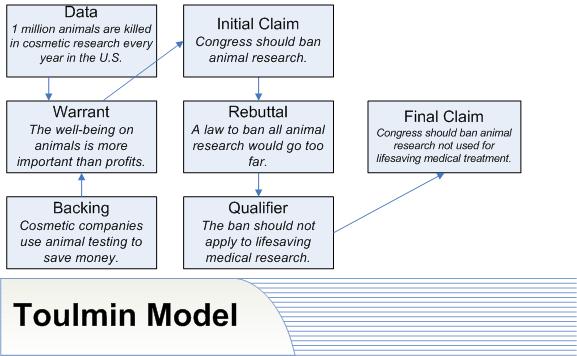 |
|
|
Sep 9 2014, 07:08 PM
Return to original view | Post
#48
|
|
VIP
3,713 posts Joined: Nov 2011 From: Torino
|
QUOTE(RED-HAIR-SHANKS @ Sep 9 2014, 07:04 PM) While I might have no problem thinking up of an idea or elaboration in my head, I do have problems from converting my ideas and convey them into my essay. Permit me to say a capital “PRACTICE!” It often seems to be a daunting task for me. |
|
|
Sep 9 2014, 07:39 PM
Return to original view | Post
#49
|
|
VIP
3,713 posts Joined: Nov 2011 From: Torino
|
QUOTE(OTRoad @ Sep 9 2014, 07:18 PM) Hi I wanna ask about this. I also have the statistics of the arah aliran from 2005 to 2012. But instead of talking about the effects and drawbacks of the changes, I wrote about the punca. May I also know how to approach it in your manner since the effects and drawbacks are quite wide? Btw, I've already handed it in, just curious to know. The method that I usually use is based on the concept of Yin-Yang, where any ideas can be expanded upon almost endlessly. If you write about the punca, you can also follow up with the akibatnya.  |
|
|
Sep 9 2014, 08:23 PM
Return to original view | Post
#50
|
|
VIP
3,713 posts Joined: Nov 2011 From: Torino
|
QUOTE(OTRoad @ Sep 9 2014, 08:20 PM) Well, that's true. The purpose of the assignment is to test your ability to analyze, interpret and evaluate statistical information. Then I guess I can talk about the effects in general. Though not year by year since the effects are likely the same every year.   |
|
|
Sep 11 2014, 02:33 PM
Return to original view | Post
#51
|
|
VIP
3,713 posts Joined: Nov 2011 From: Torino
|
QUOTE(RED-HAIR-SHANKS @ Sep 11 2014, 02:04 PM) I don't take Biology as one of my subjects, but at the mere glance of the discombobulating Krebs Cycle and the way some of my friends perpetually recapitulate them every single day in my class often seems to leave a sense of awe in me. Oh! The Citric Acid Cycle. Here are two interactive animations that help students to grasp the concepts in Biochemistry. Share with your classmates! Rodney Boyer's Concepts in Biochemistry textbook  Pratt and Cornely Essential Biochemistry textbook  |
|
|
Sep 12 2014, 10:40 PM
Return to original view | Post
#52
|
|
VIP
3,713 posts Joined: Nov 2011 From: Torino
|
QUOTE(Just Visiting By @ Sep 12 2014, 10:10 PM) Anyway third term would be much easier. Third term PA is frankly the easiest. More than 50% of candidates in my school scored a perfect A (4.00) for third term. Is Pengajian Am about the study of ideas about Politics and Policy? How does Pengajian Am empower Form 6 students? |
|
|
Sep 12 2014, 11:02 PM
Return to original view | Post
#53
|
|
VIP
3,713 posts Joined: Nov 2011 From: Torino
|
QUOTE(Just Visiting By @ Sep 12 2014, 10:48 PM) First sem is about kehakiman, kerajaan and umm....I forgot what. Haha I remember there's three k. Sounds interesting! First term is the best. You study about different courts in Malaysia and what cases they handle, you study about the laws in Malaysia and the terms like herbeas corpus, then you study about parliaments, what they do and what they discuss, and what decision needs to be made in order to pass a bill et cetera. First term is the best, but it's the hardest to study IMO.  What is the power of Habeas Corpus in Malaysia? Are there certain loopholes in the use of habeas corpus? |
|
|
|
|
|
Sep 12 2014, 11:40 PM
Return to original view | Post
#54
|
|
VIP
3,713 posts Joined: Nov 2011 From: Torino
|
QUOTE(Just Visiting By @ Sep 12 2014, 11:06 PM) LOL it has been two years since I studied it, I can't remember the definition of each law terms anymore. I thought you had fun because you took an interest in kehakiman, and not being forced to memorize. But I remember it is extremely interesting to study, but we just study the definition of terms. We don't go too specific. Luckily we did not because the first term itself covered about 75% of the terminal system syllabus! Imagine we studied what was previously studied in one year in 5 months!  I think all SPM students should learn the common law of Malaysia that protects basic individual rights and freedom. It should also promote democratic awareness among young people. Do A-level students in Malaysia know the basic kehakiman? I think all SPM students should learn the common law of Malaysia that protects basic individual rights and freedom. It should also promote democratic awareness among young people. Do A-level students in Malaysia know the basic kehakiman?  A writ of habeas corpus is a judicial mandate to a prison official ordering that an inmate be brought to the court so it can be determined whether or not that person is imprisoned lawfully and whether or not he should be released from custody. A habeas corpus petition is a petition filed with a court by a person who objects to his own or another's detention or imprisonment. The petition must show that the court ordering the detention or imprisonment made a legal or factual error. |
|
|
Sep 14 2014, 11:45 PM
Return to original view | Post
#55
|
|
VIP
3,713 posts Joined: Nov 2011 From: Torino
|
QUOTE(RED-HAIR-SHANKS @ Sep 14 2014, 09:37 AM) Please help the 4 of us. I know that if I want to achieve a satisfying mark in Speaking component, I will have to find ways to aid them and bring them up. It's not a one man job. Thanks for both of your attention and thoughtful advices. One word that will change your life — CONTROL. In other words, you must play the role as the chair, which includes coordinating the discussion; ensuring that the meeting is not dominated by a single individual; moving from one issue to the next; ensuring that the necessary decisions are made; not allow the meeting to exceed the time allotted; and seeing that the minutes are kept. Therefore, it doesn't matter if your friend wants to defend his point. In fact, he doesn't need to defend if three of you don't argue with him in the first place. Keep in mind that Task B is not a debate, just a discussion. The activities in Task B of the Speaking component are very similar to holding a meeting, perhaps less formal. A typical meeting structure is as follows: • the chair opens the meeting • the minutes (may refer to Task A) are read • the agenda is introduced • first subject introduced • the chair gives the floor to a participant (clockwise) • another speaker takes the floor • the chair keeps order • the chair moves the discussion to a new point • the chair directs the discussion • participants propose new motions • the chair moves to a vote • voting occurs • consensus reached • any other business dealt with • meeting closed The language of formal meetings, particularly the language used by the chair, can be rather stylized. The degree of formality Task B requires depends what matters are being discussed. The language suggestions set out below: » Click to show Spoiler - click again to hide... « |
|
|
Sep 15 2014, 02:37 AM
Return to original view | Post
#56
|
|
VIP
3,713 posts Joined: Nov 2011 From: Torino
|
QUOTE(RED-HAIR-SHANKS @ Sep 15 2014, 12:32 AM) But, how do I want to control the discussion in our group and keep the flow of the content in check? By control, I mean you can learn some clandestine linguistics to increase your persuasive power for good in your MUET, professional and personal life, and NOT dominating the entire 8-minute discussion. The role of controlling the flow of the discussion is to be able to bring someone else to your way of thinking in a very short amount of time with as little resistance as possible to accomplish your goals. Just imagine yourself as the talk show host who displays the qualities that help assert charismatic leadership. Watch The Oprah Winfrey show.  QUOTE(RED-HAIR-SHANKS @ Sep 15 2014, 12:32 AM) And for example, suppose that candidate A supports his view in a specific point, say, ''Money is indispensable when it comes to...''. If any other 3 candidates try to ask his opinions on why did he choose ''money'' as his point, how should he try to further elaborate his view on the importance of money without keep on rehashing and repeating the exact same point from his brief talk just a while ago? First, stop asking why to your members. If the other 3 candidates load you with the same “why” questions, how would you respond? You may ask why not ask why; and the answer is because the answer to why is because. No pun intended! When you ask why, you are likely to get reasons rather than recovering any more specific information. The reasons (“Because I love money”) will be on surface level, just like the statement (“Money is indispensable”) that you are challenging.  Next, If he repeats the same thing, disengage him graciously by asking, “Is this true in everyone's world view?” and then follow up with “To be without some of the things you want is an indispensable part of happiness”. I borrow that quote from Bertrand Russell, the philosopher who came up with the infamous Russell's teapot analogy in discussions concerning the existence of God. (I am not an atheist.)  In The Uses of Argument, first published in 1958, Toulmin presented a model of the “procedural form” of argumentation. This model aims to capture the functional elements (or steps) that can be distinguished in the defense of a standpoint by means of argumentation. According to Toulmin, the procedural form of argumentation is “field-independent,” meaning that the steps that are taken – as they are represented in the model – are always the same, irrespective of the subject that is being discussed.  This post has been edited by Critical_Fallacy: Sep 15 2014, 05:38 AM |
|
|
Sep 15 2014, 02:44 PM
Return to original view | Post
#57
|
|
VIP
3,713 posts Joined: Nov 2011 From: Torino
|
QUOTE(RED-HAIR-SHANKS @ Sep 15 2014, 01:42 PM) Alright, that's convincing enough for me to not think too much about coming up with a “perfect conclusion” at the end of the discussion. The “conclusion” means to bring an end to the discussion. It needs not to be pointing who’s right and who’s wrong. If you are quick-witted, you can come up with a metaphor or a philosophical quote that appeal to a larger picture of the topic under discussion. Or else, find a common ground and close with a thought-provoking question, “Isn’t it more important that ...?”  |
|
|
Sep 15 2014, 05:03 PM
Return to original view | Post
#58
|
|
VIP
3,713 posts Joined: Nov 2011 From: Torino
|
QUOTE(Just Visiting By @ Sep 15 2014, 09:25 AM) Practice makes perfect. I agree that practice is important, and it’s absolutely necessary to achieve expertise. Naturally, it is easy to talk about in theory, but it’s more fun to talk about in practice. Since we are having a positive discussion to help RED-HAIR-SHANKS, what do you think is the best way to practice? |
|
|
Sep 15 2014, 10:45 PM
Return to original view | Post
#59
|
|
VIP
3,713 posts Joined: Nov 2011 From: Torino
|
QUOTE(scgoh123 @ Sep 15 2014, 09:29 PM) In my opinion, the most important thing in speaking is to be able to synchronize with other 3 members and the formality of the language used. QUOTE(RED-HAIR-SHANKS @ Sep 15 2014, 09:57 PM) Anyway, if you have some suggestions or strategy on how you are able to ace in any components in MUET exams, feel free to share them up in here. Master a wide variety of language functions and use effective rhetorical strategies of repetition, including anaphora, antithesis, chiasmus, and parallelism. Just like 《獨孤九劍》, once the essence of the linguistics is grasped, the speaker can use it in endless forms and variations 《千變萬化》.Here is a list of common language functions (elementary level): » Click to show Spoiler - click again to hide... « Please note this list is not exhaustive and you should expand it. Share with your friends! |
|
|
Sep 17 2014, 09:17 PM
Return to original view | Post
#60
|
|
VIP
3,713 posts Joined: Nov 2011 From: Torino
|
QUOTE(yuza014 @ Sep 17 2014, 07:56 PM) Not yet.. Only introduction left.. My teacher rejected my intro a few time.. Show us your introduction for review. We'll see what you can do to increase the acceptance rate. .. How to do it?? DO it NOW... |
| Change to: |  0.0425sec 0.0425sec
 0.66 0.66
 7 queries 7 queries
 GZIP Disabled GZIP Disabled
Time is now: 18th December 2025 - 09:57 AM |
 Quote
Quote