Welcome Guest ( Log In | Register )

7 Pages  1 2 3 > » Bottom

Outline · [ Standard ] · Linear+

 STPM 2014/2015

views
     
Critical_Fallacy
post Jul 25 2014, 04:02 AM

∫nnộvisεr
Group Icon
VIP
3,713 posts

Joined: Nov 2011
From: Torino
QUOTE(RED-HAIR-SHANKS @ Jul 24 2014, 02:30 PM)
Q1) Ali was wearing his spectacle while driving in his car. When he was about to make a turn towards a roundabout in his right direction, he felt that his spectacle was sliding towards the left. What causes the spectacle to slide in that manner?

The correct answer: Inertia. It's because the spectacle resisted the change in the direction of the car (towards going right) by sliding to the left.

Now, I've superficially learned a thing or two about centripetal force, but why centrifugal force is not the appropriate answer for the above question? ... And if we were to refer back to the question, it clearly stated that his spectacle was sliding towards the left when Ali was about to make a turn towards the roundabout, which is in his right. It makes a perfect sense to me but why the answer is not centrifugal force, but instead it is inertia? Where did I go wrong? icon_question.gif
Quite incorrect. The inertia does not cause Ali’s glasses suddenly slid toward the opposite direction (left) of car's heading direction (right), as if there was a hidden repulsive force. That's an ILLUSION! cool2.gif

While the car moves in the circular arc at the roundabout, it is in uniform circular motion; that is, it has an acceleration that is directed toward the center of the roundabout. By Newton’s 2nd law, a force must cause this acceleration. Moreover, the force must also be directed toward the center of the roundabout. Thus, it is a centripetal force, which means center-seeking force, where the adjective indicates the direction. The centripetal force, in this case, is provided by the friction between the road and the car’s tires.

Because Ali drove the car, naturally, we assume that he strapped the seat belt on his car’s seat that held him firmly in the seat. This assumption is critical or else, Ali will slide across the seat toward the left and then jam against the car wall for the rest of the turn. Since Ali was wearing his glasses when he turned right, rounding the roundabout, and if his glasses was to move in uniform circular motion along with the car, there must also be a centripetal force on his glasses.

However, apparently the frictional forces on Ali’s glasses from his nose-bridge and ears were not great enough to make his glasses go in a circle with the car. The dirt and oil on Ali’s face could have affected the frictional force. Thus, Ali’s “face” slid beneath his glasses, until he pushes it up with his forefinger so that the frames sit rightly on the top of his nose. Then, the push that Ali provided the needed centripetal force on the glasses allows his glasses to join the car’s uniform circular motion.

If Ali does not attempt to prevent his glass from sliding to his left as he turns right, however, there won’t be a centripetal force acting on his glasses, which would slide off in the direction that is tangent to the circle due to it inertia (according to Newton’s 1st law). This gives Ali the sensation of his glasses slid toward his left. In fact, to a stationary observer, Ali’s glasses are sliding off in a straight line until it jams up against the left wall of the car. The centripetal force from the car wall is required to push the glasses inward along the car’s uniform circular path. icon_idea.gif

user posted image

This post has been edited by Critical_Fallacy: Jul 25 2014, 04:51 AM
Critical_Fallacy
post Jul 25 2014, 04:19 AM

∫nnộvisεr
Group Icon
VIP
3,713 posts

Joined: Nov 2011
From: Torino
QUOTE(RED-HAIR-SHANKS @ Jul 24 2014, 02:30 PM)
Q2)Which force does the work on a satellite orbiting around the Earth?

The correct answer: Gravitational force.

Why the answer for Q2) cannot be centripetal force? I sense that there are some similarities between both of these forces that causes the satellite to orbit around the Earth in such manner.... hmm.gif
As stated by maximR, a centripetal force is NOT a new kind of force. The name merely indicates the direction of the force. It's an adjective!! Therefore, it can be a frictional force, a gravitational force, the force from a car wall, the tension force from a string, or any other force in this universe you could name it.

user posted image

Artificial satellites are continually accelerating towards the Earth. This is because of the gravitational force of attraction between the satellite and the Earth. If a satellite stopped moving forwards, the Earth’s gravitational pull would make it fall to Earth. icon_rolleyes.gif

This post has been edited by Critical_Fallacy: Jul 25 2014, 04:25 AM
Critical_Fallacy
post Jul 25 2014, 03:04 PM

∫nnộvisεr
Group Icon
VIP
3,713 posts

Joined: Nov 2011
From: Torino
QUOTE(maximR @ Jul 25 2014, 02:18 PM)
How are you?  icon_rolleyes.gif
I'm “busy-body” as usual. laugh.gif

Recently I'm expanding my collection of books. A peculiar bibliophile, huh?. blush.gif

I noticed that your Physics of Motion is now at a whole new level after entering Sunway.

You were talking about “modeling”, a process that most scientists and engineers employ to represent and study a particular real-world system or phenomenon, when many Pre-U students are probably still struggling to understand its concept.

Keep up the good work! wink.gif
Critical_Fallacy
post Jul 25 2014, 05:18 PM

∫nnộvisεr
Group Icon
VIP
3,713 posts

Joined: Nov 2011
From: Torino
QUOTE(RED-HAIR-SHANKS @ Jul 25 2014, 03:23 PM)
why it is said that the Newton's Second Law would cause the ball to move tangentially to the circle if the string snaps? unsure.gif 
hmm.gif I'm wondering, what do they tell you about centripetal force in your Physics textbook?

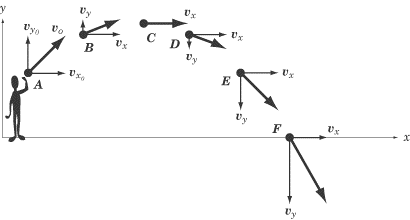
In reality, this is a Projectile motion. If you ignore air resistance and resolve the motion of the ball into vertical and horizontal components, you will see that the norm of the horizontal velocity vector stays the same, because the tension from the string is no longer acting on the ball (Newton's 1st Law). The varying vertical velocity vector shows the motion of the ball during its free fall and this is due to gravity acts on the ball (Newton's 2nd Law).

user posted image
Critical_Fallacy
post Jul 25 2014, 09:25 PM

∫nnộvisεr
Group Icon
VIP
3,713 posts

Joined: Nov 2011
From: Torino
QUOTE(RED-HAIR-SHANKS @ Jul 25 2014, 07:41 PM)
I would like to thank maximR and you for helping me out in clearing my misconceptions and doubts regarding those questions that I posted. I need to find out more stuffs that are pertaining to circular motion as I cannot totally get the hang of it currently.
I recall that I shared a link with you on how to get the free & good quality, “OpenStax College Physics” textbook (Web / PDF / EPUB) in this post 3 months ago.

You can also get nearly a dozen of Higher Education textbooks. Just click the image. Choose a high-quality text now! happy.gif

user posted image
Critical_Fallacy
post Jul 31 2014, 01:36 AM

∫nnộvisεr
Group Icon
VIP
3,713 posts

Joined: Nov 2011
From: Torino
QUOTE(scgoh123 @ Jul 30 2014, 05:39 PM)
I have downloaded the copy, and I like that book very much. but to print out?! Thats ridiculous~~
1000+ pages !!!!!  shakehead.gif  shocking.gif
Most college textbooks on Science and Mathematics are usually very thick. Some authors split the subject in 2 or 3 volumes.

If you really like the book, you should find a printing service center to print out the book in Black & White (or colors) with hardcover binding.

For 1,000++ pages, you can probably negotiate the price. wink.gif

This is free stuff with bloods & sweats from the Authors. So, don't ridicule! icon_rolleyes.gif
Critical_Fallacy
post Aug 1 2014, 07:16 PM

∫nnộvisεr
Group Icon
VIP
3,713 posts

Joined: Nov 2011
From: Torino
QUOTE(maximR @ Aug 1 2014, 06:20 PM)
I think one of them should be enough, as they are very dense and you won't need to study all the chapters.
Physics for Scientists and Engineers with Modern Physics by Serway & Jewett is my primary college physics reference book. icon_rolleyes.gif

user posted image

Here is a sample chapter :: Motion in Two Dimensions
Critical_Fallacy
post Aug 2 2014, 04:38 PM

∫nnộvisεr
Group Icon
VIP
3,713 posts

Joined: Nov 2011
From: Torino
QUOTE(sagethesausage @ Aug 2 2014, 11:46 AM)
Anyone done their Maths T PBS assignment yet?  Can give me a brief description on how to answer each question? My teacher don't want to teach about the assignment because have to catch up with syllabus.
Do you mind putting up the Math T assignment on this thread? sweat.gif
Critical_Fallacy
post Aug 2 2014, 06:58 PM

∫nnộvisεr
Group Icon
VIP
3,713 posts

Joined: Nov 2011
From: Torino
QUOTE(sagethesausage @ Aug 2 2014, 06:52 PM)
why can't my stupid phone upload images? urgh
Try something else.
Critical_Fallacy
post Aug 3 2014, 05:45 AM

∫nnộvisεr
Group Icon
VIP
3,713 posts

Joined: Nov 2011
From: Torino
QUOTE(RED-HAIR-SHANKS @ Aug 3 2014, 01:35 AM)
You know, it would be helpful too if you're able to ask your teacher or someone that is good in Maths to possibly come up with another formula of Qn which is different than the one my friend gave.
Your friend is sure stingy. Gave you formula but no explanation. Anyhow, look at my approach careful. The final formula in the outcome, I've eliminated the Σ sign from the general formula and it is replaced with a more efficient formula. icon_idea.gif

Part 1 ::
user posted image

Part 2 ::
user posted image
Critical_Fallacy
post Aug 3 2014, 06:42 PM

∫nnộvisεr
Group Icon
VIP
3,713 posts

Joined: Nov 2011
From: Torino
QUOTE(scgoh123 @ Aug 3 2014, 12:52 PM)
Thanks for the formula! But is that methodology or an explanation of results?
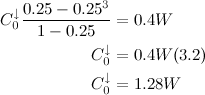
It is an attempt to model the dynamic behavior of the concentration in a regularly-spaced drug administration system, as a function of time, t. For simplicity, the assignment requires the students to model the concentration as a function of number of dose, n.

We know that a problem facing physicians is the fact that for most drugs, there is a floor concentration, q, below which the drug is ineffective and a ceiling concentration, Q, above which the drug is dangerous. Thus, the physician would like the have the concentration C(t) satisfy

user posted image

This requirement helps determine the initial dose of a drug and when the next dose should be administered.

Since we are assuming that when the drug is administered, it is diffused so rapidly throughout the bloodstream that, for all practical purposes, it reaches its highest concentration almost instantaneously, and we would see a spike in the concentration of the drug when the new dose is given, as shown in the piecewise functions below:

user posted image

CODE
plot Piecewise[{{0, x<0}, {50*e^(-1.368*x), 0<=x<1}, {62.5*e^(-1.368*(x-1)), 1<=x<2}, {65.625*e^(-1.368*(x-2)), 2<=x<3}, {66.4063*e^(-1.368*(x-3)), 3<=x<4}, {66.6016*e^(-1.368*(x-4)), 4<=x<5}}]


As you can see below, the two concentrations (graphs) in the body just before and after every dose as functions of number of dose, are in fact the upper-bound and lower-bound envelopes of the exponential decay model. They are finite data, and not continuous graphs, which you must point out clearly in your assignment Q.1(b). It is advised to use dashed-lines instead of solid lines.

user posted image

This post has been edited by Critical_Fallacy: Aug 3 2014, 06:47 PM
Critical_Fallacy
post Aug 4 2014, 06:27 AM

∫nnộvisεr
Group Icon
VIP
3,713 posts

Joined: Nov 2011
From: Torino
QUOTE(scgoh123 @ Aug 3 2014, 12:59 PM)
Do we need to list out all the values until Q8 or until Qn?
QUOTE(RED-HAIR-SHANKS @ Aug 4 2014, 03:34 AM)
I think it should only be until user posted image, as question 2(a) is correlated with the first question about user posted image, where it's stated that n=1,2,3,...,8.
The purpose of Q.2a(i) is to test your understanding and ability to calculate the steady-state concentrations of both the minimum effective level and the safe limit. In fact, there is no significant difference in concentration between user posted image and user posted image. You should be able to interpret the following graph:

user posted image

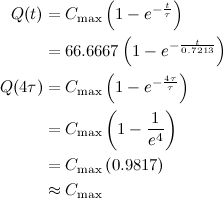
From the function of the upper-bound envelope, we see that the time constant, τ = 0.7213 day. Using this info, we can predict that the concentration Q(t) will reach steady-state at 4τ = 2.8852 days, or about 3 hours before the 4th dose is given. This is consistent with the graph.

user posted image

For this reason, in Q.2a(ii) and Q.2a(iii), you need to calculate the concentration of the dosage at least up to Q4 or the 4th dose, in order to determine the drug effectiveness of 50 mg daily dosage on a 35-kg person and a 60-kg person. If you want to, you can also calculate the time interval of ineffectiveness for a specific person before the 2nd dose is given, and justify whether this ineffective time window is acceptable or not.

For example, the minimum effective level for a 35-kg person is 14 mg. And it takes roughly 22 hours from the initial dose 50 mg for the concentration to drop below 14 mg. Say if the 35-kg patient is given IV drip every morning 9:00 a.m., then the ineffective time window is between 7:00 a.m. (14.0 mg) to 9:00 a.m. (12.5 mg) or 2 hours before the 2nd dose is given. Is this acceptable from the physician's view? unsure.gif

This post has been edited by Critical_Fallacy: Aug 4 2014, 06:32 AM
Critical_Fallacy
post Aug 4 2014, 07:56 PM

∫nnộvisεr
Group Icon
VIP
3,713 posts

Joined: Nov 2011
From: Torino
QUOTE(RED-HAIR-SHANKS @ Aug 4 2014, 02:47 AM)
An intricate steps of approach indeed, thanks for your amazing input as always smile.gif . Took me some time there to assimilate all of them sweat.gif .
SAMPLE ::
*********
user posted image
Critical_Fallacy
post Aug 5 2014, 08:11 PM

∫nnộvisεr
Group Icon
VIP
3,713 posts

Joined: Nov 2011
From: Torino
QUOTE(sagethesausage @ Aug 2 2014, 07:18 PM)
Well that took longer than I expected.  Was already typing half of the assignment when it suddenly uploaded the picture. Sorry for being slow
user posted image

Is your weight truly 50 kg? We are looking at this range of dosage:

user posted image

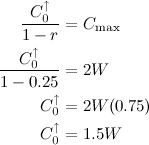
Using the formula of sum to infinity, you can calculate the upper range (safe level) of the initial dose based on your body weight.

user posted image

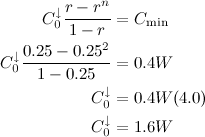
Similarly, from the derived formula of the concentration just before the 2nd dose, you can calculate the lower range (effective level) of the initial dose based on your body weight.

user posted image

However, there is a conflict because the value of the lower range cannot be higher than the value of the upper range. Because the safe limit is of higher priority, we need to determine the concentration just before the 3rd dose:

user posted image

Thus, the effective and safe dosage for every 24 hours should be at this range:

user posted image
Critical_Fallacy
post Aug 6 2014, 07:06 AM

∫nnộvisεr
Group Icon
VIP
3,713 posts

Joined: Nov 2011
From: Torino
QUOTE(RED-HAIR-SHANKS @ Aug 6 2014, 04:22 AM)
Dear scgoh123 and sagethesausage, do both of you happen to got your hands on any Chemistry books that are not published specifically for STPM students, yet are still capable of guiding us throughout the semester? unsure.gif
Most Introductory Chemistry textbooks cover more or less the same general materials. They usually differ in the way the authors organize the materials to help students developing a solid understanding and good command of the fundamentals of molecular chemistry. Search for this book in your library. Please inform maximR as well. Because Chemistry and Physics are the two major branches of science that study matter, many physicists also acquire a good command of general chemistry. icon_rolleyes.gif

Chemistry: A Molecular Approach, 3/e (2014) by Nivaldo J. Tro
user posted image
Critical_Fallacy
post Aug 15 2014, 01:17 PM

∫nnộvisεr
Group Icon
VIP
3,713 posts

Joined: Nov 2011
From: Torino
QUOTE(boyz_96 @ Aug 15 2014, 12:49 PM)
Hey guys.. My teacher asked all the students to pass the introduction for Math T coursework.. I didnt do anything yet.. I dont know how to start the paragraph.. Someone help me!! T-T
1. Background
2. The Problem
3. The Proposed Solution
Critical_Fallacy
post Aug 15 2014, 07:29 PM

∫nnộvisεr
Group Icon
VIP
3,713 posts

Joined: Nov 2011
From: Torino
QUOTE(boyz_96 @ Aug 15 2014, 03:35 PM)
Background of the quinine and malaria?? Or what?
The ordinary way of writing a typical Introduction:

1. Background
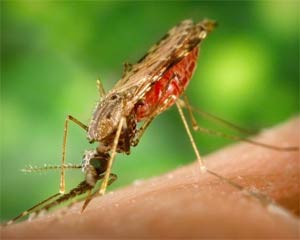
Malaria is caused by a parasite called Plasmodium, which is transmitted via the bites of infected female Anopheles mosquitoes. In the human body, the parasites multiply in the liver, and then infect red blood cells.

2. The Problem
Symptoms of malaria include fever, headache, and vomiting, and usually appear between 10 and 15 days after the mosquito bite. If not treated, malaria can quickly become life-threatening by disrupting the blood supply to vital organs. In 2010, an estimated 219 million cases of malaria occurred worldwide and 660,000 people died, most (91%) in the African Region.

3. The Proposed Solution
Key interventions to control malaria include: prompt and effective treatment with artemisinin-based combination therapies; use of insecticidal nets by people at risk; and indoor residual spraying with insecticide to control the vector mosquitoes.

Treatment of malaria depends on many factors including disease severity, the species of malaria parasite causing the infection and the part of the world in which the infection was acquired. The latter 2 characteristics help determine the probability that the organism is resistant to certain antimalarial drugs. Additional factors such as age, weight, and pregnancy status may limit the available options for malaria treatment.

user posted image

The Harry Potter way of writing an interesting Introduction:

It was nearing midnight and I could have written a wonderful Introduction tonight, but I was tired. Not because of bad dreams or pressure at work. No, I was sleepy because of a small winged, creature who snuck into my room and proceeded to offer a high pitched tone directly into my ear. When I turned on the lights to find it, it was not there. When I gave up and attempted sleep, buzzzz… or maybe zzzzinnng? I would find the perfect word, but as mentioned, I am too tired.

Many people have had this annoying experience with mosquitoes. In fact, according to Animal Planet's The Most Extreme, Season 3, #36: The animals with the highest human kill counts, Mosquitoes are actually the most dangerous animals in the world, killing more than two million people per year. Malaria or a disease resembling malaria has been noted for more than 4,000 years. From the Italian for “bad air,” mal’aria has probably influenced to a great extent human populations and human history.

On August 20th, 1897, Ronald Ross, a British officer in the Indian Medical Service, was the first to demonstrate that malaria parasites could be transmitted from infected patients to mosquitoes. In further work with bird malaria, Ross showed that mosquitoes could transmit malaria parasites from bird to bird. Thus, the problem of malaria transmission was solved. For his discovery, Ross was awarded the Nobel Prize in 1902. (you carry on...)
Critical_Fallacy
post Aug 17 2014, 09:44 PM

∫nnộvisεr
Group Icon
VIP
3,713 posts

Joined: Nov 2011
From: Torino
QUOTE(Davion96 @ Aug 17 2014, 07:35 PM)
Where can I see an example of methodology? I'm stuck there without any idea on how to start, and the teacher asked me to pass up by this Tuesday.  shocking.gif
Methodology is commonly viewed as a combination of general principles and specialized techniques.

What kind of principles and techniques normally used by the ordinary people and the professionals?

Remember that the most important instrument in problem-solving must always be the mind of man. icon_idea.gif
Critical_Fallacy
post Aug 17 2014, 09:45 PM

∫nnộvisεr
Group Icon
VIP
3,713 posts

Joined: Nov 2011
From: Torino
QUOTE(RED-HAIR-SHANKS @ Aug 17 2014, 09:43 PM)
scgoh123, sagethesausage and BlueMuffin, can you answer the following questions? blush.gif I got them from my Chemistry quiz sheet.

1.) Why does dry ice create fog?

2.) Why does your tongue sticks to a freezing metal pole?

PS: One doesn't necessarily require information or academic level of up to STPM to answer the above questions. smile.gif
I thought I can explain that using Physics! sweat.gif
Critical_Fallacy
post Aug 17 2014, 10:00 PM

∫nnộvisεr
Group Icon
VIP
3,713 posts

Joined: Nov 2011
From: Torino
QUOTE(RED-HAIR-SHANKS @ Aug 17 2014, 09:50 PM)
Well sir, of course you can. biggrin.gif

But, one thing remains unclear. Although the answer for the question no.2.) that was given by my teacher is the same as the one I found out from a lecturer, the explanations are somewhat different. hmm.gif
Put a metal spoon into the freezer for 30 min. icon_rolleyes.gif

7 Pages  1 2 3 > » Top
 

Change to:
| Lo-Fi Version
0.0411sec    0.76    7 queries    GZIP Disabled
Time is now: 18th December 2025 - 03:06 AM