

QUOTE(OTRoad @ Oct 10 2014, 04:13 PM)
... and get the answer as 0?
Answer to what problem as 0? Please show me. 
STPM 2014/2015
|
|
 Oct 10 2014, 04:32 PM Oct 10 2014, 04:32 PM
Return to original view | Post
#81
|
 
VIP
3,713 posts Joined: Nov 2011 From: Torino 
|
QUOTE(OTRoad @ Oct 10 2014, 04:13 PM) ... and get the answer as 0? Answer to what problem as 0? Please show me. |
|
|
|
|
|
Oct 10 2014, 06:26 PM
Return to original view | Post
#82
|
|
VIP
3,713 posts Joined: Nov 2011 From: Torino
|
QUOTE(OTRoad @ Oct 10 2014, 04:39 PM) You mean it doesn't work this way? Btw im so sorry. I need to seriously brush up my maths. And im already in F6 You don't have a reason make y equals to 0. Look at the following theorem. It is known as the Euclidean Division Theorem.  |
|
|
Oct 11 2014, 11:23 PM
Return to original view | Post
#83
|
|
VIP
3,713 posts Joined: Nov 2011 From: Torino
|
QUOTE(OTRoad @ Oct 11 2014, 11:15 PM) Will try to digest it, I guess. Thank you The Division Theorem is prequel to the Remainder Theorem (you learned in STPM).   |
|
|
Oct 12 2014, 11:34 PM
Return to original view | Post
#84
|
|
VIP
3,713 posts Joined: Nov 2011 From: Torino
|
QUOTE(RED-HAIR-SHANKS @ Oct 12 2014, 06:47 PM) Thank you Critical_Fallacy and Just Visiting By for helping and giving out some advice regarding the MUET speaking section. Ever since my teammates and I implemented the language functions and the style/techniques that both of you introduced up here in this thread, our practice speaking session has a little bit of an improvement. The conversation has been a little smoother and it's been reassuring knowing on what we would want to speak on that exact moment and where will the conversation leads to. That's a good thing to hear. Keep practicing and they will never look at themselves quite the same way! Even a friend of mine who was stuttering long ago while conversing in English is now even able to occasionally use logical connectors and word linker in some of his sentences. It might not seem much, but it's already considered good enough of an improvement as for me and my teammates. |
|
|
Oct 14 2014, 03:31 PM
Return to original view | Post
#85
|
|
VIP
3,713 posts Joined: Nov 2011 From: Torino
|
QUOTE(RED-HAIR-SHANKS @ Oct 14 2014, 02:49 PM) Question: Two objects The gravitational forces exerted by the Planet on the two satellites hold them in the same orbit but moving in the opposite direction (v and –v) around the Planet. Without thinking any complicated situation, this question is best answered using VECTOR ADDITION.  and and  of the same mass revolve round a planet in the same circular orbit, but in the opposite direction. When and collide and combine, what is the subsequent motion of the combined mass? of the same mass revolve round a planet in the same circular orbit, but in the opposite direction. When and collide and combine, what is the subsequent motion of the combined mass?-From the above keywords, which is collide and combine, I know that this will surely be involving the principle of momentum, where the momentum of of a combination of 2 objects will be zero. But, why the answer for it is D, can you please further enlighten me? Answers: A: It will remain in the original orbit with the same period of revolution. B: It will revolve round the planet in a smaller circular orbit. C: It will move in an elliptical orbit with the centre of mass as one of the focus of the elliptical orbit? D: It will fall down due to the gravitational field of the planet.(Correct answer)  When v = 0, then a_θ = 0. Therefore, a = a_R. |
|
|
Oct 14 2014, 03:50 PM
Return to original view | Post
#86
|
|
VIP
3,713 posts Joined: Nov 2011 From: Torino
|
QUOTE(RED-HAIR-SHANKS @ Oct 14 2014, 03:00 PM) Critical_Fallacy, I'm stuck with this question. Try this:Given a series:  , find the nth term, , find the nth term, , of the series and what is the sum of the first n term, , of the series and what is the sum of the first n term, ? ?I was only able to do it until the second step: =   It looks a kind of arithmetico-geometric sequence.  |
|
|
|
|
|
Oct 15 2014, 01:06 AM
Return to original view | Post
#87
|
|
VIP
3,713 posts Joined: Nov 2011 From: Torino
|
QUOTE(RED-HAIR-SHANKS @ Oct 14 2014, 09:30 PM) Critical_Fallacy, I have some doubts in Physics that I have to clear off my find. For ideal gases, the calculation for the internal energy is fairly straight forward.Question: A vessel contains 2 moles of helium gas,  at 350K. The mixture is heated at constant volume to 400K. Calculate the total internal energy of the mixture at (a)350K and (b)400K. at 350K. The mixture is heated at constant volume to 400K. Calculate the total internal energy of the mixture at (a)350K and (b)400K.-The answers for both (a) and (b) is  and and  respectively. Where are my mistakes and errors? respectively. Where are my mistakes and errors?My workings: -(a)T=350K, f=5(since helium consists of diatomic molecules), R=8.31, U=? -∴  -(b)T=400K -∴  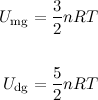 An error is detected in the question. Helium (He) is a monatomic gas. Hydrogen (H₂) is a diatomic gas. The given answers cannot be accepted.  This post has been edited by Critical_Fallacy: Oct 15 2014, 01:06 AM |
|
|
Oct 15 2014, 01:16 AM
Return to original view | Post
#88
|
|
VIP
3,713 posts Joined: Nov 2011 From: Torino
|
QUOTE(yuza014 @ Oct 14 2014, 08:24 PM) Hai.. Can someone help me to solve this question.. Question number 4(complex number) For Q4a, it is fairly easy to show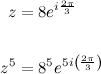 Please list the relevant formulas for dealing with complex numbers. This post has been edited by Critical_Fallacy: Oct 15 2014, 01:17 AM |
|
|
Oct 15 2014, 10:39 PM
Return to original view | Post
#89
|
|
VIP
3,713 posts Joined: Nov 2011 From: Torino
|
QUOTE(yuza014 @ Oct 15 2014, 09:55 PM) Someone help me answering this.. My answer is different from the given answer.. I got 0.309 but the answer is 0.38 mole fraction.. Question number 1 Please show your workings, so that your peers can comment.  |
|
|
Oct 19 2014, 01:40 AM
Return to original view | Post
#90
|
|
VIP
3,713 posts Joined: Nov 2011 From: Torino
|
QUOTE(RED-HAIR-SHANKS @ Oct 18 2014, 07:21 PM) Weird, I got 0.309 for the mole fraction of benzene in vapour too. I too would like some clarification for this question. QUOTE(scgoh123 @ Oct 18 2014, 11:43 PM) i got the same answer too, there is a huge possibility that the answers given may be wrong I think the answer in the textbook may be wrong. |
|
|
Oct 19 2014, 01:43 AM
Return to original view | Post
#91
|
|
VIP
3,713 posts Joined: Nov 2011 From: Torino
|
QUOTE(scgoh123 @ Oct 18 2014, 11:33 PM) can anyone help me with this? What you need to show is that the gravity g decreases with altitude h as one rises above the Earth's surface because W ∝ 1/r². From that, you can find the relationship between the gravity g at altitude h and the surface gravity g₀ (h = 0).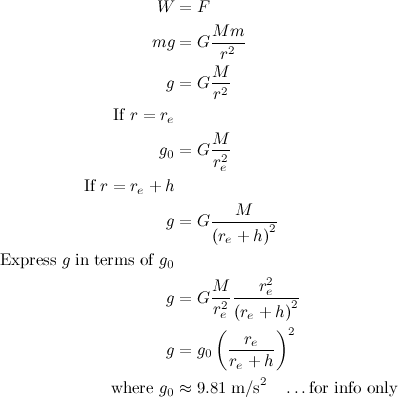 ******************************************************************** A mathematically intuitive physicist will do this, but you can skip this step if you want. 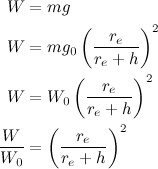 ******************************************************************** The next stage is to determine the altitude that yields the percent error, δ = 1%, or the relative error, η = 0.01. The formula for relative error η is given by 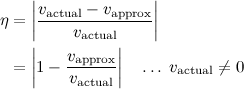 Applying the formula to the problem, we have 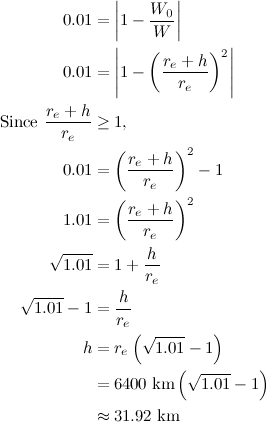 So, writing the result correct to 1 significant figure h = 30 km |
|
|
Oct 23 2014, 05:04 PM
Return to original view | Post
#92
|
|
VIP
3,713 posts Joined: Nov 2011 From: Torino
|
QUOTE(RED-HAIR-SHANKS @ Oct 23 2014, 04:05 PM) Critical_Fallacy, can you help me with this question? Displacements are vectors. And you know that the norms |PQ| ≠ |QR| ≠ |RS| ≠ |ST|. This reason alone is suffient to reject (A). Question: An object is thrown at an angle to the horizontal with a parabolic trajectory. PQRST is part of the trajectory with P as the starting point and T as the maximum point. If every two adjacent points have the same time interval, hence the displacements PQ, QR, RS, and ST A: are the same B: increase at a fixed rate C: decrease at a fixed rate D: have the same horizontal component The answer for it is D. −I used the formula of s=vt, and I find out that the horizontal displacements,s, for every 2 adjacent points are constant due to the fact that time intervals, t=constant, and the horizontal velocity, v=constant too. But, from the choices above, how do I distinguish the answers between A and D? They carry nearly the same meaning meaning, don't they? |
|
|
Nov 13 2014, 09:17 PM
Return to original view | Post
#93
|
|
VIP
3,713 posts Joined: Nov 2011 From: Torino
|
QUOTE(Just Visiting By @ Nov 13 2014, 09:11 PM) I don't know the full questions, but from the information given I think it's conservation of energy, most likely from potential energy to spring potential energy. And kinetic energy too... |
|
|
|
|
|
Nov 18 2014, 01:26 AM
Return to original view | Post
#94
|
|
VIP
3,713 posts Joined: Nov 2011 From: Torino
|
QUOTE(RED-HAIR-SHANKS @ Nov 17 2014, 04:58 PM) This is by far the most toughest paper that I did so far in my first term exams. I worry that it might send the wrong idea to other math-loving students. It is true that you don't have the luxury of time to think deeply about every question in the exam. Therefore, if you practice enough, solving math problems becomes second nature. Good intuitively problem-solving skill comes from many hours of practice. |
|
|
Nov 19 2014, 09:36 PM
Return to original view | Post
#95
|
|
VIP
3,713 posts Joined: Nov 2011 From: Torino
|
QUOTE(RED-HAIR-SHANKS @ Nov 19 2014, 02:46 PM) P/S: Thank you for the Polya's 4 Steps Problem Solving process, and if it weren't for that, I'll kiss my 6 marks goodbye. As a tactician by nature, I'm sure you can plan your strategy well to solve almost any math problems at STPM level. I suspect that the problem you are facing is that you don't have enough time to complete the paper that requires deep thinking. |
|
|
Nov 19 2014, 09:45 PM
Return to original view | Post
#96
|
|
VIP
3,713 posts Joined: Nov 2011 From: Torino
|
QUOTE(RED-HAIR-SHANKS @ Nov 17 2014, 05:12 PM) Damn, is it coincidence? Out of 34 students in my class, I'm the only one who picked question 8. The moment when I saw question 7 that involves trigonometry, I skipped that part and chose question 8. What kind of questions do you frequently get stuck at? |
|
|
Nov 24 2014, 03:33 PM
Return to original view | Post
#97
|
||
|
VIP
3,713 posts Joined: Nov 2011 From: Torino
|
QUOTE(RED-HAIR-SHANKS @ Nov 20 2014, 11:24 PM) I can't say for sure, it all based on the nature of the question I'd say. I'm quite weak in topics concerning 3D-Vectors and Trigonometry, though I might have other more weak spots. I don't know the divide between A-level and STPM. But I want to know the basic mathematical knowledge taught to STPM students in these two topics. 
Are you able to (1) plot the graphs of trigonometric functions, (2) find the particular solutions and general solutions of trigonometric equations, (3) apply the sine rule and cosine rule to solve non-right-angled triangle, (4) covert angles from degrees to radians and vice versa, (5) find the amplitude, period, frequency and phase of a wave, (6) determine the time displacement between two waves (7) use some trigonometric identities to show various engineering results, and (8) rewrite the function  as as  ? ?
Are you able to (1) apply vector addition and subtraction, (2) apply vectors to problems in mechanics, (3) write vectors of two dimensions in i and j unit vector notation, (4) find the resultant vector, (5) write vectors of three dimensions in i, j and k unit vector notation, (6) find the magnitude of a vector in 3D, (7) evaluate a unit vector, (8) determine the work done by a force vector F through a displacement r using a scalar product, and (9) determine the moment vector M, about the origin O, of a force F, passing through the point with position vector r using a cross product? |
||
|
|
Jan 2 2015, 12:20 AM
Return to original view | Post
#98
|
|
VIP
3,713 posts Joined: Nov 2011 From: Torino
|
QUOTE(RED-HAIR-SHANKS @ Jan 1 2015, 04:58 PM) How should I put this..... Bravo!        Well, I should have been more explicit in asking you to solve this riddle in my previous post. Sorry for that.  |
|
|
Jan 5 2015, 11:46 PM
Return to original view | Post
#99
|
|
VIP
3,713 posts Joined: Nov 2011 From: Torino
|
QUOTE(RED-HAIR-SHANKS @ Jan 5 2015, 03:18 PM) I got a band 5 for my MUET exam. Now your efforts have paid off. Congrats! Listening- 29/45 Speaking- 35/45 Reading- 93/120 Writing- 72/90 Aggregated score: 229/300 |
|
|
Jan 29 2015, 08:26 AM
Return to original view | Post
#100
|
|
VIP
3,713 posts Joined: Nov 2011 From: Torino
|
QUOTE(RED-HAIR-SHANKS @ Jan 28 2015, 11:07 PM) Hello Krevaki, I'm again having a trouble in solving question revolving differentiation. Isn't it obvious? Given 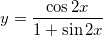 , show that , show that 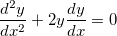 . .How do I proceed? More importantly, where are my mistakes? I retried this questions for many times, and yet I wasn't able to come to the solution. Thanks in advance. 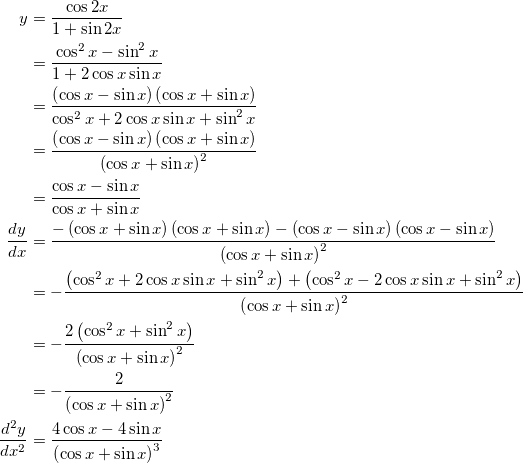 This post has been edited by Critical_Fallacy: Jan 29 2015, 05:14 PM |
| Change to: |  0.0429sec 0.0429sec
 0.57 0.57
 7 queries 7 queries
 GZIP Disabled GZIP Disabled
Time is now: 18th December 2025 - 07:54 PM |
 Quote
Quote