QUOTE(Intermission @ Jan 27 2014, 04:39 PM)
» Click to show Spoiler - click again to hide... «
Q1) I see an error in your calculation of change in momentum. Velocity is an vector, the direction matters. And also I believe what you calculated is just the rate of change of momentum when one hail stone strikes the roof, multiplied by 30.
Thank you, completely forgot to account for the direction of the two velocities.

QUOTE(ninty @ Jan 27 2014, 07:27 PM)
The idea is sound but I do not know how you came up with that answer.
» Click to show Spoiler - click again to hide... «
Should be (-∞, -1)
And I've drawn the graph explicitly just to check my calculations. I do not think f(x) = log_1/2 (x^2 - 2x - 3) is even defined on [-1,3].
Correct. Thank you ! The book provides another solution, I'll upload it here later.
QUOTE(Critical_Fallacy @ Jan 27 2014, 10:18 PM)
Not 216 N?

What is the answer?
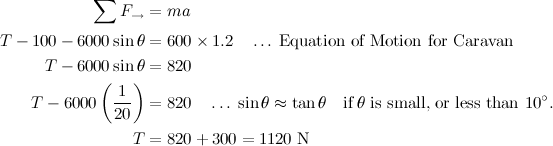
You don't need to find the angle of inclination θ because you can determine cos θ and sin θ from the Pythagorean theorem. The hypotenuse is 20 m and altitude (height) is 1 m.

Found the answer for the first question. The correct answer is 36 N.
Can you provide the full solution for the 2nd question please? The answer at the back contradicts mine.
QUOTE(Critical_Fallacy @ Jan 27 2014, 11:12 PM)
ninty and
ystiang have already covered this.

Where did you get this question at A-level?
Actually, this is not an A Level question. It's a high school [China] Mathematics challenge problem. I posed the question here because I didn't understand the end part of the solution, after thinking a lot I realised SPM Trigonometry isn't enough for me to continue with the problem. Here's the solution if you're interested, we have three solutions now. Which shows us that Mathematics is beautiful.


The main point was to realise that the question wants us the find the shortest distance between the origin and the circumference of the larger circle.
Thanks for you solutions! The first one is a little bit beyond me, but it looks very powerful.



 Jan 18 2014, 10:59 PM


 Quote
Quote







 in the first place?



 0.0626sec
 0.84
0.84
 7 queries
 GZIP Disabled