Welcome Guest ( Log In | Register )

29 Pages < 1 2 3 4 > » Bottom

Outline · [ Standard ] · Linear+

 Ask a Mathematical Physicist

views
     
TSCritical_Fallacy
post Nov 13 2013, 09:11 PM

∫nnộvisεr
Group Icon
VIP
3,713 posts

Joined: Nov 2011
From: Torino
QUOTE(E Crew @ Nov 13 2013, 02:12 PM)
This is a question from my homework that I need help with.The question asked me to find the general solution for the given second differential equation.How am I suppose to solve this ? Anyone pros can help me out please ? icon_question.gif
user posted image
At first glance, you maybe tempted to solve ODE using Laplace Transforms. But it is not easy to find the Laplace Transform of 1/(1+t²). Since the ODE is a nonhomogeneous equation y'' + p(t)*y' + q(t)*y = g(t), your Lecturer probably has taught you about the Variation of Parameters formula.

user posted image

This post has been edited by Critical_Fallacy: Nov 15 2013, 01:58 PM
TSCritical_Fallacy
post Nov 13 2013, 09:44 PM

∫nnộvisεr
Group Icon
VIP
3,713 posts

Joined: Nov 2011
From: Torino
QUOTE(ailing tan @ Nov 13 2013, 09:18 PM)
can anyone explain why this is -500j not  positive 500J ???
user posted image
Because the gas undergoes expansion from L to J

W(L,J) = (0.005 − 0.003)m³ × (100)kPa = 200 J

and then the gas undergoes compression from J to L

W(J,L) = ½ × {(0.005 − 0.003)m³ × (600 + 100)kPa} = 700 J

Therefore, the net work of the system is:

W(L,J) − W(J,L) = 200 − 700 = -500 J

Ans (A)... icon_rolleyes.gif

This post has been edited by Critical_Fallacy: Nov 14 2013, 12:39 AM
TSCritical_Fallacy
post Nov 13 2013, 09:57 PM

∫nnộvisεr
Group Icon
VIP
3,713 posts

Joined: Nov 2011
From: Torino
QUOTE(ailing tan @ Nov 13 2013, 09:34 PM)
gaussian elimination is to make d g h = 0?
user posted image
Technically NO because you missed out the Matrix B. sweat.gif

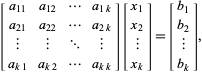
Given a system of linear equations in the form of Ax = B:

user posted image

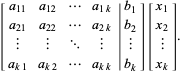
Transform the linear system into augmented matrix:

user posted image

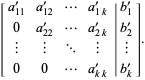
Then, perform Gaussian Elimination to put the augmented matrix into the upper triangular form:

user posted image
TSCritical_Fallacy
post Nov 14 2013, 08:02 PM

∫nnộvisεr
Group Icon
VIP
3,713 posts

Joined: Nov 2011
From: Torino
QUOTE(ailing tan @ Nov 14 2013, 06:10 PM)
how to do this???? i need ur help!!!!!
This belongs to the topic called Absolute-Value Inequalities.

To solve this problem, let's understand what is absolute value.

The absolute value of a real number R (denoted “|R|”) may be defined as the distance of R from zero.

For example, both –1 and 1 are one unit from zero, and therefore we have |–1| = |1| = 1.

The absolute value of R can be written as a function of the positive square root: |R| = √(R²).

Come back to the problem: |–2 / (x + 1)| < 1.

Let's define f(x) = –2 / (x + 1), and it follows that |f(x)| < 1.

By the above definition, we can intuitively imagine that f(x) = –1 and f(x) = 1.

To satisfy the condition of the inequality |f(x)| < 1, let's do four possible logic tests:

Test 1: f(x) < –1 :: Let f(x) = –1.1, and |f(x)| = |–1.1| = 1.1 < 1 ~ FALSE

Test 2: f(x) > –1 :: Let f(x) = –0.9, and |f(x)| = |–0.9| = 0.9 < 1 ~ TRUE

Test 3: f(x) < 1 :: Let f(x) = 0.9, and |f(x)| = |0.9| = 0.9 < 1 ~ TRUE

Test 4: f(x) > 1 :: Let f(x) = 1.1, and |f(x)| = |1.1| = 1.1 < 1 ~ FALSE

From the results, because Test 2 and 3 are TRUE, we can conclude that given the inequality |x| < a, the solution is always of the form –a < x < a.

Therefore, we have two inequalities: –1 < |f(x)| < 1.

Solve inequality #1: –1 < –2 / (x + 1) ... → ... we have x > 1.

Solve inequality #2: –2 / (x + 1) < 1 ... → ... we have x < –3.

Once you understand the concept, you can use the same simple approach as ystiang did.

Question: What if you were given the inequality |x| > a? sweat.gif
TSCritical_Fallacy
post Nov 15 2013, 12:59 PM

∫nnộvisεr
Group Icon
VIP
3,713 posts

Joined: Nov 2011
From: Torino
QUOTE(maximR @ Nov 15 2013, 11:45 AM)
If possible, post your questions in Critical_Fallacy's Ask a Mathematical Physicist Thread.  smile.gif
user posted image

Even though it is a complex number, you can solve this problem using basic algebraic manipulation skill that you have already learned in Form 2 Factorization & Form 3 Simultaneous equations. Let me show you:

Find √(16 − 30i).

Since (16 − 30i) is a complex number, your developed mathematical intuition should tell you that the expected answer must be also a complex number (a + bi). Therefore it can be written as

√(16 − 30i) = √[(a + bi)²]

Your task now is to find a and b. As simple as that, regardless of the square root sign.

16 − 30i = (a + bi)² = a² + 2abi + b²i².

Since i² = −1, you can rearrange the equation to

16 − 30i = (a² − b²) + (2ab)i.

Eq.(1): a² − b² = 16

Eq.(2): 2ab = −30 ... → ... b = −15/a

You can solve the simultaneous equations by expressing b in term of a and substitute it into Eq.(1):

a² − (−15/a)² = 16

Multiply both sides with a² and turn it into a standard quadratic equation:

(a²)² − 16a² − 225 = 0

(a² − 25) (a² + 9) = 0

By the definition of a complex number (a + bi) where a and b must be Real Numbers, it renders a² = −9 invalid and therefore

a² − 25 = 0 ... → ... a = 5

Back-substituting a = 5 into Eq.(2) to find b:

b = −15/5 = −3

With the values found for a & b, and for all complex z with Re(z) > 0, √(z²) = z, the answer for

√(16 − 30i) = 5 − 3i icon_rolleyes.gif

This post has been edited by Critical_Fallacy: Nov 15 2013, 01:59 PM
TSCritical_Fallacy
post Nov 17 2013, 01:05 AM

∫nnộvisεr
Group Icon
VIP
3,713 posts

Joined: Nov 2011
From: Torino
QUOTE(ailing tan @ Nov 16 2013, 05:20 PM)
I was given this question... can someone show how to get k=3??? my ans is not 3
user posted image

Given a system of linear equations with a set of variables x, y, z. Find k.

R1: 1x − 2y + 2z = 6
R2: 2x + 1y + 3z = 5
R3: 4x + 7y + 5z = k

Let's do some elementary row operations: You're lucky because element a11 is 1. See R1.

To eliminate coefficient of x (2) in R2, therefore 2 × R1: 2x − 4y + 4z = 12
R2 − 2R1:
R2': 5y − 1z = −7 ... eliminated x

To eliminate coefficient of x (4) in R3, therefore 4 × R1: 4x − 8y + 8z = 24
R3 − 4R1:
R3': 15y − 3z = k − 24 ... eliminated x

If you compare carefully R2' with R3', you'll notice that R2' & R3' are the same equation when scaled by a factor of 3, therefore 3 × R2': 15y − 3z = −21

Because it is stated that the equations are consistent, only then you can perform the next operation:
R3' − 3R2': 0 = k − 3

Solve for k and you have k = 3.

P.S. If you analyze the coefficient matrix, its determinant is 0, and thus the matrix is said to be singular, or it doesn't have a matrix inverse. If you plot the three equations in 3D, you'll discover that the linear system has infinitely many solutions because the equations are linearly dependent (see above R2' and R3'). If the system has a single unique solution, the three planes will intersect at a single point. icon_idea.gif

user posted image
TSCritical_Fallacy
post Nov 18 2013, 02:23 AM

∫nnộvisεr
Group Icon
VIP
3,713 posts

Joined: Nov 2011
From: Torino
QUOTE(ailing tan @ Nov 17 2013, 05:31 PM)
if i am given a question like this [ the parametric equations of curve is x = t*(t+2) y = 2*(t+1) ] How to know that this curve is ellipse, parabola, or hyperbola at first glance??
Like crazywing26 said, you hardly know which conic section is unless you have done many practices. However, it's not the end of maths. With a little quick-witted algebraic manipulation skills plus some knowledge in trigonometric identities, you can derive the General Parametric Equations for parabola, ellipse, and hyperbola. The parametric equations of a circle with radius r can be derived from the parametric equations of an ellipse by setting a = b = r.

user posted image
TSCritical_Fallacy
post Nov 18 2013, 03:41 AM

∫nnộvisεr
Group Icon
VIP
3,713 posts

Joined: Nov 2011
From: Torino
QUOTE(Flame Haze @ Nov 17 2013, 03:52 PM)
This is complicated  biggrin.gif

Let s = 1+2+4+8+....
So 2s = 2+4+8+16....
And s-1 = 2+4+8+16+...

Seems to stand true that 2s = s-1
How come s = -1?  sweat.gif
QUOTE(reconnaissance @ Nov 18 2013, 02:24 AM)
However, can it be explained this way?;

2s = s-1
2s-s = (s-1)-s
s = -1
There might be a more sinister motive behind the smiley. Well, straight to the point, it's a mathematical fallacy, where it presents an invalid proof for 3 reasons as explained in the following:

Reason #1: s has no sum.
s = 1 + 2 + 4 + 8 + … + 2^n is the infinite series whose terms are the successive powers of two. It is logically obvious that the sum of ever-growing positive-definite terms does not converge at a negative value or s = −1. In other words, it diverges to infinity, and so in the usual sense it has no sum.

Reason #2: Division-by-zero fallacy.
Let's start from here: 2s = s − 1. We know s is said to tend to infinity (∞). Using the notion of infinite limits, we can generalize that s − 1 becomes extremely close to s as s approaches indefinitely to infinity (∞).

And so, it follows that
2s = s
Divide by the non-zero s
2 = 1
The fallacious result is the implicit assumption that dividing by 0 is a legitimate operation
2 × 0 = 1 × 0
Dividing by zero gives:
2 × (0/0) = 1 × (0/0)

Reason #3: Invalid argument of power series.
Using Maclaurin series expansion, one can show that 1/(1 − x) = 1 + x + x² + x³ + …
If we plug in x = 2, the series becomes s and it sums the terms on the RHS to the finite value of −1.
Unfortunately, the expansion is only VALID for arguments |x| < 1. In plain English, invalid argument yields invalid result.

This post has been edited by Critical_Fallacy: Nov 18 2013, 03:43 AM
TSCritical_Fallacy
post Nov 18 2013, 06:27 PM

∫nnộvisεr
Group Icon
VIP
3,713 posts

Joined: Nov 2011
From: Torino
QUOTE(ailing tan @ Nov 18 2013, 03:05 PM)
i gt a physics question here...
A surface area A is bombarded normally by n molecules per unit second.. If the collision are elastic each molecule has a mass of m and moves with speed u , hence the pressure actiong on surface is 2nmu...  how to get the ans???  icon_question.gif  icon_question.gif
The information given on your physics question are incomplete. No assumptions are made. However, this is my probable explanation of the elastic collision. Do you get the concept? sweat.gif

user posted image
TSCritical_Fallacy
post Nov 18 2013, 06:44 PM

∫nnộvisεr
Group Icon
VIP
3,713 posts

Joined: Nov 2011
From: Torino
QUOTE(ailing tan @ Nov 18 2013, 06:31 PM)
sry i cant understand this....haha.. this is too difficult for me...
Perhaps you can ask your classmates, Just Visiting By or crazywing26 to explain to you. By the way, are you familiar with the fundamentals of Linear Momentum and Elastic Collision in One Dimension? icon_question.gif

user posted image
TSCritical_Fallacy
post Nov 21 2013, 03:01 PM

∫nnộvisεr
Group Icon
VIP
3,713 posts

Joined: Nov 2011
From: Torino
2013 STPM Maths T paper: Part 1 & Part 2

Hi ailing tan, crazywing26, iChronicles, yellowpika, ystiang

Here is my solution for Question 1 ~ [8 marks]:

user posted image
TSCritical_Fallacy
post Nov 21 2013, 03:02 PM

∫nnộvisεr
Group Icon
VIP
3,713 posts

Joined: Nov 2011
From: Torino
2013 STPM Maths T paper: Part 1 & Part 2

Hi ailing tan, crazywing26, iChronicles, yellowpika, ystiang

Here is my solution for Question 2 ~ [7 marks]:

user posted image
TSCritical_Fallacy
post Nov 21 2013, 03:02 PM

∫nnộvisεr
Group Icon
VIP
3,713 posts

Joined: Nov 2011
From: Torino
2013 STPM Maths T paper: Part 1 & Part 2

Hi ailing tan, crazywing26, iChronicles, yellowpika, ystiang

Here is my solution for Question 3 ~ [5 marks]:

user posted image
TSCritical_Fallacy
post Nov 21 2013, 03:03 PM

∫nnộvisεr
Group Icon
VIP
3,713 posts

Joined: Nov 2011
From: Torino
2013 STPM Maths T paper: Part 1 & Part 2

Hi ailing tan, crazywing26, iChronicles, yellowpika, ystiang

Here is my solution for Question 4 ~ [9 marks]:

user posted image
TSCritical_Fallacy
post Nov 21 2013, 06:36 PM

∫nnộvisεr
Group Icon
VIP
3,713 posts

Joined: Nov 2011
From: Torino
2013 STPM Maths T paper: Part 1 & Part 2

Hi ailing tan, crazywing26, iChronicles, WoanPing, yellowpika

Here is my solution for Question 5 ~ [9 marks]:

user posted image
TSCritical_Fallacy
post Nov 21 2013, 06:37 PM

∫nnộvisεr
Group Icon
VIP
3,713 posts

Joined: Nov 2011
From: Torino
2013 STPM Maths T paper: Part 1 & Part 2

Hi ailing tan, crazywing26, iChronicles, WoanPing, yellowpika

Here is my solution for Question 6 ~ [7 marks]:

user posted image
TSCritical_Fallacy
post Nov 21 2013, 06:37 PM

∫nnộvisεr
Group Icon
VIP
3,713 posts

Joined: Nov 2011
From: Torino
2013 STPM Maths T paper: Part 1 & Part 2

Hi ailing tan, crazywing26, iChronicles, WoanPing, yellowpika

Repost of solution for Question 7 ~ [15 marks]:

user posted image
TSCritical_Fallacy
post Nov 21 2013, 06:38 PM

∫nnộvisεr
Group Icon
VIP
3,713 posts

Joined: Nov 2011
From: Torino
2013 STPM Maths T paper: Part 1 & Part 2

Hi ailing tan, crazywing26, iChronicles, WoanPing, yellowpika

Repost of solution for Question 8 ~ [15 marks]:

user posted image
TSCritical_Fallacy
post Nov 22 2013, 11:41 PM

∫nnộvisεr
Group Icon
VIP
3,713 posts

Joined: Nov 2011
From: Torino
Hi maximR, this is Remainder Theorem. Most likely you will master this in less than 3 minutes. laugh.gif

user posted image
TSCritical_Fallacy
post Nov 23 2013, 02:14 AM

∫nnộvisεr
Group Icon
VIP
3,713 posts

Joined: Nov 2011
From: Torino
Hi maximR, this is the Solution of Cubic equations & Quartic equations. Most likely you will master this in about 10~15 minutes. wink.gif

user posted image

You have already learned the basic factorization skill in Form 2 and quadratic solution by completing the square & formula in Form 4 Add Math. So, tell me now, are your Math skills sufficient to solve cubic equations and quartic equations with the systematic procedure? sweat.gif

This post has been edited by Critical_Fallacy: Nov 23 2013, 02:20 AM

29 Pages < 1 2 3 4 > » Top
 

Change to:
| Lo-Fi Version
0.0540sec    0.80    7 queries    GZIP Disabled
Time is now: 18th December 2025 - 07:11 PM