Witcher 3: Wild Hunt Announced nigggaaaaaa
http://gematsu.com/2013/02/the-witcher-3-wild-hunt-announcedQUOTE
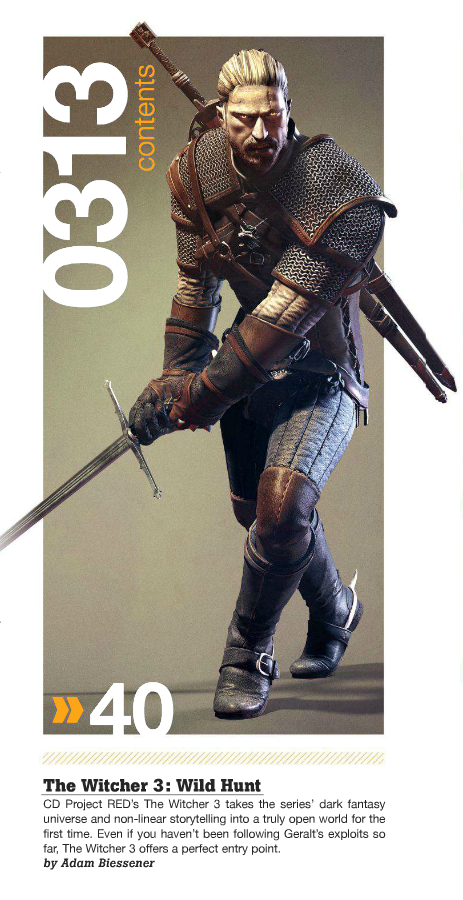
The game once again stars Geralt, his memory now restored, who is done fighting for others. His new missions include everything from solving mysteries to slaying monsters. And there will be no chapters, acts, or artificial break-points to slow him down.
Wild Hunt is set in a world 20 percent bigger than that of The Elder Scrolls V: Skyrim and 40 times larger than that of The Witcher 2—one so large that it takes 30 to 40 minutes to cross on horseback. (Boat, foot, and fast-travel for previously visited locations are also travel options.)
According to the mag, Geralt can ‘seamlessley’ cross the game world with no loading screens to disturb him. This is because the team felt it missed the freedom of open-world games such as Skyrim.
When traveling, points of interest will always be in sight. Players will explore dark caves, embattled villages, decaying ruins, and other areas. Based on where you are in the world, you’ll come across certain mini-games, too. Skellige, for example, has a knife toss mini-game through which you can earn exclusive rewards.
The game’s narrative is said to offer three forms:
Lowest Level: Free-form activities such as crafting, monster slaying (which seems to be more extensive in the third iteration), and going on quests. (There are over 100 hours of hand-scripted quests. These include helping villages and engineering the succession of the Skellige kings. Though, I think the latter would apply to the Next Level.)
Next Level: The political situation of the Nilfgaardian invasion is resolved through a core plot line for each area, including Skellige, Novigrad, and No Man’s Land.
Final Level: Geralt’s main storyline, his search for his loved ones, and the chase of the Wild Hunt.
Players will be tasked with making choices, and naturally, can skip things if they’d like, but will face whatever consequences if they choose to do so.
Each land in The Witcher 3 will have its own storyline. Major events in the main storyline are said to be “gates” for the state of the world. For example, a village threatened by bandits might be abandoned after certain events if the player doesn’t step in with a helping hand.
Weather effects are also a big part of the game. This time, they’re dynamically generated and fully modeled as real, volumetric clouds. They’re not a simple paint on the skybox anymore.
On the field, monsters, bandits, traders, animals, and others will attack anyone they determine to be hostile. But enemies won’t scale to your level. Enemy AI has been completely rebuit, and scripted boss sequences are a no-go.
When monster hunting, players can gather clues to build up information. Books hold information on monsters and townsfolk can also provide insight. Potions and similar items are important when going into battle. Depending on the time of day and other conditions, monsters may appear in different areas and boast different abilities.
In combat, you’ll be able to perform critical strikes on a monster’s weak point depending on how much you’ve learned about it. When fighting a vampire, for example, you can negate its poison attack by hitting its venom gland. Or, you can strike at both its hearts with a thrust attack for an instant kill.
After they’ve been defeated, monsters will drop loot such as normally unobtainable chemical and crafting materials required for unique potions, mutagens, and other forms of item crafting. These allow Geralt to gain special abilities and upgrades in the new mutation development tree. Monster kills provide income as well (orens drop?).
Crafting is a critical part of maximizing Geralt’s potential, but weapons and armor can be found in many other ways, as well. Players will be able to customize their crafted weapons with additional components like monster scales for leather in armor. Each armor piece will have a unique appearance through the game’s new cloth simulation tech. Also in line with customization, players will have access to a barber to change Geralt’s hairstyle. But you won’t be able to dye his hair.
The “flow of combat” and “backward difficulty curve” of previous games is being reworked. In comparison to The Witcher 2, which had 20 combat animations, The Witcher 3 will have 96. When fighting enemies, a new “weighting” system will make sure the most threatening of enemies are always in the frame. These changes were made to make sure players wouldn’t get locked into animations.
Players can strike enemies with a single button press, and each move takes “roughly equivalent time to execute.” You can always interrupt your attack in order to dodge or block, even when you’re out of stamina, but you will be staggered. Your attacks are very fast, though, as are your opponents. In place of the former dodge roll, Geralt has a new pivot move “that retains its defensive utility without game-breaking mobility.”
Proper mounted combat is still in the testing stages, but at this point is not a definite part of the game. Horses are, however, as mentioned earlier, as they’re an important tool for navigation. It’s merely on-horse combat that’s unconfirmed. Outside of combat, one idea is that players can access their long-term stash from their horse and at inns.
Regarding inventory management, the team understands it was frustrating in The Witcher 2 and are aiming to improve it in The Witcher 3.
The Witcher 3, which is being developed by a team double the size of the previous game, uses CD Projekt RED’s new REDengine 3 technology and will launch for PC and “all high-end platforms available” in 2014. A next-gen hint it is, then.
“This is the conclusion of the trilogy.”


 Jan 12 2013, 12:01 PM, updated 9y ago


 Quote
Quote


 ), if you can.




 ) and hope they do well on this 3rd game.




 , the First one overall better IMO.


 .
. . at least FarCry 3 is daring to go topless which i salute them.






























 0.3269sec
 1.03
1.03
 6 queries
 GZIP Disabled