
I finally got the grand master of bokeh - the Sony 135mm F2.8/T4.5 Smooth Transition Focus! This is the undisputed king of rendering a smooth, clean and undistracting out-of-focus area.
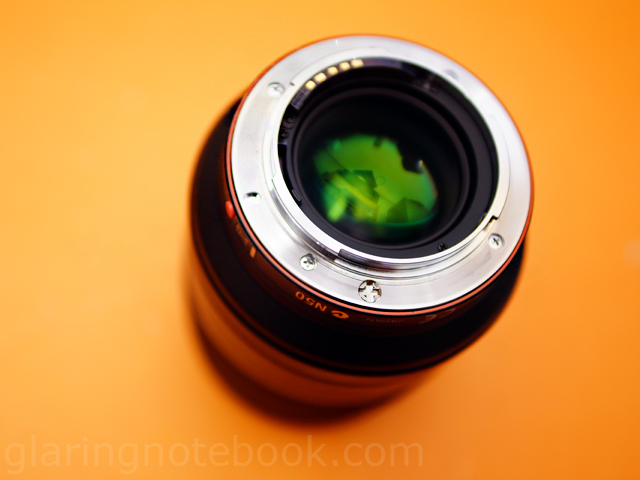
The STF is physically a 135mm F2.8 lens, but because of the apodization filter inside that darkens the periphery of the lens, it effectively lets in as much light as a F4.5 lens. Hence the T4.5 suffix (T for effective light Transmission).
Also, the lens is manual focus only - which makes it the only Minolta/Sony A-mount lens that is manual focus. The reason why is because the apodization filter causes a graduation coming from opposite ends, making it impossible for phase-detect AF to work.
I've explained this in another blog post.
You can tell immediately that the lens is the STF from the back, from the cross-shaped AF screw drive screw (it stops the AF screw drive from turning) and only 5 pins.
The only Sony lenses with 5 pins are:
1) Sony 16mm F2.8 Diagonal Fisheye
2) Sony 20mm F2.8
3) Sony 28mm F2.8
4) Sony 135mm F2.8/T4.5 Smooth Transition Focus
5) Sony 500mm F8 Reflex
There shouldn't be any reason why any of these lenses don't get a Distance Integration chip, other than Sony not having the resources or time to migrate them from their Minolta versions.
Interestingly, SSM lenses have a flat screw with a small circle inside, although its purpose is the same - to stop the AF screw drive from turning.
This lens is on the end of every A-mount user's wishlist - meaning you'd get every other lens you wanted, before this one. It is such a luxury (not that it is expensive) but it is such an optional want-to-have instead of a must-have. It doesn't help that it's manual-focus only and doesn't transmit much. I wonder if they could've made a 85mm F1.4 with the same apodization filter, which would bring it down to 85mm F1.4/T2.2!

Normal lenses will draw out-of-focus areas with a hard, solid brush (quite like the Photoshop screenshot on the left.) The STF, however, paints out-of-focus areas with a soft, shaded brush (on the right.)

So here's one from the Carl Zeiss 135mm F1.8, set to F2.8, on the A900...

...and one from the Sony 135mm F2.8/T4.5 Smooth Transition Focus, set to F2.8/T4.5, on the A900. The difference in rendition should be obvious!
You might also notice that the STF gives a tighter angle-of-view - this is because it extends when focusing, while the Carl Zeiss 135mm F1.8 has an internal focus mechanism. Internal focus mechanisms tend to make the angle-of-view wider as it focuses closer - thus the only time the Carl Zeiss 135mm F1.8 is truly 135mm is when it is focused at infinity.
It focuses to 87cm close with a maximum magnification of 1:4x - interestingly, the Carl Zeiss 135mm F1.8 also does a maximum magnification of 1:4x, but when focused to 72cm close (obviously, due to the wider angle-of-view.)
The STF also uniquely has 2 sets of aperture blades - it uses the set of 10 blades in manual aperture control mode, from T4.5 to T6.7 (stepless, but with clicks), or the set of 9 blades when set to A (auto). However, I have not tested this extensively as I have had no reason to stop down the lens!

Meanwhile, this is from the Carl Zeiss 135mm F1.8 at F1.8. I think you should be able to tell the difference between the STF and any other lens by now.

The background just melts into creamy goodness here.

You can try to put a distracting background, and it smoothens out nevertheless!

How about some harsh sunlight?

Magic hour. Here, the shading of the out-of-focus highlights is obvious. Also, the lens is remarkably free of cats-eye bokeh - where out-of-focus areas on the side become cats-eye shaped instead of perfectly round circles. This might be because the lens is much bigger in diameter compared to a regular 135mm F2.8.
This post has been edited by albnok: Mar 25 2012, 05:32 PM 

 Mar 25 2012, 12:01 AM


 Quote
Quote






 (general purpose la)


 0.0177sec
 0.99
0.99
 6 queries
 GZIP Disabled