Here is something i found on the web:
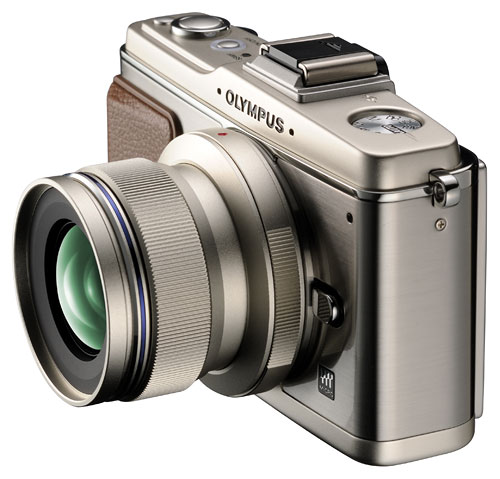
How does the E-PL1 combat noise commonly found at high ISOs?
Digital cameras vary the light sensitivity of the image sensor by varying the gain voltage applied to the sensor, much like turning up the volume on a stereo. When the gain voltage is increased, as it is when shooting with higher ISOs, the sensor becomes hot. Hot pixels perform differently under extreme conditions. The result is a graininess known as “noise.”
Noise occurs whenever sufficient heat has built up on the image sensor. Therefore, it can also be seen in images with long exposures, such as night photographs, due to the additional heat generated by charging the sensor for an extended period of time. All digital cameras include technologies to minimize the effects of noise. The E-PL1 uses a sensor that dramatically decreases noise. In addition, it combats noise with two methods: NOISE FILTER and NOISE REDUCTION.
The NOISE FILTER function is found in the menu. It has four options: OFF, LOW, STANDARD and HIGH. The majority of digital cameras have a default noise filter that is always on. Some photographers feel that this reduces detail, so Olympus has included the option to not use a noise filter at all.
If NOISE FILTER is set to OFF, it is recommended to set the SHARPNESS setting to –2. If SHARPNESS is set to 0 it may exaggerate the noise when no noise filtering is being applied.
The NOISE REDUCTION function can also be enabled from the menu. After the first exposure, the camera makes a second exposure of equal length with the shutter closed. It then, in effect, overlays the two images, finds the hot pixels in the second image (essentially, any pixels that aren't black) and deletes the corresponding pixels from the first image. This doubles the shooting time. If the first exposure is 12 minutes 30 seconds, the second, black exposure will also be 12 minutes 30 seconds for a total exposure time of 25 minutes.


 Feb 9 2011, 11:50 PM


 Quote
Quote


 Btw, how much does a kit zoom lens cost? Or anyone willing to let go their kit lens?

 how much did yours cost?


 0.0305sec
 0.35
0.35
 6 queries
 GZIP Disabled