


 Dec 16 2008, 09:05 AM


QUOTE(SapperJones @ Dec 15 2008, 11:14 PM)
which Netbook fits my needs?
=====================
already have an old dell inspiron 15" that stills works fine after 6 years.
but heavy to lug around.
am looking for a reliable, good looking netbook (black and professional-looking) that lets me do 3 things really well.
1) Word processing using MS word as I write a lot
2) Use the Internet using free WiFi
3) a bit of photo editing/touchups to go with word processing using irfanview, etc.
Other than that, I do very little DVD movie watching/music listening but it's nice to have.
since netbooks do not have DVD recorder/player, would like to get an external unit. Battery life at least 3 hours. Bluetooth is a requirement to sync with a Nokia E71.
pros and cons with HP Mini, latest FTEC don't know reliable or not and dell and lenovo look sweet. am leaning towards the later 2 esp dell since i have had good experiences with it and aftersales.
No rush... I can wait till first quarter 2009.
which would be ideal? all-in budget RM2,000. sweet spot would be RM1,600-RM1,800.

HOLD YOUR BREATH, this is gonna be a long one =====================
already have an old dell inspiron 15" that stills works fine after 6 years.
but heavy to lug around.
am looking for a reliable, good looking netbook (black and professional-looking) that lets me do 3 things really well.
1) Word processing using MS word as I write a lot
2) Use the Internet using free WiFi
3) a bit of photo editing/touchups to go with word processing using irfanview, etc.
Other than that, I do very little DVD movie watching/music listening but it's nice to have.
since netbooks do not have DVD recorder/player, would like to get an external unit. Battery life at least 3 hours. Bluetooth is a requirement to sync with a Nokia E71.
pros and cons with HP Mini, latest FTEC don't know reliable or not and dell and lenovo look sweet. am leaning towards the later 2 esp dell since i have had good experiences with it and aftersales.
No rush... I can wait till first quarter 2009.
which would be ideal? all-in budget RM2,000. sweet spot would be RM1,600-RM1,800.

Lets see, you're asking in an EEEPC Fans thread so of course the onus would be to push you towards EEEPC
Your requirements were :
1) Word processing using MS word as I write a lot
2) Use the Internet using free WiFi
3) a bit of photo editing/touchups to go with word processing using irfanview, etc.
An answer to that is : All Netbooks from the very first generation EEEPC 701 can actually do the very base of these. In fact, I can proudly say the lowest capacity of the lot can do all this.
Im pasting an answer ive put earlier in this thread on what the EEEPC can do.
I went with the EEEPC's for their lightweight and design and more importantly the SSD's. Now most Ultra Mobiles will pit SSD's ( which are small ) vs their larger capacity HDD's within. Even the 901 which I have uses the 1.8" Sata HDD which gives a space of 30gb vs the others which are all SSD's the largest being 12gb and the smallest being 4gb. Believe me, SSD's are the only way to go. Nothing beats that.
For size comparisons, from what I see the EEEPC takes about the smallest footprint as compared to its similar competitor of the same capacity and size. That being said, yes Im a fan of the EEEPC but not to say Ive nothing good to say about the rest. But if you are going for size, you will see that most the time the EEEPC will be much sleeker than the others. Have you seen how huge in comparison HP 2133 Mini Notebook is ? Or how fat MSI Wind is in comparison to the EEEPC ?
Design wise though I like the look of the Aspire One from Acer. That's just new but those lights at the side and the gloss they go really well together
EEEPC has gloss too on the 901 and 1001 but I still prefer the Aspire One look. Perhaps I may trade in one of the Laptops that I have for the Aspire One Earlier when purchasing my requirements were :
Running on / Can install Windows XP SP2 - Most if not all support that. In fact all my EEEPC's are running a small Modified version of XP SP3 which is taking only about 400mb in install footprint!
Net Surfing, (thus need Wifi and Ethernet support ) - The very essence of an Ultra Mobile PC, we can safely say for both requirements above any UMPC will fit that need.
Watch Movies, ( RMVB, Avi , moderate bitrate, maybe sometimes 720HD or 1080HD, rarely but possible) -
For this part yes most UMPC will be able to fulfill your needs but having the latest Atom Processor EEEPC in the 1001 I can play all movies except sadly for the movies running on 1080HD and 720HD, well they play but not often smooth. So yes they play but you wont get proper playback. Best stick to normal divx at the normal high resolution and not the super high ones.
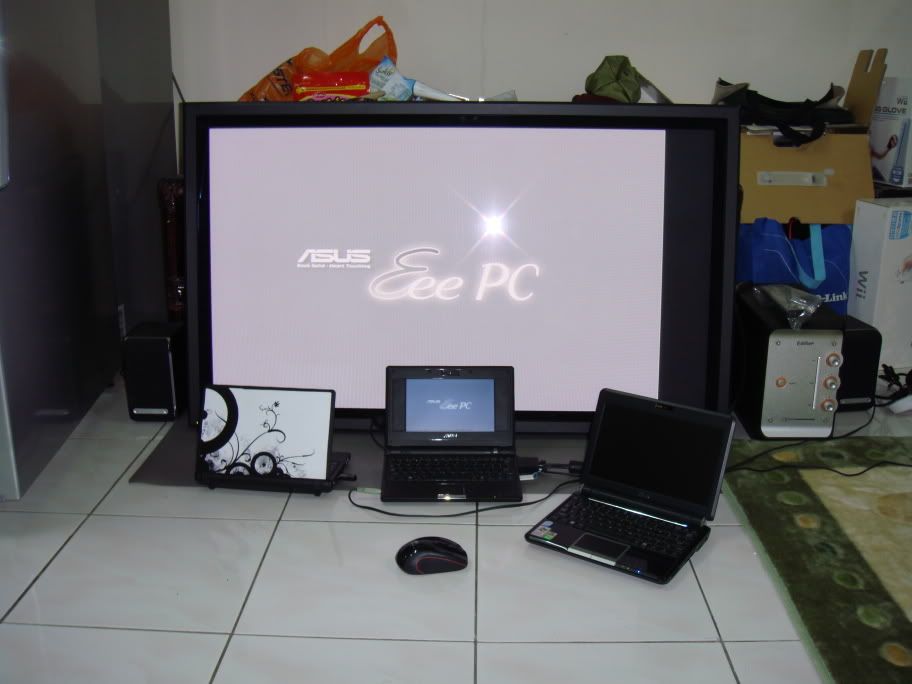
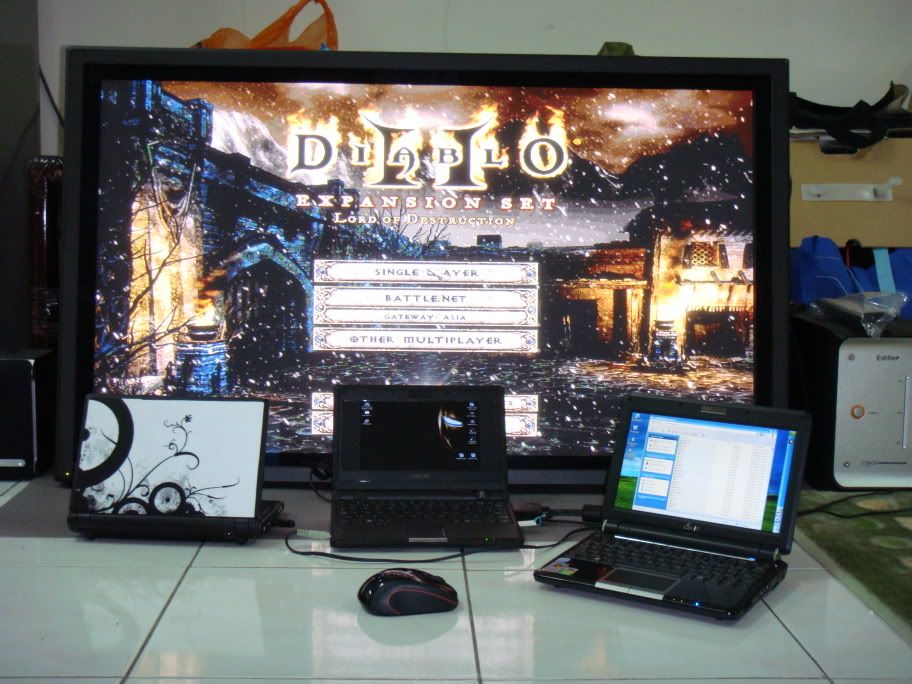
Play Games, (old school game, Counter-strike 1.6 ) - Playing Warcraft 3 on my old skool EEEPC 701 with 512mb Ram ( All the other ones have been upgraded to 2gb Ram ),
Warcraft 3 runs fine on it so safe to say you'd be fine, though playing CS on it may need you to squint a little
Running Diablo 2 on mine now too.
Office works ( MS office) - This goes without saying, In Fact MS Office 2007.
Running Garmin GPS on 2 of the UMPC's now. I have Ultra Big Screen GPS for cheap!
All my EEEPC's are running WinXP SP3 fine without problems. Speed is essential and other than my 901 which runs on 30gb SATA HDD all I can say about all of the UMPC that I have is that they run blazing fast.
Personal Tips from havocx on getting a netbook :
*There is no major reason as to why you should get an External Drive EEEPC is USB bootable too.
*Dont worry about HDD footprint, my 4G SSD still have plenty of space ( if youre good enough to manipulate it ) for WinXP SP3, Word 2003, GPS, Diablo and a couple of programs. All on only 4GB. SSD of course. So buying a new machine, think about the speed of the HDD as well, no use having a huge space when you load and run programs very slow.
* HDD size comparison 80gb, 160gb vs SSD of 12gb, 8gb ? Bah - I carry 1 Terrabyte of space with me on my very small twin external laptop drive. Why bother with space issues ?
* VGA output is a must, there are times when youd want to see that photo you took and you saved on say a larger than 20" screen.
* Try to get one with an Atom Based processor, on the same mAh battery rating, Atom based processor will last you longer, much longer. Of course size is also a factor. ( I got 2 Atom based processors but I still like my Celeron based one simply for its size, i personally think the EEEPC 1000H is a little on the fat side. No offence owners
* Ram Upgrades ? - If youre running SSD youll see that 512mb is actually enough for most things
* Better to get one with 3G WWAN Support, running on Bluetooth is fine but youre limited in speed by your Bluetooth connectivity. Nowadays you can clone your own sim card to have 2 sims with the same number and capability, just chuck one in the laptop while leaving your phone functions running. Much faster support
* Battery Life - Most common Laptops nowadays run with 4 cell batts, the more cell the better, combine that with an Atom processor and youve got a winner in how long the laptop holds up. A simple 6 cell battery with ratings of 6600mah on an Atom based processor runs about 5 hours on max setting for all. If you lower brightness sound and everything else youll get an even longer hang time!
Lets talk about the new HP Mini
Id say
1) doesnt have proper vga-out ; need spend extra for adaptor - Major ouch for me, that Adapter on its own is outrageous, i mean, i dont mind it not having a proper vga out, but please pass the adapter for free since you dont have it in your design, this to me is a major flaw

2) 3-cell battery - Tested the battery life on this, 3 cell lasted me only 1.5 hour with medium brightness and constant surfing. Even running on Atom, its a major letdown.
3) WWAN freaking xpensive >RM700 - One word Expensive! The FTEC EEBook which comes in at RM1899 comes in with Bluetooth, 10.2 Inch screen, 160Gb Hdd, 2gb Ram, Wifi, VGA Port connector and 3G Module, now that as opposed to very sleek sexy, RM1699 without the ability to display on a larger screen for presentation and no 3G WWan Module....very mahal wor.
4) hdd is 1.8" - expensive to get & very slow at 4200 rpm... - Nowadays if possible i only go with SSD anyway, reduce my XP to what size i want with a certain 3rd party software and voila, I load faster on my EEEPC 701 ( yeah first gen SSD ) than on my Quad Core Processor at home with 4GB Ram
5) Their screen size, keyboard size however might be the best for someone who writes alot like yourself
On the Dell
Battery Life - Sucks to high heaven. 3 cell battery ? Aww cmon, even on an atom based processor youll not be mobile on this, its power hungry due to its limited power supply.
On FTEC
Youve seen my comments about a few posts back. Your choice, but remember though, that brands untested so its more of a wait and see game
Pretty good specs though, wished they had SSD
Oh finally why SSD ?
I'm hoping that as per discussion real question and real world comparisons
are used and not assumption based, I have both SSD and HD based netbooks and I do not just own 1 of them so I believe in my facts. Im not saying I the all correct source but at least I would have a clearer picture of what im explaining about and for discussion purposes the other folks could know and understand what it being discussed about.
Yes to many 160Gb HDD is a heck a lot bigger than the measly 8GB of SSD but not everyone needs space for the netbooks, they are to be fast light and easy to use. I need them really really fast and though booting up speed of 5 seconds vs 16 seconds ( for instance ) on a SSD based netbook vs your HDD based netbook may seem a neglible difference to you, it is a major difference as opposed to the work that I do which needs VERY FAST hdd access speeds.
Youll also find that Im clamour for space, I own 9.46 TB of data currently and yes space is also very important to me. Its just that for a netbook, im looking to more for speed which is the reason why SSD's i personally believe is always a better option. As also mentioned earlier, i own a twin Buffalo mini casing, holding twin 250Gb laptop HDD's so basically im going around with the netbook and 500Gb of data when i need it. Not only will it save space on my netbook's Defrag, it will also not load up too much unnecessary processes when im looking at running the laptop optimally. Have you seen how long it takes to defrag a HDD based 80GB netbook ? Versus a 4GB SSD ?

There's many things that contribute to why people choose SSD's over HDD's. A little google may help you
a lot in finding out the reasons my friend. Results from Wiki.
Advantages of SSD :
- Faster start-up, as no spin-up is required (RAM & Flash). - Typically, fast random access for reading, as there is no read/write head to move (RAM & Flash).
- Extremely low read latency times, as SSD seek-times are orders of magnitude lower than the best current hard disk drives.
- (RAM) In applications where hard disk seeks are the limiting factor, this results in faster boot and application launch times.
- Extremely fast write (RAM, nearly the same for best modern flash).
- No noise: a lack of moving parts makes SSDs completely silent, unless, as in the case of some high-end and high-capacity models, they have cooling fans attached (RAM & Flash).
- For low-capacity flash SSDs, low power consumption and heat production when in active use, although high-end SSDs and DRAM-based SSDs may have significantly higher power requirements (Flash).
- High mechanical reliability, as the lack of moving parts almost eliminates the risk of mechanical failure (RAM & Flash).
- Ability to endure extreme shock, high altitude, vibration and extremes of temperature: once again because there are no moving parts.[This makes SSDs useful for laptops, mobile computers, and devices that operate in extreme conditions.
- Larger range of operating temperatures. Typical hard drives have an operating range of 5-55 degrees C. Most flash drives can operate at 70 degrees, and some industrial grade drives can operate over an even wider temperature range.
- Relatively deterministic read performance: unlike hard disk drives, performance of SSDs is almost constant and deterministic across the entire storage. This is because the seek time is almost constant and does not depend on the physical location of the data, and so, file fragmentation has almost no impact on read performance.
- For low-capacity SSDs, lower weight and size: although size and weight per unit storage are still better for traditional hard drives, and microdrives allow up to 20 GB storage in a CompactFlash 42.8×36.4×5 mm (1.7×1.4×.2 in) form-factor. Up to 256 GB, SSDs are currently lighter than hard drives of the same capacity.When failures occur, they tend to occur either 'on write', or 'on erase', rather than 'on read'. With traditional HDDs, failure tends to occur 'on read'. If the drive detects failure on write, data can be written to a new cell without data loss occuring. If a drive fails on read, then data is usually lost permanently.
As you can see there are many advantages, reasons as to why folks tend to choose SSD's.
To be fair there are of course disadvantages as you so eloquently put.
Disadvantages
Cost – as of mid-2008, SSD prices are still considerably more costly per gigabyte than are comparable conventional hard drives: consumer grade drives are typically USD 2 to 3.50 per GB for flash drives and over USD 80 per GB for RAM-based compared to less than USD 0.15 per gigabyte for hard drives. As time passes these are rapidly falling.
Capacity – currently far lower than that of conventional hard drives (Flash SSD capacity is predicted to increase rapidly, with experimental drives of 1 TB).
DRAM based SSDs have a higher vulnerability to abrupt power loss. Most SSD's have moved away from DRAM based SSD's.
Limited write (erase) cycles – flash-memory cells will often wear out after 1,000 to 10,000 write cycles for MLC, and up to 100,000 write cycles for SLC[5], while high endurance cells may have an endurance of 1–5 million write cycles (many log files, file allocation tables, and other commonly used parts of the file system exceed this over the lifetime of a computer).[18] Special file systems or firmware designs can mitigate this problem by spreading writes over the entire device (so-called wear levelling), rather than rewriting files in place.In 2008 wear levelling was just beginning to be incorporated into consumer level devices. Nevertheless newer SSD's have a higher write cycle. Thus the calculation for EEEPc will be as below.
The Eee PC will perform between 100,000 and 200,000 writes to a sector before it fails.
To use the table, choose a sub-table based on wear-leveling effectiveness and total lifetime writes. Enter the sub-table on the line that most closely represents your measured write rate in MB/s. Read across the line to the last column to see how many years until the drive fails (or perhaps becomes unusable/unreliable).
So here's what I'm seeing with the Eee PC SSD useful lifespan (limit) in years. The pairs of lines highlighted in yellow represent the typical range of results I got in my write tests. I continued the table up to a write speed of 10 MB/s just to see how short the lifespan might get.
Example: With the Eee PC SSD, a typical user (6 hours/day, 10% write rate) will write for 36 minutes per day resulting in a useful lifespan of ~25 years. In other words, I'm not going to worry about it.
Slower write speeds – as erase blocks on flash-based SSDs generally are quite large (e.g. 0.5 - 1 megabyte), they are far slower than conventional disks for random writes and therefore vulnerable to write fragmentation, and in some cases for sequential writes. SSDs based on DRAM do not suffer from this problem.
Lower storage density – hard disks can store more data per unit volume than DRAM or flash SSDs, except for very low capacity/small devices.
This post has been edited by havocx: Dec 16 2008, 09:12 AM
 Quote
Quote


 at first i still think of getting aao which is cheap now and make it into nlite xp... but now..


 ... but i would like to find something which is small and easy to bring around.. since seldom use , so the size of keyboard is not so important ... but portable and size is my first consideration now..


 0.0436sec
 0.35
0.35
 7 queries
 GZIP Disabled