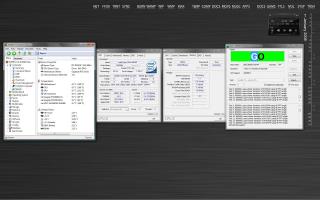
So, anyone got these babes yet? Id say these chips has a huge oc potential, this is my currently result after owning this babe for 1 day, rough overclocking with no optimizing done yet, didn't have the time. Man.. i can get to get everything done


3.8Ghz at stock voltage

orthos passed 8 hours, i was still able to boot at 3.9Ghz, but failed at 2nd hour orthos.
C2D 45nm users, come in and share your thoughts

Just to spice this thread up a little, ever wondered what exactly is Penryn? no, not the codename, the real PENRYN.
QUOTE
Penryn granite is noted for its beauty and strength. Mottled in more-or-less equally sized specks of black and white, it appears a medium-to-dark gray in color, at first glance, but takes on an almost bluish-gray hue when viewed in a subdued light or, when wet or polished. This unique stone can be seen in the foundations and walls of a number of California landmarks including The State Capital and the old U.S. Mint in San Francisco.
Taken from http://blogs.intel.com/technology/2007/04/penryn.php» Click to show Spoiler - click again to hide... «
Penryn is the code name for Intel's Next Generation Intel(R) Core(tm) 2 Family processor microarchitecture. It is also the name of the industry's first 45 nm microprocessor. It is an improvement on the Core Microarchitecture introduced last year. It delivers more performance at the same clock speed compared to our Core 2 Duo processors. It is a dual core product with a shared 6 MB L2 cache.
Intel's 45 nm High-K Metal Gate Silicon Technology allows Penryn to run at higher clock frequency than its predecessor. It features 47 new Intel SSE instructions designed to enhance Media, Graphic and Gaming. We have measured >20% perf improvement on existing games compared to today's fastest dual core processors, and more than 40 percent for gaming and video encoding with Intel SSE4 optimized video encoders. But of course, as with any performance claims "Your Mileage May Vary".
Penryn-based processors provide faster divide performance with a Fast Radix-16 Divider, roughly doubling the divider speed over previous generations for applications such as scientific computation.
Enhancements to Intel Virtualization Technology speed up virtual machine transition (entry/exit) times by an average of 25 to 75 percent.
Up to 6MB of L2 cache per die (50% larger) enables greater performance across workloads; and increased associativity ( 16 way to 24 way) improves the utilization of the larger cache.
All of this fits in a compact 107 mm2 die featuring 410 million transistors!
The Penryn family enables optimized products for each of the target market segments from the high end Xeon all the way to mobile.
It will enable mobile optimized processors that provide greater performance within the existing mobile form factors and support lower processor idle power with Deep Power Down Technology. It also supports increased performance on single threaded apps with Enhanced Dynamic Acceleration Technology, which uses the power headroom of an idle core to boost performance of the non-idle core.
For the Desktop, there will be two versions that will ship at greater than 3GHz. A second generation Quad-core with up to 12 MB of L2 cache that will fit into existing QC power envelopes, and an energy efficient dual-core version with up to 6MB of L2 cache that will maintain the 65 W envelope.
For the Server and Workstation segment, the Penryn family will extend the leadership that the Xeon Processor family delivers today with dual and quad core products. We expect the combination of new 1600 MHz FSB for HPC segments, >3 GHz clock speed, microarchitecture enhancements and larger caches to deliver up to 45% improvement on bandwidth intensive floating point workloads compared to today's fastest quad core processors. Some Java workloads exhibit up to 25 percent increase
A Little interesting fact on Intel's Codenames  This post has been edited by AoiNatsume: Jan 29 2008, 12:25 AM

 Jan 28 2008, 09:39 AM, updated 18y ago


 Quote
Quote








 0.0235sec
 0.66
0.66
 6 queries
 GZIP Disabled