Welcome Guest ( Log In | Register )

Outline · [ Standard ] · Linear+

> Active vs. Passive funds, 2 minute video

views
     
TSwild_card_my
post Aug 8 2017, 04:28 AM, updated 9y ago

Look at all my stars!!
*******
Senior Member
6,562 posts

Joined: Jan 2003
From: Kuala Lumpur

https://www.bloomberg.com/news/videos/2017-...investing-video

In Malaysia unit trust funds are being sold as if they are the final answer to your retirement plans - at least that is the impression that I am getting from unit trust consultants who are paid handsomely as commissions from the investments made by their clients. But are there other types of investments out there which are more passive, or perhaps even more active than unit trusts?

Sure, passive-wise you can look into index-funds, these funds track a particular index; the index is invested in all the stocks that make up an index - like the S&P 500.

More active-wise, you can look into hedge-funds, but I will not talk about them too much since they are not too relevant for the average-joe reading this topic. They are aggressively managed, promises good returns, but comes with very high fees, which are paid regardless of their performances (but they get paid more as they generate higher returns for the investors). Avoid laugh.gif or not, up to you.

The arguments against actively-managed investment (in this case, the aforementioned unit trust funds):

- high management fees (1 to 2.5% per annum) eating up the profits
- high agent fees also eating up your initial investments (between 5.5% to 6.5% for cash investments and 3% for EPF-withdrawal investments).
- majority of funds end up end up not beating the index in 1, 5, and even 10 years periods, as published in several studies, also quoted in the video (the high fees being quoted as a big part of the problem)

In Malaysia there is a limited number of ETFs or index funds that we can buy; you need to look overseas. You can perhaps start looking into Vanguard and other providers. I believe there are services that allow you to buy them while in Malaysia.

Disclaimer: I'm not selling anything nor am I an investment agent, I have no material interests in any of these companies/organizations.

This post has been edited by wild_card_my: Aug 8 2017, 04:33 AM
v1n0d
post Aug 8 2017, 06:06 AM

Another roof, another proof.
*******
Senior Member
3,197 posts

Joined: Mar 2007
From: Kuala Lumpur, Malaysia


I advocate opening a CDS account and learning to trade stocks by yourself. It's easy, and you don't incur any management charges. With the wealth of information available online, it's no longer a steep learning curve.
sojurn
post Aug 8 2017, 06:46 AM

Getting Started
**
Junior Member
286 posts

Joined: Jul 2007
QUOTE(wild_card_my @ Aug 8 2017, 04:28 AM)
https://www.bloomberg.com/news/videos/2017-...investing-video

In Malaysia unit trust funds are being sold as if they are the final answer to your retirement plans - at least that is the impression that I am getting from unit trust consultants who are paid handsomely as commissions from the investments made by their clients. But are there other types of investments out there which are more passive, or perhaps even more active than unit trusts? 

Sure, passive-wise you can look into index-funds, these funds track a particular index; the index is invested in all the stocks that make up an index - like the S&P 500.

More active-wise, you can look into hedge-funds, but I will not talk about them too much since they are not too relevant for the average-joe reading this topic. They are aggressively managed, promises good returns, but comes with very high fees, which are paid regardless of their performances (but they get paid more as they generate higher returns for the investors). Avoid  laugh.gif  or not, up to you.

The arguments against actively-managed investment (in this case, the aforementioned unit trust funds):

- high management fees (1 to 2.5% per annum) eating up the profits
- high agent fees also eating up your initial investments (between 5.5% to 6.5% for cash investments and 3% for EPF-withdrawal investments).
- majority of funds end up end up not beating the index in 1, 5, and even 10 years periods, as published in several studies, also quoted in the video (the high fees being quoted as a big part of the problem)

In Malaysia there is a limited number of ETFs or index funds that we can buy; you need to look overseas. You can perhaps start looking into Vanguard and other providers. I believe there are services that allow you to buy them while in Malaysia. 

Disclaimer: I'm not selling anything nor am I an investment agent, I have no material interests in any of these companies/organizations.
*
What is your personal preference for growing wealth when taking into consideration risk and return?
rcracer
post Aug 8 2017, 07:09 AM

?????
*******
Senior Member
3,772 posts

Joined: Jan 2003

Money game is way forward

All gone quiet already ,
river.sand
post Aug 8 2017, 07:24 AM

Look at all my stars!!
*******
Senior Member
3,813 posts

Joined: Feb 2012
Passive funds are not based on value investing principle, so there is a risk of bubble.
azbro
post Aug 8 2017, 07:45 AM

Look at all my stars!!
*******
Senior Member
4,403 posts

Joined: Jan 2007
From: Johor Bahru


As long as dun tipu your hard savings and cabut
red4900
post Aug 8 2017, 08:06 AM

Casual
***
Junior Member
464 posts

Joined: Aug 2008
QUOTE(wild_card_my @ Aug 8 2017, 04:28 AM)
https://www.bloomberg.com/news/videos/2017-...investing-video

In Malaysia unit trust funds are being sold as if they are the final answer to your retirement plans - at least that is the impression that I am getting from unit trust consultants who are paid handsomely as commissions from the investments made by their clients. But are there other types of investments out there which are more passive, or perhaps even more active than unit trusts?
*
Out of topic question: How much % do the UT consultant make from commission? Say, if I invest 10k, how much do the agent gets?
SUSAznRicy
post Aug 8 2017, 08:06 AM

Getting Started
**
Junior Member
59 posts

Joined: Jun 2015
QUOTE(v1n0d @ Aug 8 2017, 06:06 AM)
I advocate opening a CDS account and learning to trade stocks by yourself. It's easy, and you don't incur any management charges. With the wealth of information available online, it's no longer a steep learning curve.
*
Hmmm, for newbie who doesn't know anything or have time to monitor the stock,

wouldn't it be wiser to start off with some Monthly Investment Plan?

Straight jump into using Margin facility like Tiger bank on9 to buy stock is akin to hanging oneself with rope.
alien13579
post Aug 8 2017, 08:19 AM

New Member
*
Newbie
4 posts

Joined: Apr 2009
this is why i dnt go for unit trust consultant...due to their high sales charges/agent fee
i do it on my own through a company and sales charge/agent fee is only 1% max...sometime can go as low as 0.5%

regarding hedge fund which i have no idea how, how's the risk and volatility compared to unit trust?
alien13579
post Aug 8 2017, 08:21 AM

New Member
*
Newbie
4 posts

Joined: Apr 2009
QUOTE(red4900 @ Aug 8 2017, 08:06 AM)
Out of topic question: How much % do the UT consultant make from commission? Say, if I invest 10k, how much do the agent gets?
*
already wrote there between 5.5% to 6.5% for the amount u invested
and i did it with 1% brows.gif
v1n0d
post Aug 8 2017, 08:24 AM

Another roof, another proof.
*******
Senior Member
3,197 posts

Joined: Mar 2007
From: Kuala Lumpur, Malaysia


QUOTE(AznRicy @ Aug 8 2017, 08:06 AM)
Hmmm, for newbie who doesn't know anything or have time to monitor the stock,

wouldn't it be wiser to start off with some Monthly Investment Plan?

Straight jump into using Margin facility like Tiger bank on9 to buy stock is akin to hanging oneself with rope.
*
You don't have to sign up for a margin account. I started with a cash account and RM1k capital. The important thing is you must be willing to learn. On the way you pick up a lot about economics and financial literacy, both of which help you streamline your expenditure better.
Airwave
post Aug 8 2017, 08:28 AM

Getting Started
**
Junior Member
95 posts

Joined: May 2007
Invest with fundsupermart
Lyu
post Aug 8 2017, 09:25 AM

Enthusiast
*****
Junior Member
772 posts

Joined: Jan 2015


UT max can earn how much %
TSwild_card_my
post Aug 8 2017, 11:28 AM

Look at all my stars!!
*******
Senior Member
6,562 posts

Joined: Jan 2003
From: Kuala Lumpur

QUOTE(v1n0d @ Aug 8 2017, 06:06 AM)
I advocate opening a CDS account and learning to trade stocks by yourself. It's easy, and you don't incur any management charges. With the wealth of information available online, it's no longer a steep learning curve.
*
I agree. It is a good place to start. At some point in your life you may even think of doing the work. If it doesnt suit you, leave it. It you find it useful, you can start managing your own funds. Plenty of people do well in this area, but of course, plenty of people lost out too.

QUOTE(sojurn @ Aug 8 2017, 06:46 AM)
What is your personal preference for growing wealth when taking into consideration risk and return?
*
Personally, I prefer something that is more liquid. I dislike properties due to its illiquidity, although I am doing mortgage as my business. Directly investing in stocks are a good idea if you can manage it well - you do not have to day trade, you can always buy and hold. The best thing is that there is no capital gains tax in Malaysia (except for a time RPGT which is for properties) so if you buy a growing company which pays no dividends (which are taxed) then you would be good to go.

Disclaimer: I do not represent any CDS company nor am I interested in selling you anything

QUOTE(river.sand @ Aug 8 2017, 07:24 AM)
Passive funds are not based on value investing principle, so there is a risk of bubble.
*
Perhaps you are right. But plenty of "fund managers" tried to do value investing and still end up short. Or maybe they were successful, but due to their own management fees and agent fees, the investors end up not having enough. This is why Vanguard is the second-biggest asset-manager after BlackRock (which we can talk about in a different day)

QUOTE(red4900 @ Aug 8 2017, 08:06 AM)
Out of topic question: How much % do the UT consultant make from commission? Say, if I invest 10k, how much do the agent gets?
*
1. For cash investment, the sales charge is 5.5-6.5%, but the agent gets 3%, and beyond that goes to the upline and company. So if you are a GAM (or whatever is the highest manager level), you can make more than 3% because you will be overriding your own sales

2. For EPF investments, sales charge is capped to 3%, and the agent will get 2% flat.


QUOTE(alien13579 @ Aug 8 2017, 08:19 AM)
this is why i dnt go for unit trust consultant...due to their high sales charges/agent fee
i do it on my own through a company and sales charge/agent fee is only 1% max...sometime can go as low as 0.5%

regarding hedge fund which i have no idea how, how's the risk and volatility compared to unit trust?
*


Hedge funds would be going for active returns, or Alpha with your investments... they use multiple techniques to try to generate "very high returns". Different hedge funds will be using different strategies, and they are categorized.

If I am not mistaken, the movie the big-short has Christian Bale's character playing a hedge fund manager/analyst. it is a very hands-on fund, and costs high fees, but do they generate the highest returns? Perhaps, but like I said it is generally not accessible to the average person as there are minimum fees, and sometimes only upon invitation

From: http://www.investopedia.com/terms/h/hedgefund.asp

CODE
Fee structure: Instead of charging an expense ratio only, hedge funds charge both an expense ratio and a performance fee. This fee structure is known as "Two and Twenty"—a 2% asset management fee and then a 20% cut of any gains generated.


CODE
Because they are private investment vehicles that only allow wealthy individuals to invest, hedge funds can pretty much do what they want as long as they disclose the strategy upfront to investors


This post has been edited by wild_card_my: Aug 8 2017, 11:34 AM
TSwild_card_my
post Aug 8 2017, 11:28 AM

Look at all my stars!!
*******
Senior Member
6,562 posts

Joined: Jan 2003
From: Kuala Lumpur


QUOTE(Airwave @ Aug 8 2017, 08:28 AM)
Invest with fundsupermart
*
Investing in UT through Fundsupermart saves you on the sales fees, but the high management fees are still there. it may still be your cup of tea.

QUOTE(Lyu @ Aug 8 2017, 09:25 AM)
UT max can earn how much %
*
in general, agents would quote you 10% annualized return for 10-year periods for equity funds. It could be higher, but depends on WHEN you are asking.
Lyu
post Aug 8 2017, 11:46 AM

Enthusiast
*****
Junior Member
772 posts

Joined: Jan 2015


QUOTE(wild_card_my @ Aug 8 2017, 11:28 AM)
Investing in UT through Fundsupermart saves you on the sales fees, but the high management fees are still there. it may still be your cup of tea.
in general, agents would quote you 10% annualized return for 10-year periods for equity funds. It could be higher, but depends on WHEN you are asking.
*
10% for 10 years
A bit not my expected ROI


homicidal85
post Aug 8 2017, 12:00 PM

Getting Started
**
Junior Member
295 posts

Joined: Jun 2006
From: JB


QUOTE(v1n0d @ Aug 8 2017, 06:06 AM)
I advocate opening a CDS account and learning to trade stocks by yourself. It's easy, and you don't incur any management charges. With the wealth of information available online, it's no longer a steep learning curve.
*
bro, mind sharing more on CDS?
alien13579
post Aug 8 2017, 12:01 PM

New Member
*
Newbie
4 posts

Joined: Apr 2009
QUOTE(wild_card_my @ Aug 8 2017, 11:28 AM)
Hedge funds would be going for active returns, or Alpha with your investments... they use multiple techniques to try to generate "very high returns". Different hedge funds will be using different strategies, and they are categorized.

If I am not mistaken, the movie the big-short has Christian Bale's character playing a hedge fund manager/analyst. it is a very hands-on fund, and costs high fees, but do they generate the highest returns? Perhaps, but like I said it is generally not accessible to the average person as there are minimum fees, and sometimes only upon invitation

From: http://www.investopedia.com/terms/h/hedgefund.asp

CODE
Fee structure: Instead of charging an expense ratio only, hedge funds charge both an expense ratio and a performance fee. This fee structure is known as "Two and Twenty"—a 2% asset management fee and then a 20% cut of any gains generated.


CODE
Because they are private investment vehicles that only allow wealthy individuals to invest, hedge funds can pretty much do what they want as long as they disclose the strategy upfront to investors

*
looks like its not for me since im just an average person laugh.gif
even those "wholesale" fund that require 100k minimum i also can't afford

QUOTE(wild_card_my @ Aug 8 2017, 11:28 AM)
in general, agents would quote you 10% annualized return for 10-year periods for equity funds. It could be higher, but depends on WHEN you are asking.
*
in many cases, many public mutual customer complain hard to even out their investment due to the high sales charge
means profit is still long way
so that why smart ppl will go for FSM for the low SC for faster even thn make profit
those PB mutual agent dnt even care u make profit or not as long as they earn from your SC
TSwild_card_my
post Aug 8 2017, 12:03 PM

Look at all my stars!!
*******
Senior Member
6,562 posts

Joined: Jan 2003
From: Kuala Lumpur

QUOTE(Lyu @ Aug 8 2017, 11:46 AM)
10% for 10 years
A bit not my expected ROI
*
uhh.. its 10% annualized return per annum ya... it's OK la for hand-off investment, but not all funds get this return. Tak percaya ask the Malaysian-based China funds investors...

What is your expected ROI btw? And which investment vehicle are you looking at. Even properties market appreciation will unlikely to reach 10% per annum nowadays and going forward, too much bleeding involved - lack of tenant, damages, maintenance fees, assessments, etc.
TSwild_card_my
post Aug 8 2017, 12:05 PM

Look at all my stars!!
*******
Senior Member
6,562 posts

Joined: Jan 2003
From: Kuala Lumpur

QUOTE(alien13579 @ Aug 8 2017, 12:01 PM)
looks like its not for me since im just an average person laugh.gif
even those "wholesale" fund that require 100k minimum i also can't afford
in many cases, many public mutual customer complain hard to even out their investment due to the high sales charge
means profit is still long way
so that why smart ppl will go for FSM for the low SC for faster even thn make profit
those PB mutual agent dnt even care u make profit or not as long as they earn from your SC
*
I dont mean to bad mouth agents, but the biggest fees come from the initial sales.. and there is little that they can do to manage your investments other than switching funds - but there is a risk of you switching at the wrong time.

My mentor Azizi Ali actually said there is a sure way to make money by staying in Unit Trust - that is by being a unit trust agent. They make a boat load (well, the successful ones)
Lyu
post Aug 8 2017, 12:07 PM

Enthusiast
*****
Junior Member
772 posts

Joined: Jan 2015


QUOTE(wild_card_my @ Aug 8 2017, 12:03 PM)
uhh.. its 10% annualized return per annum ya...  it's OK la for hand-off investment, but not all funds get this return. Tak percaya ask the Malaysian-based China funds investors...

What is your expected ROI btw? And which investment vehicle are you looking at. Even properties market appreciation will unlikely to reach 10% per annum nowadays and going forward, too much bleeding involved - lack of tenant, damages, maintenance fees, assessments, etc.
*
Hmmm...
GnomeMage
post Aug 8 2017, 12:08 PM

Getting Started
**
Junior Member
198 posts

Joined: Jun 2012
QUOTE(river.sand @ Aug 8 2017, 07:24 AM)
Passive funds are not based on value investing principle, so there is a risk of bubble.
*
eh u still around?
Ask_Yip
post Aug 8 2017, 12:10 PM

Retired Audiophiles
*******
Senior Member
2,864 posts

Joined: Feb 2011
From: NoWhere
parking to read later
v1n0d
post Aug 8 2017, 12:15 PM

Another roof, another proof.
*******
Senior Member
3,197 posts

Joined: Mar 2007
From: Kuala Lumpur, Malaysia


QUOTE(homicidal85 @ Aug 8 2017, 12:00 PM)
bro, mind sharing more on CDS?
*
Everything you need to know to get started is available here. Just read through the pinned threads.
alien13579
post Aug 8 2017, 12:43 PM

New Member
*
Newbie
4 posts

Joined: Apr 2009
QUOTE(wild_card_my @ Aug 8 2017, 12:05 PM)
I dont mean to bad mouth agents, but the biggest fees come from the initial sales.. and there is little that they can do to manage your investments other than switching funds - but there is a risk of you switching at the wrong time.

My mentor Azizi Ali actually said there is a sure way to make money by staying in Unit Trust - that is by being a unit trust agent. They make a boat load (well, the successful ones)
*
yes, they made the most of their money from how much the customer invested
not so much abt after, so they dnt really care u break even or not, let alone profit laugh.gif
thats why i trust myself by going to FSM instead

agent make money from customer
customer themselves can make money to by selecting the correct fund to invest to
some of my funds are at 30% now though i dnt invest like alot into it compared to those gold/platinum member in FSM laugh.gif

expectation should be put around 4-5% annualized, 10% is more toward MLM level already laugh.gif

This post has been edited by alien13579: Aug 8 2017, 12:45 PM
TSwild_card_my
post Aug 8 2017, 12:46 PM

Look at all my stars!!
*******
Senior Member
6,562 posts

Joined: Jan 2003
From: Kuala Lumpur

QUOTE(alien13579 @ Aug 8 2017, 12:43 PM)
yes, they made the most of their money from how much the customer invested
not so much abt after, so they dnt really care u break even or not, let alone profit laugh.gif
thats why i trust myself by going to FSM instead

agent make money from customer
customer themselves can make money to by selecting the correct fund to invest to
some of my funds are at 30% now though i dnt invest like alot into it compared to those gold/platinum member in FSM laugh.gif
*
what are the switching charges for FSM funds? would it be realistic to trade the funds as if you were trading stocks - not talking about day trade
alien13579
post Aug 8 2017, 12:57 PM

New Member
*
Newbie
4 posts

Joined: Apr 2009
QUOTE(wild_card_my @ Aug 8 2017, 12:46 PM)
what are the switching charges for FSM funds? would it be realistic to trade the funds as if you were trading stocks - not talking about day trade
*
i dnt remember how much is the switching charges, need to check back
but ultimately depends on where do u switch to
if switching fund between same fund house, thn no charges...like cimb to cimb but different segment of investment
if switching fund to another fund house thn there will be charges...like cimb to affin hwang

no, from what i learn, investing in unit trust is more toward holding it
i dnt have experience whatsoever in trading stock so no comment on that but the biggest mistake a person did in investing in unit trust is "nampak rugi trus jual"
it doesn't work like that
its more of a long term investment, slow up slow down as opposed to fluctuate wildly like bitcoin
Ask_Yip
post Aug 8 2017, 04:44 PM

Retired Audiophiles
*******
Senior Member
2,864 posts

Joined: Feb 2011
From: NoWhere
QUOTE(Lyu @ Aug 8 2017, 11:46 AM)
10% for 10 years
A bit not my expected ROI
*
I got less than 1% from ETF sad.gif
Lyu
post Aug 9 2017, 09:23 AM

Enthusiast
*****
Junior Member
772 posts

Joined: Jan 2015


QUOTE(Ask_Yip @ Aug 8 2017, 04:44 PM)
I got less than 1% from ETF sad.gif
*
How come Yip sifu?
TSwild_card_my
post Aug 9 2017, 03:31 PM

Look at all my stars!!
*******
Senior Member
6,562 posts

Joined: Jan 2003
From: Kuala Lumpur

QUOTE(Ask_Yip @ Aug 8 2017, 04:44 PM)
I got less than 1% from ETF sad.gif
*
what was the investment period?
Ask_Yip
post Aug 9 2017, 03:36 PM

Retired Audiophiles
*******
Senior Member
2,864 posts

Joined: Feb 2011
From: NoWhere
QUOTE(wild_card_my @ Aug 9 2017, 03:31 PM)
what was the investment period?
*
1 year
Ask_Yip
post Aug 9 2017, 03:37 PM

Retired Audiophiles
*******
Senior Member
2,864 posts

Joined: Feb 2011
From: NoWhere
QUOTE(Lyu @ Aug 9 2017, 09:23 AM)
How come Yip sifu?
*
idunnolol

1 blue chips ETF
1 bond ETF

combined about 1%
Mikahl
post Aug 12 2017, 01:26 AM

New Member
*
Junior Member
35 posts

Joined: Dec 2008


I invested in UT over 5 year periods and I can vouch returns not fantastic. My funds' aggressiveness range from mild to aggressive with the bulk in the moderate range and still, maybe yield 2 to 3% annualised. The comments above is accurate to say that profits are eaten by sales commission and management fees.
Mikahl
post Aug 12 2017, 01:29 AM

New Member
*
Junior Member
35 posts

Joined: Dec 2008


Anyone can comment whether buying Paper Gold like from banks is worth a punt? Is it even an investment or more of a forced-saving strategy for the long-term?
lunchtime
post Aug 12 2017, 02:33 AM

Casual
***
Junior Member
487 posts

Joined: Aug 2011
QUOTE(wild_card_my @ Aug 8 2017, 04:28 AM)
https://www.bloomberg.com/news/videos/2017-...investing-video

In Malaysia unit trust funds are being sold as if they are the final answer to your retirement plans - at least that is the impression that I am getting from unit trust consultants who are paid handsomely as commissions from the investments made by their clients. But are there other types of investments out there which are more passive, or perhaps even more active than unit trusts? 

Sure, passive-wise you can look into index-funds, these funds track a particular index; the index is invested in all the stocks that make up an index - like the S&P 500.

More active-wise, you can look into hedge-funds, but I will not talk about them too much since they are not too relevant for the average-joe reading this topic. They are aggressively managed, promises good returns, but comes with very high fees, which are paid regardless of their performances (but they get paid more as they generate higher returns for the investors). Avoid  laugh.gif  or not, up to you.

The arguments against actively-managed investment (in this case, the aforementioned unit trust funds):

- high management fees (1 to 2.5% per annum) eating up the profits
- high agent fees also eating up your initial investments (between 5.5% to 6.5% for cash investments and 3% for EPF-withdrawal investments).
- majority of funds end up end up not beating the index in 1, 5, and even 10 years periods, as published in several studies, also quoted in the video (the high fees being quoted as a big part of the problem)

In Malaysia there is a limited number of ETFs or index funds that we can buy; you need to look overseas. You can perhaps start looking into Vanguard and other providers. I believe there are services that allow you to buy them while in Malaysia. 

Disclaimer: I'm not selling anything nor am I an investment agent, I have no material interests in any of these companies/organizations.
*
Out of curiosity, how much do you charge for the loan and insurance services you provide to your clients?

I am just a regular joe trying to understand the fuss about fees. I doubt the above are charity work. Every thing has a fee to pay, either built in or not. You buy a house, you pay the lawyer fee, the banker's fee, the developer's profit, the supplier's profit and so forth and like wise with everything you buy or use. Tell us who will work for free. Do you work for free?

Investing on your own make sound simple enough, read a few books and good to go, so why isn't everyone a Buffett or a Soros? Why are we still 9 to 5 kuli? In reality, it isn't that easy as you make it to be. I believe a vast majority of people don't understand UT let alone ETF or know what Vanguard is.

And likely if am I taking a loan and buying insurance, I would look for you to advise on the steps and what-to-look-fors, you wouldn't give free advice, would you? Again, what is your fee on say a 5m loan and insurance coverage for that loan?

This post has been edited by lunchtime: Aug 12 2017, 02:35 AM
SUS1malaysiajib
post Aug 12 2017, 02:37 AM

Getting Started
**
Junior Member
195 posts

Joined: Jan 2017
QUOTE(wild_card_my @ Aug 8 2017, 11:28 AM)
Investing in UT through Fundsupermart saves you on the sales fees, but the high management fees are still there. it may still be your cup of tea.
in general, agents would quote you 10% annualized return for 10-year periods for equity funds. It could be higher, but depends on WHEN you are asking.
*
So what product do you recommend fellow Kopitiam's to invest in ?
SUSempatTan
post Aug 12 2017, 02:55 AM

Regular
******
Senior Member
1,678 posts

Joined: Mar 2016


I'ld rather do grab, uber, airbnb...
river.sand
post Aug 12 2017, 07:14 AM

Look at all my stars!!
*******
Senior Member
3,813 posts

Joined: Feb 2012
QUOTE(Ask_Yip @ Aug 9 2017, 03:37 PM)
idunnolol

1 blue chips ETF
1 bond ETF

combined about 1%
*
ETF of which country?

ETF are such that the more people invest in them, the better they perform. (Until the bubbles burst, that is.)

In the US, the active/passive split is 70:30. The share of passive funds is much lower in Malaysia.

Ask_Yip
post Aug 12 2017, 07:54 AM

Retired Audiophiles
*******
Senior Member
2,864 posts

Joined: Feb 2011
From: NoWhere
QUOTE(river.sand @ Aug 12 2017, 07:14 AM)
ETF of which country?

ETF are such that the more people invest in them, the better they perform. (Until the bubbles burst, that is.)

In the US, the active/passive split is 70:30. The share of passive funds is much lower in Malaysia.
*
Singapore
TSwild_card_my
post Aug 12 2017, 04:10 PM

Look at all my stars!!
*******
Senior Member
6,562 posts

Joined: Jan 2003
From: Kuala Lumpur

QUOTE(lunchtime @ Aug 12 2017, 02:33 AM)
Out of curiosity, how much do you charge for the loan and insurance services you provide to your clients?

I am just a regular joe trying to understand the fuss about fees. I doubt the above are charity work. Every thing has a fee to pay, either built in or not. You buy a house, you pay the lawyer fee, the banker's fee, the developer's profit, the supplier's profit and so forth and like wise with everything you buy or use. Tell us who will work for free. Do you work for free?

Investing on your own make sound simple enough, read a few books and good to go, so why isn't everyone a Buffett or a Soros? Why are we still 9 to 5 kuli? In reality, it isn't that easy as you make it to be. I believe a vast majority of people don't understand UT let alone ETF or know what Vanguard is.

And likely if am I taking a loan and buying insurance, I would look for you to advise on the steps and what-to-look-fors, you wouldn't give free advice, would you? Again, what is your fee on say a 5m loan and insurance coverage for that loan?
*
For straight forward cases, I do not charge, i get my commissions from the bank. Banks have 3 channels to distribute their loans - branch bankers, mobile bankers, and outsource brokers like myself. All these channels will have their pay, be it in the form of salary, commissions, or a combination of both.

Malaysians do NOT like to pay fees upfront, so the fees for "financial planners" have to be absorbed into the loan/product itself - i.e insurances

On the second part of your questions, same. no fees are charged to you. But keep in mind that I am getting my commissions from the bank that you sign up for, and insurance companies that I am attached with. So indirectly you would be paying one way or another. Most agents don't like to talk about this; but smart consumers know that one way or another, they are still paying for the agents' or employee's work.

QUOTE(1malaysiajib @ Aug 12 2017, 02:37 AM)
So what product do you recommend fellow Kopitiam's to invest in ?
*
I can't say at all based on such a wide audience... it depends on your objective, investment horizon, capital, bumi/vs.non-bumi (yes it matters, bro sweat.gif sweat.gif sweat.gif ), etc.

As it is though, I am not promoting any investment schemes - not a UT agent nor employed for any banks or fund houses.
SUS1malaysiajib
post Aug 12 2017, 04:12 PM

Getting Started
**
Junior Member
195 posts

Joined: Jan 2017
QUOTE(wild_card_my @ Aug 12 2017, 04:10 PM)
For straight forward cases, I do not charge, i get my commissions from the bank. Banks have 3 channels to distribute their loans - branch bankers, mobile bankers, and outsource brokers like myself. All these channels will have their pay, be it in the form of salary, commissions, or a combination of both.

Malaysians do NOT like to pay fees upfront, so the fees for "financial  planners" have to be absorbed into the loan/product itself - i.e insurances

On the second part of your questions, same. no fees are charged to you. But keep in mind that I am getting my commissions from the bank that you sign up for, and insurance companies that I am attached with. So indirectly you would be paying one way or another. Most agents don't like to talk about this; but smart consumers know that one way or another, they are still paying for the agents' or employee's work.
I can't say at all based on such a wide audience... it depends on your objective, investment horizon, capital, bumi/vs.non-bumi (yes it matters, bro  sweat.gif  sweat.gif  sweat.gif ), etc.

As it is though, I am not promoting any investment schemes - not a UT agent nor employed for any banks or fund houses.
*
Bro I've posted on your loan thread and looking forward to your opinion/advice
cant think of a username
post Aug 12 2017, 04:19 PM

Getting Started
**
Junior Member
72 posts

Joined: Apr 2015
other country different all i wan to know malaysia is how?

tagged
TSwild_card_my
post Aug 12 2017, 04:21 PM

Look at all my stars!!
*******
Senior Member
6,562 posts

Joined: Jan 2003
From: Kuala Lumpur

QUOTE(1malaysiajib @ Aug 12 2017, 04:12 PM)
Bro I've posted on your loan thread and looking forward to your opinion/advice
*
And I just replied. Hahaha
lunchtime
post Aug 12 2017, 04:51 PM

Casual
***
Junior Member
487 posts

Joined: Aug 2011
QUOTE(wild_card_my @ Aug 12 2017, 04:10 PM)
For straight forward cases, I do not charge, i get my commissions from the bank. Banks have 3 channels to distribute their loans - branch bankers, mobile bankers, and outsource brokers like myself. All these channels will have their pay, be it in the form of salary, commissions, or a combination of both.

Malaysians do NOT like to pay fees upfront, so the fees for "financial  planners" have to be absorbed into the loan/product itself - i.e insurances

On the second part of your questions, same. no fees are charged to you. But keep in mind that I am getting my commissions from the bank that you sign up for, and insurance companies that I am attached with. So indirectly you would be paying one way or another. Most agents don't like to talk about this; but smart consumers know that one way or another, they are still paying for the agents' or employee's work.
I can't say at all based on such a wide audience... it depends on your objective, investment horizon, capital, bumi/vs.non-bumi (yes it matters, bro  sweat.gif  sweat.gif  sweat.gif ), etc.

As it is though, I am not promoting any investment schemes - not a UT agent nor employed for any banks or fund houses.
*
You say you don't charge a fee, would it be more correct to say fee is already built in, just that you don't disclose. Simply put it your clients are indirectly paying fees to you via the banks or insurance companies, that isn't transparent. Now for $100000 loan, how much % do you earn? Likewise with a $100000 insurance policy, how much % do you earn?

As I remember correctly, insurance agents earn a huge chuck of commissions aka fees from the premiums we pay. In the first 5 years, whatever premiums paid to insurance companies for so called savings / investment policies has minimum cash value and insurance agents commissions are about 20%-40% of the premiums we pay? Don't you think those fees are exorbitant and not transparent?

I believe I have an idea of how much you folks earn and how your fees are paid to you folks as I was recently at my insurance company's CS to check on my policies.

Again, no one in your line of work will do charity work and likewise with everyone else, there is a price to pay for services and products rendered. Do programmers work for free? Do lawyers work for free? Do accountants work for free? Do actors work for free? Do engineers work for free? And you expect fund houses to work for free?

And from the responses here asking about which UT funds to invest in, that clearly shows the lack of basic investment knowledge. And on advices to place funds with Public Mutual, that is another indication of herd mentality without doing any homework.


Mikahl
post Aug 12 2017, 07:49 PM

New Member
*
Junior Member
35 posts

Joined: Dec 2008


QUOTE(1malaysiajib @ Aug 12 2017, 02:37 AM)
So what product do you recommend fellow Kopitiam's to invest in ?
*
This had and always will be the golden question, and the answer will always be: "It depends....", meaning No Answer. Then how some can get so rich from investing? Because they are the 'some people', and you are you.

But as a general rule of thumb, the best investment IMHO, is the investment Against the Will to Spend. So long as you can save money, you already won half the battle, IF you can that is. And it really does not matter where you put your savings really, because it's the habit and not the channel that'll make you a millionaire.

But say you already have saved up to $100,000 what is the best channel or vehicle that'll grow your hard-earned money in the most effective and efficient way? Just keep it in the lowest risk area, the FD for example. But then you'll complain that the returns are too low, that even inflation will overtake the interest. Well, if you're a habitual saver, inflation won't affect you because you don't spend anyway.

But if you have say, $1m in the FD already, then maybe you have the option to consider a little bit of diversion of funds. Maybe you can do 20% in some high-risk area with high-return opportunities, maybe up to 20% PA. Maybe you'll want to go into the stock market, buy directly thru the bank, and monitor daily or weekly to see if you can make a quick buck thru capital gain, or maybe just wait for the dividends to be distributed. Then maybe you'll say you got no time to watch and wait, or no knowledge of the market, etc... so the next best option? Get a professional to manage your stocks, and one option then would be UT. But then you complain fee too high la, bla bla, bla...

Ok, then maybe property, everyone make money here right? Eeerr.. Wrong. Some do, some don't. So then you pop over to the LYN Property forum and check it out, only to find many many mixed opinions. Darn, back to square one. Where to invest?

Agar wood, forex, gold and silver, and what have you. Then maybe you hear about some individual holding the golden key to success...and you invest, and we read about you in the scam forum.

Truth is, there is no quick buck unless you're damn lucky. And if lucky is you, you'd have already won the $20m jackpot with just $3 upfront.

Net net, just save your money first, and keep it near.


SUS1malaysiajib
post Aug 12 2017, 08:27 PM

Getting Started
**
Junior Member
195 posts

Joined: Jan 2017
QUOTE(wild_card_my @ Aug 12 2017, 04:21 PM)
And I just replied. Hahaha
*
Thanks for sending me a PM, would read it tonight and would get back to you.

SUScocbum4
post Aug 12 2017, 08:42 PM

Getting Started
**
Junior Member
57 posts

Joined: Jan 2015
Unit trust fund is good for people who cannot stand the risk and stress investing in the market. So it will normally charge premium fee, so far Ayam is not very comfortable with many fund performance, some may even loss money by a big margin.
TSwild_card_my
post Aug 12 2017, 09:39 PM

Look at all my stars!!
*******
Senior Member
6,562 posts

Joined: Jan 2003
From: Kuala Lumpur

QUOTE(lunchtime @ Aug 12 2017, 04:51 PM)
You say you don't charge a fee, would it be more correct to say fee is already built in, just that you don't disclose. Simply put it your clients are indirectly paying fees to you via the banks or insurance companies, that isn't transparent. Now for $100000 loan, how much % do you earn? Likewise with a $100000 insurance policy, how much % do you earn?

As I remember correctly, insurance agents earn a huge chuck of commissions aka fees from the premiums we pay. In the first 5 years, whatever premiums paid to insurance companies for so called savings / investment policies has minimum cash value and insurance agents commissions are about 20%-40% of the premiums we pay?  Don't you think those fees are exorbitant and not transparent? 

I believe I have an idea of how much you folks earn and how your fees are paid to you folks as I was recently at my insurance company's CS to check on my policies.

Again, no one in your line of work will do charity work and likewise with everyone else, there is a price to pay for services and products rendered. Do programmers work for free? Do lawyers work for free? Do accountants work for free? Do actors work for free? Do engineers work for free? And you expect fund houses to work for free?

And from the responses here asking about which UT funds to invest in, that clearly shows the lack of basic investment knowledge. And on advices to place funds with Public Mutual, that is another indication of herd mentality without doing any homework.
*
As you put it, only the ignorant would actually think that anyone would be doing work for charity. I never tried to hide the fact that I am getting paid indirectly, as written above. Can you read? At this point though, I am not sure what is your intent - you can guess what I am making all you want.

Anyone who has a basic comprehension can read the policies and get a good idea of what the agents are making, it doesn't make you any special. Hint: it's on page 4, 5, or 6. Just look up the "insurance charge" or "wakallah fees" rolleyes.gif

Again, only someone so naive would even begin to assume that anyone would even work for free, not in this line at least, and to have someone like you even mentioning about it says a lot about you eh?


river.sand
post Aug 12 2017, 10:10 PM

Look at all my stars!!
*******
Senior Member
3,813 posts

Joined: Feb 2012
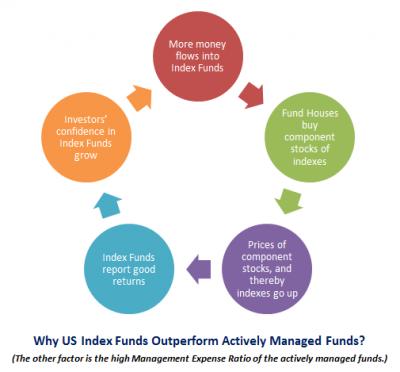
I explained in another thread before why US index funds (passive funds) outperform active funds. See attachment.

Don't expect passive funds in other countries to perform equally. This is because the 'More money flows into index funds' step is missing.

And, in the U.S., this kind of loopback is creating a bubble.


Attached thumbnail(s)
Attached Image
lunchtime
post Aug 13 2017, 01:40 AM

Casual
***
Junior Member
487 posts

Joined: Aug 2011
QUOTE(wild_card_my @ Aug 12 2017, 09:39 PM)
As you put it, only the ignorant would actually think that anyone would be doing work for charity. I never tried to hide the fact that I am getting paid indirectly, as written above. Can you read? At this point though, I am not sure what is your intent - you can guess what I am making all you want.

Anyone who has a basic comprehension can read the policies and get a good idea of what the agents are making, it doesn't make you any special. Hint: it's on page 4, 5, or 6. Just look up the "insurance charge" or "wakallah fees"  rolleyes.gif

Again, only someone so naive would even begin to assume that anyone would even work for free, not in this line at least, and to have someone like you even mentioning about it says a lot about you eh?
*
You started this thread about fees unit trust funds charge and you stated that you do not charge any fee. Can you share with us how a unit trust agent charge fees? Do they bill the client for the their fees? I doubt so, and you do the same when you close a loan agreement or insurance policy.

So what is the difference between how an unit trust agent charge fees and how you charge fees? In reality, both of you charge a fee and are paid by the company you work for via commissions, yet you claim you don't charge a fee.

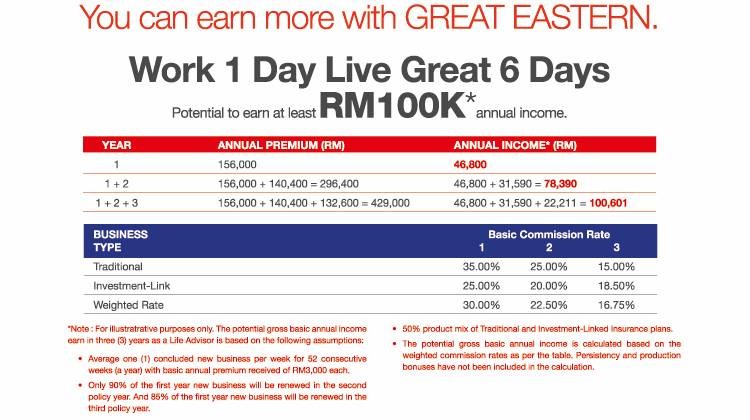
Since you brought about insurance charge, I did a bit of reading, and I must say you earn big money, earning a whopping 110% to 171% of premiums paid for those policies. No wonder insurance policies hardly have any cash value in the first 10 years. For the same total of $429k invested in unit trust at 5.5% service charge is only $23595 whereas in insurance is it $100601. Isn't your hidden fees exorbitant?

user posted image

http://www.thestar.com.my/business/busines...n-line-with-ot/

Damn, I should be smart like you rather than being stuck in a 9-5.
TSwild_card_my
post Aug 13 2017, 11:27 AM

Look at all my stars!!
*******
Senior Member
6,562 posts

Joined: Jan 2003
From: Kuala Lumpur

QUOTE(lunchtime @ Aug 13 2017, 01:40 AM)
You started this thread about fees unit trust funds charge and you stated that you do not charge any fee. Can you share with us how a unit trust agent charge fees? Do they bill the client for the their fees? I doubt so, and you do the same when you close a loan agreement or insurance policy.

So what is the difference between how an unit trust agent charge fees and how you charge fees? In reality, both of you charge a fee and are paid by the company you work for via commissions, yet you claim you don't charge a fee.

Since you brought about insurance charge, I did a bit of reading, and I must say you earn big money, earning a whopping 110% to 171% of premiums paid for those policies. No wonder insurance policies hardly have any cash value in the first 10 years. For the same total of $429k invested in unit trust at 5.5% service charge is only $23595 whereas in insurance is it $100601. Isn't your hidden fees exorbitant?   

user posted image

http://www.thestar.com.my/business/busines...n-line-with-ot/

Damn, I should be smart like you rather than being stuck in a 9-5.
*
you do have reading comprehension problems don't you?

1. I do not sell any investment products, ASB, UT, ETF, whatever you call it, I do not.

2. When I said I do not charge any fees, that was a reply to someone asking about mortgages, which is a liability and not an investment. He went out of topic because if you do not know about it yet, financing and investments are 2 different things

You wrote all that wall of text for nothing because you failed to read whistling.gif whistling.gif puke.gif
lunchtime
post Aug 13 2017, 06:26 PM

Casual
***
Junior Member
487 posts

Joined: Aug 2011
QUOTE(wild_card_my @ Aug 13 2017, 11:27 AM)
you do have reading comprehension problems don't you?

1. I do not sell any investment products, ASB, UT, ETF, whatever you call it, I do not.

2. When I said I do not charge any fees, that was a reply to someone asking about mortgages, which is a liability and not an investment. He went out of topic because if you do not know about it yet, financing and investments are 2 different things

You wrote all that wall of text for nothing because you failed to read  whistling.gif  whistling.gif  puke.gif
*
Go read what your wrote and understand what you were getting at. Don't misrepresent by stating you are FEE FREE and hiding behind company commissions. And you have be avoiding my questions, clearly shows your character on such matters.

This post has been edited by lunchtime: Aug 13 2017, 06:47 PM
TSwild_card_my
post Aug 14 2017, 10:56 AM

Look at all my stars!!
*******
Senior Member
6,562 posts

Joined: Jan 2003
From: Kuala Lumpur

QUOTE(lunchtime @ Aug 13 2017, 06:26 PM)
Go read what your wrote and understand what you were getting at. Don't misrepresent by stating you are FEE FREE and hiding behind company commissions. And you have be avoiding my questions, clearly shows your character on such matters.
*
You are a waste of my time. Anyone with a good sense understands that I am not doing my job for free, and anyone without a pea brain knows that commissions/salary are the costs that companies incur to generate sales, and these costs are passed on to the consumer, one way or another

I've never had any issues with my customers, they know they are paying me one way or another, and I am one to tell them that I get paid in commissions - but you, you are just looking for an argument aren't you? Nothing better to do eh?

This topi is about active vs. passive funds, and I am not even selling them. Not sure why it is so difficult to get that through your head. Too small maybe cool2.gif

This post has been edited by wild_card_my: Aug 14 2017, 11:31 AM
lunchtime
post Aug 14 2017, 04:15 PM

Casual
***
Junior Member
487 posts

Joined: Aug 2011
QUOTE(wild_card_my @ Aug 14 2017, 10:56 AM)
You are a waste of my time. Anyone with a good sense understands that I am not doing my job for free, and anyone without a pea brain knows that commissions/salary are the costs that companies incur to generate sales, and these costs are passed on to the consumer, one way or another

I've never had any issues with my customers, they know they are paying me one way or another, and I am one to tell them that I get paid in commissions - but you, you are just looking for an argument aren't you? Nothing better to do eh?

This topi is about active vs. passive funds, and I am not even selling them. Not sure why it is so difficult to get that through your head. Too small maybe  cool2.gif
*
Pusing pusing pusing as usual. LOL!!
zororo
post Aug 14 2017, 04:19 PM

Casual
***
Junior Member
366 posts

Joined: Mar 2011
QUOTE(AznRicy @ Aug 8 2017, 08:06 AM)
Hmmm, for newbie who doesn't know anything or have time to monitor the stock,

wouldn't it be wiser to start off with some Monthly Investment Plan?

Straight jump into using Margin facility like Tiger bank on9 to buy stock is akin to hanging oneself with rope.
*
use cash la...dont use margin.... nanti hutang banyak
TSwild_card_my
post Aug 14 2017, 04:28 PM

Look at all my stars!!
*******
Senior Member
6,562 posts

Joined: Jan 2003
From: Kuala Lumpur

QUOTE(zororo @ Aug 14 2017, 04:19 PM)
use cash la...dont use margin.... nanti hutang banyak
*
Beginners actually start investing into stocks using loans?

Taking a share margin is acceptable if you want to go big (or go home), but that is hardly for beginners

Bump Topic Add ReplyOptions New Topic
 

Change to:
| Lo-Fi Version
0.0344sec    0.44    6 queries    GZIP Disabled
Time is now: 8th December 2025 - 10:30 PM