Welcome Guest ( Log In | Register )

15 Pages « < 3 4 5 6 7 > » Bottom

Outline · [ Standard ] · Linear+

 LYN Catholic Fellowship V02 (Group), For Catholics (Roman or Eastern)

views
     
TSyeeck
post Nov 18 2017, 12:54 AM

Look at all my stars!!
*******
Senior Member
3,573 posts

Joined: Apr 2006


“Way of the Future” is a new religious organization whose officially approved statutes say its goal is to “develop and promote the realization of a Godhead based on Artificial Intelligence” in order to “contribute to the betterment of society”.

Behind this initiative is a major Silicon Valley figure, Anthony Levandowski, a 37-year-old engineer, and the father of Waymo, Google’s self-driving car. In September of 2017, the American magazine Wired revealed that the engineer wants to “promote the realization of a Godhead based on Artificial Intelligence”. The project would seem laughable if he were not a follower of a dangerous school of thought: transhumanism.

The idea behind transhumanism is for man to one day be absorbed by machines, and this idea is gradually leaving scientific ideology behind and creeping into the religious field. Anthony Levandowski also believes in the “concept of singularity” that for transhumanists means the day computers will surpass man and enter new era.

“Transhumanism is a progressive and religious form of delirium, which is likely to spread in France and the West,” warns Natalia Trouiller, director of a communications association. Why? “First of all, because of humanity’s perpetual temptation to save itself through its own strength,” she explains, before adding, “then because of the contemporary world’s fascination with Gnosticism, which consists in seeing the body as a hindrance and dreaming of being rid of it”.

Sources : La Croix/Wired

More here:
https://www.theguardian.com/technology/2017...ony-levandowski
TSyeeck
post Nov 18 2017, 06:44 PM

Look at all my stars!!
*******
Senior Member
3,573 posts

Joined: Apr 2006


On October 16, 2017, the president of the Republic of Nepal, Bidhya Devi Bhandari, promulgated an “anti-conversion” law that was adopted by Parliament on August 8. This new law will have consequences for the Christian minority in the country.

“Criminal Code 2074” is the name of the new law that aims to limit religious proselytism in Nepal. According to the newly implemented law, any person convicted of having converted someone to another religion is to be punished with five years in prison and a 50,000-rupee fine (about $500 USD ).

The amount of prison time and the heavy fine, which represents over half of the Nepalese average annual income ($762 in 2014), shows just how important conversions are in this republic where over 81% of the population of 31 million is Hindu; 9% is Buddhist, 4.4% is Muslim, and 1.4% is Christian.

Fr. Bill Robins, S.J., a missionary in the country, believes it best to remain calm: “Despite the presence of an 'anti-conversion law' that limits religious freedom and criminalizes a religious conversion, Christians in Nepal will continue to contribute to building a healthy, peaceful and harmonious society,” he told Agenzia Fides.

One factor remains unknown: in India, similar laws have been the cause of many situations of harassment and arbitrary imprisonment.

Is it a coincidence? The law was promulgated on the same day that Nepal was elected as one of the 15 new members of the Human Rights Council at the UN General Assembly.

Sources : NepalChurch.com/Fides/EDA/infochretienne
TSyeeck
post Nov 24 2017, 01:41 PM

Look at all my stars!!
*******
Senior Member
3,573 posts

Joined: Apr 2006


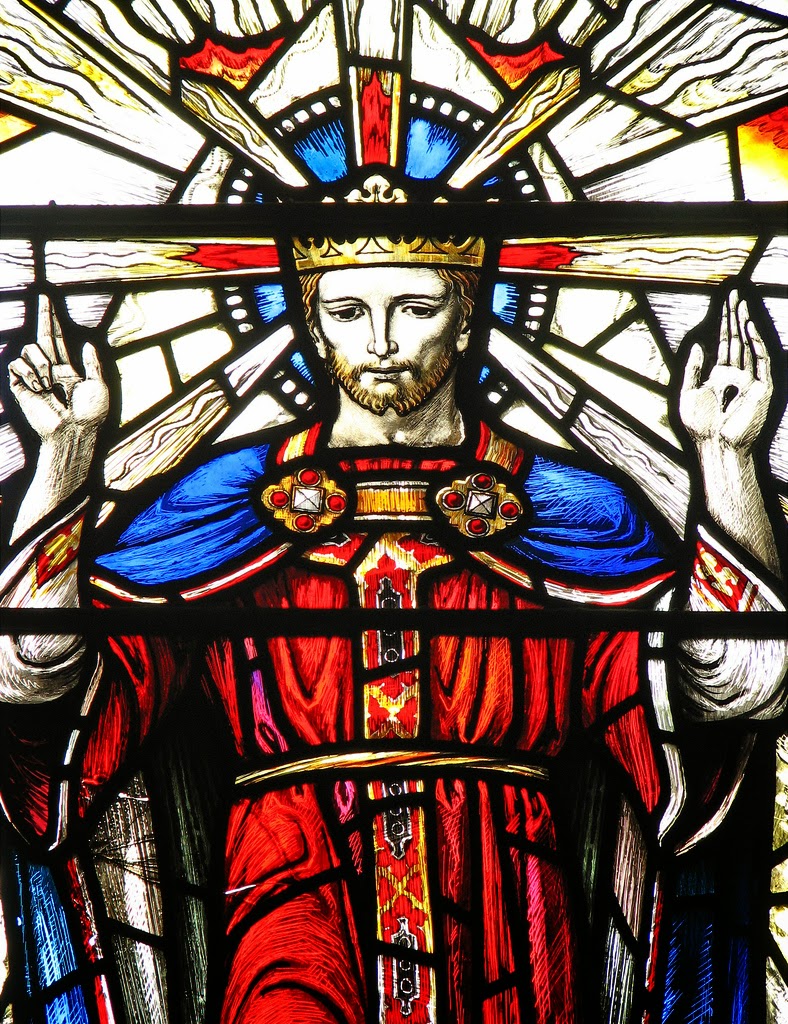
Should the Feast of Christ the King Be Celebrated in October or November?
Peter Kwasniewski

user posted image

With the revival of the traditional Roman Mass throughout the Church, a number of rather significant calendar differences between old and new make themselves increasingly felt by the faithful and those who minister to them. We are all aware, but no one better than our dedicated clergy, that almost every Sunday of the year would demand two different homilies if the same priest, intending to preach on the readings of the day, celebrated Masses in both the Ordinary and Extraordinary Forms.


One of the most egregious differences between the two calendars is the location of the Feast of the Kingship of Our Lord Jesus Christ. In the old calendar, it is always celebrated on the last Sunday of the month of October, right before All Saints. In the new calendar, however, it is the last Sunday of the liturgical year, leading up to the First Sunday of Advent. In practice, the gap between these is often as great as a month. In bi-formal parishes or chapels, the priest is advised to keep that October homily handy for November.

Noting the existence of this difference is not nearly as interesting as asking why there should be such a difference, particularly in a feast of such recent origin. After all, Pope Pius XI instituted the feast in 1925, and already, by 1970, it had been moved. To answer this question, we need to look first at the reasons given by Pope Pius XI himself for choosing the last Sunday of October:

Therefore by Our Apostolic Authority We institute the Feast of the Kingship of Our Lord Jesus Christ to be observed yearly throughout the whole world on the last Sunday of the month of October—the Sunday, that is, which immediately precedes the Feast of All Saints. … The last Sunday of October seemed the most convenient of all for this purpose, because it is at the end of the liturgical year, and thus the feast of the Kingship of Christ sets the crowning glory upon the mysteries of the life of Christ already commemorated during the year, and, before celebrating the triumph of all the Saints, we proclaim and extol the glory of him who triumphs in all the Saints and in all the Elect. Make it your duty and your task, Venerable Brethren, to see that sermons are preached to the people in every parish to teach them the meaning and the importance of this feast, that they may so order their lives as to be worthy of faithful and obedient subjects of the divine King. (Encyclical Letter Quas Primas, 28-29)

Pius XI’s intention, as can be gleaned from n. 29, is to emphasize the glory of Christ as terminus of His earthly mission, a glory and mission visible and perpetuated in history by the saints. Hence the feast falls shortly before the Feast of All Saints, to emphasize that what Christ inaugurated in His own person before ascending in glory, the saints then instantiate and carry further in human society, culture, and nations. It is a feast primarily about celebrating Christ’s ongoing kingship over all reality, including this present world, where the Church must fight for the recognition of His rights, the actual extension of His dominion to all domains, individual and social.

Indeed, there's also the obvious fact, unmentioned in Quas Primas but surely in everyone's mind, that the last Sunday in October had, for centuries, been celebrated as Reformation Sunday. A Catholic counter-feast, reminding the world not only of the comprehensive Kingship of Jesus Christ—so often denied socially and culturally by various teachings of Protestantism—but also of the worldwide kingly authority of His Church, would certainly be a reasonable application of the principle lex orandi, lex credendi.

In the liturgical reforms following the Second Vatican Council, its place was changed to the last Sunday of the Church year—that is, so that one week later would fall the first Sunday of Advent. This new position emphasizes rather the eschatological dimension of Christ’s kingship: the Kingdom of Jesus Christ, though begun in time, is here present “as in a mystery” (as Lumen Gentium phrases it) and in a “crucified” way. This Kingdom will be perfected and fully manifested only at the end of time, with the Second Coming. Hence in the new calendar the feast comes at the very end of the Church’s year, as the summation of the whole of salvation history and the symbol of what we hope for: expectantes … adventum salvatoris nostri Jesu Christi, as the liturgy in the Ordinary Form proclaims after the Lord’s Prayer.

Though both placements are defensible, it would seem that Pius XI’s intention, consistent with the encyclical as a whole, was more to insist on the rights of Jesus Christ here and now, and the corresponding duties of men and nations on earth. As Pius XI explains:

The empire of our Redeemer embraces all men. To use the words of Our immortal predecessor, Pope Leo XIII: “His empire includes not only Catholic nations, not only baptized persons who, though of right belonging to the Church, have been led astray by error, or have been cut off from her by schism, but also all those who are outside the Christian faith; so that truly the whole of mankind is subject to the power of Jesus Christ.” Nor is there any difference in this matter between the individual and the family or the State; for all men, whether collectively or individually, are under the dominion of Christ. In him is the salvation of the individual, in him is the salvation of society. … If, therefore, the rulers of nations wish to preserve their authority, to promote and increase the prosperity of their countries, they will not neglect the public duty of reverence and obedience to the rule of Christ. … When once men recognize, both in private and in public life, that Christ is King, society will at last receive the great blessings of real liberty, well-ordered discipline, peace and harmony. (Quas Primas 18-19)

From this vantage, which certainly does not sound like the language of Dignitatis Humanae or the postconciliar diplomacy of the Church, it is hard to resist thinking that the eschatological perspective betrays weak knees before the challenge of modern secularization, as well as hesitation about the perceived “triumphalism” of the earlier papal social teaching. In other words, the kingship of Christ is palatable and proclaimable so long as its realization comes at the end of time, and does not impinge too much on the political and social order right now—or on the Church’s responsibility to convert the nations, invigorate their cultures, and transform their laws by the light of the Faith.

This suspicion is confirmed by an examination of changes made to the liturgy for this feast, where direct references to Christ’s kingship over States and rulers have been suppressed, as Michael Davies documents in The Second Vatican Council and Religious Liberty (Long Prairie, MN: The Neumann Press, 1992), 243-51. In particular, the hymn for the First Vespers of the feast was significantly modified. The following verses (given here in a literal translation) were simply removed altogether:

The wicked mob screams out:
“We don’t want Christ as king!,”
While we, with shouts of joy, hail
Thee as the world’s supreme king.

May the rulers of the world publicly honor and extol Thee;
May teachers and judges reverence Thee;
May the laws express Thine order
And the arts reflect Thy beauty.

May kings find renown
In their submission and dedication to Thee.
Bring under Thy gentle rule
Our country and our homes.

Glory be to Thee, O Jesus,
Supreme over all secular authorities;
And glory be to the Father and the loving Spirit
Through endless ages. Amen.


(There were several other significant changes in the Novus Ordo liturgy of the feast, all tending in the same direction of the silent denial of Christ's kingship over nations, peoples, rulers. See Davies for a full account.)

What lesson does all of this have for us? The very first expression of the Kingship of Christ over man is found in the natural moral law that comes from God Himself; the highest expression of His kingship is the sacred liturgy, where material elements and man’s own heart are offered to God in union with the divine Sacrifice that redeems creation. Today, we are witnessing the auto-demolition of the Church on earth, certainly in the Western nations, as both the faithful and their shepherds run away and hide from the reality of the Kingship of Christ, which places such great demands on our fallen nature and yet promises such immense blessings in time and eternity. The relentless questioning of basic moral doctrine (especially in the area of marriage and family), the continual watering down of theology and asceticism, the devastation of the liturgy itself—all these are so many rejections of the authority of God and of His Christ.

They arise, the kings [and presidents and prime ministers] of the earth,
princes [in the Church] plot against the Lord and his Anointed.
“Come, let us break their fetters,
come, let us cast off their yoke.”
He who sits in the heavens laughs;
the Lord is laughing them to scorn.
Then he will speak in his anger,
his rage will strike them with terror.
“It is I who have set up my king
on Sion, my holy mountain.”

Now, O kings, understand,
take warning, rulers of the earth;
serve the Lord with awe,
and trembling, pay him your homage.

Blessed are they
who put their trust in Him! (Psalm 2)


Those vital and urgent truths for which Pius XI instituted the very feast of the Kingship of Christ—are they still alive, are they still being preached and taught, are they the lifeblood of the Church’s every liturgy, apostolate, pastoral program? Are we are looking at a feast whose time has passed? The places where the original feast is still celebrated on its original day have, in my experience, some awareness of what this is all about, and nurture a desire to live according to these truths. May the Novemberites sooner or later rediscover the full depth and breadth of this feast as its institutor conceived it.

(Photo of stained glass window courtesy of Fr. Lawrence Lew, O.P.)

https://rorate-caeli.blogspot.com/2014/10/s...st-king-be.html
TSyeeck
post Dec 6 2017, 04:49 PM

Look at all my stars!!
*******
Senior Member
3,573 posts

Joined: Apr 2006


Did you know?

Pope Paul VI published a small chant book in April of 1974 called "Jubilate Deo" in which he asked that each and every Catholic of the Latin Rite learn a core repertoire of Gregorian chants.

Who knows the following?

Adoro Te
O Salutaris Hostia
Laudate Dominum – Psalm 116
Tantum Ergo
Parce Domine
Da Pacem
Ubi Caritas
Veni Creator
Regina Coeli
Salve Regina
Ave Maris Stella
Tu Es Petrus
Magnificat
Te Deum

P.S. If you don't know them, it's not your fault; your Bishop was meant to teach them to you! wink.gif

This post has been edited by yeeck: Dec 6 2017, 04:50 PM
TSyeeck
post Dec 9 2017, 07:23 PM

Look at all my stars!!
*******
Senior Member
3,573 posts

Joined: Apr 2006


The surprising day when the devil himself praised Mary’s Immaculate Conception

user posted image

During an exorcism in Italy in 1823, two Dominican priests made the devil acknowledge the dogma that would be declared 30 years later.

December 8, 1854: Pope Pius IX promulgates the dogma of the Immaculate Conception of Mary.

March 25, 1858: On the feast of the Incarnation of the Word, the Blessed Virgin appears in Lourdes to St. Bernadette and confirms the dogma, saying, “I am the Immaculate Conception.”

But 20 years earlier, another supernatural and surprising event had already confirmed the Immaculate Conception of the Virgin Mother of God. And the one who declared it was someone we never would have expected to do so. The event is related by Fr. Gabriele Amorth, a late exorcist of the Diocese of Rome.

It was the year 1823. The devil had possessed an illiterate 12-year-old boy, who lived in what is today the Italian province of Avellino, near Naples in southern Italy. Two Dominican priests who were in the city, Fr. Gassiti and Fr. Pignataro, were both authorized by the bishop to perform exorcisms.

The priests asked the demon that was possessing the boy a series of questions—among them, one about the Immaculate Conception.

The devil admitted that the Virgin of Nazareth had never been under his power: not even at the first instant of her life, because she was conceived “full of grace” and fully belonging to God.

Although he may be the “father of lies,” the devil can be forced to tell the truth during an exorcism, even in matters of faith. This was how the two exorcists forced him to pay homage to the Virgin and praise her Immaculate Conception, in verse.

Humiliated, the devil was coerced, in the name of Christ, to sing the glory of Mary, and he did so by means of a sonnet in Italian—perfect in form and in theology!

Here, we present the original in Italian, and then the translation into English:

In Italian:

Vera Madre son Io d’un Dio che è Figlio
e son figlia di Lui, benché sua Madre;
ab aeterno nacqu’Egli ed è mio Figlio,
in tempo Io nacqui e pur gli sono Madre.

Egli è mio creator ed è mio Figlio,
son Io sua creatura e gli son Madre;
fu prodigo divin l’esser mio Figlio
un Dio eterno, e Me d’aver per Madre.

L’esser quasi è comun tra Madre e Figlio
perché l’esser dal Figlio ebbe la Madre,
e l’esser dalla Madre ebbe anche il Figlio.

Or, se l’esser dal Figlio ebbe la Madre,
o s’ha da dir che fu macchiato il Figlio,
o senza macchia s’ha da dir la Madre.

In English:

I am the true Mother of a God who is Son,
And I am his daughter, although his Mother;
He was born from eternity, and is my Son,

I was born within time, and yet I am his Mother.
He is my creator, and is my Son,
I am his creation, and his mother;

It was a divine marvel that my Son
Was an eternal God, who had Me as his Mother.
Our being is almost shared between Mother and Son
Because the Mother received her existence from her Son,
And the Son also received his existence from his Mother.

If, then, the Son received his existence from his Mother,
We either must say that the Son was stained by the Mother,
Or we must say that the Mother is Immaculate.

https://aleteia.org/2017/12/08/the-surprisi...ate-conception/

This post has been edited by yeeck: Dec 9 2017, 07:24 PM
TSyeeck
post Dec 18 2017, 11:30 PM

Look at all my stars!!
*******
Senior Member
3,573 posts

Joined: Apr 2006


TSyeeck
post Dec 20 2017, 03:38 PM

Look at all my stars!!
*******
Senior Member
3,573 posts

Joined: Apr 2006


The Catholic Church IS Israel


Here is the scripture reference to back it up. "For in Christ Jesus neither circumcision availeth any thing, nor uncircumcision, but a new creature. And whosoever shall follow this rule, peace on them, and mercy, and upon the Israel of God." - (Galatians 6:15-16) Here St. Paul tells his readers that in Christ neither circumcision (Jewish law) nor uncircumcision (Gentile custom) matters. What matters are those who follow the gospel, and those who follow the gospel are the "Israel of God." It is absolutely essential that Christians fully understand this. We, the Church, are the "Israel of God." We are Israel. We are the spiritual remnant of ancient Israel, expanded and multiplied, to encompass the whole world.


This was (and is) God's plan of salvation. It has not changed. For in the Church, it matters not whether you are Jew or Gentile. What matters is that you are in full-communion with that One who unites us together. I'm speaking of the Jewish rabbi who is both Messiah and King - Jesus of Nazareth. "In fact, from the beginning of his ministry, the Lord Jesus instituted the Twelve as 'the seeds of the new Israel and the beginning of the sacred hierarchy.'" - (Catechism of the Catholic Church, 877)


The Church, particularly the Catholic Church, is Israel. There is no other Israel today, in a Biblical sense, than the Church. The Church is also Zion. There is no other Zion, in a spiritual sense, than the Church. The Church is also the New Jerusalem. There is no other "Jerusalem," in a spiritual sense than the Church. This is a fundamental teaching of the New Testament. Without this understanding, everything becomes convoluted. If you read Israel and the Church as being two separate entities than you've missed the boat, and one of the most fundamental teachings of the New Testament just went right over your head. In the eleventh chapter of St. Paul's epistle to the Romans he uses the illustration of an olive tree to make his point. He compares the Church to a tree that has its roots in the patriarchs (Abraham, Isaac and Jacob), and its trunk representing the Law and Prophets in the Old Testament. No tree trunk grows upward into infinity. At some point it must sprout branches, and so St. Paul's "olive tree" does the same. These branches make up the modern Church in Jesus Christ. Some branches are Jewish Christians. Many branches are Gentile Christians. Both are precious in the eyes of God. This is the "Israel of God."

What about those Jews who refused to believe in Jesus Christ? St. Paul himself tells us those are the branches that were cut off from the tree - at least for the time being. These branches can however be grafted back in at any time, and indeed he assures us that someday they all will be, in the fullness of time. As far as we're concerned anyway, Christianity (neither Judaism nor some piece of real estate in the Middle East) makes up the new "Israel of God," and it's been this way ever since Christ initiated the New Covenant some 2,000 years ago.

This is how we Christians are to understand ourselves, and the Church, in the context of Israel and the Old Testament. I cannot stress how incredibly important this is, because if it is not understood, the errors that will arise from it will be nothing short of monumental!

Where does this put the Church in relation to the rest of the Jewish people? Simply put, we (the Church) are Zion! We are Israel! That is what it explicitly says in the New Testament and the Catechism of the Catholic Church. To become complete as a Jew is no different than what it takes to become complete as a Gentile. We all must be "grafted in" to Israel - which is The Catholic Church! The path is no different for a Jew than it is for a Muslim, Buddhist, Hindu or Wiccan.

It had to be this way you see. Christ fulfilled the Old Covenant, and established a New Covenant that puts us all on equal footing. He didn't destroy the Old Covenant - he FULFILLED it! The Old Covenant still remains, but is fulfilled in Christ, and must be understood fully in the context of Christ.

A great fallacy has been circulating the globe for the last century and a half. It has particularly taken root in Anglophone (English-speaking) countries. It is the fallacy called Dispensationalism. It is a heresy that not only permeates many Protestant denominations and affiliations, but it has even penetrated the Catholic Church. Yes, there are Dispensationalist groups even among Catholics. The fallacy teaches that God has formed two covenant peoples. There are the Jews of the Old Covenant, and the Church of the New Covenant. The fallacy continues to teach that the modern day Jews of today are still "Israel" and that Israel is a completely separate entity from the Church. So the fallacy goes, God has one plan of salvation for ethnic Israel (the Jews), and another for the Church (primarily Gentiles). As the fallacy of Dispensationalism has played out over the last century and a half, the national State of Israel is incorrectly assumed to be the "true Israel" while the Church is simply considered "the Church" having no real connection. Some Christians use this rationale to blindly support the State of Israel, regardless of it's politics that often harm both Palestinian Christians and Muslims. This ideology is called "Zionism" and it is contrary to the gospel. Jesus, the rightful King of Israel, plainly stated that his Kingdom was not of this world (John 18:36), because if it were his servants would fight. Jesus however, did not instruct his apostles to fight. He instructed them to pray and to teach instead. This teaching upset some of his followers, perhaps even Judas Iscariot (who eventually betrayed him), because they were waiting for years for a Messiah that would violently take back the old Kingdom of Israel from the Romans. They dreamed of a glorious battle of liberation not seen since the time of the Maccabees. Jesus had different plans. The Kingdom of God (Israel) is not about a piece of real estate and who owns it. That is not why God gave them the promised land in the first place. The promised land wasn't about the promised land, it was about providing a nursery suitable for God to raise up his people for a much greater task ahead. That being the task of taking the gospel to the world, and expanding Israel (the Church) to cover the whole planet. It was not to be a kingdom of laws and men, but rather a Realm of Spirit and Truth, founded on Jesus Christ and built on Peter the rock. To focus on real estate in the Middle East is to completely miss the point. The ancient Land of Israel was merely a nursery to raise God's people for something bigger and better. It was a means to an end, not an end in and of itself. The problem with Zionism is that it focuses completely on the land - real estate - and ignores the role of the Church.

Some Christians use the Dispensationalist rationale to seek religious fulfillment in modern Jewish ceremonies and liturgies. This is a very ancient error called "Judaizing," an error strongly condemned by St. Paul. (Most Christians who do this today are Evangelical Protestants who often call themselves "Messianics" or "Messianic Jews.")

The above are the modern manifestations of the fallacy of Dispensationalism, but it is the fallacy itself that is most dangerous, because it denies the Biblical place of the Church in the divine plan of God.

Christians would do well to remember that St. Paul, and the apostles, thought the Greek version of the Jewish scriptures (Septuagint) was just as authoritative as the Hebrew and Aramaic versions. In fact it can be said they even thought it far more relevant to the New Covenant than any other version, as the majority of quoted Old Testament passages in the New Testament come from this Greek version. Christians would do well to remember that the word most commonly used for the Nation of Israel in this Greek Old Testament is "Ecclesia" which means literally "a called out people." It's the exact same word used in the original Greek New Testament for the Church. In the eyes of St. Paul and the apostles, Israel and the Church were one in the same. This was in perfect continuity with the Old Testament as demonstrated in St. Paul's "olive tree" illustration (Romans 11).

Let us remember today why St. Paul was on the road to Damascus some 2,000 years ago. Back then he was known simply as "Saul," a pious Jew who took it upon himself to persecute the Church. He was knocked off his horse and blinded by an apparition of the Lord Jesus Christ - who asked him "Saul, why are you persecuting me?" St. Paul was persecuting the Church, using Jewish laws, in a form of inquisition sanctioned by the scribes and pharisees in Jerusalem. These scribes and pharisees had no recognition of the Church being part of Israel, but the irony was that the reason why they did not recognize Israel in the Church was because the scribes and pharisees were no longer part of Israel - at least not in a spiritual sense. They had cut themselves out, through self-excommunication, by denying Jesus as the promised Messiah. In turn, Jesus revoked the authority of the Jewish leadership, by giving the "keys of the kingdom" to St. Peter (Matthew 16:18-19) effectively making the fisherman the King's prime minister - spokesman for all Israel. St. Peter later went to Rome and founded the Church there where he eventually met up with St. Paul, and together they led the Church there, and ultimately shed their blood for her.

Today a new kind of persecution of the Church is going on, and it's rooted in the fallacy of Dispensationalism. This fallacy leads to the worst form of anti-Catholicism, as is evidenced by the volumes of anti-Catholic writings produced by Dispensationalist authors. While in some cases, Dispensationalism actually causes Christians to support some very unChristian things - such as Zionism and Judaizing for example. Let's not beat around the bush here. Dispensational theology is physically harming Christians! How? This is how it works. Dispensationalism leads Christians to support Zionism. Zionism in turn leads to the blind support of the Nation of Israel and all its policies, regardless of their effect. Many of those policies are directed against the Palestinian people, regardless of their religion, and many of those Palestinian people are Christians. Those Palestinian Christians suffer poverty and physical infirmity because of those policies. The strange irony of our time is that many Christians in the West, (mainly Evangelical Dispensationalists), including some who claim a Jewish-Christian identity, are blindly supporting a regime that is directly persecuting their Christian brethren (Palestinian Christians) in the very homeland of Jesus Christ, and they do this thinking Jesus somehow approves. The strange irony is that while St. Paul instructed Western Christians to take up collections to help Palestinian Christians during his time, Dispensationalist pastors actively take up collections to support a regime that persecutes them in our time. Dispensationalism is a fallacy that must be resisted, but this can only be effectively done by knowing and understanding the place of the Church as the new "Israel of God." This is what the New Testament teaches. It is not "replacement theology" as some have incorrectly labeled it. This is authentic "olive tree ecclesiology" as understood by the man who invented it - St. Paul himself - and has been historically called by the name "Covenant Theology."

The proper place for a Jewish believer in Jesus Christ is the same place as a non-Jewish believer in Jesus Christ, and that is the Catholic Church. Throughout her history, the Catholic Church has never been without Jewish members. Some are converts, and some are born into the Church from converts. In recent decades, there has been an increasing number of Jewish converts to the Catholic Church. As a result of this, some of these Jewish converts have organised into the Association of Hebrew Catholics, which is a simple lay apostolate approved by Cardinal Raymond Burke (Prefect of the Vatican Apostolic Signatura) designed to assist and support Jewish people entering the Catholic Church, as well as stand as a witness to the ongoing Jewish (Hebrew) presence within the Catholic Church. If you are Jewish, or have Jewish ancestry, please consider coming home to Zion -- the new Israel of God -- which is the Catholic Church.

Pope, Saint Pius X:
"We are unable to favor this movement (Zionism). We cannot prevent the Jews from going to Jerusalem-but we could never sanction it. The ground of Jerusalem, if it were not always sacred, has been sanctified by the life of Jesus Christ. As the head of the Church, I cannot answer you otherwise. The Jews have not recognized Our Lord; therefore we cannot recognize the Jewish people."

Pope St Pius X to Theodore Herzl's (founder of Zionist movement) face (1904).

This canonised Pope saw the facts clearly: since their (Jews) rejection (and crucifixion!) of Christ, the "Biblical claim" by the Jews to Israel is null and void.

Why is to so hard for theologians and clerics whether Protestant Americans or Modern “Catholics” to see the same clearly?

Pius X made a stand at the start of the 20th Century against what was called "modernism" - in essence Freemasonic ideals, libertarianism, false ecumenism and so on.

The difference between then and now is that the enemy media is stronger and that Christians have lost the will to fight - especially when battered with "holocaust guilt" - so they genuflect to what Christ called the Synagogue of Satan.

http://tradcatknight.blogspot.my/2016/01/t...-is-israel.html

This post has been edited by yeeck: Dec 20 2017, 03:39 PM
TSyeeck
post Dec 28 2017, 12:11 PM

Look at all my stars!!
*******
Senior Member
3,573 posts

Joined: Apr 2006


user posted image

“Here is the true Faith: This Baby is God, and this Woman is the Mother of God.”

With the manifestation of Jesus Christ as the eternal Son of the eternal Father, the doctrine of the Holy Trinity, which was implicit in the Old Testament, becomes explicit in the New. Now we know that the true God is a community of consubstantial, coequal, and coeval Persons, all worthy of the highest cult of adoration, thanksgiving, reparation, and petition. Before the revelation of God in the Flesh, we did not have such knowledge.

That mystery by which we know the mystery of the Trinity — the Incarnation of the eternal Word — was itself an altogether new revelation, a fulfillment of the mysterious prophesy of Jeremy, “for the Lord hath created a new thing upon the earth: A WOMAN SHALL COMPASS A MAN” (31:22).

That new thing was beloved of the holy angels and hated by the demons.

Satan’s fall was caused by his rejection of the economy of the Incarnation, with its consequent crowning of that Woman as Queen of the Angels — his Queen. In his demonic hatred of that Woman, he seduced her precursor, Eve. And in his preternatural hatred of that Woman’s “seed” (cf. Gen. 3:15), he hates all children. Under his influence, therefore, the pagan world gave us the diminution of woman to the status of man’s sexual plaything. (A role she was largely spared in Christendom owing to the cultus of the Blessed Virgin Mary, cf., Orestes Brownson’s “The Moral and Social Influence of Devotion to Mary.”) And in the darker sort of paganism — the more clearly diabolical kind — we see the wicked cult of child sacrifice.

Thus the Canaanite god, Moloch, and the Punic god, Baal were each the recipient of a cult that included child sacrifice. The former cult was practiced by apostate Israelites, who murdered their own children, which they were specifically commanded not to do in the book of Leviticus. The cult of the latter, Baal, was one of the reasons the Romans sought to destroy Carthage. Pagan though they were, the Romans were not so corrupt as to fathom child sacrifice, and their orators cited infant sacrifice in their anti-Punic rhetoric as a reason why Carthage must be destroyed. In spite of a fashionable modern attempt to rehabilitate the ancient Phoenicians’ reputation, recent archeological evidence shows that the Romans were right; these people really did sacrifice their children to demons.

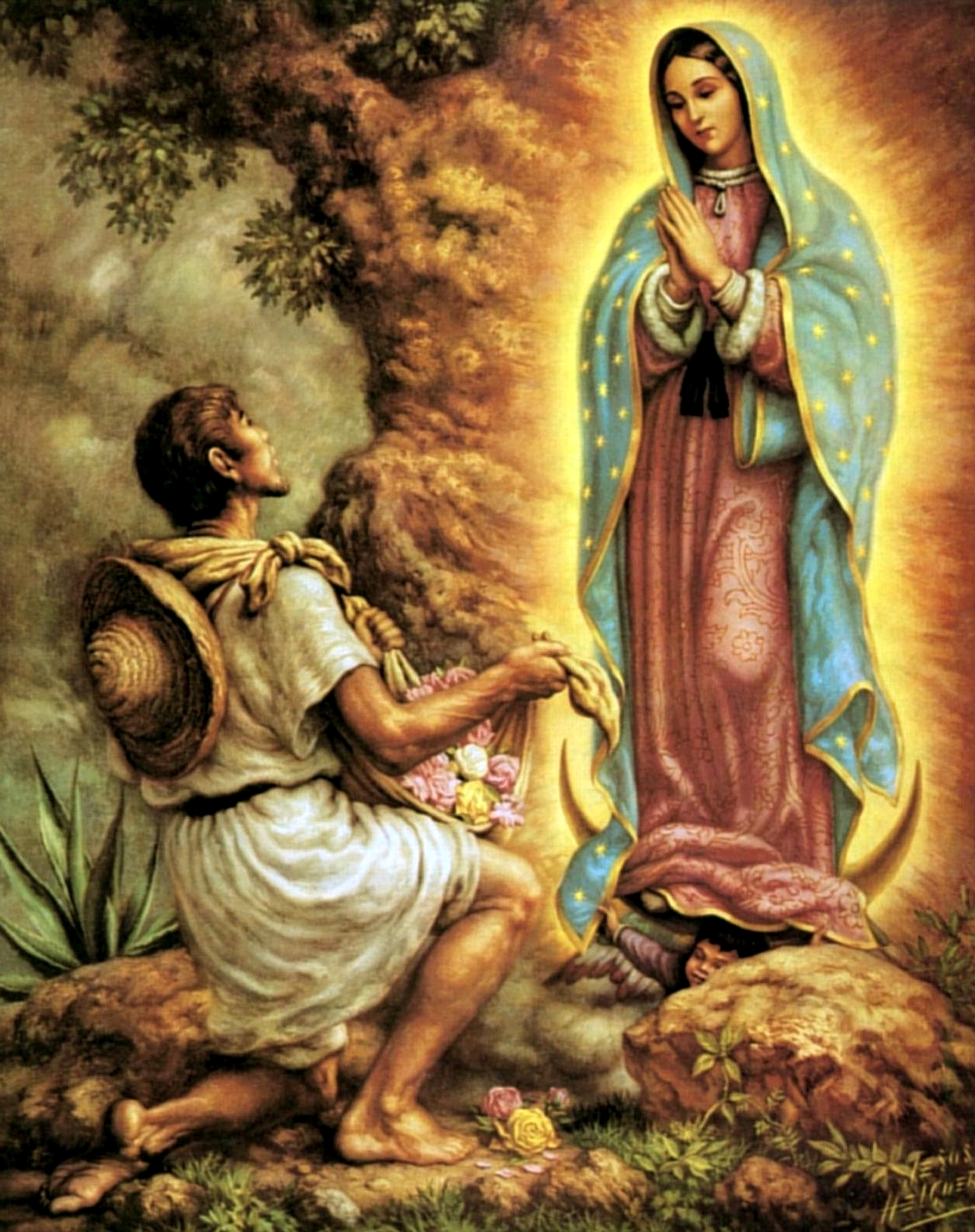
Closer to home, while the Aztecs practiced various kinds of human sacrifice, the worship of Tlaloc, their god of rain, water, and earthly fertility, specifically demanded child sacrifice, as did certain other of their cults (mentioned at various points here). We know that the holy Virgin of Guadalupe came personally to evangelize the Aztecs through the instrumentality of Saint Juan Diego and his tilma. Fighting diabolical fire with fire of a heavenly sort, the miraculous image of Guadalupe is an ingenious pictogram of a pregnant young Queen defeating the Aztec pantheon.

And her beautiful words to Saint Juan Diego show just how tender and loving a Mother that Queen is!

user posted image

* * * * * * * * * * * *

The liturgical calendar becomes strangely sanguinary just after Christmas Day. The second day of the Octave is the “Feast of Stephen,” that saintly deacon and protomartyr who heads up a bloody band to salute the newborn King. Then comes His Apostle and Evangelist, Saint John, on December 27, a martyr in all but his actual death; followed by the Holy Innocents; followed by Saint Thomas a Becket, the martyred Bishop of Canterbury.

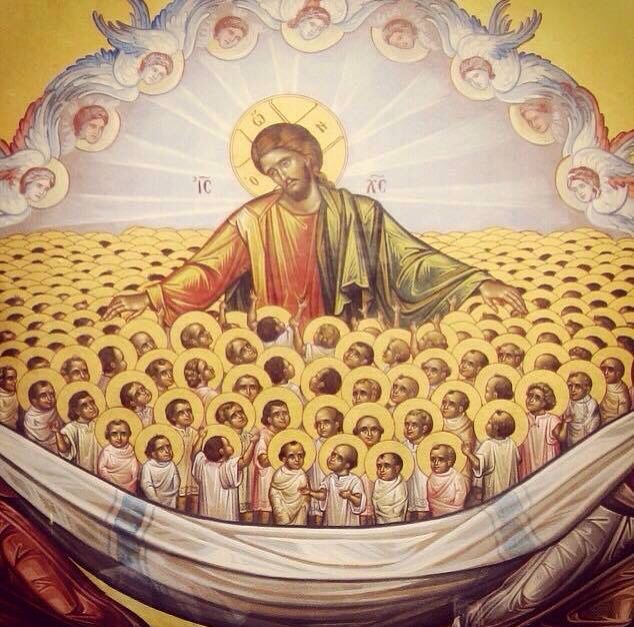
The feast of the Holy Innocents, known also as Childermas (the Mass of the Children, as Christmas is the Mass of Christ), celebrates those little Jewish boys of Bethlehem who had the honor of being mistaken for Christ. The Church, in her liturgy, gives them the graceful name flores martyrum, “flowers of the martyrs.” The hymn whence come these words has been set to music by Michael Haydn, younger brother of the more famous Franz Joseph Haydn. Speaking of musical tributes, let us not forget that the melancholy 14th-Century Coventry Carol is in honor of the Holy Innocents. The carol is melancholy, but can also be called bittersweet, the sweet coming in at the end via the tonal device known as the “Picardy third.” As tragic as the slaughter of these innocents was, it remains part of salvation history — a divine comedy in the true sense of the word, as there is a happy ending.

user posted image

In our own day, the cults of Baal, Moloch, Tlaloc, and Herod’s selfish ambitions all continue in the abortion industry, which has — at least in some places — overt connections to the Satanic. But even when not explicitly Satanic, the abortion industry is playing the role of useful idiot for Satan. Ditto for the pharmaceutical industry’s production of chemical abortifacients and other methods of birth control. The demonic hatred of the Divine Child continues in the wicked practice of onanism, a mortal sin which is nearly pandemic in our day, at least in the developed world, which seeks Herod-like to impose it on poorer nations.

user posted image

A delicate point suggests itself here. In spite of the uninformed optimism of many in the pro-life movement, and contrary to the sanguine novelties of the authors of the International Theological Commission’s study on Limbo, unbaptized babies, being yet stained by original sin, are not admitted to the Beatific Vision when they die. European witches, in the Ages of Faith, gave bizarre and sacrilegious tribute to this truth of the Catholic Faith when they sacrificed unbaptized infants to Satan in their black rites. Shakespeare, well aware of this practice, makes use of it in the grotesque list of ingredients bubbling in the witches caldron in Macbeth:

Liver of blaspheming Jew,
Gall of goat, and slips of yew
Silver'd in the moon's eclipse,
Nose of Turk and Tartar's lips,
Finger of birth-strangled babe
Ditch-deliver'd by a drab,
Make the gruel thick and slab...

Satan continues to attack and corrupt women as he did Eve. Strangely, his promises have become less attractive. Eve was promised to become like God. Via feminism, Satan promises the modern woman she can become just like men. What a bum deal! If only she is willing to sacrifice her femininity in the dark rites of abortion and contraception, she can forge her own destiny and become … enslaved in a Dilbert cubicle just like the male of the species! Maybe one day, she can even become president. And in fulfilling her ambitions and sacrificing children and family on the altar of feminism, this “liberated” woman unwittingly assists Satan in his attack on the Mother and Child.

To restore the woman and the child — and marriage and the family — to their proper place, we need to restore the place of that Woman and that Child in our own hearts and souls.

I said above that Satan continues to attack and corrupt women. Let nobody read into these words the idea that demons do not tempt men. That he does, and often, as he did in Eden, by using women. Men, if they be Christian men, and not completely corrupted by his wiles, will realize that their duty is to care for, respect, and protect women and children — for each is an image of that grand Image of Catholicity, given by God to Saint Joseph's loving care.

“Here is the true Faith: This Baby is God, and this Woman is the Mother of God.”

In the Immaculate Heart of Mary,
Brother André Marie, M.I.C.M.
TSyeeck
post Jan 3 2018, 05:58 PM

Look at all my stars!!
*******
Senior Member
3,573 posts

Joined: Apr 2006


Kazakh Bishops affirm indissolubility of marriage – and its implications

Three Kazakhstani Bishops signed a statement on Sunday confirming that it is not licit to admit to sacramental communion Catholics who are divorced and illictly remarried, if they are not living according to the long-standing teachings of the Church.
Jan 03, 2018

user posted image

By Carl Bunderson

Three Kazakhstani Bishops signed a statement on Sunday confirming that it is not licit to admit to sacramental communion Catholics who are divorced and illictly remarried, if they are not living according to the long-standing teachings of the Church.The statement was released in response to norms issued by several groups of bishops since the promulgation of Amoris laetitia.“It is not licit (non licet) to justify, approve, or legitimize either directly or indirectly divorce and a non-conjugal stable sexual relationship through the sacramental discipline of the admission of so-called 'divorced and remarried' to Holy Communion, in this case a discipline alien to the entire Tradition of the Catholic and Apostolic faith,” read the Dec. 31, 2017 letter of the Bishops.“By making this public profession before our conscience and before God who will judge us, we are sincerely convinced that we have provided a service of charity in truth to the Church of our day and to the Supreme Pontiff, Successor of Saint Peter and Vicar of Christ on earth.”The statement was signed by Archbishop Tomash Peta of Maria Santissima in Astana; his auxiliary, Bishop Athanasius Schneider; and Archbishop Jan Pawel Lenga, Archbishop Emeritus of Karaganda.It comes nearly a year after the same Bishops issued an appeal to prayer that Pope Francis would confirm the Church's constant practice regarding the indissolubility of marriage.The three Bishops noted that some Bishops around the world – such as those of Malta and Sicily – have issued norms allowing for the divorced-and-remarried who have a living spouse yet who are in “stable cohabitation more uxorio” with a third person to “receive the sacrament of Penance and Holy Communion, while continuing to live habitually and intentionally more uxorio with a person who is not their legitimate spouse.” Those norms have qualified that such permissions are limited to individual cases, at the discretion of a confessor, pastor, or Bishop.

More uxorio, which means “in the mode of marriage,” refers in this context to cohabitation and a sexual relationship between those who are not validly married. “These pastoral norms have received approval from various hierarchical authorities. Some of these norms have received approval even from the supreme authority of the Church,” they noted. Pope Francis had, in 2016, sent a letter approving of norms from the Bishops of the Buenos Aires region of Argentina, which seemed to permit reception of holy communion in particular cases.The Pope's letter, and the Buenos Aires norms, were then promulgated in the Acta Apostolicae Sedis, a fact made known last month.“The spread of these ecclesiastically approved pastoral norms has caused a considerable and ever increasing confusion among the faithful and the clergy, a confusion that touches the central manifestations of the life of the Church, such as sacramental marriage with the family, the domestic church, and the sacrament of the Most Holy Eucharist,” the Kazakh bishops stated.They said that to admit the divorced-and-remarried to Communion “means in practice a way of approving or legitimizing divorce, and in this meaning a kind of introduction of divorce in the life of the Church.”Such pastoral norms “are revealed in practice and in time” as a way of spreading the “plague of divorce”, they said, quoting from the Second Vatican Council's pastoral constitution on the Church in the modern world, Gaudium et spes.The bishops maintained that the Church should be, rather, “a bulwark and an unmistakable sign of contradiction against the plague of divorce … because of her unconditional fidelity to the doctrine of Christ.”“An approval or legitimation of the violation of the sacredness of the marriage bond, even indirectly through the mentioned new sacramental discipline, seriously contradicts God's express will and His commandment,” the Kazakh bishops wrote.They stated that sexual acts between those who are not married are “always contrary to God's will and constitute a grave offense”' and that no circumstance, including diminished guilt, can make such a sexual relationship “a positive moral reality.”The bishops also emphasized that although the Church cannot judge the internal state of grace of any person, sacramental discipline is not based on this but on their “visible and objective situation”; and that is it morally illicit “to engage in sexual relations with a person who is not one’s legitimate spouse supposedly to avoid another sin.”

They also affirmed that the divorced-and-remarried may be admitted to Communion “only when they with the help of God's grace and a patient and individual pastoral accompaniment make a sincere intention to cease from now on the habit of such sexual relations and to avoid scandal. It is in this way that true discernment and authentic pastoral accompaniment were always expressed in the Church.”

Furthermore, they said that those who violate their marriage bond with their legitimate spouse may not participate in Communion, and that “the fulfillment of God's will … constitutes the true spiritual good of the people here on earth and will lead them to the true joy of love in the salvation of eternal life.”The bishops called the recently proposed pastoral norms “a substantial alteration” of the Church's 2,000 year discipline, and added: “a substantially altered discipline will eventually lead to an alteration in the corresponding doctrine.”“The constant Magisterium of the Church … has preserved and faithfully transmitted both in the doctrine (in theory) and in the sacramental discipline (in practice) in an unequivocal way, without any shadow of doubt and always in the same sense and in the same meaning (eodem sensu eademque sententia), the crystalline teaching of Christ concerning the indissolubility of marriage.”The bishops said that the indissolubility of a ratified and consummated marriage is “the revealed word of God and the faith of the Church,” and that sacramental discipline cannot contradict this, “because of its Divinely established nature.”The faith naturally “excludes a formal contradiction between the faith professed on the one hand and the life and practice of the sacraments on the other,” they said, citing Vatican II and the writings of St. John Paul II.“In view of the vital importance that the doctrine and discipline of marriage and the Eucharist constitute, the Church is obliged to speak with the same voice. The pastoral norms regarding the indissolubility of marriage must not, therefore, be contradicted between one diocese and another, between one country and another,” they added, citing St. Irenaeus of Lyons and St. Thomas Aquinas.The bishops provided ample citations for the existing teaching and practice regarding the indissolubility of marriage, including Bl. Pius IX, Ven. Pius XII, Bl. Paul VI, St. John Paul II, and the Pontifical Council for Legislative Texts.“As Catholic bishops, who … must defend the unity of faith and the common discipline of the Church, and take care that the light of the full truth should arise for all men we are forced in conscience to profess in the face of the current rampant confusion the unchanging truth and the equally immutable sacramental discipline regarding the indissolubility of marriage according to the bimillennial and unaltered teaching of the Magisterium of the Church,” they wrote.“Being bishops in the pastoral office those, who promote the Catholic and Apostolic faith, we are aware of this grave responsibility and our duty before the faithful who await from us a public and unequivocal profession of the truth and the immutable discipline of the Church regarding the indissolubility of marriage. For this reason we are not allowed to be silent,” stated the Kazakh bishops.They made their affirmation in the spirit of Ss. John the Baptist, John Fisher, and Thomas More, who were martyred for upholding the indissolubility of marriage, and of Bl. Laura Vicuna, who offered her life for the conversion of her mother, who was living in concubinage.--CNA
TSyeeck
post Jan 5 2018, 02:26 PM

Look at all my stars!!
*******
Senior Member
3,573 posts

Joined: Apr 2006


Bishop Barron: Don’t water down Christianity

user posted image

Speaking to some 8,000 people at a Catholic leadership conference, Bishop Robert Barron said on Tuesday that trust in the risen Christ should give us the courage to preach the truth boldly.“Through the Holy Spirit, the ascended, risen Christ commands his mystical Body the Church to do what he did, and to say what he said. That’s it…that’s the task of the Church to the present day.”Barron, the auxiliary bishop of Los Angeles, is also the founder of Word on Fire Catholic Ministries and host of the award-winning “Catholicism” documentary. He delivered one of the opening keynotes at this year’s Student Leadership Summit in Chicago. Known as SLS, the summit is hosted by the Fellowship of Catholic University Students (FOCUS) every other year. It aims to train student leaders and other ministers with tools for evangelization and missionary work, largely on college campuses.This year’s SLS drew more than 8,000 participants, more than double the attendance of the last summit, hosted in 2016 in Dallas with approximately 3,400 participants.In his talk, Bishop Barron focused on the Acts of the Apostles, a Biblical book that he said “sets the agenda for us” in the work of evangelization.He noted that this book begins with an account of Jesus’ ascension, comparing Christ’s glorified position in heaven to that of a general who commands his army at a vantage point from above.

“It tells us very clearly who’s in charge, and what I mean by that is, the ascended Christ who now commands his Church.”Moving on from the Ascension to the account of Pentecost, Barron said that the descent of the Holy Spirit compels us to spread the Word of God. The Holy Spirit comes to earth to guide the Church, he said, led by the ascended Christ from heaven.“In myriad ways, according to your particular missions, bring something of heaven to earth, doing as Jesus did,” the bishop exhorted attendants.In bringing the message of heaven to earth, Catholics should be careful not to water down the Gospel or fall for bland and uninspiring half-truths, he said.He recalled an encounter that he had with Biblical scholar Scott Hahn, who remarked that “there is no historical basis for the for the claim that St. Francis said, ‘Preach always, and when necessary, use words.’”While indeed “our whole life should be a kind of preaching,” Barron said, the statement attributed to St. Francis can become a problem when it is “used as a justification for a kind of pastoral reductionism,” for example, the idea that “what it all really comes down to is taking care of the poor.”While caring for the poor is important, Barron said, this work “in and of itself can never be evangelically sufficient.”“This is not the time for anti-intellectualism in our Church! We have lots of young people, you know them, they're your friends and colleagues, who are leaving the Church for intellectual reasons,” Barron said.He called for a kind of “bold speech” needed to proclaim the Gospel, pointing to the preaching in the early Church, which challenged the widely held belief at the time that “Caesar is Lord.”“The bold speech of the Church is that not ‘Caesar,’ or any of his colleagues or predecessors or successors, but rather Jesus is Lord, Jesus is the king. And he is also Christos, anointed.”The Roman empire at the time, Barron said, was rather liberal with regards to new religions, yet still rejected the early Christians because they identified Jesus – and not Caesar – as the only Lord.“If he is Lord, everything in your life belongs to him. Your personal life, yes. Your body, yes. Your friendships, yes. Your political life, yes. Your entertainment, yes. All of it.”When Christianity becomes reduced to a mere message that can be gained from the dominant culture, Bishop Barron said, it moves from the faith of early persecuted Christians to one which is rewarded lavishly by others.

“That’s what happens to a weakened, attenuated Christianity,” he said.“In the Acts of the Apostles we hear that when those first disciples spoke, people were cut to the heart. Still true, still true to this day. Bland spiritual teachings, saying what everybody else says, that won’t cut anyone to the heart, but trust me, declaring the lordship of Jesus, that’ll cut them to the heart.”Bishop Barron highlighted Jesus’ role in light of the Old Testament, saying that only as a fulfillment of laws and the prophets does Jesus make sense. He pointed to St. Stephen’s speech to the Sanhedrin before his martyrdom, in which the saint summarized the entire Old Testament and then described Jesus’ ministry.When Jesus is cut off from his roots in Israel, he becomes just a philosopher or wise figure, a “flattened out, uninspiring Jesus,” the bishop warned.In contrast, he said, “when you present Jesus as the fulfillment of the great story of Israel, Jesus as the fulfillment of the temple that was meant to bring humanity and divinity together, when you preach him as the fulfillment of the law and the covenant and the Torah, when you preach him as the culmination of all the proclamation of the prophets, people will be cut to the heart.”Bishop Barron related a story he commonly tells of a little girl he met while working in Chicago who presented to him a detailed account of George Lucas’ “Star Wars” movies. He said that kids’ aptitude to memorize such complex plotlines and character names dispels the notion that they cannot understand the Bible.“This great, rollicking, complex, rich story that we have, full of weird names, yeah, but no weirder than Obi-Wan Kenobi, right? The kids have no trouble with that. Don’t tell me they can’t understand the Bible. And therefore don’t tell me that they can’t appreciate Jesus as the culmination of that great story.”The Bishop ended his talk by encouraging conference attendees in prayer and asking them to help “remind the world whom they are to worship.”“Everybody worships somebody or something,” he said. “Everyone’s got a king, right? Our job is to stand up boldly and say, ‘No, Christ is your king. Everything in your life belongs to him’.”--CNA

TSyeeck
post Jan 9 2018, 01:30 PM

Look at all my stars!!
*******
Senior Member
3,573 posts

Joined: Apr 2006


Seven things a bishop should say when a priest tells his congregation he’s ‘gay’

January 8, 2018 (The Catholic Thing) – Recently, a priest who was prominent in the pastoral care of those with sex addictions received his fifteen minutes of fame when he revealed to his congregation at a Sunday Mass and to the National Catholic Reporter that he was “gay.” According to news reports, his self-congratulation was met with thunderous applause. In a television interview, he proclaimed there is “nothing wrong with being gay.”

The game plan of a gay priest “coming out” was quite predictable and is politically effective. In revealing his homosexuality, the Midwestern priest was careful to assemble a string of ambiguous assertions that cannot be immediately assailed on grounds of orthodoxy, but when bundled together are morally subversive. Here is the template:

*Claim that sexual transparency is a matter of personal integrity.
*Remind the public that you are a Catholic priest in good standing.
*Proudly proclaim that you are “gay.”
*Cultivate the adulation of your congregation by claiming victim status and the freedom that comes from such an honest revelation.
*As a pre-emptive strike against disciplinary actions by ecclesiastical authorities claim that your self-revelation is truly courageous.
*Feign humility and presume you have become a necessary role model for others.
*Remind us that you and all gays (and members of the alphabet soup of sexual perversion) are created in the image of God (implying our sinful neglect).
*Commit to celibacy (i.e., not to marry), but carefully avoid the term “Christian chastity.”
*Each of these assertions, standing alone, would likely withstand ecclesiastical censure. But when woven together, the gay agenda promoting the acceptance of the homosexual lifestyle within the Church comes into a clear focus.

The priest’s bishop also responded according to a predictable contemporary ecclesiastical template: “We support [the priest] in his own personal journey and telling his story of coming to understand and live with his sexual orientation. As the Church teaches, those with same-sex attraction must be treated with understanding and compassion.”

The bishop probably succeeded in preventing a media firestorm. He also effectively allowed the priest to rise in stature as a gay freedom fighter. The studied moral ambiguity of the clerical gay activist proved to be an effective political buzz saw. The full and beautiful teachings of Christ on human sexuality, however, were further undermined.

Faithful and orthodox Catholics are at a political disadvantage in our gay-friendly culture. We realize that same-sex inclinations – as with all seriously sinful inclinations – cause great suffering and, unrestrained, can become a true slavery that endangers others including adolescents and even young children. But our opposition to the gay agenda is often crudely characterized as hateful and unreasonable. So a brief sketch of natural law in Catholic sexual morality may be helpful.

Male and female sex organs differ and have a unique reproductive function. The body of every human being contains a self-sufficient digestive or respiratory system. But it only contains half of a reproductive system and must be paired with a half-system belonging to a person of the opposite sex in order to carry out its function. These are undeniable biological facts.

“To engage in sex” is a relational term that implies male and female complementarity. Only a male and a female truly “engage in sex.” In contrast, same-sex “relations” involve the exercise of one’s sexual power, but not according to its self-evident nature. Sodomy is not really relational “sex.” It is merely a masturbatory use of sexual powers. Similarly, there is no such thing as “sexual relations” with a “sex robot” (alas, an emerging technology).

When a priest claims to be “gay and proud,” he is revealing that he has assented to his same-sex attraction. Free and deliberate thoughts have moral implications, as Jesus asserted: “But I say to you that every one who looks at a woman lustfully has already committed adultery with her in his heart.” (Mt 5:28) The difference between internal assent and external action is only a matter of a sinful opportunity. An unabashed and proud “gay” priest has already committed sodomy in his heart.

So how might an ecclesiastical superior defend Church teaching if one of his priests (or religious) claims a special dignity by “coming out” as gay? The superior should invoke immutable Christian moral principles in dealing with a self-described gay priest:

*Acknowledge that he is afflicted with “same-sex attraction” (SSA).
*Admit that SSA is an inclination toward mortal sin that if not restrained will lead him and others to eternal damnation.
*Identify and renounce any physical expression of SSA.
*Properly define celibacy to include Christian chastity that precludes all sexual activity in thought, word or deed.
*Invoke Scriptural references condemning sodomy (cf. Genesis and Saint Paul).
*Renounce the use of the word “gay” because it is a political term that has its roots in the homosexual subculture.
*Apologize for encouraging others to publicly reveal their mortally sinful inclinations. (The Eighth Commandment protects natural secrets.)
*After a careful inquiry, the superior should release a public statement of clarification, prohibiting the priest from his homosexual activism and taking further personnel action according to the demands of Catholic morality and Canon Law.

Would a media firestorm ensue? Probably. But the superior would courageously confirm that the studied ambiguity of the gay agenda promoted by the priest is a lie.

During the rite of ordination for priests, the bishop says, “May God who has begun the good work in you bring it to fulfillment.” Priests – and everyone – are in a constant state of change, for the better or for the worse. Fulfilling the duties of Holy Orders or any Christian vocation with true moral integrity is a lifelong task.

If we are going to find our true and final happiness in Christ, we must not only recognize and understand our sinful inclinations, but make firm and constant efforts to overcome them. “Celebrating” those inclinations simply makes no sense – whether the inclination is same-sex attraction or any other deviation from God’s plan for us.

Editor's Note: Father Jerry J. Pokorsky is a priest of the Diocese of Arlington. He is pastor of St. Catherine of Siena parish in Great Falls, Virginia. This piece first appeared on The Catholic Thing and is republished here by permission.

https://www.lifesitenews.com/opinion/seven-...gregation-hes-g
TSyeeck
post Jan 9 2018, 03:41 PM

Look at all my stars!!
*******
Senior Member
3,573 posts

Joined: Apr 2006


QUOTE(Mr. WongSF @ Jan 9 2018, 03:34 PM)
Excuse me, are your sacraments home made, or branded like Jacobs?
*
Better. Instituted by Christ Himself.
TSyeeck
post Jan 9 2018, 03:59 PM

Look at all my stars!!
*******
Senior Member
3,573 posts

Joined: Apr 2006


QUOTE(Mr. WongSF @ Jan 9 2018, 03:44 PM)
yeeck, do u believe u wil go to Heaven straight, or Purgatory 1st?

Have u been a good boy?
*
I hope so.

"If we say we have no sin, we deceive ourselves, and the truth is not in us. If we confess our sins, he is faithful and just, and will forgive our sins and cleanse us from all unrighteousness."
TSyeeck
post Jan 9 2018, 05:52 PM

Look at all my stars!!
*******
Senior Member
3,573 posts

Joined: Apr 2006


Primer on Indulgences

Catechism of the Catholic Church - "An indulgence is obtained through the Church who, by virtue of the power of binding and loosing granted her by Christ Jesus, intervenes in favor of individual Christians and opens for them the treasury of the merits of Christ and the saints to obtain from the Father of mercies the remission of the temporal punishment due for their sins." The Church does this not just to aid Christians, "but also to spur them to works of devotion, penance, and charity" (CCC 1478).

Indulgences are part of the Church’s infallible teaching. This means that no Catholic is at liberty to disbelieve in them. The Council of Trent stated that it "condemns with anathema those who say that indulgences are useless or that the Church does not have the power to grant them"(Trent, session 25, Decree on Indulgences). Trent’s anathema places indulgences in the realm of infallibly defined teaching.

The pious use of indulgences dates back into the early days of the Church, and the principles underlying indulgences extend back into the Bible itself. Catholics who are uncomfortable with indulgences do not realize how biblical they are. The principles behind indulgences are as clear in Scripture as those behind more familiar doctrines, such as the Trinity.

Before looking at those principles more closely, we should define indulgences. In his apostolic constitution on indulgences, Pope Paul VI said: "An indulgence is a remission before God of the temporal punishment due to sins whose guilt has already been forgiven, which the faithful Christian who is duly disposed gains under certain defined conditions through the Church’s help when, as a minister of redemption, she dispenses and applies with authority the treasury of the satisfactions won by Christ and the saints" (Indulgentiarum Doctrina 1).

This technical definition can be phrased more simply as, "An indulgence is what we receive when the Church lessens the temporal (lasting only for a short time) penalties to which we may be subject even though our sins have been forgiven." To understand this definition, we need to look at the biblical principles behind indulgences.


Principle 1: Sin Results in Guilt and Punishment


When a person sins, he acquires certain liabilities: the liability of guilt and the liability of punishment. Scripture speaks of the former when it pictures guilt as clinging to our souls, making them discolored and unclean before God: "Though your sins are like scarlet, they shall be white as snow; though they are red like crimson, they shall become like wool" (Is. 1:18). This idea of guilt clinging to our souls appears in texts that picture forgiveness as a cleansing or washing and the state of our forgiven souls as clean and white (cf. Ps. 51:4, 9).

We incur not just guilt, but liability for punishment when we sin: "I will punish the world for its evil, and the wicked for their iniquity; I will put an end to the pride of the arrogant and lay low the haughtiness of the ruthless" (Is. 13:11). Judgment pertains even to the smallest sins: "For God will bring every deed into judgment, with every secret thing, whether good or evil" (Eccl. 12:14).


Principle 2: Punishments are Both Temporal and Eternal


The Bible indicates some punishments are eternal, lasting forever, but others are temporal. Eternal punishment is mentioned in Daniel 12:2: "And many of those who sleep in the dust of the earth shall awake, some to everlasting life and some to shame and everlasting contempt."

We normally focus on the eternal penalties of sin, because they are the most important, but Scripture indicates temporal penalties are real and go back to the first sin humans committed: "To the woman he said, ‘I will greatly multiply your pain in childbearing; in pain you shall bring forth children (Gen. 3:16).


Principle 3: Temporal Penalties May Remain When a Sin is Forgiven


When someone repents, God removes his guilt (Is. 1:18) and any eternal punishment (Rom. 5:9), but temporal penalties may remain. One passage demonstrating this is 2 Samuel 12, in which Nathan the prophet confronts David over his adultery:

"Then David said to Nathan, ‘I have sinned against the Lord.’ Nathan answered David: ‘The Lord on his part has forgiven your sin; you shall not die. But since you have utterly spurned the Lord by this deed, the child born to you must surely die’" (2 Sam. 12:13-14). God forgave David but David still had to suffer the loss of his son as well as other temporal punishments (2 Sam. 12:7-12). (For other examples, see: Numbers 14:13-23; 20:12; 27:12-14.)

Protestants realize that, while Jesus paid the price for our sins before God, he did not relieve our obligation to repair what we have done. They fully acknowledge that if you steal someone’s car, you have to give it back; it isn’t enough just to repent. God’s forgiveness (and man’s!) does not include letting you keep the stolen car.

Protestants also admit the principle of temporal penalties for sin, in practice, when discussing death. Scripture says death entered the world through original sin (Gen. 3:22-24, Rom. 5:12). When we first come to God we are forgiven, and when we sin later we are able to be forgiven, yet that does not free us from the penalty of physical death. Even the forgiven die; a penalty remains after our sins are forgiven. This is a temporal penalty since physical death is temporary and we will be resurrected (Dan. 12:2).


Principle 4: God Blesses Some People As a Reward to Others


In Matthew 9:1-8, Jesus heals a paralytic and forgives his sins after seeing the faith of his friends. Paul also tells us that "as regards election [the Jews] are beloved for the sake of their forefathers" (Rom. 11:28).

When God blesses one person as a reward to someone else, sometimes the specific blessing he gives is a reduction of the temporal penalties to which the first person is subject. For example, God promised Abraham that, if he could find a certain number of righteous men in Sodom, he was willing to defer the city’s temporal destruction for the sake of the righteous (Gen. 18:16-33; cf. 1 Kgs. 11:11-13; Rom. 11:28-29).


Principle 5: God Remits Temporal Punishments through the Church


God uses the Church when he removes temporal penalties. This is the essence of the doctrine of indulgences. Earlier we defined indulgences as "what we receive when the Church lessens the temporal penalties to which we may be subject even though our sins have been forgiven." The members of the Church became aware of this principle through the sacrament of penance. From the beginning, acts of penance were assigned as part of the sacrament because the Church recognized that Christians must deal with temporal penalties, such as God’s discipline and the need to compensate those our sins have injured.

In the early Church, penances were sometimes severe. For serious sins, such as apostasy, murder, and abortion, the penances could stretch over years, but the Church recognized that repentant sinners could shorten their penances by pleasing God through pious or charitable acts that expressed sorrow and a desire to make up for one’s sin.

The Church also recognized the duration of temporal punishments could be lessened through the involvement of other persons who had pleased God. Scripture tells us God gave the authority to forgive sins "to men" (Matt. 9:8) and to Christ’s ministers in particular. Jesus told them, "As the Father has sent me, even so I send you. . . . Receive the Holy Spirit. If you forgive the sins of any, they are forgiven; if you retain the sins of any, they are retained" (John 20:21-23).

If Christ gave his ministers the ability to forgive the eternal penalty of sin, how much more would they be able to remit the temporal penalties of sin! Christ also promised his Church the power to bind and loose on earth, saying, "Truly, I say to you, whatever you bind on earth shall be bound in heaven, and whatever you loose on earth shall be loosed in heaven" (Matt. 18:18). As the context makes clear, binding and loosing cover Church discipline, and Church discipline involves administering and removing temporal penalties (such as barring from and readmitting to the sacraments). Therefore, the power of binding and loosing includes the administration of temporal penalties.


Principle 6: God Blesses Dead Christians As a Reward to Living Christians


From the beginning the Church recognized the validity of praying for the dead so that their transition into heaven (via purgatory) might be swift and smooth. This meant praying for the lessening or removal of temporal penalties holding them back from the full glory of heaven. For this reason the Church teaches that "indulgences can always be applied to the dead by way of prayer" (Indulgentarium Doctrina 3). The custom of praying for the dead is not restricted to the Catholic faith. When a Jewish person’s loved one dies, he prays a prayer known as the Mourner’s Kaddishfor eleven months after the death for the loved one’s purification.

In the Old Testament, Judah Maccabee finds the bodies of soldiers who died wearing superstitious amulets during one of the Lord’s battles. Judah and his men "turned to prayer, beseeching that the sin which had been committed might be wholly blotted out" (2 Macc. 12:42).

The reference to the sin being "wholly blotted out" refers to its temporal penalties. The author of 2 Maccabees tells us that for these men Judah "was looking to the splendid reward that is laid up for those who fall asleep in godliness" (verse 45); he believed that these men fell asleep in godliness, which would not have been the case if they were in mortal sin. If they were not in mortal sin, then they would not have eternal penalties to suffer, and thus the complete blotting out of their sin must refer to temporal penalties for their superstitious actions. Judah "took up a collection, man by man, to the amount of two thousand drachmas of silver and sent it to Jerusalem to provide for a sin offering. In doing this . . . he made atonement for the dead, that they might be delivered from their sin" (verses 43, 46).

Judah not only prayed for the dead, but he provided for them the then-appropriate ecclesial action for lessening temporal penalties: a sin offering. Accordingly, we may take the now-appropriate ecclesial action for lessening temporal penalties— indulgences—and apply them to the dead by way of prayer.

These six principles, which we have seen to be thoroughly biblical, are the underpinnings of indulgences. But, the question of expiation often remains. Can we expiate our sins—and what does "expiate" mean anyway?

Some criticize indulgences, saying they involve our making "expiation" for our sins, something which only Christ can do. While this sounds like a noble defense of Christ’s sufficiency, this criticism is unfounded, and most who make it do not know what the word "expiation" means or how indulgences work.

Protestant Scripture scholar Leon Morris comments on the confusion around the word "expiate": "[M]ost of us . . . don’t understand ‘expiation’ very well. . . . [E]xpiation is . . . making amends for a wrong. . . . Expiation is an impersonal word; one expiates a sin or a crime" (The Atonement [Downers Grove: InterVarsity, 1983], 151). The Wycliff Bible Encyclopedia gives a similar definition: "The basic idea of expiation has to do with reparation for a wrong, the satisfaction of the demands of justice through paying a penalty."

Certainly when it comes to the eternal effects of our sins, only Christ can make amends or reparation. Only he was able to pay the infinite price necessary to cover our sins. We are completely unable to do so, not only because we are finite creatures incapable of making an infinite satisfaction, but because everything we have was given to us by God. For us to try to satisfy God’s eternal justice would be like using money we had borrowed from someone to repay what we had stolen from him. No actual satisfaction would be made (cf. Ps. 49:7-9, Rom. 11:35). This does not mean we can’t make amends or reparation for the temporal effects of our sins. If someone steals an item, he can return it. If someone damages another’s reputation, he can publicly correct the slander. When someone destroys a piece of property, he can compensate the owner for its loss. All these are ways in which one can make at least partial amends (expiation) for what he has done.

An excellent biblical illustration of this principle is given in Proverbs 16:6, which states: "By loving kindness and faithfulness iniquity is atoned for, and by the fear of the Lord a man avoids evil" (cf. Lev. 6:1-7; Num. 5:5-8). Here we are told that a person makes temporal atonement (though never eternal atonement, which only Christ is capable of doing) for his sins through acts of loving kindness and faithfulness.


NIHIL OBSTAT: I have concluded that the materials
presented in this work are free of doctrinal or moral errors.
Bernadeane Carr, STL, Censor Librorum, August 10, 2004

IMPRIMATUR: In accord with 1983 CIC 827
permission to publish this work is hereby granted.
+Robert H. Brom, Bishop of San Diego, August 10, 2004

https://www.catholic.com/tract/primer-on-indulgences

TSyeeck
post Jan 10 2018, 05:53 PM

Look at all my stars!!
*******
Senior Member
3,573 posts

Joined: Apr 2006


THE RAPTURE HERESY IN A NUTSHELL
By Steven Speray 1999

People all over America are talking about the ‘Rapture.’ A new series of best selling books ‘Left Behind’ exposes this relatively new doctrine. Jack Van Impe preaches it on every one of his TV programs.

What is this Rapture, and is it in the Bible?

The teaching first appeared in the 1800’s from John Nelson Darby (Scottish Dispensationalist) and transferred by CI Scofield into his “Scofield Reference Bible.” Prior to the 1800’s no one claiming Christianity ever heard of this doctrine.

Many psuedo-Christians or heretics use verses such as (I Thess. 4:13-17), when talking about the Rapture, meaning the Church will be taken up with God in the sky before the Great Tribulation and before a 1000-year reign of Christ on earth known as the pre-millennial view or millenarianism. You may have seen bumper stickers with “In Case of Rapture, this Car will be Unmanned.”

Dr. David Jeremiah on his radio program ‘Turning Point’ explains, “that we should be looking for Christ instead of the antichrist, for the Rapture will happen first, and then the antichrist will rise for the Great Tribulation. The Faithful will not have to endure the Great Tribulation.”

Dr. Jeremiah uses (II Thess. 2:7-8) to show why he believes the Rapture happens before the Tribulation. It says, “…But the one who restrains is to do so only for the present, until he removed from the scene. And then the lawless one will be revealed.”

According to Dr. Jeremiah, “the one who restrains is the Holy Spirit and since the church cannot be with out the Holy Spirit then the Rapture happens with the removal of the restraining one.” Dr. David Reagan on his radio program ‘Christ in Prophecy’ says somewhat the same thing. Dr Reagan believes the restraining one is the Church.

Dr Jeremiah, also reasons that we will not be around for the Tribulation because nowhere in the Bible explains how we should go through it.

There are other passages that seem to illustrate a pre-tribulational Rapture. (Matt. 24:40-41) states, “Two men will be out in the field, one will be taken, and one will be left.”

(Luke 17:34-35) gives this account, “I tell you, on that night there will be two people in one bed: one will be taken, the other left.”

(I Thess. 4:13-17) has it best stating, “For the Lord himself, with a word of command, with the voice of an archangel and with the trumpet of God, will come down from heaven, and the dead in Christ will rise first. Then we who are alive, who are left, will be caught up together with them in the clouds to meet the Lord in the air. Thus we shall always be with the Lord.” (‘Will be caught up’ is Rapiemur in Latin, which we get the word ‘Rapture.’)

What are we to make of all this? First, we must be aware that there are many different forms of writing in Holy Scripture. These are called literary genres. They are easily understood when they are read within the culture of the time. The cause of the confusion is when we take a genre of a different culture from another time and place it within the same context of the present culture.

Apocalyptic writing such as the books of Daniel and Revelation is one literary genre common among the ancient Semites. It is filled with strange illusions, bizarre images and numbers that have symbolic meaning.

There are other genres used in Scripture such as the parable, the allegory, and the historical novel. In each literary form, the writer presents but not necessarily asserts the message of God. It is what the writer meant to assert that we must find out. With this in mind, Holy Scripture should be read within the historic context and living Tradition of the Church.

If this is not done, then the interpretations will vary with every whim and best guess of the reader and will ultimately end with denying the very Word of God. Scripture itself warns of traditions of men that will nullify the Word of God.

It is interesting to note that immediately after the paragraph used to proof text the Rapture theology, is found the very Scriptures that tell us about Sacred Tradition. (II Thess. 2:15) “Therefore, brothers, stand firm and hold fast to the traditions that you were taught, either by an oral statement or by a letter of ours.”

What about those passages of Scripture that seem to prove the Rapture?

One should ask how did the early Church fathers interpret these passages. Do other passages in Scripture clearly contradict those interpretations?

Without reading them in its historical and biblical context in accord to Church teaching, would be going against what Scripture itself says. As St. Peter warns, “Know this first of all, that there is no prophecy of Scripture that is a matter of personal interpretation” (II Peter 1:20) and “In them there are some things hard to understand that the unlearned and unstable distort to their own destruction, just as they do the other scriptures.” (II Peter 3:16)

Though many saints have preached a literal 1000-year reign of Christ on earth or millenarianism, never has there been taught this idea of the pre-tribulational Rapture. Scottish Dispensationalists invented this doctrine less than two hundred years ago and it has since become an American phenomenon.

When investigating the Rapture theology, several problems immediately arise. In the foundation verse for the Rapture (I Thess. 4:15-17), we see that this Rapture happens with the coming of the Lord, “for we who are alive, who are left until the coming of the Lord, … Then we who are alive, who are left, will be caught up.” In (Matthew 24:29-31) and (Mark 13:24-27), we see that when Christ comes again it is immediately after the Great Tribulation. The psuedo-Christian heretic would have to conclude two second-comings of Christ to keep from contradicting these two passages, and particularly (II Thess. 2:7-8).

On his TV program JVI Presents, Jack Van Impe denies two second-comings. He reasons that the Rapture happens when the Lord appears in the sky but doesn’t actually make His Second-Coming.

Since Van Impe uses (I Thess 4) to prove his position, he must conclude that very passage that says the “coming of the Lord” is not really the coming of the Lord because that must come later.

Also, the appearance of the Lord in the sky is precisely how Holy Scripture describes the Second Coming. See (Act 1:11)

The fact is the pre-tribulational rapture theorist must believe in two second-comings even if they refuse to acknowledge it as so. Two second-comings is not the historical Christian belief.

Jack Van Impe uses the historical belief in millenarianism to show why the Rapture should be believed. He also misrepresents Catholicism by using her books to show how the Catholic Church also believes in a pre-tribulational Rapture. Unfortunately, he reads into what he wants to see without looking at the whole picture.

Those verses found in (I Thess. 4) that speak of being “caught up” is simply speaking about the resurrection of the body for us all on the last day. It is a Christian dogma. As a matter of fact, on that same day the damned will find themselves being “caught down” in the same manner.

(Matthew 24:40), “One will be taken; and one will be left,” was fulfilled during the destruction of Jerusalem in 70 AD. This whole chapter is on that event which serves as a prototype, or prefigure of the end of time. Look at this verse in light of the next chapter where Christ said he would separate the sheep from the goats. The sheep (Faithful) will be taken and caught up with their bodies, and the goats (unfaithful) will be left and taken down to hell in their bodies. This is the plain explanation of those passages.

In (II Thess. 2:7), the restraining one might be referring to the hierarchy of the Church or perhaps it is St Michael. There is absolutely no reason to believe it is the Holy Spirit or the Church, unless of course you’re trying to make it fit into a new theology.

St. Paul writes as if the Thessalonians know what or who it is. No one knows for sure. It is important to know that whatever or whoever it is will be taken out and the antichrist will rise.

Dr. Jeremiah said Scripture doesn’t say how we should go through the Great Tribulation and reasons that me must be taken up before it happens.

However, (Matthew 10:22, 24:13) states he who endures and perseveres to the end will be saved. St. Matthew is stating quite emphatically that the Faithful might have to suffer greatly as it goes through the Great Tribulation.

(Hebrews 11:32-40, 12:1-13) is clearly saying that the Faithful may and will have to suffer greatly.

St. Peter, who holds the primacy in the hierarchy, in (I Peter 1:3-9, 2:18-25, 3:13-17, 4:1) speaks about suffering while (Matthew 10:16-18) warns us of the coming persecutions.

Dr. David Jeremiah, Dr Dave Reagan, Jack Van Impe, Hal Lindsey, Jerry Jenkins, Tim LaHaye and all those like them who profess a pre-tribulational Rapture are the very false teachers St. Peter warns us against. (II Peter 2:1)

As for the Rapture, our focus is on the coming of the Lord but this will be His Second Coming and we are not thinking about getting out of here before the Great Tribulation for we are now going through it. The number seven represents completeness or wholeness and is erroneous to believe that seven years must be a literal seven rather than a complete and whole time of trial. The number 1000 years also represents a round number of a long period of time. It is not to be taken as a literal 1000 years.

One could argue that 1000 years is a single day since Scripture also has it that a 1000 years is as one day to the Lord. (II Peter 3:8) The point is there are other ways to view the 1000 years of peace rather than the pre-millennialists or millenarianists. Pope Pius XII declared this position couldn’t be safely held.

As for the Second Coming of our Lord, we will be judged as we live since that day will usher in the Final Judgment.

We hold fast to Sacred Scripture and Sacred Tradition, and profess in the Apostles’ Creed, “ He will come again to judge the living and the dead.” On that day, the same Apostles’ Creed continues with “I believe in… the resurrection of the body.”

The resurrection of the bodies to the souls of the Faithful is the true Rapture and it happens on the last day of time as we know it when we will enter the age of ages.
TSyeeck
post Jan 11 2018, 01:39 PM

Look at all my stars!!
*******
Senior Member
3,573 posts

Joined: Apr 2006


Let’s Have a Little Hero Worship

A wonderful passage of G.K. Chesterton’s The Everlasting Man deals with the false claim that Jesus was a “man of his times.” Usually offered as a dismissal of Our Lord’s morals and doctrines as something time-bound and hence obsolete, the assertion is simply false, for many of Christ’s teachings were shocking to his contemporaries, as may be seen in his teachings on the indissolubility of marriage, which, like His Eucharistic discourse, even took his disciples by surprise. Chesterton makes the point that Christ’s teaching were no more “natural” to the men of that age than they are to us, or to men of any other age.
Our Lord Jesus Christ, being a divine Person, spent a blissful eternity utterly not subject to time, and He did not enter it as Man to be subject to its fashions, as so many of His words and deeds amply proved.

The unbelievers of Chesterton’s day seem to be on the same page as the modern infidel. They all consider religion a time-bound thing, and Christ’s religion specifically, something subject to development and constant evolution to “keep up with the times.” Sadly, many who call themselves Catholic — even our clergy — agree on that.

No, Christ’s religion is supernatural; its faith and morals are natural to not mortal. The only qualification I should make regarding that statement is that the Catholic moral law, aside from its obligations which follow exclusively from supernatural revelation, is identified with the natural law, and is therefore to that extent natural to man. But even then, in man’s fallen state, so few observe the dictates of the natural law without the benefit of supernatural grace. How many non-Catholics even know of or believe in this natural law in its integrity?

Jesus Christ cannot be dismissed as a man of His times because He was not bound by His times. On the other hand, the saints, being men and women of their age, were bound by time. But what made them saints was not that they lived in this or that epoch of history and submitted to its mores, but whether they lived lives of heroic virtue in cooperation with God’s grace. Often, they stand out in tremendous relief against their times — if by “times” here we understand not chronology, but public morals and customs of an era. Often the saints could say, like Cicero, “o tempora o mores!” — condemning the public standards of their day.

On social media, a commenter recently informed me of how mistaken I was when I expressed the need for the Church to continue to restate her moral teachings in the face of the sexual revolution. She made what she probably considered an astute observation that the Church needs to keep up with the times or she will wither away into moral irrelevance and demographic insignificance. Aside from the divine promises assuring us of her survival, and aside from the fact that we ought to preach the truth simply because it is the Church’s mission to do so, the poor woman missed another point — one of an entirely practical nature. If going along with the zeitgeist promises great success, then the trailblazing Church of England, whose 1930 Lambeth conference pioneered Christian contraception, ought to be thriving. But that institution — from its inception, a sort of anti-John the Baptist favoring the vices of the ruling elite — is not faring well lately, and has been forecast to die out later this century, something predicted over a century ago by Msgr. Robert Hugh Benson in his Lord of the World.

What the woman was proposing was that we not be heroes who stand up against the world and its evils. This is a recipe for demographic, moral, and eschatological disaster.

Mr. Sean Fitzpatrick has a commentary at The Imaginative Conservative on the degeneration of heroism: “‘The Last Jedi’ and the End of Heroism.” While we might be tempted to dismiss giving serious thought to Luke Skywalker’s merits or demerits as a waste of time, Fitzpatrick makes a good point:

Cultural representation through imaginative creations should not be taken lightly—even if they are wielding lightsabers. Societies have ever established a catalogue of heroes, and their mythologies have ever been diagnostic and didactic. Our mythology reflects our world.

I believe the point he makes there is twofold: as diagnostic of our present culture, Luke’s rejection of his own heroism is telling. We are a society with a corrupt and degenerate notion of the heroic. And as didactic, the aged and cynical Skywalker teaches bad lessons to those who flocked to the theater to see a hero. (Full disclosure: I have not seen the film, and have no interest in seeing it.)

We need good heroes. We need the edification, encouragement, and example they offer. We should strive to imitate their virtues and maintain their standards. Institutions that are meant to produce heroes are not doing so these days. The military — long since misused as a tool of globalism, Anglo-American democratic messianism, Zionism, and other dangerous -isms damaging to social order and peace — has more recently become deliberately and systematically effeminized, in stark contrast to traditional notions of martial virtue. The Boy Scouts have suffered the same fate. The social elites of our day, in Hollywood, professional sports, politics, Wall Street, and Silicon Valley, constitute, with rare exception, a parade of anti-heroes or just plain old villains. Even when these people fight with each other, both sides are often wrong, as when American feminist entertainers militate, on feminist principles, against Hollywood’s Weinsteinian perversion problems, only to be opposed by French feminists who defend a man’s “right” to seduce a woman.

It’s like watching intramural sports in the insane asylum.

We need good heroes. Thankfully, we have them in the saints. We have saints who are patrons of almost every trade, profession, vocation, avocation, state in life, skill, or hobby. We have martyr saints, virgin saints, bishop saints, pope saints, Apostle saints, matron saints, royal saints, peasant saints, middle-class saints, wealthy saints, poor saints. We have them wherever the Catholic sun doth shine — in every inhabited continent, even Oz! We have ancient saints, medieval saints, renaissance saints, baroque saints, and modern saints. We have young and old saints, and saints who were twenty- or thirty-something when they were born in eternity. We have military saints, saints who were always peaceful, and military saints who were peacemakers. We have male saints and female saints (but no others on this particular list!). We have saints who never lost their baptismal innocence and saints who make Harvey Weinstein look like a saint before their conversion. We have saints who struggled with every vice known to man and triumphed, with the grace of God. We have a saint for YOU dear reader — and lots where that came from.

Some saints we imitate, others we admire. And even those saints whose imitation is physically or morally impossible to us, there is a certain relative imitation that is possible. Saint Alphonsus de Liguori has a method he often employs in his spiritual writings whereby he gives examples of saints doing “extreme” things by way of asceticism, detachment from the world, and so forth. And after making us feel properly ashamed for being comparatively substandard, he then says — not in so many words — “surely if they can be so superlatively heroic in the practice of virtue, you can practice some genuine virtue yourself… now, get to it!” Far from making us despair of holiness, these examples are meant to encourage us in the practice of virtue, perhaps not to the extent that this or that saint practiced it, but to practice virtue and become truly holy nonetheless.

Father Leonard Feeney, as quoted by Brother Francis, taught us that, “We have only one business on earth: to become saints. What a pity if we miss out!”

We don’t read the news to be edified. We read the news, if we do, to find out what is going on in the world. But the world is fallen, and is afflicted with serious mental illnesses caused by sin. It is sick. And the more divorced this world becomes from the true religion, the sicker it gets. Therefore, if we simply look at what is going on in the world, we will not be edified — or will be so only very rarely.

We have to be proactive in seeking out good example.

So, let’s have a little hero worship — or a lot. The saints are entitled to that worship known as the cultus dulia, and they darn well ought to receive it. (Yes, we do worship saints, and there is no problem with this as long as we understand clearly what “worship” means: see “On Worshiping Mary and the Saints” and “On Cults and Man Worship, Some Fighting Words.”) Devotion to the saints is fundamentally Christian, is quite defensible, and is opposed only by heretics.

But I speak here to the faithful. Read the lives of the saints. Pray to the saints. Imitate the virtues of the saints. Pick some favorites as those you most often “bother” when you need help. Note the contrast in what they did versus what today’s fake heroes and real villains do. Imitate the former and reject the latter — even as you pray for them.

The world has its elites, but so does God. His elites are the saints, and we need to pay more attention to them than we do to the poor wretches stealing the headlines.

In the Immaculate Heart of Mary,
Brother André Marie, M.I.C.M.
TSyeeck
post Jan 11 2018, 01:50 PM

Look at all my stars!!
*******
Senior Member
3,573 posts

Joined: Apr 2006


Sabbath or Sunday?

Some religious organizations (Seventh-day Adventists, Seventh-Day Baptists, and certain others) claim that Christians must not worship on Sunday but on Saturday, the Jewish Sabbath. They claim that, at some unnamed time after the apostolic age, the Church "changed" the day of worship from Saturday to Sunday.

However, passages of Scripture such as Acts 20:7, 1 Corinthians 16:2, Colossians 2:16-17, and Revelation 1:10 indicate that, even during New Testament times, the Sabbath is no longer binding and that Christians are to worship on the Lord’s day, Sunday, instead.

The early Church Fathers compared the observance of the Sabbath to the observance of the rite of circumcision, and from that they demonstrated that if the apostles abolished circumcision (Gal. 5:1-6), so also the observance of the Sabbath must have been abolished. The following quotations show that the first Christians understood this principle and gathered for worship on Sunday.

The Didache
"But every Lord’s day . . . gather yourselves together and break bread, and give thanksgiving after having confessed your transgressions, that your sacrifice may be pure. But let no one that is at variance with his fellow come together with you, until they be reconciled, that your sacrifice may not be profaned" (Didache 14 [A.D. 70]).

The Letter of Barnabas​​​​​​​
"We keep the eighth day [Sunday] with joyfulness, the day also on which Jesus rose again from the dead" (Letter of Barnabas 15:6–8 [A.D. 74]). ​​​​​​​

Ignatius of Antioch​​​​​​​

"[T]hose who were brought up in the ancient order of things [i.e. Jews] have come to the possession of a new hope, no longer observing the Sabbath, but living in the observance of the Lord’s day, on which also our life has sprung up again by him and by his death" (Letter to the Magnesians 8 [A.D. 110]).

Justin Martyr​​​​​​​
"[W]e too would observe the fleshly circumcision, and the Sabbaths, and in short all the feasts, if we did not know for what reason they were enjoined [on] you—namely, on account of your transgressions and the hardness of your heart. . . . [H]ow is it, Trypho, that we would not observe those rites which do not harm us—I speak of fleshly circumcision and Sabbaths and feasts? . . . God enjoined you to keep the Sabbath, and imposed on you other precepts for a sign, as I have already said, on account of your unrighteousness and that of your fathers . . ." (Dialogue with Trypho the Jew 18, 21 [A.D. 155]).

"But Sunday is the day on which we all hold our common assembly, because it is the first day on which God, having wrought a change in the darkness and matter, made the world; and Jesus Christ our Savior on the same day rose from the dead" (First Apology 67 [A.D. 155]).

Tertullian​​​​​​​
"[L]et him who contends that the Sabbath is still to be observed as a balm of salvation, and circumcision on the eighth day . . . teach us that, for the time past, righteous men kept the Sabbath or practiced circumcision, and were thus rendered ‘friends of God.’ For if circumcision purges a man, since God made Adam uncircumcised, why did he not circumcise him, even after his sinning, if circumcision purges? . . . Therefore, since God originated Adam uncircumcised and unobservant of the Sabbath, consequently his offspring also, Abel, offering him sacrifices, uncircumcised and unobservant of the Sabbath, was by him [God] commended [Gen. 4:1–7, Heb. 11:4]. . . . Noah also, uncircumcised—yes, and unobservant of the Sabbath—God freed from the deluge. For Enoch too, most righteous man, uncircumcised and unobservant of the Sabbath, he translated from this world, who did not first taste death in order that, being a candidate for eternal life, he might show us that we also may, without the burden of the law of Moses, please God" (An Answer to the Jews 2 [A.D. 203]).


The Didascalia


"The apostles further appointed: On the first day of the week let there be service, and the reading of the holy scriptures, and the oblation [sacrifice of the Mass], because on the first day of the week [i.e., Sunday] our Lord rose from the place of the dead, and on the first day of the week he arose upon the world, and on the first day of the week he ascended up to heaven, and on the first day of the week he will appear at last with the angels of heaven" (Didascalia 2 [A.D. 225]).


Origen


"Hence it is not possible that the [day of] rest after the Sabbath should have come into existence from the seventh [day] of our God. On the contrary, it is our Savior who, after the pattern of his own rest, caused us to be made in the likeness of his death, and hence also of his resurrection" (Commentary on John 2:28 [A.D. 229]).


Victorinus


"The sixth day [Friday] is called parasceve, that is to say, the preparation of the kingdom. . . . On this day also, on account of the passion of the Lord Jesus Christ, we make either a station to God or a fast. On the seventh day he rested from all his works, and blessed it, and sanctified it. On the former day we are accustomed to fast rigorously, that on the Lord’s day we may go forth to our bread with giving of thanks. And let the parasceve become a rigorous fast, lest we should appear to observe any Sabbath with the Jews . . . which Sabbath he [Christ] in his body abolished" (The Creation of the World [A.D. 300]).


Eusebius of Caesarea


"They [the early saints of the Old Testament] did not care about circumcision of the body, neither do we [Christians]. They did not care about observing Sabbaths, nor do we. They did not avoid certain kinds of food, neither did they regard the other distinctions which Moses first delivered to their posterity to be observed as symbols; nor do Christians of the present day do such things" (Church History 1:4:8 [A.D. 312]).

"[T]he day of his [Christ’s] light . . . was the day of his resurrection from the dead, which they say, as being the one and only truly holy day and the Lord’s day, is better than any number of days as we ordinarily understand them, and better than the days set apart by the Mosaic law for feasts, new moons, and Sabbaths, which the apostle [Paul] teaches are the shadow of days and not days in reality" (Proof of the Gospel 4:16:186 [A.D. 319]).


Athanasius


"The Sabbath was the end of the first creation, the Lord’s day was the beginning of the second, in which he renewed and restored the old in the same way as he prescribed that they should formerly observe the Sabbath as a memorial of the end of the first things, so we honor the Lord’s day as being the memorial of the new creation" (On Sabbath and Circumcision 3 [A.D. 345]).


Cyril of Jerusalem


"Fall not away either into the sect of the Samaritans or into Judaism, for Jesus Christ has henceforth ransomed you. Stand aloof from all observance of Sabbaths and from calling any indifferent meats common or unclean" (Catechetical Lectures 4:37 [A.D. 350]).


Council of Laodicea


"Christians should not Judaize and should not be idle on the Sabbath, but should work on that day; they should, however, particularly reverence the Lord’s day and, if possible, not work on it, because they were Christians" (Canon 29 [A.D. 360]).


John Chrysostom


"[W]hen he [God] said, ‘You shall not kill’ . . . he did not add, ‘because murder is a wicked thing.’ The reason was that conscience had taught this beforehand, and he speaks thus, as to those who know and understand the point. Wherefore when he speaks to us of another commandment, not known to us by the dictate of conscience, he not only prohibits, but adds the reason. When, for instance, he gave commandment concerning the Sabbath— ‘On the seventh day you shall do no work’—he subjoined also the reason for this cessation. What was this? ‘Because on the seventh day God rested from all his works which he had begun to make’ [Ex. 20:10-11]. . . . For what purpose then, I ask, did he add a reason respecting the Sabbath, but did no such thing in regard to murder? Because this commandment was not one of the leading ones. It was not one of those which were accurately defined of our conscience, but a kind of partial and temporary one, and for this reason it was abolished afterward. But those which are necessary and uphold our life are the following: ‘You shall not kill. . . . You shall not commit adultery. . . . You shall not steal.’ On this account he adds no reason in this case, nor enters into any instruction on the matter, but is content with the bare prohibition" (Homilies on the Statutes 12:9 [A.D. 387]).

"You have put on Christ, you have become a member of the Lord and been enrolled in the heavenly city, and you still grovel in the law [of Moses]? How is it possible for you to obtain the kingdom? Listen to Paul’s words, that the observance of the law overthrows the gospel, and learn, if you will, how this comes to pass, and tremble, and shun this pitfall. Why do you keep the Sabbath and fast with the Jews?" (Homilies on Galatians 2:17 [A.D. 395]).

"The rite of circumcision was venerable in the Jews’ account, forasmuch as the law itself gave way thereto, and the Sabbath was less esteemed than circumcision. For that circumcision might be performed, the Sabbath was broken; but that the Sabbath might be kept, circumcision was never broken; and mark, I pray, the dispensation of God. This is found to be even more solemn than the Sabbath, as not being omitted at certain times. When then it is done away, much more is the Sabbath" (Homilies on Philippians 10 [A.D. 402]).


The Apostolic Constitutions


"And on the day of our Lord’s resurrection, which is the Lord’s day, meet more diligently, sending praise to God that made the universe by Jesus, and sent him to us, and condescended to let him suffer, and raised him from the dead. Otherwise what apology will he make to God who does not assemble on that day . . . in which is performed the reading of the prophets, the preaching of the gospel, the oblation of the sacrifice, the gift of the holy food" (Apostolic Constitutions 2:7:60 [A.D. 400]).


Augustine


"Well, now, I should like to be told what there is in these ten commandments, except the observance of the Sabbath, which ought not to be kept by a Christian. . . . Which of these commandments would anyone say that the Christian ought not to keep? It is possible to contend that it is not the law which was written on those two tables that the apostle [Paul] describes as ‘the letter that kills’ [2 Cor. 3:6], but the law of circumcision and the other sacred rites which are now abolished" (The Spirit and the Letter 24 [A.D. 412]).


Pope Gregory I


"It has come to my ears that certain men of perverse spirit have sown among you some things that are wrong and opposed to the holy faith, so as to forbid any work being done on the Sabbath day. What else can I call these [men] but preachers of Antichrist, who when he comes will cause the Sabbath day as well as the Lord’s day to be kept free from all work. For because he [the Antichrist] pretends to die and rise again, he wishes the Lord’s day to be held in reverence; and because he compels the people to Judaize that he may bring back the outward rite of the law, and subject the perfidy of the Jews to himself, he wishes the Sabbath to be observed. For this which is said by the prophet, ‘You shall bring in no burden through your gates on the Sabbath day’ [Jer. 17:24] could be held to as long as it was lawful for the law to be observed according to the letter. But after that the grace of almighty God, our Lord Jesus Christ, has appeared, the commandments of the law which were spoken figuratively cannot be kept according to the letter. For if anyone says that this about the Sabbath is to be kept, he must needs say that carnal sacrifices are to be offered. He must say too that the commandment about the circumcision of the body is still to be retained. But let him hear the apostle Paul saying in opposition to him: ‘If you be circumcised, Christ will profit you nothing’ [Gal. 5:2]" (Letters 13:1 [A.D. 597]).


NIHIL OBSTAT: I have concluded that the materials
presented in this work are free of doctrinal or moral errors.
Bernadeane Carr, STL, Censor Librorum, August 10, 2004

IMPRIMATUR: In accord with 1983 CIC 827
permission to publish this work is hereby granted.
+Robert H. Brom, Bishop of San Diego, August 10, 2004
TSyeeck
post Jan 12 2018, 10:34 PM

Look at all my stars!!
*******
Senior Member
3,573 posts

Joined: Apr 2006


TSyeeck
post Jan 16 2018, 12:21 PM

Look at all my stars!!
*******
Senior Member
3,573 posts

Joined: Apr 2006


The Sin of Being Silent

Vincent of Beauvais

user posted image

Dealing with the peccatum taciturnitatis (sin of being silent) in general, Vincent de Beauvais explains this grave moral fault: “Next we should consider taciturnity. For it is known that just as an excess of loquacity is a vice, so also is, at times, excessive taciturnity. Indeed, ‘There is a time to keep silence and a time to speak’ (Eccles 3:7); St. Isidore: ‘The tongue must be watched, but not inflexibly arrested.’ For it is a vice, by keeping quiet, to allow someone unworthy or unfit to be chosen for promotions and honors, or permit someone worthy to lose his dignity, goods or honor.

“The same can be said if, in meetings of the council, you keep quiet out of ignorance or malice and thus withhold the truth from the other advisers. Likewise, during a court hearing, if you see someone make a fraudulent accusation or be unjustly condemned, you will sin. And if you fail to reprehend the detractors in conversations defaming others by neither excusing nor praising the person defamed, you will sin by remaining silent. Likewise, when you perceive that a word to edify, instruct, exhort or correct someone is necessary, you commit a sin if you withhold that wholesome advice. Hence Isaiah exclaimed: ‘Woe is me, because I have held my peace’ (6:5). The same is said in Ecclesiasticus: ‘And refrain not to speak in the time of salvation’ (4:28).”

This command is directed primarily to the Hierarchs and clerks who keep quiet. Nevertheless, their defection obliges all laymen to speak up, since Vincent de Beauvais, cited below, uses the adverb especially when referring to the Prelates, which means that those who are not vested with priestly dignity have an analogous duty.

“This is obligatory especially for Prelates and all those who direct or take care of souls. This is clearly stated in Exodus: 28, whose precept called for placing little bells alternating with pomegranates hanging from the priestly chasubles so that the priest would be heard as he entered or left the sanctuary and thus would not die. St. Gregory explains this by saying: ‘The priest who enters will die if the sound is not heard, for he will attract for himself the wrath of the Eternal Judge if the sound of preaching does not come from him.’ Likewise, Ezekiel, 33:6: ‘And if the watchman sees the sword coming, and sounds not the trumpet: and the people look not to themselves, and the sword comes, and cuts off a soul from among them: he indeed is taken away in his iniquity, but I will require his blood at the hand of the watchman.’”

(Vincent of Beauvais, Speculum quadruplex sive speculum maius, Graz, Akademische Druck-Verlagsanstalt, 1964, col. 1228)
TSyeeck
post Jan 19 2018, 11:01 AM

Look at all my stars!!
*******
Senior Member
3,573 posts

Joined: Apr 2006


WALSH: Christians In The East Lose Their Lives, But Christians In The West Are Losing Their Souls
By MATT WALSH

January 18, 2018

user posted image

I was recently invited to attend and give a reflection at a prayer vigil for persecuted Christians, hosted by a church in Maryland. The church was hoping that 150 congregants would come. They got about three.

To be fair, there was some bad weather that afternoon. And it was on a Friday night, when most people would rather be relaxing on the couch or going out to a nice dinner with their spouse. There are a million reasons — a few of them even legitimate — why you might not show up to something like this. But it was sad, all the same, to see the bare pews, and to hear a couple of speakers deliver beautiful and impassioned pleas to an empty church. At the end they collected donations for a Christian school in Iraq, but nobody was there to give anything.


Before the vigil, I remember saying to my wife that every church in the country ought to do something like this at least once a month. Now I know why they don’t.

I reflected on this when I read a report that Christian persecution and genocide is worse now than it has ever been in history. Christians in Afghanistan, Somalia, Sudan, Pakistan, North Korea, Libya, Iraq, Yemen, Iran, Egypt, and many other countries, are regularly imprisoned, tortured, beaten, raped, and martyred. Their churches are destroyed. Their houses burned. They meet and worship in secret, risking their lives in the process. They live every moment in constant danger.

About 215 million Christians face what is called “extreme persecution” for their faith. It’s estimated that around a million have been slaughtered since 2005. There is no way to know exactly how many. What we do know is that Christianity has been dramatically reduced in parts of the world where it had existed for nearly 2,000 years.


Tradition tells us that St. Mark brought Christianity to Egypt in the early part of the first century. Today, the seed he planted has been ripped up. Two churches in the country were attacked and 44 Christians massacred on Palm Sunday last year. In the same year, 28 Christian pilgrims were martyred while en route to a monastery. The Muslim assailants gave them a chance to save themselves if they would recite an Islamic profession of faith. They refused and so they were shot in the head. This sort of thing is a regular occurrence in Egypt and in several other nations across the globe.

But what do we care?

There are other things to worry about here. Hollywood sex scandals. Twitter disputes. Whatever controversial thing Trump said this week. So on and so on. We — myself included — spend far more time, and spill far more ink, on these issues than we ever have on the coordinated genocide of our fellow believers in the Middle East, Africa, and Asia. Why?

I have come to believe that our disinterest stems not only from the general apathy that defines western society and the western church, but from moral cowardice. To face the plight of our brothers and sisters is to face ourselves. To see these Christians who would rather be shot dead in the desert than renounce their faith is to see our own faith as a shabby, pitiful, hollow imitation. To see Christians who would risk their very lives to go to church and preach the Gospel is to question why we will do neither of those things, even though we are perfectly free and able. We cannot confront these truths of ourselves, so we will not confront the truth of Christian persecution.

Christians in the East forfeit their lives rather than forfeit their souls, and we forfeit our souls even though we could quite easily retain both. The Church overseas has been under violent assault, yet the enemies of Christ have not won. They have diminished the Church in numbers by killing its members, but it is strong and resilient where it still stands. Our situation is exactly the reverse.

We have submitted to the forces of darkness. We have bent our knees in homage to Satan, and the enemies of the faith haven’t even fired a shot to induce our surrender. Satan does not beat us with a stick; he dangles a carrot. He lulls us to sleep. He distracts us. He tempts us. Kill us? Why would he do that? We are no threat to him. A Christian in Afghanistan is a threat. He must be destroyed. It's the only way. But a lazy, soft, equivocating Christian in the West? There is no need to persecute him. He is not worthy of it. Just give him a television and the internet and let him damn himself.

Satan’s legions in America — to include his agents within the church, of which there are many — have figured out the secret. Don’t put a gun to their heads and tell them to stop being Christian. Instead, just give them something else to do. Whatever you do, never make them afraid, because if you do that you may accidentally awaken their courage. And then your plan is in trouble.

Indeed, if your persecution produces a bunch of passionate, courageous Christians, you better go and execute every last one of them. Leave even one alive, let even one slip through the cracks, and you’re doomed. A Christian like that — one who cannot be shamed into silence, cannot be intimidated, cannot be made to conform, cannot be controlled by Earthly forces — is powerful beyond all imagining. All you can do with him is kill him. He’s too dangerous. Your tricks won’t work on him. He has the grace of God and you have nothing better to offer him.

From the Devil's perspective, this is not ideal. Murdering such a Christian means sending him straight to Heaven, which is why the mass slaughter of Christians is a bittersweet sight in Hell. On one hand, the demons enjoy such immense suffering. On the other, they are losing souls forever into the arms of the Almighty. Satan surely prefers the situation here in the West. We believe we are blessed to be free from the trials inflicted upon our brothers and sisters, but he knows better. We kick back and relax in our false sense of security while he licks his lips and prepares to feast upon us.

He knows that we have become numb in our comforts. Our faith is stagnant and stale. We don't cling desperately to God. We cling to other things: our jobs, our relationships, our ambitions, our friends, our hobbies, our phones, our pets. We don't even think of Him most of the time. We make no attempt to conform our lives to His commandments or to walk the narrow path that Christ forged for us. We are too busy for all that, we say, and it's inconvenient. Christ says, "Pick up your cross and follow," but we take this as an optional suggestion. We leave our crosses on the side of the road and head back inside where it's warm and there's a new Netflix show to binge. We tell ourselves that we'll be fine in the end because we are decent people, and we are leading normal lives, and, sure, we believe in Jesus or whatever.

And Satan laughs.

He does not want us to be jolted out of this stupor, and he has no doubt instructed his legions accordingly. The persecutors of the church in America have quite an easy job. For them, the strategy is clear: Put down the gun. Drop the machete. Don't scare these people. Don't make martyrs of them. Don't give them any hint that there is a war going on and the fate of their souls lies in the balance. Let them be arrogant and self-assured. Let them push out any thought of their own mortality. Let them dismiss everything I'm saying right now as "pessimistic" and "negative." Let them enjoy themselves. Let them have their spiritual indifference and let them dress it up as "positivity" and "hopefulness." Let them have it all. Fluff their pillow for them, even. Turn on the TV and hand them the remote. Feed them. Pamper them. Pleasure them. Give them everything their hearts desire. Don’t appeal to their fear; appeal to their lust, their laziness, their gluttony, their vanity, their pride, their boredom.

And watch them drop like flies.

15 Pages « < 3 4 5 6 7 > » Top
 

Change to:
| Lo-Fi Version
0.1039sec    0.49    7 queries    GZIP Disabled
Time is now: 1st December 2025 - 06:54 PM