Welcome Guest ( Log In | Register )

15 Pages « < 4 5 6 7 8 > » Bottom

Outline · [ Standard ] · Linear+

 LYN Catholic Fellowship V02 (Group), For Catholics (Roman or Eastern)

views
     
TSyeeck
post Jan 19 2018, 11:17 AM

Look at all my stars!!
*******
Senior Member
3,576 posts

Joined: Apr 2006


Is Faith a Gift?
FATHER LEONARD FEENEY, M.I.C.M.

When Our Lord was asked: “Master, which is the great commandment in the law? He replied: “Thou shalt love the Lord thy God with thy whole heart, and with thy whole soul, and with thy whole mind.”

The triumphant answer which Our Lord gave to the question concerning the great commandment, clearly indicates that He is prepared to supply through revelation truths equal to supporting such a wholesale love. Our Lord’s statement is an open promise that He is in the act of teaching a gospel intense enough in content to arouse such an all-embracing outlook on salvation.

And when Our Lord went on to add: “This is the greatest and first commandment. And the second is like to this: Thou shalt love thy neighbor as thyself,” obviously He meant to say: “And if thy neighbor should come to thee and ask: ‘What is the great commandment for me? ’ You must tell him what I have told you; and you must realize that the overwhelming overture I offer you in the first commandment is meant as much for your neighbor as it is for you. In this way, you will clearly show that you love your neighbor as you do yourself, by sharing with him your best gift – your Faith.”

How this codicil to the great commandment, “Thou shalt love thy neighbor as thyself,” has been taken from the context in which Our Lord put it, anyone knows who has had to go through the torture of listening to liberal Catholics explaining to self-interested Protestants how they can get to heaven without joining the Catholic Church. Nothing of the sustained challenge of Our Lord is left after the liberal Catholics have finished with it. “We must,“ they say, “love God with our whole heart our whole soul, and our whole mind. You, dear heretics, may not be equal to such a thorough performance. Even so, do not worry. We shall love you almost more than if you were. For the second commandment of Christ interests us much more than the first does, and we are determined to love our neighbor as ourselves, even when we do not see the slightest reason for doing so.”

When I was a child, the Protestant doctrine I resented most was Calvinism. Calvinism predestined one group (the group to which I did not belong) to heaven. The rest of us were earmarked for hell. There was no way of getting either in or out of this rigid system of predestination, not even by believing in Jesus and loving Him with all your heart. And it seemed to me altogether a brutal arrangement on God’s part to make a good life on earth completely unnecessary so as to deserve reward in the life to come.

I have come, in adult years to detest another doctrine even more than that of Calvinism. It is the doctrine taught by Catholic liberals. They teach the predestination of one group to the right way of saving one’s soul and of another group to the wrong way of doing so. Indeed, we are expected to love those who are “saving” their souls in the wrong way, even more than those who are doing it as Christ prescribes. In this hell-instructed arrangement, Our Lord becomes no longer an Evangel, but an Evangelist; He ceases to be the Way, the Truth, and the Life, and degenerates into being some sort of general good news for everybody. The needful and essential Graces leading to salvation, particularly those of Baptism and the Eucharist, are compensated for by uncovenanted equivalents — with such labels as “the soul of the Church” and “baptism of desire.” Movements entitled “inter-faith,” abetted by Catholic liberals, quickly become movements of inter-hope and inter charity, telling us that the road to the Beatific Vision is any route one chooses to follow.

And now we may come to the pointed question. Is Faith a gift? Yes, it is a gift, a sheer gift, bestowed on us out of God’s lavishness, and not out of any implicit contract in the covenant of creation. Faith is a dynamic gift, too, which means that it is both freely given and freely received. It is also a fruitful gift to such an extent that once we have it, we must never look on it as something which is our due, and ours to keep. We must freely give what we have freely received. Whenever we meet a heretic or a pagan, we must remember that our best gift, our Faith, is one which is also intended for him-even providentially so, once he has met us.

That Faith is a gift, we know only by Faith. To allow a garrulous sophist like Mortimer Adler to stand on a Catholic lecture platform and borrow from our Faith an excuse for his not being a Catholic — namely, that Faith is a gift — is truly to let the native instruct the missionary and all nations teach the Church.1

The question, “Is Faith a gift?” Is not always an innocent inquiry, seeking for a doctrinal explanation. It is often a mixture of interrogation and subterfuge, hoping for a psychological excuse. As such, we should treat it, not with our courtesy, but with our clear contempt.

Is Faith a gift? Yes it is a gift which God need not have given, but has. Ask and you shall receive; seek and you shall find; knock and it shall be opened to you. But do not say when Faith is held out to you, “I cannot take it. It is a gift.”

This article by Father Feeney was published in the 1940’s. The Jewish philosopher, Mortimer J. Adler, probably knew much more of Saint Thomas Aquinas’ philosophy and theology than most Catholic priests of his day. Yet he remained an unbeliever. When he would speak at Catholic institutions, Professor Adler would sometimes be asked why he was not a Catholic. His answer was “Faith is a gift.” Thankfully, after about 15 years as an Episcopalian, Adler entered the Catholic Church in December of 1999. The gift was both offered and accepted. The sophist found wisdom at last. ↩
TSyeeck
post Jan 19 2018, 03:25 PM

Look at all my stars!!
*******
Senior Member
3,576 posts

Joined: Apr 2006


The Feast of St Anthony the Abbot
GREGORY DIPIPPO

St Athanasius of Alexandria is best known as the great champion of the Nicene Faith, for which he was exiled five times over the course of an episcopate of 45 years (328-373); for his witness to the truth of the Incarnation, and his important writings on the subject, he is honored as a Doctor of the Church. But it was also he who brought to the attention of the West the ascetic and anchoretic life, a phenomenon well-established in his native Egypt by the early fourth-century, but at that point just emerging in the West. This was done by writing the Life of St Anthony of Egypt, who is often called “the Abbot” to distinguish him from his later namesake, St Anthony of Padua; in the East he is simply “Anthony the Great.” Of this Life, which was to have an enormous influence in the Church, both East and West, it might well be said what St Thomas Aquinas said about St Bonaventure writing the life of St Francis: “Let us leave the saint to work for the saint.”

St Anthony was not the first monk or hermit, as Athanasius’ Life makes quite clear; and indeed, the Church honors a saint named Paul with the title “the First Hermit.” Anthony was ninety years old, and had been living as an ascetic for over 70 years, before he first met Paul, shortly before the latter’s death at the age of 113. Paul’s feast day was long kept on January 10th, exactly a week before that of Anthony, to symbolize that he preceded him in the ascetic life. (It was later moved to his date in the Byzantine Rite, January 15.) Anthony also had as a contemporary St Pachomius, who is held in particular honor in the East as the founder of the cenobitic life, and the author of an important monastic rule. Nevertheless, Anthony may rightly be called the Father of Monasticism in the East, as St Benedict is in the West; for it was by his example, more than any other, that so many men and women of his own time and subsequent eras were inspired to embrace the monastic life.

user posted image

In the Confessions, St Augustine writes that two officials of the imperial court, (then at Trier, where Athanasius passed his first exile), on reading the life of Anthony, renounced their position to become monks, the one saying to the other, “ ‘Now I have broken loose from those hopes of ours (for preferment in the court), and am resolved to serve God; and this I begin upon, from this hour, in this place. If thou like not to imitate me, oppose me not.’ The other answered, he would cleave to him, and be his fellow in so great a reward, so great a service.” (Book 8.15)

Shortly thereafter, in the famous episode where Augustine, torn about how to free himself of his past sins and follow God, hears children singing “Take up, read; take up, read”, he takes up the epistles of St Paul and reads, “ ‘Not in rioting and drunkenness, not in chambering and impurities, not in contention and envy: But put ye on the Lord Jesus Christ, and make not provision for the flesh in its concupiscences.’ (Rom. 13, 13-14) No further would I read; nor was there need to: for instantly at the end of this sentence, by a light as it were of serenity infused into my heart, all the darkness of doubt vanished away.” But it was the life of St Anthony that convinced him that “Take up, read,” meant to take up the Bible and read it, since Anthony, “coming in (to a church) during the reading of the Gospel, received the admonition, as if what was being read was spoken to him, ‘Go, sell all that thou hast, and give to the poor, and thou shalt have treasure in heaven, and come and follow me.’ (Matthew 19, 21) And by such oracle he was forthwith converted unto Thee.” (Book 8, 29)

St Athanasius tells of many times when St Anthony struggled against devils, both by resisting temptations, and suffering bodily harm that the devil was permitted to inflict upon him. On one such occasion, early in his life as an ascetic, “a multitude of demons … so cut him with stripes that he lay on the ground speechless from the excessive pain.” He was discovered unconscious by the local villagers, who thought him dead, and brought him to their church. On recovering, he fearlessly returned to the place where he had been tormented, and
after he had prayed, he said with a shout, ‘Here am I, Antony; I flee not from your stripes, for even if you inflict more, nothing shall separate me from the love of Christ.’ … But the enemy, who hates good, marveling that … he dared to return, called together his hounds and burst forth, … so in the night they made such a din that the whole of that place seemed to be shaken by an earthquake, and the demons, as if breaking the four walls of the dwelling, seemed to enter through them, coming in the likeness of beasts and creeping things. And the place was on a sudden filled with the forms of lions, bears, leopards, bulls, serpents, asps, scorpions, and wolves, …. But Antony … said, ‘If there had been any power in you, it would have sufficed had one of you come, but since the Lord has made you weak, you attempt to terrify me by numbers: and a proof of your weakness is that you take the shapes of brute beasts.’ … So after many attempts they gnashed their teeth upon him, because they were mocking themselves rather than him.” (Life of Anthony 8 and 9)

When St Anthony went to visit St Paul the First Hermit, as recorded in the latter’s biography written by St Jerome, they greeted each other by name as they met, though they had never seen each other before. A crow then brought them a full loaf of bread, at which Paul said to Anthony, “for sixty years I have daily received (from the crow) half a loaf of bread; now at thy coming, Christ has doubled the provision for his soldiers.” Perhaps inspired by the similarity between this episode and that of the crows that brought food to the Prophet Elijah (3 Kings 17), the Byzantine Liturgy explicitly compares Anthony to Elijah in the dismissal hymn (apolytikion) of Vespers on his feast day.
You imitated the zealous Elias by your life, you followed the Baptist by straight paths, our Father Anthony; you became the founder of the desert and strengthened the whole world by your prayers. And so intercede with Christ God that our souls may be saved.
Throughout the Middle Ages, St Anthony was also venerated as the patron Saint against various skin diseases, such as erysipelas and ergotism, some of which are still called “St Anthony’s fire” or “holy fire” in places. A commonly used medieval prayer of his Mass was as follows.
Deus, qui concedis obtentu beati Antonii Confessoris tui, morbidum ignem extingui, et membris aegris refrigeria praestari: fac nos, quaesumus, ipsius meritis et precibus, a gehennae incendiis liberatos, integros mente et corpore tibi feliciter presentari.
God, who grantest by the protection of Thy blessed Confessor Anthony that the fire of illness be extinguished, and refreshment given to sickly members; we ask that by his merits and prayers, we may be delivered from the fires of hell, and happily presented to the Thee, sound in mind and body.
TSyeeck
post Jan 19 2018, 05:17 PM

Look at all my stars!!
*******
Senior Member
3,576 posts

Joined: Apr 2006


The Devil’s Doctrine
APR 25, 2005 BROTHER ANDRÉ MARIE

There is a doctrine so diabolical, so sinister and wicked that it deserves, in this author’s opinion, a unique claim to the name “The Devil’s Doctrine.” This teaching is sheer poison to the soul which embraces it. Like a spiritual AIDS, it kills the soul’s built-in immune system, the conscience, and it convicts the sinner in his sins and errors almost without hope of conversion. It either throws the sinner into a bottomless despair for his sins, or (more often today) it forces him into another sin against the virtue of hope: the deadly sin of presumption. The doctrine is none other than the familiar Calvinist one of “perseverance of the saints,” commonly expressed by that snidely presented query: “Are you saved, brother”?

The teaching is totally unbiblical and untraditional. In other words, it isn’t Christian. Yet, many who call themselves Christian, especially in America, hold this doctrine and make it a major part of their religion. Various Baptist and Presbyterian sects hold it as revealed truth, as do countless nondenominational, independent “Bible Churches” influenced by these larger sects.

T.U.L.I.P.

John Calvin (1509-1564), the Swiss Protestant “Reformer,” authored a system of grace known by the acronym, TULIP. “Five Point” Calvinism, as it is called, holds the following doctrines: (1) “Total Depravity” from original sin; so total, in fact, that man lost his free will in the fall. (2) “Unconditional Election,” which means that those who are predestined to heaven are saved without any merit or good will on their part (consequently, those predestined to hell can literally do nothing about it). (3) “Limited Atonement,” which means that Jesus’ sacrifice on the Cross was only for the elect, and not for all men. (4) “Irresistible Grace,” the idea that God’s grace is impossible to resist (by bad will), therefore, we do not and cannot cooperate with God. If He gives us the grace to do something, like puppets, we do it no matter what. (5) “Perseverance of the Saints,” which would have us believe that once we are put in the state of grace, we cannot lose that state, but will infallibly be saved. “Once saved, always saved,” is the Calvinist battle cry associated with this last part of TULIP.

So that the reader does not think mine is a rude caricature of this teaching, I cite C. H. Spurgeon (1834-92), a famous English Calvinist preacher of the last century. Spurgeon, a Baptist, gives us this Calvinistic doctrine in its simplicity: “[N]or can I comprehend a gospel which lets saints fall away after they are called, and suffers the children of God to be burned in the fires of damnation after having once believed in Jesus. Such a gospel I abhor.” (Charles H. Spurgion, “A Defence of Calvinism.”) Ironically enough, this same fiery preacher claimed, “The old truth that Calvin preached, that Augustine preached, that Paul preached, is the truth that I must preach to-day, or else be false to my conscience and my God. I cannot shape the truth; I know of no such thing as paring off the rough edges of a doctrine. John Knox’s [Scottish Calvinist founder of the Presbyterian Church] gospel is my gospel. That which thundered through Scotland must thunder through England again.”

Such is the error we mean to refute in this article. As we will see, neither St. Paul nor St. Augustine preached the “truth” that was preached by Calvin, Knox, or Spurgeon.

Given the internal logic of TULIP — and it is ruthlessly logical with itself, each piece fitting perfectly with the others — if any one of its five planks is destroyed, the whole Calvinist platform tumbles down. Therefore, this article, which is intended only to refute “perseverance of the saints,” will effectively refute the whole Calvinist system.

There are several passages in Holy Scripture that repudiate the “once saved, always saved” position. We present some of them here, but by no means pretend to include all of them. Since most “eternally secure” Protestants use the King James Version of the Bible, for the sake of polemics, all of the Biblical texts we will use in this article will be from that Bible (not that we in any way endorse this Protestant Bible over our Catholic Douay-Rheims). We should note that the grammar conventions and orthography (spelling conventions) of the original are preserved in these Bible quotes.

The Old Testament

Justification, or Righteousness, existed in the Old Testament and the holy people of that time were called to persevere in their holiness. The Old Testament shows us example after example of saints and sinners. One interesting Old Testament pair is King David and his son, Solomon. David, who was holy and just, became a terrible sinner, but then repented and died a saint. He is regarded as a saint by the Catholic Church. His son, Solomon, while he was more wise than his father and had achieved great personal holiness, fell away and became an horrendous sinner: an adulterer, idolator, murderer, etc., all sins which, by name, exclude people from heaven. (Of course, we don’t know how he died, but most authors are not optimistic about his salvation. The Church does not regard him as a saint.)

The Old Testament book of Ezechiel teaches the following doctrine: “But when the righteous turneth away from his righteousness, and committeth iniquity, and doeth according to all the abominations that the wicked man doeth, shall he live? All his righteousness that he hath done shall not be mentioned: in his trespass that he hath trespassed, and in his sin that he hath sinned, in them shall he die. Yet ye say, The way of the Lord is not equal. Hear now, O house of Israel; Is not my way equal? are not your ways unequal? When a righteous man turneth away from his righteousness, and committeth iniquity, and dieth in them; for his iniquity that he hath done shall he die.” (Ezekiel 18:24-26.)

This passage clearly shows that the “righteous” man (the just man, the man in the state of grace) can “fall away” from that righteousness and “die” in his “sin.” In Scriptural language, to “die in one’s sins” is to be a reprobate, damned. As our Lord said, “for if ye believe not that I am he, ye shall die in your sins.” (John 8:24)

The Gospels

The Gospels should always be our starting point in the New Testament, since therein are recorded the sacred utterances of the Son of God Himself. Jesus personally assures us, “he that endureth to the end shall be saved” (Matt. 10:22). Commenting on this verse, Saint Cyprian (AD 200-258) says, “So whatever precedes the end is only a step by which we ascend to the summit of salvation. It is not the final point wherein we have already gained the full result of the ascent” (On the Unity of the Church, 21). Cyprian here shows the classical distinction Catholics make between being “saved,” i.e., in heaven; and being “justified,” i.e., put in the state of grace while on earth. The first in the order of time is justification, from which, if we persevere, we “ascend to the summit of salvation.”

In the Parable of the Sower, recorded in the eighth chapter of St. Luke’s Gospel, the Divine Master illustrated for us the different ways the Gospel is received by different people. As the sower (God) spread his seeds (the faith), four different things happened: “(1) some fell by the way side… (2) some fell upon a rock; and as soon as it was sprung up, it withered away, because it lacked moisture… (3) some fell among thorns… (4) other fell on good ground, and sprang up, and bare fruit an hundredfold.”

The group that concerns us is the second, of whom our Lord says, “They on the rock are they, which, when they hear, receive the word with joy; and these have no root, which for a while believe, and in time of temptation fall away” (Luke 8:13).

They “receive the word,” and they “believe,” but then they “fall away.” Remember what Spurgeon said: “[N]or can I comprehend a gospel which lets saints fall away after they are called.” He confesses that he cannot comprehend — will not accept — the Gospel as it was preached by Jesus Christ.

Saint Paul

Next we proceed to that author most used (and abused) by all of the so-called “Reformers,” St. Paul. In his Epistle to the Romans (11:19-22), he says, “Thou wilt say then, The branches [the Jews] were broken off, that I might be graffed in. Well; because of unbelief they were broken off, and thou standest by faith. Be not highminded, but fear, For if God spared not the natural branches, take heed lest he also spare not thee. Behold therefore the goodness and severity of God: on them which fell, severity; but toward thee, goodness, if thou continue in his goodness: otherwise thou also shalt be cut off.” [The capitalizations within the sentence are in the original. This same convention appears in some of the biblical passages to follow.]

Here we have St. Paul addressing believing, genuinely born-again Christians who lived in Rome. As he puts it in the beginning of the Epistle (1:7): “To all that be in Rome, beloved of God, called to be saints…” He further says of these people to whom he writes that their faith “is spoken of throughout the whole world” (1:8). He also calls their faith, “the mutual faith, both of you and me” (1:11). These Romans, then, had the same faith as Paul; therefore they were true believers. And they were “beloved of God,” that is, in the state of grace, justification, or “friendship of God.”

According to the Calvinist doctrine, these Romans were safe. They had the “blessed assurance” of their salvation because they were true Christians (after all, since they had a mutual faith with an inspired writer of the Bible, they had to be true Christians). Why then does St. Paul tell them to “fear” that they could be “cut off”? The answer is simple: Though they presently believe and are “beloved of God,” they can fail to “continue in his goodness” and lose their salvation.

Again St. Paul affirms that the justified Christian can lose grace, when he tells the Galatians, who were being deceived by Judaizing heretics: “I marvel that ye are so soon removed from him that called you into the grace of Christ unto another gospel” (Gal. 1:6). The guilty Galatians were “removed from him,” that is, removed from Christ. He affirms in the third chapter of the same epistle that they, “having begun in the Spirit,” now fail to “obey the truth” (Gal. 3:1-3). Recall once again what Spurgeon said above, that he opposes, “a gospel which lets saints fall away after they are called.” The Gospel of St. Paul is such a one, since he accuses the Galatians of being removed from Christ and brought to a different doctrine.

Saint Paul himself — who was called directly by Christ, who bore the wounds of Christ in his body and had been raptured to the third heaven — feared for his own salvation. Writing to the Corinthians, he says, “But I keep under my body, and bring it into subjection: lest that by any means, when I have preached to others, I myself should be a castaway” (I Cor. 9:27). Are we any better than the Apostle?

Other Epistles

The Catholic Epistles (“General Epistles” in the King James Version) furnish us with more examples. St. Peter warns, “For if after they have escaped the pollutions of the world through the knowledge of the Lord and Saviour Jesus Christ, they are again entangled therein, and overcome, the latter end is worse with them than the beginning. For it had been better for them not to have known the way of righteousness, than, after they have known [it], to turn from the holy commandment delivered unto them. But it is happened unto them according to the true proverb, The dog [is] turned to his own vomit again; and the sow that was washed to her wallowing in the mire” (2 Pet. 2:20-22).

With vivid allegory, St. Peter shows the misery of the believer who has “escaped the allurements of the world” and then is “again entangled therein.” Since, in accordance with our Lord’s formula “unto whomsoever much is given, of him shall be much required” (Luke 12:48), the believer is entrusted to keep Christian Faith and morals, the “latter end” of the fallen from grace “is worse with them than the beginning.”

The Prince of the Apostles emphasizes his point in the next chapter: “Ye therefore, beloved, seeing ye know these things before, beware lest ye also, being led away with the error of the wicked, fall from your own stedfastness” (2 Peter 3:17).

After enumerating the great evils of those “having not the Spirit,” Saint Jude exhorts the faithful: “Keep yourselves in the love of God” (Jude 21). To “keep” is to “not lose.” St. Jude would not waste the inspired words of his epistle, if it were impossible for them to fail to keep the love of God.

St. John, again speaking to people who have already been made just, says, “Look to yourselves, that we lose not those things which we have wrought, but that we receive a full reward. Whosoever transgresseth, and abideth not in the doctrine of Christ, hath not God. He that abideth in the doctrine of Christ, he hath both the Father and the Son.”

St. James, in his epistle, gives the example of an erring believer and how he can be brought back: “Brethren, if any of you do err from the truth, and one convert him; Let him know, that he which converteth the sinner from the error of his way shall save a soul from death, and shall hide a multitude of sins” (James 5:19-20). “Any of you”! Note again that he is talking to people who are of the flock. If a Christian errs from the truth and is converted, the good man who helps him reaps these spiritual benefits.

All Scripture

The whole spirit of Scripture, with its countless warnings to be vigilant, to practice virtue, to avoid sin, to fear God, to keep hope, etc., tells us the just can lose what he has been given, and does so by his own free will. If the true Christian cannot lose his righteousness, then God’s issuing a whole series of moral commands in Scripture is something of a waste of words. The command not to sin is superfluous — either because the true believer cannot sin, or because, even if he did sin, it really wouldn’t matter since he is still saved. (As we will see, this second view — sin really doesn’t matter — is the common Protestant opinion.)

Paul, who says that fornicators will not inherit the kingdom of heaven, is a fool for telling Timothy to “keep thyself pure” (1 Timothy 5:22) since Timothy, the true believer, either cannot commit fornication, or if he did, would not thereby lose his righteousness. He is a fool for telling Christians to “grieve not the holy Spirit of God” (Eph. 4:30) if by doing so they would still have “blessed assurance” of their salvation. Too, he is a fool for commanding that we “be angry and sin not” (Eph. 4:26) unless sins against charity presented a spiritual danger: the danger of becoming a reprobate. St. Peter’s exhortation to “Be sober, be vigilant; because your adversary the devil, as a roaring lion, walketh about, seeking whom he may devour” (1 Peter 5:8), makes him equally a fool, since the “blood bought” Christians to whom he wrote were assured of their salvation.

Our Lord, too, would be guilty of great folly for His many exhortations in the Gospels, like this one: “And take heed to yourselves, lest at any time your hearts be overcharged with surfeiting, and drunkenness, and cares of this life, and so that day come upon you unawares. For as a snare shall it come on all them that dwell on the face of the whole earth. Watch ye therefore, and pray always, that ye may be accounted worthy to escape all these things that shall come to pass, and to stand before the Son of man.” Why “watch” and why “pray” if the justified Christian is guaranteed to “stand before the Son of man” in heaven at the end of time? Countless other exhortations and warnings could be cited. Anyone who picks up a Bible and reads for a few minutes will find one himself.

The Fathers

From Scripture we move to the early witnesses of the Apostolic Faith, the Fathers of the Church. Were they Calvinist? No. They flatly oppose the doctrines of Calvin regarding free will and perseverance. We will begin with two early authors. The first-century author, Hermas (+c. 80), says “But if any one relapse into strife, he will be cast out of the tower, and will lose his life. Life is the possession of all who keep the commandments of the Lord” (The Shepherd 3:8:7). Ignatius of Antioch (+c. 110) lets us know that repentance is possible for those who lapse: “And pray without ceasing in behalf of other men; for there is hope of the repentance, that they may attain to God. For cannot he that falls arise again, and he may attain to God?” (Letter to the Ephesians 10) Note the use of the words “arise again,” which suggests that they had, previous to their fall, “arisen” to Christian justice.

Calvin admitted that St. John Chrysostom’s (+407) teaching on grace and free will was “for many ages taught and believed.” Chrysostom clearly didn’t hold the Protestant view when he said, “Whom he draws, he draws willingly,” a clear proof of the necessity of our cooperation with divine grace. In fact, Calvin goes to the trouble of attempting a refutation of that Father (John Calvin, Institutes of the Christian Religion, Book II, chap. 3, sec. 10). But in order to legitimize his heresy, Calvin had to present his new teaching as something ancient. Therefore, he appealed to the authority of St. Augustine. But Augustine, “the Doctor of Grace,” was in no way a Calvinist, for in one sentence, he rejects TULIP: “If, however, being already regenerate and justified, he relapses of his own will into an evil life, assuredly he cannot say, `I have not received,’ because of his own free choice to evil he has lost the grace of God, that he had received.” (Rebuke and Grace, chap. 9 in Nicene and Post-Nicene Fathers, a Protestant edition) In the same work, a work which the African Bishop wrote to show the benefit of a rebuke for the sake of repentance, he writes “…we still rebuke those, and reasonably rebuke them, who, although they were living well, have not persevered therein; because they have of their own will been changed from a good to an evil life, and on that account are worthy of rebuke; and if rebuke should be of no avail to them, and they should persevere in their ruined life until death, they are also worthy of divine condemnation for ever.” (Rebuke and Grace, chap 12 in NPNF edition) By way of beating a dead horse, permit me to insert yet another reminder of the lie of the Calvinist Spurgeon: “The old truth that Calvin preached, that Augustine preached, that Paul preached, is the truth that I must preach to-day…”

Another early Christian (and a foremost authority on the Bible), St. Jerome (+420), also holds the Catholic view (he was a Roman Catholic, after all). Jerome had a celebrated controversy with a heretic named Jovinian. One of Jovinian’s principal errors was that the just man could never sin. He used this text from St. John as his major apologetic: “Whosoever is born of God doth not commit sin; for his seed remaineth in him: and he cannot sin, because he is born of God” (I John 3: 9).

In St. Jerome’s refutation of Jovinian, he gives the following paraphrase as the true understanding of that text: “Therefore I tell you, my little children, whosoever is born of God, committeth no sin, in order that you may not sin and that you may know that you will remain sons of God so long as you refrain from sin.” (Against Jovinian, Book II, chap. 2. emphasis added.) In the two italicized portions, Jerome teaches (1) that the just man has the free will to choose to sin, and (2) that he will forfeit his justice if he does sin.

He continues in the same vein, commenting on the Our Father, “Why do we pray that we may not enter into temptation, and that we may be delivered from the evil one, if the devil cannot tempt those who are baptized? The case is different if this prayer belongs to the Catechumens, and is not adapted to faithful Christians. Paul, the chosen vessel, chastised his body, and brought it into subjection, lest after preaching to others he himself should be found a reprobate…” (Against Jovinian, Book II, chap. 3).

At the beginning of this article, we stated, “The teaching is totally unbiblical and untraditional. In other words, it isn’t Christian.” The above proofs from Holy Scripture and the Fathers authenticate this.

What the Church Teaches

For the record, we should cite the authority of the Church condemning Calvin’s view of perseverance. The Council of Trent (1545 – 1563) was convened primarily to condemn the Protestant heresies that had started earlier in the same century. In two canons, the council censures the teachings of Calvin on perseverance. Canon 15 states, “If any one saith, that a man, who is born again and justified, is bound of faith to believe that he is assuredly in the number of the predestinate; let him be anathema.” Canon 16 adds, “If any one saith, that he will for certain, of an absolute and infallible certainty, have that great gift of perseverance unto the end, unless he have learned this by special revelation; let him be anathema.”

Thus the Church backed up with her solemn authority the teaching which had, since the beginning of the Church, been believed by all Catholics. It was only necessary that she do so because the likes of Calvin questioned the orthodox doctrine.

The Devil’s Doctrine?

The Church was harsh on Calvin’s teaching for good reason: It is error. But is it really justified to say that it is the “devil’s doctrine”? Yes. Let me illustrate with a true account of something that just happened to me. When I was preparing this article, I wanted to find an example of a modern church that teaches “eternal security.” Spurgeon has gone to his reward, but I wanted a living example to show the præternatural evil of this heresy. I had a few Chick Tracts that I got at a truck stop, so I flipped through them to see if they had this teaching. (For those who are unfamiliar with Jack Chick, he runs an international fundamentalist “ministry” which produces and distributes small cartoon tracts.) None of the four tracts I had explicitly expressed the “blessed assurance” doctrine, but they all had this on the inside back cover:

QUOTE
Nobody else can save you. Trust Jesus today!

Admit you are a sinner.
Be willing to turn from sin (repent).
Believe that Jesus Christ died for you, was buried and rose from the dead.
Through prayer, invite Jesus into your life to become your personal Saviour.
What to Pray:

Dear God, I am a sinner and need forgiveness. I believe that Jesus Christ shed His precious blood and died for my sin. I am willing to turn from sin. I now invite Christ to come into my heart and life as my personal Saviour.

Did you accept Jesus Christ as your own personal Saviour?


Next to the question, there were two check boxes, one marked “yes” and the other “no,” with a line to write down the date.

Having no direct proof that Chick promotes the Calvinist doctrine on perseverance, I took advantage of the phone number on the back of the tract. I told the lady who answered the phone that I had a question about the Bible. She put me on the line with “Brother Jim,” who was only too happy to preach to me. I posed the question, “If I say this prayer and mean it in my heart — really mean it — (he interrupted me to assure me that he knew I meant it)… does this mean that I’m saved”?

“YES!” came the reply.

“Can I lose that…?”

“NO!” (He also assured me that my name was written in the book of life!)

I asked him about what St. Paul had told the Romans and the Galatians (see above) regarding being “cut off,” “removed …unto another gospel,” etc. His answer was that we can be cut off from fellowship, but not friendship. Neither are we removed from sonship. He gave the typical Calvinist example that when you are born “biologically” (i.e., naturally) your parents will always remain your parents, so when you become a son of God, you can’t lose that either. (This is a poor example, since a child can be cut off from his inheritance by being disowned, and salvation is our supernatural inheritance. The question, then, becomes, “So God doesn’t have the same right that even a natural parent has to disown his bad child?”)

It didn’t take long before he hung up on me, but my mission was accomplished. Without any tricks or manipulations from me, he said that I would literally never forfeit my salvation once I said Jack Chick’s little prayer. Nothing could ever make me go to hell. Literally nothing. I was amazed. (For the record, I neither told any lies nor even suggested a single untruth during the conversation. I mostly asked questions and let him answer. The few declarative sentences I used — e.g. “I read this tract,” “I am reading from the King James Bible,” etc. — were all true.)

This is why “blessed assurance” is diabolical: Somebody finds a Chick tract at a truck stop. He’s lived a bad life and knows it. He reads the tract that shows pictures of people like him being thrown into hell by the angels, while nice Calvinist folks are flying up to heaven. He gets a little scared, but then he sees that all he has to do is say the “Chick prayer” and he’s saved. He recites the prayer — probably becoming very emotional — in some private place in the truck stop. Then he hops in his rig and goes on his merry way, thinking that nothing he does can keep him from heaven. If he gets drunk, commits adultery, or repeatedly cheats the Teamsters out of his dues, he is still saved. If he feels guilty, he calls “Brother Jim” at Chick Publications, who tells him that the devil wants him to doubt his salvation, but since he was born again, he cannot go to hell. Since his salvation is already accomplished (it’s a “finished work”), the man never sincerely and humbly prays to be saved, which prayer God would hear and reward with grace. That grace, if cooperated with, would lead him to the truth (Catholicism).

This satanic psychology doesn’t go just with Chick tracts, but with most common forms of Fundamentalist, Evangelical, or Reformed Protestantism, no matter where they can be found. These people have infected themselves with the dirty needle of presumption. When a Catholic talks with one of them about the Faith, the very first thing that comes to mind, no matter what doctrine is being discussed, is “I’m already saved.” The fundamentalist repeats it like a mantra, and treats any contrary evidence (Holy Scripture, etc.), as the devil trying to get him to doubt his salvation so that he can’t lead others to God.

Of course, God’s grace can convert the fundamentalist, but one task of the Catholic is to show him that he cannot have such assurance of his salvation. Once this diabolical “first line of defense” is knocked down, if he has good will, his conversion will begin.

A Catholic Alternative

But what is the alternative to the Protestant “perseverance of the Saints”? Hope. The Christian should never fall into the sin of despair, thinking that he cannot be saved. But neither is he permitted to presume that he will have the grace of final perseverance. What all sound authorities say, including Fathers and Doctors of the Church, is that we may, with the indispensable aid of divine grace, obtain the grace of perseverance by constant and unremitting prayer. Indeed, what better thing is there to pray for than one’s salvation? The prayer of St. Peter, simple as it is, is a good starting point: “Lord, save me.” (Matthew 14:30)

TSyeeck
post Jan 23 2018, 12:10 PM

Look at all my stars!!
*******
Senior Member
3,576 posts

Joined: Apr 2006


-duplicate-

This post has been edited by yeeck: Jan 23 2018, 12:11 PM
TSyeeck
post Jan 23 2018, 12:11 PM

Look at all my stars!!
*******
Senior Member
3,576 posts

Joined: Apr 2006


QUOTE(Mr. WongSF @ Jan 22 2018, 08:24 PM)
Congrats guys  rclxm9.gif ,

You're actually mentioned in the Bible, in the book of Revelation chapter 17 !

“The woman was arrayed in purple and scarlet, and adorned with gold and precious stones and pearls, having in her hand a golden cup full of abominations and the filthiness of her fornication.” - Revelation 17:4

“THE MOTHER OF HARLOTS AND OF THE ABOMINATIONS OF THE EARTH.” - Revelation 17:5
In 1564 A.D  Pope Pius IV proclaimed in the Council of Trent, 12 decrees which he charged all men that would be saved, to own and to swear unto. The 11th one states:

I do acknowledge that holy Catholic and apostolic Roman Church to be the mother and mistress of all churches: And I do promise to swear true allegiance to the Bishop of Rome, the successor of St. Peter, the prince of the apostles, and Vicar of Jesus Christ.
*
If I follow your logic, then scarlet and purple would be haram for Christians? laugh.gif Alright, here we go again, for newcomers who have missed the earlier posts by other anti-Catholics.

Hunting the Whore of Babylon

Some anti-Catholics claim the Catholic Church is the Whore of Babylon of Revelation 17 and 18. Dave Hunt, in his 1994 book, A Woman Rides the Beast, presents nine arguments to try to prove this. His claims are a useful summary of those commonly used by Fundamentalists, and an examination of them shows why they don’t work.


#1: Seven Hills


Hunt argues that the Whore "is a city built on seven hills," which he identifies as the seven hills of ancient Rome. This argument is based on Revelation 17:9, which states that the woman sits on seven mountains.

The Greek word in this passage is horos. Of the sixty-five occurrences of this word in the New Testament, only three are rendered "hill" by the King James Version. The remaining sixty-two are translated as "mountain" or "mount." Modern Bibles have similar ratios. If the passage states that the Whore sits on "seven mountains," it could refer to anything. Mountains are common biblical symbols, often symbolizing whole kingdoms (cf. Ps. 68:15; Dan. 2:35; Amos 4:1, 6:1; Obad. 8–21). The Whore’s seven mountains might be seven kingdoms she reigns over, or seven kingdoms with which she has something in common.

The number seven may be symbolic also, for it often represents completeness in the Bible. If so, the seven mountains might signify that the Whore reigns over all earth’s kingdoms.

Even if we accept that the word horos should be translated literally as "hill" in this passage, it still does not narrow us down to Rome. Other cities are known for having been built on seven hills as well.

Even if we grant that the reference is to Rome, which Rome are we talking about—pagan Rome or Christian Rome? As we will see, ancient, pagan Rome fits all of Hunt’s criteria as well, or better, than Rome during the Christian centuries.

Now bring in the distinction between Rome and Vatican City—the city where the Catholic Church is headquartered—and Hunt’s claim becomes less plausible. Vatican City is not built on seven hills, but only one: Vatican Hill, which is not one of the seven upon which ancient Rome was built. Those hills are on the east side of the Tiber river; Vatican Hill is on the west.


#2: "Babylon"—What’s in a Name?


Hunt notes that the Whore will be a city "known as Babylon." This is based on Revelation 17:5, which says that her name is "Babylon the Great."

The phrase "Babylon the great" (Greek: Babulon a megala) occurs five times in Revelation (14:8, 16:19, 17:5, 18:2, and 18:21). Light is shed on its meaning when one notices that Babylon is referred to as "the great city" seven times in the book (16:19, 17:18, 18:10, 16, 18, 19, 21). Other than these, there is only one reference to "the great city." That passage is 11:8, which states that the bodies of God’s two witnesses "will lie in the street of the great city, which is allegorically called Sodom and Egypt, where their Lord was crucified."

"The great city" is symbolically called Sodom, a reference to Jerusalem, symbolically called "Sodom" in the Old Testament (cf. Is. 1:10; Ezek. 16:1–3, 46–56). We also know Jerusalem is the "the great city" of Revelation 11:8 because the verse says it was "where [the] Lord was crucified."

Revelation consistently speaks as if there were only one "great city" ("the great city"), suggesting that the great city of 11:8 is the same as the great city mentioned in the other seven texts—Babylon. Additional evidence for the identity of the two is the fact that both are symbolically named after great Old Testament enemies of the faith: Sodom, Egypt, and Babylon.

This suggests that Babylon the great may be Jerusalem, not Rome. Many Protestant and Catholic commentators have adopted this interpretation. On the other hand, early Church Fathers often referred to Rome as "Babylon," but every references was to pagan Rome, which martyred Christians.


#3: Commits Fornication


Hunt tells us, "The woman is called a ‘whore’ (verse 1), with whom earthly kings ‘have committed fornication’ (verse 2). Against only two cities could such a charge be made: Jerusalem and Rome."

Here Hunt admits that the prophets often referred to Jerusalem as a spiritual whore, suggesting that the Whore might be apostate Jerusalem. Ancient, pagan Rome also fits the description, since through the cult of emperor worship it also committed spiritual fornication with "the kings of the earth" (those nations it conquered).

To identify the Whore as Vatican City, Hunt interprets the fornication as alleged "unholy alliances" forged between Vatican City and other nations, but he fails to cite any reasons why the Vatican’s diplomatic relations with other nations are "unholy."

He also confuses Vatican City with the city of Rome, and he neglects the fact that pagan Rome had "unholy alliances" with the kingdoms it governed (unholy because they were built on paganism and emperor worship).


#4: Clothed in Purple and Red


Hunt states, "She [the Whore] is clothed in ‘purple and scarlet’ (verse 4), the colors of the Catholic clergy." He then cites the Catholic Encyclopedia to show that bishops wear certain purple vestments and cardinals wear certain red vestments.

Hunt ignores the obvious symbolic meaning of the colors—purple for royalty and red for the blood of Christian martyrs. Instead, he is suddenly literal in his interpretation. He understood well enough that the woman symbolizes a city and that the fornication symbolizes something other than literal sex, but now he wants to assign the colors a literal, earthly fulfillment in a few vestments of certain Catholic clergy.

Purple and red are not the dominant colors of Catholic clerical vestments. White is. All priests wear white (including bishops and cardinals when they are saying Mass)—even the pope does so.

The purple and scarlet of the Whore are contrasted with the white of the New Jerusalem, the Bride of Christ (Rev. 19:8). This is a problem for Hunt for three reasons: (a) we have already noted that the dominant color of Catholic clerical vestments is white, which would identify them with New Jerusalem if the color is taken literally; (b) the clothing of the Bride is given a symbolic interpretation ("the righteous acts of the saints;" 19:8); implying that the clothing of the Whore should also be given a symbolic meaning; and © the identification of the Bride as New Jerusalem (Rev. 3:12, 21:2, 10) suggests that the Whore may be old (apostate) Jerusalem—a contrast used elsewhere in Scripture (Gal. 4:25–26).

Hunt ignores the liturgical meaning of purple and red in Catholic symbolism. Purple symbolizes repentance, and red honors the blood of Christ and the Christian martyrs.

It is appropriate for Catholic clerics to wear purple and scarlet, if for no other reason because they have been liturgical colors of the true religion since ancient Israel.

Hunt neglects to remind his readers that God commanded that scarlet yarn and wool be used in liturgical ceremonies (Lev. 14:4, 6, 49–52; Num. 19:6), and that God commanded that thepriests’ vestments be made with purple and scarlet yarn (Ex. 28:4–8, 15, 33, 39:1–8, 24, 29).


#5: Possesses Great Wealth


Hunt states, "[The Whore’s] incredible wealth next caught John’s eye. She was ‘decked with gold and precious stones and pearls . . . ’ [Rev. 17:4]." The problem is that, regardless of what it had in the past, the modern Vatican is not fantastically wealthy. In fact, it has run a budget deficit in most recent years and has an annual budget only around the size of that of the Archdiocese of Chicago. Furthermore, wealth was much more in character with pagan Rome or apostate Jerusalem, both key economic centers.


#6: A Golden Cup


Hunt states that the Whore "has ‘a golden cup [chalice] in her hand, full of abominations and filthiness of her fornication.’" This is another reference to Revelation 17:4. Then he states that the "Church is known for its many thousands of gold chalices around the world."

To make the Whore’s gold cup suggestive of the Eucharistic chalice, Hunt inserts the word "chalice" in square brackets, though the Greek word here is the ordinary word for cup (potarion), which appears thirty-three times in the New Testament and is always translated "cup."

He ignores the fact that the Catholic chalice is used in the celebration of the Lord’s Supper—a ritual commanded by Christ (Luke 22:19–20; 1 Cor. 11:24–25); he ignores the fact that the majority of Eucharistic chalices Catholics use are not made out of gold, but other materials, such as brass, silver, glass, and even earthenware; he ignores the fact that gold liturgical vessels and utensils have been part of the true religion ever since ancient Israel—again at the command of God (Ex. 25:38–40, 37:23–24; Num. 31:50–51; 2 Chr. 24:14); and he again uses a literal interpretation, according to which the Whore’s cup is not a single symbol applying to the city of Rome, but a collection of many literal cups used in cities throughout the world. But Revelation tells us that it’s the cup of God’s wrath that is given to the Whore (Rev. 14:10; cf. Rev. 18:6). This has nothing to do with Eucharistic chalices.


#7: The Mother of Harlots


Now for Hunt’s most hilarious argument: "John’s attention is next drawn to the inscription on the woman’s forehead: ‘THE MOTHER OF HARLOTS AND ABOMINATIONS OF THE EARTH’ (verse 5, [Hunt’s emphasis]). Sadly enough, the Roman Catholic Church fits that description as precisely as she fits the others. Much of the cause is due to the unbiblical doctrine of priestly celibacy," which has "made sinners of the clergy and harlots out of those with whom they secretly cohabit."

Priestly celibacy is not a doctrine but a discipline—a discipline in the Latin Rite of the Church—and even this rite has not always been mandatory. This discipline can scarcely be unbiblical, since Hunt himself says, "The great apostle Paul was a celibate and recommended that life to others who wanted to devote themselves fully to serving Christ."

Hunt has again lurched to an absurdly literal interpretation. He should interpret the harlotry of the Whore’s daughters as the same as their mother’s, which is why she is called their mother in the first place. This would make it spiritual or political fornication or the persecution of Christian martyrs (cf. 17:2, 6, 18:6). Instead, Hunt gives the interpretation of the daughters as literal, earthly prostitutes committing literal, earthly fornication.

If Hunt did not have a fixation on the King James Version, he would notice another point that identifies the daughters’ harlotries with that of their mother: The same Greek word (porna) is used for both mother and daughters. The King James Version translates this word as "whore" whenever it refers to the mother, but as "harlot" when it refers to the daughters. Modern translations render it consistently. John sees the "great harlot" (17:1, 15, 16, 19:2) who is "the mother of harlots" (17:5). The harlotries of the daughters must be the same as the mother’s, which Hunt admits is not literal sex!


#8: Sheds the Blood of Saints


Hunt states, "John next notices that the woman is drunk—not with alcohol but with the blood of the saints, and with the blood of the martyrs of Jesus . . . [cf. verse 6]." He then advances charges of brutality and killing by the Inquisitions, supposed forced conversions of nations, and even the Nazi holocaust!

This section of the book abounds with historical errors, not the least of which is his implication that the Church endorses the forced conversion of nations. The Church emphatically does not do so. It has condemned forced conversions as early as the third century (before then they were scarcely even possible), and has formally condemned them on repeated occasions, as in theCatechism of the Catholic Church (CCC 160, 1738, 1782, 2106–7).

But pagan Rome and apostate Jerusalem do fit the description of a city drunk with the blood of saints and the martyrs of Jesus. And since they were notorious persecutors of Christians, the original audience would have automatically thought of one of these two as the city that persecutes Christians, not an undreamed-of Christian Rome that was centuries in the future.


#9: Reigns over Kings


For his last argument, Hunt states, "Finally, the angel reveals that the woman ‘is that great city, which reigneth over the kings of the earth’ (verse 18). Is there such a city? Yes, and again only one: Vatican City."

This is a joke. Vatican City has no power over other nations; it certainly does not reign over them. In fact, the Vatican’s very existence has been threatened in the past two centuries by Italian nationalism.

Hunt appeals to power the popes once had over Christian political rulers (neglecting the fact that this was always a limited authority, by the popes’ own admission), but at that time there was no Vatican City. The Vatican only became a separate city in 1929, when the Holy See and Italy signed the Lateran Treaty.

Hunt seems to understand this passage to be talking about Vatican City, since the modern city of Rome is only a very minor political force. If the reign is a literal, political one, then pagan Rome fulfills the requirement far better than Christian Rome ever did.


NIHIL OBSTAT: I have concluded that the materials
presented in this work are free of doctrinal or moral errors.
Bernadeane Carr, STL, Censor Librorum, August 10, 2004

IMPRIMATUR: In accord with 1983 CIC 827
permission to publish this work is hereby granted.
+Robert H. Brom, Bishop of San Diego, August 10, 2004
TSyeeck
post Jan 24 2018, 11:00 AM

Look at all my stars!!
*******
Senior Member
3,576 posts

Joined: Apr 2006


QUOTE(unknown warrior @ Jan 23 2018, 09:14 PM)
Sorry to interrupt but do explain to me Mr. Wong,

1. I don't get what you said about literal Babylon was never part of Roman Empire...what is the point here?

2. When you mention about RC being false religion..... killing Christians,  what do you mean by killing? Can you be more specific?
*
I think his point 2 is that the RC persecuted what we considered as heretics (which one? they couldn't tell). I have heard similar accusations from sylar and a few others before. Asked for proof but nothing forthcoming. Typical Protestant black history propaganda.
TSyeeck
post Jan 24 2018, 11:03 AM

Look at all my stars!!
*******
Senior Member
3,576 posts

Joined: Apr 2006


QUOTE(Mr. WongSF @ Jan 23 2018, 07:38 PM)
Why would there be a reason for purple & red to be haram to Christians?  doh.gif  funny logic you have there. Unless of course you are confused. Very confused!
According to *Rev 17:6, the saints (Christians) will be killed by the Roman Catholic church! SO why would the colors of the RCC have anything to do with Christians??!!

Don't tell me you consider yourselves as Christians!

Are you not even aware of the doctrinal distinctions, between your religion(RCC) & the Christians?


*
You even got your bible wrong by saying Rev 17:6 says saints will be killed by the RCC when it says no such thing. Just because you imply the RCC fits the description doesn't mean that's what the Bible said. As for the colours, I was just following your own warped logic when you quoted something like that. laugh.gif

FYI, pagan Rome persecuted the early Catholics and the first 33 popes were martyrs.

The earliest recorded evidence of the use of the term "Catholic Church" is the Letter to the Smyrnaeans that Ignatius of Antioch wrote in about 107 to Christians in Smyrna. Exhorting Christians to remain closely united with their bishop, he wrote: "Wherever the bishop shall appear, there let the multitude [of the people] also be; even as, wherever Jesus Christ is, there is the Catholic Church."

This post has been edited by yeeck: Jan 24 2018, 11:07 AM
TSyeeck
post Jan 24 2018, 01:31 PM

Look at all my stars!!
*******
Senior Member
3,576 posts

Joined: Apr 2006


Brethren, Know you not that they that run in the race, all run indeed, but one receiveth the prize? So run that you may obtain. And every one that striveth for the mastery refraineth himself from all things; and they indeed that they may receive a corruptible crown; but we an incorruptible one. I therefore so run, not as at an uncertainty; I so fight, not as one beating the air: but I chastise my body, and bring it into subjection: lest perhaps when I have preached to others, I myself should become a castaway. For I would not have you ignorant, brethren, that our fathers were all under the cloud, and all passed through the sea, and all in Moses were baptized, in the cloud and in the sea: and did all eat the same spiritual food, and drank the same spiritual drink: (that they drank of the spiritual rock that followed them: and the rock was Christ.) But with most of them God was not well pleased.

1 Cor. 9. 24-27; 10. 1-5
TSyeeck
post Jan 25 2018, 11:13 AM

Look at all my stars!!
*******
Senior Member
3,576 posts

Joined: Apr 2006


QUOTE(Mr. WongSF @ Jan 25 2018, 12:37 AM)
-loads of Jack Chick trash-
Yes, as Man Jesus did not write a book. God inspired mortal men to write it. Fundamental thing like that also you got it wrong? Oh my... doh.gif

Again the Bible did not call the RCC the great whore. Throughout history, yes heretics like Protestants are not tolerated but the punishment was meted out by the civil authorities who wanted order in society. Same thing happened in England to Catholics under the rule of Henry VIII, Elizabeth I and Oliver Cromwell. Tell me, did Jesus found many Churches of conflicting doctrines?

You said "The true Church of Jesus Christ are the Evangelical Protestant churches. The Methodists, Baptists, Lutherans, etc" yet you attack Christmas and Easter which are celebrated by these groups? LOL. laugh.gif laugh.gif laugh.gif laugh.gif laugh.gif

You sir need to have your mind checked and repent for your blasphemies against Christ, His Mother and saints and His Church. And stop worshiping Jack Chick as if everything he produced is the truth.

This post has been edited by yeeck: Jan 25 2018, 11:20 AM
TSyeeck
post Jan 25 2018, 11:18 AM

Look at all my stars!!
*******
Senior Member
3,576 posts

Joined: Apr 2006


The Common priesthood of the faithful


The priesthood of the faithful - It's a point that is so often misunderstood by Catholics and by non- Catholics who deny the ministerial priesthood as instituted by Christ.


This notion might be a surprise to you but the notion of universal priesthood does have its place in Catholic Theology. The Problem is that non-Catholics will always bring up the words of St. Peter " You are royal priesthood."- In order to do away with the ministerial priesthood. However, what they forget is that this notion of a "universal priesthood" of all believers is not something new. St. Peter was merely quoting from the book of Exodus were God said to Moses "thus shall you say...to the people of Israel...now...you shall be to me a kingdom of priests and a holy nation." (Exodus 19:3,6) .


Now if this was understood in the Old Testament were they still maintained a distinct ministerial priesthood from that of the common priesthood of all believers, how much more should this distinction so exist in the New Testament since as I previously mentioned the Old Testament priesthood is far inferior to that of the New.


And so, we see that in biblical theology, the three-fold model of the priesthood which was in use at the time of Aaron in the Old Testament was carried over into the New Testament and thus we find there also a high priest, ministerial priests, and the common priesthood of all believers. In the New Testament age the high priest is Jesus Christ (Heb. 3:1), the ministerial priests are Christ's ordained ministers of the gospel (Rom. 15:16), and the universal priests are the entire Christian faithful (1 Peter. 2:5, 9).


Our Holy Faith tells us that all the faithful participate in the priesthood of Our Lord in a passive way- that is they now have the power to receive the sacraments due to their character of baptism and confirmation, without which they could not partake of the other sacraments. As to sacrifice that they offer, St. Peter tells us that they are to offer up "spiritual sacrifice acceptable to God by Jesus Christ" (1 Peter 2:5). In other words the faithful offer up spiritual sacrifice on the altar of their hearts to God. This priesthood however is what the Council of Trent refers to as the "internal Priesthood" of the baptized faithful. While the Ministerial priesthood of the Ordained, alone has an external active participation in the priesthood of Christ by which they offer up not merely a spiritual sacrifice but a substantive sacrifice – The Holy sacrifice of the Mass.
TSyeeck
post Jan 25 2018, 11:45 AM

Look at all my stars!!
*******
Senior Member
3,576 posts

Joined: Apr 2006


QUOTE(unknown warrior @ Jan 25 2018, 11:32 AM)
you know, God performed miracles within the catholics and also within the protestants.
*
God can do whatever He pleases and to whomever He wants. Suffice for me to say that the Catholic Church investigates any claims of "miracles" thoroughly (even allowing secular scientists to join in the investigations) before claiming them as such.
TSyeeck
post Jan 26 2018, 11:46 AM

Look at all my stars!!
*******
Senior Member
3,576 posts

Joined: Apr 2006


TSyeeck
post Jan 27 2018, 04:38 PM

Look at all my stars!!
*******
Senior Member
3,576 posts

Joined: Apr 2006


FWIW

https://www.christianpost.com/news/kenneth-...tenance-214408/
TSyeeck
post Jan 29 2018, 05:42 PM

Look at all my stars!!
*******
Senior Member
3,576 posts

Joined: Apr 2006


TSyeeck
post Jan 30 2018, 02:28 PM

Look at all my stars!!
*******
Senior Member
3,576 posts

Joined: Apr 2006


Who’s Afraid of Predestination?
PETER KWASNIEWSKI

Not the Roman Catholic Church, who prays in her central prayer, the Roman Canon:

Hanc igitur oblationem servitutis nostrae, sed et cunctae familiae tua, quaesumus, Domine, ut placatus accipias: diesque nostros in tua pace disponas, atque ab aeterna damnatione nos eripi, et in electorum tuorum jubeas grege numerari.

We therefore beseech Thee, O Lord, to be appeased and accept this oblation of our service, as also of Thy whole family; and to dispose our days in Thy peace, and command that we be rescued from eternal damnation and numbered among the flock of Thine elect.


This petition is a liturgical distillation of the teaching of the Apostle Paul, as found especially in Romans 8 and Ephesians 1.

Who hath predestinated us unto the adoption of children through Jesus Christ unto himself: according to the purpose of his will … In whom we also are called by lot, being predestinated according to the purpose of him who worketh all things according to the counsel of his will. (Eph 1:5, 1:11).

For whom he foreknew, he also predestinated to be made conformable to the image of his Son; that he might be the firstborn amongst many brethren. And whom he predestinated, them he also called. And whom he called, them he also justified. And whom he justified, them he also glorified. (Rom 8:29–30).

Verifying yet again the Golden Axiom lex orandi, lex credendi, we find this truth perfectly enshrined in a number of places in the usus antiquior, such as the Dies Irae Sequence of the Requiem Mass, and in the following Secret from the Twenty-Third Sunday after Pentecost:

Pro nostrae servitutis augmento sacrificium tibi, Domine, laudis offerimus: ut, quod immeritis contulisti, propitius exsequaris.

May this sacrifice of praise that we offer to Thee, O Lord, be for an increase of our servitude [i.e., our service to Thee]: that what Thou hast begun without our merits Thou mayest mercifully bring to completion.


In what is perhaps the most beautiful of all such liturgical testimonies, the Postcommunion for the usus antiquior Feast of the Holy Name of Jesus, a relatively recent addition from the 16th century (and incorporated into the general calendar in the 18th), reads thus:

Omnipotens æterne Deus, qui creasti et redemisti nos, respice propitius vota nostra: et sacrificium salutaris hostiæ, quod in honorem nominis Filii tui, Domini nostri Jesu Christi, majestati tuæ obtulimus, placido et benigno vultu suscipere digneris; ut gratia tua nobis infusa, sub glorioso nomine Jesu, æternæ prædestinationis titulo gaudeamus nomina nostra scripta esse in cælis.

O almighty and everlasting God Who didst create and redeem us, look graciously upon our prayer, and with a favourable and benign countenance deign to accept the sacrifice of the saving Victim, which we have offered to Thy Majesty in honour of the Name of Thy Son, our Lord Jesus Christ: that through the infusion of Thy grace we may rejoice that our names are written in heaven, under the glorious Name of Jesus, the pledge of eternal predestination.[1]


The doctrine of predestination (with varying accents and nuances) was taught without embarrassment by all the Fathers of the Church, and received its definitive account in Question 23 of the Prima Pars of the Summa theologiae of St. Thomas Aquinas. In the twentieth century, Réginald Garrigou-Lagrange devoted much of his labor to explicating and defending the Angelic Doctor’s teaching on just this point, as, for example, in his excellent (if unimaginatively titled) book Predestination.

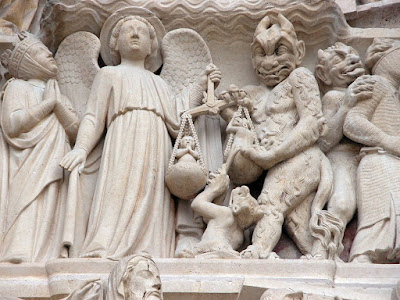
If anyone doubts that the Catholic Church has always taught and still teaches the doctrine of predestination — obviously, not an erroneous Protestant version of it, but the true notion — he may satisfy himself by consulting the Catechism of the Catholic Church, nn. 257, 600, 2012, 2782, and 2823. The Catechism deftly steers clear of the Dominican-Molinist controversy by merely repeating multiple times the statements of St. Paul, and adding only this gloss: “To God, all moments of time are present in their immediacy. When therefore he established his eternal plan of ‘predestination,’ he includes in it each person’s free response to his grace” (n. 600).

user posted image
From the main portal of Notre Dame cathedral, Paris

Command that we be rescued from eternal damnation and numbered among the flock of Thine elect. With this pair of entreaties, the Roman Canon repudiates the universalist mentality of our age, which assumes that men will be saved unless they conscientiously and egregiously reject God. On the contrary, the Canon embodies the truth of the Catholic Faith as taught by the Fathers, Doctors, and premodern Popes of the Church, for whom man, due to his inheritance of original sin, cannot enter into the kingdom of heaven unless he dies and rises with Christ in baptism.

Without entering here into subtle exegesis of John 3, we can say as a matter of fact that the consensus of Catholic theologians from ancient times until the early twentieth century was that mankind is a massa damnata (“condemned crowd”) and that Christ came into the world to save sinners from the destruction due to our sins, inherited and actual. The sole path of salvation is to be clothed with Christ,[2] incorporated into His Mystical Body, and to die in a state of sanctifying grace. As Scott Hahn says in a lecture on the Gospel of John, “the history of salvation is also the history of damnation”: Christ came into the world for judgment, to cause separation by revealing the truth and exposing darkness.[3] This is why the Roman Martyrology carefully records not only the names of each martyr, but the names of their persecutors as well.

Moreover, in utter opposition to Pelagianism, the Church teaches that God, not man, takes the first step in the renewal of our life; that all our sufficiency is from Him (2 Cor 3:5); that no man comes to Jesus unless the Father draws him (Jn 6:44); that we become adopted sons of God by His predestinating purpose (Eph 1:5); that we persevere by His gift, not by our own efforts. In short, God must number us in the flock of His chosen ones; He knowingly and lovingly chooses us to be the “rational sheep” (as the Akathist hymn says) of His flock. He does not, as it were, happen to find us there in the sheepfold and express pleasant surprise; He brings us there and keeps us there.

All this the Roman Canon succinctly transmits in words as simple as they are sobering: Command that we be rescued from eternal damnation and numbered among the flock of Thine elect.

But why is this doctrine important to us spiritually?

In modern times we are constantly told how good we are, how well-intentioned, and how much we are victims of our environment or upbringing, entitled to various compensations. We are reassured of the greatness of man, of his dignity and rights. But we are in sore danger of forgetting fundamental truths about our condition. We are fallen beings alienated from God, from our neighbors, even from our very selves. We have no rights to stand on before God; we are like “filthy rags,” as Isaiah says (Is 64:4). We are utterly dependent on the divine Mercy at every moment — for our very existence, for our conversion to good, for our repentance from evil, for our escape from damnation, and above all, for the gift of eternal life in Christ Jesus.

We stand at the edge of an abyss of neverending misery into which we may fall at any moment by mortal sin, if our life is snuffed out before we have repented of it, or if the Lord does not, in His mercy, prevent us from falling or, after we have fallen, grant us the gift of repentance. “Lead us not into temptation…” Lead us not into the abyss. Command that we be rescued from eternal damnation. This is reality, as opposed to the shallow fantasy of egoism, the “broad path that leads to destruction,” with which our contemporary culture envelops us.

user posted image

We stand, too, at the edge of an upward abyss, that of the neverending bliss of heaven, into which we are drawn up out of ourselves, in reverse gravity, to the supernatural grandeur of the sons of God. This, too, is a gift we could never have merited; Christ alone won it for us by shedding His Precious Blood upon the Cross, in the one supreme sacrifice that is made present at every offering of the Holy Mass. It is precisely on the verge of making this sacrifice newly present in our midst that we humbly beseech the Lord: Command that we be numbered among the flock of Thine elect. Number us, O Lord, with the good thief to whom Thou didst say: “This day thou shalt be with Me in paradise.”

The doctrine of predestination has as its positive spiritual effects a deep and abiding thanksgiving to the Lord for His mercies without number, since He died for us while we were yet His enemies, that we might become His friends; a profound humility at having been chosen by God for no beauty of our own but solely that He might make us beautiful in His sight; a sober watchfulness and earnestness, lest our names be erased from the Book of Life; and, most of all, a constant recourse to prayer, that we will be established more and more in Christ, and not in ourselves, for it is by “being made conformable to the image of His Son” (Rom 8:29), and in no other way, that our predestination is actually accomplished.

In response to so great a mercy, the Church places the words of the Psalmist on the lips of her priests as they receive the Precious Blood, price of our souls:

What shall I render to the Lord for all the things that He hath rendered to me? I will take the chalice of salvation, and I will call upon the Name of the Lord. Praising I will call upon the Lord, and I shall be saved from mine enemies.

It is therefore of immense importance for nourishing the right faith of the people that the doctrine of predestination, transmitted pure and entire in the Roman Canon, be present to priests in their celebration of the Mass and to the people in their participation in it.[4]


NOTES

[1] In yet another display of theological “neutralization,” the Novus Ordo — from whose calendar the feast of the Holy Name had initially been purged by Paul VI, no doubt because it was a Baroque accretion, only to be replaced later under John Paul II as an “optional memorial” — politely trims down this postcommunion to an acceptable banality: “May the sacrificial gifts offered to your majesty, O Lord, to honor Christ's Name and which we have now received, fill us, we pray, with your abundant grace, so that we may come to rejoice that our names, too, are written in heaven.” The doctrine is there, but as if muffled beneath several layers of sterile cotton.

[2] Cf. Rom 13:14, Gal 3:27; cf. Mt 22:12.

[3] Cf. Jn 9:39; cf. Jn 3:16–21, 5:24–29; Lk 12:51.

[4] Although not intended to be the focus of this article, it surely ought to be disturbing from the point of view of lex orandi, lex credendi that the sole anaphora of the Western Church, prayed every day at every Mass from ancient times until the 1960s, was displaced by alternative Eucharistic prayers in 1970 — a novelty and rupture the magnitude of which had never been seen in the history of any liturgical rite. See Fr. Cassian Folsom, O.S.B., “From One Eucharistic Prayer to Many: How it Happened and Why,” first published in the Adoremus Bulletin 2.4, 2.5, and 2.6 (September, October, and November 1996). Fr. Cassian quotes an Italian liturgist on the Roman Canon: “its use today is so minimal as to be statistically irrelevant.” (This was more true of the nineties than it is today, when we are enjoying some fruits of Benedict XVI's pontificate.) This rupture best illustrates the untenability of asserting that the usus antiquior and the usus recentior are merely two versions of the same thing, namely, the Roman Rite. It makes little difference that the passages from Ephesians 1 and Romans 8 are contained in the new lectionary (e.g., Weds of week 30 per annum, year I; 17th Sunday per annum, Year A; Thurs of week 28 per annum, year II; Immaculate Conception, 2nd reading), since readings come and go, like birds at a bird-feeder, whereas the danger of damnation and the divine mercy of predestination are woven into the very fabric of the traditional Roman rite. Moreover, most of the prayers that point to predestination in the usus antiquior have been either removed or toned down in the usus recentior, so that it would be much more difficult to establish that the revised liturgy teaches clearly and unambiguously this Scriptural and traditional doctrine.
TSyeeck
post Feb 3 2018, 06:17 PM

Look at all my stars!!
*******
Senior Member
3,576 posts

Joined: Apr 2006


Reflections on obedience for the Feast of Candlemas
By Veronica A. Arntz

user posted image

The feast of Candlemas is a rich tradition in the Church; it is a day that we celebrate many events, including the purification of the Blessed Virgin Mary, the Presentation of our Lord in the Temple, and the Nunc Dimittis of Simeon. In reflecting on this beautiful feast day, one common theme that we find present is obedience. Obedience is the proper response of an individual to God’s invitation and call; it is the fitting response to God’s commandments and law. We too should strive in obedience to follow the commandments of God, just as we find in the Holy Family and the aged Simeon.

The first example of obedience is Mary who, even though she was conceived without original sin, went to be purified in the Temple in accordance with the Mosaic Law. As we read, “And when the time came for their purification according to the law of Moses, they brought him up to Jerusalem to present him to the Lord (as it is written in the law of the Lord, ‘Every male that opens the womb shall be called holy to the Lord’)” (Luke 2:22-23, RSV-CE).

I shall return to the Presentation of Christ later. For now, the reference to purification comes from Leviticus 12:2-8, which gives the laws for purification after a woman has given birth to a child. As St. Paul explains to the Galatians, we know that these laws were given to Israel because of the nation’s sinfulness: “Why then the law? It was added because of transgressions” (Galatians 3:19). In other words, God gave to the Israelites the laws about food, purification, and sacrifice because of their sinful behavior; in an attempt to bring them back into His covenant, He gave them more ritual laws to follow, to separate them from the other nations.

What is remarkable is the Blessed Mother’s obedience: in a certain way, she was not bound by these laws because of her lack of sin. Nevertheless, because she, like the individual in Psalm 1, who “meditates upon the law day and night” (Psalm 1:2), is faithful to God’s laws, submits herself to them out of obedience, and comes to the Temple for her purification. What a sublime example for those of us who live in the age of grace: we, who are fettered by the chains of sin, should strive to be obedient to God’s commands and to repent for our sins as we attempt, through His grace, to remain ever more faithful to His laws.

Furthermore, we find obedience in the Holy Family in bringing Christ to be presented in the Temple. This presentation is also rooted in the Old Covenant; as cited above, Luke quotes from Exodus 13:2, which states, “Consecrate to me all the first-born; whatever is the first to open the womb among the sons of Israel, both of man and of beast, is mine.” Further, we read, “You shall set apart to the Lord all that first opens the womb” (Exodus 13:12). Thus, we see that the Holy Family is following the prescriptions of the Old Law: Jesus Christ, as Mary’s first-born Son (Luke 2:7), is brought to the Temple to be consecrated to the Lord.

This should strike us as somewhat odd and ironic. Jesus is the Lord; He is God. Should that not exempt Him from the laws, which He Himself established? How can the Lord be presented to the Lord? First, we should note the Holy Family’s obedience to the Torah: Mary and Joseph are righteous Jews (Matthew 1:19), and so they desire to obey all the precepts of the Law. Even though one might think that they, above all people, should be exempt from bringing Jesus to be presented (since he is the Son of God), they still follow the precepts of the Law and bring him to the Temple. Moreover, this presentation is a further sign of Jesus’s divinity. As we read in Psalm 110:2, “The Lord says to my lord: ‘Sit at my right hand, till I make your enemies your footstool.’” This verse is often interpreted to reveal the divinity of Christ: Christ the Lord is the only one who can speak to His Lord.

Similarly, only the Lord can be offered to His Lord in the Temple. Christ’s whole life was an act of obedience to the Father. As He prays in His high priestly prayer, “‘Father, the hour has come; glorify your Son that the Son may glorify you, since you have given him power over all flesh, to give eternal life to all whom you have given him….I glorified you on earth, having accomplished the work which you gave me to do; and now, Father, glorify me in your own presence with the glory which I had with you before the world was made” (John 17:1-2, 4-5). Christ accomplished the will of the Father on earth; he glorified the Father through His work, and now He asks to be glorified through His death, which is also an act of obedience.

Finally, on this feast day, we celebrate the obedience of the aged Simeon, who is described as a “righteous and devout” man, “looking for the consolation of Israel” (Luke 2:25). Furthermore, “it had been revealed to him by the Holy Spirit that he should not see death before he had seen the Lord’s Christ” (Luke 2:26). Simeon comes to the Temple by the prompting of the Holy Spirit when Mary and Joseph bring Christ to be presented, and upon seeing them, he proclaims his beautiful and profound Nunc Dimittis prayer: “Lord, now let your servant depart in peace, according to your word; for my eyes have seen your salvation which you have prepared in the presence of all peoples, a light for revelation to the Gentiles, for glory to your people Israel” (Luke 2:29-32). Simeon is finally rewarded for his obedience to God, in remaining devout and faithful, trusting in his promises. He has seen his salvation, and he can now pass into the next life peacefully. The Nunc Dimittis has traditionally become the Church’s prayer during Compline: we too are called to be like Simeon, obediently waiting for our Lord and anticipating our salvation.

Holy Mother Church gives us the opportunity to reflect on these holy individuals as examples of obedience to God. Indeed, even Jesus Christ, our Lord, is revealed as an example of obedience to His Father in Heaven. We too, who are living in the New Covenant, are called to give our obedience to God through obeying His commands, following the teachings of the Church, and frequenting His sacraments. These are the means given to us to receive His grace; just as Mary and Joseph were righteous before God through following the Old Covenant, which Christ had come to fulfill, so too are we justified before God through His grace by being obedient to the means of salvation He has given to us in His Church. Let us then pause on this beautiful feast day, especially as we approach the season of Lent, and ask for the grace to increase our obedience to the Father, through the “obedience of faith” (Romans 16:26).
TSyeeck
post Feb 7 2018, 12:02 PM

Look at all my stars!!
*******
Senior Member
3,576 posts

Joined: Apr 2006


This is the End of the Law
BROTHER ANDRÉ MARIE

user posted image
Christ, the Lawgiver of the New and Eternal Covenant

Our beloved mentor, Brother Francis, used to remind us often of the importance of purpose. One way he did this was to tell the story, related in various ascetical treatises on the religious life, of the monk who used to look up at the sky from time to time. When asked by those unfamiliar with his custom what he was doing, the monk would reply, “I’m fixing my aim.”

The monk’s purpose was to become a saint, to go to Heaven, and in this bodily, sensible way, he recalled to mind this supernatural end. In doing such things, devout souls stir up holy desires and draw closer to their goal.

If I were to say that the purpose of law is identical to that monk’s purpose in looking up to the heavens, I would be taken for a fool by a good number of people. Yet, that is exactly the purpose of law according to Saint Thomas Aquinas.

Now the first principle in practical matters, which are the object of the practical reason, is the last end: and the last end of human life is bliss or happiness, as stated above (I-II:2:7; I-II:3:1). Consequently the law must needs regard principally the relationship to happiness. (ST, Ia, IIae, Q. 90, A. 2.)

Those familiar with Saint Thomas’ notions of happiness know well that the Angelic Doctor identifies it with heavenly beatitude. Mere human law is powerless to effect this end, so we need Divine Law in order to achieve it. But more on that further down. The point here is that law has as its purpose to direct man to his final end, which is Heaven. While human law cannot achieve that end — but, rather it aims at a merely temporal happiness that is not our true finality — it must not hinder it. (This is one of the reasons secular societies just do not work. The state inevitably makes itself the end of man.)

Modernity has given us various errors concerning law. By way of defect, we may consider the errors of the antinomians, who absolve Christians from following the moral law. By way of excess and misdirection, we have the legal positivists, who elevate all law to the same level, while equating law with the arbitrary dictates of whatever ruling class is in power — no matter how contrary such “laws” are to one another or to the moral law. The proponents of such errors, who plague the Church as well as civil society, do not much value Saint Thomas’ definition of law, with all four of its constituent notes:

[T]he definition of law … is nothing else than an ordinance of reason for the common good, made by him who has care of the community, and promulgated. (ST, Ia, IIae, Q. 90, A. 4.)

If it is not for the common good, it is not a law. If it is not an ordinance of reason, it is not a law. Roe v. Wade? Not a law. Some ordinance forbidding “discrimination” against sodomites who demand a wedding cake from a Christian baker for their post-abomination bacchanalia? Not a law. A statute decriminalizing usury? Not a law. Examples could be multiplied ad nauseam. Should Saint Thomas be given plenipotentiary veto power over our state and federal system of statutes and court cases, the weighty tomes found in law libraries would become suddenly lighter. And many a lawyer would not understand what happened, because the poor fellow is a legal positivist.

Even in the Church, it seems, there are those who would cut Saint Thomas’ definition in half and make law into the diktat of the lawmaker. But while such may come from “him who has care of the community,” and may be “promulgated,” if it is not an ordinance of reason for the common good, it is not a law. At least that is the opinion of Saint Thomas, and I, for what it is worth, have the temerity to agree with him.

Supposed laws, whether civil or ecclesiastical, that form obstacles to man’s salvation contradict the very purpose of law and therefore have no authority whatsoever.

Saint Thomas distinguishes the eternal law, the natural law, human law, and Divine law. There is some overlapping here, so to present them in sharper categories we distinguish between the Divine (positive) law, the natural law (which also comes from God) and human law. The Divine positive law and the natural law are included in the “eternal law,” because the eternal law is God’s own governance of the universe. Human law comes from a human authority, and it is distinguished into ecclesiastical and civil law. Canon law, while it pertains, in part, to divine things, is not Divine law, although it does, in places, cite the Divine positive law. Canon Law, and all ecclesiastical law, is therefore human law.

It remains to explain what the Divine positive law is. Saint Thomas distinguishes two such bodies of law: the Old Law and the New Law, corresponding to the Old and New Testaments of Sacred Scripture. The Old Law is divided by a threefold division: ceremonial precepts, judicial precepts, and the moral law. Of these three, the only part of that law that survives as binding on Christians is the moral law, which is none other than the natural law. The New Law of Christ, on the other hand, consists primarily in the grace of the Holy Ghost and only secondarily in the written law of the Gospel, which is summarized in the Sermon on the Mount.

Saint Thomas notes that if man had a mere natural end, then the natural law would be sufficient to guide him to that end, which would consist in natural happiness. However, man has an end that is above nature, and for that end he needs a higher law to guide him. This higher law consists in the twofold, supernaturally revealed word of God. The Old Law is a preparation for the New, while the New Law surpasses its predecessor by far, having the intrinsic power to justify man — that is, to make man holy. It has this power because, as Saint Thomas argues, the New Law is itself primarily the interior grace of the Holy Ghost.

Is it any mystery, then, that the treatise on grace follows immediately after the treatise on law in the Summa?

Such a lofty conception of law is no doubt foreign to some readers, but this is the language and accompanying worldview of the Ages of Faith, something that must be brought back if we are to have a restored Christendom.

Let us get back to purpose. The purpose of all this law is to guide man to his end, which is happiness. (And no, this is not selfish.) For this reason, then, we see the Beatitudes at the heart of the written (i.e., secondary) part of the New Law. The Beatitudes each have two parts, the merit and the reward. The merit pertains to this life, and the reward pertains imperfectly to this life, but perfectly to the next. By living according to the grace of the Holy Spirit in this life, and availing ourselves of the supernatural panoply of divine helps dispensed by Christ through His Church, we can, even in this vale of tears, enjoy an anticipation of heavenly beatitude.

Only in this way, by living according to the New Law of Christ, can man achieve his ultimate end, his happiness.

Far from being a burden to human nature and an indignity to a free man, the law of God is profoundly liberating and life giving. It helps us “fix our gaze” on a happiness that is infinitely higher than what we could have in this life, because it is a Divine life.

“The Lord is sweet and righteous: therefore he will give a law to sinners in the way” (Ps. 24:8).

http://catholicism.org/ad-rem-no-300.html

This post has been edited by yeeck: Feb 7 2018, 12:07 PM
TSyeeck
post Feb 7 2018, 12:06 PM

Look at all my stars!!
*******
Senior Member
3,576 posts

Joined: Apr 2006


Simian Antinomianism
BROTHER ANDRÉ MARIE

The heresy of antinomianism received its name from Martin Luther, who, wrote against the more “extreme” doctrines of Johannes Agricola, the enfant terrible of Luther’s own novel doctrine of Justification by faith only. In brief, antinomianism — coming from anti + nomos (Gk: “law”) — is the contention that Christians are absolved from adherence to the moral law.

That Luther would object to Agricola was hypocritical on at least two fronts. First, once the cat of sola scriptura was let out of the bag, with its corollary of private interpretation, one would think Luther’s objecting to another’s use of the principle would be self-defeating. (Who did he think he was, the Pope?) Secondly, Agricola’s doctrine, relatively “extreme” as it might have been, agreed in kind with many of Luther’s own remarks denying the necessity of good works or the need of the Christian believer to resist temptation. (It was not for nothing that Luther called the canonical Epistle of Saint James “an epistle of straw.”) In short, Luther himself held to a form of antinomianism.

Agricola’s heresy was not unique. Some early gnostic sects and various weird medieval movements held similar errors. For the antinomian gnostics, one who was adept at the gnosis (the esoteric knowledge) somehow transcended good and evil.

Today, our society is caught in a tug-of-war between two opposite errors on the question of law. Besides the popular antinomianism that denies the natural law and its demands (voiced in such pat-phrases as, “you can’t legislate morality” and “we are free to do whatever we like as long as it doesn’t hurt someone else”), there is the legal positivism of the statist. This latter is the doctrine that law derives from the written body of legislation (statutes, court cases), and does not depend upon a higher standard that is antecedent to the written corpus. Statist liberals are not the only legal positivists by a long shot. Some putative “conservatives” are rightly numbered as such, as they consider the Constitution itself is sufficient as the nation’s law, without reference to the natural law.

The two errors are opposite, but, they are also complementary in a larger dialectic. Where antinomianism reigns, people will act like beasts, naturally. This moral anarchy makes the many and minute laws of the gigantic modern state seem necessary, hence the perceived reasonableness of positivism to bring order out of chaos. The Italian communist revolutionary, Antonio Gramsci, understood this, and therefore considered cultural and moral subversion a better alternative to the violent global revolution of his Soviet fellows.

(In “Conscience and the Nanny State” I considered at greater length this phenomenon of moral anarchy breeding tyranny.)

The idea that young people ought to be taught the moral law so that they might be masters of themselves and work for an ordered and just society is brought out in Rudyard Kipling’s classic, The Jungle Book. Those who have only seen the Disney film — which does not remotely do the book justice — should read Kipling’s work before they object to my recommending it. (Which I do, especially in the complete Penguin Classics edition, which contains almost all the Mowgli stories plus much more.)

A passage I find compelling is the description, in the chapter entitled “Kaa’s Hunting,” of the monkeys. These comical creatures are among Mowgli’s enemies because of their lawlessness, but the young “man-cub” does not realize this yet, and is flattered when they seek his company after Baloo, his bear-mentor, had been particularly hard on him during his lessons. When Baloo discovers the illicit friendship, he sternly rebukes the boy. Even Bagheera, the panther, who is much milder than Baloo, is irate that Mowgli would play with the Bandar-log, as the monkeys are called.

Note well the description of the monkeys as without remembrance, without a leader, without a law. For this reason, they are rudderless, fickle, silly, mercurial — and very dangerous. They are, it may be said, without a tradition — and therefore they go chaotically from one novelty to another to another, never learning from their mistakes, yet remaining stubbornly convinced that they are better than all the people of the jungle.

“Mowgli,” said Baloo, “thou hast been talking with the Bandar-log—the Monkey People.”

Mowgli looked at Bagheera to see if the Panther was angry too, and Bagheera’s eyes were as hard as jade stones.

“Thou hast been with the Monkey People—the gray apes—the people without a law—the eaters of everything. That is great shame.”

“When Baloo hurt my head,” said Mowgli (he was still on his back), “I went away, and the gray apes came down from the trees and had pity on me. No one else cared.” He snuffled a little.

“The pity of the Monkey People!” Baloo snorted. “The stillness of the mountain stream! The cool of the summer sun! And then, man-cub?”

“And then, and then, they gave me nuts and pleasant things to eat, and they—they carried me in their arms up to the top of the trees and said I was their blood brother except that I had no tail, and should be their leader some day.”

“They have no leader,” said Bagheera. “They lie. They have always lied.”

“They were very kind and bade me come again. Why have I never been taken among the Monkey People? They stand on their feet as I do. They do not hit me with their hard paws. They play all day. Let me get up! Bad Baloo, let me up! I will play with them again.”

“Listen, man-cub,” said the Bear, and his voice rumbled like thunder on a hot night. “I have taught thee all the Law of the Jungle for all the peoples of the jungle—except the Monkey-Folk who live in the trees. They have no law. They are outcasts. They have no speech of their own, but use the stolen words which they overhear when they listen, and peep, and wait up above in the branches. Their way is not our way. They are without leaders. They have no remembrance. They boast and chatter and pretend that they are a great people about to do great affairs in the jungle, but the falling of a nut turns their minds to laughter and all is forgotten. We of the jungle have no dealings with them. We do not drink where the monkeys drink; we do not go where the monkeys go; we do not hunt where they hunt; we do not die where they die. Hast thou ever heard me speak of the Bandar-log till today?”

“No,” said Mowgli in a whisper, for the forest was very still now Baloo had finished.

“The Jungle-People put them out of their mouths and out of their minds. They are very many, evil, dirty, shameless, and they desire, if they have any fixed desire, to be noticed by the Jungle People. But we do not notice them even when they throw nuts and filth on our heads.”

He had hardly spoken when a shower of nuts and twigs spattered down through the branches; and they could hear coughings and howlings and angry jumpings high up in the air among the thin branches.

“The Monkey-People are forbidden,” said Baloo, “forbidden to the Jungle-People. Remember.”

A little later, we see that the Monkey-folk, besides desiring to be noticed by the Jungle People, and despite their evident demerits, are intensely conceited and consider themselves cutting-edge:

“They were always just going to have a leader, and laws and customs of their own, but they never did, because their memories would not hold over from day to day, and so they compromised things by making up a saying, ‘What the Bandar-log think now the jungle will think later,’ and that comforted them a great deal.”

This is a wonderful description of the modernist, the man who hates tradition, law, and Christian social order — and moreover despises those who love such things.

When later, the Bandar-log turn on Mowgli and kidnap him, Baloo and Bagheera resort to the only means they know: to summon the aid of Kaa, the hungry thirty-foot python with the mesmerizing glance, the one creature in the Jungle that the monkeys fear. Mowgli is saved, but only after a gruesome scene of simian carnage that would not be appropriate for a children’s cartoon.

Lord Baden Powell, the founder of scouting, was a personal friend of Rudyard Kipling. Imagery from The Jungle Book was explicitly incorporated into Baden Powell’s program of forming young men. Mowgli, who had to learn the Law of the Jungle, represents the youth being directed and formed according to the “law” of scouting, and names like “cub,” “wolf,” “Akela,” etc., all finding a place in the scouting nomenclature.

http://catholicism.org/ad-rem-no-216.html
TSyeeck
post Feb 7 2018, 02:49 PM

Look at all my stars!!
*******
Senior Member
3,576 posts

Joined: Apr 2006


Q&A: Why do Catholics believe that Christ is sacrificed in each and every Mass, when Scripture plainly states that He was sacrificed on Calvary once and for all?

user posted image

Most non-Catholics do not realize it, but Christ Himself offered the first Mass at the Last Supper. At the Last Supper He offered (sacrificed) Himself to His Father in an unbloody manner, that is, under the form of bread and wine, in anticipation of His bloody sacrifice on the cross to be offered on the following day, Good Friday. In the Mass, not now by anticipation, but rather in retrospect, Christ continues to make that offering of Himself to His Father – by the hands of the priest. "And whilst they were at supper, Jesus took bread, and blessed, and broke: and gave to his disciples, and said: Take ye, and eat. This is my body. And taking the chalice, he gave thanks, and gave to them, saying: Drink ye all of this. For this is my blood of the new testament, which shall be shed for many unto remission of sins." (Matt. 26:26-28). Christ ordered His Church to perpetuate that sacrificial rite for the continued sanctification of His followers, saying, "Do this for a commemoration of me" (Luke 22:19) – so the Catholic Church complies with His order in the Mass. In other words, every Mass is a re-enactment of Our Lord's one sacrifice of Calvary. The Mass derives all its value from the Sacrifice of the Cross; the Mass is that same sacrifice, not another. It is not essentially a sacrifice offered by men (although men also join in), but rather it is the sacrifice of Jesus Christ.

Christ's bloody sacrifice on Calvary was accomplished "once" (Heb. 10:10), just as Scripture says. The Catholic Church likewise teaches that the sacrifice of the Cross was a complete and perfect sacrifice – offered "once." But the Apostle Paul – the same Apostle who wrote this text in the book of Hebrews – also bears witness that the sacrificial rite which Christ instituted at the Last Supper is to be perpetuated – and that it is not only important for man's sanctification, but is the principal factor in man's final redemption. In 1 Corinthians 11:23-26, St. Paul tells how, at the Last Supper, Our Lord said: "This do ye, as often as you shall drink, for the commemoration of me. For as often as you shall eat this bread, and drink the chalice, you shall show the death of the Lord, until he come." Thus at every Mass the Christian has a new opportunity to worship God with this one perfect sacrifice and to "absorb" more of Christ's saving and sanctifying grace of Calvary. This grace is infinite, and the Christian should continuously grow in this grace until his death. The reason the Mass is offered again and again is not from any imperfection in Christ, but from our imperfect capacity to receive.

Finally, the holy sacrifice of the Mass fulfills the Old Testament prophecy: "For from the rising of the sun even to the going down, my name is great among the Gentiles, and in every place there is sacrifice, and there is offered to my name a clean oblation: for my name is great among the Gentiles, saith the Lord of hosts." (Mal. 1:11). The Sacrifice of the Mass is offered every day throughout the world, and in every Mass the only truly "clean oblation" is offered, that is, Christ Himself; thus the Mass is the perfect fulfillment of this prophecy.


TSyeeck
post Feb 8 2018, 02:47 PM

Look at all my stars!!
*******
Senior Member
3,576 posts

Joined: Apr 2006


A Vatican-Based Bishop Extols China
Reality checks in Rome are badly needed these days.
By George Weigel — February 7, 2018

Despite the media and blogosphere attention he attracts, Bishop Marcelo Sánchez Sorondo, a 75-year-old Argentine who is chancellor of various pontifical academies, is a small-bore bit player in the current drama of what friends and critics alike regard as an increasingly dysfunctional Vatican. Yet when someone of even his relative insignificance announces that “right now, those who are best implementing the social doctrine of the Church are the Chinese,” that dysfunction comes into sharp relief — and a correction of the record is imperative.

Catholic social doctrine is built on four foundational principles: the inviolable dignity and value of every human person, the responsibility of all to exercise their rights in ways that contribute to the common good, the importance of social pluralism and civil society (and thus the rejection of totalitarianism), and the imperative of solidarity (the virtue of civic friendship that binds free societies together). Those principles helped shape the revolution of conscience that preceded and helped make possible the political revolution of 1989 in Central and Eastern Europe. Those principles were also in play in the democratic transformations of Latin America and East Asia in the latter decades of the 20th century. Those principles remain the core of the social doctrine of the Church today.

And in 2018, those principles are systematically denied, in both theory and practice, by the People’s Republic of China.

Bishop Sánchez Sorondo seems to have been much impressed by a recent tour of the PRC, noting in an interview that the Chinese “do not have shantytowns” and Chinese young people “do not take drugs,” which he attributed to a “positive national conscience.” In that same interview, the Argentine prelate also managed to get in a dig at El Norte, claiming that, in China, “the economy does not dominate politics, as happens in the United States.”

What the bishop evidently did not see, or conjure with, during his tour were the following:

There are over 1,000 laogai camps spread across China, where slave labor is the rule and political prisoners are frequently murdered, so their transplantable organs can be harvested to benefit the more politically reliable members of the population.

In China, the state, not a husband and wife, determine the number of children a couple can have, and while the notorious one-child policy has been replaced by a two-child policy, the regime continues to insist that official cadres, not parents, decide on the number of children a family may welcome.

To enforce its internal population policies, the Chinese state claims the right to conduct compulsory abortions when women become pregnant in violation of state-determined birth quotas — a grotesque cruelty regularly practiced in the PRC today.

China’s draconian population-control policies have resulted in what amounts to a genocide of unborn baby girls, which has resulted in the most imbalanced boy-to-girl ratio of any country on the planet.

China’s people have no right of free movement within their own country, as the ministry of public security assigns every subject of the regime an official residence, a hukou, which is usually the home of one’s parents; yet many Chinese do move away from their hukou, making them illegal aliens in their own country. As one of America’s keenest students of China, Nicholas Eberstadt, put it in a memo to me, “Peasants who move for work to a big city . . . have no right to services like health care or education; are routinely compensated less for work than ‘natives’ with comparable education and skills; and are virtually certain to lose in any dispute with a local. It’s Soweto with Chinese characteristics.”

China is an officially atheistic state, according to the Chinese Communist Party, and religious persecution is a staple of the regime’s repressive apparatus.

Those are the facts. To try to square them with the social doctrine of the Catholic Church requires something approaching a psychotic detachment from reality — or, worse, a willful ignorance, turning a blind eye to repression and persecution in order to indulge fantasies of a socialist paradise freed from the unpleasantness of bourgeois liberal society. The same detachment from reality also informed Bishop Sánchez’s praise of China’s adherence to the Paris climate accord and its “moral leadership” in the field of climate change. What air, one wonders, did the bishop breathe in China, one of the most heavily polluted countries in the world? And does His Excellency imagine that a totalitarian regime, bent on asserting itself as a global power and unaccountable to its populace, is going to seriously address its problems of massive air, water, and soil pollution because it signed a piece of paper in the City of Light?

The “useful idiot” has been a player on the world stage since the days of Lenin (although one wonders whether, in this case, the idiocy is so extreme that the perpetrator’s utility to the regime begins to decline). Bishop Sánchez Sorondo’s absurd misrepresentations of the realities of 21st-century China put him in a rogues’ gallery that includes such notables as Walter Duranty, who deliberately failed to report the Ukrainian terror famine in 1932–33 to the readers of the New York Times, and Herbert Matthews, whose encomia to Fidel Castro similarly misled the readers of what was once a national paper of record.

The further problem in Sánchez’s case is that his statements, however bizarre, inevitably implicate the pope he serves and cast doubt not only on the prudence of the Vatican’s current attempts at a démarche with the PRC (which I addressed here) but on the integrity of the Holy See. If a Vatican official, no matter how far down the totem pole, can, with impunity, spout inanities that provide cover for a wicked regime, something is gravely wrong in one of the few centers of power in the world whose primary stock-in-trade is truth-telling.

According to the Vatican yearbook, the Annuario Pontificio, Bishop Marcelo Sánchez Sorondo turned 75, the normal retirement age for bishops, last September 8. Perhaps his China escapade will suggest to his superiors that it is past time to accept the resignation he submitted then, and thereby deprive him of the megaphone he has used to embarrass the Church, to grossly distort Catholic social doctrine, and to betray the persecuted Catholics of China.

— George Weigel is Distinguished Senior Fellow of Washington’s Ethics and Public Policy Center, where he holds the William E. Simon Chair in Catholic Studies.

"If we renounce our faith,
we will disappear and
there will not be a resurrection.
If we are faithful, we will still disappear,
but there will be a resurrection."

Bishop Ignatius Kung Pinmei - 1954

This post has been edited by yeeck: Feb 8 2018, 02:47 PM

15 Pages « < 4 5 6 7 8 > » Top
 

Change to:
| Lo-Fi Version
0.1107sec    0.55    7 queries    GZIP Disabled
Time is now: 5th December 2025 - 10:12 AM