Welcome Guest ( Log In | Register )

15 Pages « < 2 3 4 5 6 > » Bottom

Outline · [ Standard ] · Linear+

 LYN Catholic Fellowship V02 (Group), For Catholics (Roman or Eastern)

views
     
TSyeeck
post Sep 14 2017, 11:24 AM

Look at all my stars!!
*******
Senior Member
3,573 posts

Joined: Apr 2006


This is the End of the Law

Our beloved mentor, Brother Francis, used to remind us often of the importance of purpose. One way he did this was to tell the story, related in various ascetical treatises on the religious life, of the monk who used to look up at the sky from time to time. When asked by those unfamiliar with his custom what he was doing, the monk would reply, “I’m fixing my aim.”

The monk’s purpose was to become a saint, to go to Heaven, and in this bodily, sensible way, he recalled to mind this supernatural end. In doing such things, devout souls stir up holy desires and draw closer to their goal.

If I were to say that the purpose of law is identical to that monk’s purpose in looking up to the heavens, I would be taken for a fool by a good number of people. Yet, that is exactly the purpose of law according to Saint Thomas Aquinas.

Now the first principle in practical matters, which are the object of the practical reason, is the last end: and the last end of human life is bliss or happiness, as stated above (I-II:2:7; I-II:3:1). Consequently the law must needs regard principally the relationship to happiness. (ST, Ia, IIae, Q. 90, A. 2.)

Those familiar with Saint Thomas’ notions of happiness know well that the Angelic Doctor identifies it with heavenly beatitude. Mere human law is powerless to effect this end, so we need Divine Law in order to achieve it. But more on that further down. The point here is that law has as its purpose to direct man to his final end, which is Heaven. While human law cannot achieve that end — but, rather it aims at a merely temporal happiness that is not our true finality — it must not hinder it. (This is one of the reasons secular societies just do not work. The state inevitably makes itself the end of man.)

Modernity has given us various errors concerning law. By way of defect, we may consider the errors of the antinomians, who absolve Christians from following the moral law. By way of excess and misdirection, we have the legal positivists, who elevate all law to the same level, while equating law with the arbitrary dictates of whatever ruling class is in power — no matter how contrary such “laws” are to one another or to the moral law. The proponents of such errors, who plague the Church as well as civil society, do not much value Saint Thomas’ definition of law, with all four of its constituent notes:

[T]he definition of law … is nothing else than an ordinance of reason for the common good, made by him who has care of the community, and promulgated. (ST, Ia, IIae, Q. 90, A. 4.)

If it is not for the common good, it is not a law. If it is not an ordinance of reason, it is not a law. Roe v. Wade? Not a law. Some ordinance forbidding “discrimination” against sodomites who demand a wedding cake from a Christian baker for their post-abomination bacchanalia? Not a law. A statute decriminalizing usury? Not a law. Examples could be multiplied ad nauseam. Should Saint Thomas be given plenipotentiary veto power over our state and federal system of statutes and court cases, the weighty tomes found in law libraries would become suddenly lighter. And many a lawyer would not understand what happened, because the poor fellow is a legal positivist.

Even in the Church, it seems, there are those who would cut Saint Thomas’ definition in half and make law into the diktat of the lawmaker. But while such may come from “him who has care of the community,” and may be “promulgated,” if it is not an ordinance of reason for the common good, it is not a law. At least that is the opinion of Saint Thomas, and I, for what it is worth, have the temerity to agree with him.

Supposed laws, whether civil or ecclesiastical, that form obstacles to man’s salvation contradict the very purpose of law and therefore have no authority whatsoever.

Saint Thomas distinguishes the eternal law, the natural law, human law, and Divine law. There is some overlapping here, so to present them in sharper categories we distinguish between the Divine (positive) law, the natural law (which also comes from God) and human law. The Divine positive law and the natural law are included in the “eternal law,” because the eternal law is God’s own governance of the universe. Human law comes from a human authority, and it is distinguished into ecclesiastical and civil law. Canon law, while it pertains, in part, to divine things, is not Divine law, although it does, in places, cite the Divine positive law. Canon Law, and all ecclesiastical law, is therefore human law.

It remains to explain what the Divine positive law is. Saint Thomas distinguishes two such bodies of law: the Old Law and the New Law, corresponding to the Old and New Testaments of Sacred Scripture. The Old Law is divided by a threefold division: ceremonial precepts, judicial precepts, and the moral law. Of these three, the only part of that law that survives as binding on Christians is the moral law, which is none other than the natural law. The New Law of Christ, on the other hand, consists primarily in the grace of the Holy Ghost and only secondarily in the written law of the Gospel, which is summarized in the Sermon on the Mount.

Saint Thomas notes that if man had a mere natural end, then the natural law would be sufficient to guide him to that end, which would consist in natural happiness. However, man has an end that is above nature, and for that end he needs a higher law to guide him. This higher law consists in the twofold, supernaturally revealed word of God. The Old Law is a preparation for the New, while the New Law surpasses its predecessor by far, having the intrinsic power to justify man — that is, to make man holy. It has this power because, as Saint Thomas argues, the New Law is itself primarily the interior grace of the Holy Ghost.

Is it any mystery, then, that the treatise on grace follows immediately after the treatise on law in the Summa?

Such a lofty conception of law is no doubt foreign to some readers, but this is the language and accompanying worldview of the Ages of Faith, something that must be brought back if we are to have a restored Christendom.

Let us get back to purpose. The purpose of all this law is to guide man to his end, which is happiness. (And no, this is not selfish.) For this reason, then, we see the Beatitudes at the heart of the written (i.e., secondary) part of the New Law. The Beatitudes each have two parts, the merit and the reward. The merit pertains to this life, and the reward pertains imperfectly to this life, but perfectly to the next. By living according to the grace of the Holy Spirit in this life, and availing ourselves of the supernatural panoply of divine helps dispensed by Christ through His Church, we can, even in this vale of tears, enjoy an anticipation of heavenly beatitude.

Only in this way, by living according to the New Law of Christ, can man achieve his ultimate end, his happiness.

Far from being a burden to human nature and an indignity to a free man, the law of God is profoundly liberating and life giving. It helps us “fix our gaze” on a happiness that is infinitely higher than what we could have in this life, because it is a Divine life.

“The Lord is sweet and righteous: therefore he will give a law to sinners in the way” (Ps. 24:8).

In the Immaculate Heart of Mary,
Brother André Marie, M.I.C.M.
TSyeeck
post Oct 2 2017, 11:10 PM

Look at all my stars!!
*******
Senior Member
3,573 posts

Joined: Apr 2006


user posted image
TSyeeck
post Oct 3 2017, 12:00 AM

Look at all my stars!!
*******
Senior Member
3,573 posts

Joined: Apr 2006


user posted image

Introibo ad altare Dei

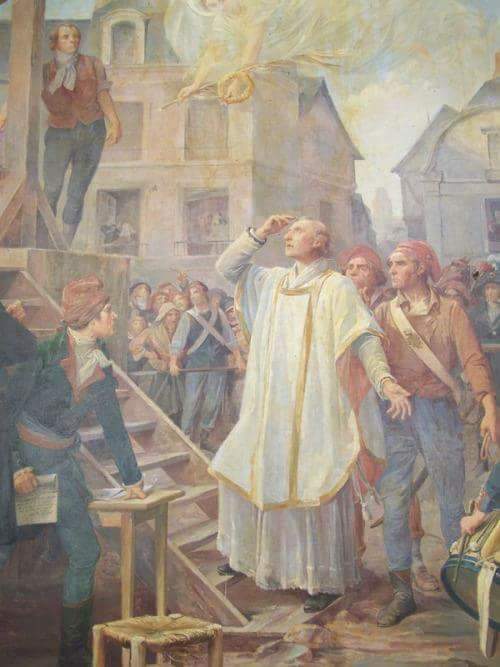
Blessed Noel Pinot, priest & martyr (feast February 21), Noel was born at Angers in 1747. He became a priest and excelled in ministering to the sick. In 1788, he was made pastor at a parish in Louroux Beconnais, which he revitalized spiritually through his piety and preaching.

Father Noel refused to take the oath of allegiance to the new French Republic which denied the authority of the Church, and was sentenced to be deprived of his parish for two years. Nonetheless, he continued to carry out his ministry in secret. Later, the holy priest even took clandestine possession of his parish and continued his pastoral work, managing to avoid capture for his defiance of the Revolutionary edict.

However, one day while fully vested for Mass, Father Noel was captured and dragged through the streets to the jeers of hostile spectators and soldiers. He remained in jail for twelve days and was given the death sentence for refusing to take the oath. The holy priest went to the guillotine still vested for Mass and uttering the words that began the Traditional Latin Mass: “I will go to the altar of God, to God Who gives joy to my youth.” He joined his sacrifice to that of his Master on February 21, 1794, and was beatified in 1926.

TSyeeck
post Oct 11 2017, 11:20 AM

Look at all my stars!!
*******
Senior Member
3,573 posts

Joined: Apr 2006


user posted image
TSyeeck
post Oct 24 2017, 04:26 PM

Look at all my stars!!
*******
Senior Member
3,573 posts

Joined: Apr 2006


500 Years of the Protestant Revolution - (1) How Luther viewed the Holy Roman Church (Strong Language)

In solemn and mournful remembrance of the events surrounding the grievous actions of Martin Luther, that split Europe and deprived hundreds of millions of souls of the benefits of sacramental life, we will post again important articles on the matter.

***

Martin Luther and the Catholic Church

a guest-post by John R. T. Lamont (2016)


"HERE I STAND":
Luther's version of the "NON SERVIAM"(Gedaechtniskirche, Speyer)

A number of favourable comments about Martin Luther have been made by Catholic authorities to mark the occasion of the 500th anniversary of the Reformation in 2017. In particular, the Pontifical Council for Christian Unity, whose president is Cardinal Kurt Koch, has issued a Catholic-Lutheran ‘Common Prayer’ for 500 years of Reformation together with the Lutheran World Federation. This ‘Common Prayer’ includes the following prayers: ‘Help us to rejoice in the gifts that have come to the Church through the Reformation’, and ‘The ecumenical journey enables Lutherans and Catholics to appreciate together Martin Luther’s insight into and spiritual experience of the gospel of the righteousness of God, which is also God’s mercy’; ‘Thanks be to you O God for the many guiding theological and spiritual insights that we have all received through the Reformation.’ This is not of course an initiative of the magisterium of the Church, but it is as effective in forming the beliefs of Catholics as a magisterial statement, since it is presented in the media as a position of the Church. This initiative urgently requires comment and criticism from faithful Catholics.

The best way to criticise Luther is by citing his own words. Unfortunately these words are often very obscene and repugnant, and a strong stomach is needed to peruse them. It is regretted that the necessities of the times should make it important to recall these writings to the notice of Catholics.

The first element of Luther’s thought that should be addressed is his view of the Roman Catholic Church. His mature views on this topic were presented in a letter on the Roman Papacy, ‘Against the Roman Papacy, An Institution of the Devil’, that he published in 1545. The letter was illustrated with woodcuts of startling obscenity, which will not be reproduced here. The offensive and blasphemous remarks in the letter are of course deplored by Rorate Caeli - and are given here in illustration of the man now praised by Cardinals and high prelates.

***

Against the Roman Papacy, An Institution of the Devil

Martin Luther


The Most Hellish Father, St. Paul III, in his supposed capacity as the bishop of the Roman church, has written two briefs to Charles V, our lord emperor, wherein he appears almost furious, growling and boasting, according to the example of his predecessors, that neither an emperor nor anyone else has the right to convoke a council, even a national one, except solely the pope; he alone has the power to institute, ordain, and create everything which is to be believed and done in the church. He has also issued a papal bull (if one may speak like that) for about the fifth time; now the council is once again to take place in Trent, but with the condition that no one attend except his own scum, the Epicureans and those agreeable to him; whereupon I felt great desire to reply, with God’s grace and aid. Amen!
…. Meanwhile, we see and hear what a masterly conjurer the pope is. He is like a magician who conjures gulden into the mouths of silly people, but when they open their mouths they have horse dirt in them. So this shameful fop Paul III calls for a council now for the fifth time, so that anyone who hears the words must think he is serious. But before we can turn around, he has conjured horse dirt into our mouths, for he wants to have a council over which he can exercise his power, and whose decisions he could trample on. The very devil himself would thank him for such a council, and no one but the miserable devil, together with his mother, his sister, and his whoring children, pope, cardinals, and the rest of his devilish scum in Rome will get there. …
These three words, “free, Christian, German,” are to the pope and the Roman court nothing but sheer poison, death, devil, and hell; he cannot stand them, nor see or hear them. That’s the way it is! It is certain that he would rather let himself be torn to pieces and would rather become Turkish or devilish or whatever else would help him. …
This is the language of the see in Rome, so that when he grants a free council, you may henceforth also understand it in Roman: when they say “free,” it means captive” with us Germans; when they say “white,” you must understand “black”; when they say “the Christian church,” you must understand “the scum of all the scoundrels in Rome”; when they call the emperor a “son of the church,” it is as much as to say he is the most accursed man on earth, who they wish were in hell so that they would have the empire; when they call Germany the praiseworthy nation, it means the beasts and barbarians who are not worthy to feed on the pope’s dung, like the Italian Campanus (as one says) did when he had been in Germany (not to his disadvantage) and, on returning to the Italian frontier, turned his back on Germany, squatted, bared his behind, and said, “Aspice nudatas, Barbara terra, nates,” “Look here, you beasts, look up my ass.” …
Someone may think here that I am satisfying my own desire with such scornful, wounding, stinging words to the pope. O Lord God, I am far, far too insignificant to deride the pope. For over six hundred years now he has undoubtedly derided the world, and has laughed up his sleeve at its corruption in body and soul, goods and honour. He does not stop and he cannot stop, as St. Peter calls him in II Peter 2 [:14], “insatiable for sin.” No man can believe what an abomination the papacy is. A Christian does not have to be of low intelligence, either, to recognize it. God himself must deride him in the hellish fire, and our Lord Christ, St. Paul says in II Thessalonians 2 [:8], “will slay him with the breath of his mouth and destroy him by his glorious coming.” I only deride, with my weak derision, so that those who now live and those who will come after us should know what I have thought of the pope, the damned Antichrist, and so that whoever wishes to be a Christian may be warned against such an abomination. …
Those in Rome have been practiced and well versed in such rascality and roguery for over four hundred years now, as one can see from the pope’s decretals and all the histories of emperors. Just look how the poor lawyers are plagued, patching, unifying, and smoothing the Roman rascality with glosses before they can give it any sort of shape; it is just as though a furrier patched up a bad pelt on which neither the skin nor the fur is any good, and which is moreover full of spit, pus, and excrement! …
If [the popes] have not been able to kill the emperors with treachery and every diabolical wickedness, it is nevertheless their definite intention, and their regret has always been that their bloodthirsty, murderous, evil intentions have been foiled and prevented. The descendants of the emperor Phocas, their founder and regicide, are, as was said, desperate, thorough arch rascals, murderers, traitors, liars, the very scum of all the most evil men on earth as is said in Rome itself. They embellish themselves with the names of Christ, St. Peter, and the church, even though they are full of all the worst devils in hell-full, full, and so full that they can do nothing but vomit, throw, and blow out devils! You will say that this is true when you read the histories of how they have treated the emperors. …
Until now we had to believe that the pope was the head of the church, the most holy, the savior of all Christendom. Now we see that he, with his Roman cardinals, is nothing but a desperate scoundrel, the enemy of God and man, the destroyer of Christendom, and Satan’s bodily dwelling, who, through him, only harms both church and state, like a werewolf, and mocks and laughs up his sleeve when he hears that such hurts God or man more of this later. …
And even if they would be reformed in a council which really is not possible and the pope and cardinals should promise in blood to observe it, it would still be wasted trouble and labor; they would only grow worse afterward than they were before, as happened after the Council of Constance. For since they believe that there is no God, no hell, no life after this life, and live and die like a cow, sow, or other animal, II Peter 2 [:12], it is to them ridiculous to keep seals and letters, and reform. That is why it would be best for the emperor and estates of the empire to let the blasphemous, abominable rascals and damned scum of Satan in Rome just go to the devil. …
Thus this pope of Sodomists, this founder and master of all sins, here wants to push sin and damnation off onto Emperor Charles, although he knows quite well that his rascally tongue lies abominably. And such accursed villains want to convince the world that they are head of the church, the mother of all churches, and masters of the faith. Why even if we were stones and wooden blocks, we could see by their works throughout all the world that they are lost, desperate children of the devil and also mad, crude asses in Scripture. Someone probably would like to curse them so that they might be struck down by lightning and thunder, burned by hellish fire, have the plague, syphilis, epilepsy, the plague of St. Anthony, leprosy, carbuncles, and all the plagues but these are all caresses, and God has long ago punished them with greater plagues, just like God’s despisers and blasphemers should be punished, Romans 1 [:26, 27], namely, that in sanity they have become so obviously mad and raving that they do not know whether they are or want to be male or female; they are not ashamed in the presence of women, and their mothers, sisters, and grandmothers are among those forced to see and hear such things of them, to their great distress. Shame on you, popes, cardinals, and whatever you are at the curia, that you are not afraid of the cobblestones upon which you ride, which would like to swallow you! …
The imperial laws have much to say about how to handle furious, insane, mad people. How much greater the need is here to put into stocks, chains, and prisons the pope, cardinals, and the whole Roman See, who have not become raving mad in the usual way, but who rage so horribly that at one time they want to be men, at another women, and never know at any one time when their mood will strike them. We Christians should nevertheless believe that such raving and lunatic Roman hermaphrodites have the Holy Spirit and are the heads, masters, and teachers of Christendom! But I must stop here, or save what I could write further against the papal briefs and bulls, for my head is weak, and I feel that I might not get everything said, and yet I still have not gotten to the points I had intended to make in this book. …
These extracts from the letter convey its message accurately, although the entire text (which is quite long) contains passages that are considerably more vulgar and obscene than those given here.
In connection with Luther and Lutheranism, it is important to call attention to the fact that Cardinal Koch and the Pontifical Council for Promoting Christian Unity have also recently issued a document on relations between Catholics and Jews, entitled ‘The Gifts and Calling of God are irrevocable’. Its stated goal is to contribute to ‘enriching and intensifying the theological dimension of Jewish-Catholic dialogue’. Like the document on Lutheranism, it has no magisterial authority, but has been presented as the official position of the Church. In the light of the Pontifical Council’s praise for ‘Martin Luther’s insight into and spiritual experience of the gospel of the righteousness of God’, it is opportune to recall Luther’s position on the Jews. Luther initially hoped that Jews would all convert to Lutheranism, and made some positive assertions about them, but when they declined to do so he changed his tune. His mature thought on Jews and Judaism is expressed in his work ‘On the Jews and their Lies’. Its main recommendations are as follows:
***
On the Jews and their Lies
Martin Luther
What shall we Christians do with this rejected and condemned people, the Jews? Since they live among us, we dare not tolerate their conduct, now that we are aware of their lying and reviling and blaspheming … I shall give you my sincere advice:
First, to set fire to their synagogues or schools and to bury and cover with dirt whatever will not burn, so that no man will ever again see a stone or cinder of them. … Second, I advise that their houses also be razed and destroyed. For they pursue in them the same aims as in their synagogues. Instead they might be lodged under a roof or in a barn, like the gypsies. … Third, I advise that all their prayer books and Talmudic writings, in which such idolatry, lies, cursing, and blasphemy are taught, be taken from them. ... Fourth, I advise that their rabbis be forbidden to teach henceforth on pain of loss of life and limb. … Fifth, I advise that safe-conduct on the highways be abolished completely for the Jews. … Sixth, I advise that usury be prohibited to them, and that all cash and treasure of silver and gold be taken from them and put aside for safekeeping. … Seventh, I recommend putting a flail, an ax, a hoe, a spade, a distaff, or a spindle into the hands of young, strong Jews and Jewesses and letting them earn their bread in the sweat of their brow, as was imposed on the children of Adam. For it is not fitting that they should let us accursed Goyim toil in the sweat of our faces while they, the holy people, idle away their time behind the stove, feasting and farting, and on top of all, boasting blasphemously of their lordship over the Christians by means of our sweat. No, one should toss out these lazy rogues by the seat of their pants. … In brief, dear princes and lords, those of you who have Jews under your rule: if my counsel does not please you, find better advice, so that you and we all can be rid of the unbearable, devilish burden of the Jews. …
Now let me commend these Jews sincerely to whoever feels the desire to shelter and feed them, to honor them, to be fleeced, robbed, plundered, defamed, vilified, and cursed by them, and to suffer every evil at their hands -- these venomous serpents and devil’s children, who are the most vehement enemies of Christ our Lord and of us all. And if that is not enough, let him stuff them into his mouth, or crawl into their behind and worship this holy object. Then let him boast of his mercy, then let him boast that he has strengthened the devil and his brood for further blaspheming our dear Lord and the precious blood with which we Christians are redeemed. Then he will be a perfect Christian, filled with works of mercy for which Christ will reward him on the day of judgment, together with the Jews in the eternal fire of hell!


The absurdity of the Pontifical Council for Christian Unity issuing both these documents within a month of each other (Dec. 12th 2015 for the one on Lutheranism, Jan. 11th 2016 for the document on Catholics and Jews) is too patent to require comment.
TSyeeck
post Oct 27 2017, 04:16 PM

Look at all my stars!!
*******
Senior Member
3,573 posts

Joined: Apr 2006


Heaven: A Holy Beatitude, not a Carnal Fantasy

Muslims and Mormons, it is fairly well known, have a very carnal eschatology. The paradise of the Muslims has rivers of wine (a beverage forbidden to them on earth), along with rivers of milk and clarified honey. Each man will have between seventy and one hundred women whose companionship will be, let us say, something other than Platonic.

While the Mormon afterlife appears to be a subject of great misunderstanding, even among Mormons, it seems reasonable to conclude that they believe in a polygamous afterlife, with men being eternally “sealed” to any women they have married (simultaneously or consecutively) in this life. To Mormons, God was once a man like us, and Mormons will become gods like Him one day, which renders their whole concept of the divinity itself carnal.

It is, in a sense, too easy to single out either of these two religions. Islam is justly disliked for (among other reasons) the historical bane it has been to Christendom and the terrorism it still engenders. Mormonism, a genuine American-made religion that harkens back to similar strange sects spawned by the Second Great Awakening, is known for its unconventional beliefs about Planet Kolob, temple garments, and baptizing dead people, the latter practice being deemed inappropriate by some of the living. Clever Mormons even joke about being joked about.

In contrast to an overly carnal paradise stands the spiritualized yet depersonalized afterlife of the Buddhist. For most eastern pantheists, the afterlife is a sort of Nirvana, which is nothing remotely like the Christian concept of heaven, but, rather an annihilation of the person, who is absorbed into the cosmic divinity which is more like the “pure potency” of prime matter than the “Pure Act” of the true God. The term itself, Nirvana, literally means “blown out,” as in extinguished.

But, to be just, if most occidentals do not take oriental pantheism very seriously, how many people have a more spiritual and less carnal idea of heaven than Muslims and the LDS? Closer to home, how many Catholics have the idea that Heaven will be a big party in the sky? Does it not happen at Catholic wakes and funerals that trite comments are made about the deceased?

“Fred’s lucky; he gets to play as many holes as he wants now that he’s up in that Big Golf Course in the Sky. And no sand traps up there!”

“I’ll bet Saint Michael’s pouring Ralph another heavenly martini, and the big lug’s looking down on us right now, gettin’ tipsy. ‘Attaboy, Ralph!”

In the Old Testament, material rewards were promised and given for fidelity to the Law. The examples of Job, Tobias, and Judith come to mind, who were rewarded for their virtue by material prosperity. And the Messianic Age is explained to the Jews in terms of temporal abundance. But the Old Law instructed the human race as one instructs a child, whereas the New Law instructs us as one instructs an adult. The comparison, which some moderns might deem offensive, belongs to Saint Thomas, who inferred it from Saint Paul.

Regarding those temporal blessings spoken of in the Old Testament, the abundance of wheat, wine, and oil promised in the times of the Messias have been fulfilled in the Eucharist, Holy Orders, Confirmation, and Extreme Unction — material things, to be sure, but also sacraments that spiritually divinize us.

The true Christian concept of Heaven is supernatural.

There are secondary aspects of happiness in Heaven, e.g., the fellowship of the saints, but Heavenly Beatitude consists primarily in the best activity of what is highest in man. That best activity is contemplation; that highest human faculty is the intellect. When we call it the “Beatific Vision,” we borrow vocabulary from the sense of sight, but the “vision” here is not an ocular act, but an act of the intellect directly intuiting the Divine Essence. It is with the intellect that we “see God.” As Our Lord put it: “This is eternal life, that they may know Thee, the only true God” (John 17:3). Compare this to what Saint John wrote elsewhere: “When He shall appear, we shall be like to Him because we shall see Him as He is” (1 John 3:2).

The life of glory in Heaven is a fulfillment of the life of grace begun here on earth. The scholastics expressed this gracefully when they declared that gratia est semen gloriae (grace is the seed of glory). From this truth, we can draw some connecting lines from the life of grace here to the life of glory in Heaven.

The state of glory itself is the fulfillment of the state of grace. Here, we are given the gift of a new nature which is none other than being made “partakers of the divine nature” (2 Pet. 1:4) in this life. By this, we are made children of God, a dignity that does not come as part of human nature. In Heaven, this state is perfected in such a way that it cannot be lost. In the technical language of scholastic theology, we call sanctifying grace an “entitative habit” because it is a habit of being that gives us, as it were, a new nature added to the natural man. The state of glory is the entitative habit that fulfills and replaces this in Heaven.

Even though we are raised to a higher nature by sanctifying grace, this grace, which perfects the soul itself, does not give us the power to act according to that new nature. To illustrate with a natural example: Just because I am a man, does not mean I have the virtues or skills that make me a good or useful man. Even to operate minimally as a man, I need a modicum of certain habits like the knowledge of language so I can communicate as a man, or the art of gathering food so that I do not starve to death. These are called, technically, “operative habits,” and their supernatural counterparts are the infused virtues and the gifts of the Holy Ghost whereby we are made not just to be, but to operate in the supernatural order, as children of God.

So the life of heavenly beatitude is a fulfillment of the life of Faith, Hope, and Charity in this life. Without these habits we cannot be saved. By performing acts proper to these virtues, we can, here and now, build up treasures in Heaven. The first two are only for this life, and will be replaced by something higher in the next; that is to say, Faith gives way to vision, Hope to possession. Charity, the “greatest of these” (I Cor. 13:13), abides forever.

Along with the infused theological virtues that orient us directly to God as our last end, the other operative habits that allow us to act in a supernatural way are the infused moral virtues. These do not have God as their formal object, but creatures. By infused prudence, justice, temperance, and fortitude, we operate in relation to creatures in a way that pleases God.

An important exception bears mentioning, and that is the virtue of religion, which is a part of the virtue of justice. The Scholastics enumerated various moral virtues that are related as “parts” to the cardinal virtues. Piety, e.g., is the part of justice that regulates giving their due to your family members; patriotism is the part of justice that relates to what you owe your homeland, the patria. Religion is that part of justice by which we render to God what is His due (principally adoration, thanksgiving, reparation, and petition). It is the only moral virtue whose formal object is God and not a creature.

We will not need all the moral virtues in Heaven (for St. Thomas’ subtle teaching on this go to ST II IIae, Q. 135 A. 1 and scroll down to the reply to Objection 1), but it is easy to see how the virtue of religion, perfected by the gift of piety, will abide forever (Cf. Apoc. 7:9-11).

When we perform acts of the virtues with ease and facility, the resultant acts are called Fruits of the Holy Ghost. When the Gifts of the Holy Ghost perfect the activity of the virtues, the resulting acts are called Beatitudes, which are a foretaste of the life of Heaven. When we read the lives of the saints, it is a good idea to recall the Beatitudes at times to see how they are manifested in the saint we are studying.

As we can see, the life of grace on this earth is supernatural in character. Yes, grace builds on nature; it does not destroy it, so, with grace, we remain fully human with all our human faculties. But the life of grace itself remains radically supernatural.

What is true of our life of grace in via is true in an even higher sense in the life of glory in patria. While the blessed remain fully human, retaining their distinct personalities (it’s not Nirvana!), the state of glory and the possession of God by the Beatific Vision is radically supernatural in character.

As a mission entirely unique to her, the Catholic Church distributes the treasures of this life to the poor exiled children of Eve so that, becoming children of the Second Eve, they may enter into the eternal nuptials of Christ and His triumphant Bride.

In the Immaculate Heart of Mary,
Brother André Marie, M.I.C.M.
TSyeeck
post Nov 1 2017, 11:15 PM

Look at all my stars!!
*******
Senior Member
3,573 posts

Joined: Apr 2006


Martin Luther Is Probably In Hell

ALAN FIMISTER
Assistant Professor, Saint John Vianney Theological Seminary

One might imagine that to write an article with this title is presumptuous in the extreme. But I do not make this assertion based on the wicked acts of Martin Luther — his division of Christendom, his hatred of the Jews, his licensing of polygamy, his accusations of adultery against the Savior, his railing, his curses or his insults — but upon the simple principle of faith alone. For faith has the power to wipe out any sin by the precious blood of our Lord and Savior Jesus Christ, but without faith we are lost.

It may surprise many readers to know that the Catholic Church teaches, as Dogma, justification by faith alone. She teaches this in the sense that she holds it to be impossible for anyone to be rendered acceptable in the sight of God unless and until they receive the supernatural virtue of living faith.

Furthermore, she teaches that nothing done before receiving this virtue can in any way merit justification in the sight of God nor can anything done apart from faith do so. What then is faith? Considered in itself faith is defined by the Catholic Church as “a genuine assent of the intellect to truth received by hearing from an external source by which assent, because of the authority of the supremely truthful God, we believe to be true that which has been revealed and attested to by a personal God, our Creator and Lord.” It is for this reason that Blessed John Henry Newman felt able to say, “Protestants, generally speaking, have not faith.”

A shocking statement, you might suppose, but it follows from the definition of faith just given. If the reason that we believe what God has revealed is that God can neither deceive nor be deceived, then knowingly to doubt or deny a single proposition thus revealed is implicitly to deny that God has spoken at all and so to divest oneself of the saving virtue of faith. So that we might know what God has revealed and assent to it upon the strength of God’s own veracity, it is necessary that the means by which His revelation is conducted to us be endowed with infallibility. The Church teaches that every statement consigned to writing by the human authors of scripture, in the sense they intended when they wrote these books, is inspired by God and free from all error.

Nevertheless, for us to believe the saving words of this holy text on God’s authority, we must also have a divinely guaranteed interpreter. Otherwise, the one who receives Holy Scripture will be believing nothing more than his own interpretation guided by his own speculations; he will not have faith and he will remain in his sins. Catholics therefore “accept Sacred Scripture according to that sense which Holy Mother Church held and holds, since it is her right to judge of the true sense and interpretation of the Holy Scriptures” nor do they ever “receive and interpret them except according to the unanimous consent of the fathers.” To stand alone without this authority is to have faith in oneself alone.

Martin Luther stood upon two principles: justification by faith alone and the Bible alone as the principle of true doctrine. The second of these principles betrays the fact that what he meant by faith is not the faith the Church proclaims, not the life-giving message of Jesus Christ, but a figment of his own invention. No doubt this is why he felt able to remove books from scripture itself and to falsify his translation of St. Paul’s greatest epistle with no better excuse than “Dr. Martin Luther will have it so.”

While we pray for God’s mercy upon Luther, we must conclude, in the words of the Second Vatican Ecumenical Council, that whosoever “knowing that the Catholic Church was made necessary by Christ, would refuse to enter or to remain in it, could not be saved.”

Dr. Alan Fimister is assistant professor at Saint John Vianney Theological Seminary.
TSyeeck
post Nov 6 2017, 10:14 PM

Look at all my stars!!
*******
Senior Member
3,573 posts

Joined: Apr 2006


Report: Texas Church Shooter Was Atheist, Thought Christians ‘Stupid’


The man who shot and killed 26 people in a Texas church on Sunday is reported to be a creepy, crazy, and weird outcast who preached atheism online.
Former classmates of the Texas church shooter, Devin Patrick Kelley, said he was an atheist and outcast who thought Christians were stupid, the Daily Mail reported.

“He was always talking about how people who believe in God we’re stupid and trying to preach his atheism,” former New Braunfels High School classmate Nina Rose Nava posted on Facebook. She said she was in “complete shock” after learning Kelley was the killer. “I legit just deleted him off my fb cause I couldn’t stand his post.”

Facebook user Christopher Leo Longoria responded, saying, “I removed him off FB for those same reasons! He was being super nagtive (sic) all the timd (sic),” the news outlet reported.

Another classmate, Patrick Boyce, told the Daily Mail, “He was the first atheist I met. He went Air Force after high school, got discharged but I don’t know why.” He said Kelley seemed depressed lately. “He had a kid or two, fairly normal,” he said. “I was just shocked. Shill haven’t quite processed how he could have done that.”

Responding to Nava’s Facebook post, Michael Goff stated, “He was weird but never that damn weird, always posting his atheist sh** like Nina wrote, but damn he always posted pics of him and his baby — crazy.”

Nava described her former classmate as an outcast but not a loner. “He was popular among other outcast. I haven’t spoke to him since high school,” she wrote.

Sill another outcast, whose identity the Daily Mail kept private, said “I grew up going to school with him… Always creeped me out and was different.”

She said that Kelley recently made a comment on one of her Facebook posts, “I said I just want to move back to Texas,” she explained. “He said something along the lines of ‘Texas isn’t any better.”

“It’s crazy to think I grew up with him,” she stated. “Same town. Same school. Same classes.”

“He was different in school and creeped me out but never would I have thought he would do such a horrific thing.”

Cord Eubank Brown, another former classmate, took to social media and said, “There were people I knew who stayed away from this guy for many reasons, which all make sense now.” Brown said he recently received a friend request from Kelley on Facebook.

After carrying out one of the worst church shootings in recent history, Kelley was shot by a resident of Sutherland Springs and fled the scene. Multiple residents reportedly pursued Kelley as he fled from the church until he crashed a few miles later. Police discovered multiple weapons and possible explosives inside his SUV, the Daily Mail reported.

http://www.breitbart.com/texas/2017/11/05/...istians-stupid/
TSyeeck
post Nov 6 2017, 10:48 PM

Look at all my stars!!
*******
Senior Member
3,573 posts

Joined: Apr 2006


QUOTE(r2t2 @ Nov 6 2017, 10:40 PM)
Dear yeeck,

why lah quote or read from www.breitbart.com site ... that's associated with Steve Bannon and Alex Jones.
*
Alright then, maybe this? https://www.thesun.co.uk/news/4851812/texas...devin-kelley-2/
TSyeeck
post Nov 9 2017, 09:11 AM

Look at all my stars!!
*******
Senior Member
3,573 posts

Joined: Apr 2006


QUOTE(khool @ Nov 8 2017, 06:24 PM)
the following question has been asked:
an answer would be most appreciated from anyone serving in Sunday School around Malaysia when answering, however please refer to brother @RomanCatholic as I am posting on his behalf

Tq & GBU!!!
*
Shouldn't it be the Catechism rather than only the Holy Bible?
TSyeeck
post Nov 9 2017, 09:23 AM

Look at all my stars!!
*******
Senior Member
3,573 posts

Joined: Apr 2006


Wow the heresies spreading on the Protestant thread, implying that God gives something bad to His people.
TSyeeck
post Nov 9 2017, 09:35 AM

Look at all my stars!!
*******
Senior Member
3,573 posts

Joined: Apr 2006


QUOTE(r2t2 @ Nov 9 2017, 09:30 AM)
Hmm ... I thought most Protestants are Fundamentalist, i.e. they rely only on The Bible; where in the Holy Book is it mentioned that God sometimes does bad things (or simply let bad things happened ... Job's one can be argued...) to us?
*
To permit bad things to happen as opposed to being the source of evil, that's the difference. What was implied in the other thread is being the source of evil.

This post has been edited by yeeck: Nov 9 2017, 09:35 AM
TSyeeck
post Nov 9 2017, 10:54 AM

Look at all my stars!!
*******
Senior Member
3,573 posts

Joined: Apr 2006


-duplicate-

This post has been edited by yeeck: Nov 9 2017, 11:13 AM
TSyeeck
post Nov 9 2017, 10:54 AM

Look at all my stars!!
*******
Senior Member
3,573 posts

Joined: Apr 2006


What did St Paul mean by Faith and Works of the Law?
by Dr Taylor Marshall

Faith and works, right? But have you ever met a Protestant or Evangelical who insists that we are saved by “faith alone”?

If so, this post is for you:

Faith and Works of the Law

Saint Paul continually insists that we are justified apart from “works of the law.” Is this not also implicitly confirming that we are justified by faith alone? To answer this question, we must first discover what Saint Paul meant by “works of the law.”

user posted image
Saint Paul, the Apostle of Faith

Paul used the phrase “works of the law” six times and only within Romans and Galatians. Here’s the full list within context:

For no human being will be justified in his sight by works of the law, since through the law comes knowledge of sin (Rom 3:20).

For we hold that a man is justified by faith apart from works of law (Rom 3:28).

Yet we know that a man is not justified by works of the law but through faith in Jesus Christ, so we also have believed in Christ Jesus, in order to be justified by faith in Christ, and not by works of the law, because by works of the law shall no one be justified (Gal 2:16).

Let me ask you only this: Did you receive the Spirit by works of the law, or by hearing with faith? (Gal 3:2)

Does he who supplies the Spirit to you and works miracles among you do so by works of the law, or by hearing with faith? (Gal 3:5)

For all who rely on works of the law are under a curse. For it is written, ‘Cursed be every one who does not abide by all things written in the book of the law, and do them’ (Gal 3:10).
When Saint Paul speaks of the “works of the law,” he refers to what we know as the six hundred and thirteen precepts of the Torah, such as Jewish prohibitions against eating pork, the mandate of circumcision, and the observance of Passover.

The Three Kinds of Precepts in the Old Testament

According to Moses, these precepts of the Old Law fall into three divisions: “the precepts, the ceremonies, and the judgments” (Deut 6:1). Saint Thomas Aquinas and the Christian tradition recognize Moses’ threefold division as (1) the moral precepts, (2) the ceremonial precepts, and (3) the judicial precepts of the Old Law of Moses.

First, the moral precepts are those precepts known to us as the Ten Commandments—the basic moral law of God for men.
Second, the ceremonial precepts relate to such things as the Jewish teaching regarding circumcision on the eighth day and the kosher prohibition against eating pork.
Third, the judicial precepts are the civil laws governing the nation of Israel as a political state.
Saint Paul’s epistles to the Romans and to the Galatians are particularly concerned with baptized Christians who wrongly believed that the observance of the circumcision and the other ceremonial precepts were necessary for salvation. Some Roman and Galatian Christians had wrongly concluded that a Christian must believe in Jesus and obey the ceremonial precepts of Moses in order to be saved. Against this error, Saint Paul presents faith in Christ as opposed to the “works of the law.” In his historical context, Saint Paul rejected any attempt to bind Christians to the ceremonial law. In other words, Paul did not believe that Christians should receive circumcision or abstain from pork.

What are Works of the Law?

So then, when Saint Paul wrote: “Man is justified by faith apart from works of the law,” did he simply mean that Christians are not justified by the ceremonial law? Or did Paul mean that Christians are not justified by works of any sort? To put the question another way, when Saint Paul refers to “works of the law” did he mean “works of the ceremonial law,” or did he mean “all works without distinction”? The way we answer this important question determines how we understand “works” with regard to grace and faith.

It would seem that contemporary Protestant scholars associated with the so-called “New Perspective on Paul,” such as E.P. Sanders and James Dunn, tend to interpret the “works of the law” as simply referring to circumcision and the ceremonial law.

Amateur Catholic apologists also appeal to this interpretation in order to shake off their Protestant interlocutors. Their argument goes something like this: “When Paul writes that a man is justified by faith apart from works of the law, he means that a man is justified apart from keeping the ceremonial law required by Jewish circumcision. Paul is not arguing against works in general but against Jewish ceremonial works.”

This explanation conveniently protects the role of the moral law and faith within justification—something universally affirmed by the Catholic Church. Notably, Saint Jerome defended this interpretation of “works of the law” as merely the ceremonial precepts of the Old Law. Certainly, within Saint Paul’s immediate historical context, he is concerned chiefly with the ceremonial precepts of Moses. We know this because Saint Paul taught that the Gentile Christians should not keep the ceremonial precepts of Judaism—they were not to be circumcised and they were not restricted by the Jewish calendar or Jewish dietary regulations.

Nevertheless, Saint Paul includes the moral precepts (for example, “thou shalt not covet”) as belonging to the “works of the law” (Rom 7:6-8). Consequently, the Catholic Church has officially followed the interpretation of Saint Augustine, who taught that the phrase “works of the law” refers to the entire Law of Moses—to the moral precepts, to the ceremonial precepts, as well as to the judicial precepts. Augustine recognized the “works of the law” referred specifically to the ceremonial precepts in their Jewish context, but he also understood that the message extended to a general interpretation of “works.”

The Council of Trent and the Augustinian Tradition

Corresponding to this Augustinian tradition, the Catholic Church, at the Council of Trent, declared with Paul that none of the works of the law could justify a man:

Canon I. If any one says that man may be justified before God by his own works, whether done through the teaching of human nature, or that of the law, without the grace of God through Jesus Christ—let him be anathema.
This canon from the Council of Trent demonstrates that the Catholic Church does not distinguish between “works” and “works of the law” when stating that a man is not justified by “works of the law.” Instead, the Catholic Church condemns anyone who attempts to justify himself “by his own works,” regardless of whether the works belong to the moral precepts or to the ceremonial precepts of the law. Hence, one cannot be justified even if he perfectly fulfilled the moral precepts of the Ten Commandments, since these do not equip a man for the beatific vision of God’s essence. The ceremonial precepts (“do not eat swine’s flesh”) cannot transform us into the righteousness of Christ. Moreover, not even obedience to the moral precepts (“thou shalt not kill”) can fill us with the Holy Spirit. The Council of Trent elaborates:

We are therefore said to be justified freely, because that none of those things which precede justification—whether faith or works—merit the grace itself of justification. For, if it be a grace, it is not now by works, otherwise, as the same Apostle says, grace is no more grace.

Grace remains primary in Catholic teaching. Neither faith nor works merit our justification. Justification is received by faith and perfected by works of charity, but it is not earned by works alone. Yes, prevenient grace is needed even for our initial faith in Christ. No man can be justified simply by observing the moral law found in the Ten Commandments. This is the authentic Catholic teaching of the Catholic Church. “And without faith it is impossible to please God” (Heb 11:6). There is a synergy between faith and works, as James teaches (Jas 2:24). It is not faith alone. It is not works alone. It is faith first and works following—each flowing from the wellspring of grace springing from the wounded side of the crucified Christ.

Do the Ten Commandments Apply to Christians?

We would be wrong to assume that Saint Paul taught that the moral precepts of the Ten Commandments no longer applied to Christians. “Do we then overthrow the law by this faith? By no means! On the contrary, we uphold the law” (Rom 3:31). We have already established how Saint Paul teaches that good works in themselves cannot justify the sinner. However, this does not entail that works have no role in our salvation. Many Protestants wrongly believe that Catholics hold to justification by works alone since we do not believe in justification by faith alone. For the Catholic, works without faithful love are worthless. The Catholic does not believe that one must choose between either faith or works. Instead, the Catholic Church exhorts her children to both faith and works. Saint Paul confirms that faith alone is not enough:

If I have all faith, so as to remove mountains, but have not love, I am nothing. If I give away all I have, and if I deliver my body to be burned, but have not love, I gain nothing (1 Cor 13:2-3).

Faith Without Love?

Faith cannot be alone because it must be accompanied by love. Moreover, love is not passive but active. Love works. Love operates. Saint Paul summed up the Catholic doctrine of justification perfectly in Galatians when he wrote, “For in Christ Jesus neither circumcision nor uncircumcision is of any avail, but faith working through love” (Gal 5:6). Faith working through love. This is the Catholic doctrine of justification. Faith in Christ must be informed by love for Christ. This is a working faith. As our Lord Jesus Christ explained, “If you love me, you will keep my commandments” (Jn 14:15). A faith that is opposed to obedience is a faith without love. It is not saving faith.
TSyeeck
post Nov 10 2017, 01:55 PM

Look at all my stars!!
*******
Senior Member
3,573 posts

Joined: Apr 2006


QUOTE(Roman Catholic @ Nov 9 2017, 09:27 PM)
I am not quite sure that I am able too follow you with that one. Please explain a little more.

What I am sure is this, Catechism is drawn from the Holy Bible itself, the same source that the Magisterium draws from, like Living Water, under the guidance of the Holy Spirit.

Thanks khool for your kind assistance. Great to be connected again.
*
I don't think that is correct. Divine Revelation and the Deposit of Faith is transmitted to successive generations in Sacred Scripture and Sacred Tradition (through the teaching authority and interpretation of the Magisterium).
TSyeeck
post Nov 13 2017, 12:33 PM

Look at all my stars!!
*******
Senior Member
3,573 posts

Joined: Apr 2006


QUOTE(Roman Catholic @ Nov 10 2017, 08:55 PM)
Once there was a Catholic lawyer who couldn't forgive his previous Parish Priest now matter how hard he tried at the confessional. No matter what he did, he simply failed to forgive this particular priest.

Then this lawyer had a conversation with his friend one day, an uneducated Catholic man who was deeply in Scriptures & Jesus Christ. Strangely the discussion somehow led this lawyer to say things which were only kept in a confessional.

It wasn't long the cat was out of the bag and the idea of non-forgiveness arose was because of what the priest had said during the homily, "Commit bigger sins and don't waste time with small trivial ones!" So the lawyer added, "How can this be ? A Catholic priest encouraging his flock to commit greater sin, shouldn't it be the other way round ?"

With sadness his friend frantically & quietly, said a prayer knowing very well this was already way way beyond him. As he has never heard of anything similar before and how was he to address the issue of forgiveness of the heart, since that's clearly stated in the Holy Bible.

So, was it correct or incorrect for the priest to say of such things to his parishioners, when in fact he should be encouraging his parishioners of repentance.

Do you think the uneducated friend, whom the lawyer confided in, was able to find an answer in the Holy Bible to soothe desperately the heart in need of forgiveness ?

What do you think ?
*
The priest will have to answer to God during judgement, but during our own confession, we should confess our own sins and not mention those of others.
TSyeeck
post Nov 13 2017, 11:16 PM

Look at all my stars!!
*******
Senior Member
3,573 posts

Joined: Apr 2006


QUOTE(Roman Catholic @ Nov 13 2017, 07:44 PM)
Yeeck, when people walk up for assistance this is what I see, wounded sheep looking for the Good Shepherd and I more than happy to guide them using the Holy Bible like any servant. That is no confession definitely for I do not have the authority to forgive sins nor do I seek or want it.

Out of the blue, these words came hearing the pleas of the lawyer, "My friend, you have totally misunderstood what the priest was actually saying! What the priest was actually saying indirectly under in the influence of the Holy Spirit is this, "Stop making a mockery of the Sacrement of Penance without any real repentance for Kingdom of heaven is near!"

"Have you not heard the Scriptures which says it's better to lose an eye or a limb and enter into the Kingdom of Heaven than to keep those and not enter. Go then and find out what it means."

The Catholic priest was and is correct for the words used were not his and there is nothing to answer for. It's us the laities who has been separated from the Word of God for too long that our eyes no longer see and our ears no longer hear just liked what's written in the Scriptures by the prophets of old.

As a laity, I doubt the Magesterium would ever open the vault of the Vatican for me even if they did, there is nothing I could possibly understand out of the Deposit of Faith but what I am truly grateful to our living God is for the gift of the Holy Bible and the Holy Spirit, so that I shall no longer walk in darkness! This is definitely not exclusive to me alone for anyone else can have this too. I reckon the only question left is what do you do with it, once you've asked for it.

Everything emanates from the Holy Bible, no question about that, even Catechism. Divine Revelation will always be in line with the Catholic Churches teaching and once you really "tuned-in", you will soon notice that the words use is identical to the priest during the Mass, for it's always the same Spirit, the Spirit of God.

As for the question posed by khool on my behalf, I guess nobody shall be replying and I will now sent the letter to be published as I have been told to do, about the absence of the Holy Bible not only in Sunday School but also in our life's. God bless. 🙏🏻
*
Hmm a bit lost on what you typed there. Who misunderstood whom? My response is only based on what was typed.

You wrote "Everything emanates from the Holy Bible, no question about that, even Catechism. Divine Revelation will always be in line with the Catholic Churches teaching and once you really "tuned-in", you will soon notice that the words use is identical to the priest during the Mass, for it's always the same Spirit, the Spirit of God. "

This is unfortunately incorrect. John 21:25 "But there are also many other things which Jesus did; which, if they were written every one, the world itself, I think, would not be able to contain the books that should be written."
TSyeeck
post Nov 14 2017, 02:19 PM

Look at all my stars!!
*******
Senior Member
3,573 posts

Joined: Apr 2006


Communism (mixed in with materialism) is still well and alive today.

https://www.thestar.com.my/news/regional/20...illagers-urged/
TSyeeck
post Nov 15 2017, 03:42 PM

Look at all my stars!!
*******
Senior Member
3,573 posts

Joined: Apr 2006


TSyeeck
post Nov 16 2017, 05:54 PM

Look at all my stars!!
*******
Senior Member
3,573 posts

Joined: Apr 2006


AsiaNews.it

Mass for a deceased underground priest. Card. Zen asks for God ‘s grace to save the Church in China and the Holy See from the 'precipice'

by Li Yuan

Fr. Wei Heping, 41, died in mysterious circumstances, his body dumped in a river in Taiyuan (Shanxi). For the police claim he committed suicide. Family members are not allowed to even see the autopsy report. For Card. Zen the Holy See (which "is not necessarily the Pope") seeks a compromise at all costs with the Chinese government, risking "to sell out the faithful Church". Justice and Peace publish a booklet about Fr. Wei, not to forget.


Hong Kong (AsiaNews) - Card. Joseph Zen, Emeritus Bishop of Hong Kong, has asked God to save the Holy See "from the brink of the precipice and not sell out the faithful Church [to the Chinese government]". The cardinal expressed his concerns in his homily recalling Fr. Wei Heping (alias Yu Heping), who died two years ago in mysterious and suspicious circumstances.

The Mass was held last night in the Church of St. Jude, organized by the Diocesan Commission for Justice and Peace. Pointing out that "the Holy See is not necessarily the Pope," the cardinal remarked that in recent years, in which an initial dialogue between Beijing and the Vatican is taking place, the Holy See has often remained silent about the grave events of the Chinese Church such as death of Fr. Wei, the captivity of Msgr. Giacomo Su Zhimin, the destruction of crosses and churches in Zhejiang.

"Dialogue - said Card. Zen - is important and necessary. However, it [the Holy See] is too optimistic about the communist regime. It has depended on its diplomacy instead of faith. It does not have a bottom line to reach an agreement."

He continued “The Holy See is ceaselessly compromising and has even arrived at the point of selling itself out to appease. This is by no means what God expects of the Church and by no means faithful to the mission that Christ gave the Apostles. "

These comments seem to have been provoked by some news the Cardinal has recently received and which is "very shocking". Previously, Card. Zen had thought the negotiations were stalled, that "the Pope was more cautious" perhaps because "Beijing had expressed other demands on which he could not agree."

Without mentioning the diocese, the emeritus bishop of Hong Kong said that "they are pushing for an evil plan: to ask faithful bishops to resign in order to leave room for illicit and excommunicated bishops. This is a bolt out of the blue! And it is the approach of a huge disaster for the Church. "

"Someone - he added - might think I'm using the Mass to complain. No, I think Fr. Wei is using my mouth to communicate. These words serve to let us know what kind of grace we are asking for today. "

The body of Fr. Wei, an active 41-year-old priest of the underground community, was found in suspicious circumstances in the Ren River, near Taiyuan City (Shanxi) on November 8, 2015. He had been expected to return the day before from a trip to Liaoning Province.

According to ecclesial sources, who closely followed his case, the autopsy revealed a wide hemorrhagic area in the right part of the brain, but there were no visible wounds on the skin. The police concluded that he had committed suicide and archived the case.

To the family of Fr. Wei was not allowed to have a copy of the autopsy report and they asked to reopen the investigation but the police refused.

A faithful in the underground community thanked Card. Zen for remembering Fr. Wei and the Church's difficulties in China, and said she was saddened after reading the Cardinal's homily, posted today on his blog: "After reading this, my heart bleeds. As the cardinal said, maybe we should retreat to a cave and weep. But my heart does not give me peace. "

The Justice and Peace Commission, which organized the Mass for Fr. Wei also published a paper and electronic booklet titled "Peace Pilgrim", symbolically using his name (Heping means "peace") and his tireless commitment to evangelization (see here).

The booklet contains articles written by his family, friends, and faithful who received catechism from him, hoping that Catholics will not forget Fr. Wei, before the truth about his death is revealed.

The text also includes a reflection of the priest and his opinion on the relations between China and the Vatican, entitled "Time belongs to God". In it he said there should be no hurry to make an agreement, if the political situation is not yet ready.

user posted image
11/11/2017 12:40:00 - East Asia China Hong Kong


2003 © All rights reserved - AsiaNews C.F. e P.Iva: 00889190153 - GLACOM®

15 Pages « < 2 3 4 5 6 > » Top
 

Change to:
| Lo-Fi Version
0.1109sec    0.51    7 queries    GZIP Disabled
Time is now: 1st December 2025 - 02:12 PM