Welcome Guest ( Log In | Register )

38 Pages « < 11 12 13 14 15 > » Bottom

Outline · [ Standard ] · Linear+

 LYN Catholic Fellowship V02 (Group), For Catholics (Roman or Eastern)

views
     
khool
post Sep 13 2017, 05:25 PM

Getting Started
**
Junior Member
225 posts

Joined: Mar 2008


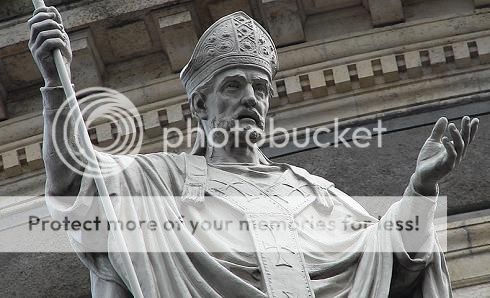
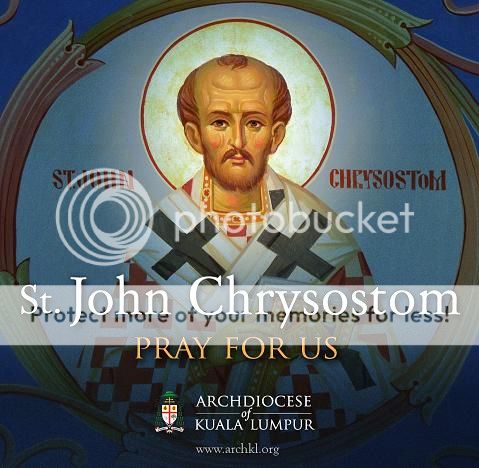
Saint John Chrysostom
(c. 349 - September 14, 407)

user posted image

The ambiguity and intrigue surrounding John, the great preacher (his name
means "golden-mouthed") from Antioch, are characteristic of the life of
any great man in a capital city. Brought to Constantinople after a dozen
years of priestly service in Syria, John found himself the reluctant
victim of an imperial ruse to make him bishop in the greatest city of
the empire. Ascetic, unimposing but dignified, and troubled by stomach
ailments from his desert days as a monk, John became a bishop under the
cloud of imperial politics.

If his body was weak, his tongue was powerful. The content of his sermons,
his exegesis of Scripture, were never without a point. Sometimes the point
stung the high and mighty. Some sermons lasted up to two hours. His lifestyle at the
imperial court was not appreciated by many courtiers. He offered a
modest table to episcopal sycophants hanging around for imperial and
ecclesiastical favours. John deplored the court protocol that accorded
him precedence before the highest state officials. He would not be a
kept man.

His zeal led him to decisive action. Bishops who bribed their way
into office were deposed. Many of his sermons called for concrete steps
to share wealth with the poor. The rich did not appreciate hearing from
John that private property existed because of Adam's fall from grace any
more than married men liked to hear that they were bound to marital
fidelity just as much as their wives were. When it came to justice and
charity, John acknowledged no double standards.

Aloof, energetic, outspoken, especially when he became excited in the
pulpit, John was a sure target for criticism and personal trouble. He
was accused of gorging himself secretly on rich wines and fine foods.

His faithfulness as spiritual director to the rich widow, Olympia,
provoked much gossip attempting to prove him a hypocrite where wealth
and chastity were concerned. His actions taken against unworthy bishops
in Asia Minor were viewed by other ecclesiastics as a greedy,
uncanonical extension of his authority.

Theophilus, archbishop of Alexandria, and Empress Eudoxia were determined
to discredit John. Theophilus feared the growth in importance of the
Bishop of Constantinople and took occasion to charge John with fostering heresy.
Theophilus and other angered bishops were supported by Eudoxia.

The empress resented his sermons contrasting gospel values with the
excesses of imperial court life. Whether intended or not, sermons mentioning
the lurid Jezebel and impious Herodias were associated with the empress, who finally
did manage to have John exiled. He died in exile in 407.

Reflection

John Chrysostom's preaching, by word and example, exemplifies the
role of the prophet to comfort the afflicted and to afflict the comfortable.
For his honesty and courage, he paid the price of a turbulent ministry as
bishop, personal vilification, and exile.

Saint John Chrysostom is the Patron Saint of:
- Orators
- Preachers
- Speakers

user posted image

Source: https://catholic.org.my/index.php/hagiograp...john-chrysostom

khool
post Sep 14 2017, 09:30 AM

Getting Started
**
Junior Member
225 posts

Joined: Mar 2008


Fr. Tom to Pope Francis: I offered my suffering for you and the Church

user posted image
Father Tom Uzhunnalil meets with Pope Francis in Vatican City on Sept. 13, 2017. Credit: L'Osservatore Romano.

Vatican City, Sep 13, 2017 / 11:25 am (CNA/EWTN News).- Just one day after being released from 18 months of captivity, Indian priest Fr. Tom Uzhunnalil shared an emotional meeting with Pope Francis, saying that throughout his time as a prisoner, he offered his suffering for the Pope and the Church.

According to a Sept. 13 article published in the Vatican newspaper L'Osservatore Romano, the encounter took place at the Pope's residence in the Vatican's St Martha guesthouse immediately after the general audience on Wednesday.

Photos of the encounter show an emotional scene as Fr. Uzhunnalil bends down to kiss the Pope's feet, after which the Pope tenderly gives the priest his blessing.

While Fr. Uzhunnalil appeared with an overgrown beard in the majority of photos published during his time in captivity, today's pictures show him clean-shaven and dressed in clerics.

According to L'Osservatore Romano, Fr. Uzhunnalil thanked the Pope, saying “(I) prayed for you every day, offering my suffering for your mission and for the good of the Church.” These words, the newspaper reports, moved the Pope to tears.

A Salesian missionary, Fr. Uzhunnalil first garnered the world's attention when he was kidnapped March 4, 2016, during an attack on a Missionaries of Charity home in Aden, Yemen, that left 16 people dead, including four Sisters.

His international profile grew when rumors spread that he was to be crucified on Good Friday, which were later discredited. After that, numerous photos and videos were released depicting Fr. Uzhunnalil, thin and with an overgrown beard, pleading for help and for his release, saying that his health was deteriorating and he was in need of hospitalization.

In comments to L’Osservatore Romano, Fr. Uzhunnalil said he couldn't celebrate Mass while in captivity, but “every day inside, in my heart, I repeated the words of the celebration.”

The priest remarked that he would continue to pray “for all those who were beside me spiritually,” and offered a special word of remembrance for the 16 people who died during the attack in which he was kidnapped.

He also offered thanks to the government of Oman, in particular Sultan Qaboos bin Said al Said, and to the Holy See for their role in brokering his release.

On his part, Pope Francis embraced Fr. Uzhunnalil and told him that he would continue to pray for him, as he had every day while the priest was imprisoned. Visibly moved, the Pope then gave the priest his blessing, L’Osservatore Romano reported.

Accompanying Fr. Uzhunnalil was Cardinal Oswald Gracias, Archbishop of Bombay and a member of the Pope's Council of Cardinal advisers.

In comments to L’Osservatore Romano, the cardinal said that after this “terrible experience, the essential message that Tom is about to convey is that 'Jesus is great and loves us.'”

He recalled the words of the priest, who after being released said, “Truly, every day I felt Jesus next to me, I always knew and felt in my heart that I was not alone.”

In a Sept. 13 letter, Fr. Ángel Fernández Artime, Major Rector of the Salesian order, said Fr. Uzhunnalil arrived to their community around 6 p.m. Sept. 12, having flown to Rome directly from the Muscat airport in Oman.

He said Fr. Uzhunnalil will stay with them for a few days in order to ensure that he has medical treatment and time to rest, and also “to be able to embrace him in the name of all brother Salesians and the entire Salesian family.”

Artime said that while they were aware that discussions were underway with the priest's kidnappers, the community did not know that Fr. Uzhunnalil had been freed until he was already on his way to Rome.

He stressed that “the Salesian Congregation was not asked for any ransom payment,” and said they are unaware of any payment that may have been made to ensure Fr. Uzhunnalil's release.

The rector offered his thanks to the various parties involved in securing Fr. Uzhunnalil's release, as well as all those who kept the priest in their prayers.

Fr. Uzhunnalil's freedom, he said, “is a motivation to continue to respond in the future with utmost fidelity and authenticity to the call and to the charism he has entrusted to us, and to which Fr. Tom has given his life: the announcement of Jesus and his Gospel, preaching to young boys, girls and youth throughout the world, among them, the poor and abandoned.”

In a separate article published on the Salesian Information Agency, it was noted that after his arrival, one of Fr. Uzhunnalil's first requests was to pray in the Salesian community's chapel in the Vatican, and to celebrate Mass.

Due to the necessity of immediate medical examinations, he was not able to celebrate Mass right away, but he asked if he could go to confession before the medical staff arrived, since he not had the opportunity while in captivity.

The article says Fr. Tom was treated to a traditional Indian meal later that night. In sharing his experience with the community, the priest said he never once felt that his life was in danger, and that at one point, his captors provided medicine for his diabetes.

No official date was given for when Fr. Uzhunnalil will return to India, however, he is expected to go back to Kerala within a few days.

Source: http://www.catholicnewsagency.com/news/fr-...e-church-74095/

khool
post Sep 14 2017, 09:46 AM

Getting Started
**
Junior Member
225 posts

Joined: Mar 2008


Feast of the Exaltation of the Holy Cross
Lectionary: 638


user posted image

Reading 1 (Nm 21:4b-9)

With their patience worn out by the journey,
the people complained against God and Moses,
"Why have you brought us up from Egypt to die in this desert,
where there is no food or water?
We are disgusted with this wretched food!"

In punishment the LORD sent among the people saraph serpents,
which bit the people so that many of them died.
Then the people came to Moses and said,
"We have sinned in complaining against the LORD and you.
Pray the LORD to take the serpents from us."
So Moses prayed for the people, and the LORD said to Moses,
"Make a saraph and mount it on a pole,
and if any who have been bitten look at it, they will live."
Moses accordingly made a bronze serpent and mounted it on a pole,
and whenever anyone who had been bitten by a serpent
looked at the bronze serpent, he lived.

Responsorial Psalm (Ps 78:1bc-2, 34-35, 36-37, 38)

R. Do not forget the works of the Lord!

Hearken, my people, to my teaching;
incline your ears to the words of my mouth.
I will open my mouth in a parable,
I will utter mysteries from of old.
R. Do not forget the works of the Lord!

While he slew them they sought him
and inquired after God again,
Remembering that God was their rock
and the Most High God, their redeemer.
R. Do not forget the works of the Lord!

But they flattered him with their mouths
and lied to him with their tongues,
Though their hearts were not steadfast toward him,
nor were they faithful to his covenant.
R. Do not forget the works of the Lord!

But he, being merciful, forgave their sin
and destroyed them not;
Often he turned back his anger
and let none of his wrath be roused.
R. Do not forget the works of the Lord!

Reading 2 (Phil 2:6-11)

Brothers and sisters:
Christ Jesus, though he was in the form of God,
did not regard equality with God something to be grasped.
Rather, he emptied himself,
taking the form of a slave,
coming in human likeness;
and found human in appearance,
he humbled himself,
becoming obedient to death,
even death on a cross.
Because of this, God greatly exalted him
and bestowed on him the name
that is above every name,
that at the name of Jesus
every knee should bend,
of those in heaven and on earth and under the earth,
and every tongue confess that
Jesus Christ is Lord,
to the glory of God the Father.

Alleluia

R. Alleluia, alleluia.
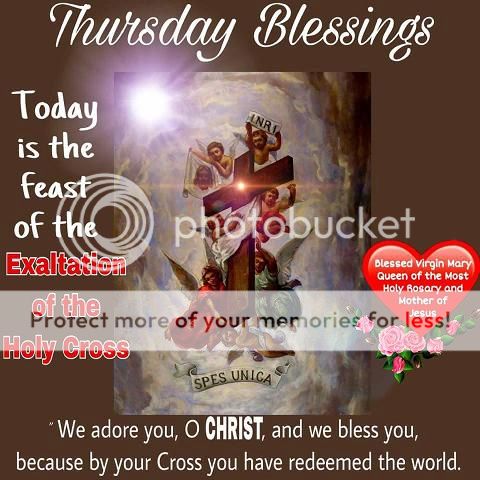
We adore you, O Christ, and we bless you,
because by your Cross you have redeemed the world.
R. Alleluia, alleluia.

Gospel (Jn 3:13-17)

Jesus said to Nicodemus:
"No one has gone up to heaven
except the one who has come down from heaven, the Son of Man.
And just as Moses lifted up the serpent in the desert,
so must the Son of Man be lifted up,
so that everyone who believes in him may have eternal life."

For God so loved the world that he gave his only Son,
so that everyone who believes in him might not perish
but might have eternal life.
For God did not send his Son into the world to condemn the world,
but that the world might be saved through him.

user posted image

REFLECTION

SO MUST THE SON OF MAN BE LIFTED UP. The cross (Greek stauros) is an ancient instrument of execution often employed by the Greeks
and the Romans for its deterrent value, especially against rebellious slaves and seditious provincials. Because of the protracted
suffering and extreme ignominy of this punishment, crucifixion was viewed as the supreme penalty, the “most wretched of death.”

That Christians would hold as Messiah and worship as Lord one who died on the cross was foolish and scandalous to both Jews and
pagans (cf 1 Cor 1:18-25). The scandal of the cross would only be removed if the meaning attached to it were completely overturned.
This happened with Jesus’ resurrection. In the light of the resurrection, the death of Jesus on the cross took a salvific meaning.
It was seen as an atonement, a sacrifice, Jesus’ kenosis or self-emptying, proof of God’s love for us.

Today’s Gospel presents Jesus’ crucifixion as His “lifting up,” part of Jesus’ ascent to glory. This ascent already begins when
Jesus is lifted up on the cross. It continues when He is raised up by the Father, and climaxes when He is lifted up to heaven. This
Paschal mystery is a saving action. Thus, Jesus compares His crucifixion to Moses’ lifting up of the bronze serpent in the desert
(cf Nm 21:9). Just as the Israelites who looked at it were immunized from the venom of the snakes, so Jesus on the cross is a
source of life for those who will look up to Him with faith.

How often do you make the sign of the cross? Do you pay attention to what you are doing?

SOURCE: “365 Days with the Lord 2017,” ST. PAULS Philippines, 7708 St. Paul Rd., SAV, Makati City (Phils.) http://www.ssp.ph/

user posted image

khool
post Sep 14 2017, 09:54 AM

Getting Started
**
Junior Member
225 posts

Joined: Mar 2008


THE EXALTATION OF THE HOLY CROSS

1. FEAST INTRODUCTION

Our Mother the Church sings of the triumph of the Holy Cross, the instrument of our salvation. In order to follow Christ, the Christian must take up his cross and become obedient with Christ, who was obedient until death, even death on the Cross.

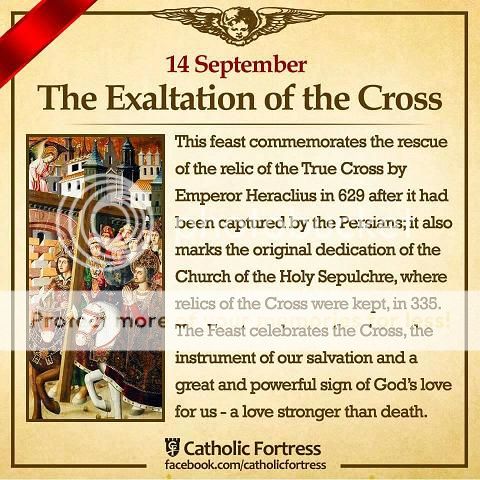
The feast of the Exaltation of the Cross sprang at Rome at the end of the seventh century. The 3rd of May was called the feast of the Invention of the Cross, and it commemorated in a special manner Saint Helena's discovery of the sacred wood of the Cross; the 14th of September, the feast of the Exaltation of the Cross, commemorated above all the circumstances in which Heraclius recovered from the Persians the True Cross, which they had carried off.

2. GOSPEL READING: Jn 3:13–17

Jesus said to Nicodemus: “No one has gone up to heaven except the one who has come down from heaven, the Son of Man. And just as Moses lifted up the serpent in the desert, so must the Son of Man be lifted up, so that everyone who believes in him may have eternal life.”

For God so loved the world that he gave his only Son, so that everyone who believes in him might not perish but might have eternal life. For God did not send his Son into the world to condemn the world, but that the world might be saved through him.

3. DIVINE OFFICE 2ND READING: A discourse of St Andrew of Crete, The cross is Christ's glory and triumph

We are celebrating the feast of the cross which drove away darkness and brought in the light. As we keep this feast, we are lifted up with the crucified Christ, leaving behind us earth and sin so that we may gain the things above. So great and outstanding a possession is the cross that he who wins it has won a treasure. Rightly could I call this treasure the fairest of all fair things and the costliest, in fact as well as in name, for on it and through it and for its sake the riches of salvation that had been lost were restored to us.

Had there been no cross, Christ could not have been crucified. Had there been no cross, life itself could not have been nailed to the tree. And if life had not been nailed to it, there would be no streams of immortality pouring from Christ’s side, blood and water for the world’s cleansing. The legal bond of our sin would not be cancelled, we should not have attained our freedom, we should not have enjoyed the fruit of the tree of life and the gates of paradise would not stand open. Had there been no cross, death would not have been trodden underfoot, nor hell despoiled.

Therefore, the cross is something wonderfully great and honourable. It is great because through the cross the many noble acts of Christ found their consummation – very many indeed, for both his miracles and his sufferings were fully rewarded with victory. The cross is honourable because it is both the sign of God’s suffering and the trophy of his victory. It stands for his suffering because on it he freely suffered unto death. But it is also his trophy because it was the means by which the devil was wounded and death conquered; the barred gates of hell were smashed, and the cross became the one common salvation of the whole world.

The cross is called Christ’s glory; it is saluted as his triumph. We recognise it as the cup he longed to drink and the climax of the sufferings he endured for our sake. As to the cross being Christ’s glory, listen to his words: Now is the Son of Man glorified, and in him God is glorified, and God will glorify him at once. And again: Father, glorify me with the glory I had with you before the world came to be. And once more: “Father, glorify your name.” Then a voice came from heaven: “I have glorified it and will glorify it again.” Here he speaks of the glory that would accrue to him through the cross. And if you would understand that the cross is Christ’s triumph, hear what he himself also said: When I am lifted up, then I will draw all men to myself. Now you can see that the cross is Christ’s glory and triumph.

Responsory
℟. O wonderful cross, upon whose branches hung the treasure and redemption of captive men,* through you the world is redeemed by the blood of the Lord.
℣. Hail, O cross, consecrated by the body of Christ, whose limbs, like precious jewels, adorn your wooden timbers.* Through you the world is redeemed by the blood of the Lord.


Let us pray.

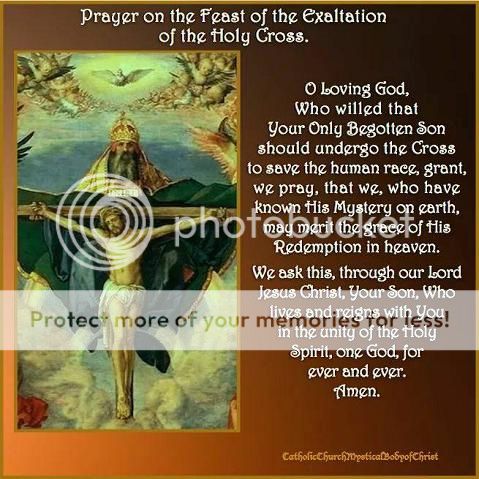
O God, who willed that your Only Begotten Son should undergo the Cross to save the human race, grant, we pray, that we who have known his mystery on earth may merit the grace of his redemption in heaven. Through our Lord.

user posted image

Source: https://www.facebook.com/Catholicsstrivingf...848061095370889

khool
post Sep 14 2017, 10:03 AM

Getting Started
**
Junior Member
225 posts

Joined: Mar 2008


user posted image

Now strengthen my hands, Nehemiah 6:9, "we all face challenges and difficulties in life, but as GOD helped Nehemiah, He will also strengthen our hands for the rest of our lives in whatever tasks He gives to us, LIFE'S challenge are designed not to break us but to bend us toward GOD ..."

khool
post Sep 14 2017, 12:15 PM

Getting Started
**
Junior Member
225 posts

Joined: Mar 2008


user posted image


This post has been edited by khool: Sep 14 2017, 12:15 PM
khool
post Sep 18 2017, 09:45 AM

Getting Started
**
Junior Member
225 posts

Joined: Mar 2008


Monday of the Twenty-fourth Week in Ordinary Time
Lectionary: 443


user posted image

Reading 1 (1 Tm 2:1-8)

Beloved:
First of all, I ask that supplications, prayers,
petitions, and thanksgivings be offered for everyone,
for kings and for all in authority,
that we may lead a quiet and tranquil life
in all devotion and dignity.
This is good and pleasing to God our savior,
who wills everyone to be saved
and to come to knowledge of the truth.

For there is one God.
There is also one mediator between God and men,
the man Christ Jesus,
who gave himself as ransom for all.

This was the testimony at the proper time.
For this I was appointed preacher and Apostle
(I am speaking the truth, I am not lying),
teacher of the Gentiles in faith and truth.

It is my wish, then, that in every place the men should pray,
lifting up holy hands, without anger or argument.

Responsorial Psalm (Ps 28:2, 7, 8-9)

R. Blessed be the Lord, for he has heard my prayer.

Hear the sound of my pleading, when I cry to you,
lifting up my hands toward your holy shrine.
R. Blessed be the Lord, for he has heard my prayer.

The LORD is my strength and my shield.
In him my heart trusts, and I find help;
then my heart exults, and with my song I give him thanks.
R. Blessed be the Lord, for he has heard my prayer.

The LORD is the strength of his people,
the saving refuge of his anointed.
Save your people, and bless your inheritance;
feed them, and carry them forever!
R. Blessed be the Lord, for he has heard my prayer.

Alleluia (Jn 3:16)

R. Alleluia, alleluia.
God so loved the world that he gave his only-begotten Son,
so that everyone who believes in him might have eternal life.
R. Alleluia, alleluia.

Gospel (Lk 7:1-10)

When Jesus had finished all his words to the people,
he entered Capernaum.
A centurion there had a slave who was ill and about to die,
and he was valuable to him.
When he heard about Jesus, he sent elders of the Jews to him,
asking him to come and save the life of his slave.
They approached Jesus and strongly urged him to come, saying,
"He deserves to have you do this for him,
for he loves our nation and he built the synagogue for us."
And Jesus went with them,
but when he was only a short distance from the house,
the centurion sent friends to tell him,
"Lord, do not trouble yourself,
for I am not worthy to have you enter under my roof.
Therefore, I did not consider myself worthy to come to you;
but say the word and let my servant be healed.
For I too am a person subject to authority,
with soldiers subject to me.
And I say to one, Go, and he goes;
and to another, Come here, and he comes;
and to my slave, Do this, and he does it."
When Jesus heard this he was amazed at him
and, turning, said to the crowd following him,
"I tell you, not even in Israel have I found such faith."
When the messengers returned to the house,
they found the slave in good health.

user posted image

REFLECTION

Not even in Israel. Jesus often complains of his disciples’ “little faith” or utter lack of faith (cf Mk 4:40). His own townsmen in Nazareth amaze Jesus for their lack of faith (cf Mk 6:6). In two instances when Jesus points to great faith, the persons concerned do not happen to belong to the group of His disciples or to the practicing Jews but are strangers and outsiders to the Jewish religion.

The first is the Canaanite woman who holds the distinction of having successfully argued with Jesus and won the deliverance of her daughter from the demon (cf Mt 15:28). The second is the Roman centurion in the Gospel: he seeks a cure for his slave and recognizes the authority of Jesus to bring healing in God’s name. Jesus acknowledges the centurion’s faith and consequently voices criticism of Israel’s faith in him. Luke thus presents the Roman official as a symbol of Gentile belief over against the general reaction of Israel and prepares for the story of the conversion by Peter of the Roman centurion Cornelius (cf Acts 10:2).

“People will come from the east and the west and from the north and the south and will recline at table in the Kingdom of God” (Lk 13:29).

SOURCE: “365 Days with the Lord 2017,” ST. PAULS Philippines, 7708 St. Paul Rd., SAV, Makati City (Phils.) http://www.ssp.ph/

user posted image

khool
post Sep 18 2017, 12:42 PM

Getting Started
**
Junior Member
225 posts

Joined: Mar 2008


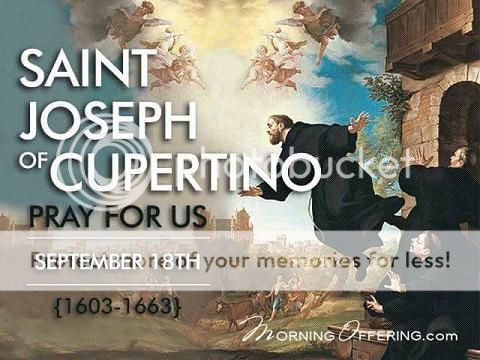
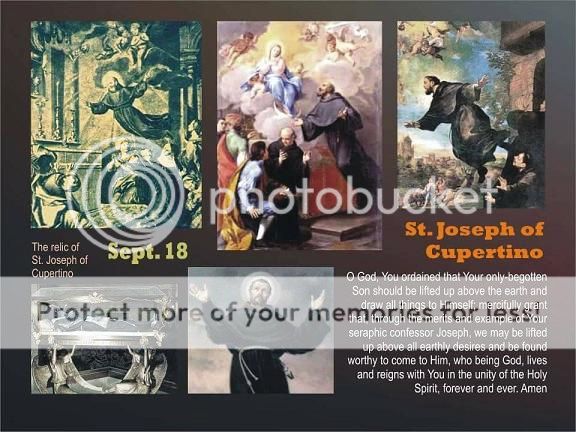
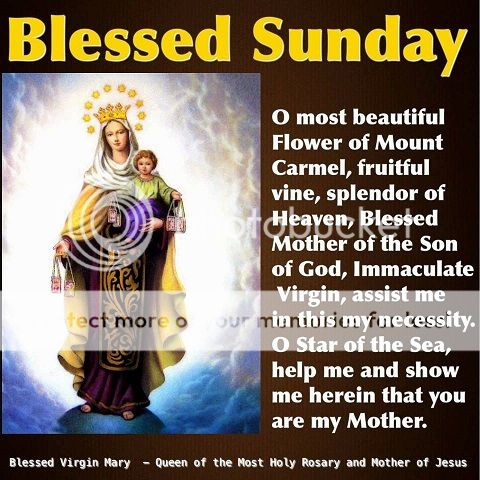
Saint of the Day: St. Joseph of Cupertino (1603-1668)

user posted image

St. Joseph of Cupertino was an Italian mystic whose life is a wonderful combination of a complete lack of natural capacity and an extraordinary supernatural efficiency. He lacked every natural gift. He was incapable of passing a test, maintaining a conversation, taking care of a house, or even touching a dish without breaking it. He was called Brother Ass by his companions in the monastery.

He was born on June 17, 1603 into a family of poor artisans. Because of his father's debts, he was born in a shed behind the house, which was in the hands of bailiffs. He was sickly and often at death's door during his childhood, and at age seven he developed a gangrenous ulcer which was later cured by a religious man. He was always despised by his companions who called him a fool. Even his mother wearied of him and repudiated him for his lack of any human value.

Later, when he entered the religious life, he faced worse difficulties. The Capuchins received him as a lay brother but his ineptitude and abstraction made him unbearable for the other religious. Often he was taken in ecstasy and, oblivious of what he was doing, he would drop the food or break the dishes and trays. As a penance, bits of broken plates were fastened to his habit as a humiliation and reminder not to do the same again. But he could not change. He could not even be trusted with serving the bread because he would forget the difference between the white and brown breads.

Finally, considering that he was good for nothing, the religious took his habit and expelled him from the monastery. Later, he declared that having the habit taken from him was the greatest suffering of his life and that it was as if his skin had been torn from his body.

When he left the monastery he had lost part of his lay clothes. He was without a hat, boots, or stockings, and his coat was moth-eaten and worn. He presented such a sorry sight that when he passed a stable down the lane, dogs rushed out on him and tore his apparel to worse tatters. He escaped and continued along the road, but soon came upon some shepherds, who thought he was a miscreant and were about to give him a beating, when one of their number had pity on him and persuaded them to let him go free.

He went to the house of his uncle, who, ashamed of him, scolded him and sent him back into the streets with nothing. Reaching his native town, he came to the house of his parents, where his own mother berated him.

Finally, the superior of the Monastery of Grottela discerned his sanctity and decided to take him in as a servant. He was appointed to the stable, and made the keeper of the monastery's donkey.

It was there that the sanctity of St. Joseph of Cupertino began to be recognized. He was always humble, willing to serve, and of good cheer. The Superior decided to admit him to the monastery with hopes that he might learn enough to be ordained, but the effort seemed hopeless. Joseph could not comment on any passage of Scriptures except one: "Beatus venter qui Te portavit" [Blessed be the womb that bore Thee].

When the time came for his examination for the diaconate, the Bishop opened the Gospels at random and his eyes fell on that one text Joseph knew well. Joseph was able to expound on it with success. A year later came the tests for the priesthood. All the postulants except Joseph were very well prepared. The Bishop called on a number of the candidates, who responded superbly. Supposing that all were at the same intellectual level, the Bishop approved all of them without questioning the rest. Joseph was among the candidates who were asked nothing. Therefore, on March 4, 1628, Joseph became a priest at 25 years of age despite his limitations and the opinion of men.

During this period of his life, the spiritual consolations he had enjoyed since his childhood abandoned him. Later he wrote to a friend about that difficult time: "I complained a lot to God about God. I had left everything for Him, and He, instead of consoling me, delivered me to mortal anguish."
He continued: "One day, when I was weeping and wailing in my cell, a religious knocked on my door. I did not answer, but he entered my room and said: 'Friar Joseph, how are you?'

"'I am here to serve you,' I answered.
"'I thought you did not have a habit,' he continued.
"'Yes, I have one, but it is falling apart,' I responded.


"Then, the unknown religious gave me a habit, and when I put it on, all my despair disappeared immediately. No one ever knew who that religious was."

From this time on, the life of St. Joseph of Cupertino changed. He became famous for his ecstasies, miracles, and for the gift of levitation, reported by numerous eye-witnesses. He experienced this so often he became known as "the flying Friar." He began to attract so many pilgrims to the monastery that his superiors had to transfer him from one monastery to another to avoid the commotion. Finally, he arrived in Osimo in 1657, where he continued to experience supernatural manifestations of God’s favors daily until he died on September 18, 1663 at age 60.

Comments of Prof. Plinio:

It is difficult to comment on the extraordinary life of St. Joseph of Cupertino. I will try to do so by dividing the topic into parts.

First, you see that Our Lady put everything negative in this man. But, since "for love nothing is impossible," according to the maxim of St. Therese of Lisieux, he accomplished everything that his vocation called him to do.

There is a misconception about efficiency that defines it purely in terms of production. This is wrong because to do something is not an end in itself. What explains the action is the end one has in mind.

The right notion of efficiency is to do what one is supposed to do according to his vocation. Therefore, in order to be efficient, each one should ask if he is accomplishing the plans of God for him. If he works in collaboration with the plans of God, the grace will multiply his efforts and he will do much more than he is capable of otherwise. This rule, which applies to St. Joseph of Cupertino, also applies to St. Thomas Aquinas, who is situated at the other pole of human capacity.

Even though he was poorly gifted humanly speaking, St. Joseph of Cupertino did the will of God, sanctified his soul, and allowed God to shine through his incapacity in a way that attracted the admiration of multitudes. Even today, when one of us hears about his extreme incapacity and the marvelous things God did through him, we do not forget his name. It is the application of that passage of the Magnificat: "For He has found humility in His handmaid, and all generations shall call me blessed." Once we hear about the incapacity of St. Joseph of Cupertino and his humility in accepting the will of God, his name remains in our memories forever.

Second, the depth of spirit of St. Joseph of Cupertino is expressed in his comment about when his habit was taken from him and he was expelled from the monastery. He affirmed that this caused him huge suffering, as if they were tearing off the very skin from his body. In this episode, you can see the wisdom of the man. There is a great difference between his attitude and that of many of today's theologians, who, even though they may know Aramaic and Sanskrit and make extensive comments on Holy Scriptures, have no love for their habits and readily abandon them. I leave aside the fact that many of these theologians reach conclusions that either God does not exist or that all religions worship the one true God. How greatly superior St. Joseph of Cupertino was to these men!

His comments regarding the loss of the spiritual consolations he had enjoyed since childhood also reflect his superiority. He had a profound detachment from material goods, and valued the spiritual gifts he had above all else. This is positively a manifestation of superiority. Then, even those consolations were taken from him.

What did he do? Did he revolt? No. He "complained to God about God," according to his own extraordinary words. He turned to God to respectfully ask Him why He was treating him that way. Our Lady did something analogous when she asked the Divine Child why He had gone to the Temple to discuss with the doctors without warning her and St. Joseph. It was a lovely complaint. So also was the attitude of St. Joseph of Cupertino. It expresses well the superiority of his soul.

Third, for a person accustomed to "happy endings," the life of St. Joseph comes as a shock. In it, this person finds a complete inversion of patterns. Take, for example, the episode where he was expelled from the monastery and lacked decent lay clothing to wear. He set out on the road and was attacked by dogs. Not well mannered, clean dogs but bad-natured, dirty stable dogs. Those dogs bit him and tore his clothes to tatters. He looked so bad that some shepherds of the area took him for a thief. He went to ask help from his uncle and was rejected. Afterward, his own mother turned him away from her house. His misfortunes multiplied, and everyone persecuted the poor, ugly, dirty and tattered man.

You can imagine the great confidence in Our Lady St. Joseph of Cupertino had to have in order to avoid falling into despair. He was perfectly capable of feeling the scorn that people had for him, and he also probably considered that such a reaction had a basis in reality, that is, that he was unintelligent, ugly, dirty, etc.

So what did he do? He continued on without concern about himself, without discouragement, but thinking only of the glory of God and Our Lady. Isn't this a beautiful thing? I think that it is incomparably more beautiful than being very intelligent. Doing this, he was imitating Our Lord in His Passion, being despised by the populace and receiving all kinds of outrages for the glory of God.

Fourth, St. Joseph of Cupertino represents in the Catholic Church a way to be detached from the gifts that many receive. A man gifted with great intelligence should meditate on how well St. Joseph of Cupertino accepted his lack of intelligence so that he might better use the gifts God gave him. Another who is noble by birth should admire the way St. Joseph accepted his humble social condition in order to keep from being proud and remain accessible to simple people. Yet another who is rich should ponder the ready acceptance St. Joseph of Cupertino had of his extreme poverty so that he might use it to glorify God and Our Lady.

That is, St. Joseph of Cupertino represents one side of the scale that gives a perfect equilibrium to the Catholic Church. Both he and St. Thomas Aquinas are necessary for that perfect balance. I think that in Heaven the two could be closely joined glorifying Our Lady and Our Lord.

What is the application for us? If we received gifts from nature or from God, let us admire St. Joseph of Cupertino in order to be detached from them and use them well. If we lack qualities or have to endure sufferings, let us admire him and follow his example of confidence in order to accomplish what God has planned for us.

Source: https://www.facebook.com/groups/16632189972...57844307792514/

user posted image


This post has been edited by khool: Sep 18 2017, 12:44 PM
khool
post Sep 18 2017, 01:50 PM

Getting Started
**
Junior Member
225 posts

Joined: Mar 2008


khool
post Sep 19 2017, 01:52 PM

Getting Started
**
Junior Member
225 posts

Joined: Mar 2008


Tuesday of the Twenty-fourth Week in Ordinary Time
Lectionary: 444


user posted image

Reading 1 (1 Tm 3:1-13)

Beloved, this saying is trustworthy:
whoever aspires to the office of bishop desires a noble task.
Therefore, a bishop must be irreproachable,
married only once, temperate, self-controlled,
decent, hospitable, able to teach,
not a drunkard, not aggressive, but gentle,
not contentious, not a lover of money.
He must manage his own household well,
keeping his children under control with perfect dignity;
for if a man does not know how to manage his own household,
how can he take care of the Church of God?
He should not be a recent convert,
so that he may not become conceited
and thus incur the Devil's punishment.
He must also have a good reputation among outsiders,
so that he may not fall into disgrace, the Devil's trap.

Similarly, deacons must be dignified, not deceitful,
not addicted to drink, not greedy for sordid gain,
holding fast to the mystery of the faith with a clear conscience.
Moreover, they should be tested first;
then, if there is nothing against them,
let them serve as deacons.
Women, similarly, should be dignified, not slanderers,
but temperate and faithful in everything.
Deacons may be married only once
and must manage their children and their households well.
Thus those who serve well as deacons gain good standing
and much confidence in their faith in Christ Jesus.

Responsorial Psalm (Ps 101:1b-2ab, 2cd-3ab, 5, 6)

R. I will walk with blameless heart.

Of mercy and judgment I will sing;
to you, O LORD, I will sing praise.
I will persevere in the way of integrity;
when will you come to me?
R. I will walk with blameless heart.

I will walk with blameless heart,
within my house;
I will not set before my eyes
any base thing.
R. I will walk with blameless heart.

Whoever slanders his neighbor in secret,
him will I destroy.
The man of haughty eyes and puffed up heart
I will not endure.
R. I will walk with blameless heart.

My eyes are upon the faithful of the land,
that they may dwell with me.
He who walks in the way of integrity
shall be in my service.
R. I will walk with blameless heart.

Alleluia (Lk 7:16)

R. Alleluia, alleluia.
A great prophet has arisen in our midst
and God has visited his people.
R. Alleluia, alleluia.

Gospel (Lk 7:11-17)

user posted image

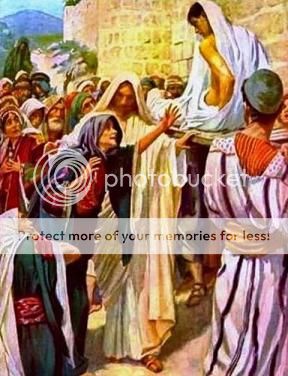
Jesus journeyed to a city called Nain,
and his disciples and a large crowd accompanied him.
As he drew near to the gate of the city,
a man who had died was being carried out,
the only son of his mother, and she was a widow.
A large crowd from the city was with her.
When the Lord saw her,
he was moved with pity for her and said to her,
"Do not weep."
He stepped forward and touched the coffin;
at this the bearers halted,
and he said, "Young man, I tell you, arise!"
The dead man sat up and began to speak,
and Jesus gave him to his mother.
Fear seized them all, and they glorified God, exclaiming,
"A great prophet has arisen in our midst,"
and "God has visited his people."
This report about him spread through the whole of Judea
and in all the surrounding region.

user posted image

REFLECTION

Moved with pity. Luke’s gospel shows special interest in foreigners, the poor, and women. The story above, unique to Luke, complements the preceding healing miracle for the slave of the centurion, a foreigner in Galilee. Jesus here brings back to life the only son of a Jewish widow.

Both miracles attest to Luke’s presentation of Jesus as the Savior of all. No one is excluded from the salvation he offers – neither people regarded as sinners and lost nor widows and orphans considered helpless and defenseless.

Jesus is sensitive to the needs of people. While he looks for faith, it is the widow’s helplessness that draws his gracious compassion. No one has to ask him; he intervenes to give the young man back to his mother. His actions – eating with sinners, feeding thousands, healing the sick, bringing the dead back to life – are signs of what he can do for all people: save them from sin and give them new life and total liberation.

“Jesus Christ is the face of the Father’s mercy. These words might well sum up the mystery of the Christian faith” (Pope Francis, MV).

SOURCE: “365 Days with the Lord 2017,” ST. PAULS Philippines, 7708 St. Paul Rd., SAV, Makati City (Phils.) http://www.ssp.ph/

user posted image

khool
post Sep 19 2017, 01:53 PM

Getting Started
**
Junior Member
225 posts

Joined: Mar 2008


user posted image

khool
post Sep 20 2017, 01:04 PM

Getting Started
**
Junior Member
225 posts

Joined: Mar 2008


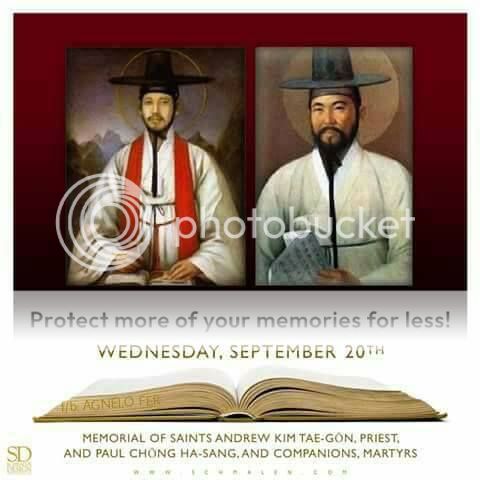
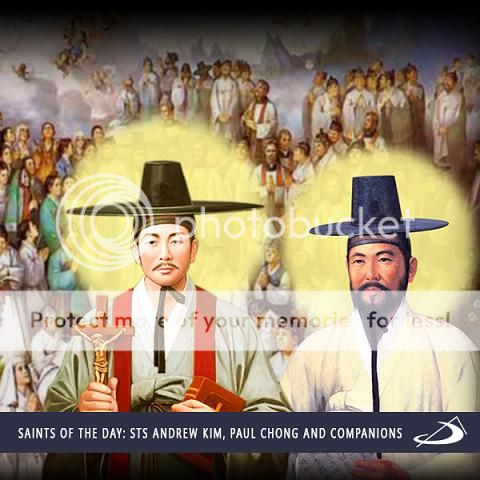
Memorial of Saints Andrew Kim Tae-gŏn, Priest, and Paul Chŏng Ha-sang, and Companions, Martyrs
Lectionary: 445


user posted image

Reading 1 (1 Tm 3:14-16)

Beloved:
I am writing you,
although I hope to visit you soon.
But if I should be delayed,
you should know how to behave in the household of God,
which is the Church of the living God,
the pillar and foundation of truth.
Undeniably great is the mystery of devotion,

Who was manifested in the flesh,
vindicated in the spirit,
seen by angels,
proclaimed to the Gentiles,
believed in throughout the world,
taken up in glory.

Responsorial Psalm (Ps 111:1-2, 3-4, 5-6)

R. How great are the works of the Lord!

I will give thanks to the LORD with all my heart
in the company and assembly of the just.
Great are the works of the LORD,
exquisite in all their delights.
R. How great are the works of the Lord!

Majesty and glory are his work,
and his justice endures forever.
He has won renown for his wondrous deeds;
gracious and merciful is the LORD.
R. How great are the works of the Lord!

He has given food to those who fear him;
he will forever be mindful of his covenant.
He has made known to his people the power of his works,
giving them the inheritance of the nations.
R. How great are the works of the Lord!

Alleluia (See Jn 6:63c, 68c)

R. Alleluia, alleluia.
Your words, Lord, are Spirit and life,
you have the words of everlasting life.
R. Alleluia, alleluia.

Gospel (Lk 7:31-35)

user posted image

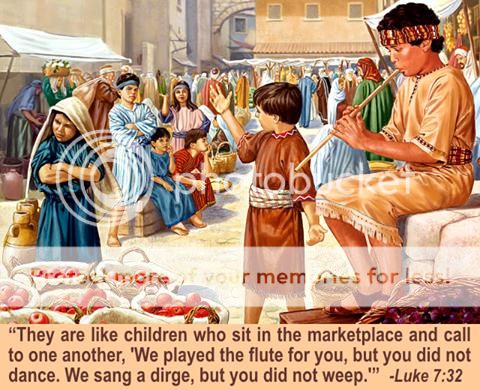
"To what shall I compare the people of this generation?
What are they like?

user posted image

'We played the flute for you, but you did not dance.
We sang a dirge, but you did not weep.'

user posted image

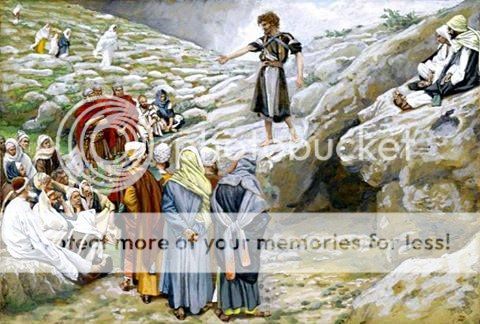
For John the Baptist came neither eating food nor drinking wine,
and you said, 'He is possessed by a demon.'
The Son of Man came eating and drinking and you said,
'Look, he is a glutton and a drunkard,
a friend of tax collectors and sinners.'
But wisdom is vindicated by all her children."

REFLECTION

Like children who sit in the Marketplace. Nowadays, with children focused on their modern gadgets and lost in the digital world, one can only look back with nostalgia to the time when children made their own toys and organized their games. They would argue over what games to play, but they would usually end up enjoying their play.

Jesus uses the “parable” of children unwilling to play with their mates to point to people’s rejection both of John the Baptist and of himself. They do not find the ascetic John to their liking. But they also bitterly criticize Jesus for mixing with the ordinary people – especially those branded as sinners – and joining in their celebrations.

Despite this frequent rejection of God’s messengers, nevertheless, God’s wisdom is shown to be right by her children, i.e., those who respond to John the Baptist and to Jesus. It is in fact basically the religious leaders – the Pharisees and lawyers and priests – who reject John and Jesus, while the common people, and especially the despised tax collectors, are baptized by John and crowd around Jesus to listen to his message.

“For those who believe, no miracle is necessary. For those who do not, no miracle is sufficient.” What prevents you from being committed to your faith?

SOURCE: “365 Days with the Lord 2017,” ST. PAULS Philippines, 7708 St. Paul Rd., SAV, Makati City (Phils.) http://www.ssp.ph/

user posted image

khool
post Sep 20 2017, 01:58 PM

Getting Started
**
Junior Member
225 posts

Joined: Mar 2008


St. Andrew Kim Taegon, St. Paul Chong Hasang, and Companions

user posted image

September 20 is the memorial of St. Andrew Kim Taegon, priest and martyr, St. Paul Chong, martyr, and companions. During the persecutions of 1839, 1846, 1866, and 1867, one hundred and three Christians in Korea gave their lives as martyrs. The martyrs included clergy, but were, for the most part, members of the laity. They consecrated the rich beginnings of the Church in Korea with their blood. Among them were Fr. Andrew Kim of Taegon, the first Korean priest and pastor, and Paul Chong of Hasang, a lay apostle.

St. Andrew Kim Taegon was born into a noble Korean family. He traveled to China to become a Catholic priest and he was ordained in Macao. When he returned to Korea, as the first native priest, he was arrested, tortured, and eventually beheaded.

Paul Chong Hasang was a seminarian, aged 45. As a layman, he was one of the great founders of the Catholic Church in Korea. He was persecuted before he could be ordained.

Saint Quotes for Reflection

“We have received baptism, entrance into the Church, and the honor of being called Christians. Yet what good will this do us if we are Christians in name only and not in fact?”
~St. Andrew Kim Taegon

“I urge you to remain steadfast in faith, so that at last we will all reach heaven and there rejoice together.”
~ St. Andrew Kim Taegon, Final Exhortation

History

It is interesting to note that during the Korean War of 1950 – 53 many priests, nuns, and lay people were killed or expelled. In today’s still divided Korea, the Church flourishes in the South, both in terms of numbers and intellectually, but it remains underground in the North.

QUOTE
“The Korean Church is unique because it was founded entirely by laypeople. This fledgling Church, so young and yet so strong in faith, withstood wave after wave of fierce persecution. Thus, in less than a century, it could boast of 10,000 martyrs. The death of these many martyrs became the leaven of the Church and led to today’s splendid flowering of the Church in Korea. Even today their undying spirit sustains the Christians of the Church of Silence in the north of this tragically divided land.”

~Pope St. John Paul II at the canonization of the Korean Martyrs, May 6, 1984

Prayer

Almighty Father, You have created all nations and You are their salvation. In the land of Korea, Your call to the Catholic faith formed a people of adoption whose growth You nurtured by the blood of Saints Andrew, Paul, and their companions. Through their intercession, give us the strength to always remain faithful to Your commandments and to courageously and boldly proclaim the gospel message to all your people through our actions and our words. We ask this through in the precious name of Our Lord Jesus Christ. Amen.

Source: http://www.jeanmheimann.com/2017/09/st-and...ang-companions/

khool
post Sep 20 2017, 02:06 PM

Getting Started
**
Junior Member
225 posts

Joined: Mar 2008


user posted image

khool
post Sep 20 2017, 02:39 PM

Getting Started
**
Junior Member
225 posts

Joined: Mar 2008


WORD TODAY

user posted image

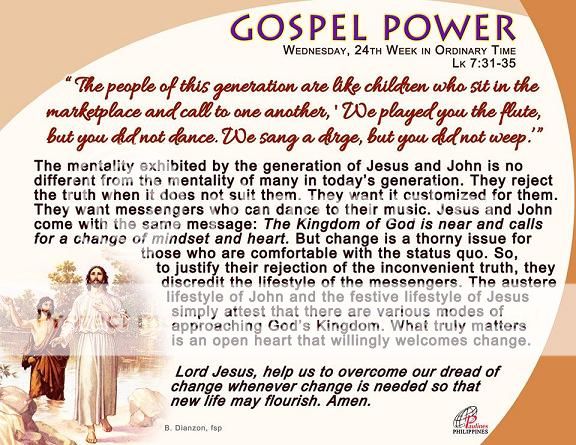
Jesus says, "To what shall I compare the people of this generation? What are they like? They are like children who sit in the marketplace and call to one another, 'We played the flute for you, but you did not dance. We sang a dirge, but you did not weep.'"

In today's Gospel, Jesus compares our generation to a bunch of spoiled brats playing a basketball game with rules that we keep changing to suit ourselves, then demand that everyone else follow. He is describing perfectly how we today decide which of God's laws are correct or wrong. We pick those we like, and for those we do not like, we replace with new human laws that accommodate our perversions of God's eternal truths, laws that make our wrongs into rights.

Then when society, nature, family and personal lives fall apart, we throw a tantrum and cry "Why do You allow these troubles, Lord? WHY?!"

St. Paul points out the obvious. It's because we have rejected the house-rules and deny that we caused our own troubles. He says we "should know how to behave in the household of God, which is the Church of the living God, the pillar and foundation of Truth." (First Reading)

Modern man thinks he no longer needs God We think we can do better than Him. We regard His laws as obstacles to our freedom. That is because "freedom" for today's culture means to be able to pleasure ourselves without responsibility to others in the Body of Christ. But God's laws in fact guarantee that if we live by them, each one of us His children has the freedom to flourish and achieve happiness and fulfillment within the household of God, the Church, the Body of Christ.

God's Word is unchanging Truth. Jesus is the Living Word of God. He is the Way, the Truth and the Life. He was sent by the Father to give us the complete rules that apply to all people of all places and all time.

Then, so that His rules may not be misunderstood or be intentionally perverted, He appointed the Church to be His perpetual coach (Matthew 16:18-19) to infallibly guide us to victory in the Eternal Home Court.

Source: https://www.facebook.com/CatholicMassReflec...780597888904635

khool
post Sep 21 2017, 09:46 AM

Getting Started
**
Junior Member
225 posts

Joined: Mar 2008


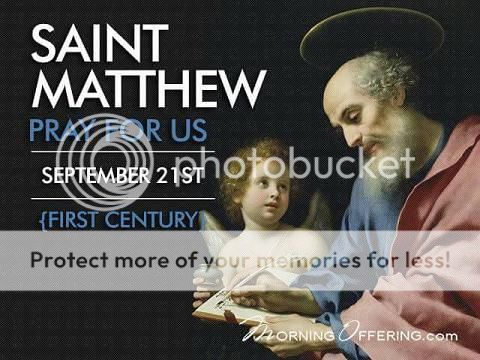
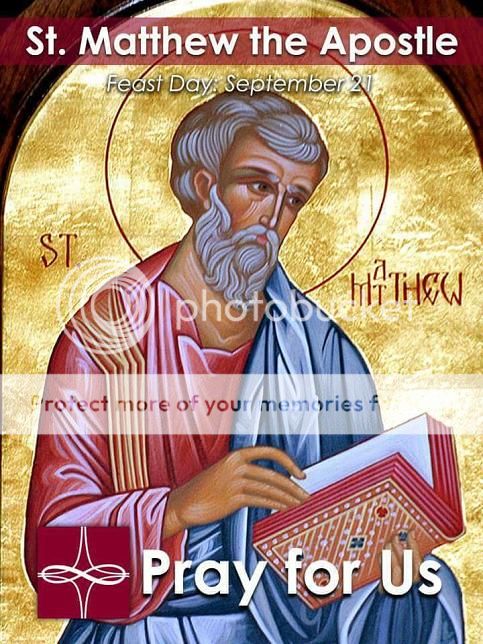
Feast of Saint Matthew, Apostle and evangelist
Lectionary: 643


user posted image

Reading 1 (Eph 4:1-7, 11-13)

Brothers and sisters:
I, a prisoner for the Lord,
urge you to live in a manner worthy of the call you have received,
with all humility and gentleness, with patience,
bearing with one another through love,
striving to preserve the unity of the Spirit
through the bond of peace:
one Body and one Spirit,
as you were also called to the one hope of your call;
one Lord, one faith, one baptism;
one God and Father of all,
who is over all and through all and in all.

But grace was given to each of us
according to the measure of Christ's gift.

And he gave some as Apostles, others as prophets,
others as evangelists, others as pastors and teachers,
to equip the holy ones for the work of ministry,
for building up the Body of Christ,
until we all attain to the unity of faith
and knowledge of the Son of God, to mature manhood,
to the extent of the full stature of Christ.

Responsorial Psalm (Ps 19:2-3, 4-5)

R. Their message goes out through all the earth.

The heavens declare the glory of God;
and the firmament proclaims his handiwork.
Day pours out the word to day,
and night to night imparts knowledge.
R. Their message goes out through all the earth.

Not a word nor a discourse
whose voice is not heard;
Through all the earth their voice resounds,
and to the ends of the world, their message.
R. Their message goes out through all the earth.

Alleluia (See Te Deum)

R. Alleluia, alleluia.
We praise you, O God,
we acclaim you as Lord;
the glorious company of Apostles praise you.
R. Alleluia, alleluia.

Gospel (Mt 9:9-13)

As Jesus passed by,
he saw a man named Matthew sitting at the customs post.

user posted image

He said to him, "Follow me."
And he got up and followed him.

user posted image

He heard this and said,

user posted image

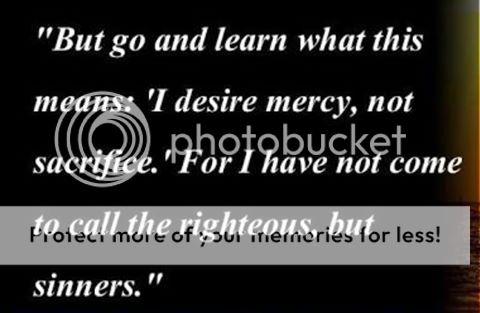
Go and learn the meaning of the words ...

"I desire mercy, not sacrifice.
I did not come to call the righteous but sinners."


REFLECTION

user posted image

He saw a man named Matthew. Scriptures abound with stories of persons encountered and called by God while they are going about their daily work. Moses was called by God through the burning bush while he was tending the flock of his father-in-law Jethro (cf Ex 3:1-2). God indicated to Samuel his election of David as king while the boy was out tending the sheep (cf 1 Sm 16:11-13). Through the prophet Elijah, God called Elisha while he was plowing with twelve yoke of oxen (cf 1 Kgs 19:19). God called Amos to be a prophet while he was working as a herdsman and a dresser of sycamores (cf Am 7:14).

Jesus called Simon, Andrew, James, and John while they were occupied as typical Galilean fisherman (cf Mt 4:18-22). In the Gospel, he calls Matthew who is sitting at the customs post in his work as a tax collector. God needs not idealists or idlers but “laborers for his harvest” (Mt 9:38; Lk 10:2).

Pope Francis finds a personal resonance in the call of Matthew. He shares: “Passing by the tax collector’s booth, Jesus looked intently at Matthew. It was a look full of mercy that forgave the sins of that man, a sinner and a tax collector, whom Jesus chose – against the hesitation of the disciples – to become one of the Twelve. Saint Bede the Venerable, commenting on this Gospel passage, wrote that Jesus looked upon Matthew with merciful love and chose him: miserando atque eligendo. This expression impressed me so much that I chose it for my episcopal motto.”

“The Church is made up not of people who are better than the rest, but of people who want to become better than they are” (Anonymous).

SOURCE: “365 Days with the Lord 2017,” ST. PAULS Philippines, 7708 St. Paul Rd., SAV, Makati City (Phils.) http://www.ssp.ph/

user posted image

This post has been edited by khool: Sep 21 2017, 03:03 PM
khool
post Sep 21 2017, 09:55 AM

Getting Started
**
Junior Member
225 posts

Joined: Mar 2008


Matthew 9:12 -13

user posted image


user posted image

user posted image

khool
post Sep 21 2017, 02:14 PM

Getting Started
**
Junior Member
225 posts

Joined: Mar 2008


user posted image

khool
post Sep 24 2017, 11:07 AM

Getting Started
**
Junior Member
225 posts

Joined: Mar 2008


Twenty-fifth Sunday in Ordinary Time
Lectionary: 133


user posted image

Reading 1 (IS 55:6-9)

Seek the LORD while he may be found,
call him while he is near.
Let the scoundrel forsake his way,
and the wicked his thoughts;
let him turn to the LORD for mercy;
to our God, who is generous in forgiving.
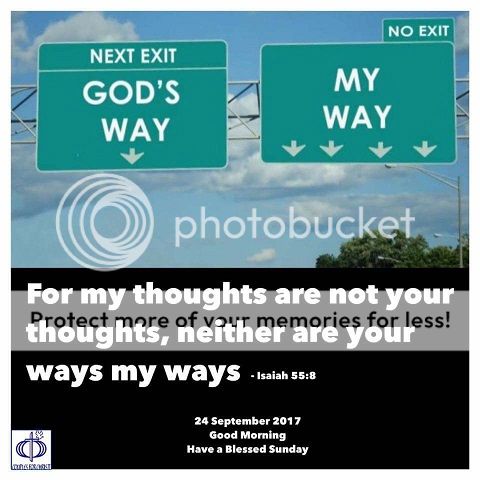
For my thoughts are not your thoughts,
nor are your ways my ways, says the LORD.
As high as the heavens are above the earth,
so high are my ways above your ways
and my thoughts above your thoughts.

Responsorial Psalm (PS 145:2-3, 8-9, 17-18)

R. The Lord is near to all who call upon him.

Every day will I bless you,
and I will praise your name forever and ever.
Great is the LORD and highly to be praised;
his greatness is unsearchable.
R. The Lord is near to all who call upon him.

The LORD is gracious and merciful,
slow to anger and of great kindness.
The LORD is good to all
and compassionate toward all his works.
R. The Lord is near to all who call upon him.

The LORD is just in all his ways
and holy in all his works.
The LORD is near to all who call upon him,
to all who call upon him in truth.
R. The Lord is near to all who call upon him.

Reading 2 (PHIL 1:20C-24, 27A)

Brothers and sisters:
Christ will be magnified in my body, whether by life or by death.
For to me life is Christ, and death is gain.
If I go on living in the flesh,
that means fruitful labor for me.
And I do not know which I shall choose.
I am caught between the two.
I long to depart this life and be with Christ,
for that is far better.
Yet that I remain in the flesh
is more necessary for your benefit.

Only, conduct yourselves in a way worthy of the gospel of Christ.

Alleluia (CF. ACTS 16:14B)

R. Alleluia, alleluia.
Open our hearts, O Lord,
to listen to the words of your Son.
R. Alleluia, alleluia.

Gospel (MT 20:1-16A)

Jesus told his disciples this parable:
"The kingdom of heaven is like a landowner
who went out at dawn to hire laborers for his vineyard.
After agreeing with them for the usual daily wage,
he sent them into his vineyard.
Going out about nine o'clock,
the landowner saw others standing idle in the marketplace,
and he said to them, 'You too go into my vineyard,
and I will give you what is just.'
So they went off.
And he went out again around noon,
and around three o'clock, and did likewise.
Going out about five o'clock,
the landowner found others standing around, and said to them,
'Why do you stand here idle all day?'
They answered, 'Because no one has hired us.'
He said to them, 'You too go into my vineyard.'
When it was evening the owner of the vineyard said to his foreman,
'Summon the laborers and give them their pay,
beginning with the last and ending with the first.'
When those who had started about five o'clock came,
each received the usual daily wage.
So when the first came, they thought that they would receive more,
but each of them also got the usual wage.
And on receiving it they grumbled against the landowner, saying,
'These last ones worked only one hour,
and you have made them equal to us,
who bore the day's burden and the heat.'
He said to one of them in reply,
'My friend, I am not cheating you.
Did you not agree with me for the usual daily wage?
Take what is yours and go.
What if I wish to give this last one the same as you?
Or am I not free to do as I wish with my own money?
Are you envious because I am generous?'
Thus, the last will be first, and the first will be last."

user posted image

REFLECTION

In fairness. God has been accused of sleeping on the job many times over. People say, God does not answer prayers right away. God delays. Why does God allow evil things to happen? In the parable of the Workers in the Vineyard, the workers who showed up early accuse God for being unfair, because God treats the early birds and the latecomers equally, paying them the same amount of wages. God seems to condone indiscipline and sluggishness, when everyone should be up on their toes.

The evangelist Matthew writes the parable to defend God. God is God and has his way of doing things. God has his own measuring stick and way of reckoning time. God does not follow the human system of weights and measurements. God’s reward system depends on the generosity of his heart, not on our efforts or measuring devices. God computes according to the abundance of his heart. God has an infinite supply of love.

The Gospel story reminds us not to impose our terms on God. We should not make God act like a human being, in fairness to God. As the First Reading puts it, “My thoughts are not your thoughts, nor are your ways my ways, says the Lord” (V 8). Our total well-being is God’s top priority. God encourages those who have strayed to return as soon as possible. God does not care whether we have ignored him for so long. God just wants us back. God does not discriminate against the late penitents, in fairness to them.

In the First Reading, Isaiah calls his compatriots to go back to God, to seek him, to turn to him for mercy. The prophet reminds his fellow exiled Jews in Babylon (586-539 BC) that God is merciful, generous in forgiveness, and fair to sinners. After a brief punishment, God will bring them back home.

As Catholics, we experience God’s forgiveness especially through the sacrament of Reconciliation. When we make a good confession, we are liberated from a lot of heavy burdens, from sin and guilt.

In the Second Reading, Paul in prison sees his end is near. This former persecutor of Christians says that he does not mind whether he dies or continues to live. Either is to his advantage. If he dies, he will be with Christ and receive his great reward. If he is allowed to go on living, he can continue his mission. Paul believes that he will go to heaven, not because of his accomplishments, like bringing people to Christ and building Christian communities, but because of the merits of the risen Lord. God has been fair to him.

God is fair to us. God does not sleep but is always on the lookout to welcome us who repent even at the last minute.

SOURCE: “365 Days with the Lord 2017,” ST. PAULS Philippines, 7708 St. Paul Rd., SAV, Makati City (Phils.) http://www.ssp.ph/

user posted image

khool
post Sep 25 2017, 06:55 AM

Getting Started
**
Junior Member
225 posts

Joined: Mar 2008


38 Pages « < 11 12 13 14 15 > » Top
 

Change to:
| Lo-Fi Version
0.1009sec    0.54    7 queries    GZIP Disabled
Time is now: 3rd December 2025 - 05:38 PM