Welcome Guest ( Log In | Register )

38 Pages « < 10 11 12 13 14 > » Bottom

Outline · [ Standard ] · Linear+

 LYN Catholic Fellowship V02 (Group), For Catholics (Roman or Eastern)

views
     
khool
post Sep 8 2017, 09:58 AM

Getting Started
**
Junior Member
225 posts

Joined: Mar 2008


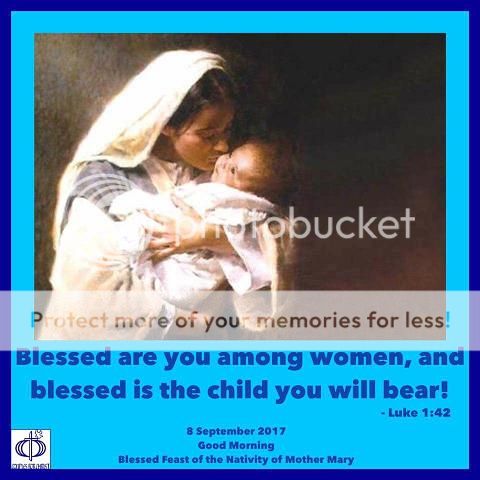
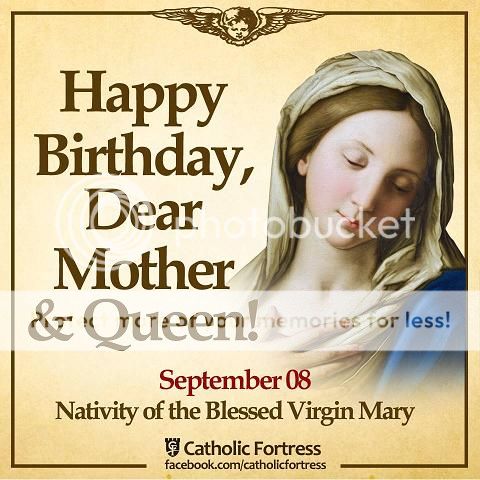
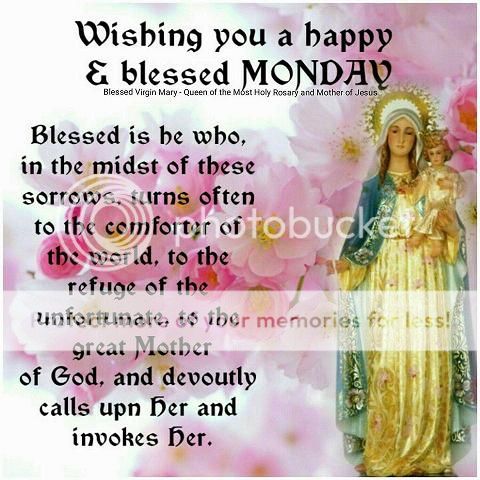
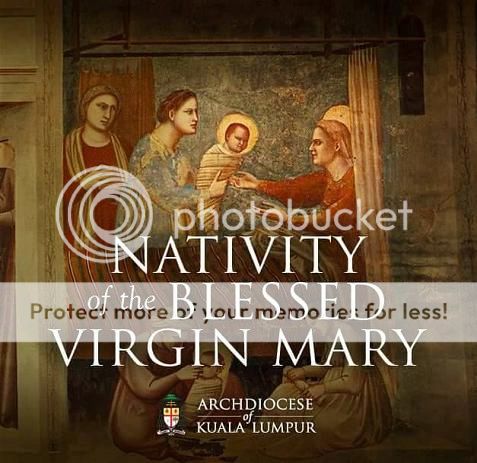
Feast of the Nativity of the Blessed Virgin Mary
Lectionary: 636


user posted image

Reading 1 (Mi 5:1-4a)

The LORD says:
You, Bethlehem-Ephrathah,
too small to be among the clans of Judah,
From you shall come forth for me
one who is to be ruler in Israel;
Whose origin is from of old,
from ancient times.
(Therefore the Lord will give them up, until the time
when she who is to give birth has borne,
And the rest of his brethren shall return
to the children of Israel.)
He shall stand firm and shepherd his flock
by the strength of the LORD,
in the majestic name of the LORD, his God;
And they shall remain, for now his greatness
shall reach to the ends of the earth;
he shall be peace.

or

Rom (8:28-30)

Brothers and sisters:
We know that all things work for good for those who love God,
who are called according to his purpose.
For those he foreknew he also predestined
to be conformed to the image of his Son,
so that he might be the firstborn
among many brothers.
And those he predestined he also called;
and those he called he also justified;
and those he justified he also glorified.

Responsorial Psalm (Ps 13:6ab, 6c)

R. (Isaiah 61:10) With delight I rejoice in the Lord.

Though I trusted in your mercy,
let my heart rejoice in your salvation.
R. With delight I rejoice in the Lord.

Let me sing of the LORD, "He has been good to me."
R. With delight I rejoice in the Lord.

Alleluia

R. Alleluia, alleluia.
Blessed are you, holy Virgin Mary, deserving of all praise;
from you rose the sun of justice, Christ our God.
R. Alleluia, alleluia.

Gospel (Mt 1:1-16, 18-23)

The Book of the genealogy of Jesus Christ,
the son of David, the son of Abraham.

Abraham became the father of Isaac,
Isaac the father of Jacob,
Jacob the father of Judah and his brothers.
Judah became the father of Perez and Zerah,
whose mother was Tamar.
Perez became the father of Hezron,
Hezron the father of Ram,
Ram the father of Amminadab.
Amminadab became the father of Nahshon,
Nahshon the father of Salmon,
Salmon the father of Boaz,
whose mother was Rahab.
Boaz became the father of Obed,
whose mother was Ruth.
Obed became the father of Jesse,
Jesse the father of David the king.

David became the father of Solomon,
whose mother had been the wife of Uriah.
Solomon became the father of Rehoboam,
Rehoboam the father of Abijah,
Abijah the father of Asaph.
Asaph became the father of Jehoshaphat,
Jehoshaphat the father of Joram,
Joram the father of Uzziah.
Uzziah became the father of Jotham,
Jotham the father of Ahaz,
Ahaz the father of Hezekiah.
Hezekiah became the father of Manasseh,
Manasseh the father of Amos,
Amos the father of Josiah.
Josiah became the father of Jechoniah and his brothers
at the time of the Babylonian exile.

After the Babylonian exile,
Jechoniah became the father of Shealtiel,
Shealtiel the father of Zerubbabel,
Zerubbabel the father of Abiud.
Abiud became the father of Eliakim,
Eliakim the father of Azor,
Azor the father of Zadok.
Zadok became the father of Achim,
Achim the father of Eliud,
Eliud the father of Eleazar.
Eleazar became the father of Matthan,
Matthan the father of Jacob,
Jacob the father of Joseph, the husband of Mary.
Of her was born Jesus who is called the Christ.

Now this is how the birth of Jesus Christ came about.
When his mother Mary was betrothed to Joseph,
but before they lived together,
she was found with child through the Holy Spirit.
Joseph her husband, since he was a righteous man,
yet unwilling to expose her to shame,
decided to divorce her quietly.
Such was his intention when, behold,
the angel of the Lord appeared to him in a dream and said,
"Joseph, son of David,
do not be afraid to take Mary your wife into your home.
For it is through the Holy Spirit
that this child has been conceived in her.
She will bear a son and you are to name him Jesus,
because he will save his people from their sins."
All this took place to fulfill
what the Lord had said through the prophet:

Behold, the virgin shall be with child and bear a son,
and they shall name him Emmanuel,


which means "God is with us."
user posted image

REFLECTION

She will bear a son. Two narratives of the “Annunciation” are fitting Gospel readings for the feast of the birthday of the Blessed Virgin Mary.

In Luke, the angel Gabriel is sent to the town of Nazareth to a young woman already betrothed or soon to be married (cf Lk 1:26-27). But Mary is more than meets the eye. She may be an ordinary woman to her neighbors, but not so in the eyes of God. The angel Gabriel calls her kecharitomene or “favored one” by God. This is because the Lord has looked upon the lowliness of his handmaid and chose her to be the mother of the Messiah who is also the Son of God (cf Lk 1:28, 48). Later, Elizabeth will call her most blessed among women because of the fruit of her womb (Jesus) and because she believed that the word of the Lord would come true (cf Lk 1:42, 45). Indeed, to be the mother of the Lord is Mary’s singular privilege, but she also measures up to the criterion of blessedness in the Kingdom of heaven: listening to the word of God and keeping it (cf Lk 11:28). Mary is thus doubly blessed as “mother” and “disciple.” Before she conceives Jesus in her womb, she conceives him in her heart with her fiat to the angel: “I am the handmaid of the Lord. May it be done to me according to your word” (Lk 1:38).

In Matthew, the “annunciation” is made to Joseph, but who is spoken about is Mary. When she is found pregnant, Joseph suspects adultery and plans to divorce her quietly. But he is informed that Mary has conceived by the Holy Spirit, and this is the fulfillment of the oracle of Isaiah about the Immanuel (cf Is 7:14). The Child in her womb is not only a symbol of God’s special care and protection for his people. He is truly God’s presence among men – God who became man, lived among us, and continues to be with us until the end of time (cf Mt 28:20).

SOURCE: “365 Days with the Lord 2017,” ST. PAULS Philippines, 7708 St. Paul Rd., SAV, Makati City (Phils.) http://www.ssp.ph/
user posted image

khool
post Sep 8 2017, 11:51 AM

Getting Started
**
Junior Member
225 posts

Joined: Mar 2008


khool
post Sep 8 2017, 02:16 PM

Getting Started
**
Junior Member
225 posts

Joined: Mar 2008


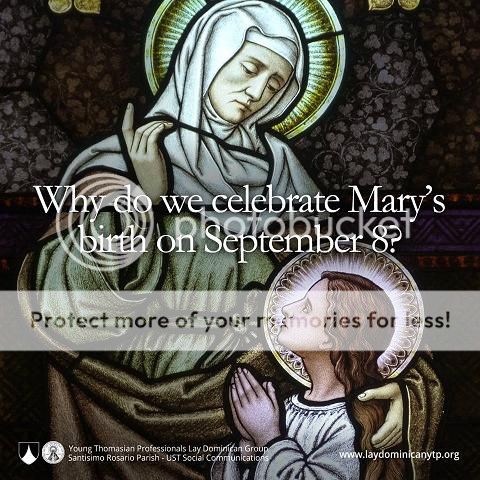
WHY DO WE CELEBRATE MARY'S BIRTH ON SEPTEMBER 8?

user posted image

Like some other celebrations in the Church's calendar, we are unable to ascertain if September 8 really is the date of birth of Mary. However, it must be pointed out that the date is NOT THE REASON for the celebration, but the great event, which is a significant part of God's saving plan for us.

Since the early centuries of the Church, Mary's birth has been commemorated in various places in Christendom on different dates. When the solemnity of the Immaculate Conception was fixed on December 8, the Church counted nine months forward leading to September 8, a logical date to commemorate the Virgin's birth. [1]

It is worth reminding ourselves that the solemnity of the Immaculate Conception refers to the conception of Mary in the womb of her mother, St. Anne, without the stain of original sin. It does not refer to Jesus' conception in the womb of Mary, which is actually commemorated on the Feast of the Annunciation every March 25.

The immaculate conception and birth of Mary are significant in our salvation because it was God's desire to save humanity that led Him to grant this extraordinary privilege to Mary —that is, to be born without the stain of the original sin committed by our first parents, Adam and Eve— so that God's only begotten Son may dwell in a worthy womb to take the form of human flesh. We must remember that we all inherited the stain of original sin from our first parents, and if Mary had also inherited it, then any offspring of her womb would inherit it as well. This is not to be in the case of Jesus Christ, who is the second person in the Holy Trinity and who, being God, cannot be stained with sin. In other words, without the privilege of the immaculate conception, there would be no woman on earth who could bear the long-awaited Messiah. The incarnation of the Son of God and his subsequent passion and death could not take place without a worthy womb.

Mary's immaculate conception was based not on her sole merit, but on the merit of the passion and death of our Lord, Jesus Christ. She too, as a human being, needed salvation, but God applied the effects of salvation prior to —and that it might pave the way for— the supreme offering of the Lamb of God. Hence, the Church teaches: "the most Blessed Virgin Mary, in the first instance of her conception, by a singular grace and privilege granted by Almighty God, IN VIEW OF THE MERITS OF JESUS CHRIST, the Savior of the human race, was preserved free from all stain of original sin..." [2].

We thank God for the privilege given to Mary and we honor her because of her humility and obedience to the will of God. In the annunciation, God sought her permission to be the mother of the messiah. She did not understand everything; nevertheless, she courageously and faithfully said, "I am the handmaid of the Lord. Be it done unto me according to your word." By her faithfulness to God throughout her life, she is honored as the first and perfect Christian.

The importance we accord the Virgin Mary does not deify her or place her beside God. The Church never taught that Mary is divine, and she doesn't attribute anything to herself. [3] Everything great about Mary came from the grace of God Himself, and Mary admits this in her wonderful song of praise, the Magnificat: "My soul proclaims the greatness of the Lord, my spirit rejoices in God my Savior for he has looked with favor on his lowly servant. From this day all generations will call me blessed: the Almighty has done great things for me, and holy is his Name!" [4]

SOURCE: https://www.facebook.com/LayDominicanYTP/po...643172845893387

user posted image

khool
post Sep 8 2017, 02:18 PM

Getting Started
**
Junior Member
225 posts

Joined: Mar 2008


khool
post Sep 9 2017, 09:33 AM

Getting Started
**
Junior Member
225 posts

Joined: Mar 2008


Memorial of Saint Peter Claver, Priest
Lectionary: 436


user posted image

Reading 1 (Col1:21-23)

Brothers and sisters:
You once were alienated and hostile in mind because of evil deeds;
God has now reconciled you
in the fleshly Body of Christ through his death,
to present you holy, without blemish,
and irreproachable before him,
provided that you persevere in the faith,
firmly grounded, stable,
and not shifting from the hope of the Gospel that you heard,
which has been preached to every creature under heaven,
of which I, Paul, am a minister.

Responsorial Psalm (Ps 54:3-4, 6 and 8)

R. God himself is my help.

O God, by your name save me,
and by your might defend my cause.
O God, hear my prayer;
hearken to the words of my mouth.
R. God himself is my help.

Behold, God is my helper;
the Lord sustains my life.
Freely will I offer you sacrifice;
I will praise your name, O LORD, for its goodness.
R. God himself is my help.

Alleluia (Jn 14:6)

R. Alleluia, alleluia.
I am the way and the truth and the life, says the Lord;
no one comes to the Father except through me.
R. Alleluia, alleluia.

Gospel (Lk 6:1-5)

While Jesus was going through a field of grain on a sabbath,
his disciples were picking the heads of grain,
rubbing them in their hands, and eating them.
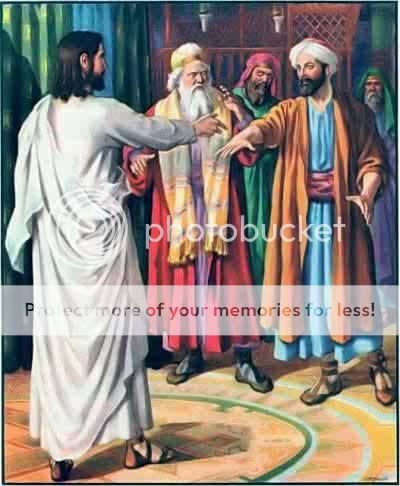
Some Pharisees said,
"Why are you doing what is unlawful on the sabbath?"
Jesus said to them in reply,
"Have you not read what David did
when he and those who were with him were hungry?
How he went into the house of God, took the bread of offering,
which only the priests could lawfully eat,
ate of it, and shared it with his companions?"
Then he said to them, "The Son of Man is lord of the sabbath."

user posted image

REFLECTION

Lord of the Sabbath. There are two main reasons for the observance of the Shabath or day of rest. The first is to imitate the Lord God who rested on the seventh day from his work of creation. The second is to allow people – especially the slaves – a day of repose from their heavy burden. Since the Israelites were once slaves in Egypt, they knew the burden of slavery. Now as free people, they are free to rest… and allow the heavily burdened also to rest.

To safeguard the commandment of the Sabbath rest, the rabbis listed 39 kinds of work as transgressing the observance of the holy day. The Pharisees equate picking heads of grain with reaping, one of the works prohibited on the Sabbath. Jesus’ disciples who do this are therefore doing something unlawful.

Jesus defends his disciples’ conduct by saying that even an institution like the Sabbath rest must yield to other considerations, among which is the satisfaction of human need. Just as the hungry David and his men were exempted from the regulations of the “holy bread,” so the disciples are permitted to ease their hunger even on a Sabbath. But the ultimate justification is that Jesus, the Son of Man, has supreme authority over the Law that mandates the Sabbath.

How does your family keep holy the Lord’s Day – Sunday? Are you sufficiently rested to face another week?

SOURCE: “365 Days with the Lord 2017,” ST. PAULS Philippines, 7708 St. Paul Rd., SAV, Makati City (Phils.) http://www.ssp.ph/

user posted image

khool
post Sep 9 2017, 06:30 PM

Getting Started
**
Junior Member
225 posts

Joined: Mar 2008


khool
post Sep 10 2017, 11:09 AM

Getting Started
**
Junior Member
225 posts

Joined: Mar 2008


Twenty-third Sunday in Ordinary Time
Lectionary: 127


user posted image

Reading 1 (EZ 33:7-9)

Thus says the LORD:
You, son of man, I have appointed watchman for the house of Israel;
when you hear me say anything, you shall warn them for me.
If I tell the wicked, "O wicked one, you shall surely die, "
and you do not speak out to dissuade the wicked from his way,
the wicked shall die for his guilt,
but I will hold you responsible for his death.
But if you warn the wicked,
trying to turn him from his way,
and he refuses to turn from his way,
he shall die for his guilt,
but you shall save yourself.

Responsorial Psalm (PS 95:1-2, 6-7, 8-9)

R. If today you hear his voice, harden not your hearts.

Come, let us sing joyfully to the LORD;
let us acclaim the rock of our salvation.
Let us come into his presence with thanksgiving;
let us joyfully sing psalms to him.
R. If today you hear his voice, harden not your hearts.

Come, let us bow down in worship;
let us kneel before the LORD who made us.
For he is our God,
and we are the people he shepherds, the flock he guides.
R. If today you hear his voice, harden not your hearts.

Oh, that today you would hear his voice:
"Harden not your hearts as at Meribah,
as in the day of Massah in the desert,
where your fathers tempted me;
they tested me though they had seen my works."
R. If today you hear his voice, harden not your hearts.

Reading 2 (ROM 13:8-10)

Brothers and sisters:
Owe nothing to anyone, except to love one another;
for the one who loves another has fulfilled the law.
The commandments, "You shall not commit adultery;
you shall not kill; you shall not steal; you shall not covet, "
and whatever other commandment there may be,
are summed up in this saying, namely,
"You shall love your neighbor as yourself."
Love does no evil to the neighbor;
hence, love is the fulfillment of the law.

Alleluia (2 COR 5:19)

R. Alleluia, alleluia.
God was reconciling the world to himself in Christ
and entrusting to us the message of reconciliation.
R. Alleluia, alleluia.

Gospel MT (18:15-20)

Jesus said to his disciples:
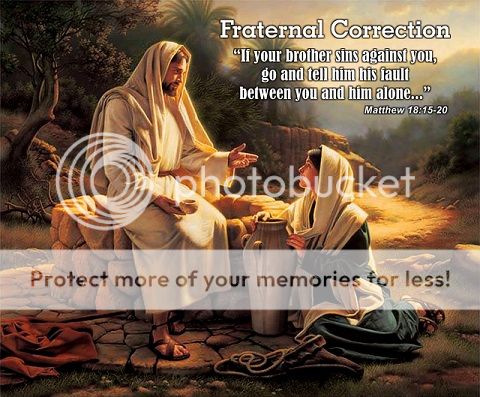
"If your brother sins against you,
go and tell him his fault between you and him alone.
If he listens to you, you have won over your brother.
If he does not listen,
take one or two others along with you,
so that 'every fact may be established
on the testimony of two or three witnesses.'
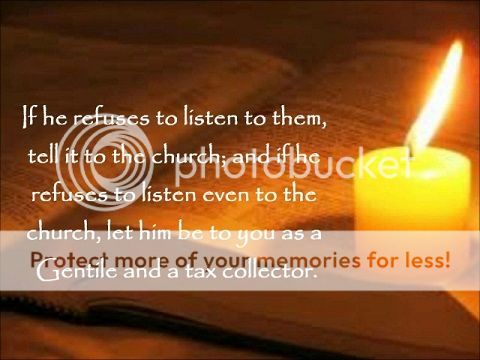
If he refuses to listen to them, tell the church.
If he refuses to listen even to the church,
then treat him as you would a Gentile or a tax collector.
Amen, I say to you,
whatever you bind on earth shall be bound in heaven,
and whatever you loose on earth shall be loosed in heaven.
Again, amen, I say to you,
if two of you agree on earth
about anything for which they are to pray,
it shall be granted to them by my heavenly Father.
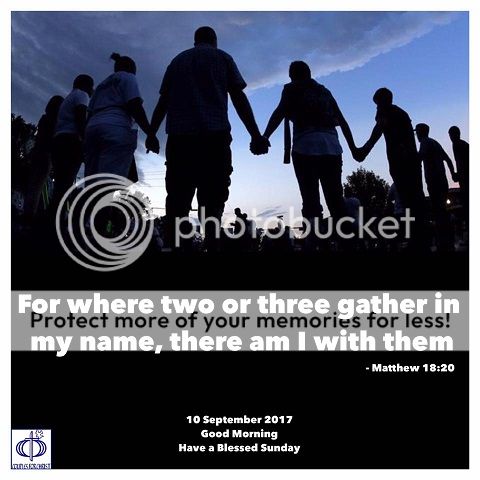
For where two or three are gathered together in my name,
there am I in the midst of them."

user posted image

REFLECTION

"Love one another; for the one who loves another has fulfilled the law." (Second Reading)
Love does no wrong, therefore the spirit of the 10 Commandments (the law) is met in Christ's "love one another as I have loved you."
And how did Jesus love us? By dying for us so we can go to heaven. As His followers, He expects us to do the same; to make sacrifices and bring souls to heaven. God will hold us responsible if we refuse to love and just quietly watch a sinner go to hell (First Reading).
It is a criminal act if we do not do what we can to stop someone from jumpin off a building. And jumping off to the eternal fires of hell is infinitely worse. Caring for another's spiritual health is more important than his physical welfare. This is why Jesus orders us to point out to a sinner the danger he is in.
"If today you hear His voice, harden not your hearts." (Responsorial Psalm) If we have forgotten about this supreme act of love, let us be aware of it today, the Lord's Day. Out of love and in the spirit of love, let us practice our duty and invite once again our spouse, children or parent to come and worship the Lord.

Source: https://www.facebook.com/CatholicMassReflec...jLJYHNc&fref=nf

user posted image


This post has been edited by khool: Sep 10 2017, 04:07 PM
khool
post Sep 10 2017, 03:33 PM

Getting Started
**
Junior Member
225 posts

Joined: Mar 2008


khool
post Sep 10 2017, 03:56 PM

Getting Started
**
Junior Member
225 posts

Joined: Mar 2008


THE BURDEN OF KNOWLEDGE

user posted image

What do we do when we see that something is wrong or that one of our brothers or sisters is doing something wrong or going the wrong way? What makes it even more difficult is when that person is a loved one, our superior or colleague. To speak out might result in a soured relationship, and we do not want to break up a good relationship. At the same time, knowing that the person is harming himself and others put us at unease. Sometimes the situation becomes more difficult when exposing the wrong means causing friction and scandal. So we are in a dilemma either way. This is what the burden of knowledge is all about.

This precisely was the tension that Ezekiel spoke about in the first reading. The truth is that we are our brother’s keeper. “The word of the Lord was addressed to me as follows, ‘Son of man, I have appointed you as sentry to the House of Israel. When you hear a word from my mouth, warn them in my name.’” The knowledge of what is right and wrong imposes an obligation on us to speak the truth. Failure to do so would cause harm to the person who is living a sinful life. We in turn will suffer the sin of omission and our conscience will prick us for not doing the right thing to warn the person who could be ignorant or entrapped by sin. “If I say to a wicked man: Wicked wretch, you are to die, and you do not speak to warn the wicked man to renounce his ways, then he shall die for his sin, but I will hold you responsible for his death.”

Exposing falsehood is not always welcome. Indeed, in this age of individualism and relativism, all of us hold different views of life, of morality and of truth. So when we seek to speak the truth, we can expect strong opposition and defense. They will seek to justify themselves. Few would take our correction humbly. Right from the outset, we must remember that our task is not to convert them, because that is the work of the Holy Spirit. Our role is simply to be a sentry and a spokesman for God to enlighten the person who is doing wrong. Once that is done, our conscience is clear. We should not feel responsible when the person refuses to change and as a result harm himself eventually. This is what Ezekiel is saying. “If, however, you do warn a wicked man to renounce his ways and repent, and he does not repent, then he shall die for his sin, but you yourself will have saved your life.”

In the final analysis, the heart of fraternal correction must be rooted in love of neighbor. Those of us who desire to offer correction must do so only out of love for our errant brothers and sisters. This is what St Paul teaches in the second reading. “Avoid getting into debt, except the debt of mutual love. If you love your fellow men you have carried out your obligations. All the commandments … are summed up in this single command: You must love your neighbour as yourself. Love is the one thing that cannot hurt your neighbour; that is why it is the answer to every one of the commandments.”

Hence, those of us who feel the call to correct those whom we think are going the wrong way, must examine our motivation. If we are motivated by self-interest because our rights are violated, then we are seeking justice rather than fraternal correction. We are speaking out not to help the other person but simply to protect our turf. It is motivated by self-love rather than love for others. If we are motivated by self-righteousness, then we are motivated by pride and presumption. Some of us think so highly of ourselves and our opinions, so much so that when others disagree with us, they are deemed to be wrong. We are deceived by pride.

So before we seek to correct our errant brothers or sisters, we must desire to do so because we love them sincerely and do not wish to see them destroying themselves. Unless it is motivated by a genuine love for them, we lack charity and sobriety in helping them to walk the way of truth. When they perceive that we are their enemies rather than their friends, they will also not listen to us as they will become defensive. But when we correct out of love, then we will be more sensitive to their feelings. We will speak or write with gentleness, compassion and understanding. Those who are judgmental and angry in correcting their brothers and sisters have lost their objectivity in looking at the situation.

For this reason, we must pray before we make any decision or undertake to initiate the process to correct the wrong doer. Prayer is very important to discern our motivations for wanting to correct our brothers or sisters. In prayerful discernment, we purify our motives in wishing to correct the other person. At the same time, we become more aware of our feelings and motives in what we seek to do. The process must begin with prayer and continues throughout with prayer so that we seek only the will of God and not ours. We want to correct a person with charity and compassion whilst seeking the truth.

The way of charity is marked by a process. When we genuinely seek to help someone, we would take courage to approach the person privately. This is what the Lord advises us to do. He said, “If your brother does something wrong, go and have it out with him alone, between your two selves. If he listens to you, you have won back your brother.” This is to give space and privacy for dialogue and understanding. At the same time, if what we see is true, it gives dignity to the person to correct his or her fault quietly without being shamed or embarrassed in public. Those who seek to correct others in the wrong by airing their complaints and grievances publicly are not doing it out of charity but out of revenge. There is no love for those who have done wrong. All they are seeking is to destroy them rather than to help them to be better. In such situations, the issue is made worse because those who are hurt will retaliate in return.

But sometimes a personal dialogue between two parties fails. Or one might find it difficult to speak to the person directly because of expected hostility. In such a situation, Jesus advises us accordingly, “If he does not listen, take one or two others along with you: the evidence of two or three witnesses is required to sustain any charge.” There are some conflicts we cannot settle by ourselves. We need good mediators who are neutral to find some common ground for dialogue. At this stage, the correction is still done privately so that no one has to be on the defensive. It is still part of the process to enlighten, explain and find a middle ground. It is hoped that with good moderators, the conflict can be resolved and all parties are satisfied.

Only as a last resort and out of love is the case brought up officially to the community. And this is done only when all other attempts at dialogue have failed. Again those who go directly to the authorities are those who are not interested in dialogue. They have already pronounced judgement and expect everyone to agree with them. What they are seeking is the endorsement of their opinions by those in authority and to punish the wrongdoers, expose, reprimand and shame them publicly by way of getting even with them. This is not done out of love but out of spite, self-righteousness and anger. By skipping the process of inter-personal dialogue, they are not giving dialogue a chance. And if the authorities do not side with their views, they turn against the authority for failing to do their job. At any rate, when the case goes up to the highest authority, there is no recourse for appeal and the decision is final as there is no higher court to refer to.

However if the process is followed, then the authority representing the community has to make a conscientious decision after listening to all the views. The decision will be binding. “I tell you solemnly, whatever you bind on earth shall be considered bound in heaven; whatever you loose on earth shall be considered loosed in heaven.” If the decision is negative, the person who refuses to accept the judgment may be excommunicated. “But if he refuses to listen to these, report it to the community; and if he refuses to listen to the community, treat him like a pagan or a tax collector.” Again, it must be noted that the juridical process of excommunication is not a punishment per se, but an attempt to awaken the sinner to a consciousness of the gravity of his or her sin so that the person would reflect seriously on his or her actions; and then seek repentance.

In this whole process, we must ask ourselves whether we are attentive to the voice of God. Whether with respect to the one who is reporting the offence or the accused, or those mediating, it is necessary that all the parties concerned be available to a prayerful discernment at every stage of the process. The responsorial psalm urges us, “O that today you would listen to his voice! ‘Harden not your hearts as at Meribah, as on that day at Massah in the desert when your fathers put me to the test; when they tried me, though they saw my work.” If we are all listening to the Lord together, He will provide us the way out of the situation. For the Lord said, “I tell you solemnly once again, if two of you on earth agree to ask anything at all, it will be granted to you by my Father in heaven. For where two or three meet in my name, I shall be there with them.”

Source: http://empoweringgoans.com/2017/09/09/the-...n-of-knowledge/

user posted image

khool
post Sep 11 2017, 09:30 AM

Getting Started
**
Junior Member
225 posts

Joined: Mar 2008


Monday of the Twenty-third Week in Ordinary Time
Lectionary: 437


user posted image

Reading 1 (Col1:24–2:3)

Brothers and sisters:
I rejoice in my sufferings for your sake,
and in my flesh I am filling up
what is lacking in the afflictions of Christ
on behalf of his Body, which is the Church,
of which I am a minister
in accordance with God's stewardship given to me
to bring to completion for you the word of God,
the mystery hidden from ages and from generations past.
But now it has been manifested to his holy ones,
to whom God chose to make known the riches of the glory
of this mystery among the Gentiles;
it is Christ in you, the hope for glory.
It is he whom we proclaim,
admonishing everyone and teaching everyone with all wisdom,
that we may present everyone perfect in Christ.
For this I labor and struggle,
in accord with the exercise of his power working within me.

For I want you to know how great a struggle I am having for you
and for those in Laodicea
and all who have not seen me face to face,
that their hearts may be encouraged
as they are brought together in love,
to have all the richness of assured understanding,
for the knowledge of the mystery of God, Christ,
in whom are hidden all the treasures of wisdom and knowledge.

Responsorial Psalm (Ps 62:6-7, 9)

R. In God is my safety and my glory.

Only in God be at rest, my soul,
for from him comes my hope.
He only is my rock and my salvation,
my stronghold; I shall not be disturbed.
R. In God is my safety and my glory.

Trust in him at all times, O my people!
Pour out your hearts before him;
God is our refuge!
R. In God is my safety and my glory.

Alleluia (Jn 10:27)

R. Alleluia, alleluia.
My sheep hear my voice, says the Lord;
I know them, and they follow me.
R. Alleluia, alleluia.

Gospel (Lk 6:6-11)

On a certain sabbath Jesus went into the synagogue and taught,
and there was a man there whose right hand was withered.
The scribes and the Pharisees watched him closely
to see if he would cure on the sabbath
so that they might discover a reason to accuse him.
But he realized their intentions
and said to the man with the withered hand,
"Come up and stand before us."
And he rose and stood there.
Then Jesus said to them,
"I ask you, is it lawful to do good on the sabbath
rather than to do evil,
to save life rather than to destroy it?"
Looking around at them all, he then said to him,
"Stretch out your hand."
He did so and his hand was restored.
But they became enraged
and discussed together what they might do to Jesus.

user posted image

REFLECTION

COME AND STAND BEFORE US.

While teaching in a synagogue, Jesus sees a person with a shriveled right hand and takes the initiative to heal him. Such an injury prevents the man from pursuing a vocation. In other words, while not in mortal danger, the man is limited in what he can do.

The scribes and the Pharisees watch Jesus. The Greek word used really means “to spy.” They want to level a charge against Jesus. In the Jewish view, a person who is not in mortal danger can wait to be healed.

“Is it lawful to do good on the sabbath rather than to do evil, to save life rather than to destroy it?” Jesus’ question has an ironic edge, because he is looking at the Sabbath from a relational angle. In fact, the way he pursues the question almost suggests that a failure to act here would be doing evil. The leadership, on the other hand, is plotting evil.

The action becomes a test. Will God allow the healing? Will he vindicate Jesus and reveal the answer to Jesus’ question? Jesus looks at everyone and acts. He asks the man to stretch out his hand, and the man gets healed.

Rather than rejoicing, the scribes and the Pharisees get angry to the point of pathological anger. Refusing to accept the evidence Jesus lays before them, they reveal hardness of heart and begin to plot against Jesus.

SOURCE: “365 Days with the Lord 2017,” ST. PAULS Philippines, 7708 St. Paul Rd., SAV, Makati City (Phils.) http://www.ssp.ph/

user posted image

khool
post Sep 11 2017, 01:51 PM

Getting Started
**
Junior Member
225 posts

Joined: Mar 2008


WORD Today
September 11, 2017
(A reflection on the Bible readings in today's Holy Mass)


user posted image

St. Paul said, "I rejoice in my sufferings for your sake, and in my flesh I complete what is lacking in Christ's sufferings for the sake of His Body, which is the Church." (Colossians 1:24)

Paul is now an old man writing this letter to the church in Colossae while he suffered imprisonment in Rome for 2 years for preaching the Good News and building churches all over the known world.

Paul's idea of joy is very alien in today's culture of pleasure, where the smallest suffering must be avoided, where "blessing" means simply receiving from God without any sense of duty to work for Him.

Jesus came to build the Kingdom of God through the Church. All who believed in Him were baptized into the Church and were saved. Jesus suffered to build the Church, not just at the cross on Calvary but daily. He gave all of Himself, His time and energy to the mission. In today's Gospel, He continues His works of love even on the day of rest, the Sabbath, suffering the wrath and scorn of the Jewish authorities.

Like St. Paul, all baptized Christians inherit Christ's mission and continue His work of Church-building, to share in His suffering and sacrifices, at home, at school, at the workplace - and receive the joy of a life filled with purpose and meaning.

As a new week starts, let us ask for true blessings of opportunities to love and serve the Body of Christ.

Source: https://www.facebook.com/CatholicMassReflec...505095987923510

user posted image

khool
post Sep 11 2017, 03:29 PM

Getting Started
**
Junior Member
225 posts

Joined: Mar 2008


When Christ Becomes Real to Us
Fr. Nnamdi Moneme, OMV

user posted image

She had grown up among many siblings in her poor Bangladeshi family. She was the only one that her parents could afford to send to school with the hope that she would help the family out financially. She sensed a call to leave her job and all things to follow Jesus as a religious sister in an international community of sisters here in the Philippines. With great pains to her and to her loved ones, she received the blessing of her parents and prepared to begin her formation process. She had a motor accident on the day of her departure while on the way to the airport with her family that left her mother crippled. She still boarded the plane the next day and left for the Philippines to begin her formation for the religious life.

She narrates her vocation story with deep pains but always ends with these words, “I know that Jesus is here with me and that He will take care of my mother and family in His own way and time and more than I could ever do for them.” How can Jesus be so real for her despite all that she had gone through in doing what she perceived as His will for her? How can Jesus be so real for us that we know with that certainty that we are never alone in the moments of life? Her story shows us that Jesus Christ becomes real for us when we are willing to take a risk or to sacrifice something dear to us just to be close to Jesus or to imitate Jesus more closely. We give God a chance to act and to reveal His veiled presence in our lives when we are willing and ready to risk something to be close to Jesus or to speak and act like Jesus has done.

Today’s Gospel passage begins with the disciples seeing Jesus Christ as a ghost walking on the troubled sea, “When the disciples saw Him walking on the sea they were terrified. ‘It is a ghost,’ they said.” But the Gospel passage ends with Jesus being so real to them that they acknowledged His divinity, “Those who were in the boat did Him homage, saying, “Truly, you are the Son of God.”

But how did the disciples move from seeing Jesus as a phantom, a ghost, to Jesus being so real with them that they affirmed His own divinity? This is possible because one man, Peter, chose to take a risk and come out of the safety of his boat to journey to Jesus, to be with Him on the troubled waters and to do what Jesus was doing, “Lord, if it is you, command me to come to you on the water.” Upon Jesus’ command, “Peter got out of the boat and began to walk on the water towards Jesus.” Yes, Peter did not persevere long in walking on water but began to drown soon. He may look like a failure, one who lost his faith and succumbed to fear; but at least he gave Jesus a chance to act and to show him that He (Jesus) is so close to us and can save us in the storms, “Immediately Jesus stretched out his hand and caught Peter, and said to him, “O you of little faith, why did you doubt?” They thus ceased seeing Jesus as a ghost but Jesus became so real to them.

My dear brothers and sisters in Christ, how real is the living Christ to each of us today? Is Jesus just a memory, like a hero of the past who has moved on and all we have are stories of Him and His saving actions? Is our Eucharist just a brief encounter with the living Christ who we think abandons us in our life situations? Are our life experiences more real to us than the presence of Jesus Christ in our midst? In short, is Jesus Christ a mere phantom or ghost to us or is He the Son of God who holds all of reality in His hands and for whom all things exist?

What are we willing to risk or to sacrifice to be more united with Christ today and to imitate Him more faithfully? Jesus Christ is inviting us out of our own comfort zone and situations to take a risk and draw closer to Him in readiness to imitate His words and actions. What are we willing to risk so as to love selflessly like Jesus? Are we ready to speak the truth in world that is ready to condemn us as bigots just like Jesus, the Truth, who suffered death at the hands of His countrymen because He revealed the Father’s love for us? Are we willing to risk losing our reputation, the approval of our acquaintances, our comforts, pleasures, etc just to be with Christ and to follow more closely in His footsteps? Jesus Christ becomes real for us only when we risk or sacrifice anything for the sake of greater unity with Christ and closer imitation of Him. This is how we allow God to act and reveal Himself to us in our daily lives.

We must never be afraid of failures when we sense Jesus inviting us to take a risk for His sake. A relative of mine once asked me this question shortly before I went to the seminary, “What would you do if you did not make it and become a priest at the end after giving up your job and all that you had achieved in life? How would you integrate back into society and continue your life after so many wasted years?” I look back now and I know that through the good and the bad moments of priestly and religious formation and ministry, I have seen that hand of Jesus reaching out to draw me out of the waters of failures, sin and sufferings. I have heard His voice booming louder over the loud winds and storms and calling me to courage and perseverance in my vocation. Like Peter, I have seen and experienced Jesus acting in my life. He is definitely no ghost to me. I thank God for the grace to take a risk to follow Him.

The Blessed Virgin Mary took a great risk when she said yes to the request of St. Gabriel at the Annunciation. She almost got herself stoned to death if St. Joseph had disowned the child Jesus. She risked and sacrificed her comfort by giving birth to Him in a manger and fleeing to Egypt with Him. She risked her life to journey with her condemned Son to Calvary and to stand with Him on Calvary, associating with Him to the very end in the face of such hatred from her own people. In all these, she waited patiently for the Resurrection of her Son because Jesus and His promise to her of the Resurrection were more real than anything she could experience. May we learn from Mary to be ready to risk and sacrifice all for the sake of Christ so that Jesus may not remain a ghost to us.

The risen Christ whom we encounter in today’s Eucharist says to each of us, “Come.” He invites us out of our comfort zones to draw closer to Him and to imitate Him closely in our world today. He invites us to pray, love God and others, serve all people, forgive all, worship God alone, bear witness to the Father etc just as He has done. It is risky and there will surely be failures on our part. But if we never cease taking risks for His sake, ready to sacrifice all just to be more united and conformed to Jesus, Jesus will never be a ghost to us but He will be so real to us that no matter what we are going through in life, we shall say to Him, “Truly, you are the Son of God.”

Glory to Jesus!!! Honor to Mary!!!

Source: http://catholicexchange.com/christ-becomes-real-us

khool
post Sep 11 2017, 05:00 PM

Getting Started
**
Junior Member
225 posts

Joined: Mar 2008


user posted image

khool
post Sep 12 2017, 10:50 AM

Getting Started
**
Junior Member
225 posts

Joined: Mar 2008


Tuesday of the Twenty-third Week in Ordinary Time
Lectionary: 438


user posted image

Reading 1 (Col 2:6-15)

Brothers and sisters:
As you received Christ Jesus the Lord, walk in him,
rooted in him and built upon him
and established in the faith as you were taught,
abounding in thanksgiving.
See to it that no one captivate you with an empty, seductive philosophy
according to the tradition of men,
according to the elemental powers of the world
and not according to Christ.

For in him dwells the whole fullness of the deity bodily,
and you share in this fullness in him,
who is the head of every principality and power.
In him you were also circumcised
with a circumcision not administered by hand,
by stripping off the carnal body, with the circumcision of Christ.
You were buried with him in baptism,
in which you were also raised with him
through faith in the power of God,
who raised him from the dead.
And even when you were dead in transgressions
and the uncircumcision of your flesh,
he brought you to life along with him,
having forgiven us all our transgressions;
obliterating the bond against us, with its legal claims,
which was opposed to us,
he also removed it from our midst, nailing it to the cross;
despoiling the principalities and the powers,
he made a public spectacle of them,
leading them away in triumph by it.

Responsorial Psalm (Ps 145:1b-2, 8-9, 10-11)

R. The Lord is compassionate toward all his works.

I will extol you, O my God and King,
and I will bless your name forever and ever.
Every day will I bless you,
and I will praise your name forever and ever.
R. The Lord is compassionate toward all his works.

The LORD is gracious and merciful,
slow to anger and of great kindness.
The LORD is good to all
and compassionate toward all his works.
R. The Lord is compassionate toward all his works.

Let all your works give you thanks, O LORD,
and let your faithful ones bless you.
Let them discourse of the glory of your Kingdom
and speak of your might.
R. The Lord is compassionate toward all his works.

Alleluia (See Jn 15:16)

R. Alleluia, alleluia.
I chose you from the world,
that you may go and bear fruit that will last, says the Lord.
R. Alleluia, alleluia.

Gospel (Lk 6:12-19)
Jesus departed to the mountain to pray,
and he spent the night in prayer to God.
When day came, he called his disciples to himself,
and from them he chose Twelve, whom he also named Apostles:
Simon, whom he named Peter, and his brother Andrew,
James, John, Philip, Bartholomew,
Matthew, Thomas, James the son of Alphaeus,
Simon who was called a Zealot,
and Judas the son of James,
and Judas Iscariot, who became a traitor.

And he came down with them and stood on a stretch of level ground.
A great crowd of his disciples and a large number of the people
from all Judea and Jerusalem
and the coastal region of Tyre and Sidon
came to hear him and to be healed of their diseases;
and even those who were tormented by unclean spirits were cured.
Everyone in the crowd sought to touch him
because power came forth from him and healed them all.

user posted image

REFLECTION

user posted image

HE CALLED HIS DISCIPLES... AND FROM THEM HE CHOSE TWELVE.

Rising opposition means that Jesus must organize his followers. His selection of the Twelve (vv 12-16) is a preparation for the mission to come (cf 9:1-6; 10:1-12) as well as an anticipation of his future departure in death.

Three facts dominate the list, along with its parallels: 1) Peter is always first; 2) the first four are Peter, Andrew, James and John (though sometimes in different order); and 3) there are three groups of four, with Peter, Philip, and James the son of Alphaeus leading each group.

Peter is a key figure. He often speaks for the disciples and takes a key role in the group. His brother Andrew is hardly discussed outside the lists. The sons of Zebedee, James and John, complete the initial group and the sequence of four fishermen.

In the second group, Philip is mentioned separately only a few times in John. Bartholomew may well be the same person as Nathanael of Jn 1:45, since many Jews had two prominent names. Matthew is probably Levi, the tax collector. Thomas is the disciple who will have to be convinced of Jesus’ resurrection (Jn 20:24-29).

In the third group, we know very little about James the son of Alphaeus. Simon the Zealot was a political nationalist before meeting Jesus. He may have hated Matthew, who as a tax collector represented the despised Roman state. Judas, not Iscariot, may be the addeus of other lists. Judas Iscariot will become infamous by his betrayal of Jesus.

SOURCE: “365 Days with the Lord 2017,” ST. PAULS Philippines, 7708 St. Paul Rd., SAV, Makati City (Phils.) http://www.ssp.ph/

user posted image

khool
post Sep 12 2017, 01:58 PM

Getting Started
**
Junior Member
225 posts

Joined: Mar 2008


"I AM THE TRUTH (Jn 14:6)." THE DUMB DEVIL. THE NEED FOR SINCERITY.

1. The “dumb devil”.

St. Matthew (9, 32-33) recounts how the Apostles brought to him “a dumb demoniac… And when the demon had been cast out, the dumb man spoke; and the crowds marvelled, saying, ‘Never was anything like this seen in Israel.’”

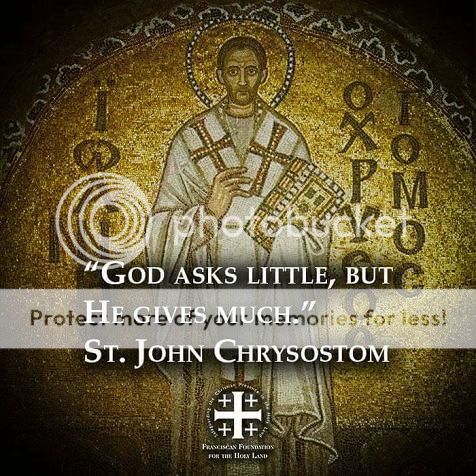
St John Chrysostom comments that this man "could not present his petition by himself, for he was dumb; And he could not beg for the others, for the devil had bound his tongue, and his tongue was tied to his soul "(Hom. Vang., 32, 1).

• When in personal prayer we do not speak to the Lord of our miseries and do not beg him to cure them; or when in Confession or spiritual direction, out of shame, we do not reveal our miseries, we have then allowed the dumb devil to take control of us, and exploit our pride and vanity to hide our spiritual wounds. The result? Allowing the “dumb devil” to dominate us will prevent us to recover interior peace, to receive the help of God’s grace through His instruments, and to return to the right path.
• Hence, the necessity of the virtue of sincerity, which is a manifestation of humility, indispensable if we are to grow in our love for God.

2. “I am the Truth.” The need for sincerity with God, with one’s self, and with others. Some consequences of falsehood.

Are we men and women who love and respect the truth? Truth is oftentimes so obscured by sin, our disordered passions and materialism. Let us not forget that Jesus loves this virtue so much that He declared of himself: I am the Truth (Jn 14:6), while the devil is a liar and the father of lies (Jn 8: 44), all that he promises is falsehood. Jesus asked the Father for his own, for us, to be sanctified in the truth (Cf. Jn 17: 17ff).

There is much talk today of being sincere, of being genuine, transparent, authentic. Yet how many men and women prefer to hide themselves in anonymity and often disguise the true motives of their actions before themselves and before others.
Sincerity is a Christian virtue of the first order. We could not be good Christians if we did not live it to its ultimate consequences: we cannot be good Christians we are not sincere with God, with ourselves, and with others.

• If we are not sincere with God:
- we cannot love Him nor serve Him;
- a personal relationship and encounter with Him in prayer would be impossible.
- We will be enclosed within ourselves, impenetrable by God’s light, mercy, love and grace.

• If we are not sincere with ourselves:
- we cannot have a well-formed conscience for an insincere person distorts his conscience, and becomes blind for the things of God;
- if one is insincere with himself, one will live his life based on a lie;
- one cannot love what is good and true, nor reject that which is evil; one cannot love what is good and true, nor reject that which is evil; he will always be at the mercy of what is convenient and pleasurable rather than what is good and true;
- we will never be willing to recognize our faults, without dissimulating them nor without seeking false excuses;

• If we do not love the truth and are not sincere in our dealings with others, (especially to those who are in charge of directing our soul):
- receiving help from parents, friends, mentors… will be impossible;
- coexistence becomes unbearable,
- human relationships will be contaminated by lie, fraud, hypocrisy, suspicion, deceit, falsehood, treachery, calumny, disloyalty and infidelity.
- Spiritual direction without sincerity will be useless;
- Confessions: sacrilegious and invalid,
- Governments and institutions, impregnated by rampant corruption,
-Society and world: without truth, justice and peace....
All these to the detriment of the dignity and fundamental rights of each and every human being.

3. The means to grow in sincerity

• PRAYER: to ask the Lord to see the errors, the defects of the character ..., to give us strength to recognize them as such, and courage to ask for help and fight.

• Daily, brief but effective EXAMINATION OF CONSCIENCE, to know ourselves.

• Then, the SPIRITUAL DIRECTION and the CONFESSION, truly opening the soul, telling the entire –not half-truths-, with the desire that they know our intimacy so that they can help us in our walk towards God. Oftentimes it will help us to be sincere by saying first that which we do not want to be known.

QUOTE
“Do not let even the smallest focal point of corruption take root in your souls, no matter how tiny it may be. Speak out. When water flows, it stays clean; blocked up, it becomes a stagnant pool full of repugnant filth. What was once drinking water becomes a breeding-ground for insects (St. Josemaria, Friends of God, n. 181).”

“Go to those who direct your souls with your hearts open wide. Do not close your hearts, for if the dumb devil gets in, it is very difficult to get rid of him.

Forgive me for insisting on these points, but I believe it is absolutely necessary for you to have deeply impressed on your minds the fact that humility, together with its immediate consequence, sincerity; are the thread which links the other means together. These two virtues act as a foundation on which a solid victory can be built. If the dumb devil gets inside a soul, he ruins everything. On the other hand, if he is cast out immediately, everything turns out well; we are happy and life goes forward properly. Let us always be brutally sincere, but in a good mannered way. (St. Josemaria, Friends of God, n. 188).”
Dear brethren in Christ, let us reject that dumb demon constantly trying to fasten our tongue, and strive to be sincere, with the help of God’s grace, we will experience immediate joy and interior peace.

Let us ask God for this virtue, for us and for others and daily strive to be humble by being sincere with God, with our self, and with others.

user posted image

Source: https://www.facebook.com/Catholicsstrivingf..._location=group

khool
post Sep 12 2017, 04:17 PM

Getting Started
**
Junior Member
225 posts

Joined: Mar 2008


user posted image


This post has been edited by khool: Sep 12 2017, 05:03 PM
khool
post Sep 12 2017, 05:01 PM

Getting Started
**
Junior Member
225 posts

Joined: Mar 2008


Empty, Seductive Philosophies

user posted image

Suppose you drive up to the preschool to pick up your (grand)child. There are twenty or thirty little ones standing out front, and a teacher is monitoring the group. When you stop to get your grandchild, the teacher takes one child at random and places her in the backseat of your car. You protest that this child is not yours. In response the teacher shrugs off your comment and says, “kids are kids; one’s as good as another.”

We would be horrified to hear a teacher talk this way. Of course, in many ways kids look the same, but there is an infinite difference between my grandchild and another child chosen at random.

How is it that we know the critical importance of recognising our true grandchild, but when it comes to religion, we buy easily into the statement, “religions are pretty much the same; one is as good as another?” We have accepted a strange kind of tolerance that leads us to surrender what is true—what is ours. St. Paul called this way of thinking an “empty, seductive philosophy.”

He warns the Colossians about getting seduced into a wrong way of thinking and watering down their understanding of Christ (Colossians 2:6-15). “See to it that no one captivate you with an empty, seductive philosophy according to the tradition of men, according to the elemental powers of the world and not according to Christ.” Philosophies and religions abound. They are contrived by the thinking of men– based on human ideas. Christianity is not a philosophy or religion that some guru, named Jesus Christ, came up with. It is the truth that came, not from the minds of men, but was revealed by God himself. There is as much difference between revealed truth and human philosophy as there is between your grandchild and another random child in front of the preschool.

To emphasize his point, Paul reminded this people who Jesus really is. He is not just a religious leader among other religious leaders. “For in him dwells the whole fullness of the deity bodily, and you share in this fullness in him, who is the head of every principality and power.” There is no other human being who has the “fullness” of God in him or her. There is no mere human being who rules over the angelic principalities and powers that govern the universe. Comparing any other religious leader or philosophy to Jesus Christ is like comparing a drop of water to the Pacific Ocean. How is it that we are so easily seduced by empty ideas and opinions?

The truth of Christ is not just something that we learned in a theology class. It is something that has actually happened to us. “In him you were also circumcised with a circumcision not administered by hand, by stripping off the carnal body, with the circumcision of Christ. You were buried with him in baptism in which you were also raised with him through faith in the power of God…he brought you to life along with him, having forgiven us all our transgressions…” We were stripped of our natural selves, drowned in the water of baptism, and wiped clean of sin which held us in eternal bondage. Could we forget an experience in which we were stripped, drowned, and then resuscitated and set free? Our faith is not just a set of ideas that we studied in school; it is born of a life-changing transformation that no empty philosophy has the power to accomplish.

Jesus does not stand side by side with a variety of religions and philosophies, offering us a choice. He has conquered and exposed all of these making a prisoner of the ruling spirits that create such “alternatives.” “…despoiling the principalities and the powers, he made a public spectacle of them, leading them away in triumph by it (the cross).”

Paul exhorts us to stay rooted in Christ Jesus the Lord, to walk in him, and to be established in the faith we were taught, “abounding in thanksgiving.” We would not, through carelessness, want to give up one of our children or grandchildren. So, also, we go to extremes to make sure we do not let someone put some empty philosophy into the “backseats” of our minds. When we value what we have, we never stop thanking God for it.

“I chose you from the world, that you may go and bear fruit that will last” (John 15:16).

Source: https://www.facebook.com/Foodforsoulisthewo...957568297832930

user posted image


This post has been edited by khool: Sep 12 2017, 05:14 PM
khool
post Sep 13 2017, 09:33 AM

Getting Started
**
Junior Member
225 posts

Joined: Mar 2008


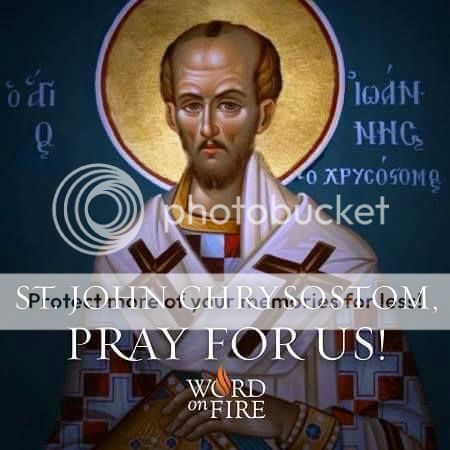
Memorial of Saint John Chrysostom, Bishop and Doctor of the Church
Lectionary: 439


user posted image

Reading 1 (Col 3:1-11)

Brothers and sisters:
If you were raised with Christ, seek what is above,
where Christ is seated at the right hand of God.
Think of what is above, not of what is on earth.
For you have died, and your life is hidden with Christ in God.
When Christ your life appears,
then you too will appear with him in glory.

Put to death, then, the parts of you that are earthly:
immorality, impurity, passion, evil desire,
and the greed that is idolatry.
Because of these the wrath of God is coming upon the disobedient.
By these you too once conducted yourselves, when you lived in that way.
But now you must put them all away:
anger, fury, malice, slander,
and obscene language out of your mouths.
Stop lying to one another,
since you have taken off the old self with its practices
and have put on the new self,
which is being renewed, for knowledge,
in the image of its creator.
Here there is not Greek and Jew,
circumcision and uncircumcision,
barbarian, Scythian, slave, free;
but Christ is all and in all.

Responsorial Psalm (Ps 145:2-3, 10-11, 12-13ab)

R. The Lord is compassionate toward all his works.

Every day will I bless you,
and I will praise your name forever and ever.
Great is the LORD and highly to be praised;
his greatness is unsearchable.
R. The Lord is compassionate toward all his works.

Let all your works give you thanks, O LORD,
and let your faithful ones bless you.
Let them discourse of the glory of your Kingdom
and speak of your might.
R. The Lord is compassionate toward all his works.

Making known to men your might
and the glorious splendor of your Kingdom.
Your Kingdom is a Kingdom for all ages,
and your dominion endures through all generations.
R. The Lord is compassionate toward all his works.

Alleluia (Lk 6:23ab)

R. Alleluia, alleluia.
Rejoice and leap for joy!
Your reward will be great in heaven.
R. Alleluia, alleluia.

Gospel (Lk 6:20-26)

Raising his eyes toward his disciples Jesus said:

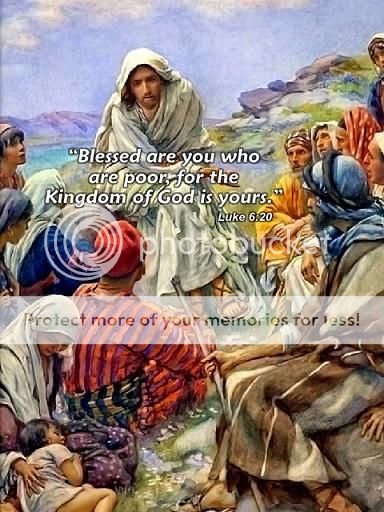
"Blessed are you who are poor,
for the Kingdom of God is yours.
Blessed are you who are now hungry,
for you will be satisfied.
Blessed are you who are now weeping,
for you will laugh.
Blessed are you when people hate you,
and when they exclude and insult you,
and denounce your name as evil
on account of the Son of Man.

Rejoice and leap for joy on that day!
Behold, your reward will be great in heaven.
For their ancestors treated the prophets
in the same way.

But woe to you who are rich,
for you have received your consolation.
But woe to you who are filled now,
for you will be hungry.
Woe to you who laugh now,
for you will grieve and weep.
Woe to you when all speak well of you,
for their ancestors treated the false prophets in this way."

user posted image

REFLECTION

Blessed are you. The Gospel is the start of what is referred to as Jesus’ Sermon on the Plain because Jesus teaches a
great crowd while on a stretch of level ground (cf Lk 6:17). It is the counterpart of Matthew’s more familiar Sermon
on the Mount (Mt 5:1-7:27). While the Beatitudes in Matthew are addressed to the crowds that include Jesus’
disciples, Luke’s Blessings and Woes are intended for the disciples alone: Jesus raises His eyes towards them.

The introductory portion consists of blessings and woes, a theme central to Luke’s Gospel. Those who are blessed by
God are not those whom the world considers favored. The poor and the lowly indeed appear as unfortunate in the eyes
of the world, but blessings come from God. These are blessed because they mirror the person of the Son of God – Jesus
Christ – who lives poor and is denounced as evil during his passion. In sharing the condition and fate of the Son of
Man, the disciples share His look of tender mercy to the poor, the marginalized, and the vulnerable. But they also
share the joy and happiness of those who work and struggle for the Kingdom of God.

SOURCE: “365 Days with the Lord 2017,” ST. PAULS Philippines, 7708 St. Paul Rd., SAV, Makati City (Phils.) http://www.ssp.ph/

user posted image

khool
post Sep 13 2017, 01:53 PM

Getting Started
**
Junior Member
225 posts

Joined: Mar 2008


user posted image

user posted image


This post has been edited by khool: Sep 13 2017, 02:17 PM
khool
post Sep 13 2017, 04:50 PM

Getting Started
**
Junior Member
225 posts

Joined: Mar 2008


WORD TODAY
13 September 2017

In the Gospel, Jesus reveals to us what is true blessedness (or happiness). It is to be poor, hungry, weeping and cast out.
No, He is not saying it's a blessing to be a beggar and a leper. We are blessed if we willingly choose to follow Christ's radical way of life.

We are blessed if we choose to live and eat simply like Christ, unencumbered by the weight of the world’s standard of success, and rely only on God to be filled and renewed. We are blessed if we weep with the poor, the abused, the homeless and other little ones of society, and help them with their cross for love for Jesus. We are blessed if we are ridiculed and cast out by friends and society for living a holy life, for we are in the company of none other than the Son of God, starting here and now, and eternally with the martyrs and saints.

We are truly blessed if we allow Jesus to form our actions, thoughts, words, and lifestyle. We are truly happy when we are released from sin and set free to worship, serve and evangelize as living witnesses to the power and glory of God.

In the First Reading, St. Paul who chose to follow Jesus says, "Now is the time to get rid of anger, rage, malicious behavior, slander, and dirty language... Put on your new nature, and be renewed as you learn to know your Creator and become like him." (Colossians 3:8,10 NLT)

Here is an illustration:

On the way home to her apartment after work, a secretary was attracted by a beautiful vase in a store display window. She admired it for some time and then she decided to buy it. She took it to her room and placed it on a small table beside the window.

But the vase didn't look as nice as it did in the store window, so she bought a pretty tablecloth to cover the bare table and curtains for the window. Then she noticed the dirty wallpaper so she soaped and wiped it clean. Then she mopped her grimy floor and axed it. Next she focused on the broken furniture and had it fixed. And so on.

Over time, her once ugly room was transformed and made worthy of the beautiful vase...

So it is when we give Jesus a place in our heart. With daily Communion, Bible reading and frequent confession, Jesus will make us see what needs cleaning, fixing and replacing in our life, gradually make it worthy of Him.
Let us leave our old life of woes and live the new life of blessings. With Jesus, life will be joyful and beautiful.


user posted image

Source: https://www.facebook.com/CatholicMassReflec...778052155825875


38 Pages « < 10 11 12 13 14 > » Top
 

Change to:
| Lo-Fi Version
0.1113sec    0.39    7 queries    GZIP Disabled
Time is now: 2nd December 2025 - 05:08 AM