Welcome Guest ( Log In | Register )

38 Pages « < 8 9 10 11 12 > » Bottom

Outline · [ Standard ] · Linear+

 LYN Catholic Fellowship V02 (Group), For Catholics (Roman or Eastern)

views
     
khool
post Aug 22 2017, 10:25 AM

Getting Started
**
Junior Member
225 posts

Joined: Mar 2008


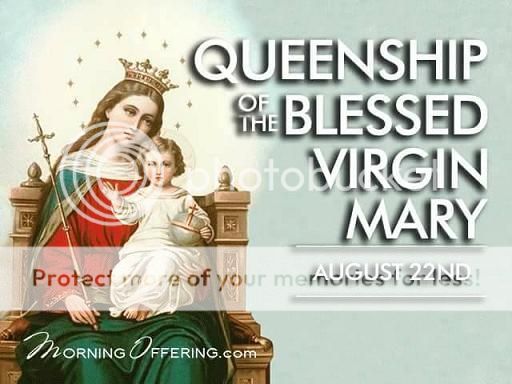
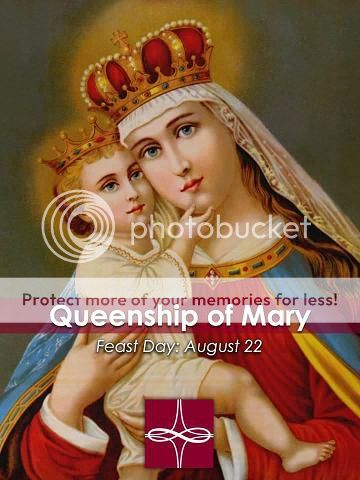
Memorial of the Queenship of the Blessed Virgin Mary
Lectionary: 420


user posted image

Hail, holy Queen, Mother of mercy,
Hail, our life, our sweetness and our hope.

To thee do we cry, poor banished children of Eve:
To thee do we send up our sighs, mourning and weeping in this vale of tears.

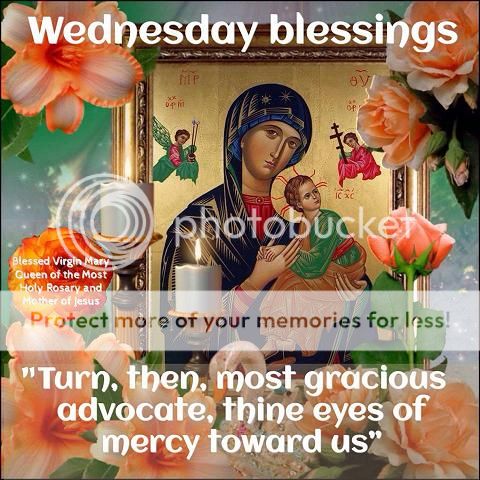
Turn then, most gracious Advocate, thine eyes of mercy toward us,
And after this our exile, show unto us the blessed fruit of thy womb, Jesus,

O loving, O merciful, O sweet Virgin Mary! Amen!!

user posted image

Reading 1 (Jgs 6:11-24a)

The angel of the LORD came and sat under the terebinth in Ophrah
that belonged to Joash the Abiezrite.
While his son Gideon was beating out wheat in the wine press
to save it from the Midianites,
the angel of the LORD appeared to him and said,
"The LORD is with you, O champion!"
Gideon said to him, "My Lord, if the LORD is with us,
why has all this happened to us?
Where are his wondrous deeds of which our fathers
told us when they said, 'Did not the LORD bring us up from Egypt?'
For now the LORD has abandoned us
and has delivered us into the power of Midian."
The LORD turned to him and said, "Go with the strength you have
and save Israel from the power of Midian.
It is I who send you."
But Gideon answered him, "Please, my lord, how can I save Israel?
My family is the lowliest in Manasseh,
and I am the most insignificant in my father's house."
"I shall be with you," the LORD said to him,
"and you will cut down Midian to the last man."
Gideon answered him, "If I find favor with you,
give me a sign that you are speaking with me.
Do not depart from here, I pray you, until I come back to you
and bring out my offering and set it before you."
He answered, "I will await your return."

So Gideon went off and prepared a kid and a measure of flour
in the form of unleavened cakes.
Putting the meat in a basket and the broth in a pot,
he brought them out to him under the terebinth
and presented them.
The angel of God said to him, "Take the meat and unleavened cakes
and lay them on this rock; then pour out the broth."
When he had done so,
the angel of the LORD stretched out the tip of the staff he held,
and touched the meat and unleavened cakes.
Thereupon a fire came up from the rock
that consumed the meat and unleavened cakes,
and the angel of the LORD disappeared from sight.
Gideon, now aware that it had been the angel of the LORD,
said, "Alas, Lord GOD,
that I have seen the angel of the LORD face to face!"
The LORD answered him,
"Be calm, do not fear. You shall not die."
So Gideon built there an altar to the LORD
and called it Yahweh-shalom.

Responsorial Psalm (Ps 85:9, 11-12, 13-14)

R. The Lord speaks of peace to his people.

I will hear what God proclaims;
the LORD–for he proclaims peace
To his people, and to his faithful ones,
and to those who put in him their hope.
R. The Lord speaks of peace to his people.

Kindness and truth shall meet;
justice and peace shall kiss.
Truth shall spring out of the earth,
and justice shall look down from heaven.
R. The Lord speaks of peace to his people.

The LORD himself will give his benefits;
our land shall yield its increase.
Justice shall walk before him,
and salvation, along the way of his steps.
R. The Lord speaks of peace to his people.

Alleluia (2 Cor 8:9)

R. Alleluia, alleluia.
Jesus Christ became poor although he was rich
so that by his poverty you might become rich.
R. Alleluia, alleluia.

Gospel (Mt 19:23-30)

Jesus said to his disciples:
"Amen, I say to you, it will be hard for one who is rich
to enter the Kingdom of heaven.
Again I say to you,
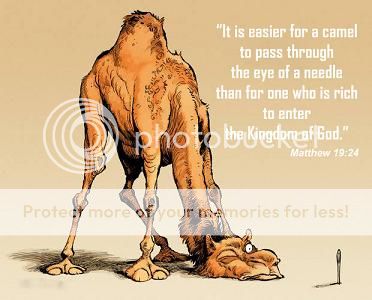
it is easier for a camel to pass through the eye of a needle
than for one who is rich to enter the Kingdom of God."
When the disciples heard this, they were greatly astonished and said,
"Who then can be saved?"
Jesus looked at them and said,
"For men this is impossible,
but for God all things are possible."
Then Peter said to him in reply,
"We have given up everything and followed you.
What will there be for us?"
Jesus said to them, "Amen, I say to you
that you who have followed me, in the new age,
when the Son of Man is seated on his throne of glory,
will yourselves sit on twelve thrones,
judging the twelve tribes of Israel.
And everyone who has given up houses or brothers or sisters
or father or mother or children or lands
for the sake of my name will receive a hundred times more,
and will inherit eternal life.
But many who are first will be last, and the last will be first."

REFLECTION

IT WILL BE HARD FOR ONE WHO IS RICH TO ENTER THE KINGDOM OF HEAVEN.

Why? If we take at face value the statements of the rich young man (cf 19:16-22), it is not that he is an evil person, an oppressor, or an extortionist. He has kept the commandments—all of them—including the commandments not to steal, not to covet what belongs to somebody else, and to love his neighbor. The problem with the man is not that he is dishonorable; the trouble is that he is rich. The problem is not with the evil he has done to others, but with the evil his wealth is doing to him. Because he is rich, it is hard for him to surrender to God. He finds it painfully difficult to become humble like a child. His wealth reinforces his commitment to the present age and to his own status in it; his wealth underscores his self-sufficiency.

One commentator observed: “ The young man asked, ‘What good thing shall I do?’ and insisted, ‘All these things I have observed, what do I still lack?’ He assumes that entering the Kingdom of heaven is something that he can bid for and pull off on his own.”

SOURCE: “365 Days with the Lord 2017,” ST. PAULS Philippines, 7708 St. Paul Rd., SAV, Makati City (Phils.) http://www.ssp.ph/

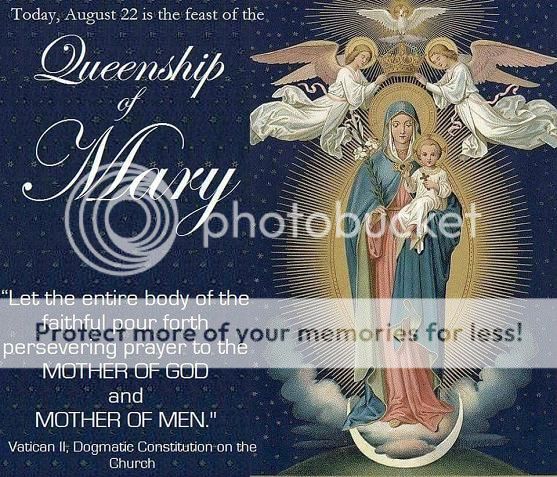
Saint of the Day: Queenship of Mary
user posted image

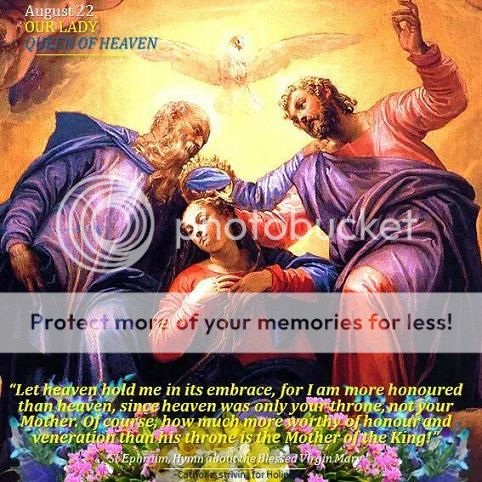
From the earliest centuries of the Church, Christians have addressed fervent prayers and hymns of praise to the Blessed Virgin Mary. Because of her eminence, Christians have always acknowledged the royal excellence of the Mother of God whose Son “will reign in the house of Jacob forever” (Lk 1:32).

From the testimonies of the Fathers, theologians concluded that the Blessed Virgin is Queen of all creation, Sovereign Mistress of all humankind. “Since the great Virgin Mary was raised to the dignity of Mother of the King of Kings, the Church justly honors her, and wishes that she be honored with the glorious title of Queen,” says Saint Alphonsus de Liguori.

Proposing the traditional doctrine on the Queenship of Mary, Pope Pius XII says in his encyclical Ad Coeli Reginam: “We commend that on the festival there be renewed the consecration of the human race to the Immaculate Heart of the Blessed Virgin Mary. Upon this there is founded a great hope that there may arise an era of happiness that will rejoice in the triumph of religion and in Christian peace.

“Therefore, let all approach with greater confidence more than before, the throne of mercy and grace of our Queen and Mother to beg help in difficulty, light in darkness and solace in trouble and sorrow; and let them strive to free themselves from the servitude of sin....”

Reflection: “Mary’s conformity to the will of God was total. Mary enjoys God. She ... has a very special place in paradise: more perfect than that of the other saints because she is the Queen” (Blessed James Alberione).

Source: https://www.facebook.com/stpaulspubindia/po...441785945899604
user posted image


This post has been edited by khool: Aug 22 2017, 10:27 AM
khool
post Aug 22 2017, 10:32 AM

Getting Started
**
Junior Member
225 posts

Joined: Mar 2008


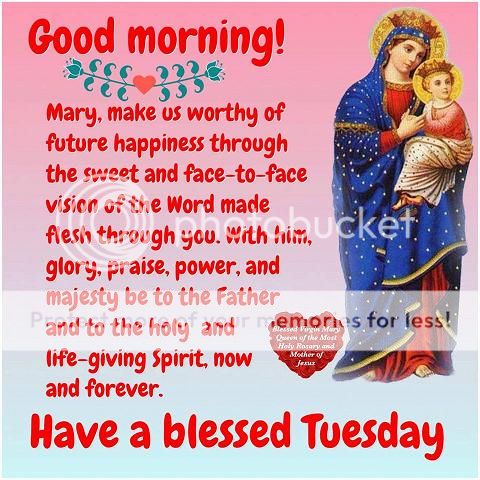
DIVINE *:•¸✞ 👥¸.•*AID★★.¸.•* *:•:.• 💞 .🕊️. ╮

......... •*¨`*• ....
(¯`'•. //(*_*)\\ ¸.•'´¯)Ɠσσ∂. ✞ .👥Mσяηιηg .¸.•*☀
*•`'•. .…* * *¸.•'´•´
<3 •✤•HAPPY•ღ✤ღ• FEAST°•✤• <3
╰ ✤QUEENSHIP OF VIRGIN MARY✤╮
..*:•¸..✞...•**
.//(︺︹︺)\\'
/((.:. <3 .:.))\\\.. .(~_~)✤ Queen of Home
:.` /.........\' ........:.🙏🏼.: ..✤ Queen of our hearts.
.:.:/_____\.........._I I_......✤ Queen of all Gracious.
.(¸.•´ (¸.•` (¸.•´ (¸.•`(¸.•`.........✤ Queen above all.
HAVE A..✞ed.. TUESDAY"*:•


user posted image

¸.•* *:•✞
╰ あ Good Morning .O Mary, Queen of all hearts,

Advocate of hopeless causes,
Mother so pure, so compassionate,
Mother of divine Love and full of divine light,
I place in your hands so gentle
the favors that we await from you today.

Look upon our wretchedness,
our hearts, our tears, our interior trials, our sufferings:
You can answer our prayers through
the merits of your divine Son, Jesus Christ.

We promise, if our prayers are heard,
to spread your glory and to make you known
under the title of Mary, Queen of all hearts
and Queen of all creation.

Graciously hear our prayers at your altar,
where every day you give so many proofs of your power and your love
for the healing of the soul and of the body.

We hope against all hope:
Ask of Jesus our healing, our pardon and our final perseverance.

O Mary, Queen of all hearts,
Bless us and keep us in your mantle and protect us......
We place our trust in you. (3 times).. . ᎪmєᏁ✟ <3 ╮

Bless .≽✞≼ us, our (*︺🙏🏼︺) Lord our God
protect us from all evil
and bring us to everlasting life.

(*︺︹︺)八八.. .We ask and prayer . in Jesus Christ, Holy Spirit and Mother Mary name..who taught us to pray to you. Amen! ✟. ╮.
Glory to the Father, and to the Son, and to the Holy Spirit: *
as it was in the beginning, is now, and will be for ever. Amen!

user posted image

Source: https://www.facebook.com/permalink.php?stor...100009929195903

khool
post Aug 22 2017, 12:07 PM

Getting Started
**
Junior Member
225 posts

Joined: Mar 2008


tongue.gif tongue.gif tongue.gif biggrin.gif biggrin.gif biggrin.gif

user posted image

khool
post Aug 22 2017, 01:56 PM

Getting Started
**
Junior Member
225 posts

Joined: Mar 2008


khool
post Aug 23 2017, 09:56 AM

Getting Started
**
Junior Member
225 posts

Joined: Mar 2008


Wednesday of the Twentieth Week in Ordinary Time
Lectionary: 421


user posted image

Reading 1 (Jgs 9:6-15)

All the citizens of Shechem and all Beth-millo came together
and proceeded to make Abimelech king
by the terebinth at the memorial pillar in Shechem.

When this was reported to him,
Jotham went to the top of Mount Gerizim and, standing there,
cried out to them in a loud voice:
"Hear me, citizens of Shechem, that God may then hear you!
Once the trees went to anoint a king over themselves.
So they said to the olive tree, 'Reign over us.'
But the olive tree answered them, 'Must I give up my rich oil,
whereby men and gods are honored,
and go to wave over the trees?'
Then the trees said to the fig tree, 'Come; you reign over us!'
But the fig tree answered them,
'Must I give up my sweetness and my good fruit,
and go to wave over the trees?'
Then the trees said to the vine, 'Come you, and reign over us.'
But the vine answered them,
'Must I give up my wine that cheers gods and men,
and go to wave over the trees?'
Then all the trees said to the buckthorn, 'Come; you reign over us!'
But the buckthorn replied to the trees,
'If you wish to anoint me king over you in good faith,
come and take refuge in my shadow.
Otherwise, let fire come from the buckthorn
and devour the cedars of Lebanon.'"

Responsorial Psalm (Ps 21:2-3, 4-5, 6-7)

R. Lord, in your strength the king is glad.

O LORD, in your strength the king is glad;
in your victory how greatly he rejoices!
You have granted him his heart's desire;
you refused not the wish of his lips.
R. Lord, in your strength the king is glad.

For you welcomed him with goodly blessings,
you placed on his head a crown of pure gold.
He asked life of you: you gave him
length of days forever and ever.
R. Lord, in your strength the king is glad.

Great is his glory in your victory;
majesty and splendor you conferred upon him.
You made him a blessing forever,
you gladdened him with the joy of your face.
R. Lord, in your strength the king is glad.

Alleluia (Heb 4:12)

R. Alleluia, alleluia.
The word of God is living and effective,
able to discern the reflections and thoughts of the heart.
R. Alleluia, alleluia.

Gospel (Mt 20:1-16)

Jesus told his disciples this parable:
"The Kingdom of heaven is like a landowner
who went out at dawn to hire laborers for his vineyard.
After agreeing with them for the usual daily wage,
he sent them into his vineyard.
Going out about nine o'clock,
he saw others standing idle in the marketplace,
and he said to them, 'You too go into my vineyard,
and I will give you what is just.'
So they went off.
And he went out again around noon,
and around three o'clock, and did likewise.
Going out about five o'clock,
he found others standing around, and said to them,
'Why do you stand here idle all day?'
They answered, 'Because no one has hired us.'
He said to them, 'You too go into my vineyard.'
When it was evening the owner of the vineyard said to his foreman,
'Summon the laborers and give them their pay,
beginning with the last and ending with the first.'
When those who had started about five o'clock came,
each received the usual daily wage.
So when the first came, they thought that they would receive more,
but each of them also got the usual wage.
And on receiving it they grumbled against the landowner, saying,
'These last ones worked only one hour,
and you have made them equal to us,
who bore the day's burden and the heat.'
He said to one of them in reply,
'My friend, I am not cheating you.
Did you not agree with me for the usual daily wage?
Take what is yours and go.
What if I wish to give this last one the same as you?
Or am I not free to do as I wish with my own money?
Are you envious because I am generous?'
Thus, the last will be first, and the first will be last."

user posted image

REFLECTION

Take what is yours and go. The landowner says this to the vineyard worker who has false expectations. The worker who has toiled all day thinks he should be given more than the one who has just reported for work. For him, the landowner is being unfair.

Trouble may well be avoided if the first workers were paid first. But the parable is not about religious or labor practice. It is meant to prick the mind of the listeners or readers as to how the Kingdom of God works.

The landowner represents God or Jesus. The workers are all those who are invited to work in God’s Kingdom. All who respond to God’s call will be treated equally. They will enjoy seeing God face to face in the same level without discrimination.

We cannot combine the standards of the world’s kingdoms With those of God’s reign.

SOURCE: “365 Days with the Lord 2017,” ST. PAULS Philippines, 7708 St. Paul Rd., SAV, Makati City (Phils.) http://www.ssp.ph/

user posted image

khool
post Aug 23 2017, 10:33 AM

Getting Started
**
Junior Member
225 posts

Joined: Mar 2008


WORD Today - August 23, 2017
(A reflection on the Bible readings in today's Holy Mass)


user posted image

Today's readings present two ways of messing up a faith community or a church ministry, and ultimately disrupt the buildup of God's Kingdom.

In the Gospel, Jesus tells the Parable of the Workers in the Vineyard wherein the vineyard owner (God) recruits workers from the start of the day till almost quitting time. Those who worked early expected more pay than the ones who come late. But they are disappointed when they all get the same pay. The owner asks them if they are jealous because he is generous to all.

This parable highlights the jealousy that some entrenched old-timers can display toward new-comers whose work get the same recognition as theirs, or even more. They feel that new-comers must always take the backseat.

In the First Reading is a fable. The trees in a forest decide to choose a king. They ask an olive tree, then a fig tree, then a grape vine to serve as their leader. One by one, they refused, saying they are already producing good fruits for all and should not be bothered anymore. Finally the trees had to ask a buckthorn bush that neither produced fruit for the hungry nor shade for the weary. The bush accepted the job to lead the trees much taller than it was.

This exposes what happens when better-qualified old-timers refuse the call to serve in other ways because they are already comfortable in their "important" post. The organization is forced to give the job to the unqualified or incompetent.

We must always remember that the Son of God sacrificed the comforts of heaven for the misery of the cross in order to build His Father's Kingdom. Let us pray for wisdom to know where our talents can best be used by Jesus, and the humility to give up places of honor in gratitude for the way our Savior gave up His life.

user posted image

Source: https://www.facebook.com/CatholicMassReflec...503454052367317

khool
post Aug 23 2017, 02:02 PM

Getting Started
**
Junior Member
225 posts

Joined: Mar 2008


khool
post Aug 24 2017, 09:35 AM

Getting Started
**
Junior Member
225 posts

Joined: Mar 2008


Feast of Saint Bartholomew, Apostle
Lectionary: 629


user posted image

Reading 1 (Rv 21:9b-14)

The angel spoke to me, saying,
"Come here.
I will show you the bride, the wife of the Lamb."
He took me in spirit to a great, high mountain
and showed me the holy city Jerusalem
coming down out of heaven from God.
It gleamed with the splendor of God.
Its radiance was like that of a precious stone,
like jasper, clear as crystal.
It had a massive, high wall,
with twelve gates where twelve angels were stationed
and on which names were inscribed,
the names of the twelve tribes of the children of Israel.
There were three gates facing east,
three north, three south, and three west.
The wall of the city had twelve courses of stones as its foundation,
on which were inscribed the twelve names
of the twelve Apostles of the Lamb.

Responsorial Psalm (Ps 145:10-11, 12-13, 17-18)

R. Your friends make known, O Lord, the glorious splendor of your Kingdom.

Let all your works give you thanks, O LORD,
and let your faithful ones bless you.
Let them discourse of the glory of your Kingdom
and speak of your might.
R. Your friends make known, O Lord, the glorious splendor of your Kingdom.

Making known to men your might
and the glorious splendor of your Kingdom.
Your Kingdom is a Kingdom for all ages,
and your dominion endures through all generations.
R. Your friends make known, O Lord, the glorious splendor of your Kingdom.

The LORD is just in all his ways
and holy in all his works.
The LORD is near to all who call upon him,
to all who call upon him in truth.
R. Your friends make known, O Lord, the glorious splendor of your Kingdom.

user posted image

Alleluia (Jn 1:49b)

R. Alleluia, alleluia.
Rabbi, you are the Son of God;
you are the King of Israel.
R. Alleluia, alleluia.

Gospel (Jn 1:45-51)

Philip found Nathanael and told him,
"We have found the one about whom Moses wrote in the law,
and also the prophets, Jesus son of Joseph, from Nazareth."
But Nathanael said to him,
"Can anything good come from Nazareth?"
Philip said to him, "Come and see."
Jesus saw Nathanael coming toward him and said of him,
"Here is a true child of Israel.
There is no duplicity in him."
Nathanael said to him, "How do you know me?"
Jesus answered and said to him,
"Before Philip called you, I saw you under the fig tree."
Nathanael answered him,
"Rabbi, you are the Son of God; you are the King of Israel."
Jesus answered and said to him,
"Do you believe
because I told you that I saw you under the fig tree?
You will see greater things than this."
And he said to him, "Amen, amen, I say to you,
you will see heaven opened and the angels of God
ascending and descending on the Son of Man."

user posted image

REFLECTION

Come and see. This is the response of Philip to his fellow Apostle Nathanael (Bartholomew). It is an invitation to discover for himself the person spoken of by the law and the prophets.

Nathanael responds to the invitation and goes with Philip and finds out what his fellow Apostle is referring to, the man Jesus who comes from an insignificant place called Nazareth. Indeed, compared to the other towns in the region of Sepphoris, Nazareth is like a hamlet in the countryside.

As soon as they arrive, Jesus initiates the conversation. He shows his awareness of Nathanael’s whereabouts before being called by Philip. Right away, Nathanael acknowledges who is now in front of him. He is a rabbi, the Son of God, and the King of Israel.

Jesus goes further and stimulates Nathanael’s mind to challenge his initial skepticism. Because of his spontaneous response of faith, Jesus promises him more. Without saying it, Jesus repeats, “Come and see…” Nathanael will witness more and even greater things.

Do you invite people to experience Jesus in the Church and in the sacraments?

SOURCE: “365 Days with the Lord 2017,” ST. PAULS Philippines, 7708 St. Paul Rd., SAV, Makati City (Phils.) http://www.ssp.ph/

user posted image

This post has been edited by khool: Aug 24 2017, 02:36 PM
khool
post Aug 24 2017, 11:06 AM

Getting Started
**
Junior Member
225 posts

Joined: Mar 2008


Jesus is God Why We Believe "I AM" by Fr. James Kubecki


khool
post Aug 24 2017, 02:24 PM

Getting Started
**
Junior Member
225 posts

Joined: Mar 2008


khool
post Aug 24 2017, 02:32 PM

Getting Started
**
Junior Member
225 posts

Joined: Mar 2008


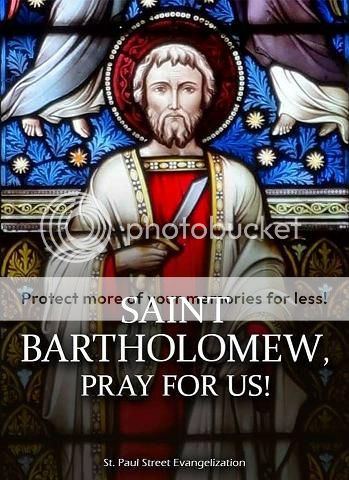
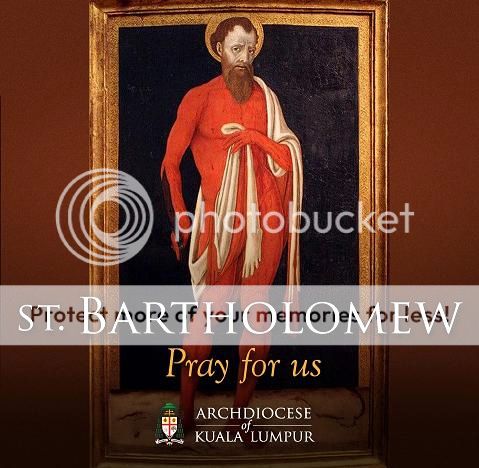
Saint Bartholomew, Apostle and Martyr

user posted image

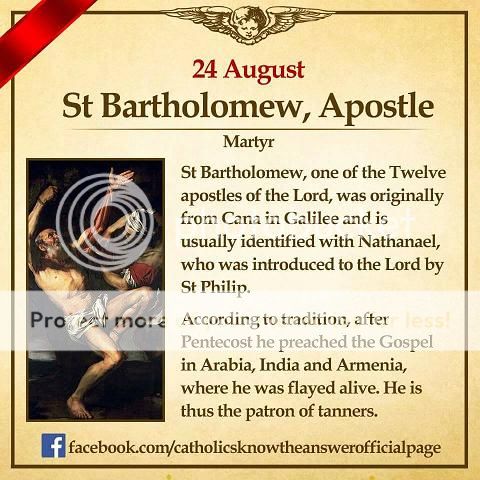
August 24 is the feast of Saint Bartholomew, one of the twelve apostles who is mentioned only a few times in the Synoptic Gospels. While Matthew, Mark, and Luke all include Bartholomew as an apostle, John’s gospel does not mention him, but refers to a Nathaniel, whom ancient writers and Catholic tradition have identified as Bartholomew. The name (Bartholomaios) means “son of Talmai”, which was an ancient Hebrew name.

Saint Bartholomew carried the Gospel through the most barbarous countries of the East (India and greater Armenia), baptizing neophytes and casting out demons. Saint Pantænus testified that Bartholomew brought a copy of the Gospel of Saint Matthew to this vast region in the third century. Saint John Chrysostom said that Bartholomew also preached in Asia Minor and, with Saint Philip, suffered there for the faith. His last mission was in Armenia, where he was martyred. The manner of his death is uncertain. Some report that he was beheaded, while others recount that he was flayed alive and crucified, head downward.

According to tradition, the relics of Saint Bartholomew made their way from Armenia to the Isle of Lipari (near Sicily) in the seventh century. From there, they were moved to Benevento, in Campania, northeast of Naples, in 809, and finally came to rest in 983 in the Church of Saint Bartholomew-in-the-Island, on the Isle of Tiber in Rome.

Saint Bartholomew is the patron saint of: bookbinders, butchers, furriers, leather-workers, plasterers, shoemakers, tailors, tanners, vine-growers, Florentine salt and cheese merchants. He is also invoked against nervous disorders and tics.

Prayer

Lord,
sustain within us the faith
which made Saint Bartholomew ever loyal to Christ.
Let your Church be the sign of salvation
for all the nations of the world.
We ask this through our Lord Jesus Christ, your Son,
who lives and reigns with you and the Holy Spirit,
one God, for ever and ever. Amen.


user posted image

Source: http://www.jeanmheimann.com/2017/08/saint-...apostle-martyr/

This post has been edited by khool: Aug 24 2017, 02:34 PM
khool
post Aug 25 2017, 09:53 AM

Getting Started
**
Junior Member
225 posts

Joined: Mar 2008


Friday of the Twentieth Week in Ordinary Time
Lectionary: 423


user posted image

Reading 1 (Ru 1:1, 3-6, 14b-16, 22)

Once in the time of the judges there was a famine in the land;
so a man from Bethlehem of Judah
departed with his wife and two sons
to reside on the plateau of Moab.
Elimelech, the husband of Naomi, died,
and she was left with her two sons, who married Moabite women,
one named Orpah, the other Ruth.

When they had lived there about ten years,
both Mahlon and Chilion died also,
and the woman was left with neither her two sons nor her husband.
She then made ready to go back from the plateau of Moab
because word reached her there
that the LORD had visited his people and given them food.

Orpah kissed her mother-in-law good-bye, but Ruth stayed with her.

Naomi said, "See now!
Your sister-in-law has gone back to her people and her god.
Go back after your sister-in-law!"
But Ruth said, "Do not ask me to abandon or forsake you!
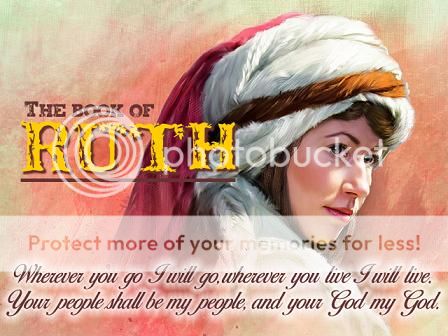
For wherever you go, I will go, wherever you lodge I will lodge,
your people shall be my people, and your God my God."

Thus it was that Naomi returned
with the Moabite daughter-in-law, Ruth,
who accompanied her back from the plateau of Moab.
They arrived in Bethlehem at the beginning of the barley harvest.

Responsorial Psalm (Ps 146:5-6ab, 6c-7, 8-9a, 9bc-10)

R. Praise the Lord, my soul!

Blessed is he whose help is the God of Jacob,
whose hope is in the LORD, his God,
Who made heaven and earth,
the sea and all that is in them.
R. Praise the Lord, my soul!

The LORD keeps faith forever,
secures justice for the oppressed,
gives food to the hungry.
The LORD sets captives free.
R. Praise the Lord, my soul!

The LORD gives sight to the blind.
The LORD raises up those who were bowed down;
The LORD loves the just.
The LORD protects strangers.
R. Praise the Lord, my soul!

The fatherless and the widow he sustains,
but the way of the wicked he thwarts.
The LORD shall reign forever;
your God, O Zion, through all generations. Alleluia.
R. Praise the Lord, my soul!

Alleluia (Ps 25:4b, 5a)

R. Alleluia, alleluia.
Teach me your paths, my God,
guide me in your truth.
R. Alleluia, alleluia.

Gospel (Mt 22:34-40)

When the Pharisees heard that Jesus had silenced the Sadducees,
they gathered together, and one of them,
a scholar of the law, tested him by asking,
"Teacher, which commandment in the law is the greatest?"
He said to him,
"You shall love the Lord, your God, with all your heart,
with all your soul, and with all your mind.
This is the greatest and the first commandment.
The second is like it:
You shall love your neighbor as yourself.
The whole law and the prophets depend on these two commandments."

user posted image

REFLECTION

You shall love the Lord. Jesus replies to a Pharisee who wants to test him. The guy is an expert of the law. He must be much older than Jesus. He must be much older than Jesus. He spends most of his time studying the law and its interpretations. He can engage in debates like the Sadducees. He thinks he can fare better than they. So he begins to test Jesus.

Jesus’ first commandment does not come as a surprise; it is not new to the Jews who pray it morning and evening in the recitation of the Shema based on Dt. 6:4-6. The second greatest is culled from Leviticus.

Jesus picks up an important teaching of Jewish religion, love. Love is expressed in one’s relationship with God and neighbor. This God of love is the God of history. He accompanies his people towards liberation. The neighbor is one’s brother journeying with him in the community. The neighbor is also the stranger.

Religion is not so much a conformity to set rules and regulations and their interpretation as the spontaneous practice of love. True religion is the religion of the heart. An excessive academic approach leads to legalism and quantification.

How do you practice your religion? Does it increase your knowledge of your religion or your capacity to love?

SOURCE: “365 Days with the Lord 2017,” ST. PAULS Philippines, 7708 St. Paul Rd., SAV, Makati City (Phils.) http://www.ssp.ph/

user posted image

user posted image

khool
post Aug 25 2017, 10:09 AM

Getting Started
**
Junior Member
225 posts

Joined: Mar 2008


This is how to bless your children

user posted image

It is an ancient tradition that parents can do every day.

Parents have the weighty task of bringing their children to God. The Catechism of the Catholic Church explains how, “Through the grace of the sacrament of marriage, parents receive the responsibility and privilege of evangelizing their children. Parents should initiate their children at an early age into the mysteries of the faith of which they are the ‘first heralds’ for their children” (CCC 2225).

This is certainly not an easy task and at times can seem fruitless. Sometimes we may never know until years later the effect we had on our children.

One important part of “evangelizing” our children is quite simple and very ancient. It is called the “Parental Blessing” and consists of an ability to call down God’s blessings upon your children. As parents we have a special responsibility and duty to entrust our children to God and our prayers have a double effect upon them. God has given them to us and it is our duty to give them back to God.

Examples of this type of blessing run throughout the Old Testament. One of the most well known examples is that of Isaac blessing his son Jacob (cf. Genesis 27). There are many other examples in the Old Testament and for this reason many people use these blessings with their own children.

One blessing that is frequently used is from the book of Numbers and is referred to as the Aaronic Blessing: “The Lord bless you and keep you. The Lord let his face shine upon you, and be gracious to you. The Lord look upon you kindly and give you peace” (Numbers 6:24-26).

Another blessing comes from the book of Tobit, where Tobit gives his son Tobias a blessing before he departs on a journey: “May God in heaven protect you on the way and bring you back to me safe and sound; may his angel accompany you” (Tobit 5:17).

A simple way to do this would be to take a bit of holy water (if available) and trace the sign of the cross on the forehand of your child (or simply place your hand on their head). While doing this you can pray any of the above prayers, or just say, “May God bless you in the name of the Father, and the Son, and the Holy Spirit.”

The formula of the prayer is not set in stone and a parent can use a spontaneous prayer to bless their children. The important part is to invoke God’s blessing upon them, recognizing the power God has given you as a parent.

This blessing is most typically done before bedtime, but can also be used before your child goes off to school, boards the bus or goes on a journey. It will give you added comfort to know that God is with them as they leave your home and an angel is there beside them every step of the way.

It’s not easy being a parent and teaching them the faith can seen like an insurmountable task. However, with God’s help, all things are possible.

Source: https://aleteia.org/2017/08/23/this-is-how-...-your-children/

user posted image

khool
post Aug 25 2017, 02:04 PM

Getting Started
**
Junior Member
225 posts

Joined: Mar 2008


khool
post Aug 25 2017, 02:12 PM

Getting Started
**
Junior Member
225 posts

Joined: Mar 2008


WORD Today
August 25, 2017


REFLECTION

user posted image

In today's Gospel, Jesus summarizes the eternal 10 Commandments as "You shall love the Lord, your God" and "You shall love your neighbor as yourself." (Mt 22:37-39)

The first 3 Commandments are about loving God:
1. I am the Lord your God: You shall no other gods before me.
2. You shall not take the name of the Lord your God in vain.
3. Remember to keep holy the Lord's Day.


The other 7 are about loving our "neighbor", or fellow man:
4. Honor your father & your mother.
5. You shall not kill.
6. You shall not commit adultery.
7. You shall not steal.
8. You shall not bear false witness against your neighbor.
9. You shall not covet your neighbor's wife.
10. You shall not covet your neighbor's goods.


The complete text of the 4th Commandment is "Honor your father and your mother, that your days may be long in the land which the Lord your God gives you." (Exodus 20:12)

It is the only Commandment with a promise of reward. Today's First Reading is a truly heart-moving and beautiful example of this Commandment. Do read the short and romantic Book of Ruth. It is a true story and it shows how God keeps His promise to those who love their parents and all elderly people.

user posted image

Ruth's true story happened around 1,100 years before Jesus was born. It's more romantic than any fictional tele-novela (TV drama) ever created.

Ruth (a non-Israelite) and her Israelite mother-in-law Naomi, lived under one roof in the land of Moab, far from Israel. Then, in a span of ten years, both their husbands passed away. In those times and in that culture, widows were the most miserable and defenseless people. Having practically no rights and no protection under civil laws, widows were like objects without owners, at the mercy of any man passing by.

Ruth was beautiful and still young. She would have been welcome to return to the security of her own maternal family and their familiar ways and gods. Even her mother-in-law Naomi urged her to do this and re-marry. But in reply, Ruth uttered these beautiful words, "Do not ask me to abandon or forsake you. For wherever you go I will go, wherever you live I will live. Your people shall be my people, and your God my God." (Ruth 1:16)

Then she went with her old and penniless mother-in-law to travel back to Bethlehem, Naomi's hometown in Israel. Ruth chose to spend the rest of her life in an uncertain future in a strange land of strange people with strange customs. Ruth was under no obligation to do this - she chose to do it. She chose to serve Naomi her nearest neighbor and alternate mother, and to worship the One True God.

There in her adopted homeland, her faith (love for God) and kindness to old Naomi (love for neighbor) turned their tragedy into a new beginning and a happy ending. [This will be tomorrow's First Reading.]

All sacrificial suffering (the ultimate expression of love), whether big or small, when offered to God will never fade away. God will use and merge our offerings to bring good for someone, somewhere, some-when, in ways beyond our understanding or imagination.

"God has willed that, after Him, we should honor our parents to whom we owe life and who have handed on to us the knowledge of God. We are obliged to honor and respect all those whom God, for our good, has vested with His authority."
-Catechism of the Catholic Church (CCC), no. 2197


This teaching of the Church is inspired by how the Son of God honored and loved His earthly parents Mary and Joseph whom God vested with authority for the good of all humanity.

Reflecting on Ruth's love for her mother-in-law, let us review our relationship with our parents and all the elderly of our extended family. Let us ask God for forgiveness for any failure, and ask His help to correct what needs correcting.


Source: https://www.facebook.com/CatholicMassReflec...503630481578908

This post has been edited by khool: Aug 25 2017, 02:24 PM
khool
post Aug 25 2017, 02:20 PM

Getting Started
**
Junior Member
225 posts

Joined: Mar 2008


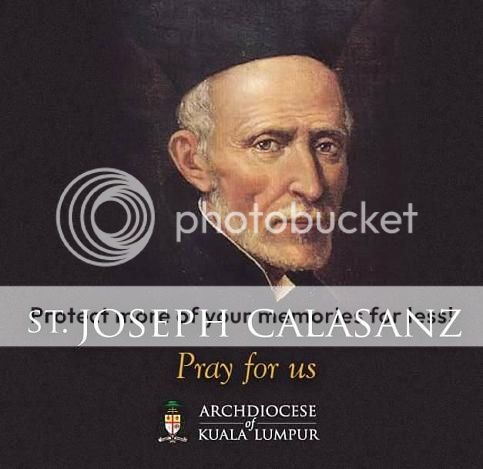
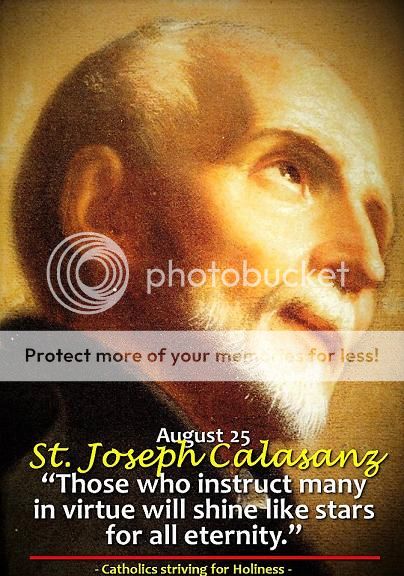
ST. JOSEPH CALASANZ
August 25


user posted image

"Let us strive to cling to Christ and please him alone."

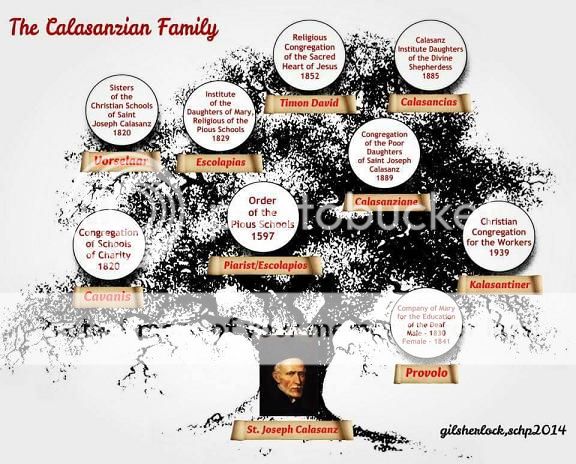
Born in Aragon, Spain, St. Joseph of Calasanz (1557-1648) was ordained priest and went to Rome to found the Piarist Congregation dedicated to the care and education of poor children. He suffered trials, slander, and persecution silently and serenely.

From St Joseph de Calasanz to Cardinal M.A. Tonti ...

"Let us strive to cling to Christ and please him alone"

Everybody realises the great dignity and merit of that ministry in which men devote themselves to the education of boys, especially poor boys, so that they may learn the way to eternal life. When, in the interests of soul and body, knowledge is imparted, piety cultivated, Christian doctrine inculcated, their teachers share in a certain manner in the work of their guardian angels.

Help of the most excellent kind is given to young people, whatever their origin or station, so that not only are they preserved from evil but they are more easily and gently drawn towards good. It is universally accepted that when the young receive such aid, they become so much changed for the better as to be no longer recognizable for what they previously were. The young, like tender plants, are easily trained in the desired direction, but if allowed to toughen, we find that our best efforts may fail to correct their wills.

The education of youth, particularly of the poor, while it assists them to grow in human dignity, also concerns all members of Christian society. Parents rejoice to see their children being led along the right path; civil authorities approve the formation of good-living subjects and citizens. The Church especially has cause to be glad, for, as lovers of Christ and defenders of the gospel, the young are more speedily and efficaciously brought into her many and varied fields of life and action.

user posted image

Those who undertake this work of teaching, surely a task to be carried out with the greatest care, must be endowed with overflowing charity, inexhaustible patience, and, above all, profound humility. So may they be found worthy for the Lord, in answer to their humble entreaties, to make them fellow-workers with Truth itself; may he strengthen them to carry out their noble office, and finally, may he grant them a heavenly reward in accordance with the saying: ‘Those who instruct many in virtue will shine like stars for all eternity.’

They will attain more easily to this, if, having made profession of perpetual service, they strive wholeheartedly to cleave to Christ and to please him only, who said: ‘Whatever you did to one of the least of my little ones, you did it to me.’

Responsory
℟. In our great longing for you, we desired nothing better than to offer you our own lives as well as God’s gospel,* so greatly have we learned to love you.
℣. My little children, I shall always be concerned about you, until I can see Christ’s image formed in you,* so greatly have we learned to love you.

Let us pray.
O God, who adorned the Priest Saint Joseph Calasanz with such charity and patience that he labored tirelessly to educate children and endow them with every virtue, grant, we pray, that we who venerate him as a teacher of wisdom may constantly imitate him, for he worked in harmony with your truth. Through our Lord.


user posted image

Source: https://www.facebook.com/Catholicsstrivingf...838971302946535

khool
post Aug 27 2017, 10:50 AM

Getting Started
**
Junior Member
225 posts

Joined: Mar 2008


Twenty-first Sunday in Ordinary Time
Lectionary: 121


user posted image

Reading 1 (IS 22:19-23)

Thus says the LORD to Shebna, master of the palace:
"I will thrust you from your office
and pull you down from your station.
On that day I will summon my servant
Eliakim, son of Hilkiah;
I will clothe him with your robe,
and gird him with your sash,
and give over to him your authority.
He shall be a father to the inhabitants of Jerusalem,
and to the house of Judah.
I will place the key of the House of David on Eliakim's shoulder;
when he opens, no one shall shut
when he shuts, no one shall open.
I will fix him like a peg in a sure spot,
to be a place of honor for his family."

Responsorial (Psalm PS 138:1-2, 2-3, 6, 8)

R. Lord, your love is eternal; do not forsake the work of your hands.

I will give thanks to you, O LORD, with all my heart,
for you have heard the words of my mouth;
in the presence of the angels I will sing your praise;
I will worship at your holy temple.
R. Lord, your love is eternal; do not forsake the work of your hands.

I will give thanks to your name,
because of your kindness and your truth:
When I called, you answered me;
you built up strength within me.
R. Lord, your love is eternal; do not forsake the work of your hands.

The LORD is exalted, yet the lowly he sees,
and the proud he knows from afar.
Your kindness, O LORD, endures forever;
forsake not the work of your hands.
R. Lord, your love is eternal; do not forsake the work of your hands.

Reading 2 (ROM 11:33-36)

Oh, the depth of the riches and wisdom and knowledge of God!
How inscrutable are his judgments and how unsearchable his ways!
For who has known the mind of the Lord
or who has been his counselor?
Or who has given the Lord anything
that he may be repaid?
For from him and through him and for him are all things.
To him be glory forever. Amen.

Alleluia (MT 16:18)

R. Alleluia, alleluia.
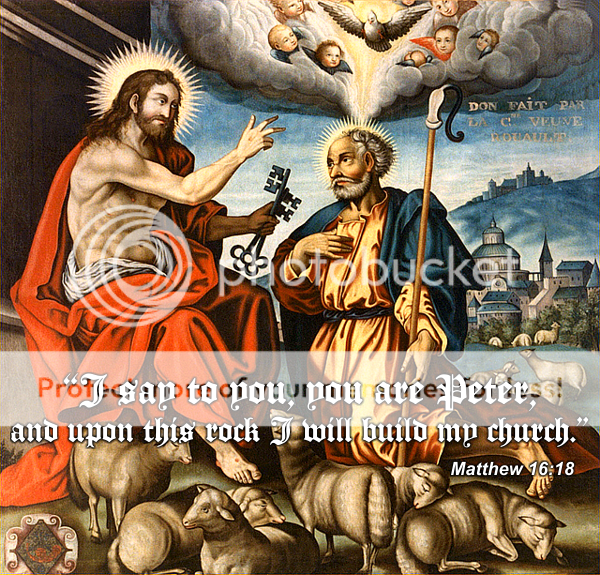
You are Peter and upon this rock I will build my Church
and the gates of the netherworld shall not prevail against it.
R. Alleluia, alleluia.

Gospel MT 16:13-20)

Jesus went into the region of Caesarea Philippi and
he asked his disciples,
"Who do people say that the Son of Man is?"
They replied, "Some say John the Baptist, others Elijah,
still others Jeremiah or one of the prophets."
He said to them, "But who do you say that I am?"
Simon Peter said in reply,
"You are the Christ, the Son of the living God."
Jesus said to him in reply,
"Blessed are you, Simon son of Jonah.
For flesh and blood has not revealed this to you, but my heavenly Father.
And so I say to you, you are Peter,
and upon this rock I will build my church,
and the gates of the netherworld shall not prevail against it.
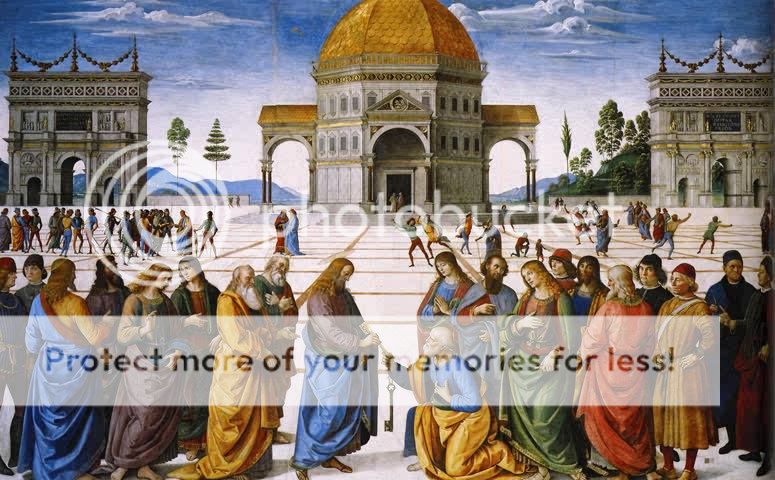
I will give you the keys to the kingdom of heaven.
Whatever you bind on earth shall be bound in heaven;
and whatever you loose on earth shall be loosed in heaven."
Then he strictly ordered his disciples
to tell no one that he was the Christ.

user posted image

REFLECTION

Our faith is your faith. In the Gospel, Jesus – the Messiah and Son of God – asks, “Who do you say that I am?” (v 15).

As Simon Peter’s confession of faith and the Lord’s affirmation of this confession strike us with awe, we can exclaim what the Apostle Paul writes to the Romans in the Second Reading: “How inscrutable are [God’s] judgments and how unsearchable his ways!” (v 33). By means of two related questions – “Who do people say…?” (v 13) “Who do you say that I am?” (v 15). – Jesus reveals to us the true nature of our Catholic faith.

The disciple’s response to Jesus’ first question makes it evident that people fail to grasp the real Jesus. They simply confine themselves to the understanding that Jesus is “one of the prophets” (v 14). And so the question now falls upon Simon Peter, the disciple who is always mentioned first among the Twelve.

Peter’s response is bold and sure, “You are the Christ, the Son of the living God” (v 16). Does Peter’s response mean that Peter is either a god or God is lesser than Peter? No, for Jesus confirms, “Blessed are you, Simon son of Jonah. For flesh and blood has not revealed this to you, but my heavenly Father” (v 17).

Finally, the Lord tells Peter, “I will give you the keys to the Kingdom of heaven” (v 19). Similar to what God promised to Eliakim in the First Reading (v 22), Jesus will give Peter the keys, the symbol of authority and of the power to bind and to loose.

From this dialogue between the disciples and Jesus, we can understand the mystery of our Catholic faith.

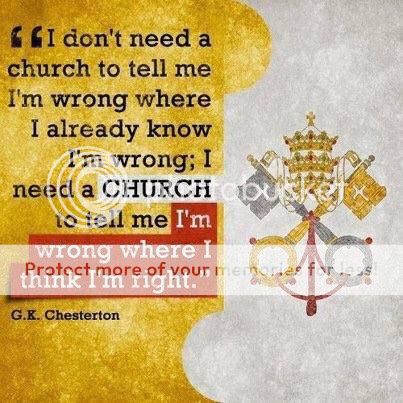
The Catechism of the Catholic Church (CCC) teaches, “Faith is first of all a personal adherence of man to God” who revealed himself (cf n 150). Yet, being a personal response to God’s revelation, this faith is prone to subjective interpretation and is constantly in need of guidance. Far from being an individual adherence, believing then ought to be an act of the Church also (cf CCC 181). Every baptized person needs the Church as mother, guide, and teacher who “teaches us the language of faith in order to introduce us to the understanding and the life of faith” (cf CCC 171).
.
Though the Church’s leaders – Peter and the Apostles’ successors – are humans, prone to weakness and sin, their teaching needs to be heeded more than ever. Christ’s promise remains: “The gates of the netherworld shall not prevail against it” (Mt 16:18).

St. Cyprian synthesized this truth in simple terms: “No one can have God as Father who does not have the Church as Mother” (De unit. 6: PL4, 519). Our faith should be your faith.

SOURCE: “365 Days with the Lord 2017,” ST. PAULS Philippines, 7708 St. Paul Rd., SAV, Makati City (Phils.) http://www.ssp.ph/

user posted image

khool
post Aug 27 2017, 11:00 AM

Getting Started
**
Junior Member
225 posts

Joined: Mar 2008


The Lord does not abandon His Church
Twenty First Sunday in Ordinary Time Year A

user posted image

One of the weirdest movies I’ve ever watched is The Hitchhiker’s Guide to the Galaxy, based on the Douglas Adam’s trilogy of books. The setting of the story is simple, the planet Earth is faced with destruction by an alien race as it wants to make way for an inter-galactic super-highway. At the beginning of the movie, we are treated to a strange commentary of dolphins being the most intelligent beings on Earth. Curiously enough, the dolphins had long known of the impending demolition of Earth and had made many attempts to alert mankind to the danger. The funny thing was that most of their communications were misinterpreted, and as a result, you see amusing attempts to punch footballs, or whistle for titbits, so they eventually gave up and left Earth by their own means - shortly before the aliens arrived. The last ever dolphin message was misinterpreted as a surprisingly sophisticated attempt to do a double backwards somersault through a hoop, whilst whistling the ‘Star-Spangled Banner’. The simple message was, in fact, “So long and thanks for all the fish”. In short, “It’s farewell and goodbye!”

Many Catholics who seem to have an apocalyptic bent in reading the signs of the times may feel like the dolphins. There is no doubt that we live in troubled times: times that can challenge our faith. It is wearisome to be constantly reminded of the persecution of Christians in the Middle East, terrorism, uprisings, wars and rumours of wars and so on. In recent years even the spectre of schism and new apostasy has been added to this litany of woes. The faithful are abandoning the Church in droves! The number of priestly and religious vocations are plummeting! Let us not forget the two shafts of lightning that had struck the dome of St. Peter’s Basilica just hours after the previous Pope announced his resignation. These doom-sayers have been trying to communicate their concerns about the imminent destruction of the Church to their fellow Catholics, but their feeble attempts have come across as hysterical rantings and over-exaggerations about the actual state of affairs. Thus, many are on the verge of bailing out, if they have not already done so, before the barque of St Peter, the Catholic Church capsizes.

Recently, Pope Emeritus Benedict XVI paid tribute to his friend, the late Cardinal Meisner, one of the four dubia Cardinals, in a message read out at the latter’s funeral mass. “He learned to let go and to live out of a deep conviction that the Lord does not abandon His Church, even when the boat has taken on so much water as to be on the verge of capsizing.” Many had latched on to the last part of the quotation, about the Church capsizing, whilst conveniently ignoring the rest of the message. Some take it as a subtle slap-down of the present administration of the current Pope, whilst others see it as an admission that the Church is indeed in trouble, and we are all threatened with a sinking ship. What most Catholics fail to recognise is that throughout its 2000 years history, the Catholic Church has always been threatened with the risk of capsizing. And yet, with all the odds stacked against it, she has somehow miraculously remained afloat! In paying so much attention to this last part of the message and in giving it an ominous interpretation, these commentators failed to give due attention to what I believe to be the most important statement in this message, “The Lord does not abandon His Church.”

This resonates with the promise given by our Lord to St Peter in today’s gospel, “You are Peter and on this rock I will build my Church. And the gates of the underworld can never hold out against it.” Saint Ambrose said: “The Church is like the moon; it may wane, but never be destroyed; it may be darkened, but it can never disappear.” Another great saint, Saint Anselm said that the barque of the Church may be swept by the waves, but it can never sink, because Christ is there. When the Church is in greatest need, Christ comes to its help by miracles, or by raising up saintly men to strengthen and purify it. It is the barque of Peter; when the storm threatens to sink it, the Lord awakens from His sleep, and commands the winds and waters into calm: “Peace; be still!” Yes, the Lord does not, and will not abandon His Church because the Lord always keeps His promises.

This is the meaning of the doctrine “indefectibility”, a term which does not speak of the Church’s lack of defects but confesses that, despite all its many weaknesses and failures, Christ is faithful to His promise that the gates of hell shall not prevail against it. The First Vatican Council declared that the Church possesses “an unconquered stability” and that, “built on a rock, she will continue to stand until the end of time”. The Church's indefectibility, therefore, means that she now is and will always remain the institution of salvation, founded by Christ. This affirms that the Church is essentially unchangeable in her teaching, her constitution, and her liturgy. It does not exclude modifications that do not affect her substance, nor does it exclude the decay of individual local churches or even whole dioceses.

Historically, when the Church was just beginning, the Roman emperors vowed to destroy it. Nero, Domitian, Diocletian and others tried to exterminate the Church. It could have died. In the early Christian centuries and throughout history, there have been so many heresies and schisms that had threatened to destroy the unity and integrity of the Church, but they failed. Many of these heresies and schisms still continue in different forms today. In the 16th century, the Protestant reformation seemed to have succeeded in diminishing the Church’s numbers and even sucking life out of it. In the same century, it spread to America and Asia. In the 18th century, the French Enlightenment and the French Revolution was aimed at destroying the Church in France. The Church survived and the French Revolution is now history, though Enlightenment ideas are still here with us. In the 20th century, fascist, communist, socialist, secular regimes have tried to ban and destroy the Church, but in many of these countries, the Catholic faith continues to thrive in spite of the persecution and widespread restrictions.

So please, my fellow Catholics, the proper response when reading headlines about the corruption or destruction of the Church due to the mismanagement by her leaders is not panic or rage or despair, and definitely not to join the chorus of dolphins in singing, “Farewell, so long and thanks for all the fish.” Rather, it’s a yawn, an eye-roll, and a resigned sigh and to be reminded once again of the greatness of Our Lord’s promise to St Peter. Catholics should not allow distress over the present situation, to shake their faith in Our Lord’s promise to preserve the Church from damnable error and to provide a trustworthy barque for the salvation of souls. They mustn’t succumb to the temptation to turn their frustrations, with fellow Catholics and even Church’s leaders, against the Church of Christ herself. Every Catholic should resolve to live as a saint, growing in charity of words and behaviour, keeping faith in the midst of a godless society and never letting go of the hope that looks to the return of Our Lord in all His glory to judge the living and the dead. Finally, they should never cease or slack in praying for our Holy Father, the successor of St Peter, and for the unity of the episcopate, the successors of the Apostles.

Perhaps, it’s good to remember the words of the late Cardinal Meisner in his Last Will and Testament. The words are beautiful, powerful and timely:
"Christ gave the Petrine office to the Church in order to give an orientation and support to the many people in the different times. That is my last request to you all for your salvation. Stay with our Holy Father. He is the Peter of today. Follow his guidance. Listen to his word. Peter wants nothing for himself, but everything for the Lord and for his brothers and sisters… I do not desire the grace which the Apostle John received, nor the forgiveness with which You pardoned Peter. I only desire the words which You said to the robber on the Cross: “Today you will be with me in Paradise.”"

Source: https://michaelckw.blogspot.my/2017/08/the-...his-church.html

user posted image

khool
post Aug 27 2017, 11:03 AM

Getting Started
**
Junior Member
225 posts

Joined: Mar 2008


user posted image

khool
post Aug 28 2017, 02:05 PM

Getting Started
**
Junior Member
225 posts

Joined: Mar 2008


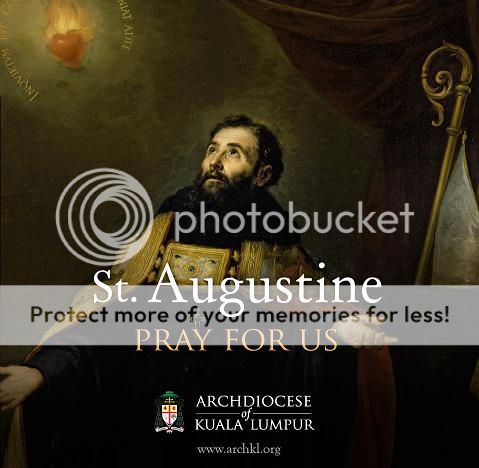
Memorial of Saint Augustine, Bishop and Doctor of the Church
Lectionary: 425


user posted image

Reading 1 (1 Thes 1:1-5, 8b-10)

Paul, Silvanus, and Timothy to the Church of the Thessalonians
in God the Father and the Lord Jesus Christ:
grace to you and peace.

We give thanks to God always for all of you,
remembering you in our prayers,
unceasingly calling to mind your work of faith and labor of love
and endurance in hope of our Lord Jesus Christ,
before our God and Father,
knowing, brothers and sisters loved by God, how you were chosen.
For our Gospel did not come to you in word alone,
but also in power and in the Holy Spirit and with much conviction.
You know what sort of people we were among you for your sake.
In every place your faith in God has gone forth,
so that we have no need to say anything.
For they themselves openly declare about us
what sort of reception we had among you,
and how you turned to God from idols
to serve the living and true God and to await his Son from heaven,
whom he raised from the dead, Jesus,
who delivers us from the coming wrath.

Responsorial Psalm (Ps 149:1b-2, 3-4, 5-6a and 9b)

R. The Lord takes delight in his people.
or:
R. Alleluia.

Sing to the LORD a new song
of praise in the assembly of the faithful.
Let Israel be glad in their maker,
let the children of Zion rejoice in their king.
R. The Lord takes delight in his people.
or:
R. Alleluia.

Let them praise his name in the festive dance,
let them sing praise to him with timbrel and harp.
For the LORD loves his people,
and he adorns the lowly with victory.
R. The Lord takes delight in his people.
or:
R. Alleluia.

Let the faithful exult in glory;
let them sing for joy upon their couches;
Let the high praises of God be in their throats.
This is the glory of all his faithful. Alleluia!
R. The Lord takes delight in his people.
or:
R. Alleluia.

Alleluia (Jn 10:27)

R. Alleluia, alleluia.
My sheep hear my voice, says the Lord;
I know them, and they follow me.
R. Alleluia, alleluia.

Gospel (Mt 23:13-22)

Jesus said to the crowds and to his disciples:
"Woe to you, scribes and Pharisees, you hypocrites.
You lock the Kingdom of heaven before men.
You do not enter yourselves,
nor do you allow entrance to those trying to enter.

"Woe to you, scribes and Pharisees, you hypocrites.
You traverse sea and land to make one convert,
and when that happens you make him a child of Gehenna
twice as much as yourselves.

"Woe to you, blind guides, who say,
'If one swears by the temple, it means nothing,
but if one swears by the gold of the temple, one is obligated.'
Blind fools, which is greater, the gold,
or the temple that made the gold sacred?
And you say, 'If one swears by the altar, it means nothing,
but if one swears by the gift on the altar, one is obligated.'
You blind ones, which is greater, the gift,
or the altar that makes the gift sacred?
One who swears by the altar swears by it and all that is upon it;
one who swears by the temple swears by it
and by him who dwells in it;
one who swears by heaven swears by the throne of God
and by him who is seated on it."

user posted image

REFLECTION

Woe to you,… Hypocrites. Jesus pronounces this invective against the scribes and Pharisees who hinder people from
going to heaven. Instead of making them saints, these religious leaders are making people evil. They invent a lot of
unnecessary things in the name of religion and require people to do them. They abuse their little knowledge and
prestige. They take advantage of people’s ignorance.

Jesus calls these spiritual teachers hypocrites. They will be punished severely for misleading the people. They will
not enter the Kingdom of heaven. That is the consequence of their pretentions.

It is true that we need teachers; it is dangerous to handle faith and Scriptures just by oneself or without a good
reference. But if even the teachers do not know their own theology, anything can happen. Theology puts all things
about faith and traditions into their proper places. It is a kind of check and balance. It prevents or minimizes
misinterpretation or erroneous conclusion.

Do you know and live your faith enough to teach it by word and example?

SOURCE: “365 Days with the Lord 2017,” ST. PAULS Philippines, 7708 St. Paul Rd., SAV, Makati City (Phils.) http://www.ssp.ph/

user posted image


38 Pages « < 8 9 10 11 12 > » Top
 

Change to:
| Lo-Fi Version
0.1064sec    0.47    7 queries    GZIP Disabled
Time is now: 1st December 2025 - 09:08 AM