Welcome Guest ( Log In | Register )

65 Pages « < 57 58 59 60 61 > » Bottom

Outline · [ Standard ] · Linear+

 LYN Catholic Fellowship V02 (Group), For Catholics (Roman or Eastern)

views
     
khool
post Sep 18 2020, 06:36 PM

Getting Started
**
Junior Member
225 posts

Joined: Mar 2008


QUOTE(yeeck @ Sep 15 2020, 05:26 PM)
I haven't watched it, have you?
*
Hey Yeeck!

Long time no chat. In answer to your question, yes. Managed to watch it on youtube. Some people posted the full movie on the site, but I think has been taken down already. In any case, I am waiting for official version to be available for purchase on BluRay. It's good.

khool
post Sep 21 2020, 11:38 AM

Getting Started
**
Junior Member
225 posts

Joined: Mar 2008


Jim wears the Jerusalem Cross!!! Amen!!!!


Justin.Loong
post Oct 6 2020, 11:46 AM

Look at all my stars!!
*******
Senior Member
8,332 posts

Joined: Feb 2014


user posted image
QUOTE
The Chancery of the Catholic Metropolitan Archdiocese of Kuala Lumpur has temporarily suspended all public masses located within Kuala Lumpur and Selangor, starting tomorrow (7 Oct).

In a statement today, Reverend Julian Leow, the Archbishop of Kuala Lumpur, said that with the number of Covid-19 cases on the rise and with the emergence of sporadic cases, the Archdiocesan Crisis Management Task Force had recommended that additional public health measures be taken immediately to reduce the risk of transmission.
“Temporary suspension of all public masses in parishes located within Kuala Lumpur and the State of Selangor will start tomorrow (October 7) with immediate effect.
“This suspension will be reviewed before October 20 and the parishes will be notified accordingly of any future changes
,” he said.

Leow also emphasised that Catholics residing in Kuala Lumpur should refrain from travelling to other states to attend Mass, as to avoid more transmissions of Covid-19.

He also added that parishes within Pahang, Negri Sembilan and Terengganu are to continue with scheduled Mass but should insist on pre-registration of worshipers wishing to attend.
He said that livestreaming of masses will still continue for those who are unable to attend Mass in person.


Leow also urged for the postponement of celebrations of the Sacrament of Confirmation, First Holy Communion, baptisms and weddings.
Should a delay be unavoidable, however, he recommended that the guest list should not exceed 20 person, before stressing that those in high-risk categories and above the age of 70 are not allowed to attend. The same limitations apply to funeral services.


“Additional measures may be taken in the future for individual parishes and districts, should the situation worsen in these areas.
“Let us continue to be vigilant and fulfill our civic duty in working to bring this current second wave under control. Let us also pray for all the health care personnel and first responders,” he said.

Yesterday, Malaysia announced 432 new Covid-19 cases, a new record daily high for the country.
Out of those cases, 429 were local cases and just three were imported cases.
Source: Catholic church suspends
TSyeeck
post Oct 6 2020, 02:49 PM

Look at all my stars!!
*******
Senior Member
3,573 posts

Joined: Apr 2006


Simian Antinomianism
BROTHER ANDRÉ MARIE

The heresy of antinomianism received its name from Martin Luther, who, wrote against the more “extreme” doctrines of Johannes Agricola, the enfant terrible of Luther’s own novel doctrine of Justification by faith only. In brief, antinomianism — coming from anti + nomos (Gk: “law”) — is the contention that Christians are absolved from adherence to the moral law.

That Luther would object to Agricola was hypocritical on at least two fronts. First, once the cat of sola scriptura was let out of the bag, with its corollary of private interpretation, one would think Luther’s objecting to another’s use of the principle would be self-defeating. (Who did he think he was, the Pope?) Secondly, Agricola’s doctrine, relatively “extreme” as it might have been, agreed in kind with many of Luther’s own remarks denying the necessity of good works or the need of the Christian believer to resist temptation. (It was not for nothing that Luther called the canonical Epistle of Saint James “an epistle of straw.”) In short, Luther himself held to a form of antinomianism.

Agricola’s heresy was not unique. Some early gnostic sects and various weird medieval movements held similar errors. For the antinomian gnostics, one who was adept at the gnosis (the esoteric knowledge) somehow transcended good and evil.

Today, our society is caught in a tug-of-war between two opposite errors on the question of law. Besides the popular antinomianism that denies the natural law and its demands (voiced in such pat-phrases as, “you can’t legislate morality” and “we are free to do whatever we like as long as it doesn’t hurt someone else”), there is the legal positivism of the statist. This latter is the doctrine that law derives from the written body of legislation (statutes, court cases), and does not depend upon a higher standard that is antecedent to the written corpus. Statist liberals are not the only legal positivists by a long shot. Some putative “conservatives” are rightly numbered as such, as they consider the Constitution itself is sufficient as the nation’s law, without reference to the natural law.

The two errors are opposite, but, they are also complementary in a larger dialectic. Where antinomianism reigns, people will act like beasts, naturally. This moral anarchy makes the many and minute laws of the gigantic modern state seem necessary, hence the perceived reasonableness of positivism to bring order out of chaos. The Italian communist revolutionary, Antonio Gramsci, understood this, and therefore considered cultural and moral subversion a better alternative to the violent global revolution of his Soviet fellows.

(In “Conscience and the Nanny State” I considered at greater length this phenomenon of moral anarchy breeding tyranny.)

The idea that young people ought to be taught the moral law so that they might be masters of themselves and work for an ordered and just society is brought out in Rudyard Kipling’s classic, The Jungle Book. Those who have only seen the Disney film — which does not remotely do the book justice — should read Kipling’s work before they object to my recommending it. (Which I do, especially in the complete Penguin Classics edition, which contains almost all the Mowgli stories plus much more.)

A passage I find compelling is the description, in the chapter entitled “Kaa’s Hunting,” of the monkeys. These comical creatures are among Mowgli’s enemies because of their lawlessness, but the young “man-cub” does not realize this yet, and is flattered when they seek his company after Baloo, his bear-mentor, had been particularly hard on him during his lessons. When Baloo discovers the illicit friendship, he sternly rebukes the boy. Even Bagheera, the panther, who is much milder than Baloo, is irate that Mowgli would play with the Bandar-log, as the monkeys are called.

Note well the description of the monkeys as without remembrance, without a leader, without a law. For this reason, they are rudderless, fickle, silly, mercurial — and very dangerous. They are, it may be said, without a tradition — and therefore they go chaotically from one novelty to another to another, never learning from their mistakes, yet remaining stubbornly convinced that they are better than all the people of the jungle.

“Mowgli,” said Baloo, “thou hast been talking with the Bandar-log—the Monkey People.”

Mowgli looked at Bagheera to see if the Panther was angry too, and Bagheera’s eyes were as hard as jade stones.

“Thou hast been with the Monkey People—the gray apes—the people without a law—the eaters of everything. That is great shame.”

“When Baloo hurt my head,” said Mowgli (he was still on his back), “I went away, and the gray apes came down from the trees and had pity on me. No one else cared.” He snuffled a little.

“The pity of the Monkey People!” Baloo snorted. “The stillness of the mountain stream! The cool of the summer sun! And then, man-cub?”

“And then, and then, they gave me nuts and pleasant things to eat, and they—they carried me in their arms up to the top of the trees and said I was their blood brother except that I had no tail, and should be their leader some day.”

“They have no leader,” said Bagheera. “They lie. They have always lied.”

“They were very kind and bade me come again. Why have I never been taken among the Monkey People? They stand on their feet as I do. They do not hit me with their hard paws. They play all day. Let me get up! Bad Baloo, let me up! I will play with them again.”

“Listen, man-cub,” said the Bear, and his voice rumbled like thunder on a hot night. “I have taught thee all the Law of the Jungle for all the peoples of the jungle—except the Monkey-Folk who live in the trees. They have no law. They are outcasts. They have no speech of their own, but use the stolen words which they overhear when they listen, and peep, and wait up above in the branches. Their way is not our way. They are without leaders. They have no remembrance. They boast and chatter and pretend that they are a great people about to do great affairs in the jungle, but the falling of a nut turns their minds to laughter and all is forgotten. We of the jungle have no dealings with them. We do not drink where the monkeys drink; we do not go where the monkeys go; we do not hunt where they hunt; we do not die where they die. Hast thou ever heard me speak of the Bandar-log till today?”

“No,” said Mowgli in a whisper, for the forest was very still now Baloo had finished.

“The Jungle-People put them out of their mouths and out of their minds. They are very many, evil, dirty, shameless, and they desire, if they have any fixed desire, to be noticed by the Jungle People. But we do not notice them even when they throw nuts and filth on our heads.”

He had hardly spoken when a shower of nuts and twigs spattered down through the branches; and they could hear coughings and howlings and angry jumpings high up in the air among the thin branches.

“The Monkey-People are forbidden,” said Baloo, “forbidden to the Jungle-People. Remember.”

A little later, we see that the Monkey-folk, besides desiring to be noticed by the Jungle People, and despite their evident demerits, are intensely conceited and consider themselves cutting-edge:

“They were always just going to have a leader, and laws and customs of their own, but they never did, because their memories would not hold over from day to day, and so they compromised things by making up a saying, ‘What the Bandar-log think now the jungle will think later,’ and that comforted them a great deal.”

This is a wonderful description of the modernist, the man who hates tradition, law, and Christian social order — and moreover despises those who love such things.

When later, the Bandar-log turn on Mowgli and kidnap him, Baloo and Bagheera resort to the only means they know: to summon the aid of Kaa, the hungry thirty-foot python with the mesmerizing glance, the one creature in the Jungle that the monkeys fear. Mowgli is saved, but only after a gruesome scene of simian carnage that would not be appropriate for a children’s cartoon.

Lord Baden Powell, the founder of scouting, was a personal friend of Rudyard Kipling. Imagery from The Jungle Book was explicitly incorporated into Baden Powell’s program of forming young men. Mowgli, who had to learn the Law of the Jungle, represents the youth being directed and formed according to the “law” of scouting, and names like “cub,” “wolf,” “Akela,” etc., all finding a place in the scouting nomenclature.
TSyeeck
post Oct 7 2020, 11:54 AM

Look at all my stars!!
*******
Senior Member
3,573 posts

Joined: Apr 2006


user posted image

user posted image
TSyeeck
post Oct 8 2020, 02:45 PM

Look at all my stars!!
*******
Senior Member
3,573 posts

Joined: Apr 2006


A Soul's Journey

This article contains the very moving story of one man’s sin, repentance and redemption. That man was Dr. Bernard Nathanson (1926-2011). He was arguably one of the most influential practitioners and proponents of abortion in the late 1960s into the 1970s. Then one day he saw a human baby in the womb moving in an ultrasound video. And he felt convicted that, despite all of the reasons that he had proposed in favor of abortion, that aborting human beings was morally wrong. And this conviction led him thereafter to become a powerful voice in favor of the right to life of the unborn. In the 1980s he was the narrator for the film “The Silent Scream.” And years later, as an old man, he told a young woman who came to interview him the story of his conversion and repentance. That woman was Terry Beatley, and this is her story of their encounter. The article appears in the October edition of Inside the Vatican magazine.

America’s “Abortion King” (Dr. Bernard Nathanson) and the “Catholic Strategy”
Decades of Political Support for Abortion Began With This Sophisticated Propaganda Campaign
By Terry T. Beatley with Clare Ruff

At a prayer vigil in November 2009, I discerned the Lord asking me to interview Dr. Bernard Nathanson, the last surviving co-founder of NARAL — the National Association for the Repeal of Abortion Laws (late renamed NARAL Pro-Choice America). In the late 1960’s, Bernard Nathanson and Lawrence Lader crafted what they called the “Catholic Strategy,” later called “the most brilliant political strategy of all time.” It was a stealthy and effective scheme to destroy America’s historical protection of unborn life by undermining the spiritual authority of Divine Law and marginalizing the moral authority of the Catholic Church. As co-founders of NARAL, these two atheists deployed their Catholic Strategy with tactical precision and great efficacy. They were the pioneers of the sinister industry of abortion, which depended on political victory to deceive and destroy. And then a miracle of sorts happened, and Bernard Nathanson became immovably pro-life.

I was daunted by the prospect of interviewing Dr. Nathanson, and even doubted its possibility, but I felt I was supposed to try. Tracking down his phone number via a pro-life attorney, I dialed with trepidation. His wife answered and explained that her 83-year-old husband was very frail from terminal cancer and had not granted an interview in over a year. But she instructed me to fax my letter of request, and promised to present it to her husband.

A few days later she called to inform me that, much to her surprise, Dr. Nathanson had agreed to my request. On December 1, 2009, I flew to New York City to interview the man who trained Planned Parenthood how to kill children in the womb and who worked as Medical Director for the largest abortion center in the world, the Center for Reproductive and Sexual Health (CRASH). These credentials earned him the title “The Abortion King.” Yet, he was the same man who spent his final 35 years working tirelessly to undo what he had regrettably unleashed upon America: deceiving the courts, maligning clergy, manipulating the media, training doctors and crushing the souls of millions of mothers and fathers by stopping the beating hearts of their unborn children.

user posted image
Dr. Nathanson meets US President Ronald Reagan

user posted image
Dr. Nathanson and Mother Teresa of Calcutta

user posted image
Dr. Nathanson meets Pope John Paul II

What Changed?
In 1973, just a few months after celebrating the Roe v Wade decision, Dr. Nathanson witnessed for the first time a new technology: real-time ultrasound. He observed an unborn child in the womb — smiling, stretching, and wiggling her toes. He told me, “Real-time ultrasound was the bomb. It made everything come alive.” Science revealed the beauty, goodness and truth of life in this sacred space, demanding intellectual honesty from Dr. Nathanson; he had to acknowledge that abortion kills an existing human life, and admit that what he had been doing was morally wrong. In that moment, he realized he had two patients: the mother and her child. His job was to protect and save them both. In that moment, Dr. Nathanson’s pro-life journey began.


He spent two years persuading NARAL that real-time ultrasound exposed a major ethical and moral dilemma, but the organization cared little and would not alter its position.

Dr. Nathanson resigned from NARAL on the second anniversary of Roe v Wade. In his resignation letter, addressed to Lawrence Lader (left), he wrote:


“The judgments of the Supreme Court were never meant to be infallible or eternal. And what if we’ve been wrong – if the Court should soon reverse itself on the abortion issue in the light of changing times and/or new scientific evidence? What an incalculable injustice will have been perpetrated. What an immeasurable, irretrievable loss will have been suffered. The annual dues to NARAL are ten dollars a year and the hubris of certainty. I can no longer afford those dues.”

By 1979, the father of America’s abortion industry had become 100% pro-life – without exceptions. The industry, in his words, grew “fecklessly out of control.” And fueling it was NARAL’s Catholic Strategy.

Following his defection from the abortion industry, Dr. Nathanson suffered nearly a decade of depression, frequently contemplating suicide, until he crossed paths with a priest who introduced him to the love and mercy of Jesus Christ. On December 8, 1996, America’s “Abortion King” was baptized at St. Patrick’s Cathedral in New York City, and was made new in Christ as a Child of Light.


Background: My Promise
As I sat beside Dr. Bernard Nathanson in the interview he had granted me, listening to his great remorse for orchestrating and leading the war on America’s unborn children, I felt a deep sense of empathy. He was too ill to get his message out anymore, which compelled me to make him an offer: if he had a message for America, I would deliver it across the country until it became common knowledge – or until Roe v Wade was overturned.

In a thin, raspy voice weakened by his illness, but coupled with a slight twinkle of hope in his eyes, he responded, “Yes, yes…Continue teaching about the strategy I used to deceive America, but also deliver this special message. Tell America that the co-founder of NARAL says to ‘Love one another. Abortion is not love. Stop the killing. The world needs more love. I’m all about love now.’” I reached over and shook his feeble hand, promising that one day America would hear his story — and his important message.

The non-profit pro-life organization I founded, named Hosea Initiative, is committed to revealing this vital piece of American history to the public. Our informal polling shows that more than 90% of our predominantly pro-life, Catholic audience lacks awareness of Bernard N. Nathanson’s “Saul-to-Paul” conversion or NARAL’s Catholic Strategy. This is essential information for Catholics walking into the voting booth this November 3.

The “Opposition Element”
NARAL successfully united a fractured pro-abortion movement and aggressively lobbied for the overturn of a 140-year-old New York law which protected infants from abortion. When Governor Nelson Rockefeller signed liberal pro-abortion legislation into law in April 1970, New York City became the nation’s abortion epicenter. Only nine months later, NARAL’s Executive Committee assembled for an emergency meeting to discuss a grave risk to their blossoming abortion crusade. An increasing number of infants were born alive following second-trimester saline abortions.

Executive Director Lawrence Lader showed no empathy for these salt-burned infants. He expressed just the opposite. Dr. Nathanson described Lader’s response in his post-conversion book, The Abortion Papers: Inside the Abortion Mentality (1983): “[He] saw these abortion survivors as an embarrassment to NARAL and was concerned that the press had made much of them and that the opposition elements were seizing upon them as a tactic in the abortion wars.”(p. 177)

Who Was the Most Feared “Opposition Element”? The Roman Catholic Church
The Catholic Church was NARAL’s primary opposition due to its long-standing, uncompromising doctrine regarding the sanctity of human life. While the Anglican Church reversed its position on contraception at the 1930 Lambeth Conference and other Protestant denominations followed, Rome held its position against contraception and abortion as destructive moral evils against God’s gift of life.

For a deeper understanding of the genesis of NARAL’s response to Catholic opposition, look to Lawrence Lader’s 1966 book Abortion, where he identifies the Catholic hierarchy as “a force inimical” to what he called “legalized abortion — the final freedom.”

Nathanson says Lader shows his true colors and the level of his vitriol against the Catholic Church in the sequel, Abortion II: Making the Revolution. In it, Lader names individuals with their religious affiliation (most Catholic) only if they did not support his agenda. (Interestingly, the current “cancel culture” phenomenon mirrors tactics from NARAL’s playbook.)

Naral’s Religious War
Together, Lader and Nathanson executed an all-out, anti-Catholic religious war: Anti-Catholic warp was a central strategy, a keystone of the abortion movement. It was, in a sense, the self-fulfilling prophecy: knowing that the Catholic Church would vigorously oppose abortion, we laced the campaign with generous dollops of anti-Catholicism, and once the monster was lured out of the cave in response to the abortion challenge and the nakedly biased line, we could make the Catholic Church the point man of the opposition. The more vigorously the church opposed, the stronger the appeal of the anti-Catholic line became to the liberal media, to the northeastern political establishment, to the leftist elements of the Protestant Church, and to the Catholic intellectuals themselves. (The Abortion Papers, p.196)

Lader also modeled his anti-Catholic bigotry after the queen of racism and eugenics, Margaret Sanger, the founder of the Birth Control Federation of America (later renamed Planned Parenthood).

She started her dirty deeds in 1916 as a fallen-away Catholic whose socialist father taught her to despise the Church. In the early 1920s, she strategically pitted Protestants against Catholics over the issue of contraception.

By 1939, she launched the “Negro Project,” an aggressive plan to reduce the black race by pushing birth control and sterilization onto minority communities under the guise of women’s health care. In the late 1950s, she led the charge for a little white pill which fueled an era of unfettered promiscuity and out-of-wedlock births. Then, she passed the baton of abhorrence of the Catholic Church to Lader, her biographer and admirer, who soon thereafter partnered with Nathanson to form NARAL.

Dr. Nathanson explained that NARAL braced itself for a response, especially from the Catholic hierarchy. But none came. And it only fueled NARAL’s confidence and purpose.

What continually surprised us in the planning sessions and strategy meetings at NARAL was not only the comparatively mild quality of the organized Catholic opposition, but also the virtual absence of response to what was blatantly an anti-Catholic campaign. (Ibid., p.190)

Later, writing with a heavy heart, Nathanson described the tactics as morally detestable, with no modern parallel. He was convinced that “there has been, then, no social change in American history as sweeping, as potent in American family life, or as heavily dependent upon an anti-religious bias for its success as the abortion movement.” (Ibid., p. 197)

The efficacy of NARAL’s Catholic Strategy helps explain why the vast majority of current U.S. Senators who identify as Roman Catholics consider themselves “pro-choice” and voted against the “Twenty-week Fetal Pain Bill,” which would have banned abortions from 20 weeks gestation onward, as well as the “Abortion Survivor Infant Protection Act,” which would have guaranteed, by law, health care to babies who survive attempted abortion.

(article continued below)


The Catholic Strategy
Like wartime strategists, NARAL’s Executive Committee stealthily devised four primary points of attack against their leading opposition, the Catholic Church.

First: Blame and Accuse the Hierarchy
Cardinals, bishops and clergymen were targeted relentlessly by the NARAL team. Every time a woman was maimed or died from complications of illegal abortion, NARAL never accused the physician of malpractice, but blamed the hierarchy and Church opposition to legal abortion. Every press conference, editorial, or published article linked the name of a clergyman with social ills or women’s woes.

The blame game included an endless indictment of Church leaders for starting a religious war, abusing tax-exempt status and even attempting to overturn the Bill of Rights!

Nathanson explained: “The anti-Catholic tactic was… central to the maintenance of unity within the High Command of the movement. In providing a palpable, visible opposition it allowed those of us setting policy and devising a strategy to occupy ourselves with the enemy. We were kept too busy to contemplate in any critical way the quintessential brutality of permissive abortion. There was always another bishop to denounce, another pastoral letter to be rebutted, another cardinal to excoriate.” (Ibid., p. 197)

Second: Support and Campaign for Catholic Pro-abortion Candidates
NARAL recognized and praised Catholic politicians who publicly expressed a softened stance on abortion. It assisted legislators with election campaigns, grassroots efforts, and financial support, regardless of party affiliation. As long as the candidate embraced legalized abortion, s/he was a candidate for NARAL’s backing. Using the complicit media, NARAL made it appear times were changing, and “pro-choice” politicians were the new majority. NARAL understood the power of perception.

Third: Split and Set Catholics Against Each Other
NARAL recognized that John and Jacqueline Kennedy were models of the modern, enlightened twentieth-century Catholic, thinking for themselves “without obeisance to church dogma.” NARAL’s strategists, formed mostly of atheists and former Jews, recognized two categories of Catholic faithful: the well-educated, fashionable “Kennedy Catholics,” and blue-collar, conservative Catholics, only one generation removed from immigration. NARAL fueled divisiveness within the Catholic Church, pitting liberal against conservative Catholics. As Dr. Nathanson recounted it, everything was in place “for the portrayal of the Catholic Church as a political force, for the use of anti-Catholicism as a political instrument, and for the manipulation of Catholics themselves by splitting them and setting them against each other.” (Ibid., p. 181)

The leap from practicing contraception to supporting legalized abortion proved an easy one.

Fourth: Execute the Straddle
Perhaps the most common and effective tool in the NARAL strategy toolbox was ‘the Straddle’: a separation of religious conviction from legislative judgment. Nathanson wrote that it was first proposed to the Board by “such notables as Robert Drinan, SJ, and Richard Cardinal Cushing.” (Ibid., p. 177)

“To maintain their appearance as enlightened and progressive while still retaining their bona fides as Catholics, we provided [Kennedy Catholics] with the now classic ‘straddle’ for Catholics in public positions: abortion is personally abhorrent, but everyone must be free to make their own choice. Now we were ready to use them to call over the more traditional, less trendy Catholics to our cause.” (Ibid., p.181)

Of course, substitute “slavery” for “abortion” and few would agree that one person can find slavery personally abhorrent while others are free to choose whether or not to own slaves. Yet, it’s a refrain we’ve heard for decades in politics. Dr. Nathanson prophetically warned that, as long as abortion is legal, there would be increased violence, increased public turmoil and the disintegration of the American family. These bitter fruits are everywhere apparent.

I believe the abortion ethic is fatally and forever flawed by the immorality of the means of its victory. A political victory achieved by such odious tactics is at best an unstable tyranny spawned by an unscrupulous and unprincipled minority. At the very least this disclosure of those odious tactics should compel those who are uneasy with permissive abortion to re-examine the issue. I believe that an America which permits a junta of moral thugs to foist an evil of incalculable dimensions upon it, and continues to permit that evil to flower, creates for itself a deadly legacy: a millennium of shame. (Ibid., p. 209)

This powerful quote of Dr. Nathanson’s is one of my favorites. It reveals how intimately he understood the diabolic industry. Abortion does not simply “happen” as civilizations evolve; it is created with evil intent. Dr. Nathanson wanted every bishop, priest and Catholic layperson to know how they were deliberately exploited, and be motivated to act in defense of their Faith and the sanctity of every human life. It’s time to challenge the anti-Catholic bias which marginalizes the prophetic voice of the Church. Pivotal in this effort is the courage to elect pro-life leaders with the power to reverse the ebbing tide of pro-life legislation. It’s time to abort our “millennium of shame.”


Terry T. Beatley is President of the Hosea Initiative and author of What If We’ve Been Wrong? Keeping My Promise to America’s “Abortion King.” Clare Ruff is Hosea Initiative’s Vice-President of Events and Outreach.


Bibliophile
post Oct 15 2020, 08:39 AM

Getting Started
**
Junior Member
109 posts

Joined: Jun 2017


user posted image

I think you guys will appreciate this. We managed to squeeze in one last liturgy before the CMCO, celebrating the Feast of the Intercession of the Theotokos. May you all be protected by our Lady's intercessions to God as well!

This post has been edited by Bibliophile: Oct 15 2020, 08:41 AM
Justin.Loong
post Oct 15 2020, 12:41 PM

Look at all my stars!!
*******
Senior Member
8,332 posts

Joined: Feb 2014


QUOTE
user posted image
In a statement by the Archdiocese of Kuala Lumpur issued out on 14 October, a Covid-19 positive case has been identified in the Church of the Sacred Heart, Jalan Peel.

It is said that the person had attended mass at the aforementioned church on 27 September and they have tested positive for Covid 19 on 12 October. They are currently undergoing treatment at the Sungai Buloh Hospital.
Church of the Sacred Heart, Jalan Peel statement
The statement says that the person was asymptomatic at that time and the mass held was compliant with the MKN SOP and the Archdiocesan Guidelines before, during and after to reduce the risk of infection.

The church is cooperating with the authorities by giving them the seating arrangement and necessary information for contact tracing purposes. Public masses were put on hold from 7 October and the church has been closed for complete sanitisation on 14 October.

Attendees of the mass on 27 September are urged to seek treatment if they are experiencing any symptoms.
Source: Asymptomatic KL churchgoer attended mass before testing positive Covid-19
khool
post Oct 28 2020, 02:00 PM

Getting Started
**
Junior Member
225 posts

Joined: Mar 2008


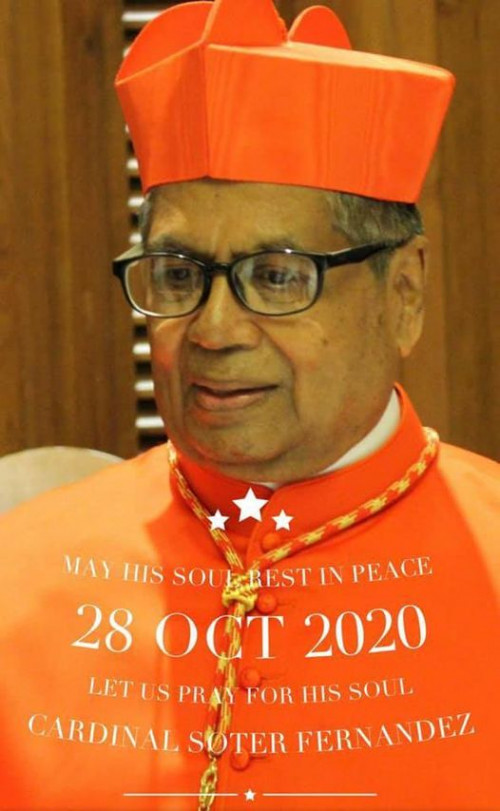
Eternal rest grant unto him Oh Lord,
And may the perpetual light shine upon him,
Amen!

user posted image
cicakopi P
post Oct 30 2020, 01:39 PM

New Member
*
Probation
9 posts

Joined: Oct 2020
From: Kedai Mamak, Malaysia

How do you do my fellow Catholics? Just kidding, i'm Protestant by faith but arguments aside I would like to discuss a particular aspect of Catholicism which I admire as a Protestant. Recently, i've been reading about the Crusades and the influence of Christianity on the Medieval West. The topic of Cynocephaly came in mind and if you don't know what it means here's a brief explanation.

"The characteristic of cynocephaly, having the head of a dog—or of a jackal—is a widely attested mythical phenomenon existing in many different forms and contexts. The literal meaning of "cynocephaly" is "dog-headed"; however, that this refers to a human body with a dog head is implied. Cynocephalics are known in mythology and legend from many parts of the world, including ancient Egypt, India, Greece, and China. Further mentions come from the medieval East and Europe. Cynocephaly is generally based humanlike dogs that can talk."
-Simplified from Wikipedia

Before you call me out for "furry", this topic is intriguing since there has been recorded statements of popular figures in Christian history reporting such sightings of "dog headed people". This is further backed up by the idea that supernatural powers exist as written in the Bible such as the angel, Seraphim. Take a look at these statements.

"The ninth-century Frankish theologian Ratramnus wrote a letter, the Epistola de Cynocephalis, on whether the Cynocephali should be considered human (he thought that they were). If human, a Christian's duty would be to preach the Gospels to them. If animals, and thus without souls, such would be pointless."
-Ratramnus

"Paul the Deacon mentions cynocephali in his Historia gentis Langobardorum: "They pretend that they have in their camps Cynocephali, that is, men with dogs' heads. They spread the rumor among the enemy that these men wage war obstinately, drink human blood and quaff their own gore if they cannot reach the foe."
-Paul The Deacon

Of course, we can just dismiss it as legends and myths passed down from generation to generation but remember that giants like Goliath existed.
Any thoughts?

user posted image
TSyeeck
post Oct 30 2020, 02:31 PM

Look at all my stars!!
*******
Senior Member
3,573 posts

Joined: Apr 2006


Maybe these were really humans but wearing dog helmets during war to scar the daylights out of their enemies? Who knows?
TSyeeck
post Oct 30 2020, 05:48 PM

Look at all my stars!!
*******
Senior Member
3,573 posts

Joined: Apr 2006


A Sower Went Out to Sow, But Why?

Why did Our Lord Jesus Christ teach in parables? The answers to this question vary. To many, these earthy stories are like supernatural versions of Aesop’s Fables or Grimm’s Fairy Tales: great stories with a solid moral lesson, only even better because, well, Jesus told them.

Others would say that the parables employ figurative language — as extended similes — to teach obscure and hidden things using easily understood figures. And that answer, too, sounds reasonable.

But neither of these is the reason Jesus Himself gave for teaching in parables. He was asked by the disciples why he taught the multitudes this way (Matt. 13:10), and He answered the question in a way that might mystify us:

Because to you it is given to know the mysteries of the kingdom of heaven: but to them it is not given. For he that hath, to him shall be given, and he shall abound: but he that hath not, from him shall be taken away that also which he hath. Therefore do I speak to them in parables: because seeing they see not, and hearing they hear not, neither do they understand. And the prophecy of Isaias is fulfilled in them, who saith: By hearing you shall hear, and shall not understand: and seeing you shall see, and shall not perceive. For the heart of this people is grown gross, and with their ears they have been dull of hearing, and their eyes they have shut: lest at any time they should see with their eyes, and hear with their ears, and understand with their heart, and be converted, and I should heal them. (Matt. 13:11-15)

These challenging words should be pondered and explained, but before I explain my own ponderings on them, it will be good to consider their context. Our Lord says these things after telling the Parable of the Sower, which prompts the disciples to ask him why he teaches in parables. After His jarring reply, above, Jesus tells the disciples how blessed they are for seeing and hearing His Person and His divine teachings, things which the saints of the Old Testament longed for but were not given the grace to witness (Cf. Matt. 13:16-17).

At that point, Jesus goes on to explain to them in detail what the Parable of the Sower means. In summary, there are three categories of bad soil and then there is the good soil, which, in Matthew’s telling, is also threefold. The bad ground comes in these varieties: the wayside soil, hard from being trampled on by the husbandmen, represents those who hear God’s word and do not understand it, the demons taking the word from their hearts; the rocky soil, where the seeds first take root and then quickly wither because they have not much soil, are those who receive the word joyfully but fall away when persecution comes; lastly, the thorny ground, where the seeds take root and grow only for the plants to be choked by the thorns, represent those who are too taken with the cares of this world and “the deceitfulness of riches,” which render these men spiritually “fruitless.”

It would seem that these categories of men fail respectively in faith, in hope, and in charity.

Finally, there is the good soil, which Jesus distinguishes into a further three categories, showing thereby that there are different degrees of spiritual fruitfulness, i.e., of earthly merit and its consequent heavenly reward: “But he that received the seed upon good ground, is he that heareth the word, and understandeth, and beareth fruit, and yieldeth the one an hundredfold, and another sixty, and another thirty” (Matt. 13:23).

And now, to explain those challenging words of Our Lord I cited above (Matt. 13:11-15). The short review of the Parable of the Sower was first necessary because that parable tells us something about the “method behind the madness” of this manner of preaching, for the Parable of the Sower is reflexive; that is, it is a parable about parables — and, by extension, about hearing the word of God in general. Considering those harsh words of Matt. 13:11-15 in light of the three categories of bad soil Jesus Himself explained, we may conclude that He preached to the multitudes in the (unexplained) enigmas of parables because they were the bad ground. By contrast, the disciples, whom Our Lord here calls “blessed,” are the good ground. There is a parallel, then, between Matt. 13:11-15 and Matt. 13:19-22 and another parallel between Matt. 13:16-17 and Matt. 13:23.

Cornelius a Lapide, in his Great Commentary admits that there were probably among Our Lord’s auditors at Capharnaum some who were of good will and therefore who truly constituted “good ground,” and that these would have humbly asked Our Lord or the disciples for some explanation of the parable. Yet these were not representative of the majority, who were not, due to their own ill will, worthy of the sublime truths they were being taught obscurely and in a manner beyond their reach.

We should keep in mind, too, that to the Apostles, the nascent ecclesiastical hierarchy, it was “given to know the mysteries of the kingdom of heaven” (Matt. 13:11). They could and did teach those mysteries later to the four corners of the world.

This episode unfolded in time as a part of Our Lord’s larger public ministry, and many of His hearers likely had other opportunities to hear His teaching, or subsequently the preaching of the Apostles. Even among those who clamored for the crime of deicide, there were those who later “had compunction in their heart” at the preaching of Saint Peter on Pentecost day (Acts 2:37). Their hard-packed, stony, or thorny ground was, in time, harrowed by their own sins, by the preaching of the Apostle, and by the remorse they felt for their part in the horrors of the Passion. Above all this was God’s grace at work.

Soil can change; just ask a farmer. Souls can change; just ask a priest.

In the Pre-Anaphora of the Maronite Divine Liturgy (corresponding to our Roman Offertory), the following lovely words are sung from the vantage point of Our Lord:

I am the Bread of Life. From the Father I was sent as Word without flesh to give new life. Of the Virgin Mary I was born, taking flesh as man; as good earth receives a seed, her womb received me. Priestly hands now lift me high above the altars… .

The words I underlined show that whoever wrote this sublime liturgical text beautifully juxtaposed the mystery of the Annunciation with the Parable of the Sower — and all just moments before the Eucharistic consecration. How’s that for an Angelus meditation!

Just as there are varying degrees of bad soil, there are varying degrees of good soil, too. Mary’s is the best — the richest, the most perfectly prepared soil, for it is the mystical “garden of delights” heralded by the terrestrial paradise of Eden, as Saint Jerome and Saint John Eudes assure us.

There is so much to the Parable of the Sower, and indeed there is much more to Our Lord’s use of parables in general than what I have written about here. I refer the reader to the masterpiece of Cornelius a Lapide that I have already referenced. I will close these lines with one lovely passage from that work, but before doing so, I would like to turn tropological.

In the medieval quadriga, the four-fold manner of interpreting Holy Scripture, the tropological sense is that reading of the Bible that “turns” the passage upon the reader so that he may examine himself in it as in a mirror. How can we turn this parable upon ourselves? We can and we should, by becoming spiritual “soil scientists” and seeing how it is we respond to the seed of the word in the Gospel. Do we receive it well? Even those passages that are challenging? Even those passages that fulminate against our very favorite vices? A good examination of conscience might reveal to us that we have become hard, stony, or thorn-choked and therefore fruitless; our faith, hope, and charity may need reviving. The fertilizer of prayer and penance may be necessary to break up the clods, while the purging action of toil and good works may be necessary to trim back the thorns that would choke the life of grace in us. We have been commanded to bear fruit (Luke 13:9, John 15:4). Are we doing so?

Soil can change from good to bad and back again. Change is a constant in this vale of tears, but not all change is good.

Here is one of Cornelius a Lapide’s insights into the Parable of the Sower, which beautifully ties in the parable to the Catholic doctrine of grace and free will:

Just as a father and a mother cooperate in generating offspring, so too, for the production of fruit, there must be a meeting of earth and seed, in such a way, however, that the earth draws from the seed all of its power to produce this or that kind of fruit. Similarly, for good works there must be the concurrence of the word of God, which is both an external force and even more so an internal force, and of man’s free will, which must cooperate with the word of God, in such manner, however, that the will derives all its power of producing a spiritual, supernatural and divine work from the word and grace of God, in order that they may be pleasing unto God, and may merit eternal life. This is taught by the Council of Trent, session 6. In like manner, from free will the fruit derives liberty, that is to say, the fact that it is a free work and not compulsory nor done of necessity. For the interior word, which God speaks in the soul, stirring it up and strengthening it for acts of penance, patience, charity, religion, etc., is nothing else but the grace of God itself, illuminating the understanding, and strengthening the affection or the will, and inflaming it to the divine works of virtue. This interior word, or grace, God customarily adds to the external word of preaching, thus enlivening, so to speak, what would otherwise be without grace and inanimate, incapable and powerless to perform such works. Therefore, what the preacher speaks outwardly in the ear, God must speak inwardly in the heart, if it is to bear fruit.

All three Synoptic Gospels relate the Parable of the Sower. In this piece, I have relied exclusively on Saint Matthew’s account in chapter thirteen of his Gospel. I recommend to my readers the parallel passages in Mark four and Luke eight. They all provide ample matter for meditation.

Perhaps it’s because I have recently been thinking more than I am accustomed to about such things as animals, plants, and soil, but Our Lord’s agricultural similes are more meaningful to me lately. I hope that’s a good sign. If the parables of Our Lord grow on us, maybe we are good ground.

Most devotedly yours in the Hearts of Jesus and Mary,
Brother André Marie, M.I.C.M.
khool
post Nov 1 2020, 09:14 PM

Getting Started
**
Junior Member
225 posts

Joined: Mar 2008


Happy All Saints Day!!!


khool
post Nov 2 2020, 06:24 AM

Getting Started
**
Junior Member
225 posts

Joined: Mar 2008


khool
post Nov 7 2020, 04:08 PM

Getting Started
**
Junior Member
225 posts

Joined: Mar 2008


TSyeeck
post Nov 13 2020, 02:28 PM

Look at all my stars!!
*******
Senior Member
3,573 posts

Joined: Apr 2006


The Raising of Jairus’ Daughter and the Healing of the Haemorrhissa

The secular pieties being imposed upon us by our ascended masters are a hodgepodge of blasphemies, abominations, and lies meant to keep the common man enslaved while at the same time fooling him into thinking he is actually free. The cult of the lie — or dare I say it, the DAMN LIE — forms the black heart of these pieties. To resist such a malign cult, we must at times back away from the mundane and enervating nonsense that passes for our national discourse and look up, contemplating the eternal verities that do not change amid the very changeable things of this world. I invite my reader to do just that with me now by considering a liturgical pericope from this past Sunday’s traditional Roman Mass.

user posted image

The Gospel for the twenty-third Sunday after Pentecost is Saint Matthew’s brief account of a revealing pair of miracles Our Lord performed to benefit two whose destinies were interwoven in the eternal decrees of Providence: the daughter of Jairus and the Haemorrhissa, i.e., the “woman with an issue of blood.” If, as Saint Thomas tells us, God teaches us things with words and also teaches us things with other things, what might He be teaching us by the things this Gospel presents on its surface? While completely accepting the historical veracity of the literal sense of the account, we can and should dig deeper into the spiritual senses and learn much from them for our benefit, which we now purpose to do with these events that are related by all three synoptic Gospels:

Matthew 9:18-26
Mark 5:22-43
Luke 8:41-56
The essentials of the story are that a ruler of the Synagogue of Capharnaum, one Jairus by name, approaches Our Lord asking the Master to heal his twelve-year-old daughter, who is dying. As Jesus makes His way with Jairus and the disciples, He finds Himself in a packed crowd of people. A woman who has suffered with an issue of blood for twelve years approaches to touch the hem of Our Lord’s garment, reasoning (correctly, as it turns out) that if she were just to touch it, she would be healed. She does so and immediately senses that she has been cured of what physicians could not remedy, even though she had spent all her substance on them. Jesus, still thronged about by people, asks “Who touched me?” — a question that confuses the Apostles, who note that this query seems incongruous, as they find themselves in a very congested tangle of people. But Our Lord notes that He has felt power going out of Himself, and He wants the person who touched Him to be identified. As those around her deny one by one that they touched Jesus, the woman realizes that she must step forth, which she does trembling and fearful, to relate all that happened — all, including her embarrassing condition. Jesus commends her faith, and tells her to leave in peace. Then come messengers from Jairus’ house to inform him that his girl is dead. Jesus tells him not to fear but only to believe, and the party proceeds to the house, which is now draped in mourning. In bombastic Mideastern fashion, the wailers and the minstrels playing mournful music are making quite a din in the house, but Jesus tells them not to weep so, because the girl is only sleeping. Showing their emotional agility, the crowd in the house now laugh Jesus to scorn, knowing her to be dead indeed; nonetheless, they obey His command to leave the house, where only six people remain with the dead girl: Jesus, Peter, James, John, Jairus, and the girl’s mother. The Master takes the girl by the hand and utters, “Talitha cumi” (maid arise), and she is immediately restored to life and health, after which He commands food to be brought to her, while everyone marvels at the miracle. Jesus then commands them not to tell what they had seen, but the fame of what happened was nevertheless widely publicized.

At nine verses, Saint Matthew’s account is the shortest of the three, while Saint Mark’s twenty-two-verse treatment is the longest, leaving Saint Luke’s fifteen-verse version in between. This fact alone rather demolishes a favorite Modernist idea about Saint Mark’s Gospel being an earlier version of the Synoptics that the others built upon by adding further details. Among other details Saint Mark alone relates, it is he who gives us those tender words spoken in Aramaic by the Divine Physician, which he immediately translates for his Greek readers: talitha cumi, “young girl, arise.”

In his Spartan account, Saint Matthew begins with Jairus saying to Our Lord, “My daughter is even now dead.” One might object that this is a contradiction because the other evangelists have him telling Our Lord that his daughter is dying, not dead. But there is no contradiction, and commentators have pointed out two ways to reconcile the different accounts: The first is that when Jairus left the house, he knew his daughter to be near death, so that he reasoned within himself that she must be dead by this time. The second possibility is based upon what we know for certain occurred according to Luke and Mark, namely, that messengers arrived while these events were in progress to inform the distressed father that his daughter had indeed died in the meantime. In this second scenario, Saint Matthew could simply have omitted the first part of the conversation. Either way, there is not a hard contradiction among the accounts.

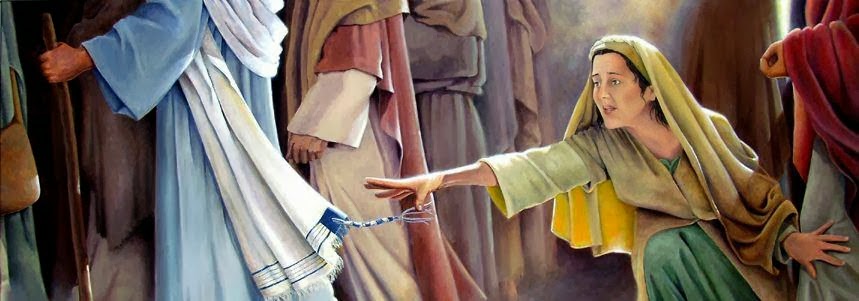
Jewish men wore a garment called the tallit, a rectangular white prayer shawl with dyed blue patterns on it, and fringed about with tassels called tzitzit. This is what the woman touched. While modern authors perhaps draw unwarranted conclusions from this, the fact that this is the “hem of his garment” mentioned by the evangelists is practically beyond dispute. Cornelius a Lapide certainly holds it to be the case. The tallit, a sort of Old-Testament sacramental, was a reminder to Jewish men of their covenant with God (cf. Num. 15:38-40).

user posted image

user posted image
Fresco, Catacomb of Sts. Marcellinus and Peter, Rome, early 4th Century showing the haemorrhissa being healed by touching Christ’s garment (Mk 5:25–34)

A woman with an issue of blood would have been considered ritually impure. Her religious observance, and even her routine social interaction with other Jews would have been drastically curtailed by this impurity. She could not, in fact, touch others without rendering them impure. This may well be why she was trembling and fearful when called upon to identify herself, which supposition leads to a question: Why did Jesus call her out in the first place, thus subjecting her to such embarrassment and fear? Perhaps it was to give her confidence, and to assure her that it was perfectly fine for her to “steal” this cure, or perhaps it was to try her for the purpose of building her up, removing her fears while at the same time calling the attention of the bystanders to the miracle. Maybe it was to assure this good woman that it was He who had healed her and not merely His tzitzit, thus strengthening her faith. Whatever the exact reasons were in the Mind of Our Lord, after the humiliation consequent upon this public acknowledgment, the Haemorrhissa is commended for her faith and told to be “at peace,” whereas before she was “trembling” and “fearful.” Jesus challenged her to reveal her vulnerability — to be open, trusting, docile, and completely abandoned to His goodness. None the worse for all this, she walks away not only physically healed, but also reassured, comforted, confident, and sanctified.

There is a tradition — that identifies this good woman with Saint Veronica of the Veil.

What must it have been like for poor Jairus to witness this episode that “distracted” the Master while on the way to cure his dying daughter? One can imagine mixed emotions based upon a newfound confidence in the Master along with a heightened urgency to present the dying girl to Jesus. The ruler’s emotional state would then have been exacerbated by the news that came after the woman’s cure and subsequent dialogue with Jesus, when messengers arrived to inform him that his little girl was dead. Undaunted by the news, Jesus tells the anguished father to fear not but only to believe.

As with the now-cured Haemorrhissa, Jairus is being tested to believe in and trust Jesus even more. These two cases are practical studies in how Our Lord deals with people. Never satisfied with where they are, He tries them and thus invites them to come higher by practicing greater virtue and relying more and more on Him, rewarding their cooperation with further graces. These lessons are invaluable for us.

When Jesus arrives at the house of Jairus, He is greeted by a very extroverted display of emotion. There were musicians there, and possibly hired mourners (“professional wailers” as they are called), who were paid for the service of priming the pump of people’s tears. Saint Matthew mentions “minstrels and the multitude making a rout,” whereas Mark calls it “a tumult, the people weeping and wailing much, and Luke laconically says “all wept and mourned for her.” There is nothing of Anglo-Saxon reserve in Middle Eastern mourning, where bombast is the order of the day; add to that, though, the fact that this was a twelve-year-old girl. Even in our comparatively frigid North-American culture, the funeral of a child is different than that of an adult. The note of tragedy is there, making the mourning deeper.

Then Jesus says something at least materially untrue: “The girl is not dead, but sleepeth.” Is this a lie? No, of course not; He is simply notifying the mourners of the temporary nature of the girl’s condition. He said something similar about Lazarus (John 11:11), whom He was also about to “awake... out of sleep” at the time. Death and sleep often stand as metaphors for each other in Scripture and in the Church’s liturgy, but here as with Lazarus, Jesus miraculously renders death just as susceptible to interruption as routine sleep.

Having dispelled the noisy mourners and brought in His three favorites and the girl’s parents, Jesus approaches the damsel with only six people in the room — six, the imperfect number which therefore represents evil, a whole trinity of sixes being the very number of the beast. Man was made on the sixth day, but he was made for the seventh day, the eternal sabbath of Heaven, according to Saint Augustine. At the resurrection of the dead girl, the scene is now representative of perfection, because six living souls become seven. Jesus perfects our imperfections if we “fear not, but believe only.”

Those three favorites Jesus brought with him — Peter, James, and John — would witness two other things that the rest of the Twelve did not see: the Transfiguration and the Agony in the Garden. The first two were, or should have been, an adequate preparation for the third. Peter represents faith because his profession of faith at Caesarea-Phillipi was rewarded with the office of being Christ’s Vicar. Saint John, being “the beloved disciple,” evidently represents charity. Less clear is how Saint James the Great represents hope — less clear, that is, until we realize that he was the first of the Twelve to have his hope give way to vision when he died in A.D. 42, a victim of Herod Agrippa, who had him beheaded.

When the girl is raised from the dead, Jesus commands that she be brought something to eat. Why? Well, no doubt as a courtesy because He cared, but there was another good reason: to assure the onlookers that she was indeed alive and perfectly healthy, so that she could eat and retain food. After His Resurrection, on the night of the first Easter Sunday, Jesus asked for food and they gave Him fish and a honeycomb so that they could see that He had a real body and was in perfect health.

Even in a quick reading we might notice the curious fact that the woman suffered from the issue of blood for twelve years, and Jairus’ daughter was twelve years old when she died (though Luke says she was “almost twelve years old”). In his Catena Aurea, Saint Thomas quotes the medieval monastic writer, Rabanus Maurus, on the significance of this. In summary, Jairus represents Moses, and his daughter the Synagogue, while the woman with the issue of blood represents the Gentiles. Jesus is sent to the lost sheep of the house of Israel, but on the way, He also heals the Gentiles. Twelve and a half years was considered marriageable age for a girl, though they often waited till they were thirteen or fourteen to marry. The lesson here, according to Rabanus, is that just when the Synagogue should have been fruitful in bringing about offspring, she dies from her own infidelity; but the Gentiles — who had apostatized from God and consequently became spiritually fruitless around the time the Hebrews were chosen out of the mass of humanity — even these will enter the Church of the Messias. In the Matins reading for this Sunday, Saint Jerome applies two Biblical passages to this Jew-Gentile reading of the two females in our Gospel: First, “Ethiopia [the Gentiles, represented by the Haemorrhissa] shall soon stretch forth her hands unto God” (Ps. 67:32; note the gesture of “stretching forth her hands” as if to touch Jesus’ tzitzit), and second, “Blindness in part is happened to Israel, until the fullness of the Gentiles is come in and so all Israel shall be saved” (Rom. 11:25). Near the end of time, after the complete conversion of all the Gentile nations, the Jews, who spiritually “died” prematurely, will come to life and enter the Church.

In these days of increasing ugliness and hate in the world, let us meditate upon and avail ourselves of the supreme moral beauty and efficacious love of our Divine Physician, “looking on Jesus” (Heb. 12:2), “Who his own self bore our sins in his body upon the tree: that we, being dead to sins, should live to justice: by whose stripes you were healed” (1 Pet. 2:24).

Most devotedly yours in the Hearts of Jesus and Mary,
Brother André Marie, M.I.C.M.

This post has been edited by yeeck: Nov 13 2020, 02:34 PM
khool
post Nov 15 2020, 07:30 AM

Getting Started
**
Junior Member
225 posts

Joined: Mar 2008


talita kuhm ...
TSyeeck
post Dec 18 2020, 10:24 AM

Look at all my stars!!
*******
Senior Member
3,573 posts

Joined: Apr 2006


EVERY night, in the traditional office of Compline, we encounter the following words of Saint Peter (I Pet. 5:8):
Fratres: Sóbrii estóte, et vigiláte: quia adversárius vester diábolus tamquam leo rúgiens círcuit, quærens quem dévoret: cui resístite fortes in fide.
V. Tu autem, Dómine, miserére nobis.
R. Deo grátias.

In English:

Brothers: Be sober and watch: because your adversary the devil, as a roaring lion, goeth about seeking whom he may devour. Whom resist ye, strong in faith:
V. But thou, O Lord, have mercy upon us.
R. Thanks be to God.

Faith is the initium salutis, “the beginning of human salvation” — not the middle, not the end. This doctrine comes to us from the Council of Trent, which cites Saint Fulgentius of Ruspe (468-533) as its source. Among the three theological virtues — and, indeed, within the supernatural life as a whole — faith is “first,” not chronologically or in any other respect “mathematically,” but first in that ontological sense in which all else that comes after is dependent upon it; without it, there simply is no supernatural life.

Fortitude is a moral virtue, and one of the four cardinal moral virtues. Its other names are “courage” and “bravery.” It exists in us as a power to restrain fear, which itself exists in us as a perfectly useful human passion, though we can allow fear to traumatize us as people are clearly being traumatized by all manner of false fears lately. On the other hand, without fear, we would endanger ourselves unnecessarily by doing foolhardy things. Like all the passions, fear is a potentially very good servant, but a poor master, and therefore needs to be directed according to reason. Subjecting fear to reason is precisely the function of fortitude — about which I wrote more elsewhere.

Fortitude, to be a genuinely Christian virtue, must rest firmly on the Rock of Christ. Otherwise, what we have will be a counterfeit of fortitude, a bravado or machismo founded upon the shifting sands of pride and disordered self-love. How then, can we guarantee that our fortitude rests firmly on the Rock of Christ? There are three powerful adhesives that firmly attach fortitude to that Rock and assure its strength: humility, abandonment, and confidence in God.

Concerning these, Saint Paul gives us a wonderful image in a much celebrated passage (II Cor. 12:7-10):

And lest the greatness of the revelations should exalt me, there was given me a sting of my flesh, an angel of Satan, to buffet me. For which thing thrice I besought the Lord, that it might depart from me. And he said to me: My grace is sufficient for thee; for power is made perfect in infirmity. Gladly therefore will I glory in my infirmities, that the power of Christ may dwell in me. For which cause I please myself in my infirmities, in reproaches, in necessities, in persecutions, in distresses, for Christ. For when I am weak, then am I powerful.

Father Challoner comments as follows on that passage:

The strength and power of God more perfectly shines forth in our weakness and infirmity; as the more weak we are of ourselves, the more illustrious is his grace in supporting us, and giving us the victory under all trials and conflicts.

See how the great Apostle recognizes his own smallness and dependence, and even glories in his infirmities as he abandons himself to God’s good pleasure with the full confidence that Christ’s power will dwell in him in the midst of those manifold threats, torments, betrayals, and life-threatening dangers he only partially narrated to the Corinthians in the preceding chapter. He will continue manifest this his humble, abandoned, and confident fortitude even unto martyrdom, thus maximally availing himself of the grace of Christ.

Christian fortitude is not remotely possible without the theological virtue of faith, and there are times when faith itself needs the moral virtue of fortitude to shield it from harm — as when that roaring lion seeks to devour us. These two great virtues support one another.

Concerning the virtue of faith, its truths admit of no negotiation, no compromise, and no attenuation. For this reason, faith has a paradoxical double aspect: In itself, it is a house of stone built upon a rock, but it can also be a house of cards, or, to use Christ’s own figure at the end of the Sermon on the Mount, a house built upon the sand.

How explain this paradox?

Objectively speaking, as it comes from God through the Church, the divine and catholic faith is an impregnable, enduring, unbreakable fortress of stone built upon solid rock. Subjectively speaking — that is, as that faith exists in each one of us as in its subject — it is assailable. It can be compromised, even destroyed. If we remove one stone from that sturdy edifice, it crumbles like a house of cards. By our own assent to superstition or heresy, or even our own deliberate doubt of just one revealed truth, we can mutilate what is divine into a merely human faith.

Here is Saint Thomas explaining how a heretic does not have “living faith” (that is, faith accompanied by hope, charity, and sanctifying grace), or even “lifeless faith” (faith without the last two of those things, i.e., the faith of an orthodox Catholic in mortal sin):

Neither living nor lifeless faith remains in a heretic who disbelieves one article of faith.

The reason of this is that the species of every habit depends on the formal aspect of the object, without which the species of the habit cannot remain. Now the formal object of faith is the First Truth, as manifested in Holy Writ and the teaching of the Church, which proceeds from the First Truth. Consequently whoever does not adhere, as to an infallible and Divine rule, to the teaching of the Church, which proceeds from the First Truth manifested in Holy Writ, has not the habit of faith, but holds that which is of faith otherwise than by faith. Even so, it is evident that a man whose mind holds a conclusion without knowing how it is proved, has not scientific knowledge, but merely an opinion about it. Now it is manifest that he who adheres to the teaching of the Church, as to an infallible rule, assents to whatever the Church teaches; otherwise, if, of the things taught by the Church, he holds what he chooses to hold, and rejects what he chooses to reject, he no longer adheres to the teaching of the Church as to an infallible rule, but to his own will. Hence it is evident that a heretic who obstinately disbelieves one article of faith, is not prepared to follow the teaching of the Church in all things; but if he is not obstinate, he is no longer in heresy but only in error. Therefore it is clear that such a heretic with regard to one article has no faith in the other articles, but only a kind of opinion in accordance with his own will.

We are all subject to doubts and to trials of our faith. Saint Peter, whose words began the present lines, writes elsewhere of “the trial of your faith (much more precious than gold which is tried by the fire)” (I Pet. 1:7). In fact, the great saints have their faith and other theological virtues tried a great deal as they become perfected in the interior life.

We must frequently renew this fundamental virtue by making interior acts of faith, by daily reciting the Credo, and by not permitting any doubt to undermine this necessary foundation to our spiritual edifice. But when our faith is assailed, let us be at peace. Only in peace can we have the proper internal atmosphere whereby the power of Christ can freely operate in us. If we are humble, abandoned, and confident, we will also be peaceful. Our faith will not evaporate for all that, but, rather, be strengthened. On the other hand, when we suffer from anxiety, depression, or disordered fear, we can lose our trust in the divine promises and subject ourselves to the undermining forces of the devil. (Which reminds me that the woodpecker, for its ability to undermine the structural integrity of a tree is a symbol of both heresy and the Devil)

Faith is the initium salutus, the beginning of human salvation, but not its end. Faith cleaves in this life to God as Truth. From there, we cleave by hope to God as our last Good, but that is not the highest virtue. The highest virtue is the one that cleaves to God as the Good to be loved in Himself, and that is charity, "the greatest of these" (I Cor. 13:13), which abides forever. Without faith, we cannot have charity; therefore, we cannot have God. Because of this, charity perfects what was begun by faith. Moreover, because “perfect charity casteth out fear” (1 John 4:18), charity also completes the work of fortitude.
TSyeeck
post Dec 21 2020, 04:36 PM

Look at all my stars!!
*******
Senior Member
3,573 posts

Joined: Apr 2006


Fourth Sunday of Advent

In the Epistle, St. Paul tells us: " Let a man so account us, as servants of Christ and stewards of the mysteries of God. Now here it is required in stewards that a man be found trustworthy" (I Cor 4;1). Let us say a few words about this fidelity that the Good Lord expects from us.

God the Creator of the universe and our lives is the Source of all wisdom and goodness. He knows and organises everything down to the smallest details, from the first moment of the world to the last. Does this mean that we have nothing else to do but to "undergo" God's plan, passively and with fatalism? Not at all, because God introduces us, to a certain extent, to the knowledge and understanding of His plan so that we can take an active, free and voluntary part in its execution. What the Good Lord therefore expects from us is the acceptance and faithful execution of His plan, each one at his own level. It is like an architect who has drawn up the detailed plan of a house and explains it to the foreman who is going to build the house: what does he expect from the foreman? To be faithful to carry out the plan as indicated and to put all his know-how and energy into it. The Good Lord has revealed to us through the Bible and the perennial teaching of the Church's Magisterium what we should know about His plan, established for the glory of the Holy Trinity and the eternal salvation of mankind by Our Lord Jesus Christ: He expects us now to work on it actively and faithfully, applying all our energy and qualities to it with perseverance.

During Advent, the Church makes us meditate particularly on St. John the Baptist. He is the type of the faithful servant, a great model for all of us. The Good Lord laid out in details the plan of the Incarnation, the life of the Saviour in Palestine. He established St. John the Baptist to be the precursor of the Saviour and introduced him into the knowledge of the Mystery of the Incarnation so that he could prepare souls to welcome Our Lord Jesus Christ and send them to Him. In his hymn, St. Zechariah prophetically expressed his son's programme: "Thou shalt go before the face of the Lord to prepare his ways: to give knowledge of salvation to his people, unto the remission of their sins."(Lk 1:77). St. John the Baptist understood his place in God's plan and faithfully fulfilled his mission, preaching the salutary truth to each and every one. To all he said, "Bring forth therefore fruits worthy of penance" (Lk 3; 8) and "he that has two coats, let him give to him that hast none; and he that hast meat, let him do in like manner" (Lk 3; 11).To thieving officials he preached the virtue of justice: "Do nothing more than that which is appointed you” (Lk 3; 13); to the police and army, brutal and oppressive, he preached the virtue of Fortitude: "Do violence to no man, neither calumniate any man; and be content with your pay" (Lk 3; 14); to the proud and heretical religious leaders, he denounced their malice: "Ye, brood of vipers, who hath shewed you to flee from the wrath to come?" (Mt 3 7) and he preached to them the humility of the true servant of Jesus Christ: "the latchet of whose shoe I am not worthy to loose" (Jn 1; 27); to the scandalous political leaders, he denounced their corruption: "It is not lawful for thee to have thy brother’s wife" (Mk 6:18); to all, St. John the Baptist showed the way to eternal salvation: "Behold the Lamb of God, behold Him who taketh away the sin of the world... and I saw and gave testimony that this is the Son of God" (Jn 1:29,34). And because of his faithful testimony, he was murdered. Should we be shocked by this? Should we be afraid of it? No, because " Now here it is required in stewards that a man be found trustworthy " and this up to martyrdom. St John the Baptist was faithful to the end. Glory to him: "Amen I say to you, there hath not risen among them that are born of women a greater than John the Baptist" (Mt 11:11).

This phrase of St. Paul " Now here it is required in stewards that a man be found trustworthy " applies to each one of us. We are the stewards, each at our own level, of the treasure of Faith: the Good Lord has made known to us how all honour is given to Him only through Our Lord Jesus Christ, how the salvation of mankind is possible only through Our Lord Jesus Christ. There is no need to look for a mission: what we are asked to do is to be the faithful witnesses to Christ in our personal life, our family life, our social and political life. And too bad, if this does not please the publicans, soldiers, Pharisees, Sadducees and Herods of the civil and religious societies of our times.

During the time of Advent we are preparing two events: the first one is about the past and it is the birthday of the Saviour on Christmas Day. In honour of Jesus, you are going to offer various gifts to your children, relatives and friends: that's good. The second event concerns the future and it is the coming of the same Saviour at the end of the world to judge the living and the dead. In view of this moment, there is a very precious gift to give to your children, parents and friends: the Catholic Faith. Our Lord gave a terrible warning in the Gospel: "When the Son of Man cometh, shall he find, think you, faith on earth? "(Lk 18:8), which suggests our falling into tepidity and unfaithfulness. So, while you are wrapping your Christmas presents, remember that above anything else, towards and against all odds and even at the cost of your life, it is the living Catholic Faith that you must pass on to your children, relatives and friends.

khool
post Dec 25 2020, 11:03 AM

Getting Started
**
Junior Member
225 posts

Joined: Mar 2008


Why is Christmas on December 25?

It’s that time of year again when many Christians encounter claims that pagan deities predating Jesus Christ were born on December 25. In popular films, Internet videos, and other media you can find long lists of gods who were supposedly born on the same day.

This idea is not limited to unbelievers. I have heard many Christians claim that the date of Christmas was intended to provide an alternative to pagan celebrations. In some ways it has become a pious legend. On the other hand, some Fundamentalist denominations refuse to celebrate Christmas for this reason.

Of all the deities of whom people make this claim, only three can be found to come close: Saturn, Sol Invictus (Unconquered Sun), and Mithras.

Saturnalia
Saturnalia was the feast dedicated to the Roman god Saturn. Established around 220 B.C., this feast was originally celebrated on December 17. Eventually the feast was extended to last an entire week, ending on December 23. The supposed connection to Christmas is based on the proximity of the two festivals to each other.

This can be found repeatedly on the Internet. In his article Saturnalia: The Reason We Celebrate Christmas in December, columnist Mark Whittington explains:

It has been suggested that Christians in the 4th Century assigned December 25th as Christ’s birthday (and hence Christmas) because pagans already observed this day as a holiday. In this way the problem of eliminating an already popular holiday would be sidestepped, thus making the Christianizing of the population easier.

If the suggestion were correct, one would expect to find at least a single reference by early Christians to support it. Instead we find scores of quotations from Church Fathers indicating a desire to distance themselves from pagan religions.

Sol Invictus and Mithras
The feast of Sol Invictus was the attempt by the Roman emperor Aurelian to reform the cult of Sol, the Roman sun god, and and reintroduce it to his people, inaugurating Sol’s temple and holding games for the first time in A.D. 274. Not only was this festival not annual, it also cannot be historically documented as having been established on December 25 by Aurelian (cf. Steven HijMans, Sol Invictus, The Winter Solstice, and the Origins of Christmas, Mouseion, Series III, vol. 3, pp. 377-398).

According to inscriptions on candle votives and other ancient works of art, there is a link between Mithras and Sol Invictus. In some cases it appears the Mithraists believed that Mithras and Sol were two different manifestations of the same god. In others they appear to be two gods united as one. These connections are difficult to understand given our limited knowledge of the Mithraic belief system, but they are important because they help to explain why skeptics claim the birthday of Mithras was celebrated on December 25.

A manuscript known as the Chronography of 354 shows the birth of Sol Invictus being celebrated on December 25. Given the fact that the Mithraists equated their god with Sol in one way or another, it is understandable that they may have appropriated the date as their own. The problem for the skeptic is that no evidence exists to suggest that Aurelian was a Mithraist, or that he even had Mithraism in mind when he instituted the feast of Sol Invictus. The connection of Mithra to December 25 is only coincidental.

The deathblow to both the Mithras and Sol Invictus parallels is that the Chronography of 354 is the earliest mention of any pagan god being celebrated on December 25. The celebration of the birth of Christ by Christians is also mentioned on the calendar as having been celebrated on that day, which diminishes the likelihood that the pagan feast came first. At the very least, it negates the claim that it can be proved from the historical record that any December 25 pagan festival predates the Christian tradition.

The Reason for Choosing December 25
Although the date of Christ’s birth is not given to us in Scripture, there is documented evidence that December 25 was already of some significance to Christians prior to A.D. 354. One example can be found in the writings of Hyppolytus of Rome, who explains in his Commentary on the book of Daniel (c. A.D. 204) that the Lord’s birth was believed to have occurred on that day:

For the first advent of our Lord in the flesh, when he was born in Bethlehem, was December 25th, Wednesday, while Augustus was in his forty-second year, but from Adam, five thousand and five hundred years. He suffered in the thirty-third year, March 25th, Friday, the eighteenth year of Tiberius Caesar, while Rufus and Roubellion were Consuls.

The reference to Adam can be understood in light of another of Hyppolytus’ writings, the Chronicon, where he explains that Jesus was born nine months after the anniversary of Creation. According to his calculations, the world was created on the vernal equinox, March 25, which would mean Jesus was born nine months later, on December 25.

Nineteenth-century liturgical scholar Louis Duchesne explains that “towards the end of the third century the custom of celebrating the birthday of Christ had spread throughout the whole Church, but that it was not observed everywhere on the same day” (Christian Worship, Its Origin and Evolution: a study of the Latin liturgy up to the time of Charlemagne, p. 260).

In the West, the birth of Christ was celebrated on December 25, and in the East on January 6.

Duchesne writes “one is inclined to believe that the Roman Church made choice of the 25th of December in order to enter into rivalry with Mithraism. This reason, however, leaves unexplained the choice of the 6th of January” (ibid., p. 261). His solution, therefore, was that the date of Christ’s birth was decided by using as a starting point the same day on which he was believed to have died. This would explain the discrepancies between the celebrations in the East and West.

Given the great aversion on the part of some Christians to anything pagan, the logical conclusion here is that one celebration has nothing to do with the other. In his book, Spirit of the Liturgy, Pope Benedict XVI explains:

The claim used to be made that December 25 developed in opposition to the Mithras myth, or as a Christian response to the cult of the unconquered sun promoted by Roman emperors in the third century in their efforts to establish a new imperial religion. However, these old theories can no longer be sustained. The decisive factor was the connection of creation and Cross, of creation and Christ’s conception (p. 105-107).

While these explanations of how December 25 came to be the date of Christmas are all plausible, we know one thing for sure: The evidence that this day held a special significance to Christians predates the proof of a supposed celebration of Sol Invictus or other pagan deities on that day.

That the Christians chose a date so close to the winter solstice is also not proof that this was done to mimic pagan festivals. The various pagan religions all had festivals spanning the calendar. Whatever month the early Christians might have otherwise chosen would still place Christmas near some pagan celebration, and oppositional theorists would still be making the same claims.

The solstice was important to everyone for agricultural reasons in the same way water is important to the survival of human beings, and so we see rituals involving water showing up in various religions. That doesn’t prove that one borrowed the idea or theme from another.

Source: Why is Christmas on December 25?

This post has been edited by khool: Dec 25 2020, 11:04 AM

65 Pages « < 57 58 59 60 61 > » Top
 

Change to:
| Lo-Fi Version
0.0398sec    0.45    6 queries    GZIP Disabled
Time is now: 3rd December 2025 - 08:26 AM