

LYN Catholic Fellowship V02 (Group), For Catholics (Roman or Eastern)
LYN Catholic Fellowship V02 (Group), For Catholics (Roman or Eastern)
|
|
 May 31 2020, 09:58 PM May 31 2020, 09:58 PM
|
 
Junior Member
225 posts Joined: Mar 2008  
|
|
|
|
|
|
|
May 31 2020, 11:05 PM
|
|
Junior Member
225 posts Joined: Mar 2008
|
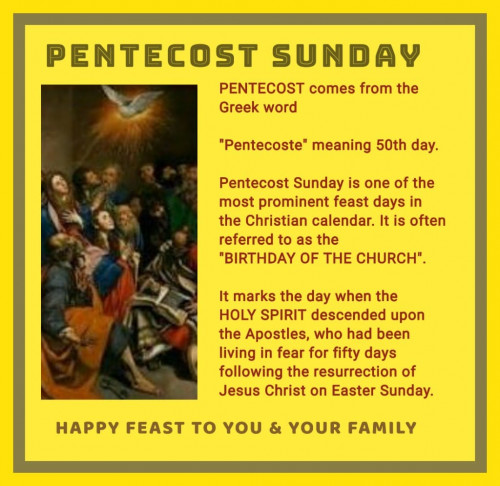
Receive The Power (Malaysian Edition)
The finale video from the Pentecost Day Celebration organised by Covenanted for Christ Covenant Community (CFCC) Penang & Taiping and Servants of Yahweh Covenant Community (SOYCC), KL. |
|
|
Jun 5 2020, 08:59 PM
|
|
Junior Member
225 posts Joined: Mar 2008
|
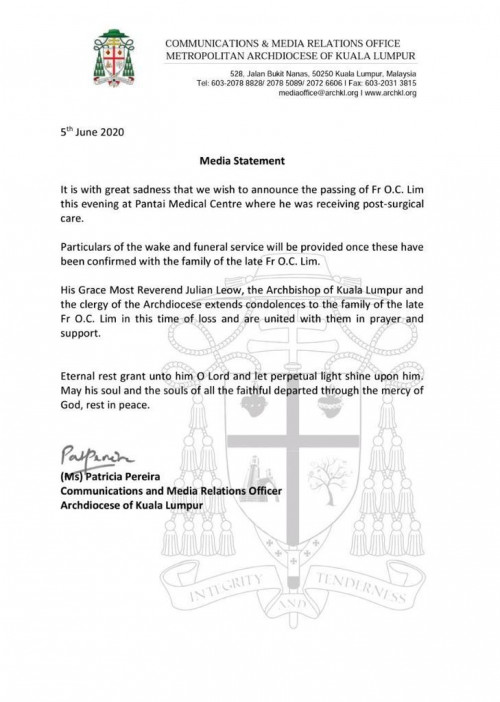 Eternal rest grant unto your faithful servant O Lord, And may the perpetual light shine upon him ... This post has been edited by khool: Jun 5 2020, 09:00 PM |
|
|
Jun 6 2020, 04:32 AM
Show posts by this member only | IPv6 | Post
#1144
|

Junior Member
155 posts Joined: May 2007
|
QUOTE(khool @ Jun 5 2020, 08:59 PM) Eternal rest grant unto your faithful servant O Lord, And may the perpetual light shine upon him ...   Rest in Peace, Fr. OC Lim. Inspiring sermons when I attended mass at SFX previously. Eternal rest grant unto him O Lord and let perpetual light shine upon him. |
|
|
Jun 6 2020, 06:22 PM
|
|
Junior Member
225 posts Joined: Mar 2008
|
|
|
|
Jun 10 2020, 11:43 AM
|

Senior Member
3,573 posts Joined: Apr 2006
|
|
|
|
|
|
|
Jun 10 2020, 03:48 PM
|
|
Senior Member
3,573 posts Joined: Apr 2006
|
|
|
|
Jun 12 2020, 03:27 PM
|
|
Senior Member
3,573 posts Joined: Apr 2006
|
Amid This Chaos, You Will Serve God or Satan
AS WE witness the appalling phenomenon of American cities burning amid horrible violence, we hear unbelievable cries from radicals for defunding police departments. Forces that are opposed to Christian social order — organizations funded by George Soros and other bankrollers of chaos — may be working for their own perverse agenda, but they are ultimately only proxy warriors in the effort to bring about a more powerful Nanny State. As one who is very happy with the police force who serves the community he lives in (the Cheshire County Sheriff’s Office), I can make no complaints regarding “bad cops” — certainly not in my own experience. I am certain that there are many other Americans who can say the same thing. These are locals who are our fellow citizens and neighbors, whose presence has been peaceful and benevolent, as it should be. It is nonetheless true that some police forces across the nation — including Minneapolis, Minnesota have been trained by the Israeli police, whose history of brutality is well documented (see here and here). In some American locales, we are witnessing an increased militarization of the police, many of whose members are combat veterans of our prolonged wars in the Middle East with experience in “urban warfare.” Add to that the near total loss of military ethics in our armed forces, and this becomes a recipe for disaster. What we have here is a classic dialectic of action and counter-reaction that serves no other cause than to plunge the nation into chaos and thus invite tighter control and despotism. It’s a Big-State globalist’s dream come true, for the present effort at defunding the police does not have as its endgame an anarchical America, but rather an America with a federalized police force (a very bad idea; see also here and here). This movement is nothing new; to their credit, since 1963, the John Birch Society has worked to stop this agenda of a nationalized or federalized police force. The puppet masters who are adding their financial fuel to this fire are counting on the fact that they can manipulate human passions. They are using the old Marxist dialectic to pit the white man against the black man, the rich against the poor, and any group of so-called “haves” against an opposed category of “have-nots.” Inevitably, the rich almost never lose (some are actually getting richer); rather, it’s the middle class that is being destroyed — but you’re not supposed to notice that. The tried-and-true methodology of Cultural Marxism is at work, with a great deal of help from the servile mainstream media. You can choose to become part of the dialectic by hating, execrating, and doing violence to the dialectical opposite class that you’ve been assigned, or you can choose not to enter into that Marxist matrix. Saint Augustine famously told us about the “two cities” in his classic, The City of God: “Accordingly, two cities have been formed by two loves: the earthly by the love of self, even to the contempt of God; the heavenly by the love of God, even to the contempt of self. The former, in a word, glories in itself, the latter in the Lord.” As part of those two cities, along with the two “loves,” there are also two opposed “services” or “slaveries.” The denizen of the City of Man, in his disordered love of self, serves his own pride or his base passions. He is a “servant of sin” (John 8:34) — that is, a slave to vice. On the other hand, the inhabitant of the City of God has been cleaned by the Blood of Christ “to serve the living God” (Heb. 9:14), knowing “that [his] old man is crucified with [Jesus], that the body of sin may be destroyed, to the end that [he] may serve sin no longer” (Rom. 6:6). In the Sermon on the Mount, Our Lord Himself connected the ideas of love and service: “No man can serve two masters. For either he will hate the one, and love the other: or he will sustain the one, and despise the other. You cannot serve God and mammon” (Matt. 6:24). You will serve God or Satan. If the latter, you will be a slave of your pride and of your passions. You will either allow your irascible appetite to be aroused by exposure to mainstream media accounts of violence, or your concupiscence appetites to be captivated by such evils as pornography — or both! In any such scenario, as a slave of sin, you will become prey to the demons and their willing accomplices on earth. In other words, you will have been reduced to the status of a useful idiot of Satan. The idea of being a slave or servant of God is all over the Scriptures, Old and New Testaments. The word for “servant” in many of the New-Testament passages I have in mind is δοῦλος (doulos), which can also be translated “slave.” Here is a small sampling of the Apostles calling themselves slaves: “Simon Peter, servant and apostle of Jesus Christ, to them that have obtained equal faith with us in the justice of our God and Saviour Jesus Christ” (2 Pet. 1:1). “Paul, a servant of Jesus Christ, called to be an apostle, separated unto the gospel of God…” (Rom. 1:1; cf. Titus 1:1). “Jude, the servant of Jesus Christ, and brother of James: to them that are beloved in God the Father, and preserved in Jesus Christ, and called” (Jude 1:1). Jesus Himself gave the ultimate example of holy servitude: “But I am in the midst of you, as he that serveth [διακονῶν]” (Luke 22:27); He “emptied himself, taking the form of a servant” (Philip 2:7; cf., Imitating Christ’s Humility), while the Devil gives us its polar opposite where tradition attributes to him those words Jeremias puts on the lips of rebellious Jews: Non serviam! (I will not serve.) John Milton, in Paradise Lost (1667), has Satan saying, “Better to reign in Hell, than serve in Heaven.” Slavery is found in the Church’s liturgy. In the Holy Mass, the celebrant refers to his priestly action as a “service,” and himself as a “servant”: In the Hanc Igitur, he refers to the oblationem servitutis nostrae (“oblation of our service”); shortly after the consecration, he refers to himself and his fellow sacred ministers as nos servi tui (“we, your servants”); and at the Placeat just before the final blessing, he refers to the Mass as the obsequium servitutis meae (“tribute of my service”). The concept of slavery or service cuts to the very heart of what religion is. Among the diverse etymologies proposed for the word “religion” is an origin from the Latin verb religo, religare meaning “to bind fast” (Saint Augustine preferred this etymology). Whether or not that is the actual origin of the word, the fact remains that an act of the virtue of religion is the rendering to God of what is His due, and that includes our very selves and hence our service. In his controversy with John the Faster, Pope Saint Gregory the Great appropriated to himself, and consequently to the highest office in the Church Militant, the title, Servus servorum Dei (the Servant of the Servants of God). Had not Jesus said, “whosoever will be the greater among you, let him be your minister: And he that will be first among you, shall be your servant” (Matt. 20:26-27)? Truth itself is a conformity (of the mind to reality), which implies a servitude or slavery to reality — to what is. Slavery, then, of the right sort, is an eminently reasonable thing. It is rational and even ennobling to serve something greater than oneself. It is irrational and degrading to serve a base creature or one’s own passions. If we may press the matter further, any act of the free will is something that limits man. This is so because with it, we can either choose to act or not to act (not both); and we can choose to do this or that act (often not both). Our free-willed decisions and acts therefore bind us (bondage=slavery) to a certain decision. By our morally good or morally evil decisions, we are constantly either bettering or worsening ourselves. Ultimately, we will either serve God or Satan. Why not, then, stop all pretense that we are utterly autonomous and will serve nobody? This is a diabolical lie, a false liberty that can end nowhere but in Hell. If we serve the Queen of Heaven, our service goes to the King, Our Lord Jesus Christ; and through Him, to the Holy Trinity. Such slavery elevates us. Moreover, if we really live it, we will not be the slaves of Satan, of sin — or of George Soros, for that matter. Most devotedly yours in the Hearts of Jesus and Mary, Brother André Marie, M.I.C.M. This post has been edited by yeeck: Jun 12 2020, 03:28 PM |
|
|
Jun 24 2020, 09:27 AM
|
|
Junior Member
225 posts Joined: Mar 2008
|
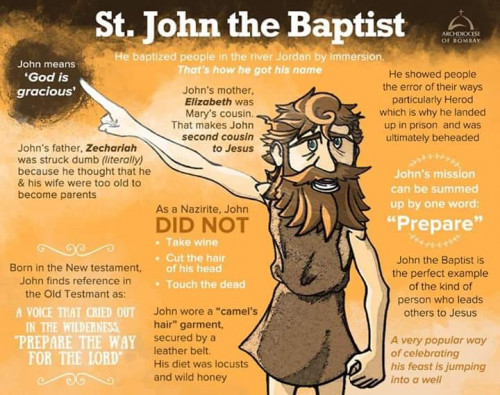 Catholic Treasurers - SPIRITUAL FOOD FOR WEDNESDAY OF THE 12TH WEEK IN ORDINARY TIME. 24TH JUNE, 2020. SOLEMNITY OF THE NATIVITY OF JOHN THE BAPTIST Isaiah 49:1-6. Ps 139:1b-3, 13-15. Acts 13:22-26. Luke 1:57-66, 80 YOU ARE UNIQUE IN THE SIGHT OF GOD: YOU HAVE BEEN CHOSEN AND CALLED Today the Church celebrates the birth of John the Baptist, the precursor, the herald, the forerunner of Jesus, the voice of the one crying in the wilderness, the friend of the Bridegroom. While the Church celebrates the day of a saint’s death as the feast day since it marks the entrance into heaven, there are two exceptions to this, the Blessed Virgin Mary and the feast of today. The first reading perfectly fits the narrative of the birth of the Baptist, one whose role was the conversion of the nation and the restoration of Israel. In the gospel, we saw that John spent his time in the desert, he was a man of the desert, thus the desert prepared him for the arduous task of being the forerunner of the Saviour until his appearance or manifestation to the people of Israel. Lk. 1.80. Without a doubt, John was a special child who leapt for joy and was filled with the Holy Spirit in the womb when he recognized the Saviour at the visit of the Blessed Virgin Mary to Elizabeth. This incident has been seen by bible scholars as the singular moment when John the Baptist was cleansed of original sin, since it was foretold by the Angel that John would be filled with the Holy Spirit even while in the womb (Luke 1:15). John was the cousin of Jesus, they were relatives. Dear child of God, the feast of today challenges all Christians on different levels. First, to the fundamental attitude of being Christians-our total trust and dependence on God. Despite the tragedies and “hopelessness” of life, the parent of the Baptist continued to hope in the Lord. Moreover, they remained optimistic and continued in their lifestyle of serving God. We are called to be good parents and Guardians to our children and wards, like the parents of John the Baptist. This godly parent was pivotal in the upbringing of this child who had a great mission to accomplish, this can be seen more in the insistence on the name of “John” as foretold by the angel to be the name of the Baptist. (2) Placing our life within the will of God the Father, as John did: He lived in the desert, and later began his ministry preparing the way for the Saviour without usurping the role of the Saviour or betraying the trust and the duties given to him by God. (3) We ‘need to ask God’s help to get rid of the barrenness of our heart, cleanse it daily, liberate it from evil attachments and prepare it for the rebirth of Jesus’. (4) Each one of us born into this world has a destiny with our Creator. We are given name as “precious and unique” in the sight of God, it doesn’t matter whether you are black or white, yellow or dark or brown. Moreover, even in the womb before your organs are fully formed, God has given you a name! Thus, those who push for abortions should have a rethink, destroying what God has already created and given a name! the abortionists’ agenda in Kenya is pushing for the legalization of abortion in the country and they have succeeded in fast-tracking the reading of the bill for the second time in the apex chamber, waiting eagerly to pass it into law. However, the life of John will later on tells us that: “not everything that is allowed by law is morally right, e.g. divorce and abortion” as we see in his stern condemnation of king Herod and Herodias. (5) Let us learn from John the Baptist and be like him in bearing witness to the Gospel, he brought discomfiture to the rich and the comfortable, and comforted the poor and gave hope to the hopeless who were waiting for the Saviour. His humility was excellent. Let us pray for more Johns’ to be born and be raised up in our time since we need them urgently and quickly. St. John the Baptist pray for us and intercede for our broken world. Blessed Wednesday and happy feast. Blessings to you +. “A CHRISTIAN IS NOT AN ORDINARY PERSON AND THE LIFE OF A CHRISTIAN IS A LIFE OF WARFARE”. (Padre Pio, CMF). |
|
|
Jun 25 2020, 03:44 PM
|
|
Senior Member
3,573 posts Joined: Apr 2006
|
Fighting the New Iconoclasm by Loving Tradition
“They are just statues,” quoth the tweet of a young Portuguese man in response to my own tweets lamenting the toppling of monuments to Saint Junípero Serra in California and the proposed removal of a statue of Saint Louis in his eponymous city on the Mississippi. My response: “True. And words are only words, ideas only ideas. In all three cases, they mean things. Some of those things are true, good, or beautiful; others false, evil, or ugly.” According to his Twitter profile, the young man who said that these images of the Saints are “just statues” is himself a Third Order Franciscan, which is notable in light of the fact that both saints being dishonored here were Franciscan: Fray Junípero Serra was a friar of the First Order, and Saint Louis was a member of the Franciscan Third Order; in fact, he is one of the patrons of that branch of the Order, now also known as the Secular Franciscan Order (SFO). (For that matter, Christopher Columbus was a Franciscan Tertiary, too.) We Christians, we Catholics, are terrible ingrates and sinners — myself very much included. We take far too much for granted. And because we take God’s gifts for granted, He, in his Providence, either withdraws them from us, or allows them to be taken away by those whose hostile intention is not to purify Christians, but who in spite of themselves become instruments of Providence to do just that. This ties in to what many spiritual writers tell us, namely, that God treats with us through both sufferings and consolations: the former purify us of our sins, the latter draw us closer to Him. Such divine operations are seen not only in our lives as individual Christians, but also in the larger history of the Catholic Church, and in the Old-Testament faithful before us. Seeing a figure like Attila the Hun or Genghis Khan as a “Scourge of God” (flagellum Dei) is part of this Catholic outlook of history. Much respect that the Church has had in this Republic through her historical heroes is evaporating before our eyes with the assaults against Columbus, Saint Louis, and Saint Junípero. If the tyranny of Cultural Marxism continues, many of the freedoms we have enjoyed here will also evaporate. And why? Because we took them for granted and, worse, abused or neglected them. In other words, we did not avail ourselves of the respect and the freedom we had to evangelize the nation. Instead, we have been content to be part of its pluralism — a pluralism that may soon eat us. When our enemies attack what is or should be sacred to us, it is a wake-up call from Our Lord to help us appreciate that thing. This is, in part, why I recommend honoring the Saints all the more when our enemies hate them. So we should learn more about Saint Junípero and Saint Louis. There is a great deal of edification we can draw from learning about their lives. In the case of Saint Louis, we see a model Christian King whose medieval France marked perhaps the apogee of Christendom. Those deeply interested in Catholic social teaching and history would do well to read about Saint Louis’ France in Dr. Andrew Willard Jones’ Before Church and State. In the case of Saint Junípero, we have not only a model of Franciscan piety, but also an exemplar of Catholic missionary zeal. The attacks on his person are really attacks on that extension of the Church and of Christendom that was the enterprise of the great missionaries of his day. Historically, when heretics attacked some particular teaching or practice of the Church, God rose up saints to defend it. We see this especially in the Ecumenical Councils — special mention in this context being due to Nicaea II and the old Iconoclasm. Loyal, brave, and loving hearts rose up to defend our patrimony, even to the point of martyrdom, at the same time articulating for the faithful a greater understanding of the object being attacked. The same should be true of all Catholic things. The intramural assault on the Church’s traditional liturgy provides another timely example. The work of Dr. Peter Kwasniewski in defending and promoting the Traditional Latin Liturgy makes him a real apologist and even philosopher of the Church’s liturgical tradition. His corpus of his work over the last few years represents a stellar example of what we are attempting to articulate here: “fighting the new iconoclasm by loving tradition.” To love a thing, we must first know it and strive to understand it. Books like Dr. Kwasniewski’s latest are invaluable for this. Back to our assailed statues, even if our enemies are reacting out of irrational and uninformed hatred, in picking on these two particular saints, they have chosen well, for these French and Spanish sons of Saint Francis incarnate so much of the truth, goodness, and beauty of Catholicism that they are worthy targets of the enemies of the Church. We know, of course, that the new iconoclasts will not stop with Saints Louis and Junípero. When the recent round of statue smashing started, a friend joked, “Maybe we should take down all statues of people who ever sinned. That way, we would only have statues of Jesus and Mary left standing.” That extreme (and not-so-traditional) Catholic solution could not possibly satisfy the iconoclasts. As if in response to my friend, one of the iconoclast provocateurs, who is getting a name for himself by saying ridiculous things, just declared that all images of Jesus and Mary that show them looking “European” must also come down. Apparently, only perfectly accurate depictions of first-century Jews will be tolerated. No inculturation allowed! Certainly not European, and, we assume — because our enlightened iconoclast cannot possibly be a racist — we must also destroy all depictions of Jesus and Mary as Asian, African, Eskimo, or Latina. Too bad. I rather like these historically inaccurate images of our Savior and His Mother, just as I love the inaccurate Huron Carol of Saint John de Brebeuf (hear it in Huron on YouTube). Iconoclasts and Philistines just don’t get art. In the case of today’s new iconoclasts, art is seen through the lens of the Marxist class struggle. Why aren’t Catholic men — Bishops, priests, Knights of Columbus (ahem!), etc. — defending our sacred patrimony when it is being assailed? The answer is implicit in what I’ve already written. It is a failure of love, a failure to appreciate the good things, and good people, God has given us and to show them the honor that is their due. Because so many of the leadership of Catholic institutions — including many of our clergy — have been intellectually colonized by the enemy via liberalism, modernism, and other toxic -isms, they have become willing accomplices in the destruction of our patrimony, even if only by a halfhearted response to the assaults. In the case of ideologically compromised Catholics, the failure to love what should be loved includes another element: not perceiving the enemy as an enemy, but as an ally. This misperception among intellectually colonized Catholics is a very present reality at so many levels — doctrinal, philosophical, academic, and political. (For an illustration of a large-scale political aspect of the phenomenon, see “Defund the USCCB” and “Welcoming the $tranger: What’s Really Motivating the USCCB on Immigration & Refugees?”) Aside from defending our sacred objects (churches, statues, etc.) from physical attack, there needs to be the longer-term and more sustained effort at learning to love them and what they represent. Why “love” a piece of bronze formed into the likeness of a man with a sword on a horse? What is there to love in that? It is, after all, “just a statue.” Or is it something more? Does the Apotheosis of Saint Louis portray the standards of valor, honor, and chivalry of a Christian Crusader and King, ideals still appreciated on the Feast of Saint Francis, October 4, 1906, when that statue was first unveiled in the “Rome of the West”? If those and similar ideals are what the statue represents, then we should love it. But then, today, those very standards — Christian standards — are also under attack, so we must learn to love them the more, too. Throughout this piece, I have used the words “enemy” and “enemies” a lot — seven times so far, if my computer isn’t lying to me. In one sense, I use the word unapologetically, but that will not prevent me from offering an apologia. After all, these days, we are likely to be lectured for claiming to have enemies. Of course we have enemies. Our Lord had enemies and He promised that, as the servant is not greater than the master, we will, too (Cf. Matt. 10:24-25 and context, John 15:18-20). The difference is that we Christians are commanded to love our enemies, and that in a supernatural sense, as terms of our adoption as children of the heavenly Father (Matt. 5:44-45). When a certain prominent churchmen once told Brother Francis, “the Church has no enemies anymore” (“after Vatican II,” was, I believe, the unstated adverbial phrase), Brother replied, “Then we cannot follow Our Lord’s command to love our enemies, Your Excellency.” The fact is that we have enemies. The challenge is that we must love them. While we must love our enemies, there are also things we must hate, and there are things we ought not tolerate. Ven. Emmanuel D’Alzon has some sage words on this subject: We love Christ with the same kind of love as the early Christians because He still faces the same kind of enemies that he faced then. We love Him with the love that made the Apostles say “if anyone does not love Jesus Christ, let him be cursed” [1 Cor. 16:22]. This may not be very tolerant, but you know that those who love much tolerate little. Properly speaking, true love is revealed in the power of a noble and frank intolerance. In these days with no energy left for either love or hate, men do not see that their tolerance is just another form of weakness. We are intolerant because we draw our strength from our love of Jesus Christ. The kind of “intolerance” being promoted by the Venerable founder of the Assumptionists is not violent, oppressive, or totalitarian. Those adjectives rather attach to the new iconoclasts, whom it is our challenge to love supernaturally even as they seek to destroy what we hold sacred. In loving both our holy treasures and our enemies we show ourselves to be Christian. Most devotedly yours in the Hearts of Jesus and Mary, Brother André Marie, M.I.C.M. |
|
|
Jun 27 2020, 06:14 PM
|
|
Junior Member
225 posts Joined: Mar 2008
|
|
|
|
Jun 29 2020, 09:20 AM
|
|
Junior Member
225 posts Joined: Mar 2008
|
|
|
|
Jun 29 2020, 09:27 AM
|
|
Junior Member
225 posts Joined: Mar 2008
|
Glory to God in the Highest!
 |
|
|
|
|
|
Jun 29 2020, 09:36 AM
|
|
Junior Member
225 posts Joined: Mar 2008
|
 |
|
|
Sep 5 2020, 10:38 PM
|
|
Junior Member
225 posts Joined: Mar 2008
|
|
|
|
Sep 6 2020, 12:35 AM
Show posts by this member only | IPv6 | Post
#1156
|

Senior Member
3,520 posts Joined: Feb 2017
|
QUOTE(khool @ Jun 27 2020, 06:14 PM) |
|
|
Sep 6 2020, 10:12 AM
|
|
Junior Member
225 posts Joined: Mar 2008
|
QUOTE(Roman Catholic @ Sep 6 2020, 12:35 AM) There is nothing mysterious about John the Baptist. Born of the Spirit, John was doing the will of God that is telling the truth, calling out in a broken world. That is how it is with anyone who is born again, for it is the Holy Spirit that compels the born again to speak of the truth. no arguments there brother ...  |
|
|
Sep 10 2020, 01:06 PM
|
|
Junior Member
225 posts Joined: Mar 2008
|
Excellent movie!!
|
|
|
Sep 15 2020, 05:26 PM
|
|
Senior Member
3,573 posts Joined: Apr 2006
|
QUOTE(khool @ Sep 10 2020, 01:06 PM) Excellent movie!! I haven't watched it, have you? |
|
|
Sep 17 2020, 12:49 PM
|
|
Senior Member
3,573 posts Joined: Apr 2006
|
“Catholic Hymnals” • Cynthia Ostrowski
HUNG ON OUR kitchen wall is the morning prayer we say, written by Rafael Cardinal Merry del Val and translated by Father Robert Skeris. It talks about how the Jesus Christ—the Son of God, Whose power is infinite and Who will be our Judge at the end of the world—lived a life of meekness, poverty, and humiliation. This paradox calls to mind what is believed about Julian the Apostate, the last pagan emperor of Rome. Shortly before dying, he supposedly exclaimed: “Pale Galilean, Thou hast conquered.” The emperor didn’t want to believe that someone Who had died the death of a criminal was also the Son of God. Bishop Fulton J. Sheen was sensitive to paradox. He wrote that our Holy Catholic Faith began, surprisingly, with total catastrophe: “Christianity, unlike any other religion in the world, begins with catastrophe and defeat. Sunshine religions and psychological inspirations collapse in calamity and wither in adversity. But the Life of the Founder of Christianity, having begun with the Cross, ends with the empty tomb and victory.” True Christianity is not related to the “prosperity Gospel” preached by Protestants. They claim that if you believe in Jesus, you will be rewarded in this life: a big house, fine clothing, the best food to eat, the nicest cars, etc. The Catholic Church rejects such a notion; and Bishop Fulton J. Sheen once speculated that people would become Christians for the wrong reasons if the prosperity Gospel were true. The reality is that some of the holiest saints of the Church, such as the Jesuit Martyrs of North America, lived lives of unspeakable hardship and severe poverty. Earlier, I spoke of paradox. Number 869 in the Brébeuf hymnal (Solemn Hymn to the Son of God, an original hymn text by Father Dominic Popplewell) makes use of paradox. Most of the paradoxes should be fairly easy to understand, especially since the Scripture references were listed at the bottom of the page. For instance, this hymn speaks of Jesus Christ being the True Shepherd, but also the Paschal Lamb. The hymn is under copyright by the Brébeuf hymnal, so I can only provide a few verses: 2. Ever God, in time a man, Limited, whom none may span, Knowing all, whose wisdom grew, (Lk 2.52) Paschal Lamb and Shepherd true: (Jn 1.29, 36; I Cor 5.7; I Pt 1.19; Jn 10.11, 14; I Pt 2.25) Who by yielding won the strife, Who by dying garnered life, Who departed, but to bide (Mt 28.20) With the Church, your chosen Bride. (Eph 5.25-27; Ap 21.2, 9) I would like to speak of the line that says: “Who departed, but to bide | With the Church, your chosen Bride.” Jesus said (John 16:7) that He must go: “And yet I can say truly that it is better for you I should go away; he who is to befriend you will not come to you unless I do go, but if only I make my way there, I will send him to you.” But Jesus said in Matthew 28:20 that He would stay: “Behold I am with you all days, even to the consummation of the world.” Is our Lord Jesus Christ here? Or not? We know that our Savior is present in the Holy Eucharist: Body, Blood, Soul, and Divinity. The bishop of Mopsuestia (Theodore) writing in the 5th Century, said: When Christ gave the bread, He did not say, “This is the symbol of my body,” but, “This is my body.” In the same way, when He gave the cup of His blood He did not say, “This is the symbol of my blood,” but, “This is my blood.” We can also see Jesus in other ways. We see Jesus in the eyes of the poor. We see Jesus in the eyes of those who are persecuted. We see God in the wonders of Creation, such as mountains, clouds, oceans, and the snowflake. And Matthew 18:20 says: “Where two or three are gathered together in my name, I am there in the midst of them.” Theologians could probably explain more ways Jesus is here with us. Father Popplewell’s hymn (#869) continues with more verses, making much use of paradox.  This post has been edited by yeeck: Sep 17 2020, 12:49 PM |
| Change to: |  0.0214sec 0.0214sec
 0.45 0.45
 6 queries 6 queries
 GZIP Disabled GZIP Disabled
Time is now: 2nd December 2025 - 09:55 PM |
 Quote
Quote