
LYN Catholic Fellowship V02 (Group), For Catholics (Roman or Eastern)
LYN Catholic Fellowship V02 (Group), For Catholics (Roman or Eastern)
|
|
 Dec 25 2020, 11:43 AM Dec 25 2020, 11:43 AM
Show posts by this member only | IPv6 | Post
#1181
|
 
Junior Member
109 posts Joined: Jun 2017  
|
Merry Christmas! Christ is born!
|
|
|
|
|
|
Dec 26 2020, 08:38 AM
|

Junior Member
225 posts Joined: Mar 2008
|
|
|
|
Dec 26 2020, 09:20 AM
|
|
Junior Member
225 posts Joined: Mar 2008
|
QUOTE(Bibliophile @ Dec 25 2020, 11:43 AM) Merry Christmas! Christ is born! Steven Crowder? ... "Change My Mind" Bibliophile liked this post
|
|
|
Dec 27 2020, 11:04 AM
|
|
Junior Member
225 posts Joined: Mar 2008
|
 |
|
|
Dec 27 2020, 11:42 PM
Show posts by this member only | IPv6 | Post
#1185
|

Senior Member
877 posts Joined: May 2006 From: Kuching
|
For some reasons some other church followers like SIB (sorry) dont really like RC
|
|
|
Dec 28 2020, 03:26 PM
|

Senior Member
3,573 posts Joined: Apr 2006
|
QUOTE(and85rew @ Dec 27 2020, 11:42 PM) For some reasons some other church followers like SIB (sorry) dont really like RC “There are not one hundred people in the United States who hate the Catholic Church, but there are millions who hate what they wrongly perceive the Catholic Church to be.”― Fulton J. Sheen and85rew liked this post
|
|
|
|
|
|
Dec 31 2020, 09:44 PM
|
|
Junior Member
225 posts Joined: Mar 2008
|
QUOTE(and85rew @ Dec 27 2020, 11:42 PM) For some reasons some other church followers like SIB (sorry) dont really like RC Philippians 2:12 (NRSV CE)Therefore, my beloved, just as you have always obeyed me, not only in my presence, but much more now in my absence, work out your own salvation with fear and trembling; and85rew liked this post
|
|
|
Dec 31 2020, 10:44 PM
|
|
Junior Member
225 posts Joined: Mar 2008
|
|
|
|
Jan 7 2021, 05:18 PM
|
|
Junior Member
225 posts Joined: Mar 2008
|
|
|
|
Jan 13 2021, 09:45 AM
|
|
Junior Member
225 posts Joined: Mar 2008
|
|
|
|
Jan 17 2021, 06:44 PM
|
|
Senior Member
3,573 posts Joined: Apr 2006
|
The Light, the Law, and the Weapon
I would like to speak about three things today: (1) the Light, (2) the Law, and (3) the Weapon. The Light. I know a lot of people are discouraged now. There are reasons to be discouraged. Darkness seems to be ascendant, victorious, triumphant. But it’s always darkest just before the dawn. Which brings me to my first subject, “the Light.” What light am I talking about? The Light of Christ, of course! We Catholics are in the middle of the octave of the Epiphany, a liturgical celebration of eight days. It goes from Epiphany day — January 6 — to the eighth day of the Epiphany, January 13. This feast gives us the second part of the Christmas season, which is called “Epiphanytide.” On the Epiphany and for its octave and its season, the Church celebrates three great mysteries: (1) The Visit of the Magi, (2) the Baptism of Jesus in the Jordan, and (3) the Wedding Feast at Cana. All three mysteries are mysteries of Light. They are all mysteries of “showing-forth” — which is what epipháneia means in Greek: a showing forth or manifestation. We in the West emphasize the Visit of the Magi on the Epiphany. They were led to Jesus by that star that was revealed all the way back in the book of Numbers, when Balaam prophesied that “a star shall rise out of Jacob.” The traditions of that star were kept alive in the East. When these Wise Men saw it from their home in modern-day Iraq, they were enlightened by grace more than by their astrology to know that this was the sign foretold of the Promised One. They were astrologers, yes, but they also believed in one true God. They followed that light, and it led them to “THE LIGHT.” This is the Light spoken of by Saint John in the prologue to his Gospel: In the beginning was the Word, and the Word was with God, and the Word was God. ... In him was life, and the life was the light of men. And the light shineth in darkness, and the darkness did not comprehend it. That’s the saddest verse of Scripture: “The darkness did not comprehend it.” Saint John goes on: That was the true light, which enlighteneth every man that cometh into this world. He was in the world, and the world was made by him, and the world knew him not. How does the life that is the light of men enlighten every man that comes into this world? By two lights. All men have the light of human reason. This comes to us by that divine Logos by whom we were all created. It is a reflection of Him in whose image we were made. The light of natural reason is very important, but there is a higher light, the light of faith. This is a supernatural light that comes to us through the gift of divine grace. Because receiving the gift of faith is considered an “enlightenment,” “Illumination” is the ancient Christian name for the sacrament of Baptism. Some of our Eastern brethren still use this expression for holy Baptism. What does all this have to do with the Pro-Life cause and ridding our society of that abomination we call abortion? A lot. Both lights — the light of natural reason itself as well as the light of faith — reveal this horrible deed to be darkness, to be wicked; these two lights reveal two laws that we need. And, that brings me to my second point. The Law. The light of natural reason reveals to us the Natural Law. The light of supernatural revelation imparts to us the Law of Grace, which comes to us through Holy Scripture and Tradition. The Natural Law is what the Apostle Saint Paul describes as written on the hearts of the Gentiles who did not have the benefit of the supernaturally revealed Law of Moses: For when the Gentiles, who have not the law, do by nature those things that are of the law; these having not the law are a law to themselves: Who shew the work of the law written in their hearts, their conscience bearing witness to them, and their thoughts between themselves accusing, or also defending one another (Rom. 2:14-15). All men have been enlightened by the Logos, “the light of men” (John 1:4), to know the Natural Law; and that is why all men have consciences. It’s why we all know when we do wrong and why we consequently feel guilty. Even the pro-aborts know that murder is a sin; they know — many of them — that what they are doing is wrong. The Supreme Court Justices who gave us that horrible decision known as “Roe v. Wade” egregiously violated the Natural Law. They closed their eyes to the Logos, to light of natural reason, and they consequently violated that Divine Law that was written on their hearts. To be saved, we need the two lights emanating from the Logos as well as the laws that they reveal to us. To be a just civil society, we need at least the Natural Law. To be a Christian civil society — which is what we all here want — we need also the supernatural Law of Grace as well as the Natural Law to enlighten those who govern society. There is something I want to say about the Natural Law before I move on to my third part, “the Weapon.” I’m going to say something that perhaps some here will disagree with. But, I ask you all to examine your hearts and see if you are on the right side here. There is an “evil twin” that always accompanies the sin of abortion. You might say that it is abortion’s dark mirror of John the Baptist; this evil is the forerunner of abortion. What am I talking about? Contraception. Historically, ethically, medically, and legally, contraception and abortion are always together. The same herbs used in antiquity to commit the one sin also caused the other to happen, just as modern-day chemical contraceptives are often abortifacient. Legally, Roe v. Wade was heralded by Griswold v. Connecticut. Contraception is a violation of the Natural Law written by God on the heart of man. God had a very powerful way of telling the faithful of the Old Testament what He thought of this abomination. In Genesis chapter 38, a man named Onan commits this sin and was struck dead by God for it: “And therefore the Lord slew him, because he did a detestable thing” (Genesis 38:10). We will never win the abortion battle until we get the issue of birth control right. You may say, “That’s hard. It’s one thing to convince people of the evil of abortion; that’s murder — but how can you convince people that contraception is wrong? Nobody believes that!” Ladies and Gentlemen, look at a Crucifix. That was hard, too. Convincing the pagan world that this Jew who died on a Roman instrument of capital punishment is the One True God was “difficult.” This, too, was a hard pill to swallow. But eleven million martyrs later, and the Roman Empire was Christianized. We need to witness to this truth concerning the “evil twins” of contraception and abortion. We simply will not win this war against baby killing if we don’t. The Weapon. Speaking of war brings me to “the Weapon.” I’m going to show you my weapon. Don’t worry, it won’t go “bang,” but it will make a much bigger bang in eternity than weapons that make sensible noise. Do you see this? This is my weapon. It’s the Rosary. Do you know why friars in the Middle Ages wore these on their left-hand side, where I just had mine hanging on my belt? Because that’s where knights wore their swords! This is a spiritual sword. In the high Middle Ages, there was a Pro-Death heresy called Albigensianism or Catharism. It was primarily in southern France and Northern Italy. The sectarians of this dualistic heresy believed that there were two gods who had equal power. The good god made spirits, but the evil god made matter. Therefore, all matter is evil. Therefore, marriage is evil because it is all about procreation, which traps good souls in evil matter. Sex was evil to them for this reason, but so were Christian sacraments because the sacraments require matter. The Alibgensians were pro-death because they raised suicide and even murder to the status of what we would call sacraments. God raised up a great saint to battle this particular heresy. His name was Saint Dominic de Guzman, and he was the founder of the Order of Preachers. Besides his preaching and the preaching of his brethren, what was his weapon to defeat this heresy? It was this — THE ROSARY, with its fifteen mysteries and its 150 Hail Marys, symbolizing the 150 Psalms in the Old Testament. There is something both life-affirming and lightsome about each one of these mysteries. They were, in so many ways, diametrically opposed to the anti-Incarnational, anti-material heresy of the Albigensians: The Joyful mysteries — the Annunciation of Saint Gabriel to Mary, the Visitation of Mary to Elizabeth, the Nativity of Our Lord, the Presentation of Jesus in the Temple, and His Finding in the Temple — these are all mysteries of light. They are the mysteries we contemplate the most in this part of the Church’s liturgical calendar. They are full of the beautiful light of Christ, born as He was on the winter solstice, the darkest day of the year, and on the Jewish feast of Hanukkah, the Festival of Lights. The Sorrowful Mysteries speak to us of the Light, too. But they show us the contrast of Light and Darkness. These are the mysteries of Our Lord’s Passion — the Agony in the Garden, the Scourging at the Pillar, the Crowning with Thorns, the Carrying of the Cross, and finally the Crucifixion. Remember: “the darkness did not comprehend it”! Saint John also wrote that, “Men loved darkness rather than the light: for their works were evil” (John 3:19). What happens when the Darkness does not want to be enlightened? It reaches out to extinguish the light — to kill the Light of the World! But the divine irony is that when the Darkness finally killed the Light, the Darkness lost and man’s salvation was won. Then we have the Glorious Mysteries: the Resurrection of Our Lord, His glorious Ascension into Heaven, the Descent of the Holy Ghost, the Assumption of Our Lady, and Her Coronation. These mysteries point us toward the full light of glory in Heaven. Our Lady here in Her Assumption is an example of what the Church is to be: holy, perfect, saved, assumed into Heaven. She is the great achievement of the Church, the holiest of all human persons. Saint Augustine said that Mary conceived the Word in Her mind before She conceived Him in Her womb. As for Her Coronation, Saint Augustine also tells us that when God crowns our good works, He is only crowning His gifts. We must cooperate with these gifts of grace — we must cooperate as Mary did. All of these mysteries are full of life and light. You might say they are all “luminous” mysteries. This isn’t just a sword — it’s a “light saber”!  Let us all open ourselves to the two-fold Light of Christ; let us embrace His two-fold Law, and let each one of us wield this lightsome sword of the Rosary to fight the enemies of our salvation and to extend the Kingdom of God on earth. Thank you very much for listening. Most devotedly yours in the Hearts of Jesus and Mary, Brother André Marie, M.I.C.M. |
|
|
Jan 24 2021, 07:12 AM
|
|
Junior Member
225 posts Joined: Mar 2008
|
 |
|
|
Jan 27 2021, 12:00 PM
|
|
Junior Member
225 posts Joined: Mar 2008
|
|
|
|
|
|
|
Jan 29 2021, 12:41 PM
|
|
Senior Member
3,573 posts Joined: Apr 2006
|
To Heaven With You!
Catholics should always have some good spiritual book that they are reading. “Spiritual reading,” and its more ancient cousin, Lectio Divina, are staples of the Catholic spiritual diet. The need for devout reading has always been a reality for the faithful; but, the more surrounded we are by lies, filth, and ugliness, so much the more do we need to arrange scheduled encounters with the true, the good, and the beautiful so that we can “touch base,” so to speak, with our heavenly homeland. Happily, I am reading a book now that I can highly recommend to my readers, be they lay, religious, or clerical. The book is To Heaven with Diana, by Father Gerald Vann, O.P. It was published in 1960, but has been reprinted by the Dominican Nuns of the Perpetual Rosary in Summit, New Jersey. The book’s subtitle adequately summarizes its subject matter, even if it cannot possibly do justice to the treasures one will find between its covers: “A Study of [Blessed] Jordan of Saxony and [Blessed] Diana d’Andalò with a Translation of the Letters of Jordan.” There is a tendency in many modern spiritual writers to be highly introspective and “psychological.” Saint Augustine was both of those, to be sure, and he wrote insightfully and movingly in this vein; it is an undeniable part of the charm of his writing. But he also balanced these aspects with something absolutely essential if our introspection is not to become cramped, narcissistic, childish, or self-serving: He combined it with what we might call looking at Our Lord. Some of the more modern writers who venture into the interior landscape of the soul, even the good ones, are deficient in this area. Self-knowledge is important, indispensable even, but this pursuit can become harmful if it is not joined to something else that is absolutely indispensable to the spiritual life, the knowledge of God. The second Master General of the Order of Preachers and consequently Saint Dominic’s immediate successor, Blessed Jordan of Saxony (c. 1190-1237) oversaw an immense expansion of the Dominican Order. While he was attentive to the recruiting and formation of numerous men as friars, he did not neglect the cloistered nuns who were — in Saint Dominic’s vision of this great spiritual family — the contemplative “prayer engine” of the Order of Preachers. If the friars could not give themselves as much to prayer as they would like, owing to their pressing duties of preaching and lecturing, the good nuns could participate in the Dominican “Holy Preaching” by their beautiful life of contemplation and penance in the cloister. Because Master Jordan was as convinced as his Holy Father Dominic of the sagacity of this arrangement, he fought for the nuns and saw to their spiritual formation. 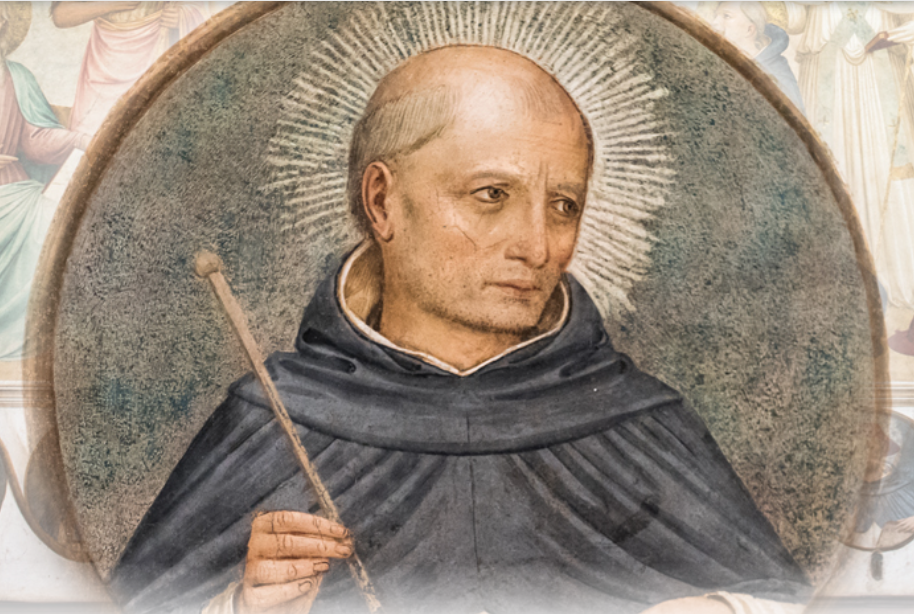 Modern readers who have been infected to one degree or another of a spirit of Jansenism or of modern sensualism may be scandalized to discover how tenderly and lovingly this holy friar addresses his “beloved” Sister Diana (1200-1236), a noble woman of keen intelligence and strong will, ten years his junior, and described by her contemporaries as beautiful in appearance. If it is true that modern man, in his weakness, has so sensualized the very notion of love that even the masculine love of friendship cannot be imagined by many of our contemporaries in terms other than the homoerotic, so, too, have we made it that all love between men and women must be sexual.  That is a pity, a grotesque falsehood, and a standing condemnation of our age. Granted that Saints Benedict and Scholastica were biological brother and sister (twins, in fact), and therefore less likely to raise pharisaical or prurient eyebrows, there remain a large number of saintly pairings of men and women who enjoyed a friendship that was not only close and mutually beneficial to the two friends, but also “charismatic” in the proper theological sense of that word, i.e., their friendship was not only for the good of the two individuals in question but also for the common good. A partial list would include Saints Francis and Clare, Saint Francis de Sales and Jane Frances de Chantal, Saints Margaret Mary Alacoque and Claude Colombiere, Saints Teresa of Avila and John of the Cross, Saints Patrick and Brigid of Kildare, Saint Catherine of Siena and Blessed Raymond of Capua. These friendships sanctified the friends named here, but they also sanctified others, in some cases, many others. The evangelism of Ireland and its highly developed male and female monasticism, the Carmelite reform, the founding of the Poor Clares and the Daughters of the Visitation, and other such works were more or less directly the products of these chaste and holy friendships. The many thousands of canonized saints produced by some of their common undertakings bear witness to the spiritual fecundity of these friendships. What is impressive about the way Blessed Jordan writes is the fact that Holy Scripture drips off his pen because his mind has been so completely soaked in it. He does not merely quote from the Bible; he has so interiorized it that Biblical language and images become his own. It was the task of Father Vann — for which we are grateful — to annotate these letters so that modern readers can know the passages being cited. Specially deserving of mention here is the frequency with which Old-Testament allusions are made, mostly in their allegorical or tropological senses. Speaking of which, Blessed Jordan’s letters are wonderfully suffused with the fourfold way of reading Holy Scripture so common in the Middle Ages, the quadriga. Along with Scripture, the fonts of Jordan’s thoughts and expressions are the Church’s liturgy and the Rule of Saint Augustine (common to both the friars and nuns of the Order of Preachers). Blessed Jordan of Saxony would have Blessed Diana d’Andalò look at Our Lord frequently. Speaking of Jesus Christ in the spousal terms that have long been standard in the lexicon of consecrated women, he constantly reminds her of the presence of her divine Bridegroom. When he thought that she was too given to bodily austerities, Brother Jordan urged Sister Diana to moderation and reminded her that what matters is loving God, desiring Him, contemplating Him, and loving her sisters in the monastery with “one mind and one heart in God” (Augustinian Rule). For the edification of my readers, I will include one complete but short letter of Blessed Jordan’s here. It was sent to Blessed Diana in her monastery at Bologna from Magdeburg, Germany, where he found himself in September of 1225 (pg. 70-71): Brother Jordan, useless servant of the Order of Preachers, to his beloved daughter Diana: may she be brought by Jesus Christ her Bridegroom into his cellar of wine [Cant. 2:4]. Since I know that your love makes you anxious about me, I wanted to let you know that after leaving Verona, the God of our salvation making my journey prosperous for me [Ps. 67:20], and giving new strength to my weak body, on the third day after the feast of St. Matthew I arrived here at Magdeburg safe and in good health and was given a very joyful welcome by our brethren, who had long been anxious about me, and by a great number of other people. I was much consoled to find everything in our convent here [a house of friars] in good order, and the recent reception of several novices rejoiced me greatly. Give thanks then to God, whose mercy looks so kindly upon us in all things [Ps. 68:17], and gives us so much more than we deserve. For the rest, beloved, preserve a due measure in your labours and apply the curb of discretion to all that you do; so that as you run after your Bridegroom, drawn by the fragrance of his ointments [Cant. 1:3], and longing to offer him myrrh, which is the chastening of the flesh, you may yet leave place for an offering of gold, following the example of the three holy Wise Men who, opening their treasure-chests, offered to Jesus gold, frankincense and myrrh [Mt. 2:11]. Thus your treasure chest must not be so filled with myrrh as to leave no room for the gold of wisdom and discretion. You must be able to say with the bride in the Song of Songs, A bundle of myrrh is my beloved to me [Cant. 1:12]; she does not liken her beloved to a great weight or load of myrrh, but to a little bundle, as showing that a due measure is to be observed in all things. Often I have told you this when I was with you, and now that I am far away I say it again: you must go forward on your way with such prudence as to be able to climb up, without stumbling, to your goal which is the land of heaven, led thither by the Son of God, Christ Jesus, who is blessed for ever and ever [2 Cor. 11:31], Amen. Commend me to the prayers of your sisters and greet them for me; and may the Spirit of truth be with you in all things [Jn. 15:26]. The next letter he sends her is a tour de force of both mourning and consolation. Brother Henry, a priest of the Order and the Prior of Cologne, has just died and Blessed Jordan is weeping for his beloved brother, son, and friend, whose death he has felt very tenderly. At the same time, Blessed Diana is mourning the death of a biological brother and sister of her own. Jordan gives full vent to his sorrow while rejoicing for the joy of the elect in heaven — without falling into presumption on behalf of their beloved deceased: “Yet, let us pray for them, so that if in death they were still burdened with some small failings, they may be the more swiftly loosed therefrom and receive their crowns” (pg. 73). The image we get here is of two very holy people who were a man and a woman of flesh and blood, of profound intellect and subtle feeling. Their religion did not make them insouciant to human suffering, but all the more sympathetic to it. It did not make them love each other or their friends and family less, but more. In short, their religion did not dehumanize them; it made them all the more human because it made them what humanity was meant to be: supernaturally united to God in grace, in faith, in hope, and in charity. Together, Blessed Jordan and Blessed Diana formed a powerful nexus of charity in the Mystical Body of Christ. Reading the letters of holy people has a certain advantage over reading their systematic treatises. In the systematic treatise, one encounters the author’s spiritual doctrine more or less well illuminated and fully developed, but in reading their letters, the doctrine is presented alongside its practical application amid the joys, sorrows, and glories of daily life. We encounter tears and smiles, longing and aching, triumph and tragedy — and all that turned to the glory of God and the sanctifying of their souls. In the letters of Blessed Jordan to Blessed Diana, we see a union of holy hearts both panting for God “as the hart panteth after the fountains of water” (Ps. 41:2). While the inmates running the asylum keep gaslighting us, we need to purify and nourish our minds with wholesome draughts of supernatural truth such as we can imbibe here. I cannot recommend this book more highly. Most devotedly yours in the Hearts of Jesus and Mary, Brother André Marie, M.I.C.M. |
|
|
Feb 17 2021, 11:41 AM
|
|
Senior Member
3,573 posts Joined: Apr 2006
|
Blessed Ash Wednesday folks!
A summary of current practice: On Ash Wednesday, Good Friday, and all Fridays of Lent: Everyone of age 14 and up must abstain from consuming meat. On Ash Wednesday and Good Friday: Everyone of age 18 to 59 must fast, unless exempt due to usually a medical reason.  GUIDE TO MAKING A SPIRITUALLY PROFITABLE LENT IN PREPARATION FOR THE PROPER CELEBRATION OF EASTER The Lenten discipline consists of three separate parts: 1. Corporal or External Fast, including the abstinence from certain foods, drinks, and amusements, i.e. music, and parties during Lent. These points of fast should be stressed today especially with the mania for entertainment besetting our society; 2. Spiritual or Internal Fast which consists of abstinence from all evil----sin. Saint John Chrysostom taught that the "value of fasting consists not so much in abstinence from food but rather in withdrawal from sinful practices." And Saint Basil the Great explains: "Turning away from all wickedness means keeping our tongue in check, restraining our anger, suppressing evil desires, and avoiding all gossiping and swearing. To abstain from these things----herein lies the true value of fast!" 3. Spiritual Change achieved by the practice of virtues and good works must be the main objective of our fasting. The Fathers of the Church insisted that during Lent the faithful attend the Lenten church services and daily Mass. In the course of the centuries, our fasting discipline has undergone numerous and radical changes. Today, unfortunately, the observance of Lent is but mere formalism, reduced to abstinence on certain days and without any stress on one's spiritual growth or the amending of one's life style. It is urgent that we return to the pristine spirit of the Great Fast which is so badly needed in our materialistic world. Listed below are suggested practices that may be used along with your usual Lenten family traditions of sacrifices and penances. Corporal or External Practices: Take less of what you like and more of what you dislike at meals today. Take nothing to drink between meals. Do not use seasoning on your food today. Do not use any sweeteners with your food or drinks today. Avoid listening to the radio at all today. Take nothing to eat between meals today. Avoid any TV or videos; instead read the Passion of Christ in your Bible or Missal. Take on!y one helping of each item at meals today. Say an extra Rosary. Spiritual or Internal Fast Practices: Don't do any unnecessary talking; instead, say little aspirations (e.g. "Jesus, Mary, Joseph, we love thee, save souls!") throughout the day. Exercise your patience today in all things. Don't make any complaints today. Restrain any anger, and go out of your way to be kind to the person who caused your anger. Don't be distracted with someone else's business. Avoid any gossip today. Instead say an extra Rosary to overcome this great fault. When asked to do something extra do so with a joyful and pleasant attitude today. Speak in a pleasant tone to everyone today. Avoid using the phone today. Tell the truth in all your dealings today. Avoid any vanity or self-seeking today. Spiritual Practices: [virtues and good works] Practice humility today in all your actions. Be generous today; help someone in need. Look for ways to be helpful throughout the day. Do a job that needs to be done without being asked. Be courageous; walk away from any impure situations today. Don't be at all idle today. Always be doing something for others or for your spiritual growth. Go out of your way today to help or talk to someone who is usually difficult. Volunteer for an extra job today. Say an extra Rosary today for the conversion of a sinner. Visit someone who is sick or lonesome today. Offer to say the Rosary with them. This post has been edited by yeeck: Feb 17 2021, 11:46 AM |
|
|
Feb 19 2021, 11:59 AM
|
|
Junior Member
225 posts Joined: Mar 2008
|
 |
|
|
Feb 25 2021, 09:43 PM
|
|
Junior Member
225 posts Joined: Mar 2008
|
|
|
|
Mar 7 2021, 05:07 PM
|
|
Junior Member
225 posts Joined: Mar 2008
|
|
|
|
Mar 7 2021, 07:12 PM
|
|
Junior Member
225 posts Joined: Mar 2008
|
  |
|
|
Mar 21 2021, 12:40 AM
|
|
Senior Member
3,573 posts Joined: Apr 2006
|
‘Same Sex Attraction,’ a Different Perspective
DR. G.C. DILSAVER once said something very provocative about “same sex attraction” in an interview with Mike Church. For those not familiar, this is the term of recent coinage used to label the intrinsically disordered attractions otherwise called “homosexual” and other adjectives no longer considered polite. (People like Saint Thomas and me, who use the words derived from that Biblical city now at the bottom of the Dead Sea, are now considered old fashioned.) The neologism does have a debatable utility in that it limits itself to the attraction alone, abstracting from both particular acts and the lifestyle founded upon that attraction. This has its advantages at times, but it is rather like considering the attraction to domestic violence while prescinding entirely from the stark reality of its traumatized victims. But what was that provocative thing that Dr. Dilsaver said? He said that he was all for “same sex attraction” — that it is indeed a good thing. After a brief moment of discomfort sufficient to let the shock value kick in, he explained himself, making a great deal of good sense: When a man sees excellent qualities and masculine virtues in another man, he is attracted to those goods, and so he should be. Such an attraction leads the beholder to admire and want to emulate the manly virtue he sees in his excellent exemplar. This is quite natural and beneficial to all concerned. We Christian men have been given the model of perfect masculinity in Our Lord Jesus Christ, the Man-God. After Him, we have the most perfect of all male human persons, Saint Joseph, in whose month of March we presently find ourselves. We should be strongly attracted to these great men, one of whom is a Divine Person, while the other is the divinely appointed guardian and protector of Jesus and Mary — who, as head of the Holy Family, stands as a human icon of God the Father. Dr. Dilsaver’s insightful provocation came to mind the other day while I was reading a book by the Marist spiritual writer, Father Thomas Dubay, “And You Are Christ’s”: The Charism of Virginity and the Celibate Life. In his preface, Father Dubay contrasts the different ways that men and women view the virginal and celibate consecrated life. The extended passage is worth citing, with my underlined emphasis drawing attention to what is most germane to my point: Just as on the natural plane women and men differ widely in their outlook on reality, so too do they vary in their attraction to the life of consecrated celibacy. Normal women are readily drawn to the Pauline imagery of the Church as the beautiful bride married to Christ. A woman’s whole bent is toward persons and love. Drawn naturally to the male and his characteristics, a woman with the virginal charism and responding fully to its implications of a total, burning love for God, easily sees herself as given in a heavenly marriage to the eternal Word of God become man. She has no problem in seeing her life, not as an impersonal career — a job to be done — but as Saint Paul describes it, giving her undivided and chaste attention to one Beloved. A man sees consecrated celibacy somewhat differently. His attraction centers on the towering and virile figure of Christ as one normal man is drawn, with not the least erotic overtones, to another extraordinary man — but immeasurably more so, for this extraordinary man is also the very Son of God. When the male responds fully to his celibate gift and thus begins to grow in a total, burning love for Christ, he sees himself not, obviously, as a bride, but as an intimate friend and brother. Such actually is another way Jesus addresses himself to his chosen intimates: “I shall not call you servants any more... I call you friends [beloved ones]” (Jn. 15:15). Yet men with the celibate charism need to be reminded that they, along with all men and women, are members of the virgin Church wedded to one husband. Before God each person is receptive, feminine. Father Dubay goes on to explain that last assertion in a clear and satisfying way, using both Old Testament and New Testament passages. In relation to God, all creation is feminine. This is a cosmological reality in the order of nature, but in the higher order of supernatural grace, it takes on a more “personal” specificity: In relation to the masculine Incarnate Logos, Jesus Christ, the Church is feminine, for the Church is the bride of Christ. For this reason, I argue that a consecrated woman is a more perfect image than a consecrated man of what the Church is. Focusing on the underlined passage, I was gratified to read that Father Dubay said that the celibate man aflame with “a total, burning love for Christ” sees Our Lord “as an intimate friend and brother.” Yes, Jesus Christ is our Friend; yes, He is our Brother. This is true for all the baptized, but just as the virgin woman looks at Christ in a special way as her Bridegroom, the consecrated male celibate sees Jesus especially as his Friend and Brother. Naturally speaking, a good and noble man’s virtue and character make him the object of our attraction. If we are blessed to have such a good man as our friend, we can discuss matters pertaining to virtue and character with him, and, in a completely natural and non-contrived way, our conversation with him would approach any topic of mutual interest from the point of view of virtue and the true good to be considered in that topic. We can learn from that friend both by his word and his example. It should be evident to anyone with a sensus Catholicus that friendships like this can and ought to be supernaturalized if our friend belongs to the household of Faith. But it gets even better than that. By reading the Gospels in a meditative and prayerful way, we can engage Our Lord in a similar friendship. In so doing, we spend time with our Friend and Brother, learning from Him both in word and deed, and speaking to Him about our struggles with sin, our failures in practicing virtue, our difficult relationships, our desires, our aspirations — or any topic we would discuss with our closest Friend. This does not exclude the acts that are due to God alone in our worship of the Blessed Trinity: adoration, thanksgiving, reparation, and petition. Not at all. But it adds to them a certain intimacy that flows from the beautiful divine condescension of the Incarnation. When our best Friend is also a Divine Person, He gives us more than advice, example, and a sympathetic ear: He gives us grace. It has already been mentioned that this is the month of Saint Joseph, the most perfect model for us men after Our Lord. Before drawing to a close, I would like to take a glance at the Patriarch of Nazareth. It is said that chivalry is dead, and that men no longer know how to treat ladies. To institute a Catholic renaissance in chivalry, I think devotion to Saint Joseph is necessary. We can even elevate chivalry above what it generally was in the past by making it truly supernatural. Here is a challenge to Catholic men: In your interactions with the fairer sex, whether with your wives, sisters, daughters, consecrated women, or whomever, strive to be chivalric like Saint Joseph. Can you imagine the awe, the respect, and the perfect adoration of God that Saint Joseph practiced in the face of the august mystery of Mary’s sanctity? Not only did he honor Her virginity, but he adored the mystery of the Incarnation in Her, fully aware that the Blessed Virgin had conceived of the Holy Ghost. It is no wonder that he considered himself unworthy of this arrangement and “was minded to put her away privately” (Matt. 1:19). I realize that we are here considering the Chosen One Herself, the supernal and immaculate Mother of God, who merits a higher regard than all others (specifically, the cultus hyperduliae). Yes, she is “blessed among women” (Luke 1:28), but all women, either as mothers or as virgins can be images, however imperfect, of the Virgin Mother of God, which is why chivalry originally grew out of devotion to the Blessed Virgin Mary in the first place. To those who object that some women simply are not ladies and therefore do not merit chivalrous treatment, all I can say is perhaps if they were treated like ladies, they would seek to become ladies. If not, at least the men striving to practice chivalry will elevate their own lot in the attempt. They would thereby be acting more like Saint Joseph and the One he so sedulously defended. Etymologically, the word “attract” comes from the Latin words ad and trahere, meaning “draw toward.” It is notable that, in the Latin Vulgate, Saint Jerome puts that same Latin verb on the Master’s lips when He says, “No man can come to me, except the Father, who hath sent me, draw him [traxerit eum]; and I will raise him up in the last day” (John 6:44). So I end with another challenge to Catholic men: Stir up in your souls that “burning love for Christ” Father Dubay wrote of, saying to yourself with Saint Paul that this heavenly exemplar of all virtue and virility, “loved me, and delivered himself for me” — and let the Father attract you deeply and ardently to “the Son of his love” (Col. 1:13). Most devotedly yours in the Hearts of Jesus and Mary, Brother André Marie, M.I.C.M. |
| Change to: |  0.0283sec 0.0283sec
 0.59 0.59
 6 queries 6 queries
 GZIP Disabled GZIP Disabled
Time is now: 2nd December 2025 - 07:23 PM |
 Quote
Quote