German military helicopter crashes in Mali, two peacekeepers killed
QUOTE
A German military helicopter assigned to the U.N. peacekeeping mission in Mali crashed in the West African nation's desert north on Wednesday, killing the two crew members, the German military said.
The Tiger helicopter crashed around midday about 70 km (45 miles) north of Gao, burning out completely with no survivors. The crash was reported by a second helicopter following in the mission.
"We have now certainty that two soldiers have given their lives in the service of our country," German Defence Minister Ursula von der Leyen told a news conference. The Germans were the first killed in combat since 2013 in Afghanistan, a military spokesman said.
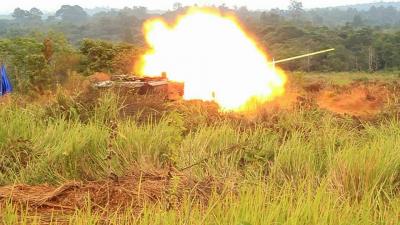
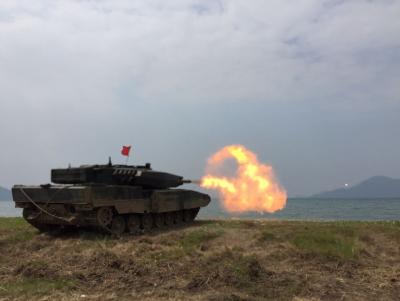
Indonesian Army Leopard 2A4 & Leopard 2RI MBTs live firing exercise at the Indonesian Army Combat Training Center in Martapura South Sumatera. Credit to nufix @ defence.pk.
This post has been edited by azriel: Jul 27 2017, 11:48 AM
Indonesia in Talks to Procure First Mini-Submarine
Indonesia is currently in the process of acquiring its first mini-submarine. Platform may partly fulfil Indonesia’s requirement to operate a fleet of 12 submarines by 2024 (photo : Navy Recognition)
The Indonesian Ministry of Defence (MoD) is currently finalising a contract with Batam-based shipbuilder PT Palindo Marine for the procurement of a mini-submarine, Indonesian Navy Tentara Nasional Indonesia – Angkatan Laut, or TNI-AL) sources informed Jane’s on 26 July.
This information has since been corroborated with officials from PT Palindo, who confirmed on the same day that discussions over the contract are currently still ongoing with officials from the MoD and the TNI-AL. “Negotiations over the procurement are still ongoing as we speak,” said Mukti Syarif Rivai, a naval architect with PT Palindo, in a phone conversation with Jane’s . “We will be making an official announcement once the contract is confirmed and signed,” he added.
According to PT Palindo, the mini-submarine will be based on the concept that was first unveiled by the MoD’s research and development branch in November 2016 at the Indo Defence exhibition in Jakarta. The concept is a product of collaboration between PT Palindo Marine, the MoD, the Indonesian Co-ordinating Ministry for Maritime Affairs, and two Indonesian tertiary institutions Institut Teknologi Sepuluh November (ITS) and the University of Indonesia (UI). The concept features an overall length of 22 m, an overall beam of 3 m, and a hull draught of 2.5 m. It displaces approximately 117 tonnes when surfaced, and 127 tonnes when submerged. The submarine has a maximum operating depth of 150 m, an endurance of six days, and a top speed of 10 kt when dived. It can accommodate a crew of five, with space for up to nine additional personnel.
The Black Army of Thailand: Thai border patrol soldiers
For decades, Thailand’s southern tip has been caught in an internal conflict that cost thousands of lives. Channel NewsAsia’s Indochina correspondent Pichayada Promchertchoo travels to the country’s restive south and finds out what it takes to be a soldier on the front line.
The Black Army forms the frontline of defence against insurgent attacks along the Thai southern border, a restive region and bloody battlefield. (Photo: Pichayada Promchertchoo)
YALA, Thailand: Thananwat Thongkam does not know if he will die while doing his job, but the possibility does not scare him. “Honour is everything,” the soldier says. His body is sticky with sweat underneath a black uniform and bullet-proof vest. His team is taking a momentary pause but remains alert as they set up tents and cook rice in the jungle of southern Thailand, where conflicts between separatists and the state have claimed thousands of lives over the past 13 years. “One day, if a bomb blows me up, I’ll die a hero.”
Just two days later after, a roadside bomb would kill six of his comrades and wound four others. The device was suspected to have been planted by separatist insurgents, who detonated it when the troops drove past.
The threat of a fatal attack is part of daily life for these soldiers.
Since 2004, more than 6,500 people have been killed in nearly 20,000 violent incidents in Thailand’s far south, a restive region and bloody battlefield. But the violence did not stop Thananwat from following his dream. In 2008, the former grilled chicken seller left his family and peaceful northeastern hometown of Kalasin to serve in the conflict-ridden south.
His reward for putting his life on the line? Less than US$400 a month. He began as a volunteer ranger. Commonly known as the Black Army, rangers are a paramilitary force comprised of soldiers and civilian recruits who patrol the border and engage in combat. In southern Thailand, they are among the prime targets of separatists.
“I'm doing what others dare not do and that makes me proud,” says Thananwat, a sergeant major in the 47th Ranger Regiment. Years of service and performance have won him promotions and formal recognition of his position in the Royal Thai Army. The journey to that position has been intense and challenging. The "black warrior" has had to undergo rigorous training regularly to prepare his physique and mind for offensive operations, ambushes and survival in rough terrain.
Practice mostly takes place under the burning sun and on rough, dusty ground, where he spends hours running, jumping and crawling. Still, the father of one submits to it for honour, pride and what he describes as “the experience that can’t be sought elsewhere”.
The Black Army is among the prime targets of separatist militants in southern Thailand. (Photo: Pichayada Promchertchoo)
Thananwat is trained for combat. He can fight with his bare hands and can wield an array of weapons and protective gear, from the AK-47 rifle to ballistic shields that weigh more than 10kg. His Operations and Intelligence unit also goes through frequent live simulations, where they work to apprehend and handle suspected insurgents in different scenarios. Along the southern borders, the Black Army forms the frontline of defence against insurgent attacks. With his comrades, Thananwat patrols risky areas and often spends weeks carrying out operations in the jungle.
“Our living conditions are harsh. We always walk and the heat is unbearable. Our body is always drenched in sticky sweat from head to toe. There is no gas or electricity. Sometimes we run out of food and have to survive on squirrels, monitor lizards and shoots. If we can’t find anything, we’ll starve,” the 35-year-old says. “There is no comfort or freedom, only rules and discipline. But that’s part of the job.”
During the border patrol, rangers only eat twice a day. Sometimes they run out of food and have to starve until the mission is completed.
Thananwat may not be so concerned about the physical hardship he faces, but when it comes to his family more than 1,000km away, they are his life and only second to the nation he serves. Whenever he is off duty, the soldier is in touch with his loved ones. “It makes me miss them a little less for a little while. I’ll keep telling them ‘Don’t worry about me. I’ll go home as soon as my mission ends’. That’s all I can say.”
CULTURAL SUPPRESSION
Thailand’s southern tip covers the provinces of Yala, Pattani and Narathiwas and parts of Songkhla. Unlike most parts of the Buddhist country, the region’s population has long been dominated by ethnic Malay Muslims. Many of them observe culturally distinctive customs and traditions, and speak Yawi – a language spoken in the nearby Malaysian state of Kelantan.
Following a push for cultural assimilation by the Thai government in the early 1930s and the introduction of Thai-centric practices, separatist movements were born among the ethnic Malay Patani, who found themselves struggling to preserve their lifestyle and traditions. Ever since, calls have been made for autonomy from the Thai state amid clashes between militants and Thai officers.
The violence remained relatively low key until 2004, when a group of insurgents broke into an army camp in Narathiwas and stole hundreds of firearms. “The situation then was violent. People died every day and bomb attacks were constant. There was a lot of distrust among local civilians,” said Captain Boonsiang Kaewkoonjob from the Fourth Army – a military division that controls southern Thailand. “It’s much better today. We have one incident a week or longer.”
Earlier this year, the Internal Security Operations Command under the Thai Government reported a steady decline in southern violence – from 663 incidents in the 2014 financial year to 193 incidents two years later.
"STAY CLOSE TO THE ENEMIES"
Despite a decline in violence in the restive south, peace advocacy groups have warned that the root cause has yet to be addressed by the Thai government. “Distress still exists among local civilians. As a result, maintaining the current situation may not provide a long-term solution,” Deep South Watch said in its annual report.
“There are also disagreements between insurgent groups at the peace talks table and those which control the militants on the ground.”
Still, the drop in violence and casualties has made life somewhat easier for soldiers on duty there. According to Captain Boonsiang, it is the result of peace talks between the government and insurgent groups – which resumed in 2015 – and a change of counter-insurgency tactics.
More efforts have been made to mend the ties between the state and civilians, severed by decades of conflict. Increasingly, soldiers are reaching out to the ethnic Malay Muslims in the region and familiarising themselves with their culture. Besides providing protection and assistance, they also work with religious leaders, village chiefs and families to stop sedition from spreading.
“We must stay close to the enemies. It’s like capturing tiger cubs; we have to be in the lair. To get the insurgents, we have to approach their family and relatives, talk to them and create a better understanding that we’re here to help,” the captain said.
“And one day, the enemies will come to us.”
Volunteer rangers at the 47th Ranger Regiment practise shooting.
As the government tries to put out the southern fire, the likes of Thananwat continue their defence on the frontline, where their comrades fall alongside civilians and insurgents. “They were colleagues from other units. I only found them when they were already dead. I couldn’t get there to help them in time.” Still, he insists on wearing the black uniform and risking his life for the country.
“My job is my pride. I don’t care about death; it happens to everyone. So I just focus on what makes me proud of who I am,” he says. “People will remember me as a hero.”
Australian counter-terrorism units in raids across Sydney
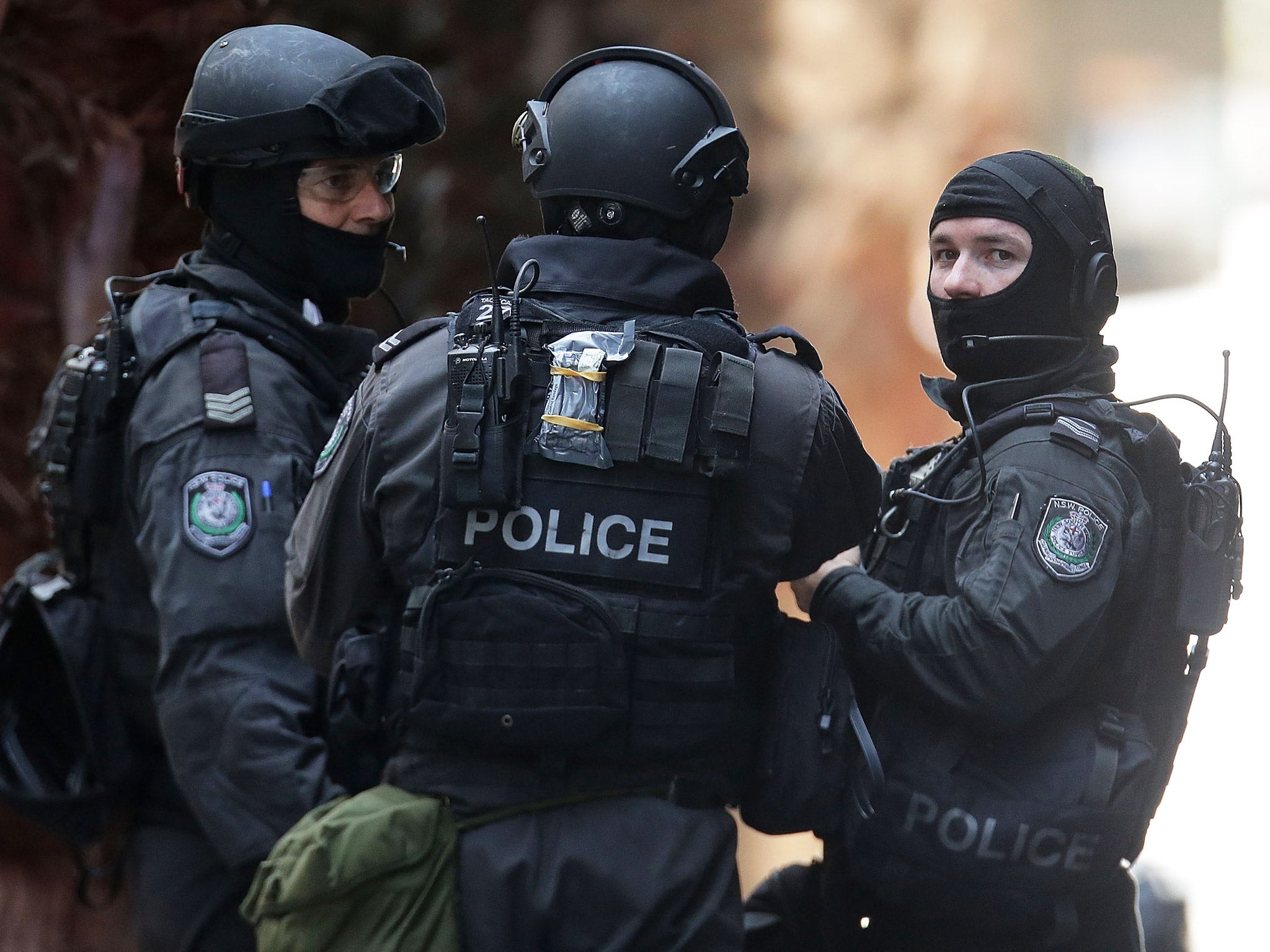
SYDNEY: Australian counter-terrorism police were conducting raids across several Sydney suburbs late on Saturday. Australian Federal Police (AFP) said the "operational activity" by the Sydney Joint Counter Terrorism Team "relates to an ongoing investigation."
"The safety of the community and police members are the primary consideration during this activity," the AFP said in a press release, declining to provide further information as the raids were still in progress.
The raids were being carried out in four suburbs in different parts of the city, police said.
Australia, a staunch ally of the United States, has been on heightened alert for attacks by home-grown militants returning from fighting in the Middle East, or their supporters, since 2014.
Authorities say they have thwarted a number of potential attacks since then, but there have been several "lone wolf" assaults, including a cafe siege in Sydney that left two hostages and the gunman dead.
About 100 people have left Australia for Syria to fight alongside organizations such as Islamic State, Australia's Immigration Minister said last month.
Australian newspaper publisher News Ltd reported up to 40 riot squad officers were seen swooping on a house in the inner city suburb of Surry Hills.
(Reporting By Jane Wardell; Editing by Christian Schmollinger) Source: Reuters
After completion of their basic training course, Salehan and Feng Xian start again at the bottom when they join the Special Operations Command while Yousheng steps up and begins life as a Section Commander at the 4th SCDF Division.
Previous episode;
» Click to show Spoiler - click again to hide... «
Frontliners
It doesn’t get more real than this – real NSmen, real incidents, real life. FRONTLINERS is an eight-part web series about NSmen in the SPF and SCDF to commemorate 50 years of National Service.
In the first episode, we follow a group of National Service Recruits as they take on the challenges of training to become Police officers and firefighters. Join us as we follow their evolution from boys to men.
This post has been edited by Fat & Fluffy: Jul 29 2017, 05:16 PM
Tank crushes car full of bombers before massive blast at Egypt checkpoint
Egypt’s armed forces are hailing an armored tank driver for intercepting and crushing an explosive-laden car that was targeting a checkpoint in North Sinai.
Production of the VT-4 (MBT-3000) for the Royal Thai Army.
Production image of the VT-4 (MBT-3000) main tank for Thai Army in the factory of Norinco, China.
Photos from: Thanapol ASEAN Military Forum
This VTR depicts the production of the VT-4 (MBT-3000) mainland tanker for the Thai Army at the Norinco plant in China, as well as the testing of tanks for the Thai Army in the field. In addition, according to the VTR, if observed well from the 25th to the 51th, the VT-4 main battle tank would be seen as a camouflage color similar to the Army's main tank M60A3. Of course, the VT- 4 to enter the army. Will not do digital camouflage ..
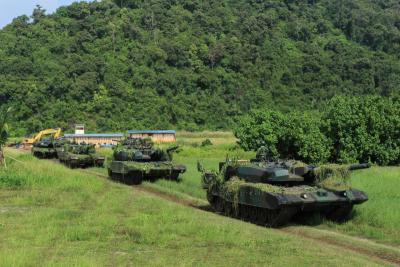
Technical, tactical & live firing exercise of the Indonesian Army 1st Kostrad Cavalry Battalion Leopard 2RI & Leopard 2A4 MBTs . Credit to Pen Kostrad.
Tank crushes car full of bombers before massive blast at Egypt checkpoint
Egypt’s armed forces are hailing an armored tank driver for intercepting and crushing an explosive-laden car that was targeting a checkpoint in North Sinai.
RIP to the person who walked towards the crushed car.
Approximately 500 personnel from The Singapore Army’s Headquarters 10th Singapore Infantry Brigade and 5th Battalion Singapore Infantry Regiment as well as 330 personnel from 1st Stryker Brigade Combat Team, 25th Infantry Division from the U.S. Army Pacific and 29th Infantry Brigade Combat Team from the Hawaii Army National Guard came together for the largest edition of Exercise Tiger Balm ever.
China's Xi calls for building elite forces during massive military parade
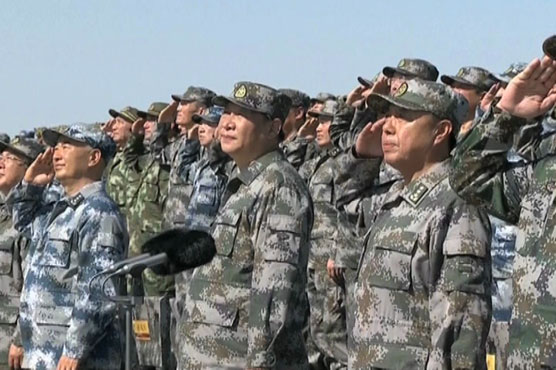
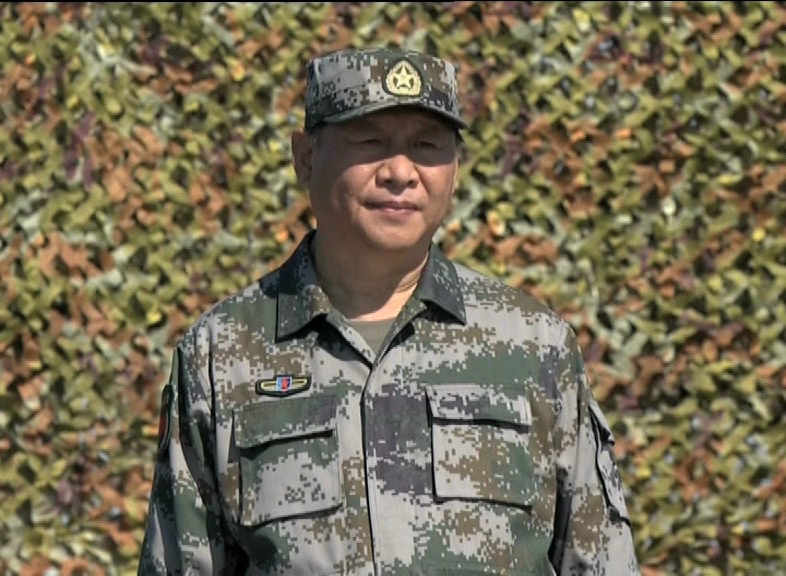
Chinese President Xi Jinping told the military on Sunday to transform itself into an elite force, as he oversaw a parade with flybys of advanced jets and a mass rally of troops to mark 90 years since the founding of the People's Liberation Army.
BEIJING: Chinese President Xi Jinping told the military on Sunday to transform itself into an elite force, as he oversaw a parade with flybys of advanced jets and a mass rally of troops to mark 90 years since the founding of the People's Liberation Army.
China's armed forces, the world's largest, are in the midst of an ambitious modernisation programme, which includes investment in technology and new equipment such as stealth fighters and aircraft carriers, as well as cuts to troop numbers.
Xi presided over the large-scale military parade at the remote Zhurihe training base in China's northern Inner Mongolia region, where he inspected troops from the back of a jeep, an event carried live on state television.
Travelling down a long strip lined with tanks, missile launchers and other military vehicles, Xi, wearing military fatigues and a field cap, greeted thousands of troops. Xi, who oversees the PLA in his role as head of the powerful Central Military Commission, repeatedly shouted, "Hello comrades!" and "Comrades, you are working hard!" into four microphones fixed atop his motorcade as martial music blared in the background. The troops bellowed back: "Serve the people!", "Follow the Party!", "Fight to win!" and "Forge exemplary conduct!".
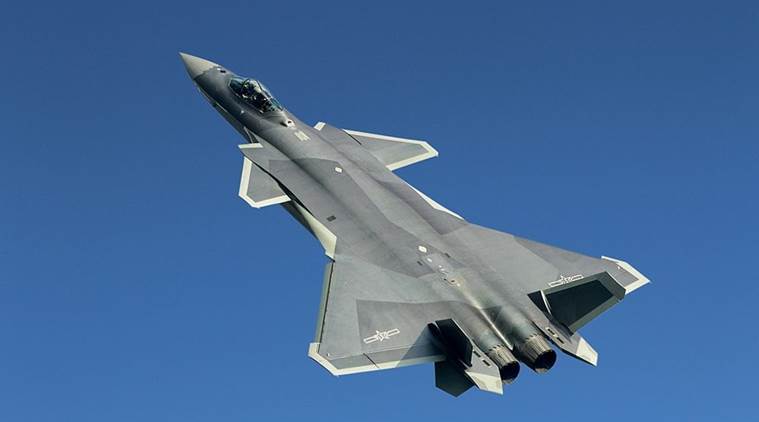
Tanks, vehicle-mounted nuclear-capable missiles and other equipment rolled by, as military aircraft flew above, including H-6K bombers, which have been patrolling near Taiwan and Japan recently, the J-15 carrier-based fighters and new generation J-20 stealth fighter.
"Today, we are closer to the goal of the great rejuvenation of the Chinese nation than any other time in history, and we need to build a strong people's military more than any other time in history," Xi told the assembled troops in a short speech that did not yield any new policy announcements. Xi said that the military must "unswervingly" back the ruling Communist Party.
"Always listen to and follow the party's orders, and march to wherever the party points," he said. Xi said that the world was not peaceful, but he did not mention any specific hot spots, such as territorial disputes in the South China Sea, Taiwan, or tensions over North Korea's nuclear weapons and missiles programmes.
Unlike a massive 2015 parade through manicured central Beijing to mark 70 years since the end of World War Two, Sunday's spectacle had fewer frills. Thousands of troop marched in combat garb, not dress uniforms, and vehicles kicked up clouds of dust as they rounded sections of the base's track. It was the first time China has marked Army Day, which formally falls on Aug. 1, with a military parade since the Communist revolution in 1949, state news agency Xinhua said. It was also the first time Xi has reviewed troops in the field like this, Xinhua added.
Chinese Defense Ministry spokesman Ren Guoqiang said in a statement that the location for the parade embodied a "dust-covered battlefield atmosphere" for the 12,000 troops who participated. The country's military is more nimble and technologically proficient following reforms to make it more compact and responsive, and less reliant on its sheer troop numbers, Xi said last week. China has not fought a war in decades and the government insists it has no hostile intent, but simply needs the ability to properly defend what is now the world's second-largest economy.
However, China has rattled nerves around Asia and globally with its increasingly assertive stance in the East and South China Seas and its military modernisation plan. Some of the military reforms have also been controversial at home. Sources with ties to the military say Xi's announcement at the 2015 parade to cut 300,000 troops has caused unease within the ranks. (Reporting by Michael Martina and Ben Blanchard; Editing by Kim Coghill and Sam Holmes)
International Army Games start in northwest China’s Xinjiang
Money For Military: Trump appoints defense industry lobbyist as army secretary
Since Donald Trump took office, the share price of a number of military-industrial companies has increased significantly. Among them are Boeing, which besides civilian planes has a range of military aircraft, Lockheed Martin, a fighter jets and missile systems producer, and Raytheon, a major US defense contractor.
However, there are growing suspicions that the president favors those companies who supported him during his campaign. RT's Miguel Francis-Santiago has more details.
Russia presents a powerful fleet of vessels on Navy Day
Russian President Vladimir Putin attended a military parade and addressed the Russian Navy during the Navy Day celebration on Kotlin Island Sunday. The island not too far from St. Petersburg saw the congregation of the most powerful vessels in the Russian Navy, including battle cruiser Pyotr Velikiy (Peter the Great) and legendary nuclear submarine Dmitry Donskoy (Source: AP).
This post has been edited by Fat & Fluffy: Jul 31 2017, 08:32 PM
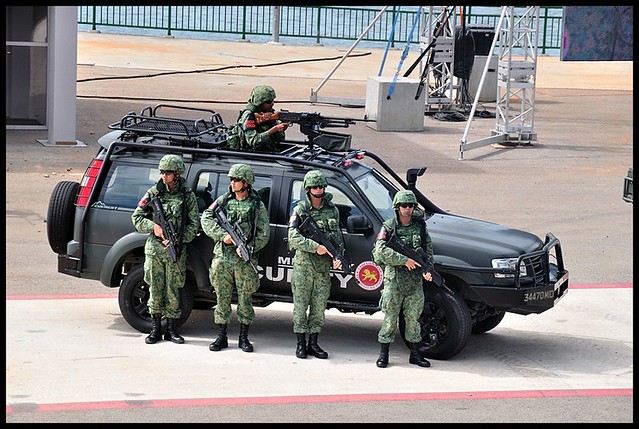
A new institute for Singapore Armed Forces (SAF) active and operationally ready national servicemen (NSmen) to be trained in homeland security and island defence roles was officially launched on Monday (July 31).
The Island Defence Training Institute (IDTI) will equip soldiers to respond to security threats alongside their Home Team counterparts. It will train up to 33,000 soldiers a year at its peak.
Speaking at the launch of the IDTI at Clementi Camp, Second Minister for Defence Ong Ye Kung said: "(The IDTI) will foster new inter-agency partnerships, strengthen existing ones, and regularly exercise avenues of collaboration."
The SAF and police held a joint homeland security demonstration at the camp witnessed by Chief of Army Major-General Melvyn Ong, deputy commissioner (operations) Lau Peet Meng and senior SAF and Singapore Police Force officers.
The new institute is made up of two centres and two schools with Homeland Security Training Centre (HSTC) and the Island Defence Training Centre located in the Clementi Camp. Defence Minister Ng Eng Hen had said in June that HSTC will train 18,000 soldiers yearly.
The Security and Policing Leadership School and the Security and Policing Vocational School are currently based in Mowbray Camp, and together with the Island Defence Training Centre, will be responsible for training 15,000 soldiers annually.
The HSTC has trained some 4,000 soldiers since March.
The seven-day syllabus at HSTC includes teaching SAF personnel their legal rights, search and arrest techniques, retractable truncheon drills, and conducting protection of critical structures.
Explaining the rationale for HSTC, commander of IDTI Senior Lieutenant-Colonel Vincent Soh Chee Yong said: "With the increasing complexity of the threat environment, as well as the numerous stakeholders we have to deal with such as the Singapore Police Force and other security partners, to have a training centre that focuses on homeland security is the right investment to make."
The HSTC syllabus includes 12 video simulation training scenarios, which involve perpetrators in a shopping mall, at a vehicle checkpoint, and at a coastal patrol. The scenarios are designed for trainees to hone their judgement by applying the correct rules of engagement.
The scenarios can be updated based on operational needs.
Full-time national serviceman Second Sergeant Muhammad Zayyani, 26, an artilleryman who received HSTC training, said: "The course was really useful. Before this, we didn't know what to expect if a perpetrator has a detonator. Such things are not taught in artillery school. It made me more confident of handling such situations, if they emerge."
In his speech, Mr Ong said global terrorism incidents have more than tripled from 5,000 cases in 2011 to almost 17,000 in 2014. South-east Asia is not spared from such threats. There have been eight ISIS-linked incidents in the region since January last year, added the minister.
"Just like the Infantry Training Institute, the centre of excellence (IDTI) needs to train and equip all our servicemen with the skills and technology to deal with several counter-terrorist and homeland defence scenarios," said Mr Ong, who is also Minister for Education (Higher Education and Skills).
Tank crushes car full of bombers before massive blast at Egypt checkpoint
Egypt’s armed forces are hailing an armored tank driver for intercepting and crushing an explosive-laden car that was targeting a checkpoint in North Sinai.
:thumbsup:
Look at the size of the blast! Thats 1 brave AND lucky tank driver :thumbsup:


 Military Thread V24, Celebrating 60th Malaysian Merdeka Day
  Jul 27 2017, 05:40 AM


 Quote
Quote
















 0.0235sec
 0.26
0.26
 6 queries
 GZIP Disabled