Welcome Guest ( Log In | Register )

23 Pages « < 10 11 12 13 14 > » Bottom

Outline · [ Standard ] · Linear+

 Venturing into Agriculture & Aquaculture, Co-Ordination & Implementation is KEY

views
     
MrFarmer
post Feb 28 2013, 12:39 PM

Casual
***
Junior Member
478 posts

Joined: Mar 2011
From: Sabah


QUOTE(poks @ Feb 27 2013, 01:06 PM)
Well, that's a good lesson for us.
anyway, if you manage to get the actual cavendish sucker do share.. my interest is still in.

as for the inter cropping, the palm and rubber trees are still young (around 9 months - 1 year trees) & going to test ginger after paddy harvesting season is over. i'm at the mercy of cost and the only option for me to clear land is by man power only. laugh.gif

yes. kudat is nice. but a lot of undeveloped land due to poverty.
all the young guys move to city but never drop their sweat to grow anything on their big family land
happy.gif
*
Shall concentrate on the Berangan as the marketing is easier. My buyers isn't familiar with Cavendish and with a bad experience, better stick with the proven varieties.

Land in Kudat I guess is less mountainous. Went there a couple of times, but only to the Tip Of Borneo.
It's the 'norm' for youngster as life in city is glamorous. Agriculture is hard and I feel you shall need a certain land size to be feasible.

Good luck to all of us.
MrFarmer
post Mar 4 2013, 12:00 AM

Casual
***
Junior Member
478 posts

Joined: Mar 2011
From: Sabah


QUOTE(zyper @ Mar 3 2013, 08:21 PM)
Hi all

Iam new to agriculture and aquaculture industry. Iam from Singapore and thinking of opening up a farm in Malaysia with some people.

Well actually someone else is looking for a land in Malaysia and he is interested in agriculture industry. He has a farm in Philippines and elsewhere with other people. Iam just starting to learn new things and this guy knows alot of things about planting stuff.

So Iam looking for land for lease, he said he wants to start with kelapa sawit. I have seen some ad online and somewhere else, but I do not know whether to trust them as I have some relatives who have been cheated when they are about to buy house in Johor. So can I get some recommendation from the trustworthy people here to lease land in Malaysia? How much is 1 acre cost?

Thanks
*
Hi Zyper, welcome to this forum. Welcome to Malaysia.

Investing in whatever business in a different country is always a big challenge. Business and Land code differs between country to country. Please proceed with great caution.

Do do a land search with the Land & Mine department once you had identify the land as this shall provide you with the status of the land, official owner, any caveats & etc. Do go through the proper channel to get things done officially.

Land prices differs greatly from location to location, land condition, size & etc. A good place to gauge shall be @ Mudah.com.

Enjoy your journey.
MrFarmer
post Mar 8 2013, 08:15 PM

Casual
***
Junior Member
478 posts

Joined: Mar 2011
From: Sabah


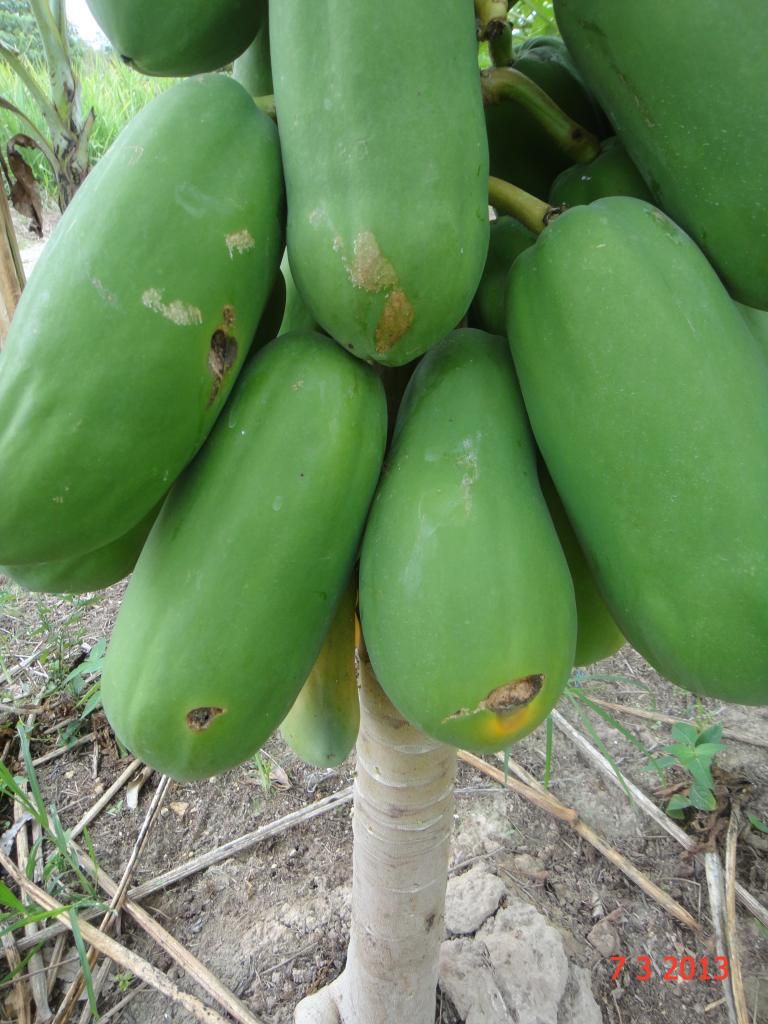
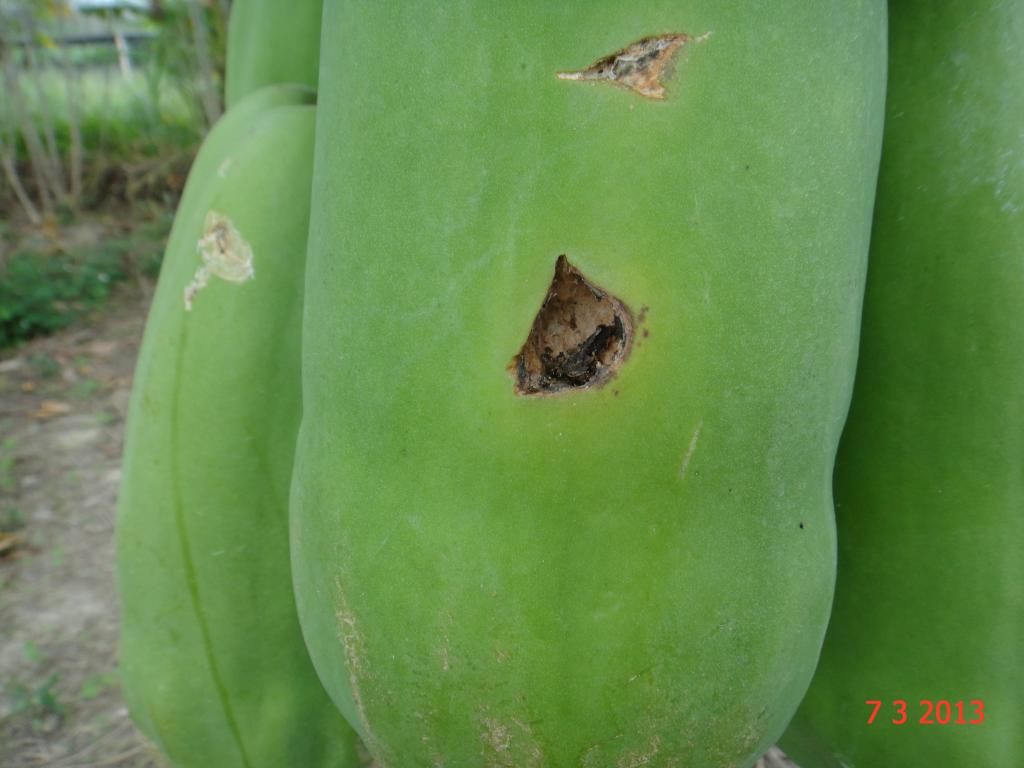
Some problems with my Papaya. Have a couple of trees with this problem. Any idea?

user posted image

user posted image

MrFarmer
post Mar 15 2013, 08:17 PM

Casual
***
Junior Member
478 posts

Joined: Mar 2011
From: Sabah


QUOTE(Michael J. @ Mar 15 2013, 02:09 AM)
Sorry for the long absence. I have been busy with my research, and will be MIA intermittently.

Youtube is really and interesting place to look for amusing stuff on agriculture. Look up the link below on Langat Aquatech's high density catfish farming.

http://www.youtube.com/watch?v=EGlIS-8QBgo

The video is old, but still quite impressive. The least dense tank contained 10,000 fishes, with a target weight of around 125g (8 fish per kg). That's a hell lot of fish for such a small tank. Going by the rate above, we're looking at 1,250kg of fish; @ retail value of RM5.00 per kg, that's about RM6,250 sitting there. Now the average growth rate of Clarias catfish to reach 125g is about 3-4 months, so that's about 3 cycles in a year. I believe that about 10 tanks can be house on say half acre space, with generators, shed house, etc. Therefore, 30 harvests of RM6,250 each = RM187,500.

Anyway, back to business.

MrFarmer:

The peck marks? Birds are attacking your papayas. They should be near ripe. The papayas, I mean.

As for Cavendish, yea, lots of process required to market the fella. This variety rarely ever does turn yellow on its own, unless almost rotten. It also doesn't ripe evenly, even after exposure to farnesene or carbide. You will need a cold room to achieve even ripening. But export market is very good. In Australia, they sell for about AUD$3.50 a kg off-peak (roughly RM13.00 here).

zypher:
Foreigners are permitted to purchase land in Malaysia. But I would suggest you get a good lawyer, aside from a good real estate negotiator. This is because not all land are designated for plantation-based agriculture, and there are some which actually specify what kind of crop is permitted (although it is usually ignored by the growers and the authorities). Also, some properties carry with them special clauses (eg. TOL land which is leased land from the government, land of limited statutes of ownership, native customary rights land etc.). You will need a good and honest lawyer to help you through this, especially in dealing with the government.
Anyway, it's been 2.5 months now since I've landed in Sarawak. I must say, Kuching+Samarahan is a pretty flat land. Very heavy clay in the higher elevations, and really swampy peat soils in the lower grounds. But overall, it is actually a pretty fertile land. Just the agronomic aspect need to be given more emphasis; noticed that agronomic practices are almost non-existent.

Also, checked out much of the wet markets around town. Aside from the usual stuff seen in Peninsular, there were a lot more other varieties of vege and fish being sold. It isn't often you find fiery Habanero chili peppers being sold in such abundance in one place, or huge Pacu (piranha) fish being traded eagerly. The variety of fish species, in particular really caught my attention. I believe that Sarawak (well at least Samarahan) has a good potential for freshwater aquaculture, as long as the downstream activities are also equally developed (eg. smoked catfish, pickled fish, etc.).

Sunlight hours in Sarawak is extremely long. I estimated about 6.5 hours of full sunshine hours here; but it may just be due to the time of the year. Weather patterns, however, is very volatile. It can be blistering hot for a moment, and then suddenly a massive thunderstorm will roll in. Might be tied to the lay of the land, and its located to the South China Sea. The mountain ranges fringing Kuching + Samarahan, in my opinion, sort of act as a funnel, channeling in the water vapour and trapping them over the two towns.

I have yet to really sample any local species for agriculture purposes, but I believe I may have found a potential catfish candidate to hybridize with the existing version of the hybrid to create a super hybrid of sorts. The current variety does grow very fast (reaches 1kg in 8-12 months), but apparently does not taste as good. Hopefully, by including more genetics of local species, the new hybrid will have better taste while retaining its high growth rate.
*
Ho Micheal, glad that you're back. Yes, having chicken problems, as neighbors (more than 4 sides) release their chickens, free ranging smile.gif
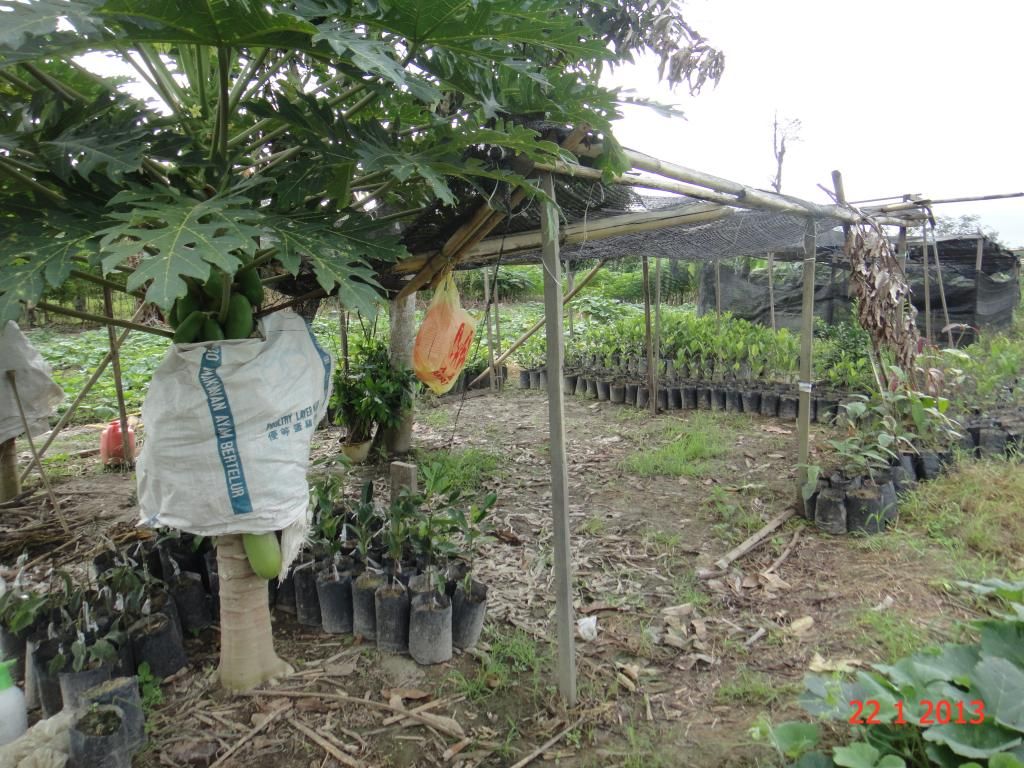
Having lots of chicken pecks on the papaya as these are the solo varieties. Had bought lots of used sacks to cover up, but still having problem. Hope it'll out grow it as the trees grows higher.

MrFarmer
post Mar 17 2013, 07:24 PM

Casual
***
Junior Member
478 posts

Joined: Mar 2011
From: Sabah


QUOTE(Michael J. @ Mar 15 2013, 11:11 PM)
MrFarmer:

Mmmm... maybe you can erect temporary fencing using whatever free materials lying around on your farm? Like short stout sticks inlaid in a conical shape around the trees?
*
Are using used bags, which cost $1 each and we most probably need 2 to fully cover the fruits. Problem is that access is difficult, we need to unwrap, check for harvest, disease, do spraying, then wrap it back. Labor intensive, if doing this for a large numbers of trees. Hope this shall be a temporary problem and hopefully as it grows higher, the chicken wouldn't peck.

user posted image
MrFarmer
post Mar 18 2013, 07:20 PM

Casual
***
Junior Member
478 posts

Joined: Mar 2011
From: Sabah


QUOTE(poks @ Mar 18 2013, 01:13 PM)
Thanks for the info again..
but mine does not look like that.
max fruit bunch is about 4 to 5 bunches.
i believe Mr Farmer's fruit will also be the same.
most probably lack of care..

anyway, thanks again..
*
We usually 'limit' the numbers of hands per bunch from 6 to 8 hands. I find this producing better harvest in my farm. For the Cavendish the top ranges from about 15 onwards bananas.

Am not sure if I'm getting it wrong, but the last hands should have more than 5 bananas.
MrFarmer
post Mar 20 2013, 07:50 PM

Casual
***
Junior Member
478 posts

Joined: Mar 2011
From: Sabah


QUOTE(Michael J. @ Mar 18 2013, 11:57 PM)
poks:

Don't worry, not all banana planting materials are the same. It really depends on the mother tree from which the clones were selected. The most important thing is the quality and weight of the final product.

The "dwarf" Cavendish I used to handle could produce up to 12 bunches on a single stalk, but in practice, like Mr Farmer noted, it is best to maintain about half this number only. For one, the lower combs produce very few fingers which are invariably small and "low grade" by market standards; secondly, most Malaysians prefer medium sized sweet bananas like Berangan, or mildly sourish ones like Rastali. In other words, there's not much of a market for off-grade Cavendish locally except in areas populated with Western expatriates.
Now there is a need to clarify something about the Cavendish banana. There are actually many forms of the Cavendish, with two being particularly important in Malaysia. The one depicted at the DOA website is the Williams strain. It grows to about 6.5 feet tall, and bears a very heavy crop (i.e. the 12 combs mentioned earlier). The other strain is known as the Grand Nain. This is a monster of a plant, reaching about 8 feet tall. It produces less combs per stalk, but each finger is far bigger and larger than the Williams.

In the past, the Montel used to be quite popular here. But you rarely see it planted these days. Still, people associate the Montel with any Cavendish banana produced nowadays.

Recently, there has also been a sharp importation of Cavendish strains from overseas, notably from China and Vietnam. There are also those that have been genetically improved, such as the Novaria. The most recent strain, the Valery, is a very disease tolerant Cavendish.

In this attachement, you can see the Williams and the Novaria Cavendish, aside from other banan cultivars:

http://www.unitedplantations.com/Products/...gress161008.pdf
*
Wow, the coconuts & banana looks good. Something to look forward when I expand brows.gif

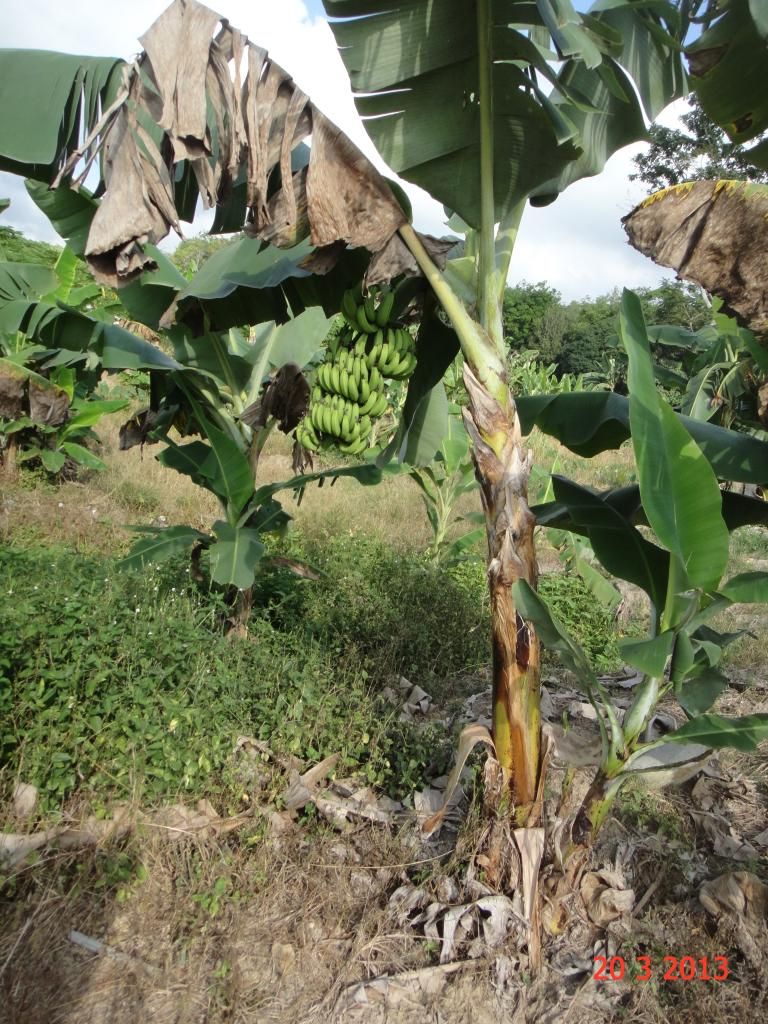
Some of our Cavendish.
user posted image

user posted image

user posted image
MrFarmer
post Mar 28 2013, 08:06 PM

Casual
***
Junior Member
478 posts

Joined: Mar 2011
From: Sabah


QUOTE(poks @ Mar 25 2013, 12:32 AM)
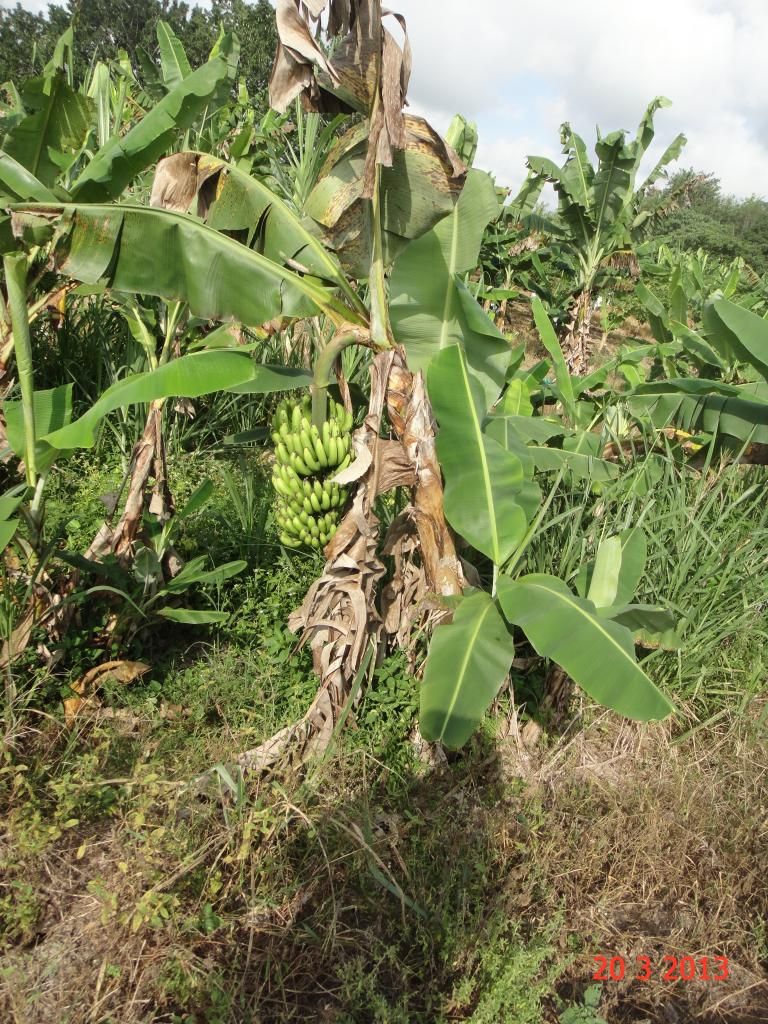
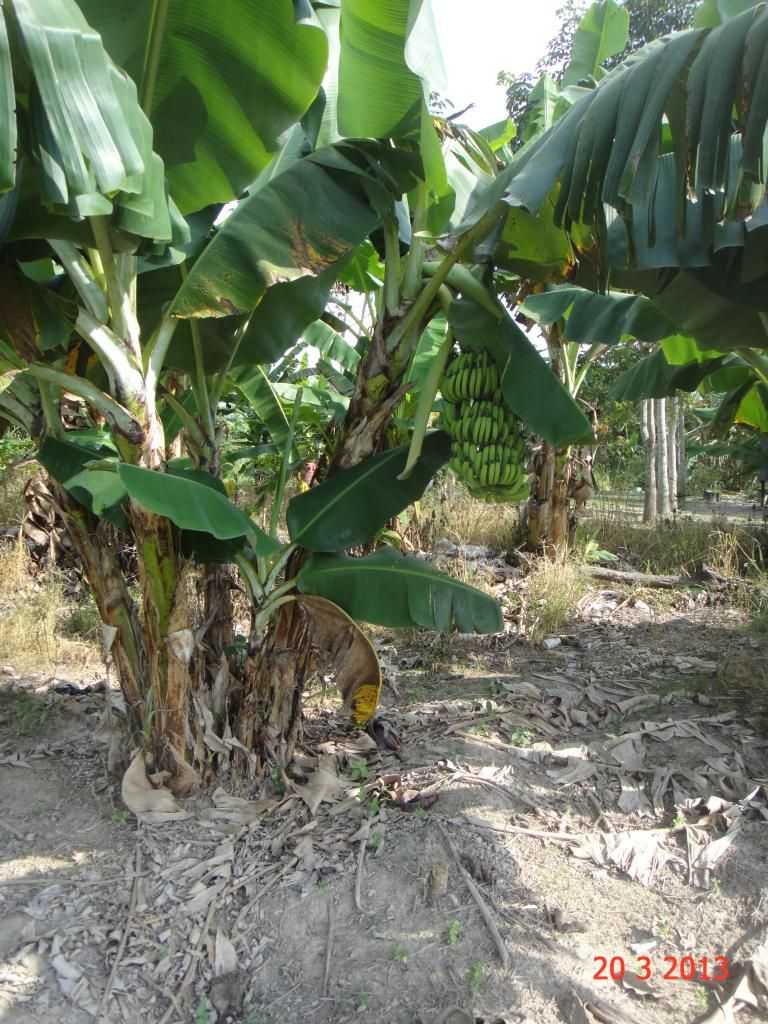
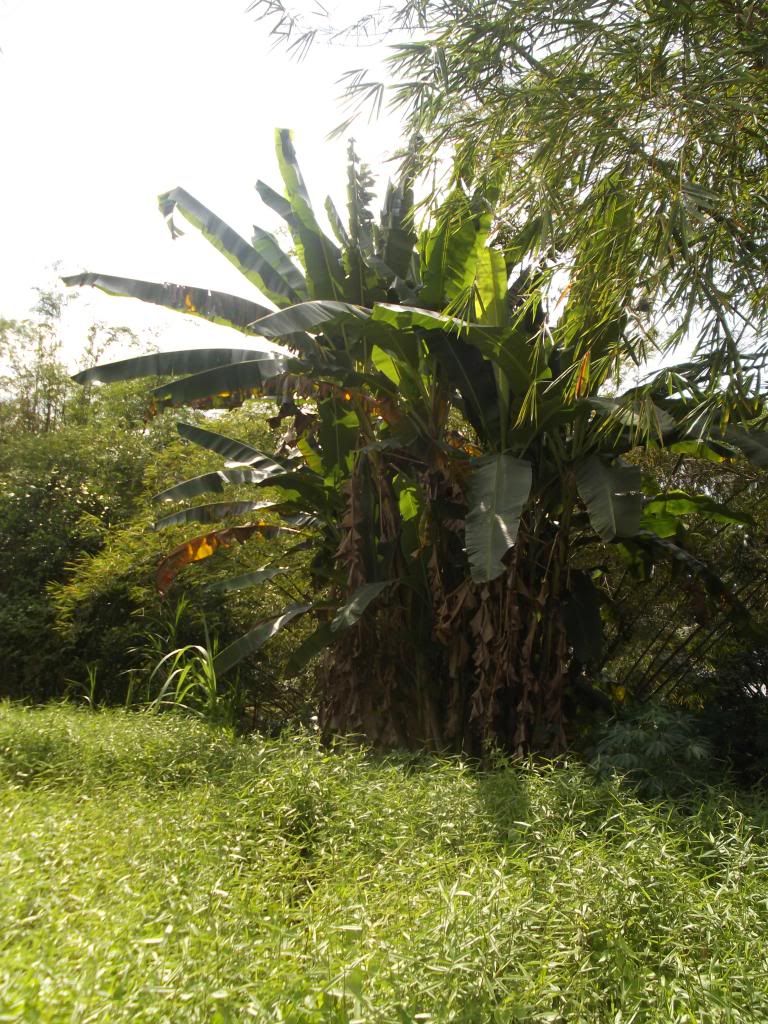
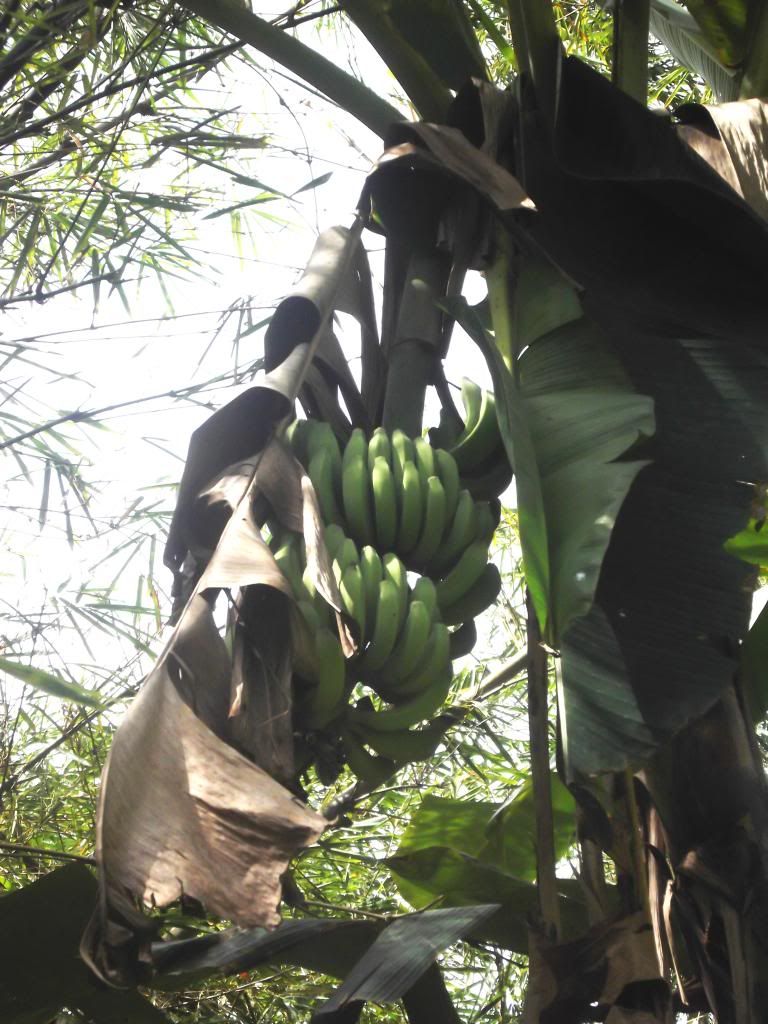
btw, i appreciate it if anyone can identify this banana.
i was debating with my mom on ripening agent for cavendish when she mentioned bout this banana.
i went to the place and took some suckers for transplanting in my farm.
it is way taller than 'pisang rebus' but the fruit arrangement is as of cavendish's.
anyway, it's the tallest banana i've ever saw. my mom said, on a very good tree there are a lot of fruit bunches and the fruit is bigger than the cavendish.
she called 'pisang berangan' and it's that tall. for sure it's at least 12 feet or more high.

hope someone can give some idea to this poor farmer

» Click to show Spoiler - click again to hide... «
Hmmh looks very tall, more than 12 ft? I don't have any banana that is that tall except for the pisang rebus / goreng ( it's called Pisang Saba), As for my Berangan, my trunk has wider diameter. The fruits could be Berangan? Raja? Cavendish? not sure.
MrFarmer
post Mar 28 2013, 09:15 PM

Casual
***
Junior Member
478 posts

Joined: Mar 2011
From: Sabah


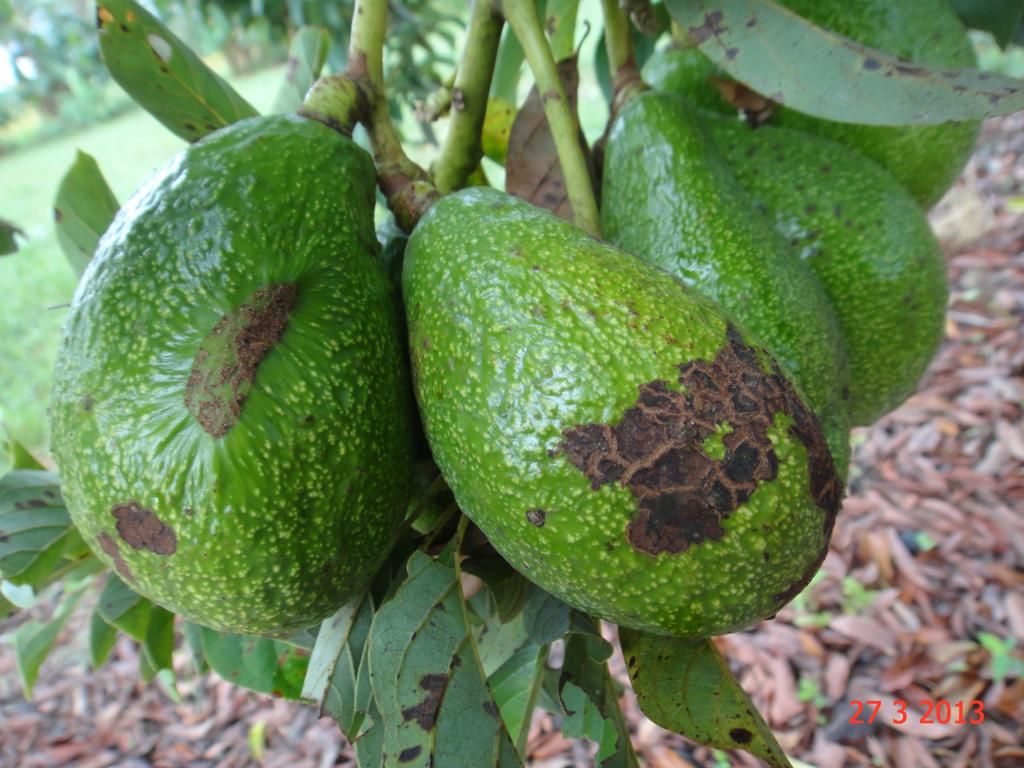
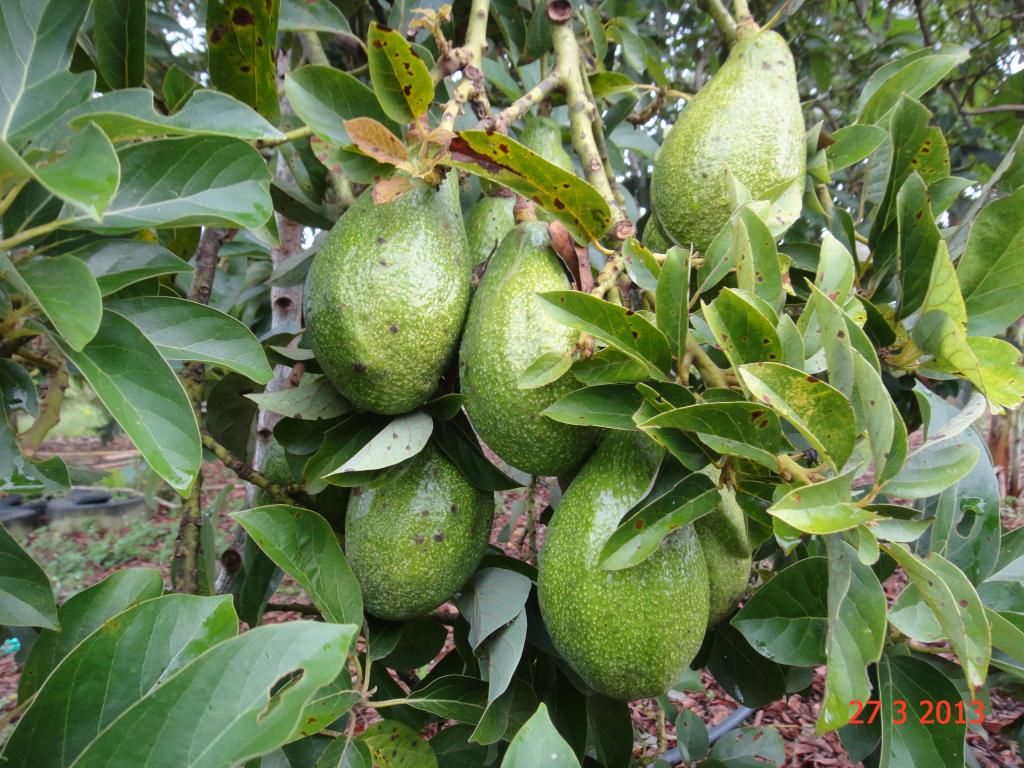
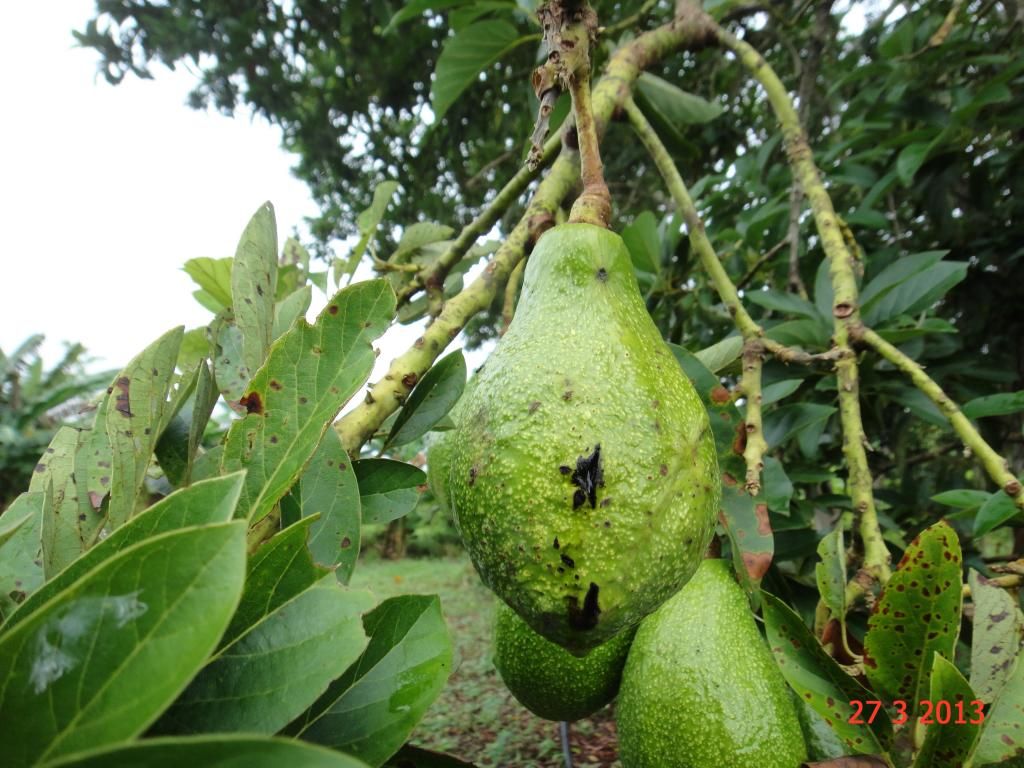
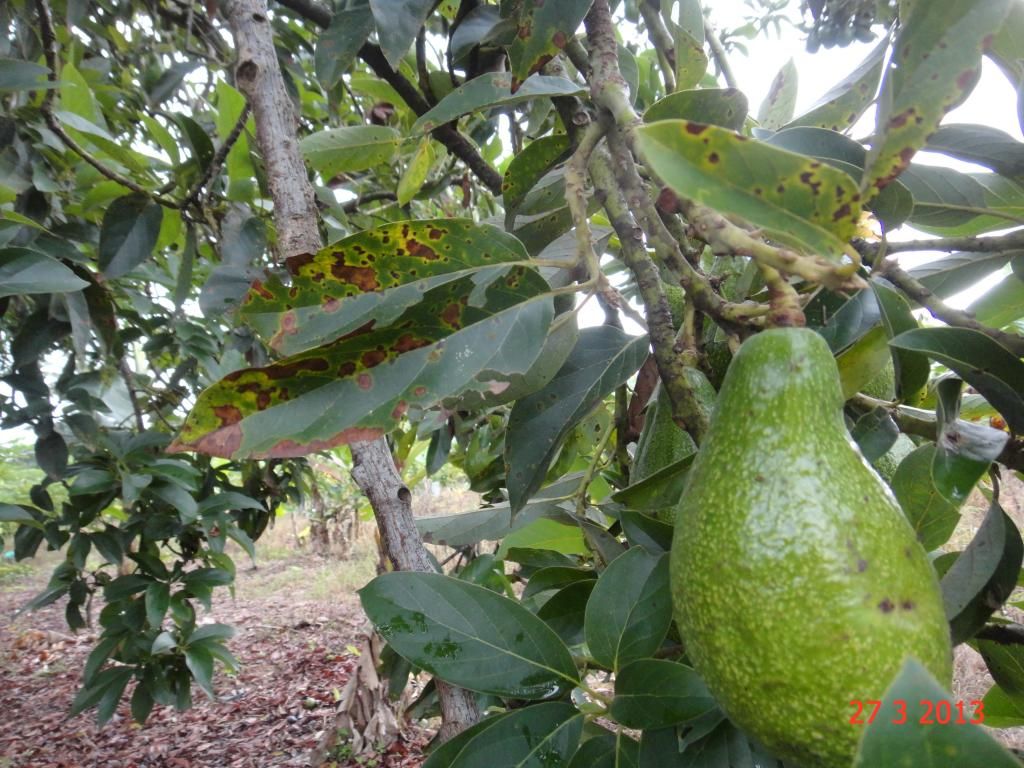
Having problems with Avocado.

user posted image

user posted image

user posted image

user posted image

MrFarmer
post Mar 29 2013, 08:11 PM

Casual
***
Junior Member
478 posts

Joined: Mar 2011
From: Sabah


QUOTE(Michael J. @ Mar 29 2013, 08:51 AM)
A very good Good Friday to all.


Mr Farmer:

Aside from anthracnose leaf blight, your avacado looks mostly ok. Maybe a few fruit fly stings here and there. That scaly brown patch is caused by the fungal infection, leading to what is called a "Hard Black Spot" (yea, cheesy name). Has your area been having high humidity? The ones with the hard scales are those that managed to recover from the infection; but that doesn't make them any easier to market. Consumers typically prefer clean skins.

You could try opening up the canopy a little more, allow better air-flow; alternatively, you could use a preventive fungicide like Benomyl or Mancozeb.

I would choose canopy forming first; you can talk to Para about this, as he does it for his durian trees.
*
Thanks Michael.

Had been scratching my head on how to do a spray on such a tall tree, easily 30 ~ 40 feet. Am thinking of getting a knack pack high pressure sprayer or a knack pack blower...wondering if it can reach such height.


MrFarmer
post Mar 30 2013, 09:01 PM

Casual
***
Junior Member
478 posts

Joined: Mar 2011
From: Sabah


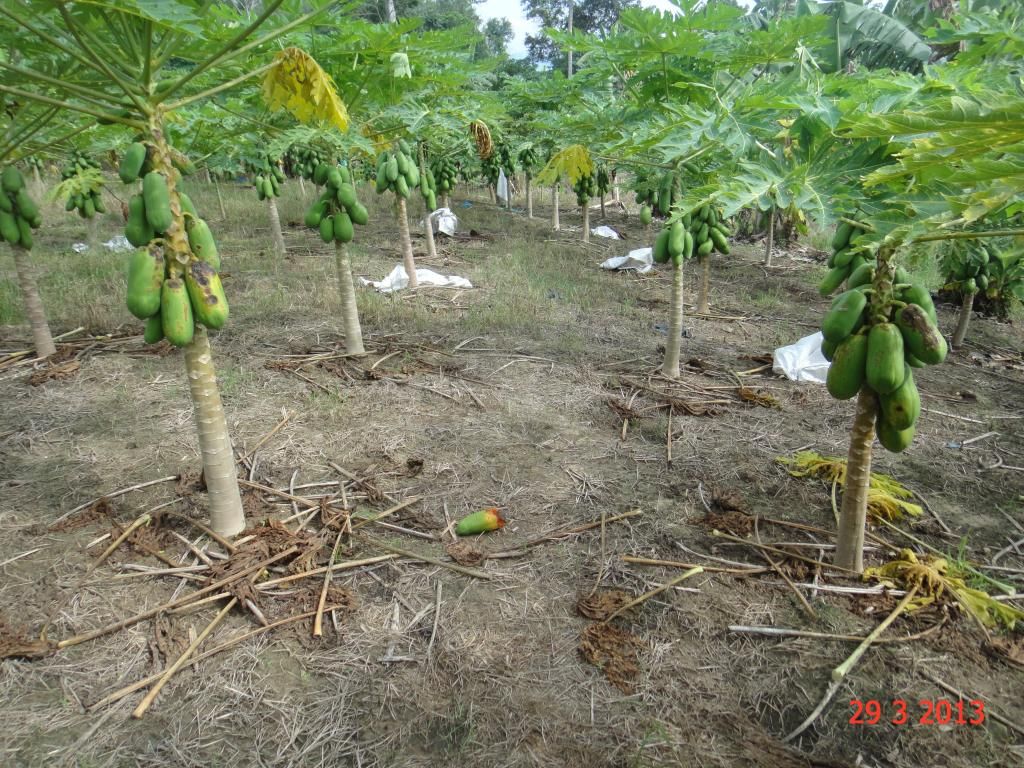
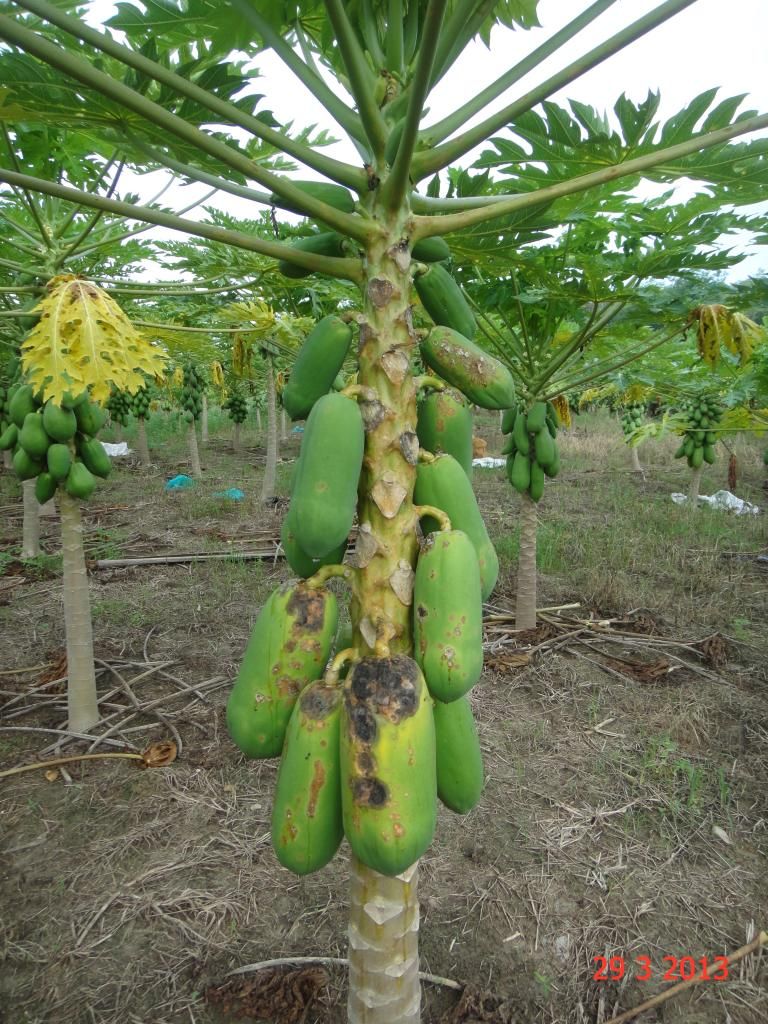
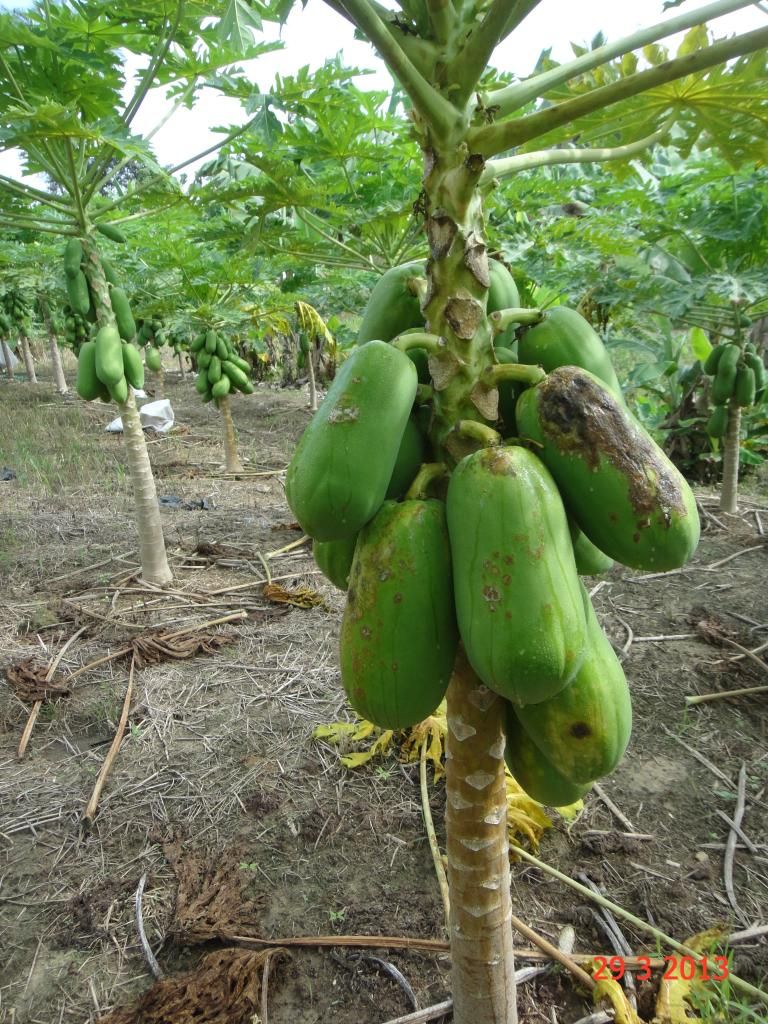
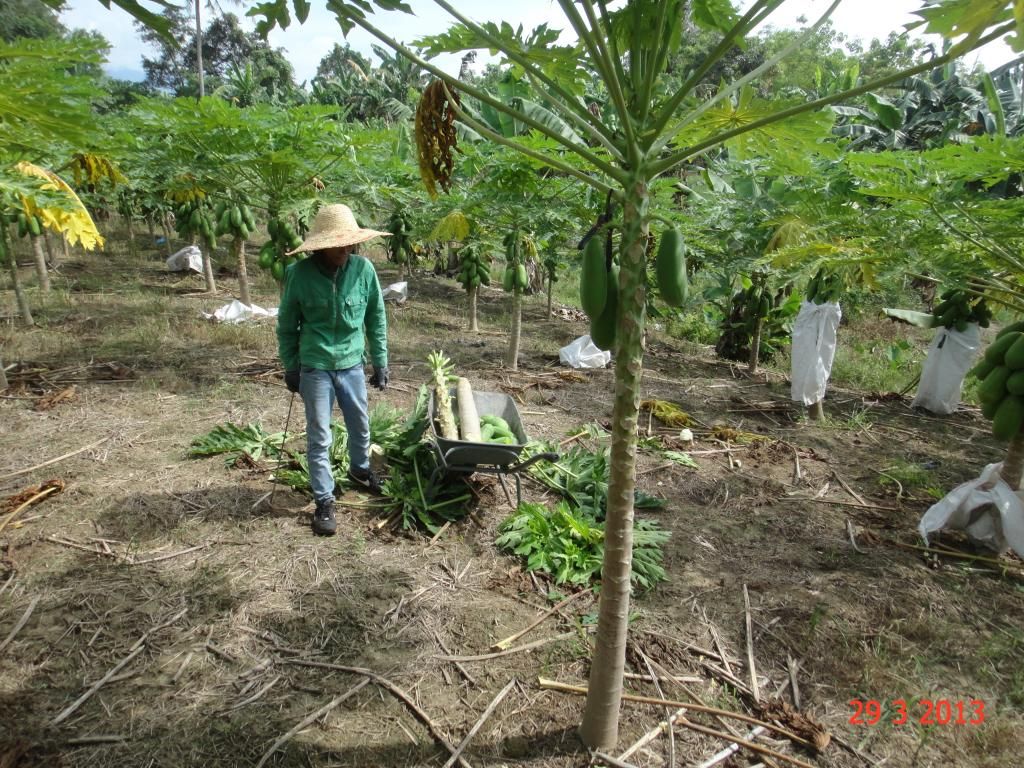
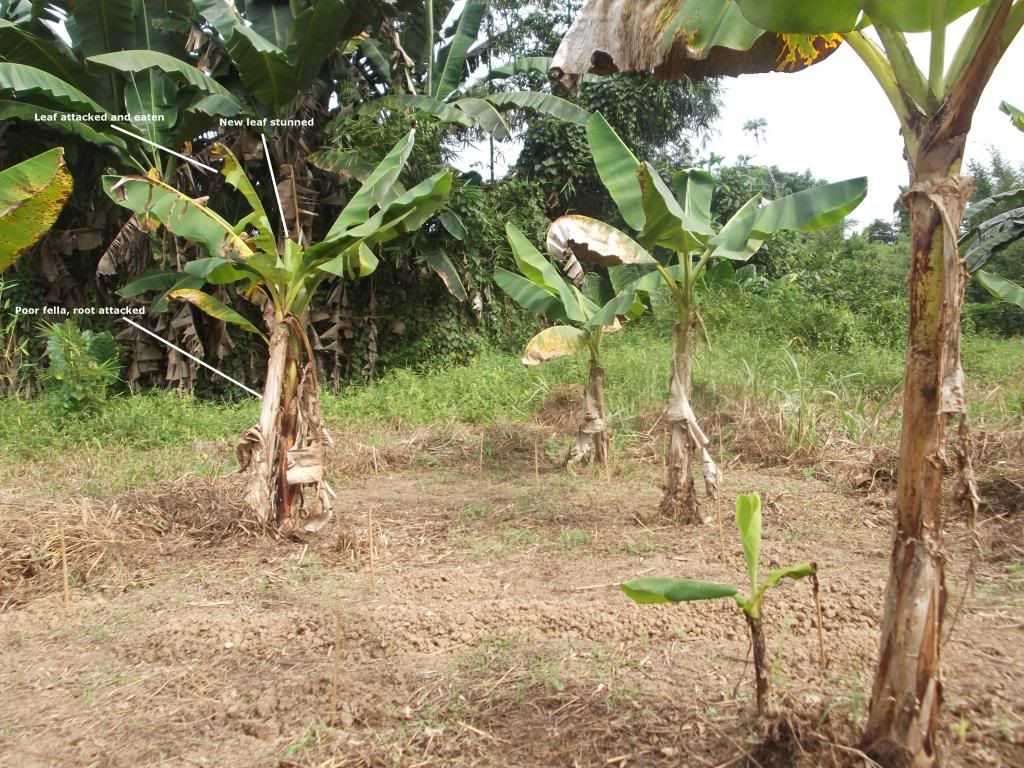
Problem with my Papayas. Noticed that 2 trees had some brownish spots. A few days later, it turned even worst. Had it culled as I don't know what's wrong with them and am afraid it could spread? After cutting off the trunk at the bottom, the trunk looks good. Fungus infection?

user posted image

user posted image

user posted image

user posted image


MrFarmer
post Mar 31 2013, 08:08 PM

Casual
***
Junior Member
478 posts

Joined: Mar 2011
From: Sabah


QUOTE(Michael J. @ Mar 31 2013, 10:44 AM)
But whatever it is, Mr Farmer, you still did what was considered the right thing at the time. Prevention is still better than cure. Anthracnose can spread easily from tree to tree, especially under wet weather, and by water droplets.

But do take to fungicide treatment when the weather permits. And treat the immediate tree neighbouring the infected ones as well. You will want to ensure the the plants 2-3 trees away stay safe.
*
blush.gif Yes, my initial thoughts was just to cull the affected fruits, but after looking at the speed of spreading and it's even on the trunk, the panic alarm rang. Hence made the drastic decision.
Had been using mencozeb & thiram to control Anthranose. I usually only gets it on the fruits. This is the 1st time that I'd seen it on the trunk. Was doing the fungus spread when I notice these 2 trees. Anyway, new plant-lets had been replanted.

Yes, the weather was temperamental recently, dry spell for 3 weeks, then sudden pour for a couple of days.
MrFarmer
post Mar 31 2013, 08:20 PM

Casual
***
Junior Member
478 posts

Joined: Mar 2011
From: Sabah


QUOTE(ParaOpticaL @ Mar 31 2013, 11:47 AM)
Hi MrFarmer,

i would suggest you start pruning down your tree and open up the canopy. the ideal height should be 10-15 feet Max. then you wouldnt have much problem with spraying or bagging or harvesting
MrFarmer,

from the picture i see that you roots are on the ground. i would also suggest you make a small "mountain" mound like the one i showed you at my farm so when it rains there would not be water logged situation and can prevent root rot.

that's my idea for you biggrin.gif
*
Hi Para, can't prune not as the Avocado are fruiting. Just did the 1st harvest for this year. Shall do it after the fruiting season.
Yes, I went to the Agriculture Park, near here. They are pruning the Jackfruits trees to 10 ~ 15 feet, small canopy, still the fruits are big & plenty. Experimenting with our Jackfruit trees. Shall give it a go.

The papaya is on a gradient slope, maybe about 10 degrees, slanting to the right where the small creeks runs. Hence I didn't do any 'hill'. Also when papaya had grown, the roots are all over the place and any hoeing shall break the roots. This farm, it's slightly sloped, both ends slopping to the middle, where the small creek runs.

Say, out of curiosity, how does a 'hill' perform during dry / extremely dry season? Am thinking of doing this for my banana to prevent toppling.
Hey your papaya harvesting already?
MrFarmer
post Apr 1 2013, 05:42 PM

Casual
***
Junior Member
478 posts

Joined: Mar 2011
From: Sabah


QUOTE(poks @ Apr 1 2013, 01:01 PM)
Thank you all for the infos..
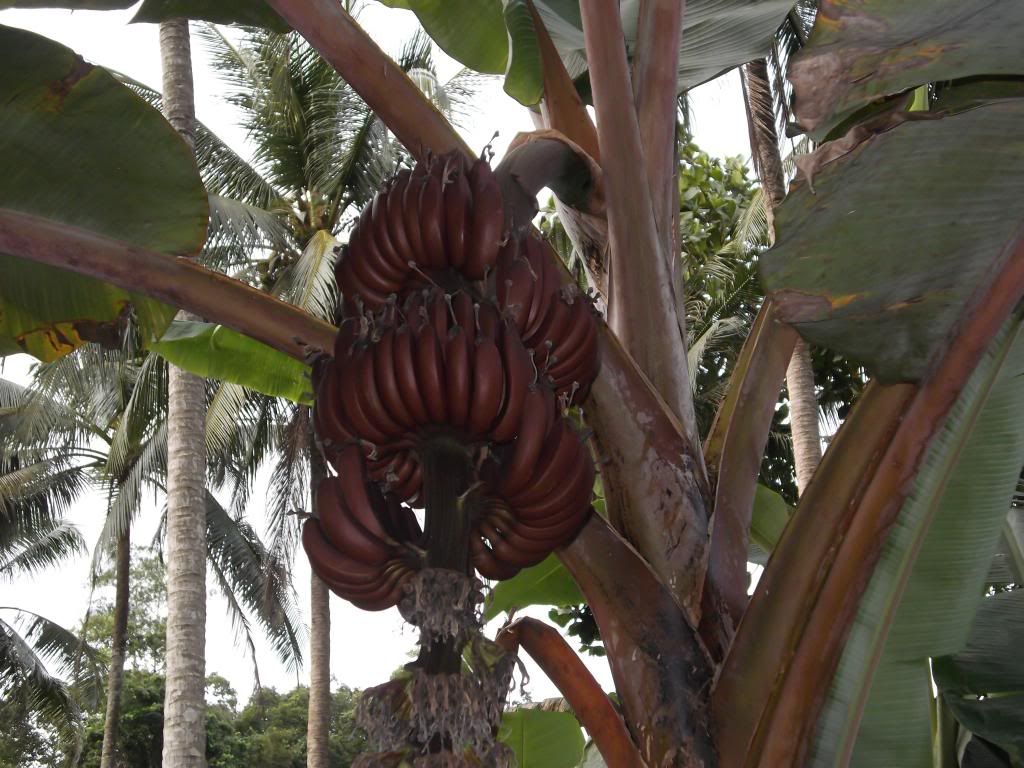
anyway, i would like to know the prospect of this red banana.
i was walking around when i notice this tree in the far end of my palm farm..
Mr Farmer, have you ever sold or plant this banana in Sabah?
thanks..

» Click to show Spoiler - click again to hide... «

» Click to show Spoiler - click again to hide... «

*

Very nice.
No I don't have any of these. I don't see anyone selling these.

But it's edible and belongs to the Cavedish group. Say, how's the taste, guess it's the same, just that it's high in carotene, hence the color.

MrFarmer
post Apr 1 2013, 05:52 PM

Casual
***
Junior Member
478 posts

Joined: Mar 2011
From: Sabah


QUOTE(Ramlan @ Mar 31 2013, 03:52 PM)
Hi all,
I have been a lurker on this thread for over a year and found quite an interesting assortment of experiences here. I am making my 1st post here in the hope of getting some pointers as where I can obtain the 'stuff' professional pest control use for termite bait stations.
I have identified the most wide-action active ingredient to be hexaflumuron or a less potent one diflubenzuron (aka DIMILIN). I am aware that it's only available to these pest control firms locally ...in theory anyway as I know DIMILIN is used in Koi (fish) disease treatment.
I have a 3 acre plot in Selangor purchased for a purpose that was still born. So I now have 40 old durian trees of unknown heritage. Over 2 years hardly a decent harvest (few and uneven ripening) and the last one was VERY FEW in nos and ALL suffered uneven ripening. I have used a rotation of commercial 'organic' and chemical fertilisers. No weed killer was used the last 2 years and only cow grass mechanically trimmed.

I am seeking pointers to the local availability of
1)hexaflumuron or
2)diflubenzuron (aka DIMILIN)
as almost all has termite tracks up their trunks and I want to avoid any mass soil application or spraying.
Hoping to eliminate termite as 1 of many causes for poor fruits in both quality and quantity.

Excuse my asking for help on my 1st posting.
*
Hi Ramlan,
If it's for termites, you may want to try Chlorpyrifos. It's effective as I use it for the rubber trees. During rainy season, the termites usually move to higher ground, climbing the rubber trees. I usually break off their tunnels/tracks, clear the trunk around the ground, then do a spray on the trunk & ground. There is only 2 trees that I need to do it twice. Got it for $34 per liter. I guess you should be able to get it cheaper in Penisular, here everything is priced higher.

http://www.agrsmart.com/pdf/102.pdf

I bought this book from Mardi, Serangga Perosak Buah-buahan Tropika Malaysia. There is lots of pictures on the pest and recommended controls. Would like to scan & digitize it so that we can share, unfortunately I don't have a scanner. Can anyone help?
MrFarmer
post Apr 3 2013, 07:47 PM

Casual
***
Junior Member
478 posts

Joined: Mar 2011
From: Sabah


QUOTE(poks @ Apr 2 2013, 07:03 AM)
MJ:

Thanks. Banana is my first successful plant. The only thing is that i have cavendish in large amount of +- 30 trees which i can't sell yellow. Have to do some experiment on ripening. As for the others, they are just normal except  for the recent tall banana and red banana. looking to propagate them  biggrin.gif
I'm still looking for more variety as collection.

btw, found some interesting ways to propagate;
1. http://www.ina.or.id/knoma-hpsp/fruit/HPSP...nana-Manual.pdf
2. http://www.cialca.org/files/files/extensio...ion_english.pdf
3. http://www.apcoab.org/uploads/files/1298295339pub_banana.pdf

Mr Farmer, i actually never seen people sell this reds in big quantity. might be a chance to open up the market  biggrin.gif
*
Ah, yes, the methods of Macro-propagation looks simple enough. I think it's do-able. Too bad that my small farm is almost full, otherwise I shall try this out.

Meeting my buyers either this or next week. Shall check with them and inquire if there is any market. Yeah, there is always a chance of getting good fruits to the market.
MrFarmer
post Apr 3 2013, 07:52 PM

Casual
***
Junior Member
478 posts

Joined: Mar 2011
From: Sabah


QUOTE(ParaOpticaL @ Apr 2 2013, 09:17 AM)
Hi MrFarmer,

yeah once they are done fruiting then just prune them slowly. massive benefits are awaiting.

that's correct for the jackfruit trees. though shorter doesnt mean that the fruit will be smaller. as my sifu calls, Focused Channeling of Energy to the required areas. His trees grow 20 fruits and averages about 30-35kg each. so yes it can be done

well the "hill" has many advantages ie, no water log and minimise the chance of root rot, and more importantly it will also helping in on holding onto the tree trunks to prevent toppling over.

the similar effect can noticed from the banana trees. out of my 400 banana trees i have less than 5 trees that toppled with this method in my farm.

during dry/extremely dry season, i just put grass mulches to help conserve moisture and more importantly the hills for for my fertiliser input and prevent water logging.

papaya should be harvesting before end of april...hahaha...need to look for buyers...lolx
*
Thanks &
Good Luck.
MrFarmer
post Apr 6 2013, 08:49 PM

Casual
***
Junior Member
478 posts

Joined: Mar 2011
From: Sabah


QUOTE(poks @ Apr 3 2013, 01:36 PM)
notworthy.gif

Btw, have you experience any disease outbreak on your bananas?
I would like to know any mitigation steps you implement to prevent diseases.
to date, i only experienced root borer problems and considering planting marigold as natural agent.

» Click to show Spoiler - click again to hide... «

*
Check on the book that I got from Mardi.
There are 2 listed here
Banana Corm Borer, Pengorek umbisi pisang
Rawatan
Rawatan hendaklah dilakukan pada rumpun pisang yang diserang terdiri daripada pokok ibu dan sulur. Siram pangkal pokok degan racun perosak chlorpyrifos (contoh: Dursban 73, 35ml/4.5 liter air)

Pokok yang diserang hendaklah ditebang, umbisinya digorek, dicincang dan didedahkan kepada cahaya matahari supaya larva dan kepompong mati.

and

Banana Stem Weevils, Pengorek batang pisang
Rawatan
same as above.

I have some Banana stem weevils problem. I don't treat, just cull it, cut to small pieces and left it under strong sun. Get a good stock and replant later.

Good luck.

MrFarmer
post Apr 9 2013, 10:13 PM

Casual
***
Junior Member
478 posts

Joined: Mar 2011
From: Sabah


QUOTE(ParaOpticaL @ Apr 7 2013, 01:05 PM)
Mr Farmer,

what was the title of the book you bought from Mardi ??

am going there tomorrow
thanks
*
Serangga Perosak Buah-buahan Tropika Malaysia
MrFarmer
post Apr 12 2013, 11:49 AM

Casual
***
Junior Member
478 posts

Joined: Mar 2011
From: Sabah


QUOTE(Kg Teratai @ Apr 11 2013, 05:16 PM)
Hi Farmer,

How is your shopping for the sprayer? Do you mind to share infromation about the sprayer that can reach to 40-50 fleets?
*
HI Teratai,
No luck

Mist Blower (backpack), it's about 15 to 25 ft high (with a micronex head attached, reduce the droplets to micron size)

Seen some photos of people using back pack power sprayer with long lance. I think for pest control, wastage is quite high. For foilar spray, fertilizer, I guess it's ok. Another thing, the long lance looks heavy, difficult to handle in the field.

Still scratching head. blush.gif

Rain stopped. Off to farm.

23 Pages « < 10 11 12 13 14 > » Top
 

Change to:
| Lo-Fi Version
0.0278sec    1.03    7 queries    GZIP Disabled
Time is now: 19th December 2025 - 10:33 AM