Welcome Guest ( Log In | Register )

Bump Topic Topic Closed RSS Feed
25 Pages « < 12 13 14 15 16 > » Bottom

Outline · [ Standard ] · Linear+

> Military Thread V17

views
     
BorneoAlliance
post Jul 21 2015, 06:35 PM

New Member
*
Newbie
0 posts

Joined: Dec 2014

PressTV-Yemen army destroys Saudi military vehicle

user posted image

Yemeni army forces backed by popular committees have destroyed a Saudi military vehicle in the southwestern port city of Aden.

The attack killed all of the vehicle's passengers as it was trying to infiltrate Aden, the Arabic-language al-Masirah satellite television network reported early on Tuesday.

Saudi jets also carried out attacks in the Harad district in Yemen’s northwestern province of Hajjah.

Earlier in the day, several people were injured in Saudi raids on the Sahar district and Sa’ada city in country’s northwestern Sa’ada province.

Airstrikes were also carried out on two separate schools and several residential areas in the northwestern Amran province.

Riyadh began a military campaign against Yemen on March 26 – without a UN mandate – in an attempt to undermine the Ansarullah movement and to restore power to the fugitive former president, Abd Rabbuh Mansur Hadi.

Based on UN figures, 3,261 people have been killed, 1,670 of whom were civilians, in the Saudi onslaught. However local sources put the death toll at over 4,500.

http://www.presstv.ir/Detail/2015/07/21/42...aden-vehicle---
BorneoAlliance
post Jul 21 2015, 06:41 PM

New Member
*
Newbie
0 posts

Joined: Dec 2014

France delivers first batch of fighter jets to Egypt

user posted image

QUOTE
Egypt yesterday took delivery of three Rafale fighter jets from France, the first of 24 warplanes sold in a €5.2bn ($5.6bn) deal earlier this year.

Egyptian authorities took charge of the planes at an air base in southern France, and they will be flown to Cairo by specially trained pilots today.

Cairo is hoping to boost its military presence as it faces an unstable Libya to the west and threats from militants in its Sinai Peninsula to the east.

For Egypt, the agreement is also a show of support for President Abdel Fattah al-Sisi, who wants to break a US monopoly over arms sales to Cairo.

The overall deal with Egypt also includes contracts for missiles and for an FREMM multi-mission frigate from naval group DCNS.

However, the deal has sparked concern from campaign groups worried about Cairo’s human rights record.
Some have accused Paris of double standards for freezing its delivery of two Mistral-class warships to Russia over the Ukraine crisis but going ahead with the Egypt deal.

The deal is a much-needed boon to cash-strapped France and Paris hopes that by showcasing French military technology it will prompt more orders for its premier combat jet, which it struggled for years to sell.

For a long period, France was the only country to buy the Rafales from Dassault. Its military forces have ordered 180 warplanes and 137 have been delivered.

Attempts to sell the jet to countries such as South Korea, Singapore, Morocco, Switzerland and Brazil have seen the Rafale lose out to its foreign competitors.

But this year the company has enjoyed much more success, clinching deals with Qatar and Egypt, as well as a firm order from India and interest from the United Arab Emirates. Eric Trappier, the head of Dassault Aviation, which manufactures the warplanes, thanked the French military “without whose support this success would not have been possible.” Planes that were supposed to be delivered to the French military were instead handed over to Egypt in order to be able to honour the contract.

In a further coup for French military exports, India in April ordered 36 Rafales in a multi-billion-euro deal that took years to conclude.


http://www.gulf-times.com/mobile//eco.-bus...r-jets-to-egypt
BorneoAlliance
post Jul 21 2015, 06:45 PM

New Member
*
Newbie
0 posts

Joined: Dec 2014

Meet Russia's New Killer Robot

user posted image

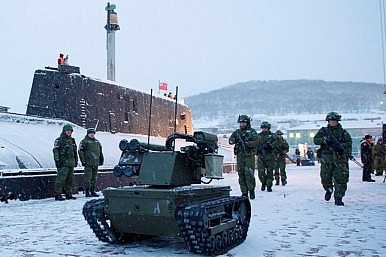
Today, the Russian military showcased its killer robot, codenamed Platform-M, in Sevastopol, Ukraine according to RT. In the video, the remotely controlled Platform-M combat robot is armed with a Kalashnikov assault rifle and four grenade launchers.

RBTH reported that an unknown number of robots for the first time participated in a military exercise of the Baltic Fleet alongside Russian ground forces in June 2014 near Kaliningrad where the “the military robots were assigned to eliminate provisional illegal armed formations in urban conditions and striking stationary and mobile targets,” according to the press office of Russia’s Western military district.

The Platform-M combat robot is equipped with “a differentiated defensive chassis and a firing platform and can carry out combative tasks during the night without unmasking instruments,” the Russian military told RBTH.

The robot’s targeting mechanism works automatically without human assistance, according to media reports. The prime task of the Platform-M will be to carry out reconnaissance and patrol missions and guard military sites.

The robot’s developers at the Progress Scientific Research Technological Institute of Izhevsk describe the Platform-M in the following way:

Platform-M is a universal combat platform. It is used for gathering intelligence, for discovering and eliminating stationary and mobile targets, for firepower support, for patrolling and for guarding important sites. The unit’s weapons can be guided, it can carry out supportive tasks and it can destroy targets in automatic or semiautomatic control systems; it is supplied with optical-electronic and radio reconnaissance locators.

Russia is also working on a more powerful and heavier robot combat platform, the URP-01G, which, according to a press release, can reach speeds up to 25 mph (40 kmh) and will be capable of operating 10 miles (16 km) from its control point.

“At present, the firm Sistemprom [the platform developer] is developing a unique automated combat module with large-caliber machine-guns and the grenade launcher compartment and is designing the strike and reconnaissance modules with the use of aircraft,” a Russian defense official told TASS.

Tasks for the combat robots will include radiation and chemical reconnaissance, patrol and mine clearing missions, and targeted strikes. The robots will be deployed “where there is danger to a person’s life,” a press release states.

Russia has allocated substantial resources in its 2016-2025 state armament program toward the development of robotic systems. By 2025, 30 percent of all military technology in the Russian Armed Forces is expected to consist of robotic hardware, according to Russia’s defense ministry. As I reported a while back, among other things, Moscow is also planning to introduce mind-controlled dual-use exoskeletons within the next five years (see: “Will Russia Field Robo-Soldiers in 5 Years?”). However, the general consensus is that Russia is about 20 years behind the United States and other Western countries in the development of robotic combat systems.

http://thediplomat.com/2015/07/meet-russia...w-killer-robot/
BorneoAlliance
post Jul 21 2015, 06:50 PM

New Member
*
Newbie
0 posts

Joined: Dec 2014

Hughes Demonstrates High Definition Video Over Satellite from Rotary Wing Aircraft

user posted image

QUOTE
MELBOURNE, Fla., July 20, 2015 /PRNewswire/ -- Hughes Network Systems, LLC (HUGHES), the global leader in broadband satellite solutions and services, today announced that its Defense and Intelligence Systems Division (DISD) successfully demonstrated the transmission of real-time, high definition video through helicopter blades with no signal disruption using its unique beyond-line-of-sight (BLoS) technology. Conducted on July 6-8, the testing of the Hughes end-to-end SATCOM solution for airborne platforms was performed on a NorthStar Aviation Bell 407 multi-role helicopter (MRH), and was supported by Boeing, General Dynamics, DataPath, and Northrop Grumman Corporation. The test was the first of its kind in the Ka-band over the Inmarsat-5 (I-5) F2 satellite, part of the Global Xpress constellation.

"High definition video with zero packet loss through rotary blades is a significant new capability for satellite communications," said Rick Lober, vice president and GM, Hughes DISD. "The military and law enforcement personnel employing helicopters for BLoS communication have been limited in the past, but not anymore. This technology opens the door for pervasive use of SATCOM-enabled helicopters over mountainous terrain, open water, natural disasters, or anywhere that line of sight communication means are blocked or out of range."

A new, ruggedized modem was employed during a series of flight tests to assess the capabilities of relaying real-time video from helicopters to ground operatives who could potentially be hundreds or even thousands of miles away from the aircraft. Rotary wing aircraft applications using the novel Hughes waveform technology include intelligence, surveillance and reconnaissance for military use, border security, search and rescue, wildfire response, news gathering and police patrol.  Though testing was conducted on the Ka-band over the Inmarsat Global Xpress system via its I-5 F2 satellite, the Hughes solution can transmit across all satellite frequency bands, and may be applied to fixed and rotary wing platforms built by Sikorsky, Boeing, Lockheed Martin, General Atomics and others. Representatives from the DoD, several large aerospace prime contractors and commercial helicopter operators attended various phases of the testing to witness the new Hughes technology.


http://www.prnewswire.com/news-releases/hu...-300115526.html
BorneoAlliance
post Jul 21 2015, 06:57 PM

New Member
*
Newbie
0 posts

Joined: Dec 2014

China begins assembly of world's largest amphibious aircraft

user posted image

A design image of the AG600. (Photo/Xinhua)

China has commenced assembling the AG600, the world's largest largest amphibious aircraft, reports the website of China's national broadcaster CCTV.

The AG600, developed by the Aviation Industry Corporation of China, is said to have entered the assembly stage in Zhuhai, a major city in southern China's Guangdong province, with hopes of conducting its maiden flight next year.

The amphibious aircraft, developed for sea rescue and firefighting missions, can takeoff from land or water and has a maximum takeoff weight of over 50 tons. It is capable of rescuing 50 people at a time on sea rescue missions.

With a maximum flight range over more than 5,000 kilometers, and an effective rescue radius of nearly 3,000 kilometers, the aircraft is also believed to have strategic value in the South China Sea, where China is embroiled in several territorial disputes.

Russia and Japan are the only other countries in the world to have developed large-sized amphibious aircraft, though the AG600 is the largest of the three and has only taken six years to reach this stage since the project was initiated in 2009.

Other large-sized aircraft being developed by China include the C919 narrow-body twin-engine jet airliner and the Y-20 large military transport aircraft.

The first batch of the C919 commercial airliners are also currently being assembled in Shanghai. The Commercial Aircraft Corporation of China has already received 507 orders for the aircraft, which can carry more than 150 passengers.

The Y-20, in the two years since its maiden flight, has been undergoing tests in various extreme environments. The plane, developed by Xi'an Aircraft Industrial Corporation, makes China the world's fourth country to develop its own large transport aircraft.

The C919 is set for its maiden flight next year, while the Y-20 is set to be delivered in the short term.

http://www.wantchinatimes.com/news-subclas...=20150720000036
BorneoAlliance
post Jul 23 2015, 10:18 AM

New Member
*
Newbie
0 posts

Joined: Dec 2014

Beijing's sub fleet a growing threat to the Indian Navy

user posted image

The INS Kalvari, India's first Scorpene-class conventional submarine, being launched in a ceremony held on April of 2015. It will begin its service with the Indian Navy in 2016. (Internet Photo)

Chaitanya Mallapur, an Indian security analyst, recently said in the Hindustand Times that the visit from a PLA Navy Type 039A diesel-electric submarine to the Pakistan's port of Karachi on its way back to China from the Arabian Sea two months ago sent a warning to India that China's submarine fleet is becoming a greater threat to the maritime security of the nation.

After arriving in Karachi on May 22, the Yuan-class submarine with its crew of 65 crew spent a week there for refueling and restocking. Unlike most convnetional submarines, the Yuan-class sub does not need to surface to breathe. It can stay underwater for weeks due to its air-independent propulsion, according to Mallapur. Currently, India has 14 submarines. Among them, only the INS Chakra, leased from Russia, is nuclear-powered.

In contrast, China has a total number of 68 submarines. This is four times as large as India's submarine fleet. Mallapur said that the PLA Navy operates at least nine nuclear-powered submarines. Four of them are attack subs while five others are ballistic missile subs.

Meanwhile, Pakistan, a traditional enemy of India is slowly building up its underwater fleet with the assistance of Beijing. China is planning to provide Pakistan with eight Type 039A Yuan-class diesel-electric submarines in near future. With this new threat in hand, India plans to add 15 more submarines to its fleet. Among those new vessels, six will be Scorpene-class conventional submarines from France. India also plans to build six nuclear-powered attack submarines and three ballistic missile submarines. New Delhi also plans to purchase four P-8I patrol aircraft to boost the nation's anti-submarine warfare capability.

http://www.wantchinatimes.com/news-subclas...=20150721000125
BorneoAlliance
post Jul 23 2015, 10:28 AM

New Member
*
Newbie
0 posts

Joined: Dec 2014

China Deploys Ultra-Modern Destroyer to Base on S. China Sea Island

user posted image

The destroyer, dubbed Yangsha, is likely to operate from the People’s Liberation Army Navy (PLAN) base at Yalong Bay on Hainan Island, reports Jane's Defense Weekly.

File photo, a Chinese Navy nuclear-powered submarine sails during an international fleet review to celebrate the 60th anniversary of the founding of People's Liberation Army Navy

The Type 052D features a universal vertical launch weapon system capable of firing anti-air, anti-surface, anti-submarine, and land attack missiles – a system not found on the preceding Type 052C.

Earlier this month, the seventh Type 052D emerged from the building shed at a shipyard in Shanghai and joined the sixth member of class which is currently fitting out, Jane’s reported. Builders have also made significant progress on the hulls of the eighth and ninth ships, circulating photographs show.

Type 054A Jiangkai II class frigates Yangzhou and Handan – the 19th and 20th ships of the class – have been handed over to the PLAN and are believed to have been commissioned, or will be shortly, Jane’s reports. Four more are under construction at two shipyards.

China's amphibious ship Jinggangshan is seen during a coordination training with a hovercraft in waters near south China's Hainan Province in the South China Sea.

On July 17, the latest Type 056 Jiangdao class corvette was launched at a shipyard in Huangpu. This is the 27th of the class and the eighth to be equipped with variable depth and towed array sonars.

Reports suggest that two days later, the 22nd of class, Suqian, also an ASW variant, was commissioned. Earlier in the month, the sixth Type 056 to be built at the Lushun Liaonan shipyard was launched, Jane’s reports.

A week earlier, two auxiliaries were commissioned – the semisubmersible heavy lift ship Donghaidao and Type 904A resupply ship Junshanhu.

http://sputniknews.com/us/20150723/1024940954.html
BorneoAlliance
post Jul 23 2015, 10:44 AM

New Member
*
Newbie
0 posts

Joined: Dec 2014

Expert: "Gaoxin-6" improves China’s anti-submarine capability greatly

user posted image

  The first fixed-wing anti-submarine patrol aircraft made in China began to serve in the naval air force of Chinese People's Liberation Army (PLA), according to recent news. This patrol aircraft is named "Gaoxin-6" and it is independently developed and manufactured by China.

  "Gaoxin-6" will make China a major anti-submarine power

  Anti-submarine aircraft is considered the most important means in anti-submarine warfare. All naval powers in the world attach great importance to the development of anti-submarine aircraft.

  Since 2000, China has developed a number of "Gaoxin" special aircraft including early warning aircraft, electronic warfare aircraft and long-range reconnaissance aircraft based on "Y-8" aircraft. The "Gaoxin-6" fixed-wing anti-submarine patrol aircraft is developed to replace "Y-8" maritime patrol aircraft of the last century.

  The new anti-submarine patrol aircraft is equipped with new turboprop engine which has improved its power, range and endurance. In 2012, "Gaoxin-6" fixed-wing anti-submarine patrol aircraft had its first flight.

  A modern large-scale land-based anti-submarine patrol aircraft requires various high-techs. It requires complicated development technology but it has long service period. After the World War II, even the United States has only has two generations of land-based anti-submarine aircraft. Therefore, a large anti-submarine aircraft has been an important symbol of a major military power.

  Currently, the commission of "Gaoxin-6" into service marked that China has become a world power in terms of large-scale anti-submarine patrol aircraft.

  4 highlights of "Gaoxin-6"

  The performance of "Gaoxin-6" is very similar to US P-3C.

  1. Fast cruising speed and wide search range.

  "Gaoxin-6" uses advanced 6-leaf sweepback turboprop engine. It has a fast cruise speed and can take off in a field airport. It is also fuel-efficient and stable. Its cruising speed and maximum takeoff weight are similar to that of P-3C anti-submarine aircraft.

  2. Strong detection capability.

  A "gill" shaped fairing is installed on the nose position of "Gaoxin-6". Combined with a 360 degree large sea search radar, it can effectively detect submarines. A "magnetic anomaly detector" is installed in its tail used to detect submarines. The antenna of "Gaoxin-6" is longer than that of the P-3C and therefore, some experts believe that "Gaoxin-6" has better detection capability.

  3. Detection and strike capabilities

  "Gaoxin-6" is equipped with anti-submarine weapons including torpedoes, depth charges, mines and air-to-submarine missiles. It can carry a crew of over 10 people. It can detect the target and provide an indication for air-to-submarine missiles as well.

  4. Self-defense capability

  "Gaoxin-6" is equipped with advanced self-defense warning system and air-to-air missiles. It can respond to threats from the air and this ability to self-defense is similar to that of P-3C.

  Some analysts believe that "Gaoxin-6" has reached the level of P-3C in terms of system and hardware. There’s no great technical generation gap of anti-submarine capabilities between "Gaoxin-6", Japan’s P-1 and US P-8A.

  However, "Gaoxin-6" only filled in China’s blank of not having fixed-wing anti-submarine patrol aircraft. Compared with advanced anti-submarine aircraft, "Gaoxin-6" has some gaps in terms of software.

  Therefore, some experts suggest that in the future, China can develop a new generation of anti-submarine aircraft based on China’s own large aircraft C919 and Y-20 and other platforms in order to achieve better high-speed performance, better low-speed performance, long range and reasonable price.

  "Gaoxin-6" improves China’s anti-submarine capability greatly

  For a long time, the development of China’s anti-submarine equipment was slow, especially the air anti-submarine equipment that is capable of performing fast patrol and rapid response in large area and wide waters.

  The service of "Gaoxin-6" has filled this blank. "Gaoxin-6" can cover and control large areas. It can arrive in anti-submarine area in a short time to quickly and efficiently conduct anti-submarine search in suspicious waters.

  "Gaoxin-6" has enabled China to have the same anti-submarine capability as the US. "Gaoxin-6" also helped China become a leader among its neighboring countries in anti-submarine technology for quite a long time.

  It also helped China expand the anti-submarine monitoring range and defense line thousands of kilometers ahead to the second island chain. Thus, the Chinese navy's underwater control range has been greatly extended.

  The service of "Gaoxin-6" filled the last equipment gap of the Chinese navy. It reflects China’s determination in improving its open ocean combat capability. It is a major improvement of Chinese navy’s wide anti-submarine capability and another sign of Chinese navy’s march to the vast ocean.

  By Xie Cheng and Li Wei from National Defense University

http://eng.mod.gov.cn/Opinion/2015-07/10/content_4594293.htm

BorneoAlliance
post Jul 23 2015, 11:42 AM

New Member
*
Newbie
0 posts

Joined: Dec 2014

3-D Printed Missiles Now a Thing

user posted image

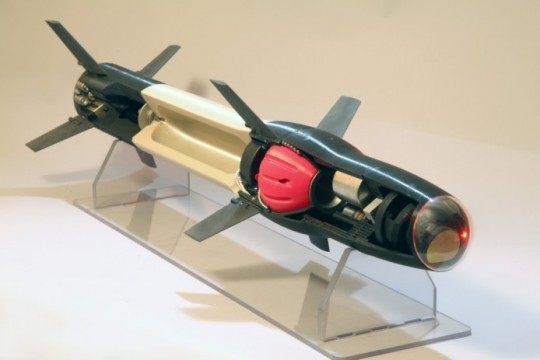
3-D printing has taken its next logical step as a defense contractor has engineered a way to use the manufacturing process in the creation of guided missiles.

Raytheon, one of the U.S.’s largest defense contractors, has built a missile almost entirely from 3-D printing technology.

“The day is coming when missiles can be printed,” Raytheon said in a press release. “Researchers at Raytheon Missile Systems say they have already created nearly every component of a guided weapon using additive manufacturing, more commonly known as 3-D printing. The components include rocket engines, fins, parts for the guidance and control systems, and more.”

“You could potentially have these in the field,” Raytheon engineer who has printed working rocket motors Jeremy Danforth said in the release. “Machines making machines. The user could [print on demand]. That’s the vision.”

Gizmodo explained exactly what 3-D printing technology could mean for the military some day.

“For the time being, Raytheon is mostly interested in the cost savings that additive manufacturing can promise, but for the military, there’s a lot of logistical upsides as well: put a stack of raw materials and a 3-D printer on an aircraft carrier, and you could have a virtually unlimited supply of munitions for the aircraft,” Gizmodo’s Chris Mills said.

Raytheon said that day may not be too far off. “There are folks in industry printing warheads,” Danforth said in the release. “We are printing demos of many of the seeker components. And we demonstrated a printed rocket motor.”

“We’ve already printed 80 percent of what would go into a missile.”

http://freebeacon.com/national-security/3-...es-now-a-thing/
BorneoAlliance
post Jul 23 2015, 02:07 PM

New Member
*
Newbie
0 posts

Joined: Dec 2014

Japan's 'submarine killer' tantalizes West

user posted image

TOKYO -- Japan's state-of-the-art maritime patrol aircraft has been attracting increasing attention, not only from its key ally, the U.S., but also from Europe amid growing concerns about movements by Russian submarines.

The P-1, built by Kawasaki Heavy Industries for Japan's Self-Defense Forces, is the country's first domestically made anti-submarine patrol plane.

Its main mission is to conduct maritime warning and surveillance activities. The aircraft is dubbed a "submarine killer" because it is capable of detecting and attacking submarines that cannot be perceived with the naked eye.

The Maritime Self-Defense Force has about 10 P-1 planes deployed at Atsugi Air Base in Kanagawa Prefecture. They have so far been operating on a trial basis. Full-scale operations are scheduled to begin during the current fiscal year.

P-1s are priced at about 20 billion yen ($163 million) each. The Defense Ministry plans to procure five per year starting in 2018 and eventually deploy a total of some 70.

On June 25 the MSDF showed a P-1 to the media for the first time, describing its improvements over the P-3, Japan's current mainstay maritime patrol plane.

The P-1 has color radar screens, making it easier to detect and track the movements of suspicious vessels, and its sonobuoy, a device used to gather acoustic data and locate submarines, also offers higher performance.

Moreover, the P-1 is a jet, while the P-3 is a propeller plane, giving the new plane a maximum speed about 30% faster than its predecessor. The P-1 also has a range of about 8,000km, compared with the P-3's approximately 6,600km.

U.S. expectations

The U.S. military is stepping up its surveillance activities in the South China Sea, flying its P-8 state-of-the-art maritime patrol aircraft, in response to China's moves to build military footholds on reclaimed land.

http://asia.nikkei.com/magazine/20150723-P...tantalizes-West
BorneoAlliance
post Jul 24 2015, 09:38 AM

New Member
*
Newbie
0 posts

Joined: Dec 2014

Rebels Find Fake U.S. Stinger Missiles in Eastern Ukraine

user posted image

A cache of U.S.-made weapons unveiled by pro-Russian separatists in eastern Ukraine has been revealed as an apparent fake.

The weapons were seemingly intended to prove U.S. involvement in the war in eastern Ukraine, where a low-level conflict between the Ukrainian army and separatists backed by Russia still simmers.

But Russian bloggers said the equipment shown by the separatists was copied from designs used in a video game, not the U.S. army.

In a video posted this week by LNR.today, a news agency in the self-proclaimed Luhansk People's Republic, separatist soldiers uncovered a storage depot at Luhansk airport, a position formerly held by Ukrainian military forces, where they found U.S.-made dry rations and opened a wooden crate labelled “U.S. ARMY,” which contained a missile launcher.


accompanying the video LNR.today quoted the republic's prosecutor general, Leonid Tkachenko, as saying the weapon appeared to be a Stinger missile — a U.S.-made shoulder-mounted anti-aircraft missile.

“This is another proof of supply of lethal weapons by foreign manufacture on the territory of Ukraine,” Tkachenko said, according to the English-language report on LNR.today.

The U.S. says that it has only provided non-lethal military aid to Ukraine, while it accuses Russia of supporting the separatists with cash, equipment and troops.

But the alleged Stinger features writing on its side that says “Tracking Rainer,” rather than “Tracking Trainer,” as is seen on Stinger missiles used by the U.S. military.

Russian video game bloggers took to Twitter to point out that this spelling mistake was used on 3-D models of Stinger missiles in the 2011 first-person shooter video game "Battlefield 3" to avoid copyright issues.

http://www.themoscowtimes.com/business/art...ine/526093.html
BorneoAlliance
post Jul 24 2015, 09:45 AM

New Member
*
Newbie
0 posts

Joined: Dec 2014

China's armed police give 'liberation shoes' the boot

user posted image

Members of the People's Liberation Army (PLA) Armed Police are finding their feet more comfortable in a new type of training shoes.

Newly equipped troops have found a cure for smelly feet and soldiers should be less vulnerable to foot-related diseases.

The new breathable black shoes will be distributed to all armed police units by the end of July, according to the force's website.

"Liberation shoes," a kind of rubber footwear used by the Chinese army since the 1950s, will be gradually decommissioned from the service.

Man Xiangdong, the armed police officer in charge of shoe design, described the new shoes as "anti-bacterial, anti-fungal and odor resistant," saying they give better support to the wearers' ankles.

"It's light. It feels like stepping on spongy cushion while running," said Li Zhixiang, a member of the armed police, on the website. "Our dorm is no longer full of the smell of feet since we got the new shoes last year."

Before going into mass production this year, the armed police tested the shoes and solicited the opinions of nearly 180,000 soldiers and officers, said Zheng Jianchun, a logistics official with the armed police.

The traditional liberation shoes, in dark green or camouflage color, are still widely used by most PLA units. After several rounds of improvements, the shoes are light and easy to carry.

The shoes passed the test of revolutionary years and have been the major footwear of the Chinese army since the 1950s, but they have their limitations. They are not puncture proof, nor water resistant, and the low-waist design easily lets sand into the shoes and does not protect the ankle. In recent years, liberation shoes have been gradually replaced by combat boots in military training, but soldiers still wear them during their downtime.

Liberation shoes still dominate Chinese peacekeeping troops' footwear on overseas missions. According to peacekeepers, the practical shoes are popular in African countries and sometimes can be exchanged with foreign soldiers for much more expensive European military boots.

http://www.wantchinatimes.com/news-subclas...=20150723000029
BorneoAlliance
post Jul 24 2015, 09:52 AM

New Member
*
Newbie
0 posts

Joined: Dec 2014

Scared of Russian BMPs, US Strykers in Europe to Get 30mm Guns

user posted image


The US Army’s 2nd Cavalry Regiment is one of only two US combat brigades left in mainland Europe. Based out of Germany, the squadron went on an 1,100 mile “Dragoon Ride” through the Baltic nations in April.

Designed as a way to showcase US military might in the face of alleged Russian aggression, the march did serve at least one practical purpose. Compared to the 100mm guns and 30mm canons of Russian transport vehicles, Army staff noticed that the 12.7mm canons of the Stryker were far too small.

Col. John Meyer, the unit’s commander, put in a request to upgrade the canons of 81 Strykers to 30mm. With a cost of $3.8 million per vehicle, those upgrades will begin soon, and could be complete within a “realistic” timeframe of 24 to 36 months.

"I did intend for it to be urgent, and the time frame I looked at is the next two years,' Meyer said during a Pentagon news conference on Wednesday.

According to Ohio Senator Rob Portman, the Army had planned to upgrade the Strykers in 2020. But, speaking to Defense News, he said that was "prior to the deteriorating situation in Europe," and that plan had to be fast-tracked.

The Army’s most likely choice is the 30mm Bushmaster II, which "can destroy anything short of a heavy tank, and do considerable damage even to those," Jim Hasik, Brent Scowcroft Center senior fellow for defense, told Defense News.

That’s if military engineers can manage to attach such a large gun to the relatively small frame of the Stryker. Earlier experiments in attaching a 105 mm Mobile Gun System proved futile.

"MGS was a failure, which is why they stopped producing them," a Hill staffer told Breaking Defense. "That said, MGS is better than nothing in terms of fire support. These [proposed] 30mm remote weapon stations help quite a bit."

Strykers are the largest US military vehicles in Europe, but reports from Tuesday suggest that the Pentagon may send M1 Abrams tanks and M2 Bradley infantry vehicles to Hungary in 2016. According to the Hungarian Napi Gazdasag newspaper, the vehicles would then be used in NATO military exercises in the region.

Washington has repeatedly cited “Russian aggression” as an excuse to increase its military presence in Eastern Europe. These actions are based largely on unproven allegations of Russia’s involvement in Ukraine, which Russia denies, and Moscow has repeatedly expressed concern over the potentially destabilizing influence of provocative NATO actions.

http://sputniknews.com/us/20150724/1024983526.html
BorneoAlliance
post Jul 24 2015, 05:37 PM

New Member
*
Newbie
0 posts

Joined: Dec 2014

How ‘smart skin’ could revolutionize military vehicles

user posted image

QUOTE
New “smart skin” for military vehicles could let them “feel” their environment, similar to a human. The skin, for example, could let combat aircraft detect any damage by “feeling” the injury. 

BAE Systems' U.K. division is developing the Smart Skin concept, which aims to give machines the ability to ‘feel’ the world around them, sense and process the data like an animal and relay the information to a “brain” within the machine.

ADVERTISEMENT
In future combat, all machines could leverage this mega-smart skin, detecting heat, damage and stress. Combat aircraft, drones, tanks and other land vehicles, as well as naval vessels could covered with the smart skin. Drones operating in air, on land, at sea or underwater could also deploy the technology.

How does it work?

Using a skin loaded with a range of sensors, machines could “feel” and sense things like an animal does. The smart skin would cover a combat aircraft -- reading, recording and processing the machine’s sensations.

The skin would be fully loaded with tiny computers. These very tiny computers work collaboratively to sense and understand the environment the machine moves through. The skin would also have its own power source. 

Embedded in the skin are hundreds or even tens of thousands of sensors, giving the machines the ability to “sense.”  Called motes, some of the sensors are the size of a grain of rice, while others – at less than 1mm squared – are the size of dust particles. The motes were created by BAE Systems Senior Research Scientist Lydia Hyde.

Commonly used sensor tech can often be big, cumbersome and expensive. However, smart skin offers, tiny, highly efficient and effective multi-purpose sensors.

How would aircraft use skin?

Imagine hundreds of the tiny sensors spread across an aircraft wing. The sensors “feel” the world around them and send data back to the pilot. The sensors, for example, could sense wind and measure wind speed. They could also take temperature measurements.

Like human skin, smart skin would “feel” physical strain and movement. Different sensors would provide data on different things. Some sensors, for example, would measure and compute airflow while others may measure how the metal is fatiguing or under stress. 


http://www.foxnews.com/tech/2015/07/23/how...itary-vehicles/
BorneoAlliance
post Jul 24 2015, 05:45 PM

New Member
*
Newbie
0 posts

Joined: Dec 2014

Smaller and smarter antennas for military use

user posted image

QUOTE
When it comes to protecting the men and women of the armed forces, University of Wisconsin-Madison researcher Nader Behdad focuses his work on an obstacle most people wouldn’t associate with combat: the physical limitations of low-frequency antennas.

For decades, the military has sought to take greater advantage of low-frequency radio waves. The long wavelengths and propagation characteristics of radio waves in the 3- to 300-megahertz range enable long distance communication, and can penetrate or diffract around natural obstacles — making them useful in many military communications systems.

This frequency range is also a crucial tool in electronic warfare — jamming an enemy's communications or, conversely, tracking down the source of a jamming signal in an electronic attack.

Photo: Nader Behdad
Nader Behdad
The laws of physics dictate that a conventional antenna has to get bigger as the wavelengths get longer. And when you're dealing with 10- to 100-meter-long wavelengths, the antennas get far too bulky to lug into real-world electronic warfare situations.

Behdad, a UW-Madison professor of electrical and computer engineering, recently received a $1.3 million grant from the Office of Naval Research to tackle this problem on two different fronts.

Building from previous research successes, Behdad and his research group will explore how to make compact, powerful antennas for transmitting jamming signals in an electronic attack and how to develop better antennas for finding the source of a hostile signal.

"If you have a small platform and you want to put an antenna on it that works across this entire low frequency band, this antenna can't be a 10-meter-long antenna," Behdad says. "If you have an unmanned aerial vehicle that's flying, you don't have that kind of real estate. Even on a ship — a ship is huge, but there are so many things on it — finding that kind of space would be a problem."

On the transmission, or attack, side Behdad is working to develop a 1-meter antenna that can send high-power signals at frequencies as low as 3 megahertz.

What the military is seeking will push Behdad's previous research — and the laws of physics — to the limit.


http://news.wisc.edu/23905
BorneoAlliance
post Jul 25 2015, 12:37 AM

New Member
*
Newbie
0 posts

Joined: Dec 2014

Offsetting Challenges to Western Military-Technological Supremacy: Time For A New Paradigm In European Capability Development

user posted image

QUOTE
Arguably, the most serious and structural challenge to Western military-technological supremacy comes from the development and proliferation of so-called ‘Anti Access Area Denial’ (A2/AD) capabilities. Most notably, the increasing accuracy and proliferation of ballistic and cruise missiles threatens US forward bases and naval assets – and poses a particularly serious problem in the Asia-Pacific. The A2/AD challenge also features cyber and anti-satellite capabilities aimed at disrupting the communications and situational awareness of US and Western militaries.

The A2/AD challenge targets the military-technological foundations of Western geopolitical supremacy, insofar as it is aimed at denying Western military forces access and freedom of movement to certain operational theaters. A2/AD capabilities are being developed primarily by China and Russia, but are also being exported to countries like Iran, Pakistan or Syria.

The US has already begun to grapple with the implications of the A2/AD challenge. In late 2014, former Defence Secretary Chuck Hagel set in motion a new offset strategy aimed at developing the necessary capabilities to overcome Chinese (and Russian) advances in A2/AD. The new offset strategy dovetails with the Pentagon’s recent efforts to develop new operational concepts – such as Air-Sea Battle or Conventional Prompt Global Strike; and will incentivise ‘breakthrough technologies’ in the realm of cyber, energy-based weaponry, stealth or robotics. It has also spearheaded efforts to achieve a more efficient bureaucratic structure within the US military, and a more flexible relationship between the Pentagon and the US defense industry.

Beyond the A2/AD problem, mounting strategic, political and financial pressures are presiding over a shift in US defense strategy – away from the emphasis on “out of area” interventions of the last decades. Greater attention is being paid to the more ‘silent’ functions of military power, such as deterrence, defence, prevention, intelligence, military diplomacy, building partnership capacity, etc. This is not to say that the era of Western expeditionary operations is over. However, long-lasting and ambitious operations à la Iraq/Afghanistan are likely to be avoided and more ‘surgical’ forms of intervention prioritised, i.e. precision strikes, Special Operation Forces, cyber-attacks, etc.


http://www.isn.ethz.ch/Digital-Library/Art...ng=en&id=192294
BorneoAlliance
post Jul 26 2015, 02:27 AM

New Member
*
Newbie
0 posts

Joined: Dec 2014
QUOTE
USS Bainbridge, a U.S. Navy Arleigh Burke-class guided missile destroyer hammers a decommissioned USS O’Bannon with SM-2 missiles, 5 inch guns, and various small arms fire. An F-18 shows up and drops a MK-82 dumb bomb on the vessel, sending it to the bottom.

If I’m not mistaken, this is the same destroyer that confronted Somali pirates after they hijacked the Maersk Alabama. Navy SEALs killed or captured the pirates and saved Tom Hanks’ acting career. ~Will


http://www.funker530.com/ship-sunk-by-uss-bainbridge/
BorneoAlliance
post Jul 26 2015, 06:37 PM

New Member
*
Newbie
0 posts

Joined: Dec 2014

PLA's underwater listening network is baloney: Taiwan colonel

user posted image

The claim made recently in various Chinese media outlets that the People's Liberation Army can monitor the movement of US submarines as far away as Guam is unrealistic, says Colonel Wang Chih-peng, a reserve officer in Taiwan's navy.

China began the development of its underwater listening network in 1996 under the codename Program 863, according to the Beijing-based Sina Military Network. The article made the claims that various underwater listening devices connected by undersea cables enable the PLA Navy to monitor the activities of submarines at distances of more than 15,000 kilometers. Monitoring operations can be enhanced in the future with the use of unmanned underwater vehicles, warships and the Y-8 GX8 Electronic Intelligence aircraft, the report claimed.

Colonel Wang said however that an underwater listening device cannot be longer than the length of an arm and is only capable of monitoring submarine activities withing a distance of 10 kilometers. Unlike the United States with its allies and security partners surrounding the Chinese coast, China is not able to establish such a massive underwater network anywhere close to Guam since it does not control any land in the Western Pacific.

The PLA Navy would not be able to power its underwater listening devices without controlling an island in the vicinity, Wang pointed out. He said warships can be used to power listening devices temporarily but not permanently. At the same time, the underwater listening network established around Okinawa helps the US Navy and Japan Maritime Self-Defense Force to monitor the movements of Chinese submarines perfectly, Wang said.

http://www.wantchinatimes.com/news-subclas...=20150726000147
BorneoAlliance
post Jul 27 2015, 08:16 PM

New Member
*
Newbie
0 posts

Joined: Dec 2014

Peru shows off its new Chinese-built rocket launchers

user posted image

President Ollanta Humala of Peru on July 18 held a ceremony to demonstrate the nation's Type 90B self-propelled multiple rocket launchers imported from China, according to the Guancha Syndicate based in Shanghai.

Peru bought a total of 40 Type 90B self-propelled multiple rocket launchers to replace its obsolete Russian-built BM-21 truck-mounted 122 mm multiple rocket launchers, of which the country had 28 in service before the introduction of the Type 90B, only 14 of which were still operational.

The first batch of the Type 90B, consisting of 27 rocket launchers, was delivered to the army at the military academy's plaza of honor in Lima's Chorrillos district.

Each Type 90B launcher can deploy an array of 40 122-mm rockets with a range of between 20 and 40 kilometers, according to Peru's ministry of defense. Defense minister Jakke Valakivi, joint command chief General Jorge Ricardo, the head of the army Ronald Hurtado, head of the navy Carlos Tejada and head of the air force Dante Arevalo were all in attendance.

The purchase of the weapons system is an important step for the army as it will benefit the new generation of artillerymen, Hurtado said.

China provided five VT-1A tanks, the export version of the Type 96A main battle tank, to Peru in 2009. The South American country was unable to buy more of the tanks as it was still reeling from the effects of the global financial crisis.

http://www.wantchinatimes.com/news-subclas...=20150726000129
BorneoAlliance
post Jul 27 2015, 08:24 PM

New Member
*
Newbie
0 posts

Joined: Dec 2014

Scientist Created Autonomous Drones

user posted image

A scientist created drones able to learn new routes while flying autonomously. The robot drones will not need on ground pilots. These aerial vehicles are able of autonomous flight, using a vision and learning system that control and navigate them without relying on trained personnel or a GPS signal.

The researcher from the National Institute of Astrophysics, Optics and Electronics in Mexico, José Martínez Carranza, designed the vision and learning system for flight control of the autonomous drones.

The Mexican researcher developed an innovative method for estimating the orientation and position of the aerial vehicle. The on-board system is allowing the drone to recognize its environment, replacing the GPS location system with some low-cost sensors such as camcorders, gyroscopes and accelerometers.

The aim of Carranza's system was to use on-board video cameras and avoid the use of GPS. His control system is using the visual information from the cameras in tandem with an algorithm to locate and orient the drone during its flight. For this purpose, the researcher adapted a function that allows using aerial view for drawing a specific route on a map. The system is similar in a way to Google maps, indicating the route to a particular destination for autonomous navigation.

The knowledge used in this project was developed in the research of UAVs' precise navigation in complex environments. José Martínez Carranza developed this study during his postdoc at the University of Bristol. The British company Blue Bear Ltd. took part in the project as well, providing the control algorithms and the drones. The financing for this project was obtained from the Defense Science and Technology Laboratory, Innovative U.K. and several British government agencies specialized in financing technological innovation projects.

Carranza returned to Mexico upon completion of these projects, working as full-time researcher at the INAO. There, the Mexican scientist has won the British Academy of Sciences' financing award Royal Society-Newton Advanced Fellowship. The financing has been used by Carranza to perform science research focused on aerial robotics, according to the researcher. José Martínez Carranza also holds a Computer Science Master degree.

He obtained funding for a project on UAVs autonomous flight in GPS-denied outdoor areas, with the objective to investigate methods to perform drone autonomous flight on environments with limited computational processing capabilities, no GPS signal and challenges as wind currents.

The system developed by Carranza requires the intervention of a pilot only when the drone takes off. Once in the air the algorithms of autonomous flight come into action and the aerial vehicle processes visual information captured by the camera in order to recognize its position and navigate to each of the points made in the route recorded.

http://www.itechpost.com/articles/15417/20...mous-drones.htm

25 Pages « < 12 13 14 15 16 > » 
Bump Topic Topic ClosedOptions New Topic
 

Change to:
| Lo-Fi Version
0.0230sec    0.97    7 queries    GZIP Disabled
Time is now: 12th December 2025 - 10:24 AM