Welcome Guest ( Log In | Register )

Bump Topic Topic Closed RSS Feed
25 Pages « < 11 12 13 14 15 > » Bottom

Outline · [ Standard ] · Linear+

> Military Thread V17

views
     
BorneoAlliance
post Jul 15 2015, 12:34 AM

New Member
*
Newbie
0 posts

Joined: Dec 2014

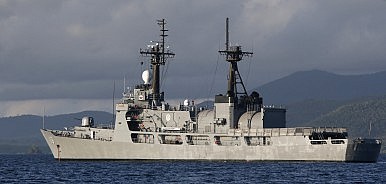
Philippines reinforces its claim to South China Sea outpost

user posted image

QUOTE
The Philippine navy is quietly reinforcing the hull and deck of a rusting ship it ran aground on a disputed South China Sea reef in 1999 to stop it breaking apart, determined to hold the shoal as Beijing creates a string of man-made islands nearby.

Using wooden fishing boats and other small craft, the navy has run the gauntlet of the Chinese coastguard to move cement, steel, cabling and welding equipment to the BRP Sierra Madre since late last year, two navy officers who have been inside the vessel told Reuters in recent interviews.

The 100 metre-long (330-foot) tank landing ship was built for the U.S. Navy during World War Two. It was eventually transferred to the Philippine navy, which deliberately grounded it on Second Thomas Shoal to mark Manila’s claim to the reef in the Spratly archipelago of the South China Sea. A small contingent of Philippine soldiers are stationed onboard.

Manila regards Second Thomas Shoal, which lies 105 nautical miles (195 km) southwest of the Philippine region of Palawan, as being within its 200-nautical mile exclusive economic zone. China, which claims virtually all the South China Sea, says the reef is part of its territory.

“We know China has been waiting for the ship to disintegrate but we are doing everything to hold it together,” said one of the officers, adding that while the work was progressing slowly, it should be finished by the year-end.

The other naval officer said welding was being done at night because of the heat. Concrete foundations were being laid inside the ship’s hull to try to stabilise it, he added.

Without giving exact dates, both sources said they witnessed the repairs taking place earlier this year. They declined to be identified because they were not authorised to speak to the media.


http://www.theguardian.com/world/2015/jul/...ding-to-reports

BorneoAlliance
post Jul 15 2015, 04:37 AM

New Member
*
Newbie
0 posts

Joined: Dec 2014

The Kremlin Hints at Reviving Cold War Laser Tanks

user posted image

QUOTE
Fair enough. But in practical terms, giant ray guns mounted on tanks were never very practical. Far more useful — and inexpensive — are smaller and more efficient “dazzlers,” such as on Chinese Type 99 tanks. These can blind enemy troops.

If you want to knock out an enemy tank, it’s better to use a cannon or a missile launcher rather than spending valuable time and money coming up with an optic-zapping tank that didn’t work very well in the 1980s.


https://medium.com/war-is-boring/the-kremli...ks-2fd04754e7c7

This post has been edited by BorneoAlliance: Jul 15 2015, 04:37 AM
BorneoAlliance
post Jul 15 2015, 07:09 AM

New Member
*
Newbie
0 posts

Joined: Dec 2014

U.S. Army Considers More-Lethal Hollow Point Bullets for New Sidearm

user posted image

QUOTE
The big news so far from the U.S. Army’s search for a new sidearm isn’t about what kind of pistol they’ll choose, but rather the bullets they might shoot.

In a significant shift, the military told industry representatives last week that it’s considering switching from full metal jacket to hollow-point rounds for its standard-issue sidearm ammunition. While hollow points are commonly used by police and civilians, they are banned in international warfare under the 1899 Hague Convention‘s early laws of war that the United States has followed even though the U.S. government never ratified the agreement.

Military lawyers say the move isn’t meant to skirt international law, but instead embrace the changing face of warfare. “The notion that [in modern warfare] two states agree to Marquess of Queensberry Rules is very archaic,” Richard Jackson, a special assistant to the Army Judge Advocate General for Law of War Matters, tells The Trace.

Hollow points, also known as dum-dum rounds, are designed to expand or break apart upon impact. The rounds quickly transfer all their kinetic energy to a target, resulting in a bigger, more devastating wound. Full metal jacket or ball ammunition — the type the Army currently uses — holds together, causing smaller wound channels and often passing straight through targets.


http://www.thetrace.org/2015/07/hollow-poi...nition-us-army/
BorneoAlliance
post Jul 15 2015, 07:34 AM

New Member
*
Newbie
0 posts

Joined: Dec 2014
user posted image
BorneoAlliance
post Jul 16 2015, 03:07 PM

New Member
*
Newbie
0 posts

Joined: Dec 2014

Pakistan shoots down Indian spy drone

user posted image

QUOTE
Mirpur/Lahore - Pakistani military Wednesday shot down an Indian spy drone along the Line of Control in Bhimbher district of Azad Jammu and Kashmir, a claim denied by Indian army despite ISPR’s releasing a photo of the crashed UAV.

“An Indian spy drone was shot down by Pakistani troops which intruded into Pakistan (along the Line of Control) near Bhimber today.
The spy drone is used for aerial photography,” the Inter-Services Public Relations (ISPR) said in a brief statement on Wednesday.

The Unmanned Ariel Vehicle (UAV) was taking aerial photographs of the border areas on the Pakistani side of the LoC when it was shot down by the Pakistani troops deputed for the security of the forward posts in Bhimbher district of AJK, the official sources confirmed to The Nation.

Industry experts said the small, unarmed model was sold commercially for aerial filming and would contain no secret military technology.
A photo supplied by the Pakistani military appeared to show a Chinese-made DJI Phantom 3, said Huw Williams, the Unmanned Systems Editor at IHS Jane’s International Defence Review, according to Reuters.

“Due to its limited operating range - about two km - if the Indian military is using the system it would most likely be for close reconnaissance or security work,” Williams.
“Our Middle East editor believes that Islamic State is using similar systems,” said the international news agency.


http://nation.com.pk/editors-picks/16-Jul-...ndian-spy-drone
BorneoAlliance
post Jul 16 2015, 03:13 PM

New Member
*
Newbie
0 posts

Joined: Dec 2014

Could China defeat America in World War III?

user posted image

QUOTE
Scattered along America's coastlines are hundreds of rusting, mothballed Navy ships. The United States doesn't keep these reserve vessels floating around to look pretty. No, it keeps them in case of World War III.

Ghost Fleet, a new novel by P. W. Singer and August Cole, is about that scenario. Having read the book, it's one of the more plausible depictions of a major 21st century war — and one of the more realistic portrayals of cyberwar — I've seen in fiction.

In a discursive and wide-ranging interview, we talked with Singer about the book's themes, science fiction, and the future of conflict. According to him, we need to get used to the idea that our technology won't save us — and that we should reconsider some older methods of warfare that are anything but antiquated.

Some spoilers follow.

A few years from now, naval officers of the United States watch holographic presentations while wearing Google Glass style heads-up displays. Warships are smaller and leaner, with skeleton crews relying on gadgetry to make up the difference.

Drones are everywhere. But this tech turns out to be a major weakness.

The Communist Party no longer rules China. In its place is a plutocratic-military regime known as the Directorate. The regime severs its ties with the U.S. — which it perceives as a declining empire holding China back from vital energy resources. With Russian support, China launches a surprise attack on the U.S. Pacific Fleet, resulting in its near total destruction.

The results are pretty horrifying. A Chinese space laser team coldly and methodically destroys most of the America's spy and GPS satellites. Washington's military computer networks are so badly compromised by jamming, spoofing, and decades of sabotage, that the beginning of the war reminded me of the opening episodes of the reimagined Battlestar Galactica.

Except that the scenario plays out in the Pacific and within our lifetimes.

"We use the book to show the consequences of that ongoing campaign," Singer said regarding Chinese espionage. "So it's not just the takedown of GPS and communications networks that matters — essentially it's like pulling the nervous system out of the U.S. military."


http://theweek.com/articles/565740/could-c...a-world-war-iii
BorneoAlliance
post Jul 16 2015, 03:21 PM

New Member
*
Newbie
0 posts

Joined: Dec 2014

Philippines reopens Subic Bay as military base to cover South China Sea

user posted image[

QUOTE
The Philippines will station new fighter jets and two frigates as it reopens the former US naval base in Subic Bay to military use in a further response to Chinese expansionism in the disputed South China Sea.

Once one of the biggest US naval facilities in the world, Subic Bay was shut in 1992 after the Philippine Senate terminated a bases agreement with Washington at the end of the cold war.

Manila converted the facility, which was never home to the Philippine military, into an economic zone.

Defence undersecretary Pio Lorenzo Batino told Reuters the Philippine military signed an agreement in May with the zone’s operator, the Subic Bay Metropolitan Authority, to use parts of the installation under a renewable 15-year lease. It marks the first time the massive installation has functioned as a military base in 23 years.

US warships have called regularly at Subic Bay since 2000 but only to dock during exercises with the Philippine military or to use its commercial facilities for repairs and resupply.
Using Subic Bay would allowing the Philippine air force and navy to respond more effectively to Chinese moves in the disputed South China Sea, security experts said. Subic Bay’s deep-water harbour lies on the western side of the main Philippine island of Luzon, opposite the South China Sea.

“The value of Subic as a military base was proven by the Americans. Chinese defence planners know that,” said Rommel Banlaoi, a Philippine security expert.

Officials said once Subic Bay was a military base again the US navy could have much greater access to it under a year-old agreement that gives US troops broad use of local military facilities, although that deal is on ice after it was challenged in the Philippine supreme court.
Using Subic would be the latest Philippine military move to combat China’s maritime ambitions.

Besides beefing up security co-operation with the United States, Japan and Vietnam, the military plans to spend $20bn over the next 13 years to modernise its armed forces, among the weakest in south-east Asia.


http://www.theguardian.com/world/2015/jul/...south-china-sea

This post has been edited by BorneoAlliance: Jul 16 2015, 03:22 PM
BorneoAlliance
post Jul 16 2015, 03:28 PM

New Member
*
Newbie
0 posts

Joined: Dec 2014

Can Indonesia Speed Up Its Military Aircraft Modernization?

user posted image

QUOTE
First, the assessing the capability of an aircraft – or any military equipment for that matter – by age alone is rather misleading. As I pointed out in an earlier piece, Indonesia is hardly the only country which buys secondhand aircraft, and its decision to do is partly because they are cheaper alternatives for a cash-strapped military that needs them badly and urgently (See: “Will Indonesia’s Fighter Jet Malfunction Affect its Defense Policy?”). Furthermore, an old aircraft can still be of use if it is properly maintained and serviced and if the necessary spare parts are available. The attention should thus be placed on Indonesia’s capacity to manage these aging aircraft rather than simply the fact that they are old.

Second, the scale of the aging problem in Indonesia’s military is far more extensive than is often appreciated and is therefore much more difficult to solve than it appears. In his announcement, Ryamizard did not say how many aircraft would be retired, merely referring to “equipment that is 30, 40, 50 years old, planes and helicopters.” But existing data gives us an idea of just how big this problem is. As Iis Gindarsah of the Center for Strategic and International Studies in Jakarta recently noted, a majority – or 52 percent to be exact – of TNI equipment has been operated for over three decades. Among the various services, the Air Force is actually in the best shape but still 38 percent of its arsenal is over three decades old (the Navy is at at 59 percent and the Army at 54 percent).

Replacing these aging aircraft is not easy either. As I have noted elsewhere, Indonesia’s military modernization has been progressing very slowly, which is the product of a myriad of factors including budgetary constraints and its procurement process. The Air Force’s slow struggle to replace its old F-5 aircraft is a case in point. While Jokowi has vowed to boost Indonesia’s defense budget to 1.5 percent of GDP from its current 0.8 percent as the country seeks to achieve a so-called Minimal Essential Force by 2024, it is unclear what exactly this will mean for the TNI in terms of its budget to procure new aircraft (“Will Indonesia Double Its Defense Budget in 2016?”). His plan to build up the domestic defense industry is a good long-term aspiration but does little to change this equation now. Ryamizard was also silent in his announcement about whether decommissioning old aircraft would mean Indonesia procuring more planes at a quicker pace to replace them.

Thus, while Indonesia’s latest plane crash should draw everyone’s attention to the country’s aging aircraft problem, they should also be aware of the complexities and trade-offs associated with procurement and military modernization more generally as the Southeast Asian state tackles this challenge.


http://thediplomat.com/2015/07/can-indones...-modernization/
BorneoAlliance
post Jul 16 2015, 03:34 PM

New Member
*
Newbie
0 posts

Joined: Dec 2014

Military defers plan, will conduct more studies

user posted image

THE MILITARY has put on hold the proposal by the Navy to purchase three submarines from China, Deputy Prime Minister and Defence Minister General Prawit Wonsuwan said yesterday, suggesting the Navy will conduct more studies on the worthiness of its proposal.

The Navy had announced early this month that it had decided to allocate Bt36 billion to buy three Yuan-class submarines from China to have the fleet for protection of maritime resources. The move met strong criticism from the public, as it came during an economic downturn and the projection of a maritime threat was not clear enough.

The Navy has to resolve the question that its investment in such heavy and expensive equipment is worthy enough in the context of the estimated Bt2 trillion maritime interests in Thai waters, Prawit said.

Prawit said the Navy should come up with clear details on the benefits and explain how suitable it is to go ahead with the purchase and how it will improve the strength and potential of the Armed Forces.

Prawit, who had earlier defended the proposal, said the military had suspended the proposal for now and will not seek Cabinet approval soon.

The Navy has made several attempts since the 1990s to get a fleet of submarines, as many neighbouring Asean countries such as Indonesia, Malaysia, Singapore and Vietnam have their own fleet. Previous proposals to acquire submarines from Germany and South Korea were never approved by civilian governments.

The Navy had expected to succeed in pushing through the proposal of the current Cabinet, as both the prime minister and defence minister are former military commanders who attached importance to the military building up its strength.

Navy Commander-in-Chief Admiral Kraisorn Chansuwanich said earlier that purchasing the submarines from China is a rational option, as relations between the two countries are closer and Beijing has offered a reasonable price.

The Navy has studied the project comprehensively, he said. The decision to submit the proposal was made by 17 young-generation committee members from the Submarine Squadron, who arrived at the decision after examining similar devices from six countries, he said.

http://www.nationmultimedia.com/politics/M...s-30264540.html
BorneoAlliance
post Jul 16 2015, 03:39 PM

New Member
*
Newbie
0 posts

Joined: Dec 2014

Z-18F anti-submarine helicopter ready to serve on Liaoning

user posted image

A photo of the Z-18F taken aboard the Liaoning last year. (Internet photo)

China is ready to put the Z-18F anti-submarine medium helicopter aboard the Liaoning, the PLA NAvy's first aircraft carrier, according to the state-run Global Times on July 13.

Designed based on the French Aerospatiale SA 321 Super Frelon, the Z-18, which was created by Changhe Aircraft Industries Corporation (CAIC), is a medium transport helicopter. It is a single-rotor helicopter powered by three improved WZ-6 turboshaft engines and has a maximum takeoff weight of 13.8 tons. CAIC produced two types of Z-18 helicopters for the PLA's naval forces. One is the Z-18J which is used to carry out early warning operations while the other, the Z-18F, is to be used for anti-submarine warfare. Global Times said the "F" is short for "Fanqian" which means anti-sumbarine in Chinese.

Last year, a photo of Z-18F operating aboard the flight deck of the Liaoning was revealed to the public for the first time. Senior Colonel Cao Weidong of the PLA Navy told the Shanghai Morning Post that China's first aircraft carrier is able to carry a total number of 10 Z-18 helicopters in the future. Among them, four will be Z-18Js and six are going to be Z-18Fs. Cao added that the Z-18F will improve the PLA Navy's anti-submarine warfare capabilities.

The photos released in August of 2014 indicated that the Z-18F had already been painted in the light blue color of the PLA Navy's carrier-based aircraft. Since only aircraft designed to serve aboard the Liaoning are painted that color, the Chinese official newspaper said that the Z-18Fs are definitely going to serve aboard the vessel.

http://www.wantchinatimes.com/news-subclas...=20150715000007
BorneoAlliance
post Jul 16 2015, 05:52 PM

New Member
*
Newbie
0 posts

Joined: Dec 2014

Naval Buildups in the South China Sea

user posted image

QUOTE
The adequacy of a fleet’s capabilities and limitations must be measured against concrete requirements that are determined by the expected adversary and the way the fleet will be used. We must consider those limiting factors and the need to evaluate capability against specific requirements – a specific enemy capability set rather than a generic mission assertion.

For example, say a given anti-ship missile can travel 100 nautical miles, but the sensors on the firing platform can only target out to 50 nautical miles, leaving the other 50 mile capability unusable. Say further that the target vessel can successfully defend against that missile, but its combat systems can only deal with some given number of missiles simultaneously and only against some number in total (due to defensive magazine capacity, which may or may not be greater). If the defensive capability of your target can be gauged, then a technical problem can be reduced to a capacity problem: You only need to fire more missiles than the target can defend against. But then other questions arise. What if the firing platform cannot carry that number of missiles? Or cannot fire that number near-simultaneously? What if the missiles are unreliable or poorly maintained, resulting in a significant failure rate that requires many more missiles to be fired for a successful salvo? Is the total missile inventory sufficient against the expected number of adversary units, and can firing platforms be rearmed under adversarial conditions? The answers to these questions are the real measure of what a Navy is capable of achieving.

Consider this example from history of the potential for mismatch between the intended (“design”) employment of a fleet and its actual employment. British battlecruisers in World War I possessed enormous capability on paper: They were large, fast, and heavily armed. But when pitched against the German battleship fleet – a role they were not originally envisioned for because their speed came at the expense of heavy armoring – these ostensibly capable ships were disastrously un-survivable against a peer adversary. A weapons system’s capability is irrelevant if the platform that carries it cannot survive an engagement long enough to use it.

Clearly, then, information useful for determining capability is also useful for identifying vulnerabilities. The sensitive nature of this technical and “readiness” information means governments will understandably classify it, and defense contractors will keep many technical details confidential, hindering independent research and analysis. Fortunately for researchers, the business opportunity the Southeast Asian defense market represents means that a substantial amount of useful information is still available from sales literature.

But fundamentally, discussing regional naval capability is implicitly asking how to solve problems with ships and explosives, and skips over asking whether ships and explosives are the right way to solve them. The overarching strategic narrative of South China Sea maritime disputes can be broken into three major strains: Stalled diplomatic initiative; “white hull” confrontations; and a regional naval arms race. The interest of peaceful resolution demands asking how relevant naval capability is to satisfactorily resolving the disputes respective to each state’s particular circumstances.


http://thediplomat.com/2015/07/naval-build...outh-china-sea/
BorneoAlliance
post Jul 17 2015, 10:36 AM

New Member
*
Newbie
0 posts

Joined: Dec 2014

ISIS Claims First Ever Naval Attack

user posted image

The Islamic State claimed responsibility for an anti tank guided missile (ATGM) attack on an Egyptian Naval frigate in the Mediterranean Sea.

user posted image

The Egyptian Navy reported that their vessel caught fire after a battle with militants, and further reported no casualties.

user posted image

Islamic State operations are on the rise in Egypt, and at least 17 Egyptian soldiers have been killed by ISIS this month. ISIS also claimed responsibility for detonating a bomb outside of Cairo’s Italian consulate last week that took one life.

Expect the heavily edited and filtered video release from ISIS propaganda outlets later this month. ~Will

http://www.funker530.com/isis-claims-first...r-naval-attack/

http://time.com/3960691/isis-frigate-egypt-sinai/

This post has been edited by BorneoAlliance: Jul 17 2015, 10:38 AM
BorneoAlliance
post Jul 17 2015, 10:48 AM

New Member
*
Newbie
0 posts

Joined: Dec 2014

Russia Develops New Coastal Defense Gun

user posted image

“We have always favored unification because it is cheaper… The knowhow obtained during the design of the Koalitsiya-SV gun can come in very handy in the development of the new coastal defense artillery systems,” Zakamennykh told RIA Novosti news agency.

He said the naval command planned to outline the technical characteristics of the new system within the next two months.

Russia’s naval commander, Admiral Viktor Chirkov earlier announced a planned switch to coastal defense artillery systems of the type used by the ground forces. The new systems will be an upgrade of the existing ones and adjusted for use by the Russian Navy, the Admiral added.

The 2S35 Koalitsiya-SV self-propelled gun was first seen in public in 2015 during rehearsals for the Moscow Victory Day parade.

The 2S35 can fire fully autonomously without any crew in the turret. The first batch of 12 2S35 152mm self-propelled howitzers was delivered to the armed forces in March 2015.

According to Russian military engineers, the new 2S35 can used high-explosive long-range precision-guided munitions with a maximum range of 70 km and high level of accuracy.

Standard equipment of the 2S35 Koalitsiya-SV includes NBC protection system, night vision, computerized fire control and screens for each members of the crew to control firing operations.

A rectangular box is mounted on each side of the main armament, which can be equipped with monitors able to provide combat mission information.

Each members of the crew has screens which displays data for sight systems and to control all firing procedures.

http://sputniknews.com/russia/20150716/1024693020.html

BorneoAlliance
post Jul 17 2015, 10:31 PM

New Member
*
Newbie
0 posts

Joined: Dec 2014

This Is the Surprising Way the Iranian Military Responded to the Nuclear Deal


QUOTE
The Iranian military are not renowned for their love of rap, rhythm and blues music and social media but Iranian generals decided they needed a novel response to this week’s nuclear deal with the U.S. and other world powers.

They helped a controversial Iranian singer, Amir Tataloo, produce a video with the Iranian army and navy, which endorses the deal but upholds Iran’s right to self defense and to patrol the Persian Gulf.


http://time.com/3958928/amir-tataloo-iranian-military/
BorneoAlliance
post Jul 18 2015, 10:46 AM

New Member
*
Newbie
0 posts

Joined: Dec 2014

Engineers complete ground tests of Storm Shadow on Euroflighter Typhoon military jet

user posted image

QUOTE
WARTON, U.K., 17 July 2015. Engineers at Finmeccanica-Alenia Aermacchi in Turin-Caselle, Italy, and at BAE Systems in Warton, Lancashire, completed a series of ground-based tests of the Eurofighter Typhoon with MBDA’s Storm Shadow cruise missile, in preparation for flight trials to take place in the U.K. later this year.


http://www.intelligent-aerospace.com/artic...litary-jet.html
BorneoAlliance
post Jul 18 2015, 02:20 PM

New Member
*
Newbie
0 posts

Joined: Dec 2014
QUOTE(LTZ @ Jul 17 2015, 09:42 PM)
Doesnt look likes a frigate to me.... just a patrol craft
*
You're absolutely right.
BorneoAlliance
post Jul 18 2015, 02:25 PM

New Member
*
Newbie
0 posts

Joined: Dec 2014
Littoral Combat Ship USS Little Rock to Set Sail - Blog

user posted image

The ninth littoral combat ship, the USS Little Rock, will be christened and launched July 18 in Marinette, Wisconsin.

The vessel, built by Lockheed Martin and Marinette Marine Corp., is one of 13 Freedom-class littoral combat ships under contract to Lockheed. Austal USA builds the Independence-class version of the ship.

USS Little Rock has the same configurations as previous versions of the Freedom-variant of the LCS, said Joe North, vice president of littoral ships and systems at Lockheed Martin.

“These configurations for the block buy are all the same,” he said. “All the weapon systems and the mission packages are defined and the same for the 32 ships that we are building in that configuration.”

Marinette currently has seven of the Freedom-class ships in production at its Wisconsin facility. LCS 11, known as the USS Sioux City, will launch later this year. LCS 13, 15 and 17 are in production. LCS 19 and LCS 21 are under contract. A contract for LCS 23 should be signed by the end of this year, North said.

The LCS has for years faced harsh criticism throughout the defense industry, with some claiming it is unsuitable for warfare and unsurvivable in combat. The Navy had planned to purchase a total of 52 littoral combat ships, but slashed that number to 32 last year. The remaining 20 ships will be modified with an eye toward increased survivability and beefed up weapon systems, though specific requirements have yet to be released. They will be designated as frigates rather than littoral combat ships.

North said while the Little Rock’s capabilities are the same as previous versions of the LCS, Lockheed has made some modifications and taken lessons learned from LCS 1, the USS Freedom, and LCS 3, the USS Fort Worth, he said.

Lockheed has rolled in design features that improve crew life and maintenance, he said. It is working on reducing the vessel’s weight. Freedom-class ships average at about 3,400 tons, North said.

“Weight reductions are constant,” he said. “We work those in as best we can into an inline process so we’re not doing rework to the hulls. We try to get that stuff done when it appears as an option.”

A vendor Lockheed uses for insulation material recently produced a material that meets all Navy requirements but is “much thinner and much lighter.” That will help trim the ship’s weight, he said.

Lockheed is planning to bid on six more littoral combat ships through fiscal year 2017 and 2018, North said. Starting in fiscal year 2019, it will bid on the remaining 20 frigates.

There are potential international customers, he said. “Well over 20 countries … have contacted the Navy with interest. There has been some interest in the Middle East and there’s interest in Southeast Asia right now,” he said. “The deployment of Freedom and Forth Worth, I think it generated a lot of that. Those countries [are] getting to see how those ships perform.”

However, there are only discussions at the moment. “Things look good,” he said. But “international sales take a long time.”

Saudi Arabia is one of the “more promising” countries but there is nothing formal yet, he said.

http://www.nationaldefensemagazine.org/blo...st.aspx?ID=1899

This post has been edited by BorneoAlliance: Jul 18 2015, 02:28 PM
BorneoAlliance
post Jul 18 2015, 08:25 PM

New Member
*
Newbie
0 posts

Joined: Dec 2014

Russian Crews of Mistral Warships Disbanded – Report

user posted image

The Russian crews of two French-made Mistral-class helicopter carriers, whose delivery has been suspended due to political tensions over the Ukraine crisis, have been disbanded, news agency Interfax reported Friday, citing a source in the Russian navy.

“The Mistral crews have been disbanded. The sailors will continue to serve on the ships of the Pacific Fleet,” Interfax quoted the source as saying.

About 500 people in total were training to serve on the Mistral-class warships, according to Interfax.

At the same time, the TASS news agency on Friday cited an unidentified source in the military as saying that the crews had in fact not been disbanded.

The crews can be disbanded only after a final decision on the ships has been made, the source said, adding that Mistral crew members are now undergoing a navy training course.

Russia ordered the two Mistrals from France in 2011 in a deal worth 1.2 billion euros ($1.3 billion).

The Russian sailors arrived in France last year to participate in exercises on the first Mistral helicopter carrier and then waited at the shipyard for the ship's delivery. When France announced that the delivery had been suspended after the EU slapped sanctions on Russia over its role in the Ukraine crisis, the sailors returned to Russia.

Citing unidentified sources, news agency RIA Novosti reported earlier this month that France and Russia had finally reached an agreement on compensation for the non-delivery of the warships. The agreement must now be approved by the governments of both countries, the report said.

http://www.themoscowtimes.com/business/art...ort/525809.html
BorneoAlliance
post Jul 18 2015, 08:34 PM

New Member
*
Newbie
0 posts

Joined: Dec 2014
user posted image
BorneoAlliance
post Jul 21 2015, 06:28 PM

New Member
*
Newbie
0 posts

Joined: Dec 2014

Lockheed to buy military copter maker Sikorsky

user posted image

On Monday, Lockheed confirmed that it would purchase Sikorsky Aircraft from United Technologies Corp for $9 billion in cash, confirming media reports from over the weekend.

Lockheed's portfolio includes the F-35 fighter jet, satellites and naval ships, but the company does not produce helicopters. Buying Sikorsky, known for the Black Hawk and the combat rescue helicopter used by US presidents, flown under the call sign Marine One, would help Lockheed rely less on its $391 billion F-35 business.

Lockheed chief executive Marillyn Hewson said: "I'm confident this acquisition will help us extend our core business into the growing areas of helicopter production and sustainment."

The acquisition is expected to close by year-end or in the first quarter of 2016.

Regulatory approval

It will be Lockheed's largest acquisition since it bought Martin Marietta Corp for about $10 billion two decades ago. Regulatory approval is expected because Lockheed does not make helicopters. A fusion would therefore not violate any antitrust rules.

Pentagon officials said last week they would carefully evaluate any sale of Sikorsky Aircraft, the U.S. military's largest helicopter supplier, and it was important to the department to maintain competition and avoid market distortions.

United Technologies said in June that it planned to shed Sikorsky, either through a sale or spinoff. The company wants to focus on high-technology systems and services for the aerospace and building industries.

While Lockheed intends to fund the sale with cash on hand and new debt issuances, United Technologies said it plans to use the sale's proceeds for additional stock buybacks.

http://www.dw.com/en/lockheed-to-buy-milit...rsky/a-18595914

25 Pages « < 11 12 13 14 15 > » 
Bump Topic Topic ClosedOptions New Topic
 

Change to:
| Lo-Fi Version
0.0602sec    0.64    7 queries    GZIP Disabled
Time is now: 12th December 2025 - 10:22 AM