

Is it worth it to invest using epf? My colleague told me that now is a good time to invest in pm..
Public Mutual Funds, version 0.0
Public Mutual Funds, version 0.0
|
|
 Jan 10 2017, 07:14 PM Jan 10 2017, 07:14 PM
|
 
Senior Member
1,608 posts Joined: Nov 2007 
|
Is it worth it to invest using epf? My colleague told me that now is a good time to invest in pm..
|
|
|
|
|
|
Jan 10 2017, 07:28 PM
|

All Stars
14,862 posts Joined: Mar 2015
|
QUOTE(eastwest @ Jan 10 2017, 07:14 PM) Is it worth it to invest using epf? My colleague told me that now is a good time to invest in pm.. read post# 980 page#49 just posted by forumer today |
|
|
Jan 10 2017, 10:14 PM
|

Junior Member
584 posts Joined: Jun 2010
|
Hi, hard to digest in this topic but I make it a simple question
Open 1000 for an account but every month add 300. The question is, it is easy to add fund maybe like m2u transfer without agen? Gonna invest for a long time > 20 years. I don't want auto deduction on my bank account. |
|
|
Jan 10 2017, 10:17 PM
|

Senior Member
1,166 posts Joined: Jul 2016
|
QUOTE(e_X @ Jan 10 2017, 10:14 PM) Hi, hard to digest in this topic but I make it a simple question Not sure about PMO but FSM do have such feature with lower SCOpen 1000 for an account but every month add 300. The question is, it is easy to add fund maybe like m2u transfer without agen? Gonna invest for a long time > 20 years. I don't want auto deduction on my bank account. But you need to ensure what fund you invest  |
|
|
Jan 10 2017, 10:38 PM
|
|
Junior Member
584 posts Joined: Jun 2010
|
QUOTE(AIYH @ Jan 10 2017, 10:17 PM) Not sure about PMO but FSM do have such feature with lower SC For PMO i can invest fund like Public SmallCap and for FSM like Kenanga Growth right? Minimum for FSM is 100?But you need to ensure what fund you invest |
|
|
Jan 10 2017, 10:59 PM
|
|
Senior Member
1,166 posts Joined: Jul 2016
|
QUOTE(e_X @ Jan 10 2017, 10:38 PM) For PMO i can invest fund like Public SmallCap and for FSM like Kenanga Growth right? Minimum for FSM is 100? Normally rm1000 to start and rm100 to top up, however you can start with 100 by subscribing to RSP (monthly regular saving) in FSMYou are right, but is better to compare the same sector region and class between peers to see which fund house provides the best return or risk return ratio |
|
|
|
|
|
Jan 10 2017, 11:12 PM
|
|
Junior Member
245 posts Joined: Aug 2015
|
Any PM fund in foreign currency? Did a simple google but can't get any useful info.
|
|
|
Jan 10 2017, 11:27 PM
|
|
Senior Member
1,166 posts Joined: Jul 2016
|
QUOTE(kyone @ Jan 10 2017, 11:12 PM) Any PM fund in foreign currency? Did a simple google but can't get any useful info. You can check from here https://iportfolio.com.my/screenIf dont have means there is no FCY mutual fund by PM |
|
|
Jan 10 2017, 11:39 PM
|
|
Junior Member
584 posts Joined: Jun 2010
|
QUOTE(AIYH @ Jan 10 2017, 10:59 PM) Normally rm1000 to start and rm100 to top up, however you can start with 100 by subscribing to RSP (monthly regular saving) in FSM tqvm You are right, but is better to compare the same sector region and class between peers to see which fund house provides the best return or risk return ratio  |
|
|
Jan 11 2017, 02:36 PM
|
|
Senior Member
1,608 posts Joined: Nov 2007
|
QUOTE(MUM @ Jan 10 2017, 07:28 PM) read post# 980 page#49 My friends said now will be a good time to buy unit from PM since the price is lower than before..just posted by forumer today |
|
|
Jan 11 2017, 02:50 PM
|
|
Senior Member
1,166 posts Joined: Jul 2016
|
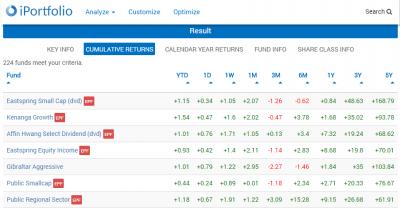
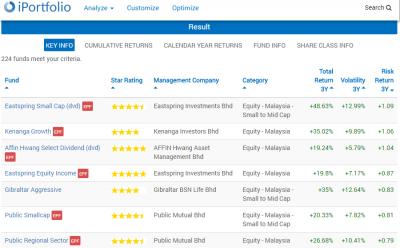
QUOTE(eastwest @ Jan 11 2017, 02:36 PM) My friends said now will be a good time to buy unit from PM since the price is lower than before.. Now is a good time to buy, but not necessary from PMTo give you an idea, compare top 7 MY funds from PM vs top 7 MY funds in Malaysia Attached thumbnail(s) 

|
|
|
Jan 11 2017, 03:34 PM
|
|
Senior Member
1,608 posts Joined: Nov 2007
|
QUOTE(AIYH @ Jan 11 2017, 02:50 PM) Now is a good time to buy, but not necessary from PM I see..To give you an idea, compare top 7 MY funds from PM vs top 7 MY funds in Malaysia Actually which part in the column is the most important one that I should take note? The YTD? |
|
|
Jan 11 2017, 03:43 PM
|
|
Senior Member
1,166 posts Joined: Jul 2016
|
QUOTE(eastwest @ Jan 11 2017, 03:34 PM) I see.. There are a lot of ways to look, each column provides different meaningActually which part in the column is the most important one that I should take note? The YTD? For example, the 3 year risk return ratio is the 3 year annualized return generated per unit of risk being taken. Generally, the higher the number, it means that within the same class of fund (equity / fixed income), it generate better return given the risk it took Lower number generally means the risk you need to bear doesnt worth the return it generated. the other cumulative performance data with different dates tell you about how each fund perform for different period, whether some funds perform better or worse recent or long term wise, which can generate better or certain returns than others for more comparison on your research, refer to iportfolio.com.my or fundsupermart.com.my or bloomberg or morningstar, but the main idea is this: PM is only on of the many fund houses in Malaysia, each fund houses had different strength in certain areas of performance, and as you will see, for each region/sector/class, they topped by different fund houses, therefore, it is important to research and compare before you decide which is better to invest, be open minded in exploring information This post has been edited by AIYH: Jan 11 2017, 03:45 PM |
|
|
|
|
|
Jan 11 2017, 04:15 PM
|
|
Senior Member
1,608 posts Joined: Nov 2007
|
QUOTE(AIYH @ Jan 11 2017, 03:43 PM) There are a lot of ways to look, each column provides different meaning Thanks for the insight...For example, the 3 year risk return ratio is the 3 year annualized return generated per unit of risk being taken. Generally, the higher the number, it means that within the same class of fund (equity / fixed income), it generate better return given the risk it took Lower number generally means the risk you need to bear doesnt worth the return it generated. the other cumulative performance data with different dates tell you about how each fund perform for different period, whether some funds perform better or worse recent or long term wise, which can generate better or certain returns than others for more comparison on your research, refer to iportfolio.com.my or fundsupermart.com.my or bloomberg or morningstar, but the main idea is this: PM is only on of the many fund houses in Malaysia, each fund houses had different strength in certain areas of performance, and as you will see, for each region/sector/class, they topped by different fund houses, therefore, it is important to research and compare before you decide which is better to invest, be open minded in exploring information and for the bold part, based on your example, what is the lowest number for return that is considered as worth the risk? This post has been edited by eastwest: Jan 11 2017, 04:17 PM |
|
|
Jan 11 2017, 04:24 PM
|
|
Senior Member
1,166 posts Joined: Jul 2016
|
QUOTE(eastwest @ Jan 11 2017, 04:15 PM) Thanks for the insight... IMO is hard to interpret it as a standalone valueand for the bold part, based on your example, what is the lowest number for return that is considered as worth the risk? For example, money market tend to have high RRR due to low volatility/ nil fluctuation, however that return may not be what you desire RRR is best to compare with several funds For example, within malayisa region equity fund, you can compare which fund has higher RRR compare to its peer, it will generally means that given the risk it takes, it can generate better return than its peers Its best to compare it in conjunction with their return within the same period the RRR were measured The picture I attached previously were sorted by RRR descending, so the top one usually can be intepreted as the better fund that can generate high return for its volatility That is the basic way to choose a good fund, if you want to go deeper, you proceed to study each fund's FFS, PHS and annual report to understand what they invest and why such a difference between funds This post has been edited by AIYH: Jan 11 2017, 04:36 PM |
|
|
Jan 11 2017, 05:37 PM
|

Junior Member
790 posts Joined: Sep 2013 From: Selangor 
|
QUOTE(AIYH @ Jan 11 2017, 02:50 PM) Now is a good time to buy, but not necessary from PM Thanks for the great guides, @AIYH do you mind to share your thought on smallcap fund either public or eastspring, these fund is it consider high risks if we consider mid term investment like 3-5 yrs from now?To give you an idea, compare top 7 MY funds from PM vs top 7 MY funds in Malaysia |
|
|
Jan 11 2017, 06:50 PM
|
|
Senior Member
1,608 posts Joined: Nov 2007
|
QUOTE(AIYH @ Jan 11 2017, 04:24 PM) IMO is hard to interpret it as a standalone value There are so many terms in this topic that I don't know yet... So many things to learn..For example, money market tend to have high RRR due to low volatility/ nil fluctuation, however that return may not be what you desire RRR is best to compare with several funds For example, within malayisa region equity fund, you can compare which fund has higher RRR compare to its peer, it will generally means that given the risk it takes, it can generate better return than its peers Its best to compare it in conjunction with their return within the same period the RRR were measured The picture I attached previously were sorted by RRR descending, so the top one usually can be intepreted as the better fund that can generate high return for its volatility That is the basic way to choose a good fund, if you want to go deeper, you proceed to study each fund's FFS, PHS and annual report to understand what they invest and why such a difference between funds Thank you again. |
|
|
Jan 11 2017, 10:05 PM
|
|
Senior Member
5,534 posts Joined: Aug 2011
|
QUOTE(e_X @ Jan 10 2017, 10:38 PM) For PMO i can invest fund like Public SmallCap and for FSM like Kenanga Growth right? Minimum for FSM is 100? PM SmallCap is a OK fund, but it has got a much better peer in the same class - the Eastspring Investments Small Cap Fund. Be it over 1, 3, 5 or 10 years, the Eastspring Small Cap Fund outperforms the PM Small Cap fund.Edit: Of course it goes without saying that Small Cap funds have a high volatility, so it should never be a short term investment (1-2 years). It should ideally be a long term investment for 5+ years. This is because it could swing from +30% to -20% to +10% to -5% to +40% in a five year period for example due to the volatile nature of the small cap market. But once you annualize it over a long term, you get very respectable return rates per year. This post has been edited by contestchris: Jan 11 2017, 10:15 PM |
|
|
Jan 11 2017, 10:16 PM
|
|
Senior Member
1,166 posts Joined: Jul 2016
|
QUOTE(ehwee @ Jan 11 2017, 05:37 PM) Thanks for the great guides, @AIYH do you mind to share your thought on smallcap fund either public or eastspring, these fund is it consider high risks if we consider mid term investment like 3-5 yrs from now? Personally I choose eastspring small cap for 4 reasons:1) Sales Charge : Public Mutual charge SC about 5% to 5.5% per investment, which may not seem much if you invest once, but to me who advocate to DCA every month by income, that will be costly to me For Eastspring, I can buy from FSM from 0.5% to 2% SC per investment, lower cost to DCA for me 2) Performance : From the performance data and chart that I posted previously along with the website you can check, EI small cap beat Public small cap by some margin 3) Flexibility : Staying invested in an isolated fund house platform, I find it hard to switch around and compare between peers if the market doesnt turn well or you want to diversify into something different In FSM, I can compare and switch between fund houses if I forsee another fund house having a better fund that what I own now, invest EI small cap in FSM allows me to switch to different fund houses in the future within the platform 4) Documents : PM hardly publish FFS publicly to update their investors about the fund update, whereas other fund house they provide FFS on their website by monthly, easier to study and compare within FSM That is just my opinion, I haven't have the knowledge to read in depth in the fundamentals of what they invest, what difference do they make and their future potential prospect, so I just provide my basic reasoning As far as I know, small cap in Malaysia is still an inefficient market, therefore investors or fund manager can try to compete for information, insight and careful selection to outperform the market. Though it is less risky compare to sector specific like property funds, it is still riskier than large cap funds, so it is advisable not to put what you cant afford to lose into this segment QUOTE(eastwest @ Jan 11 2017, 06:50 PM) There are so many terms in this topic that I don't know yet... So many things to learn.. Unless you are lucky or very rich to have a very good agent or financial planner that will update you promptly and advise you accordingly, chances that you will need to self study and understand your investment to prevent being cheated and misguided by own sentiment and peer influenceThank you again. I have been through that, and still learning Just wish to spread this awareness in some self study on your own investment |
|
|
Jan 11 2017, 10:23 PM
|
|
Junior Member
584 posts Joined: Jun 2010
|
QUOTE(contestchris @ Jan 11 2017, 10:05 PM) PM SmallCap is a OK fund, but it has got a much better peer in the same class - the Eastspring Investments Small Cap Fund. Be it over 1, 3, 5 or 10 years, the Eastspring Small Cap Fund outperforms the PM Small Cap fund. Yeah, I know and ready for the long term investment but I don't want auto deduction from my bank. Can I just manually transfer but using m2u/cimbclick/ etc etc? If auto deduction I cannot stop it when got emergency cases, if manually I can manage to add funds for 6 months straight or hold 6 months for emergency cases.Edit: Of course it goes without saying that Small Cap funds have a high volatility, so it should never be a short term investment (1-2 years). It should ideally be a long term investment for 5+ years. This is because it could swing from +30% to -20% to +10% to -5% to +40% in a five year period for example due to the volatile nature of the small cap market. But once you annualize it over a long term, you get very respectable return rates per year. |
| Change to: |  0.0238sec 0.0238sec
 0.41 0.41
 6 queries 6 queries
 GZIP Disabled GZIP Disabled
Time is now: 3rd December 2025 - 06:29 PM |
 Quote
Quote