Welcome Guest ( Log In | Register )

Bump Topic Topic Closed RSS Feed
134 Pages « < 30 31 32 33 34 > » Bottom

Outline · [ Standard ] · Linear+

 LYN Catholic Fellowship V01 (Group), For Catholics (Roman or Eastern)

views
     
TSyeeck
post Sep 22 2015, 12:10 PM

Look at all my stars!!
*******
Senior Member
3,574 posts

Joined: Apr 2006


THE PRIMACY OF CONTEMPLATION

Many Malaysians have hardly ever stepped foot in the Lake Gardens or in our National Parks. The last time they may have been to these places was when they were still at school during a compulsory science outing or a physical education class. Why such a lack of interest? I suppose that when someone is stuck in the middle of the rat race, one does not think it is worth wasting time looking at trees or walking in the heat for no other reason than enjoying the beauty of a well designed park.

And yet, it is so important to give yourself some quality time where you can relax and be detached for a few hours of what is too artificial in your daily life. Everyone needs these moments of silence and reflection when you can take a break and place your mind and soul in a state of rest.

Remember the story of Elias (3 Kings 19, 6-13). After taking the lives of 500 hundred priests of god Baal, Elias got in trouble with Queen Jezabel who sent her
soldiers to avenge them and kill him. After a day’s journey in the desert, Elias was exhausted and fell asleep under a juniper tree. Then an angel appeared to him and gave him food and drink so that he could walk for forty days and forty nights up to the mount of God, Horeb where he would meet God.

Once Elias reached Mount Horeb, he waited for God to manifest Himself to him. Here is what the Bible tell us about the encounter (verses 11 to 13):
“And behold the Lord passeth, and a great and strong wind before the Lord over throwing the mountains, and breaking the rocks in pieces: the Lord is not in the wind, and after the wind an earthquake: the Lord is not in the earthquake. And after the earthquake a fire: the Lord is not in the fire, and after the fire a whistling of a gentle air. And when Elias heard it, he covered his face with his mantle, and coming forth stood in the entering in of the cave, and behold a voice unto him, saying: What dost thou here, Elias?”

God is not in the wind, the earthquake or the fire; He is in the gentle breeze. God is not in the hustle and bustle of city life meaning that Our Lord does not talk to the soul amid the noise of modern life but rather in the quiet of contemplative prayer.

It is true that God is everywhere and can reach out to people wherever and whenever He decides. However, an intimate conversation with Our Lord is possible only if we dedicate exclusive time to Him and listen to His gentle voice. This gentle voice is heard in the silence of our heart. Only then can Jesus unveil His secrets to us.

When St Bernard wrote to Pope Eugene III regarding the importance of meditating on Divine mysteries, he mentioned that not only one’s spiritual life benefits from this exercise but also all the other aspects of life. So then, let us not neglect this great means of perfection given to us by a God who loves us so much that He takes delight in the quality time we give Him.

From now on, try to make more frequent visits to the beautiful parks that placed at your disposal, and have the aristocratic pleasure of spending time relaxing and meditating. If visitors from all over the world come to appreciate our gardens and parks, why don’t you?
khool
post Sep 22 2015, 03:57 PM

Getting Started
**
Junior Member
225 posts

Joined: Mar 2008


QUOTE(yeeck @ Sep 22 2015, 12:10 PM)
THE PRIMACY OF CONTEMPLATION

Many Malaysians have hardly ever stepped foot in the Lake Gardens or in our National Parks. The last time they may have been to these places was when they were still at school during a compulsory science outing or a physical education class. Why such a lack of interest? I suppose that when someone is stuck in the middle of the rat race, one does not think it is worth wasting time looking at trees or walking in the heat for no other reason than enjoying the beauty of a well designed park.

And yet, it is so important to give yourself some quality time where you can relax and be detached for a few hours of what is too artificial in your daily life. Everyone needs these moments of silence and reflection when you can take a break and place your mind and soul in a state of rest.

Remember the story of Elias (3 Kings 19, 6-13). After taking the lives of 500 hundred priests of god Baal, Elias got in trouble with Queen Jezabel who sent her
soldiers to avenge them and kill him. After a day’s journey in the desert, Elias was exhausted and fell asleep under a juniper tree. Then an angel appeared to him and gave him food and drink so that he could walk for forty days and forty nights up to the mount of God, Horeb where he would meet God.

Once Elias reached Mount Horeb, he waited for God to manifest Himself to him. Here is what the Bible tell us about the encounter (verses 11 to 13):
“And behold the Lord passeth, and a great and strong wind before the Lord over throwing the mountains, and breaking the rocks in pieces: the Lord is not in the wind, and after the wind an earthquake: the Lord is not in the earthquake. And after the earthquake a fire: the Lord is not in the fire, and after the fire a whistling of a gentle air. And when Elias heard it, he covered his face with his mantle, and coming forth stood in the entering in of the cave, and behold a voice unto him, saying: What dost thou here, Elias?”

God is not in the wind, the earthquake or the fire; He is in the gentle breeze. God is not in the hustle and bustle of city life meaning that Our Lord does not talk to the soul amid the noise of modern life but rather in the quiet of contemplative prayer.

It is true that God is everywhere and can reach out to people wherever and whenever He decides. However, an intimate conversation with Our Lord is possible only if we dedicate exclusive time to Him and listen to His gentle voice. This gentle voice is heard in the silence of our heart. Only then can Jesus unveil His secrets to us.

When St Bernard wrote to Pope Eugene III regarding the importance of meditating on Divine mysteries, he mentioned that not only one’s spiritual life benefits from this exercise but also all the other aspects of life. So then, let us not neglect this great means of perfection given to us by a God who loves us so much that He takes delight in the quality time we give Him.

From now on, try to make more frequent visits to the beautiful parks that placed at your disposal, and have the aristocratic pleasure of spending time relaxing and meditating. If visitors from all over the world come to appreciate our gardens and parks, why don’t you?
*
rclxms.gif rclxms.gif rclxms.gif notworthy.gif notworthy.gif notworthy.gif rclxm9.gif rclxm9.gif rclxm9.gif

khool
post Sep 24 2015, 10:10 AM

Getting Started
**
Junior Member
225 posts

Joined: Mar 2008


Do Miracles Still Occur?

Miracles have always been found in the Catholic Church, and the idea that they stopped with the death of the last apostle would have been foreign to the early Church Fathers.

Historian Ramsay MacMullen points out that contemporary miracles played a central role in Christian apologetics in the early centuries: "When careful assessment is made of passages in the ancient written evidence that clearly indicate [a] motive . . . leading a person to conversion, they show (so far as I can discover): first, the operation of a desire for blessings . . . second, and much more attested, a fear of physical pain . . . third, and most frequent, credence in miracles" (Christianizing the Roman Empire, 108).

"Christian writers themselves . . . portray the learned and sophisticated as having been won over by sheer force of logic, and the unlearned, by a sort of stupefaction or terror before the greatness of God’s power" (ibid., 109).

The Martyrdom of Polycarp
"When he [Polycarp] had . . . finished his prayer, those who were appointed for the purpose kindled the fire [to burn him to death]. And as the flame blazed forth in great fury, we to whom it was given to witness it beheld a great miracle and have been preserved that we might report to others what then took place. For the fire, shaping itself into the form of an arch, like the sail of a ship when filled with the wind, encompassed as by a circle the body of the martyr. And he appeared within, not like flesh which is burnt, but as bread that is baked, or as gold and silver glowing in a furnace. Moreover, we perceived such a sweet odor, as if frankincense or some such precious spices had been smoking there. At length, when those wicked men perceived that his body could not be consumed by the fire, they commanded an executioner to go near and pierce him through with a dagger. And on his doing this, there came forth a dove and a great quantity of blood, so that the fire was extinguished, and all the people wondered that there should be such a difference between the unbelievers and the elect" (Martyrdom of Polycarp 15–16 [A.D. 155]).

Irenaeus
"[Heretics are] so far . . . from being able to raise the dead, as the Lord raised them and the apostles did by means of prayer, and as has been frequently done in the [Catholic] brotherhood on account of some necessity. The entire church in that particular locality entreating with much fasting and prayer, the spirit of the dead man has returned, and he has been bestowed in answer to the prayers of the saints" (Against Heresies 2:31:2–4 [A.D. 189]).

Tertullian
"[When a scorpion stings someone’s heel] we have faith for a defense, if we are not smitten with distrust itself also, in immediately making the sign [of the cross] and adjuring and besmearing the heel with the beast. Finally, we often aid in this way even the heathen, seeing we have been endowed by God with that power which the apostle [Paul] first used when he despised the viper’s bite [Acts 28:3-5]" (Antidote Against the Scorpion 1 [A.D. 211]).

Eusebius of Caesarea
"The citizens of that parish [in Alexandria] mention many other miracles of Narcissus . . . among which they relate the following wonder as performed by him. . . . [T]he oil once failed while the deacons were watching through the night at the great Paschal Vigil. Thereupon, the whole multitude being dismayed, Narcissus directed those who attended to the lights to draw water and bring it to him. This being immediately done he prayed over the water and with firm faith in the Lord commanded them to pour it into the lamps. And when they had done so, contrary to all expectation, by a wonderful and divine power the nature of the water was changed into that of oil. A small portion of it has been preserved even to our day by many of the brethren there as a memento of the wonder" (Church History 6:9:1–3 [A.D. 312]).

Athanasius
"So take these as an example, beloved Dracontius, and do not say, or believe those who say, that the bishop’s office is an occasion to sin. . . . For we know both bishops who fast and monks who eat. We know bishops who drink no wine as well as monks who do. We know bishops who work miracles as well as monks who do not" (Letters 49:9 [A.D. 354]).

Ambrose of Milan
"As I do not wish anything which takes place here in your absence to escape the knowledge of your holiness [my sister], you must know that we have found some bodies of holy martyrs. . . . We found two men of marvelous stature, such as those of ancient days. All the bones were perfect. . . . Briefly we arranged the whole in order, and as evening was now coming on, transferred them to the basilica of Fausta, where watch was kept during the night and some received the laying on of hands. On the following morning we translated the relics to the basilica called Ambrosian. During the translation a blind man was healed. . . . [Arians] deny that the blind man received sight, but he denies not that he is healed. He says: ‘I, who could not see, now see,’ and proves it by the fact. . . . He declares that when he touched the hem of the robe of the martyrs, wherewith the sacred relics were covered, his sight was restored" (Letters 22:1–2, 17 [A.D. 388]).

Basil the Great
"But where shall I rank the great Gregory [the Wonderworker] and the words uttered by him? Shall we not place among the apostles and prophets a man who walked by the same Spirit as they? . . . For by the fellow-working of the Spirit, the power which he had over demons was tremendous and so gifted was he with the grace of the word . . . that, though only seventeen Christians were handed over to him, he brought the whole people alike in town and country through knowledge to God. He too by Christ’s mighty name commanded even rivers to change their course and caused a lake . . . to dry up. Moreover his predictions of things to come were such as in no way to fall short of the great prophets" (The Holy Spirit 74 [A.D. 375]).

Jerome
"[A woman with three sick children came to Hilarion and] on reaching the saint she said: ‘I pray you by Jesus our most merciful God . . . to restore to me my three sons, so that the name of our Lord and Savior may be glorified in the city of the Gentiles. Then shall his servants enter Gaza and the idol Marnas shall fall to the ground.’ At first he refused and said that he never left his cell . . . [but] the woman did not leave him till he promised he would enter Gaza after sunset. On coming thither he made the sign of the cross over the bed and fevered limbs of each [child] and called upon the name of Jesus. Marvelous efficacy of the name! . . . In that very hour they took food, recognized the mourning mother, and with thanks to God warmly kissed the saint’s hands" (Life of St. Hilarion 14 [A.D. 390]).

John Chrysostom
"In our generation, in the case of him who surpassed all in ungodliness, I mean [the Emperor] Julian, many strange things happened. Thus, when the Jews were attempting to raise up again the temple at Jerusalem, fire burst out from the foundations and utterly hindered them all; and when both his treasurer and his uncle and namesake made the sacred vessels the subject of their open insolence, one was eaten with worms and gave up the ghost, the other burst apart in the middle. Moreover, the fountains failing when sacrifices were made there and the entrance of famine into the cities together with the emperor himself was a very great sign. For it is usual with God to do such things when evils are multiplied" (Homilies on Matthew 4:2 [A.D. 391]).

Augustine
"In the same city of Carthage lived Innocentia, a very devout woman of the highest rank in the state. She had cancer in one of her breasts, a disease which, as physicians say, is incurable. . . . This lady we speak of had been advised by a skillful physician, who was intimate with her family, and she betook herself to God alone in prayer. On the approach of Easter, she was instructed in a dream to wait for the first woman that came out of the baptistery after being baptized and to have her make the sign of Christ upon the sore. She did so, and was immediately cured" (The City of God 22:8 [A.D. 419]).

"For even now miracles are wrought in the name of Christ, whether by his sacraments or by the prayers or relics of his saints. . . . But who but a very small number are aware of the cure which was wrought upon Innocentius . . . a cure wrought at Carthage, in my presence, and under my own eyes? . . . For he and all his household were devotedly pious. He was being treated by medical men for fistulae, of which he had a large number. . . . He had already undergone an operation but clearly needed another. . . . [H]e cast himself down . . . and began to pray; but in what a manner, with what earnestness and emotion, with what a flood of tears, with what groans and sobs, that shook his whole body and almost prevented him speaking. . . . [And when the] surgeons arrived, all that the circumstances required was ready; the frightful instruments were produced; all look on in wonder and suspense. . . . [But the surgeon] finds a perfectly firm scar! No words of mine can describe the joy, and praise, and thanksgiving to the merciful and almighty God, which was poured from the lips of all with tears of gladness. Let the scene [of rejoicing] be imagined rather than described!" (ibid.).

"A gouty doctor of the same city, when he had given his name for baptism and had been forbidden the day before his baptism from being baptized that year by black woolly-haired boys who appeared to him in his dreams (and whom he understood to be devils), and when . . . he refused to obey them but overcame them and would not defer being washed in the laver of regeneration, was relieved in the very act of baptism, not only of the extraordinary pain he was tortured with, but also of the disease itself" (ibid.).

"What am I to do? I am so pressed by the promise of finishing this work that I cannot record all the miracles I know, and doubtless several of our adherents, when they read what I have narrated, will regret that I have omitted many which they, as well as I, certainly know. Even now I beg these persons to excuse me and to consider how long it would take me to
relate all those miracles, which the necessity of finishing the work I have undertaken forces me to omit. . . . Even now, therefore, many miracles are wrought, the same God who wrought those we read of [in the Bible is] still performing them, by whom he will and as he will" (ibid.).

Pope Gregory I
"I determined, through the aid of your prayers for me, to send . . . a monk of my monastery for the purpose of preaching [to the heathen in Anglia]. And he, having with my leave been made bishop by the bishops of Germany, proceeded with their aid also to the end of the world to the aforesaid nation, and already letters have reached us telling us of his safety and his work, to the effect that he and those that have been sent with him are resplendent with such great miracles in the said nation that they seem to imitate the powers of the apostles in the signs they display. Moreover, at the solemnity of the Lord’s nativity [Christmas] which occurred in this first indiction, more than ten thousand Angli are reported to have been baptized by the same, our brother and fellow bishop" (Letters 30 [A.D. 597]).

"I have given some instructions to Boniface, the guardian who is the bearer of these presents, for him to communicate to your holiness in private. Moreover, I have sent you keys of the blessed apostle Peter, who loves you, which are wont to shine forth with many miracles when placed on the bodies of sick persons" (ibid., 26).


NIHIL OBSTAT: I have concluded that the materials
presented in this work are free of doctrinal or moral errors.
Bernadeane Carr, STL, Censor Librorum, August 10, 2004


IMPRIMATUR: In accord with 1983 CIC 827
permission to publish this work is hereby granted.
+Robert H. Brom, Bishop of San Diego, August 10, 2004

Source: http://www.catholic.com/tracts/do-miracles-still-occur

This post has been edited by khool: Sep 24 2015, 03:49 PM
khool
post Sep 26 2015, 08:27 AM

Getting Started
**
Junior Member
225 posts

Joined: Mar 2008


Pope Francis in the USA-Holy Mass in Madison Square Garden
It's a bit long, enjoy and rejoice!


khool
post Sep 26 2015, 09:12 PM

Getting Started
**
Junior Member
225 posts

Joined: Mar 2008


The Living Word!!!

user posted image

Cerita Dongeng
post Sep 27 2015, 12:25 AM

New Member
*
Junior Member
16 posts

Joined: Jun 2009
.

This post has been edited by Cerita Dongeng: Oct 21 2015, 12:57 PM
khool
post Sep 27 2015, 11:38 AM

Getting Started
**
Junior Member
225 posts

Joined: Mar 2008


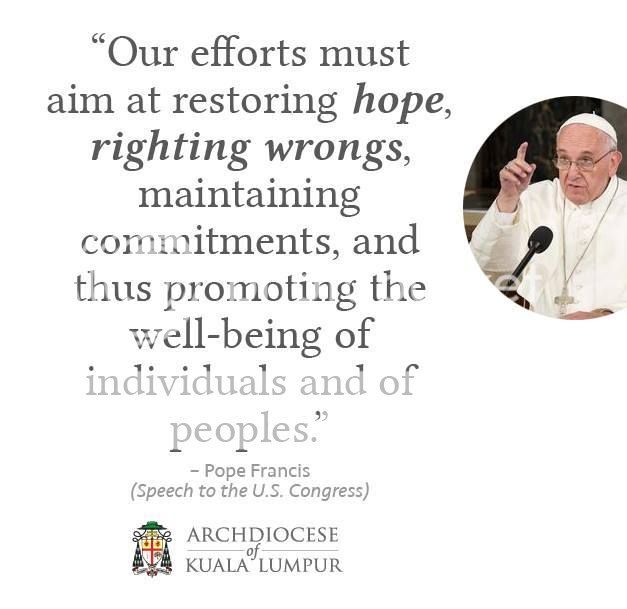
Pope Francis to US Congress ...

user posted image

TSyeeck
post Sep 27 2015, 11:15 PM

Look at all my stars!!
*******
Senior Member
3,574 posts

Joined: Apr 2006


Cerita Dongeng
post Sep 28 2015, 01:33 AM

New Member
*
Junior Member
16 posts

Joined: Jun 2009
.

This post has been edited by Cerita Dongeng: Oct 21 2015, 12:57 PM
TSyeeck
post Sep 28 2015, 02:41 PM

Look at all my stars!!
*******
Senior Member
3,574 posts

Joined: Apr 2006


St. Michael the Archangel
Feast: Sep 29th


user posted image

(Hebrew "Who is like God?").

St. Michael is one of the principal angels; his name was the war-cry of the good angels in the battle fought in heaven against the enemy and his followers. Four times his name is recorded in Scripture:

(1) Daniel 10:13 sqq., Gabriel says to Daniel, when he asks God to permit the Jews to return to Jerusalem: "The Angel [D.V. prince] of the kingdom of the Persians resisted me . . . and, behold Michael, one of the chief princes, came to help me . . . and none is my helper in all these things, but Michael your prince."

(2) Daniel 12, the Angel speaking of the end of the world and the Antichrist says: "At that time shall Michael rise up, the great prince, who standeth for the children of thy people."

(3) In the Catholic Epistle of St. Jude: "When Michael the Archangel, disputing with the devil, contended about the body of Moses", etc. St. Jude alludes to an ancient Jewish tradition of a dispute between Michael and Satan over the body of Moses, an account of which is also found in the apocryphal book on the assumption of Moses (Origen, De Principiis III.2.2). St. Michael concealed the tomb of Moses; Satan, however, by disclosing it, tried to seduce the Jewish people to the sin of hero-worship. St. Michael also guards the body of Eve, according to the "Revelation of Moses" ("Apocryphal Gospels", etc., ed. A. Walker, Edinburgh, p. 647).

(4) Apocalypse 12:7, "And there was a great battle in heaven, Michael and his angels fought with the dragon." St. John speaks of the great conflict at the end of time, which reflects also the battle in heaven at the beginning of time. According to the Fathers there is often question of St. Michael in Scripture where his name is not mentioned. They say he was the cherub who stood at the gate of paradise, "to keep the way of the tree of life" (Genesis 3:24), the angel through whom God published the Decalogue to his chosen people, the angel who stood in the way against Balaam (Numbers 22:22 sqq.), the angel who routed the army of Sennacherib (2 Kings 19:35).

Following these Scriptural passages, Christian tradition gives to St. Michael four offices:

To fight against Satan.
To rescue the souls of the faithful from the power of the enemy, especially at the hour of death.
To be the champion of God's people, the Jews in the Old Law, the Christians in the New Testament; therefore he was the patron of the Church, and of the orders of knights during the Middle Ages.
To call away from earth and bring men's souls to judgment ("signifer S. Michael repraesentet eas in lucam sanctam", Offert. Miss Defunct. "Constituit eum principem super animas suscipiendas", Antiph. off. Cf. The Shepherd of Hermas, Book III, Similitude 8, Chapter 3).
Regarding his rank in the celestial hierarchy opinions vary; St. Basil (Hom. de angelis) and other Greek Fathers, also Salmeron, Bellarmine, etc., place St. Michael over all the angels; they say he is called "archangel" because he is the prince of the other angels; others (cf. P. Bonaventura, op. cit.) believe that he is the prince of the seraphim, the first of the nine angelic orders. But, according to St. Thomas (Summa Ia.113.3) he is the prince of the last and lowest choir, the angels. The Roman Liturgy seems to follow the Greek Fathers; it calls him "Princeps militiae coelestis quem honorificant angelorum cives". The hymn of the Mozarabic Breviary places St. Michael even above the Twenty-four Elders. The Greek Liturgy styles him Archistrategos, "highest general" (cf. Menaea, 8 Nov. and 6 Sept.).
Veneration

It would have been natural to St. Michael, the champion of the Jewish people, to be the champion also of Christians, giving victory in war to his clients. The early Christians, however, regarded some of the martyrs as their military patrons: St. George, St. Theodore, St. Demetrius, St. Sergius, St. Procopius, St. Mercurius, etc.; but to St. Michael they gave the care of their sick. At the place where he was first venerated, in Phrygia, his prestige as angelic healer obscured his interposition in military affairs. It was from early times the centre of the true cult of the holy angels, particularly of St. Michael. Tradition relates that St. Michael in the earliest ages caused a medicinal spring to spout at Chairotopa near Colossae, where all the sick who bathed there, invoking the Blessed Trinity and St. Michael, were cured.

Still more famous are the springs which St. Michael is said to have drawn from the rock at Colossae (Chonae, the present Khonas, on the Lycus). The pagans directed a stream against the sanctuary of St. Michael to destroy it, but the archangel split the rock by lightning to give a new bed to the stream, and sanctified forever the waters which came from the gorge. The Greeks claim that this apparition took place about the middle of the first century and celebrate a feast in commemoration of it on 6 September (Analecta Bolland., VIII, 285-328). Also at Pythia in Bithynia and elsewhere in Asia the hot springs were dedicated to St. Michael.

At Constantinople likewise, St. Michael was the great heavenly physician. His principal sanctuary, the Michaelion, was at Sosthenion, some fifty miles south of Constantinople; there the archangel is said to have appeared to the Emperor Constantine. The sick slept in this church at night to wait for a manifestation of St. Michael; his feast was kept there 9 June. Another famous church was within the walls of the city, at the thermal baths of the Emperor Arcadius; there the synaxis of the archangel was celebrated 8 November. This feast spread over the entire Greek Church, and the Syrian, Armenian, and Coptic Churches adopted it also; it is now the principal feast of St. Michael in the Orient. It may have originated in Phrygia, but its station at Constantinople was the Thermae of Arcadius (Martinow, "Annus Graeco-slavicus", 8 Nov.). Other feasts of St. Michael at Constantinople were: 27 October, in the "Promotu" church; 18 June, in the Church of St. Julian at the Forum; and 10 December, at Athaea.

The Christians of Egypt placed their life-giving river, the Nile, under the protection of St. Michael; they adopted the Greek feast and kept it 12 November; on the twelfth of every month they celebrate a special commemoration of the archangel, but 12 June, when the river commences to rise, they keep as a holiday of obligation the feast of St. Michael "for the rising of the Nile", euche eis ten symmetron anabasin ton potamion hydaton.

At Rome the Leonine Sacramentary (sixth century) has the "Natale Basilicae Angeli via Salaria", 30 September; of the five Masses for the feast three mention St. Michael. The Gelasian Sacramentary (seventh century) gives the feast "S. Michaelis Archangeli", and the Gregorian Sacramentary (eighth century), "Dedicatio Basilionis S. Angeli Michaelis", 29 Sept. A manuscript also here adds "via Salaria" (Ebner, "Miss. Rom. Iter Italicum", 127). This church of the Via Salaria was six miles to the north of the city; in the ninth century it was called Basilica Archangeli in Septimo (Armellini, "Chiese di Roma", p. 85). It disappeared a thousand years ago. At Rome also the part of heavenly physician was given to St. Michael. According to an (apocryphal?) legend of the tenth century he appeared over the Moles Hadriani (Castel di S. Angelo), in 950, during the procession which St. Gregory held against the pestilence, putting an end to the plague. Boniface IV (608-15) built on the Moles Hadriani in honour of him, a church, which was styled St. Michaelis inter nubes (in summitate circi).

Well known is the apparition of St. Michael (a. 494 or 530-40), as related in the Roman Breviary, 8 May, at his renowned sanctuary on Monte Gargano, where his original glory as patron in war was restored to him. To his intercession the Lombards of Sipontum (Manfredonia) attributed their victory over the Greek Neapolitans, 8 May, 663. In commemoration of this victory the church of Sipontum instituted a special feast in honour of the archangel, on 8 May, which has spread over the entire Latin Church and is now called (since the time of Pius V) "Apparitio S. Michaelis", although it originally did not commemorate the apparition, but the victory.

In Normandy St. Michael is the patron of mariners in his famous sanctuary at Mont-Saint-Michel in the Diocese of Coutances. He is said to have appeared there, in 708, to St. Aubert, Bishop of Avranches. In Normandy his feast "S. Michaelis in periculo maris" or "in Monte Tumba" was universally celebrated on 18 Oct., the anniversary of the dedication of the first church, 16 Oct., 710; the feast is now confined to the Diocese of Coutances. In Germany, after its evangelization, St. Michael replaced for the Christians the pagan god Wotan, to whom many mountains were sacred, hence the numerous mountain chapels of St. Michael all over Germany.

The hymns of the Roman Office are said to have been composed by St. Rabanus Maurus of Fulda (d. 856). In art St. Michael is represented as an angelic warrior, fully armed with helmet, sword, and shield (often the shield bears the Latin inscription: Quis ut Deus), standing over the dragon, whom he sometimes pierces with a lance. He also holds a pair of scales in which he weighs the souls of the departed (cf. Rock, "The Church of Our Fathers", III, 160), or the book of life, to show that he takes part in the judgment. His feast (29 September) in the Middle Ages was celebrated as a holy day of obligation, but along with several other feasts it was gradually abolished since the eighteenth century (see FEASTS). Michaelmas Day, in England and other countries, is one of the regular quarter-days for settling rents and accounts; but it is no longer remarkable for the hospitality with which it was formerly celebrated. Stubble-geese being esteemed in perfection about this time, most families had one dressed on Michaelmas Day. In some parishes (Isle of Skye) they had a procession on this day and baked a cake, called St. Michael's bannock.

Source: Catholic Encyclopedia

---------------------------------------------------------------------------
Prayer to St Michael:

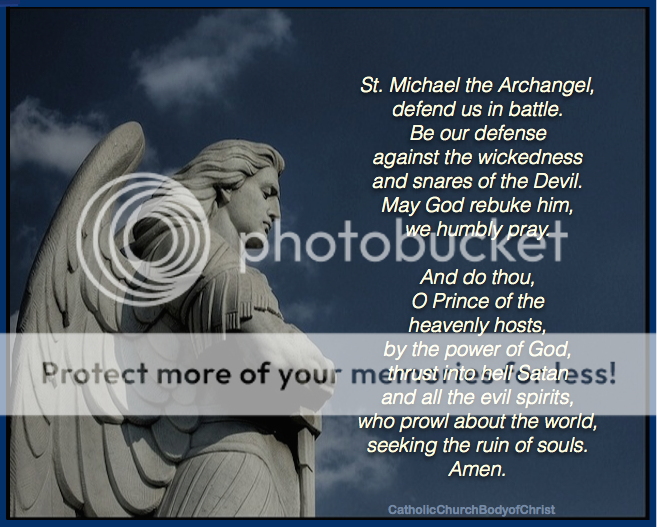
Saint Michael, the Archangel, defend us in battle; be our protection against the wickedness and snares of the devil. May God rebuke him, we humbly pray, and do thou, O prince of the heavenly host, by the power of God, thrust into Hell, Satan and all the other evil spirits, who prowl throughout the world, seeking the ruin of souls. Amen.

emiliov89
post Sep 28 2015, 06:05 PM

New Member
*
Newbie
8 posts

Joined: Feb 2012
Hi all,

Does anyone happen to know where in KL/PJ I can buy simple tealight candle holders/cups. Preferably cheaper plastic ones as I need to buy about a 100.
Ikea only has the glass ones, which are bulky and each cost about RM1.90.

Thank you.
TSyeeck
post Sep 28 2015, 11:07 PM

Look at all my stars!!
*******
Senior Member
3,574 posts

Joined: Apr 2006


QUOTE(emiliov89 @ Sep 28 2015, 06:05 PM)
Hi all,

Does anyone happen to know where in KL/PJ I can buy simple tealight candle holders/cups. Preferably cheaper plastic ones as I need to buy about a 100.
Ikea only has the glass ones, which are bulky and each cost about RM1.90.

Thank you.
*
Plastic is not suitable as we are dealing with flames here. Better be safe and go for the glass ones. RM1.90 seems a good deal.
TSyeeck
post Oct 2 2015, 12:45 AM

Look at all my stars!!
*******
Senior Member
3,574 posts

Joined: Apr 2006


TSyeeck
post Oct 2 2015, 12:56 AM

Look at all my stars!!
*******
Senior Member
3,574 posts

Joined: Apr 2006


Happy feast of the Holy Guardian Angels. Have you greeted your guardian angel today? smile.gif


This post has been edited by yeeck: Oct 2 2015, 12:57 AM
TSyeeck
post Oct 2 2015, 05:57 PM

Look at all my stars!!
*******
Senior Member
3,574 posts

Joined: Apr 2006


Oregon gunman singled out Christians during rampage
By Chris Perez, Danika Fears and Natalie MusumeciOctober 1, 2015 | 7:04pm

Oregon gunman singled out Christians during rampage

A gunman singled out Christians, telling them they would see God in “one second,” during a rampage at an Oregon college Thursday that left at least nine innocent people dead and several more wounded, survivors and authorities said.
“[He started] asking people one by one what their religion was. ‘Are you a Christian?’ he would ask them, and if you’re a Christian stand up. And they would stand up and he said, ‘Good, because you’re a Christian, you are going to see God in just about one second.’ And then he shot and killed them,” Stacy Boylen, whose daughter was wounded at Umpqua Community College in Roseburg, Ore., told CNN.

A twitter user named @bodhilooney,” who said her grandmother was at the scene of the carnage, tweeted that if victims said they were Christian “then they were shot in the head. If they said no, or didn’t answer, they were shot in the legs.”
Gunman Chris Harper-Mercer’s disdain for religion was evident in an online profile, in which he became a member of a “doesn’t like organized religion” group on an Internet dating site.
Kort­ney Moore, 18, said she saw the teacher of her Writing 115 class get shot in the head at the college’s Snyder Hall before the gunman started asking people to state their religion and opening fire, the city’s News-Review newspaper reported.
Harper-Mercer, 26, was killed in a shootout with police outside one of the classrooms, said Douglas County Sheriff John Hanlin.
“There was an exchange of gunfire,” he said. “The shooter threat was neutralized.”
Although police put the death toll at 10 — including Harper-Mercer — with seven people injured, Oregon Attorney General Ellen Rosenblum had said 13 people died.

In other developments:
The killer was carrying four guns — three pistols and a rifle — a source told CNN.
 An anonymous user wrote in an ominous post on the online bulletin board 4chan Wednesday night: “Some of you guys are alright. Don’t go to school tomorrow if you are in the northwest. happening thread will be posted tomorrow morning. so long space robots,” the post concluded.
Online profiles linked to Harper-Mercer showed that he had a fascination with the terror tactics of the Irish Republican Army, and bought Nazi memorabilia. He also wrote a blog post that mentioned Vester Lee Flanagan, who murdered a Virginia newswoman and cameraman live on air, according to CBS News. “Seems like the more people you kill, the more you’re in the limelight,” he wrote.
A former president of the college said that it has only one unarmed security officer and that the community decided against armed guards last year. “I suspect this is going to start a discussion across the country about how community colleges prepare themselves for events like this,” Joe Olson told CBS.
President Obama issued a plea for greater gun control and bemoaned that America is “the only advanced country on earth [that] sees these kind of mass shooting every few months.”
The attack brought the number of mass shootings in the nation this year to 294, according to the Mass Shooting Tracker. The Web site defines mass shootings as incidents in which four or more people are killed or injured by gunfire.
Witnesses described a chaotic scene inside Snyder Hall.

People were scrambling “like ants” when the gunman opened fire at around 10:38 a.m., according to Brady Winder, a 23-year-old student from Portland.
“People [were] screaming, ‘Get out!’ ” he told The News-Review, adding he saw a girl frantically swimming across a creek to escape.
Student Hannah Miles was sitting in a classroom next door when she heard a pop that sounded like a yardstick slapping on a chalkboard, she said.
Everyone in her classroom fled as more gunfire erupted.
Student Brandy Winter posted on Facebook, “I ran to the edge of the campus, down a hill and waited. From talking with a student in the classroom where it happened, almost every person in the room was shot by a man with four guns.’’
Another student, Luke Rogers, said he saw blood in a classroom as he was evacuated from the building.
“As we passed by the classroom, on the ground there were drops of blood,” the first-year Umpqua student told CNN. “We didn’t see any bodies. We saw books on the ground.”

One witness told The New York Times that she heard gunshots outside her classroom.
She said a middle-aged woman then tried to close the door and prevent the shooter from getting inside, but she was shot several times in the stomach.
The gunman “was just out there, hanging outside the door,” Cassandra Welding told the Times “and she slumped over and I knew something wasn’t right. And they’re like, ‘She got shot, she got shot.’ And everyone is panicking.”

Douglas County Fire Marshal Ray Shoulfer said victims were found in “multiple classrooms,” according to CNN.
The sheriff said the shooter was taken down by two officers who rushed to scene without backup minutes into the shooting.
In a national address, Obama lamented that mass shootings have become routine in America.
“I hope and pray that I don’t have to come out again during my tenure as president to offer my condolences to families in these circumstances,” he said. “But based on my experience as president, I can’t guarantee that, and that’s terrible to say, and it can change.”

Additional reporting by Sophia Rosenbaum

http://nypost.com/2015/10/01/oregon-gunman...during-rampage/
khool
post Oct 3 2015, 08:15 AM

Getting Started
**
Junior Member
225 posts

Joined: Mar 2008


Pray for us, defend us! Amen!

user posted image

TSyeeck
post Oct 3 2015, 08:05 PM

Look at all my stars!!
*******
Senior Member
3,574 posts

Joined: Apr 2006


user posted image
TSyeeck
post Oct 3 2015, 08:46 PM

Look at all my stars!!
*******
Senior Member
3,574 posts

Joined: Apr 2006


The Folly of Comfortable Christianity

http://www.pravoslavie.ru/english/82574.htm

"What did the Lord say? Take up your cross and follow Me. This is the meaning of Christianity. Comfortable Christianity is, first of all, not wanting to carry your cross. "
mindslicer81
post Oct 4 2015, 09:25 AM

New Member
*
Junior Member
23 posts

Joined: Jan 2003
From: penang, malaysia


hi all.
i am morgan from penang.
usually attend mass in assumption sunday 10am, or IC 6pm mass.
any more penangkia in the house ?
smile.gif


khool
post Oct 4 2015, 10:30 AM

Getting Started
**
Junior Member
225 posts

Joined: Mar 2008


QUOTE(yeeck @ Oct 3 2015, 08:46 PM)
The Folly of Comfortable Christianity

http://www.pravoslavie.ru/english/82574.htm

"What did the Lord say? Take up your cross and follow Me. This is the meaning of Christianity. Comfortable Christianity is, first of all, not wanting to carry your cross. "
*
Revelation 3:16New Revised Standard Version (NRSV)

16 So, because you are lukewarm, and neither cold nor hot, I am about to spit you out of my mouth.


134 Pages « < 30 31 32 33 34 > » Top
Topic ClosedOptions
 

Change to:
| Lo-Fi Version
0.0418sec    0.24    6 queries    GZIP Disabled
Time is now: 3rd December 2025 - 10:34 PM