Welcome Guest ( Log In | Register )

Bump Topic Topic Closed RSS Feed
39 Pages « < 2 3 4 5 6 > » Bottom

Outline · [ Standard ] · Linear+

 LYN Catholic Fellowship V01 (Group), For Catholics (Roman or Eastern)

views
     
khool
post Jun 15 2015, 06:01 PM

Getting Started
**
Junior Member
225 posts

Joined: Mar 2008


QUOTE(yeeck @ Jun 15 2015, 02:36 PM)
Recently I was present at the last rites of a young cancer patient at the General Hospital. Anointing of the eyes, ears, nose, mouth, legs, followed by Apostolic Blessing which carries a plenary indulgence, and reception of Holy Viaticum (communion for the sick/dying). Felt emotional.  cry.gif but glad that he was resigned to the Will of God and ready to go.
*
Extreme Unction with Last Rites?

khool
post Jun 16 2015, 10:26 AM

Getting Started
**
Junior Member
225 posts

Joined: Mar 2008


QUOTE(de1929 @ Jun 15 2015, 07:10 PM)
yeeck, just curious, do you have any website that we can study more about catholic in structured manner ? structured meaning not magazine nor book nor youtube biggrin.gif
something similar to christian bachelor of theology university courses.
*
If you are truly curious and would like to find out more, just head down to the nearest Catholic Church and enrol in the RCIA course.

This post has been edited by khool: Jun 16 2015, 11:22 AM
khool
post Jun 18 2015, 09:42 AM

Getting Started
**
Junior Member
225 posts

Joined: Mar 2008


QUOTE(de1929 @ Jun 17 2015, 09:01 PM)
seminary is common name lahh brader biggrin.gif...
http://www.stssabah.org/ i don't think that seminary is catholic

any seminary example approved by vatican ?
ah... i found online... can check the validity ?
http://www.wakingupcatholic.com/waking-up-...-resources.html

-- both of u... many thanks biggrin.gif
*
Yes, the site for RCIA is valid, however, it is just resources only. It is far better to study with other people, in a group and with guidance from RCIA facilitators.

khool
post Jun 18 2015, 03:44 PM

Getting Started
**
Junior Member
225 posts

Joined: Mar 2008


QUOTE(de1929 @ Jun 18 2015, 11:34 AM)
you n yeeck lahhh biggrin.gif ... i got questions i throw them here  thumbup.gif
*
alright, as you wish.
khool
post Jun 18 2015, 04:18 PM

Getting Started
**
Junior Member
225 posts

Joined: Mar 2008


Source: https://www.facebook.com/roman.catholicity/...0075049/?type=1

10 tips to help you PRAY (not just Say) the Rosary

1. Less Is More – In his book, The Rosary of Our Lady, Msgr. Romano Guardini offers the following advice:

“It is not necessary to ramble through the whole Rosary; it is better to say only one or two decades, and to say them right.”

Talk about removing the pressure! I’ve always struggled to make sure I complete the entire Rosary, even if it meant that I wasn’t paying attention. Now I realize that quality is more important than quantity.

2. You Are Not Alone – A great proponent of Marian devotion, St. Louis de Montfort urges us to be aware of our company while praying the rosary. In The Secret of the Rosary, Montfort reminds us that, when we pray the Rosary, we should put ourselves in God’s presence and imagine that He (along with the Blessed Mother) is watching us and that our guardian angel is standing to our right. If we say the prayers well, our angel will use them to make crowns for Jesus and Mary. Thinking about this before beginning to pray helps us to realize that we are doing A LOT more than just repeating pious words!

3. Watch What You Say – St. Josemaria Escriva, the founder of Opus Dei, contributes a simple, but often overlooked suggestion. He encourages us to pronounce each Our Father and Hail Mary clearly and without rushing. In doing so, we will better express our love for Mary and Jesus. When praying the Rosary, it’s easy to fall into the trap of mumbling and our rushing through the prayers. Remembering that the Our Father was handed down to us from Jesus and that most of the Hail Mary is taken directly from Scripture should help us to recall that the words DO mean something!

4. Been There, Done That – When we look at Mary’s life, we sometimes overlook her many struggles. Like us, Mary was forced to endure suffering and difficulties, often without a lot of explanation. Being the Mother of God didn’t make her all knowing. The Bible tells us that Mary experienced confusion and had to seek understanding through prayer. In her book, The Splendor of the Rosary, Maisie Ward (Catholic author, publisher and wife of noted apologist Frank Sheed) stated:

“In the Rosary we rejoice, sorrow and triumph with Our Lady as she walks the same path we have to walk. But now she has reached the end.”

When we pray the Rosary, we should remember that Mary understands our problems and confusion. By meditating on the events in her life and the life of her Son, we can obtain help for our daily struggles from someone who is now in a place where we’d like to someday be!

5. Listen To The Word – In his Apostolic Letter, Rosarium Virginis Mariae (On The Most Holy Rosary), Blessed Pope John Paul II recommends that we supplement our Rosary meditations with Bible reading. After announcing the individual mystery, the late Holy Father encourages us to read an appropriate Bible passage. While this is not always possible (if we are praying while walking or driving, for instance), we can still mentally recall the details of an appropriate Bible story. This underscores the importance of becoming familiar with Sacred Scripture.

6. Savor The Repetition – Sometimes it feels as if praying the Rosary is just “repeating a bunch of words”! In fact, one of the criticisms of the Rosary is that it is nothing more than “vain repetition”. In his book, The World’s First Love: Mary, Mother of God, Venerable Archbishop Fulton Sheen addresses those who consider the rosary to be monotonous. Using the analogy of a husband telling his wife “I love you” or a mother proclaiming “you’re a good boy” to her child, Sheen stresses that the words mean something different at each point in time that they are repeated. In the same way, each time we pray the Rosary, we are saying “I love you” to God, the Trinity, to Jesus and to Mary. With each successive bead (or decade) the meaning shifts as we contemplate a new aspect of Jesus or Mary’s love.

7. Do Whatever He Tells You – Praying the Rosary, no matter how devoutly, is never a substitute for following the commands of Jesus and His Church. The Rosary should spur us on to live the mysteries in our daily life. In his book, The Sermons of St. Francis de Sales on Our Lady, St. Francis de Sales had this to say:

“The worldly-minded imagine that devotion to Our Lady usually consists in carrying a rosary in their cincture. It seems to them that it is enough to pray it a number of times without doing anything else. In this they are greatly mistaken. For our dear Mistress wants us to do what her Son commands us (John 2:5) and considers as done to herself the honor we give to her Son by keeping His commandments.”

8. Think – In the preface of Father Peyton’s Rosary Prayer Book: The Family That Prays Together Stays Together, Fr. Patrick Peyton reminds us that the Rosary is more than a series of prayers to be recited. Rather, it is “a series of thoughts to be dwelt on, to be turned over in the mind, to be applied in daily life.” While we are saying the words of the prayers, we should be meditating upon the mysteries. That was a hard concept for me to understand, but it’s the key to unleashing the power of the Rosary.

9. Grow In Virtue – Mother Angelica loves the Rosary. In her book, The Prayers and Personal Devotions of Mother Angelica, she discusses how to use the Rosary to grow in virtue:

“If you’re not making progress in one virtue, say your Rosary and meditate on that virtue as Our Lord practiced it. I cannot get over my faults and weaknesses if I don’t substitute those faults and weaknesses for something of God. This is precisely why the life of Jesus and the reading of Scripture and the rosary never seem to change us – why we remain the same: Because to change you need to admire someone other than yourself.”

10. Ask Mary For Help – This one’s so obvious that it’s easy to overlook! This simple, but powerful suggestion comes from a list (Tips On Praying The Rosary More Devoutly) put together by The Association of the Miraculous Medal in Perryville, MO. Before beginning the Rosary, we should ask Our Blessed Mother to help us pray devoutly.

Although the Rosary follows a simple pattern, it can be a very challenging prayer to master. Rest assured that many of the Saints struggled with it too. If you find it difficult to pray the Rosary, try out these tips and see what happens. It might take a little time, but eventually your persistence will pay off. The next time you pick up your rosary beads, imagine that you’re holding Mary’s hand and taking a trip to visit Jesus. For when we pray the Rosary, that’s exactly what happens!

“The Rosary is the most beautiful and the most rich in graces of all prayers; it is the prayer that touches most the Heart of the Mother of God…and if you wish peace to reign in your homes, recite the family Rosary.” (Pope Saint Pius X)
khool
post Jun 20 2015, 02:52 AM

Getting Started
**
Junior Member
225 posts

Joined: Mar 2008


QUOTE(de1929 @ Jun 19 2015, 07:28 PM)
thx biggrin.gif

next question: concept about cell group / regular meeting not sunday. Is there such thing in catholic, is it endorsed from vatican or only parish level. I mean the necessiry to attend cell groups. I want to know is therre any by-law which is higher than a mere suggestions.
*
Yes, it is called "Basic Ecclesial Community", or BECs in short. Attendance is strongly encouraged (but not compulsory) and is organized mostly along geographical zones, based on Archdiocese of the region. Although recently, the Archdiocese of KL maybe reorganizing into based on interest groups also, however still under study.

Some further references:

a. Wiki: https://en.wikipedia.org/wiki/Basic_ecclesial_community
b. USA: http://www.slideshare.net/becnova/basic-ec...why-and-the-how
c. Malaysia: http://www.sfx.com.my/index.php/bec

All Church based activities must be registered and approved by the archdiocese, and Vatican before they can be implemented. Catholics must acknowledge the authority of Vatican and the Holy See in Rome.

This post has been edited by khool: Jun 20 2015, 02:56 AM
khool
post Jun 21 2015, 09:54 AM

Getting Started
**
Junior Member
225 posts

Joined: Mar 2008


Twelfth Sunday in Ordinary Time
Lectionary: 95


Reading 1 (Jb 38:1, 8-11)

The Lord addressed Job out of the storm and said:
Who shut within doors the sea,
when it burst forth from the womb;
when I made the clouds its garment
and thick darkness its swaddling bands?
When I set limits for it
and fastened the bar of its door,
and said: Thus far shall you come but no farther,
and here shall your proud waves be stilled!


Responsorial Psalm (Ps 107:23-24, 25-26, 28-29, 30-31)

R. (1b) Give thanks to the Lord, his love is everlasting.
or:
R. Alleluia.
They who sailed the sea in ships,
trading on the deep waters,
These saw the works of the LORD
and his wonders in the abyss.
R. Give thanks to the Lord, his love is everlasting.

or:

R. Alleluia.
His command raised up a storm wind
which tossed its waves on high.
They mounted up to heaven; they sank to the depths;
their hearts melted away in their plight.
R. Give thanks to the Lord, his love is everlasting.
or:
R. Alleluia.
They cried to the LORD in their distress;
from their straits he rescued them,
He hushed the storm to a gentle breeze,
and the billows of the sea were stilled.
R. Give thanks to the Lord, his love is everlasting.
or:
R. Alleluia.
They rejoiced that they were calmed,
and he brought them to their desired haven.
Let them give thanks to the LORD for his kindness
and his wondrous deeds to the children of men.
R. Give thanks to the Lord, his love is everlasting.
or:
R. Alleluia.


Reading 2 (2 Cor 5:14-17)

Brothers and sisters:
The love of Christ impels us,
once we have come to the conviction that one died for all;
therefore, all have died.
He indeed died for all,
so that those who live might no longer live for themselves
but for him who for their sake died and was raised.

Consequently, from now on we regard no one according to the flesh;
even if we once knew Christ according to the flesh,
yet now we know him so no longer.
So whoever is in Christ is a new creation:
the old things have passed away;
behold, new things have come.


Alleluia (Lk 7:16)

R. Alleluia, alleluia.

A great prophet has risen in our midst,
God has visited his people.

R. Alleluia, alleluia.


Gospel (Mk 4:35-41)

On that day, as evening drew on, Jesus said to his disciples:
“Let us cross to the other side.”
Leaving the crowd, they took Jesus with them in the boat just as he was.
And other boats were with him.
A violent squall came up and waves were breaking over the boat,
so that it was already filling up.
Jesus was in the stern, asleep on a cushion.
They woke him and said to him,
“Teacher, do you not care that we are perishing?”
He woke up,
rebuked the wind, and said to the sea, “Quiet! Be still!”
The wind ceased and there was great calm.
Then he asked them, “Why are you terrified?
Do you not yet have faith?”
They were filled with great awe and said to one another,
“Who then is this whom even wind and sea obey?”
khool
post Jun 22 2015, 03:05 PM

Getting Started
**
Junior Member
225 posts

Joined: Mar 2008


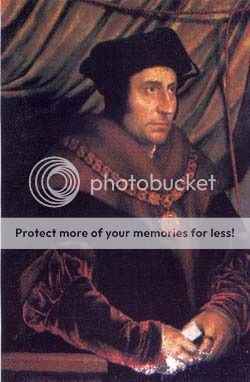
St. Thomas More, Martyr (Patron of Lawyers)

user posted image

St. Thomas More was born at London in 1478. After a thorough grounding in religion and the classics, he entered Oxford to study law. Upon leaving the university he embarked on a legal career which took him to Parliament. In 1505, he married his beloved Jane Colt who bore him four children, and when she died at a young age, he married a widow, Alice Middleton, to be a mother for his young children. A wit and a reformer, this learned man numbered Bishops and scholars among his friends, and by 1516 wrote his world-famous book "Utopia". He attracted the attention of Henry VIII who appointed him to a succession of high posts and missions, and finally made him Lord Chancellor in 1529. However, he resigned in 1532, at the height of his career and reputation, when Henry persisted in holding his own opinions regarding marriage and the supremacy of the Pope. The rest of his life was spent in writing mostly in defense of the Church. In 1534, with his close friend, St. John Fisher, he refused to render allegiance to the King as the Head of the Church of England and was confined to the Tower. Fifteen months later, and nine days after St. John Fisher's execution, he was tried and convicted of treason. He told the court that he could not go against his conscience and wished his judges that "we may yet hereafter in heaven merrily all meet together to everlasting salvation." And on the scaffold, he told the crowd of spectators that he was dying as "the King's good servant-but God's first." He was beheaded on July 6, 1535. His feast day is June 22nd.


Source: http://www.catholic.org/saints/saint.php?saint_id=324

Wiki: https://en.wikipedia.org/?title=Thomas_More
khool
post Jun 22 2015, 08:57 PM

Getting Started
**
Junior Member
225 posts

Joined: Mar 2008


QUOTE(david101 @ Jun 22 2015, 04:56 PM)
Catholics believe that the Catholic Church has the 'keys to the kingdom' of heaven, and whoever is confirmed to be in heaven is considered a saint. It is a title. And the Church has a process to determine if someone is confirmed to be in heaven. Protestants do not typically hold this view, as they typically do not 'confirm' who is in heaven or not. And as such Protestants have a different understanding when it comes to the term saint, and prefer to refer to the apostles, simply as apostles. Which is why any church which has the word 'Saint' in its name is highly likely Catholic (or Anglican) in this country.
*
Bro David's above explanation is good, just one more detail which requires slightly more explanation.

He mentions that anyone who who has gone through holy sacramental rites of Baptism and Confirmation in the Catholic Church are considered saints, with a lower case 's'. All Catholics are called to live saintly lives that reflect to the rest of the world the love and sacrifices that God has made for us. Christ Himself has mentioned it, "By their fruits you shall know them.", (Matthew 7:16)

The saints whom you use as examples like, Saints Peter, Paul, the rest of the apostles, Mary of Magdalene and some of our more contemporary saints like Jose Maria Escriva, Padre Pio and of course John Paul II, are considered 'Saints' with an upper case 'S'. They have been (officially) canonized by the Catholic Church in recognition of their extraordinary service to the Church in living, promoting and preaching the Word of the Living God to the world.

This process of canonization can sometimes take a very long time, depending on the circumstances of each individual's lives.

This post has been edited by khool: Jun 22 2015, 08:57 PM
khool
post Jun 22 2015, 09:12 PM

Getting Started
**
Junior Member
225 posts

Joined: Mar 2008


QUOTE(de1929 @ Jun 22 2015, 07:39 PM)
ok thanks biggrin.gif

next question about sunday service.

Is is authorized to have a service not in sunday (e.g. midweek service / saturday) to replace sunday. I am  not talking about individual, but a corporate decision (church level) replace sunday to other day.

case study: because church rent building at certain place, and sunday is not available, only thursday.
*
The long and the short answer to this question is, no. A weekday Mass, what you Protestants will call as a service, cannot be used to replace Sunday Mass. No matter what, Sunday Mass MUST be celebrated, and it is the duty and obligation for all Catholics to participate in it (not just mere attendance) as Jesus Christ is present in His true form during the celebration.

This is because Christ rose from the dead on Easter Sunday. As such, we celebrate His resurrection on this day of the week, replacing Saturday as the most holy of days in the week. Christ is now and always the Lord of the Sabbath. During Mass, we celebrate His life, death and resurrection in the form of the sacrament of the Holy Eucharist, where Catholics, eat the flesh and drink the blood of our saviour in the transubstantiated form of unleavened bread and Eucharistic wine which has been consecrated by the priest.

Should there be an issue with the premises being unavailable on Sunday, then I can say with great certainty that premises will not be considered for used of worship and celebration. No compromises there.

One small addendum ... attending evening sunset Mass on a Saturday fulfills this obligation. This is in keeping with Jewish belief that the next day begins at sunset, and not at the stroke of midnight.

This post has been edited by khool: Jun 22 2015, 09:17 PM
khool
post Jun 22 2015, 11:54 PM

Getting Started
**
Junior Member
225 posts

Joined: Mar 2008


QUOTE(yeeck @ Jun 22 2015, 11:46 PM)
Speaking about St Thomas More, I'm reminded of one of my favourite movies, A Man for All Seaons, winner of Best Picture in 1966.


*
I have that movie, Paul Schofield plays an excellent St. Thomas More ... biggrin.gif
khool
post Jun 23 2015, 12:32 PM

Getting Started
**
Junior Member
225 posts

Joined: Mar 2008


QUOTE(yeeck @ Jun 23 2015, 12:02 AM)

*
Thing is, was Henry VIII really that tyrannical? Hard to believe that, as he once almost joined the clergy.

This post has been edited by khool: Jun 23 2015, 12:58 PM
khool
post Jun 23 2015, 03:04 PM

Getting Started
**
Junior Member
225 posts

Joined: Mar 2008


QUOTE(yeeck @ Jun 23 2015, 01:36 PM)
He was given the title "Defensor Fidei" by the Pope for writing against Luther. But all it took were his despair for a son and other women to bewitch him.

From Wikipedia:

"Defender of the Faith" has been one of the subsidiary titles of the English and later British monarchs since it was granted on 11 October, 1521[1] by Pope Leo X to King Henry VIII of England. His wife Catherine of Aragon was also a Defender of the Faith in her own right.[2] The title was conferred in recognition of Henry's book Assertio Septem Sacramentorum (Defence of the Seven Sacraments), which defended the sacramental nature of marriage and the supremacy of the Pope. This was also known as the "Henrician Affirmation" and was seen as an important opposition to the early stages of the Protestant Reformation, especially the ideas of Martin Luther.

Following Henry's decision to break with Rome in 1530 and establish himself as head of the Church of England, the title was revoked by Pope Paul III (since Henry's act was regarded as an attack on "the Faith") and Henry was excommunicated. However, in 1544,[citation needed] the Parliament of England conferred the title "Defender of the Faith" on King Henry VIII and his successors, now the defenders of the Anglican faith, of which they (except the Catholic Mary I) remain the Supreme Governors (formally above the Archbishop of Canterbury as Primate).
*
That part I know, but it is amazing how quick he turned on his adviser and friend.
khool
post Jun 24 2015, 04:29 PM

Getting Started
**
Junior Member
225 posts

Joined: Mar 2008


QUOTE(yeeck @ Jun 15 2015, 06:20 PM)
Yeah, it is indeed a special grace to be able to die fortified with this sacrament.
*
Source: http://catholicism.about.com/od/beliefstea...c_Anointing.htm

The Sacrament of the Anointing of the Sick

Service of the Sacrament of Holy Unction (Anointing of the Sick), during the Feast of the Dormition of Theotokos. The Holy Oil (Chrism) is blessed by the Holy Spirit, and is used for anointing the faithful for the healing of infirmities of the soul and body.

Introduction:
Traditionally referred to as Extreme Unction or Last Rites, the Sacrament of the Anointing of the Sick was previously most commonly administered to the dying, for the remission of sins and the provision of spiritual strength and health. In modern times, however, its use has been expanded to all who are gravely ill or are about to undergo a serious operation, and the Church stresses a secondary effect of the sacrament: to help a person recover his health.

Like Confession and Holy Communion, to which it is closely linked, the Sacrament of the Anointing of the Sick can be repeated as often as is necessary.

Biblical Roots:
The modern celebration of the Sacrament of the Anointing of the Sick recalls the early Christian use, going back to biblical times. When Christ sent His disciples out to preach, "they cast out many devils, and anointed with oil many that were sick, and healed them" (Mark 6:13). James 5:14-15 ties physical healing to the forgiveness of sins:

Is any man sick among you? Let him bring in the priests of the church, and let them pray over him, anointing him with oil in the name of the Lord. And the prayer of faith shall save the sick man: and the Lord shall raise him up: and if he be in sins, they shall be forgiven him.

Who May Receive the Sacrament?:
Following this biblical understanding, the Catechism of the Catholic Church (para. 1514) notes that:

The Anointing of the Sick "is not a sacrament for those only who are at the point of death. Hence, as soon as anyone of the faithful begins to be in danger of death from sickness or old age, the fitting time for him to receive this sacrament has certainly already arrived."

When in doubt, priests should err on the side of caution and provide the sacrament to the faithful who request it.

The Form of the Sacrament:
The essential rite of the sacrament consists in the priest (or priests, in the case of the Eastern Churches) laying hands on the sick, anointing him with blessed oil (usually olive oil blessed by a bishop, but in an emergency, any vegetable oil will suffice), and praying "Through this holy anointing may the Lord in his love and mercy help you with the grace of the Holy Spirit. May the Lord who frees you from sin save you and raise you up."

When circumstances permit, the Church recommends that the sacrament take place during Mass, or at least that it be preceded by Confession and followed by Holy Communion.

The Minister of the Sacrament:
Only priests (including bishops) can administer the Sacrament of the Anointing of the Sick, since, when the sacrament was instituted during Christ's sending out of His disciples, it was confined to the men who would become the original bishops of the Church.

The Effects of the Sacrament:
Received in faith and in a state of grace, the Sacrament of the Anointing of the Sick provides the recipient with a number of graces, including the fortitude to resist temptation in the face of death, when he is weakest; a union with the Passion of Christ, which makes his suffering holy; and the grace to prepare for death, so that he may meet God in hope rather than in fear. If the recipient was not able to receive the Sacrament of Confession, Anointing also provides forgiveness of sins. And, if it will aid in the salvation of his soul, Anointing may restore the recipient's health.


khool
post Jun 24 2015, 04:33 PM

Getting Started
**
Junior Member
225 posts

Joined: Mar 2008


Source: http://catholicism.about.com/od/thesacrame...-Confession.htm

Seven Steps to Making a Better Confession
Or, How I Stopped Worrying and Learned to Love the Sacrament (of Reconciliation)

Just as daily Communion should be the ideal for Catholics, frequent reception of the Sacrament of Confession is essential in our struggle against sin and our growth in holiness.

For too many Catholics, however, Confession is something we do as infrequently as possible, and after the sacrament is finished, we may not feel as we do when we have received the Sacrament of Holy Communion worthily. That's not because of a flaw in the sacrament, but because of a flaw in our approach to Confession.

Approached properly, with some basic preparation, we can find ourselves as eager to partake of the Sacrament of Confession as we are to receive the Eucharist.

Here are seven steps that will help you make a better Confession, and fully embrace the graces offered by this sacrament.
1. Go to Confession More Often

If your experience of Confession has been frustrating or unfulfilling, this may seem like odd advice. It's like the opposite of that old joke:

"Doctor, it hurts when I poke myself here. What should I do?"
"Quit poking yourself there."

On the other hand, as we've all heard, "practice makes perfect," and you're never going to make a better Confession unless you're actually going to Confession. The reasons we often avoid Confession are precisely the reasons why we should be going more often:

I can't remember all of my sins;
I get nervous when I get in the confessional;
I'm afraid I'm going to forget something;
I'm not sure what I should or shouldn't confess.

The Church requires us to go to Confession once per year, in preparation for doing our Easter Duty; and we must, of course, go to Confession before receiving Communion whenever we're conscious of having committed a grave or mortal sin.

But if we want to treat Confession as an instrument of spiritual growth, we need to quit viewing it simply in a negative light—something we do only to cleanse ourselves. Monthly Confession, even if we're only aware of minor or venial sins, can be a great source of graces and can help us to focus our efforts on neglected areas of our spiritual life.

And if we're trying to get over a fear of Confession, or struggling with a particular sin (mortal or venial), going to Confession weekly for a while can help greatly. In fact, during the Church's penitential seasons of Lent and Advent, when parishes often offer additional times for Confession, weekly Confession can be a great aid in our spiritual preparation for Easter and Christmas.


2. Take Your Time

Too often I've approached the Sacrament of Confession with all of the preparation I might make if I were ordering fast food from a drive-through. In fact, since I get confused and frustrated by the menus at most fast-food joints, I usually make sure that I know well in advance what I want to order.

But Confession? I shudder to think of the number of times that I've rushed to make it to the church mere minutes before the time for Confession has ended, uttered a quick prayer to the Holy Spirit to help me recall all of my sins, and then dived into the confessional before even figuring out how long it had been since my last Confession.

That's a recipe for leaving the confessional and then remembering a forgotten sin, or even forgetting what penance the priest prescribed, because you were too focused on getting the Confession done, and not focused on what you were actually doing.

If you want to make a better Confession, take the time to do it right. Begin your preparation at home (we'll talk about that below), and then arrive early enough so that you won't be rushed. Spend a little time in prayer before the Blessed Sacrament before turning your thoughts to what you will say in Confession.

Take your time once you get in the confessional as well. There's no need to rush; when you're waiting in line for Confession, it may seem like the people in front of you are taking a long time, but usually they aren't, and neither will you. If you try to rush, you're more likely to forget things you intended to say, and then you're more likely to be unhappy later when you remember them.

When your Confession is over, don't be in a hurry to leave the church. If the priest gave you prayers for your penance, say them there, in the presence of the Blessed Sacrament. If he asked you to think about your actions or to meditate on a particular passage of Scripture, do that then and there. Not only are you much more likely to complete your penance—an important step in the reception of the sacrament—but you'll also be more likely to see the connection between the contrition you expressed in the confessional, the absolution provided by the priest, and the penance you performed.


3. Make a Thorough Examination of Conscience

As I mentioned above, your preparation for Confession should be begin at home. You'll need to recall (at least roughly) when your last Confession was, as well as the sins you've committed since then.

For most of us most of the time, that recollection of sins probably looks a lot like this: "All right—what did I confess last time, and how many times have I done those things since my last Confession?"

There's nothing wrong with that, as far as it goes. In fact, it's a pretty good starting point. But if we want to embrace the Sacrament of Confession fully, then we need to break out of old habits and look at our lives in a critical light. And that's where a thorough examination of conscience comes in.

The venerable Baltimore Catechism, in its lesson on the Sacrament of Penance, provides a good, short guide to making an examination of conscience. Reflecting on each of the following, think of the ways in which you have either done what you shouldn't have done, or have failed to do what you should do:

The Ten Commandments
The Precepts of the Church
The Seven Deadly Sins
The Duties of Your State in Life

The first three are self-explanatory; the last one requires thinking about those aspects of your life that set you apart from everyone else. For instance, in my case, I have certain duties that arise from the fact that I am a son, a husband, a father, a magazine editor, and a writer on matters Catholic. How well have I performed those duties? Are there things I should have done for my parents, wife, or children that I haven't done? Are there things that I shouldn't have done to them that I did do? Have I been diligent in my work and honest in my dealings with my superiors and subordinates? Have I treated with dignity and charity those with whom I've come into contact because of my state in life?

A thorough examination of conscience may uncover habits of sin that have become so ingrained that we hardly ever notice or think about them. Perhaps we put undue burdens on our spouse or children, or spend our coffee breaks or lunch hours gossiping with our fellow employees about our boss. Maybe we don't call our parents as often as we should, or encourage our children to pray. These things arise from our particular state in life, and while they are common to many people, the only way we can become aware of them in our own life is to spend some time in reflection on our own particular circumstances.


4. Don't Hold Back

All of the reasons that I mentioned why we avoid going to Confession stem from some sort of fear. While going more frequently may help us overcome some of those fears, other fears may rear their ugly head while we're in the confessional.

The worst, because it may lead us to make an incomplete Confession, is a fear of what the priest may think when we confess our sins. This, however, is probably the most irrational fear we could have, because unless the priest hearing our Confession is brand-spanking new, there's a very good chance that any sin we could mention is one he's heard many, many times before. And even if he hasn't heard it in a confessional, he's been prepared through his seminary training to handle pretty much anything you could throw at him.

Go ahead; try to shock him. It's not going to happen. And that's a good thing, because in order for your Confession to be complete and your absolution to be valid, you need to confess all mortal sins by kind (what you did) and number (how often you did it). You should do that with venial sins as well, but if you forget a venial sin or three, you'll still be absolved of them at the end of Confession.

But if you hold back on confessing a grave sin, you're only hurting yourself. God knows what you did, and the priest wants nothing more than to heal the breach between you and God.


5. Go to Your Own Priest

I know; I know: You always go to the next parish over, and you choose the visiting priest, if there's one available. For many of us, there's nothing more terrifying than the thought of going to Confession with our own priest. Sure, we always make a private Confession, rather than face-to-face; but if we can recognize Father's voice, he has to be able to recognize ours, too, right?

I'm not going to kid you; unless you belong to a very large parish and rarely have any interaction with your pastor, he probably does. But remember what I wrote above: Nothing you can say is going to shock him. And even though this shouldn't be your concern, he's not going to think worse of you because of anything you say in Confession.

Think about it: Rather than staying away from the sacrament, you've come to him and confessed your sins. You've asked for God's forgiveness, and your pastor, acting in the person of Christ, has absolved you from those sins. But now you're worried that he is going to deny you what God has granted to you? If that were actually the case, your priest would have bigger problems than you.

Instead of avoiding your own priest, use Confession with him to your spiritual advantage. If you're embarrassed to confess certain sins to him, you'll have added incentive to avoid those sins. While ultimately we want to get to the point where we avoid sin because we love God, embarrassment over sin can be the beginning of true contrition and a firm resolve to amend your life, whereas the anonymous Confession at the next parish over, while valid and effective, may make it easier to fall back into the same sin.

6. Ask for Advice

If part of the reason you find Confession frustrating or unsatisfying is that you find yourself confessing the same sins over and over again, don't hesitate to ask your confessor for advice. Sometimes, he'll offer it without you asking, especially if the sins you've confessed are ones that are often habitual.

But if he doesn't, there's nothing wrong with saying, "Father, I've been struggling with [your particular sin]. What can I do to avoid it?"

And when he responds, listen carefully, and don't dismiss his advice out of hand. You may think, for instance, that your prayer life is just fine, so if your confessor suggests that you spend more time in prayer, you might be inclined to regard his advice as well meaning but useless.

Don't think that way. Whatever he suggests, do it. The very act of trying to follow your confessor's advice can be a cooperation with grace. You may be surprised at the results.

7. Amend Your Life

The two most popular forms of the Act of Contrition end with these lines:

I firmly resolve, with the help of Thy grace, to confess my sins, to do penance, and to amend my life.

And:

I firmly resolve, with the help of Thy grace, to sin no more, and to avoid the near occasion of sin.

Reciting the Act of Contrition is the last thing we do in the confessional before receiving absolution from the priest. And yet those final words too often vanish from our minds as soon as we step back through the confessional door.

But an essential part of confession is sincere contrition, and that includes not only being sorry for the sins that we have committed in the past, but resolving to do whatever we can to avoid committing those and other sins in the future. When we treat the Sacrament of Confession as merely medicinal—healing the damage we've done—and not as a source of grace and strength to keep us on the right path going forward, we're more likely to find ourselves back in the confessional, reciting those same sins once again.

A better Confession doesn't end when we leave the confessional; in a sense, a new phase of Confession begins then. Being aware of the grace we have received in the sacrament, and trying our best to cooperate with that grace by avoiding not only the sins that we confessed but all sins, and indeed even occasions of sin, is the best way to ensure that we've made a good Confession.
Final Thoughts

While all of these steps can help you make a better Confession, you should not let any of them become excuses for not taking advantage of the sacrament. If you know that you need to go to Confession but you don't have the time to prepare as well as you should or to make a thorough examination of conscience, or if your priest isn't available and you have to go to the next parish over, don't wait. Get to Confession, and resolve to make a better Confession next time.

While the Sacrament of Confession, properly understood, is about more than healing the damage of the past, sometimes we have to staunch the wound before we can move on. Never let your desire for making a better Confession keep you from making the one you need to make today.

This post has been edited by khool: Jun 24 2015, 04:35 PM
khool
post Jun 27 2015, 02:42 PM

Getting Started
**
Junior Member
225 posts

Joined: Mar 2008


What Does the Legalization of Gay Marriage Mean for the Catholic Church

On June 27, 2015 five out nine Supreme Court Justices redefined the definition of marriage for the entire country. This video discusses the areas in which this decision affects the Catholic Church.


This post has been edited by khool: Jun 27 2015, 02:43 PM
khool
post Jun 27 2015, 02:48 PM

Getting Started
**
Junior Member
225 posts

Joined: Mar 2008


USCCB Statement on Marriage Ruling

Source: http://www.marriageuniqueforareason.org/20...arriage-ruling/

user posted image

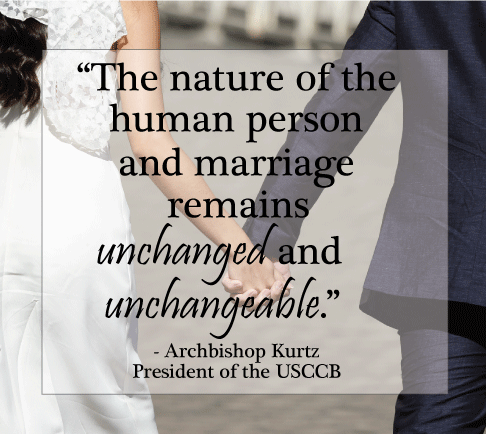
Today Archbishop Kurtz issued a statement about the Supreme Court’s marriage ruling, calling it a “tragic error that harms the common good and most vulnerable among us.” Read the full statement here.

Archbishop Kurtz compared the decision to Roe v. Wade and how it doesn’t change the truth- which is “unchanged and unchangeable.” He continues on to say that, “Neither decision is rooted in the truth, and as a result, both will eventually fail. Today the Court is wrong again. It is profoundly immoral and unjust for the government to declare that two people of the same sex can constitute a marriage.”

It is a deep truth that the human being is an embodied soul, male and female. The archbishop writes, “The unique meaning of marriage as the union of one man and one woman is inscribed in our bodies as male and female” and notes that this is part of what Pope Francis has described as “integral ecology.” “The law has a duty to support every child’s basic right to be raised, where possible, by his or her married mother and father in a stable home.”

The bishops follow Jesus Christ who taught these truths unambiguously, and the president of the USCCB encouraged Catholics to keep speaking for the truth and moving forward with the theological virtues of faith, hope and love. Archbishop Kurtz ended by saying, “I ask all in positions of power and authority to respect the God-given freedom to seek, live by, and bear witness to the truth.”

khool
post Jun 27 2015, 11:40 PM

Getting Started
**
Junior Member
225 posts

Joined: Mar 2008


Thirteenth Sunday in Ordinary Time

Lectionary: 98

Reading 1 (Wis 1:13-15; 2:23-24)

God did not make death,
nor does he rejoice in the destruction of the living.
For he fashioned all things that they might have being;
and the creatures of the world are wholesome,
and there is not a destructive drug among them
nor any domain of the netherworld on earth,
for justice is undying.
For God formed man to be imperishable;
the image of his own nature he made him.
But by the envy of the devil, death entered the world,
and they who belong to his company experience it.

Responsorial Psalm (Ps 30:2, 4, 5-6, 11, 12, 13)

R. (2a) I will praise you, Lord, for you have rescued me.
I will extol you, O LORD, for you drew me clear
and did not let my enemies rejoice over me.
O LORD, you brought me up from the netherworld;
you preserved me from among those going down into the pit.
R. I will praise you, Lord, for you have rescued me.
Sing praise to the LORD, you his faithful ones,
and give thanks to his holy name.
For his anger lasts but a moment;
a lifetime, his good will.
At nightfall, weeping enters in,
but with the dawn, rejoicing.
R. I will praise you, Lord, for you have rescued me.
Hear, O LORD, and have pity on me;
O LORD, be my helper.
You changed my mourning into dancing;
O LORD, my God, forever will I give you thanks.
R. I will praise you, Lord, for you have rescued me.

Reading 2 (2 Cor 8:7, 9, 13-15)

Brothers and sisters:
As you excel in every respect, in faith, discourse,
knowledge, all earnestness, and in the love we have for you,
may you excel in this gracious act also.

For you know the gracious act of our Lord Jesus Christ,
that though he was rich, for your sake he became poor,
so that by his poverty you might become rich.
Not that others should have relief while you are burdened,
but that as a matter of equality
your abundance at the present time should supply their needs,
so that their abundance may also supply your needs,
that there may be equality.
As it is written:
Whoever had much did not have more,
and whoever had little did not have less.

Alleluia Cf. (2 Tm 1:10)

R. Alleluia, alleluia.
Our Savior Jesus Christ destroyed death
and brought life to light through the Gospel.
R. Alleluia, alleluia.

Gospel (Mk 5:21-43)

When Jesus had crossed again in the boat
to the other side,
a large crowd gathered around him, and he stayed close to the sea.
One of the synagogue officials, named Jairus, came forward.
Seeing him he fell at his feet and pleaded earnestly with him, saying,
“My daughter is at the point of death.
Please, come lay your hands on her
that she may get well and live.”
He went off with him,
and a large crowd followed him and pressed upon him.

There was a woman afflicted with hemorrhages for twelve years.
She had suffered greatly at the hands of many doctors
and had spent all that she had.
Yet she was not helped but only grew worse.
She had heard about Jesus and came up behind him in the crowd
and touched his cloak.
She said, “If I but touch his clothes, I shall be cured.”
Immediately her flow of blood dried up.
She felt in her body that she was healed of her affliction.
Jesus, aware at once that power had gone out from him,
turned around in the crowd and asked, “Who has touched my clothes?”
But his disciples said to Jesus,
“You see how the crowd is pressing upon you,
and yet you ask, ‘Who touched me?’”
And he looked around to see who had done it.
The woman, realizing what had happened to her,
approached in fear and trembling.
She fell down before Jesus and told him the whole truth.
He said to her, “Daughter, your faith has saved you.
Go in peace and be cured of your affliction.”

While he was still speaking,
people from the synagogue official’s house arrived and said,
“Your daughter has died; why trouble the teacher any longer?”
Disregarding the message that was reported,
Jesus said to the synagogue official,
“Do not be afraid; just have faith.”
He did not allow anyone to accompany him inside
except Peter, James, and John, the brother of James.
When they arrived at the house of the synagogue official,
he caught sight of a commotion,
people weeping and wailing loudly.
So he went in and said to them,
“Why this commotion and weeping?
The child is not dead but asleep.”
And they ridiculed him.
Then he put them all out.
He took along the child’s father and mother
and those who were with him
and entered the room where the child was.
He took the child by the hand and said to her, “Talitha koum,”
which means, “Little girl, I say to you, arise!”
The girl, a child of twelve, arose immediately and walked around.
At that they were utterly astounded.
He gave strict orders that no one should know this
and said that she should be given something to eat.

Or (Mk 5:21-24, 35b-43)

When Jesus had crossed again in the boat
to the other side,
a large crowd gathered around him, and he stayed close to the sea.
One of the synagogue officials, named Jairus, came forward.
Seeing him he fell at his feet and pleaded earnestly with him, saying,
“My daughter is at the point of death.
Please, come lay your hands on her
that she may get well and live.”
He went off with him,
and a large crowd followed him and pressed upon him.

While he was still speaking, people from the synagogue official’s house arrived and said,
“Your daughter has died; why trouble the teacher any longer?”
Disregarding the message that was reported,
Jesus said to the synagogue official,
“Do not be afraid; just have faith.”
He did not allow anyone to accompany him inside
except Peter, James, and John, the brother of James.
When they arrived at the house of the synagogue official,
he caught sight of a commotion,
people weeping and wailing loudly.
So he went in and said to them,
“Why this commotion and weeping?
The child is not dead but asleep.”
And they ridiculed him.
Then he put them all out.
He took along the child’s father and mother
and those who were with him
and entered the room where the child was.
He took the child by the hand and said to her, “Talitha koum,”
which means, “Little girl, I say to you, arise!”
The girl, a child of twelve, arose immediately and walked around.
At that they were utterly astounded.
He gave strict orders that no one should know this
and said that she should be given something to eat.

Have a Blessed Sunday All! biggrin.gif
khool
post Jun 28 2015, 08:04 AM

Getting Started
**
Junior Member
225 posts

Joined: Mar 2008


QUOTE(yeeck @ Jun 28 2015, 12:24 AM)
The sad thing is 6 out of the 9 judges are Catholics...well..nominally.
*
This should come as no surprise. After all, Nancy Pelosi and Joe Biden are also Catholics, and they both unreservedly support abortion, and same sex marriage.

Technically speaking, both have already excommunicated themselves. All it needs for the Church in US is to have a very strong and confident USCCB to officially make the announcement.

For the most part, IMO, they are following the orders of their higher ups. This is the reason, I personally believe that Catholics should not go into politics, unless one has very firm grounding in their faith ... lest they end up as servants to Mammon instead.

This post has been edited by khool: Jun 28 2015, 08:06 AM
khool
post Jun 28 2015, 09:02 AM

Getting Started
**
Junior Member
225 posts

Joined: Mar 2008


SINCE YOU ASKED ..? (Q.210) Father, explain how Catholics read and interpret the Bible?


39 Pages « < 2 3 4 5 6 > » Top
Topic ClosedOptions
 

Change to:
| Lo-Fi Version
0.1417sec    0.53    7 queries    GZIP Disabled
Time is now: 1st December 2025 - 10:54 PM