Welcome Guest ( Log In | Register )

Bump Topic Topic Closed RSS Feed
134 Pages « < 120 121 122 123 124 > » Bottom

Outline · [ Standard ] · Linear+

 LYN Catholic Fellowship V01 (Group), For Catholics (Roman or Eastern)

views
     
khool
post Dec 22 2016, 10:12 AM

Getting Started
**
Junior Member
225 posts

Joined: Mar 2008


Thursday of the Fourth Week in Advent
Lectionary: 198


user posted image

Reading 1 (1 Sm 1:24-28)

In those days,
Hannah brought Samuel with her,
along with a three-year-old bull,
an ephah of flour, and a skin of wine,
and presented him at the temple of the LORD in Shiloh.
After the boy’s father had sacrificed the young bull,
Hannah, his mother, approached Eli and said:
“Pardon, my lord!
As you live, my lord,
I am the woman who stood near you here, praying to the LORD.
I prayed for this child, and the LORD granted my request.
Now I, in turn, give him to the LORD;
as long as he lives, he shall be dedicated to the LORD.”
She left Samuel there.

Responsorial Psalm (1 Sm 2:1, 4-5, 6-7, 8abcd)

R. My heart exults in the Lord, my Savior.

“My heart exults in the LORD,
my horn is exalted in my God.
I have swallowed up my enemies;
I rejoice in my victory.”
R. My heart exults in the Lord, my Savior.

“The bows of the mighty are broken,
while the tottering gird on strength.
The well-fed hire themselves out for bread,
while the hungry batten on spoil.
The barren wife bears seven sons,
while the mother of many languishes.”
R. My heart exults in the Lord, my Savior.

“The LORD puts to death and gives life;
he casts down to the nether world;
he raises up again.
The LORD makes poor and makes rich,
he humbles, he also exalts.”
R. My heart exults in the Lord, my Savior.

“He raises the needy from the dust;
from the dung heap he lifts up the poor,
To seat them with nobles
and make a glorious throne their heritage.”
R. My heart exults in the Lord, my Savior.

Alleluia

R. Alleluia, alleluia.
O King of all nations and keystone of the Church:
come and save man, whom you formed from the dust!
R. Alleluia, alleluia.

Gospel (Lk 1:46-56)

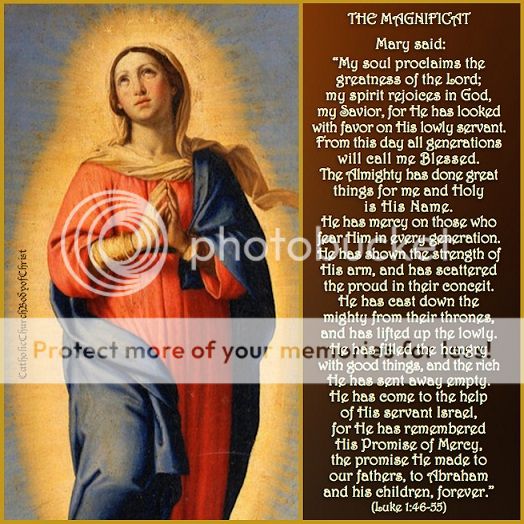
Mary said:
“My soul proclaims the greatness of the Lord;
my spirit rejoices in God my savior.
for he has looked upon his lowly servant.
From this day all generations will call me blessed:
the Almighty has done great things for me,
and holy is his Name.
He has mercy on those who fear him
in every generation.
He has shown the strength of his arm,
and has scattered the proud in their conceit.
He has cast down the mighty from their thrones
and has lifted up the lowly.
He has filled the hungry with good things,
and the rich he has sent away empty.
He has come to the help of his servant Israel
for he remembered his promise of mercy,
the promise he made to our fathers,
to Abraham and his children for ever.”

Mary remained with Elizabeth about three months
and then returned to her home.
user posted image

REFLECTION

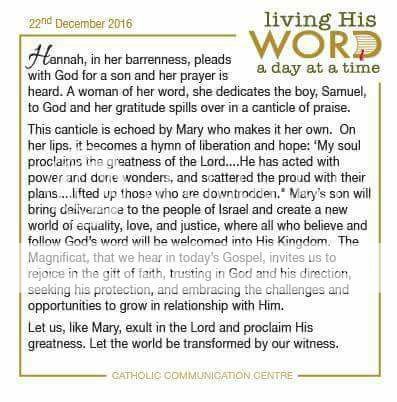
THE GREATNESS OF THE LORD. In Mary’s visit to Elizabeth, right after their conversation, Mary sings her canticle. Her song focuses on the greatness of God. Believing she is blessed and being aware of the great Child in her womb, Mary enumerates the great things God has done for her and for her people Israel.

The canticle looks innocent, but it contains memories dangerous to those who want to cling to power, wealth, and prestige. These people should learn from history that shows how God has overthrown them all. Now they are no more. God will do the same to the present oppressive worldly powers. It is just a matter of time.

Here in her song, Mary, like a conscienticized activist, shows awareness of what has happened. She is not ignorant of the struggles of her countrymen and women who have suffered much from oppression and poverty.

Mary sees that with her Son, being the fulfillment of prophecies and a sure sign that God remembers his mercy, another revolution is brewing. Her Son will overthrow the oppressive economic, political, and social systems, along with those who are promoting them. That is how God shows his greatness, and it makes Mary rejoice and sing.

Mary’s canticle challenges us to see our spirituality or religion as a power for social change or transformation and our faith as a force for liberation.

Abandon your irrelevant and self-serving piety. Embrace Jesus and his purpose.

SOURCE: “366 Days with the Lord 2016,” ST. PAULS Philippines, 7708 St. Paul Rd., SAV, Makati City (Phils.) http://www.ssp.ph/

khool
post Dec 22 2016, 10:13 AM

Getting Started
**
Junior Member
225 posts

Joined: Mar 2008


user posted image

khool
post Dec 22 2016, 10:21 AM

Getting Started
**
Junior Member
225 posts

Joined: Mar 2008


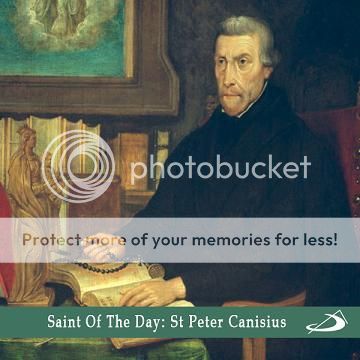
Saint of the Day: St. Peter Canisius

user posted image

In 1565, the Vatican was looking for a secret agent. It was shortly after the Council of Trent and the pope wanted to get the decrees of the Council to all the European bishops. What would be a simple errand in our day, was a dangerous assignment in the sixteenth century. The first envoy who tried to carry the decrees through territory of hostile Protestants and vicious thieves was robbed of the precious documents. Rome needed someone courageous but also someone above suspicion. They chose Peter Canisius. At 43 he was a well-known Jesuit who had founded colleges that even Protestants respected. They gave him a cover as official "visitor" of Jesuit foundations. But Peter couldn't hide the decrees like our modern fictional spies with their microfilmed messages in collar buttons or cans of shaving cream. Peter traveled from Rome and crisscrossed Germany successfully loaded down with the Tridentine tomes -- 250 pages each -- not to mention the three sacks of books he took along for his own university!

Why did the Vatican choose Peter Canisius for this delicate task?

Born in Holland in 1521, Peter had edited and written several volumes on Church history and theology, been a delegate to the Council of Trent, and reformed the German universities from heresy. Called to Vienna to reform their university, he couldn't win the people with preaching or fancy words spoken in his German accent. He won their hearts by ministering to the sick and dying during a plague. The people, the king, and the pope all wanted to make Peter bishop of Vienna, but Peter declined vigorously and administered the diocese for a year.

For many years during the Reformation, Peter saw the students in his universities swayed by the flashy speeches and the well-written arguments of the Protestants. Peter was not alone in wishing for a Catholic catechism that would present true Catholic beliefs undistorted by fanatics. Finally King Ferdinand himself ordered Peter and his companions to write a catechism. This hot potato got tossed from person to person until Peter and his friend Lejay were assigned to write it. Lejay was obviously the logical choice, being a better writer than Peter. So Peter relaxed and sat back to offer any help he could. When Father Lejay died, King Ferdinand would wait no longer. Peter said of writing: "I have never learned to be elegant as a writer, but I cannot remain dumb on that account." The first issue of the Catechism appeared in 1555 and was an immediate success. Peter approached Christian doctrine in two parts: wisdom -- including faith, hope, and charity -- and justice -- avoiding evil and doing good, linked by a section on sacraments.

Because of the success and the need, Peter quickly produced two more versions: a Shorter Catechism for middle school students which concentrated on helping this age group choose good over evil by concentrating on a different virtue each day of the week; and a Shortest Catechism for young children which included prayers for morning and evening, for mealtimes, and so forth to get them used to praying.

As intent as Peter was on keeping people true to the Catholic faith, he followed the Jesuit policy that harsh words should not be used, that those listening would see an example of charity in the way Catholics acted and preached. However, his companions were not always as willing. He showed great patience and insight with one man, Father Couvillon. Couvillon was so sharp and hostile that he was alienating his companions and students. Anyone who confronted him became the subject of abuse. It became obvious that Couvillon suffered from emotional illness. But Peter did not let that knowledge blind him to the fact that Couvillon was still a brilliant and talented man. Instead of asking Couvillon to resign he begged him to stay on as a teacher and then appointed him as his secretary. Peter thought that Couvillon needed to worry less about himself and pray more and work harder. He didn't coddle him but gave Couvillon blunt advice about his pride. Coming from Peter this seemed to help Couvillon. Peter consulted Couvillon often on business of the Province and asked him to translate Jesuit letters from India. Thanks to Peter , even though Couvillon continued to suffer depression for years, he also accomplished much good.

Peter died in December 21, 1597. He is known as the Second Apostle of Germany and was named a Doctor of the Church.

In His Footsteps
Peter believed in the importance in learning and understanding the Catholic faith. If it is available to you, resolve to read a portion of the new Catechism of the Catholic Church. Don't try to read too much but consider reading a page a day. Before we can spread our faith we must have a solid foundation in ourselves.

Prayer:
Saint Peter Canisius, you saw the good in even the most troublesome of people. You found their talents and used them. Help me to see beyond the behavior of others that may bother me to the gifts God has given them. Amen

St. Peter Canisius, Ora pro nobis!
Mother of Perpetual Help, Ora pro nobis!
Jesus Christ, miserere nobis!

Saint of The Day: - Saint Peter Canisius
#SaintOfTheDay #Confessor #DoctorOfTheChurch


Ordained Priest at 25 (1546), at age 26 Peter Canisius assisted Cardinal-Bishop of Augsburg as Theologian at the Council of Trent. After making his solemn profession as a Jesuit in 1549—the first German to do so!—he taught Theology at the University of Vienna, preached in the cathedral and at the court of Ferdinand I, and laboured in every way to restore true Catholic doctrine, for the Church in Vienna was in a deplorable state due to acute shortage of priests.

He kept himself free (in contrast to the Protestants) from all narrow-mindedness and personal vituperation, his exemplary humility, moderation and tact, making him the most influential leader of the Counter Reformation in those lands, the “Second Apostle of Germany”.

He corresponded enormously with Saints Charles Borromeo, Philip Neri and Francis de Sales, and was in demand as adviser to pope, bishop, king, prince and commoner alike. He zealously promoted Rosary sodalities, encouraged the publication of good books, and founded some 30 schools and Papal seminaries in order to form an instructed laity and a devout clergy. Thousands were won back to the Faith and crowds thronged his confessional and the Masses he celebrated.

His ascetic and homiletic writings aside he is most famous for his Triple Catechism—for children, young people and adults—containing a lucid treatise on Roman Catholic dogma, which even in his lifetime saw 200 editions in 12 languages.
Peter died in 1597, was beatified in 1864, and was canonized and declared Doctor of the Church in 1925.

Reflection: “If you want to be of use to others, begin by taking pains with yourself, the fire that is to enkindle others should be lighted at home” (Saint Ignatius de Loyola).

khool
post Dec 22 2016, 10:42 AM

Getting Started
**
Junior Member
225 posts

Joined: Mar 2008


7 powerful morning prayers you need to get your day started with God

Rise and shine – the great morning awaits all of God’s children.

This may be a well-known fact … not everyone is a morning person. Some people really struggle to get out of bed and get their day started. Praying to God is the perfect way to find the needed encouragement, peace and strength for the day’s tasks. With hopes of helping those anti-morning believers and further inspiring the go-getters of the world, we present to you a wonderful list of powerful morning prayers.

Arising from Sleep
O Master and holy God, who are beyond our understanding: at your word, light came forth out of darkness. In your mercy, you gave us rest through night-long sleep, and raised us up to glorify your goodness and to offer our supplication to You. Now, in your own tender love, accept us who adore You and give thanks to You with all our heart. Grant us all our requests, if they lead to salvation; give us the grace of manifesting that we are children of light and day, and heirs to your eternal reward. In the abundance of your mercies, O Lord, remember all your people; all those present who pray with us; all our brethren on land, at sea, or in the air, in every place of Your domain, who call upon your love for mankind. Upon all, pour down your great mercy, that we, saved in body and in soul, may persevere unfailingly; and that, in our confidence, we may extol your exalted and blessed Name, Father, Son, and Holy Spirit, always, now and forever. Amen
beautiful morning

The Good Morning God Prayer
Good Morning God!
You are ushering in another day,
untouched and freshly new.
So here I am to ask you, God,
if You’ll renew me too.

Forgive the many errors that I made yesterday
and let me try again dear God
to walk closer in Your way.

But Lord, I am well aware,
I can’t make it on my own.
So take my hand and hold it tight,
for I cannot walk alone.

Morning Offering to the Sacred Heart
O Jesus, through the Immaculate Heart of Mary, I offer You my prayers, works, joys and sufferings of this day for all the intentions of Your Sacred Heart, in union with the Holy Sacrifice of the Mass throughout the world, in reparation for my sins, for the intentions of all our associates, and in particular for the intentions of our Holy Father for this month.

Morning Prayer
I adore Thee, O my God, and I love Thee with all my heart. I give Thee thanks that Thou hast created me, made me a Christian, and preserved me this night. I offer Thee the actions of this day; grant that all of them may be according to Thy holy Will, and for Thy greater glory. Save me from sin and from all evil. Let Thy grace be always with me.
Amen.

Prayers at the Day’s Beginning
Lord, one more day to love you!
O Jesus, watch over me always, especially today, or I shall betray you like Judas.
Lord, today is the day I begin!
Jesus, shine through me and be so in me that every person I come in contact with may feel your presence in my soul.
My God, send me thy Holy Spirit to teach me what I am and what thou art!
May the Passion of Christ be ever in our heart.
And to be more with Him, more with Him, not merely with oneself.

Father, my heart is heavy. I feel like I have to carry the burden alone. Words like “overwhelmed,” “distraught,” “exhausted” seem to describe where I am. I am not sure how to let you carry my heavy load, so please show me how. Take it from me. Let me rest and be refreshed so that my heart won’t be so heavy in the morning. In Jesus’ name. Amen.

Dear Lord, help me remember what a difference it makes when I make time with You a priority in my morning. Awaken me in body and spirit each day with a desire to meet with You and to hear You speak words of affirmation, assurance and wisdom over my heart as I prepare to go into my day. In Jesus’ Name, Amen.

Source: http://catholicsay.com/7-powerful-morning-...arted-with-god/

khool
post Dec 22 2016, 08:41 PM

Getting Started
**
Junior Member
225 posts

Joined: Mar 2008


user posted image

khool
post Dec 23 2016, 09:56 AM

Getting Started
**
Junior Member
225 posts

Joined: Mar 2008


Thursday of the Fourth Week in Advent
Lectionary: 198


user posted image

Reading 1 (1 Sm 1:24-28)

In those days,
Hannah brought Samuel with her,
along with a three-year-old bull,
an ephah of flour, and a skin of wine,
and presented him at the temple of the LORD in Shiloh.
After the boy’s father had sacrificed the young bull,
Hannah, his mother, approached Eli and said:
“Pardon, my lord!
As you live, my lord,
I am the woman who stood near you here, praying to the LORD.
I prayed for this child, and the LORD granted my request.
Now I, in turn, give him to the LORD;
as long as he lives, he shall be dedicated to the LORD.”
She left Samuel there.

Responsorial Psalm (1 Sm 2:1, 4-5, 6-7, 8abcd)

R. My heart exults in the Lord, my Savior.

“My heart exults in the LORD,
my horn is exalted in my God.
I have swallowed up my enemies;
I rejoice in my victory.”
R. My heart exults in the Lord, my Savior.

“The bows of the mighty are broken,
while the tottering gird on strength.
The well-fed hire themselves out for bread,
while the hungry batten on spoil.
The barren wife bears seven sons,
while the mother of many languishes.”
R. My heart exults in the Lord, my Savior.

“The LORD puts to death and gives life;
he casts down to the nether world;
he raises up again.
The LORD makes poor and makes rich,
he humbles, he also exalts.”
R. My heart exults in the Lord, my Savior.

“He raises the needy from the dust;
from the dung heap he lifts up the poor,
To seat them with nobles
and make a glorious throne their heritage.”
R. My heart exults in the Lord, my Savior.

Alleluia

R. Alleluia, alleluia.
O King of all nations and keystone of the Church:
come and save man, whom you formed from the dust!
R. Alleluia, alleluia.

Gospel (Lk 1:46-56p)

Mary said:
“My soul proclaims the greatness of the Lord;
my spirit rejoices in God my savior.
for he has looked upon his lowly servant.
From this day all generations will call me blessed:
the Almighty has done great things for me,
and holy is his Name.
He has mercy on those who fear him
in every generation.
He has shown the strength of his arm,
and has scattered the proud in their conceit.
He has cast down the mighty from their thrones
and has lifted up the lowly.
He has filled the hungry with good things,
and the rich he has sent away empty.
He has come to the help of his servant Israel
for he remembered his promise of mercy,
the promise he made to our fathers,
to Abraham and his children for ever.”

Mary remained with Elizabeth about three months
and then returned to her home.

user posted image

REFLECTION

THE LORD HAD SHOWN HIS GREAT MERCY TOWARD HER. Elizabeth’s neighbors and relatives see her giving birth to John as a sign of God showing His great mercy to her. They are all amazed at this extraordinary childbirth. They see it as God’s intervention in her life, curing her sterility or, in Old Testament parlance, opening her womb. Elizabeth has earlier acknowledged this: “The Lord… has seen fit to take away my disgrace before others” (Lk 1:25).

The joy of the people over John’s birth comes also as a result of their own prayers and expectations. One cannot rejoice over the miraculous birth if one has not long desired it. The event is not private, not only for the elderly couple. The neighbors and relatives have been following up the developments.

In the naming of the child, God further shows mercy to Zechariah whose mouth is reopened. Nine months earlier, Zechariah was struck dumb for not quite believing God’s good news announced by the angel Gabriel (cf Lk 1:20). Once his mouth opens, Zechariah blesses God and sings his canticle, picking up the theme of God’s mercy (cf Lk 1:72, 78).

John’s birth invites us to see children being conceived and born as God’s intervention of mercy in our lives and regain our capacity to be amazed and to rejoice with women giving birth.

Do you promote the culture of life? Are you in favor of zero population growth?

SOURCE: “366 Days with the Lord 2016,” ST. PAULS Philippines, 7708 St. Paul Rd., SAV, Makati City (Phils.) http://www.ssp.ph/

TSyeeck
post Dec 25 2016, 03:01 AM

Look at all my stars!!
*******
Senior Member
3,576 posts

Joined: Apr 2006


khool
post Dec 25 2016, 10:02 AM

Getting Started
**
Junior Member
225 posts

Joined: Mar 2008


khool
post Dec 25 2016, 01:36 PM

Getting Started
**
Junior Member
225 posts

Joined: Mar 2008


user posted image

TSyeeck
post Dec 27 2016, 05:35 PM

Look at all my stars!!
*******
Senior Member
3,576 posts

Joined: Apr 2006


QUOTE(khool @ Nov 29 2016, 02:24 PM)
Looks good, can't wait to watch it!


*
Scorsese’s Silence is not a Christian film by a Catholic filmmaker, but a justification of faithlessness: apostasy becomes an act of Christian charity when it saves lives, just as martyrdom becomes almost satanic when it increases persecution. “Christ would have apostatized for the sake of love,” Ferreira tells Rodrigues, and, obviously, Scorsese agrees.
TSyeeck
post Dec 27 2016, 05:50 PM

Look at all my stars!!
*******
Senior Member
3,576 posts

Joined: Apr 2006


khool
post Dec 27 2016, 09:03 PM

Getting Started
**
Junior Member
225 posts

Joined: Mar 2008


[SIZE=7][/SIZE]

user posted image

My brothers and sisters, the end of 2016 is upon us. 2016 has proven to be a year of relentless attacks on the very fabric of our faith. The evil one is attacking the church from within, attacking its people on all fronts and on all continents of our world. We all need to return to the very basic fundamentals of Christ's love for us.

The dawn of a new age is awakening. Each year people firmly believe that this will be the year - the year they lose weight, the year they make more of an impression at work, the year something is better than the previous. This is all good but we need to make a New Year's resolutions to follow Christ and spread his good news throughout the world. Only when Christians are like Christ will we begin to drive the evil one from our midst.

Here are some things you can do to help promote the faith and strengthen your relations with our Lord:

Go to Daily Mass. The Catechism of the Catholic Church, quoting Lumen Gentium, describes the Eucharist as "the source and suumit of the Christian life" and states that "the Church strongly encourages the faithful to receive the holy Eucharist on Sundays and feast days, or more often still, even daily." Resolve to attend just one more Mass each week.

Add a new prayer to your prayer routine. There are so many ways of incorporating more prayer in your life: Daily Mass, the Rosary, the Chaplet of Divine Mercy, the Noon-time Angelus- the list is endless. Make a commitment that will be achievable - even if the only commitment you are able to make is to pray one single Our Father each day.

Read the scriptures. The Bible is the living word of God and spending just 10 minutes a day reading it will change your life. If you are new to reading the Bible - begin with the Gospel of John and commit to reading for 10 minutes. If you are already a regular scripture-reader, pick a book that you are not as familiar with and begin reading.

Forgive. Holding on to unforgiveness is hurting only one person - you. This New Year - resolve to forgive those who have hurt you. Spend some time in prayer and ask the Lord for the grace to extend forgiveness. Remember that Jesus forgave from the Cross- it is difficult to withhold forgiveness when you meditate on the crucifixion scene. A great way to start is to write a letter to the person who has hurt you (you don't have to actually send it). In the letter, be specific about what you are forgiving that person for. When you have completed the letter, place the person in the Lord's hands and let them go.

Learn to listen. Listening and patience go hand-in-hand. Learning to listen, rather than merely being present, can make a world of difference both to you and the person or people you are talking to.
Note that the art of listening is not limited to the people around you. God speaks to us every day, but how many of us can say that we have the ears to listen? Listening to God can be difficult, particularly when you are in desperate need of answers.
James 1:19 helps us understand what listening means. "Remember this, my dear brothers: everyone should be quick to listen but slow to speak and slow to human anger..." A good way to practice listening to God is to sit in a quiet place. Ask God to help you be more open to what He has to say, and ask for the patience to actively listen to those around you.
Bonus: Putting down electronics and looking people in the eye helps you become a better listener.

Be generous. This is not limited to money! Remember, when we offer to help people pack for a move, practice for a speech, listen to their worries or feed the hungry, we are being generous and mirroring Christ's heart.

Make a difference in your parish community. Believe it or not, your parish community can use your talents. Offering your talents to your faith community is one of the most effective ways to feel useful and connected to others, and it is a potentially life-changing New Year's resolution.

Be present to others. There is much celebration and mourning, joy and sorrow in peoples' lives. What a blessing it is to be able to share those times and not let others experience them alone. The gift of your presence to others is much more valuable than you realize.

Nurture friendships. Our friends are those we choose to be with, those with whom we spend our evenings, with whom we vacation, to whom we go to for advice. Friends are gifts from God who give us a greater appreciation of God's love for us. Friends need our time and love.

Lastly, whatever you do, don't give up. People give up their New Year's resolutions because of perfectionism and unrealistic expectations. So take it slow, be kind to yourself and keep trying. Resist the urge to throw your hands up and quit. You succeed through small, manageable changes over time. Ask the Lord for guidance, strength and perseverance in achieving your resolutions. In his letter to the Phillipians, Saint Paul writes: "I can do everything through Him who gives me strength" (Phil 4:13). If God is the center of our New Year's resolutions, they have a better chance for success.

Peace and blessings for a healthy, prosperous and faith filled 2017!

khool
post Dec 28 2016, 12:50 PM

Getting Started
**
Junior Member
225 posts

Joined: Mar 2008


Christmastide: The Celebration Has Just Begun!

What does December 26th mean to you?

For most people it means that Christmas is over. But for Catholics, it means the celebration has only just begun.

Many of us Catholics, however, are not aware of this, and our rhythm of celebrating Christmas is very much along the lines of the secular celebration. We put a massive amount of effort into preparing for December 25th; then, the very next day, we feel a bit blue.

“It’s over,” we think. We begin the process of removing decorations, drag the tree out onto the curb, and return to our work-a-day lives.

Don’t! Stop right there.

The carols, the feasting, the lights, the joy, have only just commenced. We are about to rejoice in an octave (and more!) of the radiant splendor of the birth of Christ, the Messiah.

There is a reason why Christmas is called a season. It does not last for a single day. After Easter, it is the most important liturgical feast in the Church calendar. Why? Because Christmas is what made Easter possible. Without Our Lord’s incarnation and birth, our redemption would not have been brought to completion, and there would be no hope for us in our fallen state.

So first, we celebrate the octave of Christmas. This means that there are eight official solemn days of rejoicing. In the language of the Church, the word “solemn” does not mean what our common use of the word defines it as. It doesn’t mean being grim, serious, or morose.

According to a simple definition: “In the Catholic Church year, a solemnity is the highest ranking holy day possible in the Church calendar…” These are days that are emphasized by particular joy, lavishness, pomp, and glory.

This might be hard to recognize in the lay life, but it’s unspeakably obvious in the religious life, where the Divine Office (the prayer known as the Liturgy of the Hours) practically shouts out Hallelujah!

Basically, during the octave of Christmas, the office that is prayed each day—for eight straight days—is more or less the same office: the one for Christmas day.

Think about what that means: it means that we are celebrating each day, for eight days, as though each of them were Christmas day itself.

Isn’t that beautiful? The Church so rejoices in the birth of her Bridegroom and Savior that she simply revels in the joy!

While the reality of the Christmas octave (the word “octave” just refers to the number 8) may be a new concept for many of us, who isn’t familiar with the “12 Days of Christmas”? These 12 days refer to the Christmas octave as well as the four subsequent days which take us to the feast of Epiphany.

And actually, if we are going to be very thorough and precise about this, on the traditional liturgical calendar, the Christmas season (also known as Christmastide) lasts 40 days. It begins with the vigil Mass said on Christmas Eve, and ends on February 2nd, Candlemas, which is the day on which we celebrate the feast of Jesus’ presentation in the temple.

Christmastide

December 26th – Christmas Octave – Feast of St. Stephen, Deacon and First Martyr

December 27th – Christmas Octave – Feast of the Holy Family (Usually this is the Feast of St. John, Apostle and Evangelist, but the Feast of the Holy Family is celebrated on the first Sunday after Christmas, so that is what is being celebrated this year)

December 28th – Christmas Octave – Feast of the Holy Innocents

December 29th – Christmas Octave – Feast of St. Thomas Becket, Archbishop and Martyr

December 30th – Christmas Octave

December 31st – Christmas Octave – Feast of St. Sylvester I, Pope

January 1st – Christmas Octave – Solemnity of Mary, Mother of God (Holy Day of Obligation)

January 2nd – Feast of Saints Basil the Great and Gregory Nazianzen, Bishops and Doctors of the Church

January 3rd – Feast of Epiphany (This feast is actually celebrated on January 6th, but in the USA it has been moved to the nearest Sunday)

January 4th – Feast of St. Elizabeth Ann Seton

January 5th – Feast of St. John Neumann

January 6th – 12th Day of Christmas (Traditionally the Feast of Epiphany)

January 7th – Christmas season – Thursday after Epiphany

January 8th – Christmas season – Friday after Epiphany

January 9th – Christmas season – Saturday after Epiphany

January 10th – End of Christmas season on the new calendar – Feast of the Baptism of the Lord

February 2nd – End of Christmas season on the old calendar – Candlemas (Presentation of the Child Jesus)

Source: https://www.catholiccompany.com/getfed/cele...e=socialnetwork

TSyeeck
post Dec 30 2016, 02:47 PM

Look at all my stars!!
*******
Senior Member
3,576 posts

Joined: Apr 2006


Circumcision: An Acceptable Practice?

The first of January is the Octave Day of Christmas. In the traditional Roman rite, it is the Feast of the Circumcision of Our Lord. Among other gems, this feast gives us the sublimely beautiful Benedictus antiphon, Mirabile mysterium, which has been wonderfully set to music and commented upon by great liturgical writers like Blessed Columba Marmion. The feast has also long had a Marian character to it, which fact gives some pretext to the new rite’s Solemnity of the Mother of God on that day.

The feast of the Circumcision shows us Mary and Joseph’s humble fidelity to the covenant made between God and Abraham, with its peculiar sign that “would be in your flesh for a perpetual covenant” (Gen. 17:13). In this rite, we see a sort of anticipation of the Passion, for Our Lord’s Precious Blood was shed for the first time on that day. The Octave of the Nativity also marks the occasion when the Holy Infant received the name “Jesus,” which means Savior, and the Church stretches this particular mystery out another day, giving us the Feast of the Holy Name of Jesus. The connection between the Precious Blood and our salvation are thus made quite clear.

Surely, with such a Biblical pedigree, the ceremony of circumcision is a good thing and something that ought to be practiced by Christians, no?

No! The Apostle tells us “For in Christ Jesus neither circumcision availeth any thing, nor uncircumcision: but faith that worketh by charity” (Gal. 5:6). And: “For in Christ Jesus neither circumcision availeth any thing, nor uncircumcision, but a new creature” (Gal. 6:15). Lastly: “Is any man called in uncircumcision? let him not be circumcised. Circumcision is nothing, and uncircumcision is nothing: but the observance of the commandments of God” (I Cor. 7:18-19).

In case the abrogation of this covenant was not obvious enough from Holy Scripture, the Church has multiple times reasserted, and very vigorously, that the religious ritual of circumcision is forbidden. It is one of those observances of the Old Law which is “both dead and deadly” according to the Church, which declared in the Council of Florence that,

All, therefore, who after that time [that is “after the promulgation of the Gospel”] observe circumcision and the Sabbath and the other requirements of the [Mosaic] law, it [The Catholic Church] declares alien to the Christian faith and not in the least fit to participate in eternal salvation, unless someday they recover from these errors. (Denz. 712)

Religious ritual circumcision is clearly off limits for Christians. But what about the modern medical practice? That’s good, right? It’s healthy, hygienic, aesthetic, and all those other wonderful things that many in the medical profession assure us it is, right?

Again, no.

What is done in modern American hospitals goes back to a Victorian obsession with physical hygiene and (believe it or not) a moral crusade to prevent what is delicately called “the solitary sin.” This is quite documented, and not just on Wikipedia. Circumcision, of course, does not help that moral disorder, the correction of which is reserved solely to the practice of virtue. Most of the Anglosphere stopped (or drastically curtailed) the practice of elective medical infant circumcision, but not the United States! We kept right on with it, due to a number of strange reasons, some cultural, and one of which is wickedly capitalist, for the American medical profession collects enormous sums from the sale of foreskins for medical research, skin grafts, and as ingredients in cosmetics (no, this is not… fake… news!).

What is done in American hospitals is not what was done to Abraham, Isaac, or Jacob. Aside from its not having the same spiritual significance, it is not the same physical operation. In the modern practice, much more perfectly healthy tissue is amputated. The Old Testament practice, called in Hebrew brit milah, accomplished the removal of a small tip of the prepuce, leaving the glans covered. But the procedure for ritual circumcision was vastly altered by the rabbis around 140 A.D. into a much more intrusive procedure which amputates the entire prepuce, with its complex network of skin folds that cover the glans, as well as thousands of nerve endings, sebaceous glands, blood vessels, and even muscle tissue — all of which is part of the bodily integrity of that organ as God created it. This procedure, called in Hebrew brit periah, is much more painful, and is not what was mandated by God in the covenant with Abraham. (This article at Fisheaters (http://www.fisheaters.com/circumcision2.html?mc_cid=cb13ae79fa&mc_eid=93d38bed20) documents the difference between brit milah and brit periah from the 1906 Jewish Encyclopedia.)

The reasons the rabbis made this change have been documented, but are a bit too indelicate for me to go into here. A clinically modest black and white series of illustrations will allow the reader a rapid glance at the considerable difference between the two practices.

The alleged health benefits that accrue to the victim of this barbarity have been debunked. But even if sexually transmitted diseases and AIDS were actually statistically lowered by infant circumcision, there are other ways of preventing those diseases — most notably living a virtuous life. We need not mutilate every boy because he might become a lecher one day and expose himself to those diseases. As for cancer, there are more chances that other organs will become cancerous (female breasts and the male prostate), and we don’t go mutilating them in newborns to prevent disease from happening decades later. If the excuse of disease prevention were consistently applied across the human anatomy, we would become a society of cripples with (potentially) fewer diseases.

There are Catholic moralists, like Father John J. Dietzen, Dr. David Lang, and (in the 1950’s) Father Edwin F. Healy, S.J., who teach that elective male infant circumcision not only violates the proper application of the time-honored principle of totality, but even fits the ethical definition of mutilation, which is gravely sinful. Indeed, if what we are talking about is a procedure that removes healthy tissue without any therapeutic reason at all, with only questionable (at best) or spurious prophylactic justifications, and that has serious risks of its own — including complications like hemorrhage, infection, ulceration, partial or total disfigurement, and even death — then there is overwhelming evidence to suggest that Catholic moral principles would oppose it.

Information on the issue abounds. Besides Catholics against Circumcision, whom I contacted while doing my own research, there are organizations like Doctors Opposing Circumcision, Mothers against Circumcision, and the National Organization of Circumcision Information Resource Centers. There are also books on the subject like Marked in Your Flesh: Circumcision from Ancient Judea to Modern America by Leonard B. Glick, What Your Doctor May Not Tell You About Circumcision by Paul M. Fleiss and Frederick Hodges, and Circumcision, The Hidden Trauma by Ronald Goldman.
khool
post Dec 30 2016, 10:07 PM

Getting Started
**
Junior Member
225 posts

Joined: Mar 2008


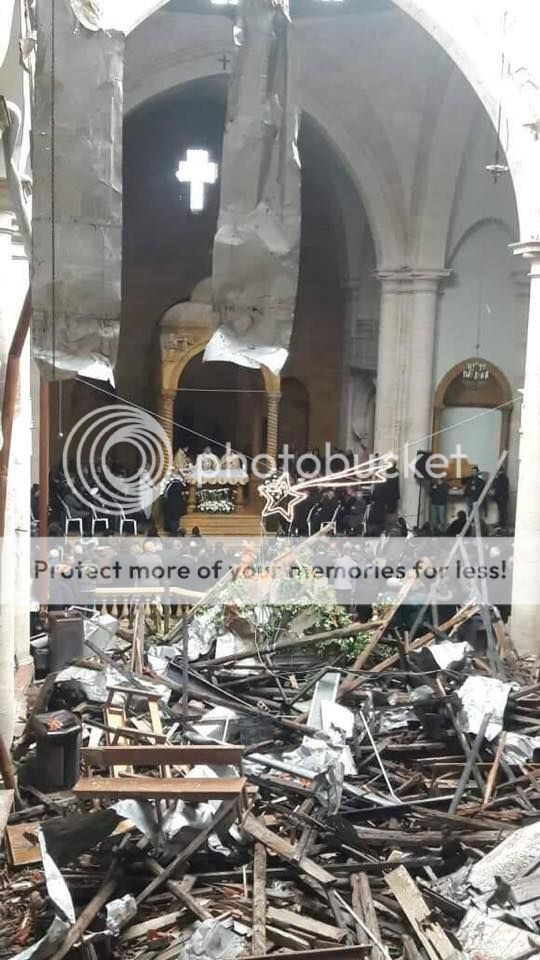
Christmas mass in Aleppo (Maronite Cathedral)

Glory to God in the highest!

user posted image

JeremyLord
post Dec 31 2016, 11:44 AM

Casual
***
Junior Member
321 posts

Joined: Nov 2012
From: Planet Earth

Jan 2 2017, 12:35 AM
This post has been deleted by yeeck because: immodest picture

TSyeeck
post Jan 2 2017, 01:12 AM

Look at all my stars!!
*******
Senior Member
3,576 posts

Joined: Apr 2006


user posted image

How Can Mary Be God’s Mother?
By: Tim Staples

For many in the more traditional Protestant communities, believing Mary to be the Theotokos (Greek, "God-bearer") or Mother of God, is an area of agreement with Catholics. If Jesus Christ is truly God, then Mary is truly the Mother of God. But millions of others in Fundamentalist and Evangelical communities would not join Catholics in celebrating the Solemnity of Mary, the Mother of God.

The objections to this great dogma of the faith are essentially three. The first objection states the obvious. Nowhere in Sacred Scripture are the words "Mother of God" used to describe Mary. "If this doctrine were as important as Roman Catholics claim, would not at least one of the inspired writers have used it?" The second objection is rooted in Luke 1:43—a text used by Catholics to demonstrate a biblical foundation for the Theotokos —wherein Elizabeth "exclaimed [to Mary] with a loud cry, ‘Blessed are you among women, and blessed is the fruit of your womb! And why is this granted me, that the mother of my Lord should come to me?’" Fundamentalists point out this text does not call Mary Mother of God; it calls her mother of my Lord. The New Testament uses the term "lord" (Gr., kurios) in the context of divinity at times, but it also uses it with reference to human persons in various contexts. The passage in Luke, it is argued, does not refer to the divinity of Christ, but to his humanity. And finally, Protestants make the point that it is impossible for God to have a Mother. "God is a Trinity. If Mary is the Mother of God, she is the mother of the Trinity. Therefore, the Trinity is no longer a Trinity—it would be a Quadrinity!"

Objection 1: Where Is That in the Bible?

To say Mary cannot be the Mother of God because Sacred Scripture does not use those explicit words places the Protestant in a very uncomfortable position. He would also have to conclude multiple essential Christian doctrines to be erroneous because they are not found verbatim in the Bible either. Take the Trinity, for example. This doctrine is preeminent among all Christian doctrines—and yet the term "Trinity" is not found in the Bible. Nor are terms like homoousios (Gr., "same nature"; Jesus has the "same nature" as his Father) or hypostatic union. The question the Protestant should ask is: Is the concept of Mary, Mother of God revealed to us in Sacred Scripture? And we will see that it is. Thus, this first objection is quite easily dismissed.

Objection 2: Luke 1:43

Objection 2 is not so easily dismissed. The Greek word kurios or "lord" can indeed be used to denote divinity but not necessarily so. In fact, an example of the latter is found in 1 Corinthians 8:5: "For although there may be so-called gods in heaven or on earth—as indeed there are many ‘gods’ and many ‘lords’ . . ." Here the term "lord" (kurios) is obviously not used to refer to divinity. Moreover, Christ himself refers to the "owner of the vineyard" in his parable of the householder in Matthew 21:33-40, as kurios, or "lord of the vineyard," in verse 40. Thus, kurios can be used specifically with regard to a human person. However, if we go back to 1 Corinthians 8:5, the next verse gives us an example of kurios being used with regard to divinity: "Yet to us there is one God, the Father, from whom are all things, and for whom we exist, and one Lord, Jesus Christ, through whom are all things and through whom we exist." Notice two key points: Jesus is called both the one Lord and he is called creator of all things. There can be no doubt the context refers to our Lord’s divinity. Every Jew knew the truth of the great Sh’ma of Deuteronomy 6:4: "Hear, O Israel: The Lord our God is one Lord." There is only one Lord in Israel. And according to 1 Corinthians, Jesus is that one Lord. Moreover, Jesus is called the creator of all things. Genesis 1:1 cannot make any clearer that it is almighty God who is the creator of all things. "In the beginning God created the heavens and the earth." The title kurios applied to Christ as creator of all things in 1 Corinthians 8:6 is clearly a title of divinity for Christ. It is the context that makes this so apparent.

The key to our discussion then is to ascertain how kurios is being used of Christ in Luke 1:43. Was it being used to describe Jesus with regard to his humanity alone, or with regard to his divinity? There are at least two reasons we can know for certain it refers to Christ as a divine person. First, if we understand its Old Testament antecedent, the conclusion becomes clear. Elizabeth was referring, almost verbatim, to a text from 2 Samuel 6:9 wherein David exclaims concerning the Old Testament Ark of the Covenant: "And David was afraid of the Lord that day; and he said, ‘How can the ark of the Lord come to me?’" When Elizabeth "exclaimed with a loud cry . . . Why is this granted me, that the mother of my Lord should come to me" (Luke 1:42-43), Mary was revealed to be the New Testament Ark of the Covenant. The question for us, then, is: Was the Ark of the Covenant in the Old Testament the ark of an earthly potentate, or was it the ark of almighty God? The answer is obvious. In the same way, the more glorious New Testament Ark of the Covenant is not an ark of an earthly potentate, but it is the Ark of Almighty God.

The second and most important reason we know Luke 1:43 is referring to Mary to be the Mother of God is summed up in the Catechism of the Catholic Church:

Called in the Gospels "the mother of Jesus," Mary is acclaimed by Elizabeth, at the prompting of the Spirit and even before the birth of her son, as "the mother of my Lord." In fact, the One whom she conceived as man by the Holy Spirit, who truly became her Son according to the flesh, was none other than the Father’s eternal Son, the second Person of the Holy Trinity. Hence the Church confesses that Mary is truly "Mother of God" (Theotokos). (CCC 495)

Mary is the Mother of God precisely because Jesus Christ, her Son, is God. And when Mary gave birth, she did not give birth to a nature, or even two natures; she gave birth to one, divine Person. To deny this essential truth of the faith, as the Council of Ephesus (A.D. 431) declared, is to cut oneself off from full communion with Christ and his Church. The first of many "anathemas" that would be accepted by the Council decreed: "If anyone does not confess that God is truly Emmanuel, and that on this account the Holy Virgin is the Mother of God (for according to the flesh she gave birth to the Word of God become flesh by birth), let him be anathema."

Notice the Council referred to the prophecy of Isaiah 7:14 in its definition. This text prophesied over 700 years before the birth of Christ that the Messiah was to be born of a woman and yet he was to be "God with us."

The real problem with denying Mary as Mother of God and affirming Mary to be only the mother of the man Christ Jesus is that in doing so, one invariably either denies the divinity of Christ (as the fourth-century Arians did), or one creates two persons with regard to Jesus Christ. Either error results in heresy. The Councils of Nicaea (325) and Constantinople (381) dealt decisively with the Arian heresy. Rather than teaching the truth that Christ is one divine person with two natures—one human, and one divine—hypostatically unified, or joined together without admixture in the one divine Person of Christ, they were teaching Christ to be two persons with a merely moral union. The Council fathers understood Christians could never affirm this. The Bible declares to us: ". . . in him the whole fullness of deity dwells bodily" (Col. 2:9). And, ". . . in him all things were created, in heaven and on earth, visible and invisible . . ." (Col. 1:16). Nowhere do we read in them; we only read of him. The error proposes essentially different Christs. Jesus is truly one divine Person. If one prays to a Jesus who is two persons, one prays to a "Jesus" who does not exist!

Objection 3: The "Quadrinity"?

"If God is Trinity, and Mary is the Mother of God, would that not mean Mary is the Mother of the Trinity?" Actually, it does not. Paragraph 495 of the Catechism is very clear that Mary is the Mother of the Second Person of the Blessed Trinity because neither the Father nor the Holy Spirit is incarnate. Simple enough. But the problem here may be deeper than just a confusion of persons within the Godhead. In my experience, this simple explanation almost invariably leads to another question that reveals the real difficulty for many Fundamentalists: "Even if Mary is only the Mother of the second Person of the Blessed Trinity, Jesus is just as eternal as the other two divine Persons are. Thus, in order to be his mother, Mary would have to be equally as eternal." The root of this "Quadrinity" problem is a false understanding of what is meant by Mary’s true motherhood and perhaps a false understanding of is meant by motherhood in general.

By saying Mary is the Mother of God, the Catholic Church is not saying that Mary is the source of the divine nature among the three Persons of the Blessed Trinity, nor is she the source of the divine nature of the second Person. But she doesn’t have to be in order to be the Mother of the second Person of the Blessed Trinity incarnate. Perhaps an analogy using normal human reproduction will help clarify the truth of the matter. My wife is the mother of my son, Timmy. But this does not mean she is the source of Timmy’s immortal soul. God directly and immediately created his soul as he does with every human being (see Eccl. 12:7). However, we do not conclude then that Valerie is merely "the mother of Timmy’s body." She is Timmy’s mother, period. She did not give birth to a body; she gave birth to a human person who is a body/soul composite: Timmy.

Analogously, though Mary did not provide Jesus with either his divine nature or his immortal human soul, she is still his Mother because she did not give birth to a body, a soul, a nature, or even two natures—she gave birth to a Person. And that one Person is God. The conclusion to the whole matter is inescapable. Just as many of the more traditional Protestants would confess with us as Catholics: If Jesus Christ is one, eternal and unchangeable divine person—God—and Mary is his mother, then Mary is the Mother of that one, eternal and unchangeable person—God.

http://www.catholic.com/magazine/articles/...2%80%99s-mother
khool
post Jan 3 2017, 02:27 PM

Getting Started
**
Junior Member
225 posts

Joined: Mar 2008


Christmas Weekday
Lectionary: 206


user posted image

Reading 1 (1 Jn 2:29–3:6)

If you consider that God is righteous,
you also know that everyone who acts in righteousness
is begotten by him.

See what love the Father has bestowed on us
that we may be called the children of God.
Yet so we are.
The reason the world does not know us is that it did not know him.
Beloved, we are God's children now;
what we shall be has not yet been revealed.
We do know that when it is revealed we shall be like him,
for we shall see him as he is.
Everyone who has this hope based on him makes himself pure,
as he is pure.

Everyone who commits sin commits lawlessness,
for sin is lawlessness.
You know that he was revealed to take away sins,
and in him there is no sin.
No one who remains in him sins;
no one who sins has seen him or known him.

Responsorial Psalm (PS 98:1, 3cd-4, 5-6)

R. All the ends of the earth have seen the saving power of God.

Sing to the LORD a new song,
for he has done wondrous deeds;
His right hand has won victory for him,
his holy arm.
R. All the ends of the earth have seen the saving power of God.

All the ends of the earth have seen
the salvation by our God.
Sing joyfully to the LORD, all you lands;
break into song; sing praise.
R. All the ends of the earth have seen the saving power of God.

Sing praise to the LORD with the harp,
with the harp and melodious song.
With trumpets and the sound of the horn
sing joyfully before the King, the LORD.
R. All the ends of the earth have seen the saving power of God.

Alleluia (Jn 1:14a, 12a)

R. Alleluia, alleluia.
The Word of God became flesh and dwelt among us.
To those who accepted him
he gave power to become the children of God.
R. Alleluia, alleluia.

Gospel (Jn 1:29-34)

John the Baptist saw Jesus coming toward him and said,
"Behold, the Lamb of God, who takes away the sin of the world.
He is the one of whom I said,
'A man is coming after me who ranks ahead of me
because he existed before me.'
I did not know him,
but the reason why I came baptizing with water
was that he might be made known to Israel."
John testified further, saying,
"I saw the Spirit come down like a dove from the sky
and remain upon him.
I did not know him,
but the one who sent me to baptize with water told me,
'On whomever you see the Spirit come down and remain,
he is the one who will baptize with the Holy Spirit.'
Now I have seen and testified that he is the Son of God."

user posted image

REFLECTION

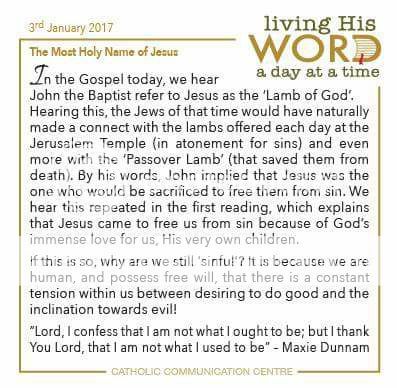
John Testified. The Gospel highlights John the Baptist’s testimony on the identity and ministry of Jesus: he is the Lamb of God who takes away the sin of the world, who existed before John, upon whom the Spirit descended, the fulfillment of a divine promise, who baptizes with the Holy Spirit, the Son of God. The different titles used to describe who Jesus is and what he does remind us that we have to be open to God’s revelation. Who Jesus is and what he does are expressed in many ways.

New evangelization calls us to “new ardor, new methods, new expressions” in proclaiming truths of our faith, so that people can appreciate the richness and vitality of life with the Lord Jesus.

In your family, workplace, and parish community, how do you show the vitality of your Catholic faith?

SOURCE: “365 Days with the Lord 2016,” ST. PAULS Philippines, 7708 St. Paul Rd., SAV, Makati City (Phils.) http://www.ssp.ph/

khool
post Jan 3 2017, 02:30 PM

Getting Started
**
Junior Member
225 posts

Joined: Mar 2008


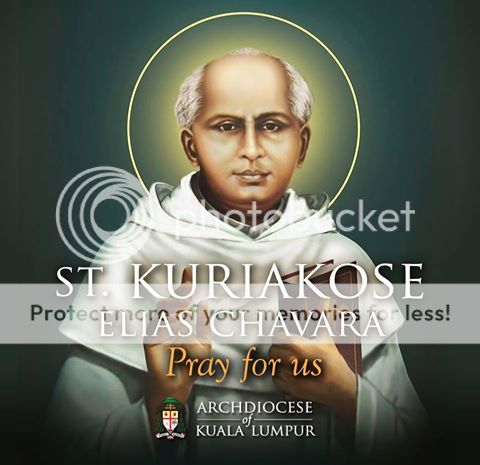
Saint Kuriakose Elias Chavara, pray for us...
Feastday: Jan 3


user posted image

Mar Kuriakose Elias Chavara is a Syrian Catholic saint and social reformer from the Indian state of
Kerala. He is the first canonised male saint of Indian origin and belongs to the Syro-Malabar Catholic
Church, an Eastern Catholic Church of the Saint Thomas Christian community founded by St. Thomas the
Apostle in the first century.[4][5] He was the co-founder and first Prior General of the first
congregation for men in the Syro-Malabar Catholic Church, now known as the Carmelites of Mary
Immaculate (C.M.I.), and of a similar one for women, the Congregation of the Mother of Carmel (C.M.C.).
* Text from Wikipedia, the free encyclopedia

“A good Christian family is the image of heaven, where persons are living together, by the bond of
blood and affection, duly respecting and obeying their parents, and walking peacefully before the Lord
and people, ensures their salvation, according to each one’s state of life.”
(Chavara, letters,II ed 133)

"Let your friends be those who love God."

khool
post Jan 5 2017, 10:44 AM

Getting Started
**
Junior Member
225 posts

Joined: Mar 2008


user posted image

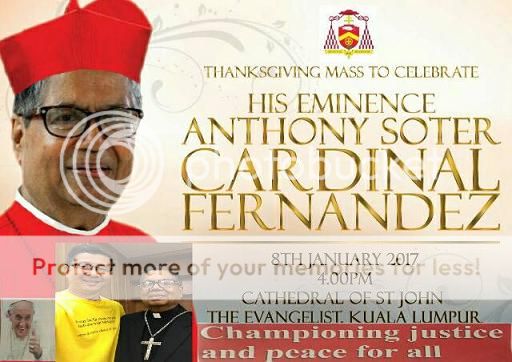
Calling all Catholics from far and near to come and join in praising and thanking God for blessing the Malaysian Church with our very first Cardinal.

It will be a joyful Thanksgiving Mass on January 8, 2017 (Sunday). The celebration will start at 3pm with Rosary, follow with Vespers at 3.30pm and Mass at 4pm.

The Cathedral of St John the Evangelist, Kuala Lumpur has arranged for a 8,000 seating capacity (in the cathedral and grounds plus at The New Community Centre and carpark areas). More chairs will be available at the AOHD , if the need arise.

The celebration is meaningful as the Cardinal also marks 50 years of priestly ministry (Dec 10 last year). The Mass will be presided by Archbishop of Kuala Lumpur, Most Rev Julian Leow. The Nuncio plus several prelates and many priests are expected to be present. VIPs and leaders from other faiths are also attending. The Religious from different Congregation will also come. Cardinal Anthony Soter Fernandez will be one of the con-celebrants. Prayer cards will be distributed on that day to all.

The celebration will conclude with a light fellowship that will be distributed along Jalan Bukit Nanas (8 distribution points). The road will be closed to traffic on that day. Those driving could park their cars at the various open carpark along Jalan Raja Chulan (7 min walk) or Bangunan Ming or other nearby buildings' carparks. Or come via LRT/MRT.


134 Pages « < 120 121 122 123 124 > » Top
Topic ClosedOptions
 

Change to:
| Lo-Fi Version
0.0407sec    0.68    6 queries    GZIP Disabled
Time is now: 4th December 2025 - 05:44 PM