Welcome Guest ( Log In | Register )

Bump Topic Topic Closed RSS Feed
134 Pages « < 118 119 120 121 122 > » Bottom

Outline · [ Standard ] · Linear+

 LYN Catholic Fellowship V01 (Group), For Catholics (Roman or Eastern)

views
     
TSyeeck
post Dec 9 2016, 12:21 AM

Look at all my stars!!
*******
Senior Member
3,577 posts

Joined: Apr 2006


user posted image

Mary's Immaculate Conception

by Father William G. Most

In teaching that Mary was conceived immaculate, the Catholic Church teaches that from the very moment of her conception, the Blessed Virgin Mary was free from all stain of original sin. This simply means that from the beginning, she was in a state of grace, sharing in God's own life, and that she was free from the sinful inclinations which have beset human nature after the fall.

History of the Doctrine

There are two passages in Scripture which point us to this truth. We look first at Genesis 3.15, in which we see the parallel between Mary and Eve of which the early Church Fathers already spoke: "I will put enmity between you and the woman, and between your seed and her seed: he shall bruise your head, and you shall bruise his heel." The Jews saw this passage as referring to the struggle between Christ and Satan, and so the Church see in "the woman" a prophetic foreshadowing of the Virgin Mary (Vatican II, Lumen gentium, # 55).

If there is to be complete enmity between the woman and the serpent, then she never should have been in any way subject to him even briefly. This implies an Immaculate conception.

We can also reason from the text of Lk 1:28, in which the angel calls her "full of grace". If we can validate the translation--we can, and will do so, shortly--then in this verse we can see even more strongly the complete enmity with the serpent--for God's grace is complete opposed to Satan's reign. But if Mary was "full of grace," it seems that she must have been conceived immaculate.

We turn to the early Fathers of the Church. First, many, not all of them, make sweeping statements about her holiness. That could imply an Immaculate Conception. Secondly, very many of them speak of her as the New Eve. They could have reasoned: the first Eve had an immaculate start in life--no sin was yet committed. So the New Eve, who was to share in undoing the harm of original sin, should have also an immaculate start. However, none of the Fathers actually followed this line of reasoning. (A few Fathers even tried to find sins she had committed, e.g. St. John Chrysostom, Homilies on John 21. PG 59. 130ff).

During the middle ages, authors such as St. Bernard of Clairvaux and St. Thomas Aquinas denied the doctrine. At this time, the data from Scripture and the Fathers was still not clear. In addition, the understanding of original sin was not as clear as it should have been--it was often thought of as having a positive element, instead of merely being an original lack of the grace to which God calls us. This positive element was thought to be transmitted from parents to children through the marital act (which was itself thought to be somehow sinful, though pardoned by God), and so it was hard to see how there could be an immaculate conception. This conception had been found in some, though by no means all, of the Fathers. Now of course we know it to be false. Finally, it was not generally seen at this time how an Immaculate conception of Mary would not take away from the universality of redemption through Christ.

After a while, however, the theological tide began to turn, and the objections which had long obscured the content of divine revelation began to be overcome. This was due especially to the work of the Franciscan, Venerable John Duns Scotus. He showed that for God to preserve Mary from original sin was a greater redemption than to allow her to fall into it and then rescue her. Scotus wrote (cited from J. B. Carol, Mariology I, 368): "Either God was able to do this, and did not will to do it, or He willed to preserve her, and was unable to do so. If able to and yet unwilling to perform this for her, God was miserly towards her. And if He willed to do it but was unable to accomplish it, He was weak, for no one who is able to honor his mother would fail to do so."

We also note again that behind most of the objections was the rather positive notion of original sin. If we jump ahead several centuries to the clearer understanding of original sin we have now, we can remove this objection. Pope John Paul II epressed this understanding in a General Audience on Oct 1, 1986: "In context it is evident that original sin in Adam's descendants has not the character of personal guilt. It is the privation of sanctifying grace in a nature which, through the fall of the first parents, has been diverted from its supernatural end. It is a 'sin of nature' only analogically comparable to 'personal sin'". In other words: It is only the lack, or privation, of that which God wanted us to have, which we should have inherited from our first parents."

Now back to our history. After that this change in theological tide had gone far towards removing objections, the Popes began to make statements of varying clarity. Sixtus IV in 1477 (DS 1400) praised the liturgical celebration of the Immaculate Conception. The same Pope added further support in 1483 (DS 1425-26), condemning those who said it was sinful to preach and believe the Immaculate Conception. The Council of Trent explicitly declared in its decree on original sin (DS 1516): "... it is not its intention to include in this decree ... the blessed and Immaculate Virgin Mary, Mother of God. Rather, the Constitutions of Sixtus [IV] of happy memory are to be observed."

After Trent, the attacks on the Immaculate Conception were greatly moderated. Then Pope St. Pius V, in 1567 (DS 1973) condemned the error of Baius who said Our Lady was subject to original sin. And in 1568 the same Pope put the feast of the Immaculate Conception on the calendar of the Roman breviary. Alexander VII in 1661 explained the doctrine much as Pius IX did later: DB 1100. Pope Clement XI in 1708 made December 8 a holyday of obligation. Further, the Sixth Provincial Council of Baltimore in the U. S. in 1846 declared Mary Immaculate to be Patroness of the United States, and Pius IX on Feb. 7, 1847 confirmed this dedication.

The result was that about a century and a half before the definition of 1854, the whole Church believed the Immaculate Conception. Finally, in Ineffabilis Deus, in 1854, Pius IX defined this doctrine and added that Mary was conceived immaculate by anticipation of the merits of Christ. This is not strange, for to the eye of God, all time is present.

Now the Church continues to elucidate the scriptural basis of the doctrine of the Immaculate Conception. Pius XII, in Fulgens corona, 1953 wrote: "... the foundation of this doctrine is seen in the very Sacred Scripture itself, in which God ... after the wretched fall of Adam, addressed the ... serpent in these words... 'I will put enmity....' But if at any time, the Blessed Virgin Mary, defiled in her conception with the hereditary stain of sin, had been devoid of divine grace, then at least, even though for a very brief moment of time, there would not have been that eternal enmity between her and the serpent ... but instead there would have been a certain subjection."

Preventive redemption

We have said that Mary needed redemption, although she was never subject to original sin. Nor did she have an "obligation" to contract it, as some have foolishly said: there can be no obligation to any sin. We can merely say she would have been in original sin in the sense just explained, i.e. , she would have been born without grace, were it not for the preventive redemption. The word "preventive" means anticipatory: the grace she received at her conception was given in anticipation (Latin praevenire) of Christ's merits, which earned that grace.

The nature of Mary's grace at the Immaculate Conception

In Lk 1:28 the archangel hails her as, "full of grace". Most versions today do not use that rendering, but greatly weaken it. Yet it is the correct translation as we can see from the Magisterium (Pius XII, Fulgens Corona, AAS 45, 579, and constant use of the Church) and also from philology.

For the Greek word in the Gospel is kecharitomene. It is a perfect passive participle of the verb charitoo. A perfect passive participle is very strong. In addition, charitoo belongs to a group of verbs ending in omicron omega. They have in common that they mean to put a person or thing into the state indicated by the root. Thus leukos means white, so leukoo means to make white. Then charitoo should mean to put into charis. That word charis can mean either favor or grace. But if we translate by favor, we must keep firmly in mind that favor must not mean merely that God, as it were, sits there and smiles at someone, without giving anything. That would be Pelagian: salvation possible without grace. So for certain, God does give something, and that something is grace, are share in His own life. So charitoo means to put into grace. But then too, kecharitomene is used in place of the name "Mary". This is like our English usage in which we say, for example, someone is Mr. Tennis. That means he is the ultimate in tennis. So then kecharitomene should mean "Miss Grace", the ultimate in grace. Hence we could reason that fullness of grace implies an Immaculate Conception.

Overflowing grace: Pius IX, in the document, Ineffabilis Deus, defining the Immaculate Conception in 1854 wrote: "He [God] attended her with such great love, more than all other creatures, that in her alone He took singular pleasure. Wherefore He so wonderfully filled her, more than all angelic spirits and all the Saints, with an abundance of all heavenly gifts taken from the treasury of the divinity, that she, always free from absolutely every stain of sin, and completely beautiful and perfect, presented such a fullness of innocence and holiness that none greater under God can be thought of, and no one but God can comprehend it."

What about the words of Jesus in Lk 11:27-28 (cf. Mt. 12:46-50 and Mk 3:35)? A woman in the crowd exclaimed: "Blessed is the womb that bore you...." He replied: "Rather blessed are they who hear the word of God and keep it."

The dignity of being Mother of God is a quasi infinite dignity, as we just saw from the words of Pius XI. Yet here, our Lord is teaching us that the holiness coming from hearing the word of God and keeping it is something greater still. Her holiness must indeed be great--so great that "none greater under God can be thought of, and no one but God can comprehend it."

Even though Mary was full of grace at the start of her life, yet she could still grow, for, as it were, her capacity for grace could increase.

In general, a soul will grow in proportion to these things: (1) The greater the dignity of the person, the greater the merit In her case, the dignity of Mother of God is the highest possible for a creature. (2) The greater the work, the greater the merit: her cooperation in the redemption was the greatest work possible to a creature. (3) The greater the love, the greater the merit. Love of God means the attachment of our will to His. Her will adhered supremely, with no obstacle at all, so that even ordinary household duties, which she saw as the will of the Father for her, were supremely valuable.

Excerpted and adapted from Theology 523: Our Lady in Doctrine and Devotion, by Father William G. Most.
Copyright © 1994 William G. Most.

This electronic text © Copyright EWTN 1996. All rights reserved.
khool
post Dec 9 2016, 09:38 AM

Getting Started
**
Junior Member
225 posts

Joined: Mar 2008


Friday of the Second Week in Advent
Lectionary: 185


Reading 1 (Is 48:17-19)

Thus says the LORD, your redeemer,
the Holy One of Israel:
I, the LORD, your God,
teach you what is for your good,
and lead you on the way you should go.
If you would hearken to my commandments,
your prosperity would be like a river,
and your vindication like the waves of the sea;
Your descendants would be like the sand,
and those born of your stock like its grains,
Their name never cut off
or blotted out from my presence.

Responsorial Psalm (Ps 1:1-2, 3, 4 and 6)

R. Those who follow you, Lord, will have the light of life.

Blessed the man who follows not
the counsel of the wicked
Nor walks in the way of sinners,
nor sits in the company of the insolent,
But delights in the law of the LORD
and meditates on his law day and night.
R. Those who follow you, Lord, will have the light of life.

He is like a tree
planted near running water,
That yields its fruit in due season,
and whose leaves never fade.
Whatever he does, prospers.
R. Those who follow you, Lord, will have the light of life.

Not so the wicked, not so;
they are like chaff which the wind drives away.
For the LORD watches over the way of the just,
but the way of the wicked vanishes.
R. Those who follow you, Lord, will have the light of life.

Alleluia

R. Alleluia, alleluia.
The Lord will come; go out to meet him!
He is the prince of peace.
R. Alleluia, alleluia.

Gospel (Mt 11:16-19)

Jesus said to the crowds:
“To what shall I compare this generation?
It is like children who sit in marketplaces and call to one another,
‘We played the flute for you, but you did not dance,
we sang a dirge but you did not mourn.’
For John came neither eating nor drinking, and they said,
‘He is possessed by a demon.’
The Son of Man came eating and drinking and they said,
‘Look, he is a glutton and a drunkard,
a friend of tax collectors and sinners.’
But wisdom is vindicated by her works.”

user posted image

REFLECTION

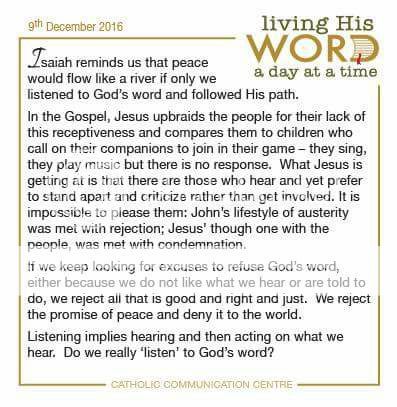
WISDOM IS VINDICATED BY HER WORKS. The mission of John the Baptist and Jesus is wisdom personified. The unbelieving generation misinterprets the methods of both. When John fasts as he preaches the baptism of repentance, the unbelievers do not take it as edifying but see it as an evil to exorcise. When Jesus adopts a different stance, as He eats and drinks with sinners, they take offense at Him. They are always negative, no matter what. As a saying puts it, “Damned if you do, damned if you don’t.”

There is wisdom in fasting. John the Baptist gains a lot of followers. He is able to prepare people for the coming of Jesus.

Here is also wisdom in associating with sinners. They draw closer to Jesus. Misinterpretations happen when we do not identify who John or Jesus is in the history of salvation. John paves the way for Jesus who is considered the “Son of Man.” This title, mentioned in the Book of Daniel, has an apocalyptic bearing. When the Jews were persecuted by the Hellenists, they prayed for God’s protection. It would be the Son of Man who would accomplish this, giving judgment to the unbelievers.

Do you see Christ in your neighbors? Do you recognize the wisdom of approaching those who do not know anything about their faith?

SOURCE: “366 Days with the Lord 2016,” ST. PAULS Philippines, 7708 St. Paul Rd., SAV, Makati City (Phils.) http://www.ssp.ph/

shioks
post Dec 9 2016, 10:23 AM

On my way
****
Senior Member
627 posts

Joined: Jun 2009
Uncle Yeeck, how do you explain this Jeremiah 44 passage on queen of heaven?

44 The word that came to Jeremiah for all the Jews living in the land of Egypt, those who were living in Migdol, Tahpanhes, Memphis, and the land of Pathros, saying, 2 “Thus says the Lord of hosts, the God of Israel, ‘You yourselves have seen all the calamity that I have brought on Jerusalem and all the cities of Judah; and behold, this day they are in ruins and no one lives in them, 3 because of their wickedness which they committed so as to provoke Me to anger by continuing to burn [a]sacrifices and to serve other gods whom they had not known, neither they, you, nor your fathers. 4 Yet I sent you all My servants the prophets, [b]again and again, saying, “Oh, do not do this abominable thing which I hate.” 5 But they did not listen or incline their ears to turn from their wickedness, so as not to burn [c]sacrifices to other gods. 6 Therefore My wrath and My anger were poured out and burned in the cities of Judah and in the streets of Jerusalem, so they have become a ruin and a desolation as it is this day. 7 Now then thus says the Lord God of hosts, the God of Israel, “Why are you doing great harm to yourselves, so as to cut off from you man and woman, child and infant, from among Judah, leaving yourselves without remnant, 8 provoking Me to anger with the works of your hands, burning [d]sacrifices to other gods in the land of Egypt, where you are entering to reside, so that you might be cut off and become a curse and a reproach among all the nations of the earth? 9 Have you forgotten the wickedness of your fathers, the wickedness of the kings of Judah, and the wickedness of their wives, your own wickedness, and the wickedness of your wives, which they committed in the land of Judah and in the streets of Jerusalem? 10 But they have not become [e]contrite even to this day, nor have they feared nor walked in My law or My statutes, which I have set before you and before your fathers.”’

11 “Therefore thus says the Lord of hosts, the God of Israel, ‘Behold, I am going to set My face against you for [f]woe, even to cut off all Judah. 12 And I will take away the remnant of Judah who have set their [g]mind on entering the land of Egypt to reside there, and they will all [h]meet their end in the land of Egypt; they will fall by the sword and meet their end by famine. Both small and great will die by the sword and famine; and they will become a curse, an object of horror, an imprecation and a reproach. 13 And I will punish those who live in the land of Egypt, as I have punished Jerusalem, with the sword, with famine and with pestilence. 14 So there will be no refugees or survivors for the remnant of Judah who have entered the land of Egypt to reside there and then to return to the land of Judah, to which they are [i]longing to return and live; for none will return except a few refugees.’”

15 Then all the men who were aware that their wives were burning [j]sacrifices to other gods, along with all the women who were standing by, as a large assembly, [k]including all the people who were living in Pathros in the land of Egypt, responded to Jeremiah, saying, 16 “As for the [l]message that you have spoken to us in the name of the Lord, we are not going to listen to you! 17 But rather we will certainly carry out every word that has proceeded from our mouths, [m]by burning [n]sacrifices to the queen of heaven and pouring out drink offerings to her, just as we ourselves, our forefathers, our kings and our princes did in the cities of Judah and in the streets of Jerusalem; for then we had plenty of [o]food and were well off and saw no [p]misfortune. 18 But since we stopped burning [q]sacrifices to the queen of heaven and pouring out drink offerings to her, we have lacked everything and have [r]met our end by the sword and by famine.” 19 “And,” said the women, “when we were burning [s]sacrifices to the queen of heaven and [t]were pouring out drink offerings to her, was it without our husbands that we made for her sacrificial cakes [u]in her image and poured out drink offerings to her?”
TSyeeck
post Dec 9 2016, 02:40 PM

Look at all my stars!!
*******
Senior Member
3,577 posts

Joined: Apr 2006


QUOTE(shioks @ Dec 9 2016, 10:23 AM)
Uncle Yeeck, how do you explain this Jeremiah 44 passage on queen of heaven?

44 The word that came to Jeremiah for all the Jews living in the land of Egypt, those who were living in Migdol, Tahpanhes, Memphis, and the land of Pathros, saying, 2 “Thus says the Lord of hosts, the God of Israel, ‘You yourselves have seen all the calamity that I have brought on Jerusalem and all the cities of Judah; and behold, this day they are in ruins and no one lives in them, 3 because of their wickedness which they committed so as to provoke Me to anger by continuing to burn [a]sacrifices and to serve other gods whom they had not known, neither they, you, nor your fathers. 4 Yet I sent you all My servants the prophets, [b]again and again, saying, “Oh, do not do this abominable thing which I hate.” 5 But they did not listen or incline their ears to turn from their wickedness, so as not to burn [c]sacrifices to other gods. 6 Therefore My wrath and My anger were poured out and burned in the cities of Judah and in the streets of Jerusalem, so they have become a ruin and a desolation as it is this day. 7 Now then thus says the Lord God of hosts, the God of Israel, “Why are you doing great harm to yourselves, so as to cut off from you man and woman, child and infant, from among Judah, leaving yourselves without remnant, 8 provoking Me to anger with the works of your hands, burning [d]sacrifices to other gods in the land of Egypt, where you are entering to reside, so that you might be cut off and become a curse and a reproach among all the nations of the earth? 9 Have you forgotten the wickedness of your fathers, the wickedness of the kings of Judah, and the wickedness of their wives, your own wickedness, and the wickedness of your wives, which they committed in the land of Judah and in the streets of Jerusalem? 10 But they have not become [e]contrite even to this day, nor have they feared nor walked in My law or My statutes, which I have set before you and before your fathers.”’

11 “Therefore thus says the Lord of hosts, the God of Israel, ‘Behold, I am going to set My face against you for [f]woe, even to cut off all Judah. 12 And I will take away the remnant of Judah who have set their [g]mind on entering the land of Egypt to reside there, and they will all [h]meet their end in the land of Egypt; they will fall by the sword and meet their end by famine. Both small and great will die by the sword and famine; and they will become a curse, an object of horror, an imprecation and a reproach. 13 And I will punish those who live in the land of Egypt, as I have punished Jerusalem, with the sword, with famine and with pestilence. 14 So there will be no refugees or survivors for the remnant of Judah who have entered the land of Egypt to reside there and then to return to the land of Judah, to which they are [i]longing to return and live; for none will return except a few refugees.’”

15 Then all the men who were aware that their wives were burning [j]sacrifices to other gods, along with all the women who were standing by, as a large assembly, [k]including all the people who were living in Pathros in the land of Egypt, responded to Jeremiah, saying, 16 “As for the [l]message that you have spoken to us in the name of the Lord, we are not going to listen to you! 17 But rather we will certainly carry out every word that has proceeded from our mouths, [m]by burning [n]sacrifices to the queen of heaven and pouring out drink offerings to her, just as we ourselves, our forefathers, our kings and our princes did in the cities of Judah and in the streets of Jerusalem; for then we had plenty of [o]food and were well off and saw no [p]misfortune. 18 But since we stopped burning [q]sacrifices to the queen of heaven and pouring out drink offerings to her, we have lacked everything and have [r]met our end by the sword and by famine.” 19 “And,” said the women, “when we were burning [s]sacrifices to the queen of heaven and [t]were pouring out drink offerings to her, was it without our husbands that we made for her sacrificial cakes [u]in her image and poured out drink offerings to her?”
*
http://www.catholic-convert.com/wp-content...eenOfHeaven.pdf
TSyeeck
post Dec 9 2016, 05:05 PM

Look at all my stars!!
*******
Senior Member
3,577 posts

Joined: Apr 2006


Blessed be God in His angels and in His saints!
TSyeeck
post Dec 10 2016, 10:29 PM

Look at all my stars!!
*******
Senior Member
3,577 posts

Joined: Apr 2006


WHERE THE ROSARY APPEARS IN “THE LORD OF THE RINGS”

user posted image

In The Lord of the Rings, the Lady Galadriel gives Frodo a gift upon his departure from Lothlórien: a phial, somehow filled with the light of Eärendil, the star that serves as a sort of Polaris or Morning Star to guide the Eldar (elves) to the Undying Lands. When Galadriel gives Frodo the phial, she expresses her purpose for the gift: “May it be a light to you in dark places, when all other lights go out.” Frodo first uses the phial as a light in Shelob’s lair, a cave which bore a “sense of malice so intense that Frodo reeled” (Lord of the Rings, IV.9). As he raises the phial aloft, he exclaims “Aiya Eärendil Elenion Ancalima!” which translates to “Hail Eärendil, brightest of stars!” At his words, the light shines forth brighter. Later, when Sam uses the phial, he cries out:

O Elbereth Gilthoniel
o menel palan-diriel,
le nallon sí di’nguruthos!
A tiro nin, Fanuilos!


Oh Elbereth Starkindler,
from the high firmament gazing afar,
to thee do I cry amid this horror!
Look kindly upon me, Ever-pure Lady!”

For those who aren’t Tolkien geeks, Elbereth (or Varda) is the Queen of the Stars in Tolkien’s mythology. At Sam’s words, the light “flamed like a star that leaping from the firmament sears the dark air with intolerable light.”

Given by Lady Galadriel and a source of light through prayer, the phial is for us an image of the Rosary. The Blessed Virgin Mary, fairest of all women, gave us the Rosary as a light in dark places. In praying the Rosary, we cry out to Mary the Morning Star that she may guide us to Heaven in her Son. In whispering our Aves, we ask the Queen of Heaven, the Woman robed in stars, for Her aid in the darkest times of life. Even Sam’s prayer to Elbereth is suspiciously similar to the Hail Holy Queen, which we pray to end the Rosary: “Hail Holy Queen…to thee do we cry…in this valley of tears! Turn then, most gracious advocate, thine eyes of mercy towards us.”

We can identify three effects of the phial which also apply to the Rosary. First, the phial provides light to illuminate the hobbits’ path, lest they stumble: By praying the Rosary, we grow in grace and can thus understand better the way we should turn. We have faith that, by praying to God through the powerful intercession of the Mother of God, He will draw us closer to Himself, in Whom is all our joy. Second, the phial gives the hobbits hope. Despite the trials they are facing, the light of Eärendil reminds them of the great stories about how others have triumphed over evil and how, above all the gloom of Mordor, there is yet beauty and goodness and truth. The Rosary of Mary is a source of hope for us, for by meditating on the life of Christ and walking with Him, we come to understand all the more that death is not the end of life, that Christ has conquered death, and that He has promised His kingdom to those who follow Him. The Rosary is Mary’s humble way of leading us through this world while keeping us from despairing of the fullness of life to come. Third, the phial is a terror to evil ones. Shelob, an ancient evil in spider form, took to flight at the flame of the shining phial. Similarly, the Holy Rosary is a terror to demons, a sure weapon in our fight against our own vice and against the world’s evils. For proof, just take a close look at the lives of the saints.

But the Rosary itself is far more powerful than the phial. It’s a prayer that can be a petition, a meditation, a prayer of thanksgiving, a prayer of praise, even a prayer of reparation for sins. There is one thing, however, that the Rosary is not: an instant solution to all our problems. In the closing prayer to the Rosary, we pray that we might imitate what the mysteries contain and obtain what they promise. It is easy to forget about the former intention while praying fervently for the latter, but they are a package deal. We must imitate what the mysteries contain, all the mysteries, from the Annunciation through the Crucifixion to the Resurrection and beyond. The Rosary does not take away the pain of this life; rather it helps us to see our suffering in the Cross of Christ. So let us rejoice, knowing with a living hope that the Blessed Virgin Mary will lead us, through whatever may come our way, to her Son and our Lord, Jesus Christ.
khool
post Dec 10 2016, 10:52 PM

Getting Started
**
Junior Member
225 posts

Joined: Mar 2008


QUOTE(yeeck @ Dec 10 2016, 10:29 PM)
WHERE THE ROSARY APPEARS IN “THE LORD OF THE RINGS”

user posted image

In The Lord of the Rings, the Lady Galadriel gives Frodo a gift upon his departure from Lothlórien: a phial, somehow filled with the light of Eärendil, the star that serves as a sort of Polaris or Morning Star to guide the Eldar (elves) to the Undying Lands.  When Galadriel gives Frodo the phial, she expresses her purpose for the gift: “May it be a light to you in dark places, when all other lights go out.”  Frodo first uses the phial as a light in Shelob’s lair, a cave which bore a “sense of malice so intense that Frodo reeled” (Lord of the Rings, IV.9).  As he raises the phial aloft, he exclaims “Aiya Eärendil Elenion Ancalima!” which translates to “Hail Eärendil, brightest of stars!”  At his words, the light shines forth brighter. Later, when Sam uses the phial, he cries out:

O Elbereth Gilthoniel
o menel palan-diriel,
le nallon sí di’nguruthos!
A tiro nin, Fanuilos!
Oh Elbereth Starkindler,
from the high firmament gazing afar,
to thee do I cry amid this horror!
Look kindly upon me, Ever-pure Lady!”

For those who aren’t Tolkien geeks, Elbereth (or Varda) is the Queen of the Stars in Tolkien’s mythology. At Sam’s words, the light “flamed like a star that leaping from the firmament sears the dark air with intolerable light.”

Given by Lady Galadriel and a source of light through prayer, the phial is for us an image of the Rosary. The Blessed Virgin Mary, fairest of all women, gave us the Rosary as a light in dark places.  In praying the Rosary, we cry out to Mary the Morning Star that she may guide us to Heaven in her Son.  In whispering our Aves, we ask the Queen of Heaven, the Woman robed in stars, for Her aid in the darkest times of life.  Even Sam’s prayer to Elbereth is suspiciously similar to the Hail Holy Queen, which we pray to end the Rosary: “Hail Holy Queen…to thee do we cry…in this valley of tears!  Turn then, most gracious advocate, thine eyes of mercy towards us.” 

We can identify three effects of the phial which also apply to the Rosary.  First, the phial provides light to illuminate the hobbits’ path, lest they stumble: By praying the Rosary, we grow in grace and can thus understand better the way we should turn.  We have faith that, by praying to God through the powerful intercession of the Mother of God, He will draw us closer to Himself, in Whom is all our joy.  Second, the phial gives the hobbits hope.  Despite the trials they are facing, the light of Eärendil reminds them of the great stories about how others have triumphed over evil and how, above all the gloom of Mordor, there is yet beauty and goodness and truth.  The Rosary of Mary is a source of hope for us, for by meditating on the life of Christ and walking with Him, we come to understand all the more that death is not the end of life, that Christ has conquered death, and that He has promised His kingdom to those who follow Him. The Rosary is Mary’s humble way of leading us through this world while keeping us from despairing of the fullness of life to come. Third, the phial is a terror to evil ones.  Shelob, an ancient evil in spider form, took to flight at the flame of the shining phial.  Similarly, the Holy Rosary is a terror to demons, a sure weapon in our fight against our own vice and against the world’s evils.  For proof, just take a close look at the lives of the saints.

But the Rosary itself is far more powerful than the phial.  It’s a prayer that can be a petition, a meditation, a prayer of thanksgiving, a prayer of praise, even a prayer of reparation for sins. There is one thing, however, that the Rosary is not: an instant solution to all our problems.  In the closing prayer to the Rosary, we pray that we might imitate what the mysteries contain and obtain what they promise.  It is easy to forget about the former intention while praying fervently for the latter, but they are a package deal.  We must imitate what the mysteries contain, all the mysteries, from the Annunciation through the Crucifixion to the Resurrection and beyond.  The Rosary does not take away the pain of this life; rather it helps us to see our suffering in the Cross of Christ. So let us rejoice, knowing with a living hope that the Blessed Virgin Mary will lead us, through whatever may come our way, to her Son and our Lord, Jesus Christ.
*
Stella Maris ... rclxm9.gif rclxm9.gif rclxm9.gif icon_idea.gif icon_idea.gif icon_idea.gif
TSyeeck
post Dec 10 2016, 11:15 PM

Look at all my stars!!
*******
Senior Member
3,577 posts

Joined: Apr 2006


QUOTE(khool @ Dec 10 2016, 10:52 PM)
Stella Maris ...  rclxm9.gif  rclxm9.gif  rclxm9.gif  icon_idea.gif  icon_idea.gif  icon_idea.gif
*
Stella Matutina...jeng jeng jeng.... biggrin.gif
khool
post Dec 10 2016, 11:55 PM

Getting Started
**
Junior Member
225 posts

Joined: Mar 2008


khool
post Dec 11 2016, 08:04 AM

Getting Started
**
Junior Member
225 posts

Joined: Mar 2008


Third Sunday of Advent
Lectionary: 7


Advent prayer for Third Week in Advent - Gaudete Sunday - we light the pink candle.

user posted image

Reading 1 (Is 35:1-6a, 10)

The desert and the parched land will exult;
the steppe will rejoice and bloom.
They will bloom with abundant flowers,
and rejoice with joyful song.
The glory of Lebanon will be given to them,
the splendor of Carmel and Sharon;
they will see the glory of the LORD,
the splendor of our God.
Strengthen the hands that are feeble,
make firm the knees that are weak,
say to those whose hearts are frightened:
Be strong, fear not!
Here is your God,
he comes with vindication;
with divine recompense
he comes to save you.
Then will the eyes of the blind be opened,
the ears of the deaf be cleared;
then will the lame leap like a stag,
then the tongue of the mute will sing.

Those whom the LORD has ransomed will return
and enter Zion singing,
crowned with everlasting joy;
they will meet with joy and gladness,
sorrow and mourning will flee.

Responsorial Psalm (Ps 146:6-7, 8-9, 9-10)

R. Lord, come and save us.

The LORD God keeps faith forever,
secures justice for the oppressed,
gives food to the hungry.
The LORD sets captives free.
R. Lord, come and save us.

The LORD gives sight to the blind;
the LORD raises up those who were bowed down.
The LORD loves the just;
the LORD protects strangers.
R. Lord, come and save us.

The fatherless and the widow he sustains,
but the way of the wicked he thwarts.
The LORD shall reign forever;
your God, O Zion, through all generations.
R. Lord, come and save us.

Reading 2 (Jas 5:7-10)


Be patient, brothers and sisters,
until the coming of the Lord.
See how the farmer waits for the precious fruit of the earth,
being patient with it
until it receives the early and the late rains.
You too must be patient.
Make your hearts firm,
because the coming of the Lord is at hand.
Do not complain, brothers and sisters, about one another,
that you may not be judged.
Behold, the Judge is standing before the gates.
Take as an example of hardship and patience, brothers and sisters,
the prophets who spoke in the name of the Lord.

Alleluia (Is 61:1 (cited in Lk 4:18)

R. Alleluia, alleluia.
The Spirit of the Lord is upon me,
because he has anointed me
to bring glad tidings to the poor.
R. Alleluia, alleluia.

Gospel (Mt 11:2-11)

When John the Baptist heard in prison of the works of the Christ,
he sent his disciples to Jesus with this question,
“Are you the one who is to come,
or should we look for another?”
Jesus said to them in reply,
“Go and tell John what you hear and see:
the blind regain their sight,
the lame walk,
lepers are cleansed,
the deaf hear,
the dead are raised,
and the poor have the good news proclaimed to them.
And blessed is the one who takes no offense at me.”

As they were going off,
Jesus began to speak to the crowds about John,
“What did you go out to the desert to see?
A reed swayed by the wind?
Then what did you go out to see?
Someone dressed in fine clothing?
Those who wear fine clothing are in royal palaces.
Then why did you go out? To see a prophet?
Yes, I tell you, and more than a prophet.
This is the one about whom it is written:
Behold, I am sending my messenger ahead of you;
he will prepare your way before you.
Amen, I say to you,
among those born of women
there has been none greater than John the Baptist;
yet the least in the kingdom of heaven is greater than he.”

user posted image

REFLECTION

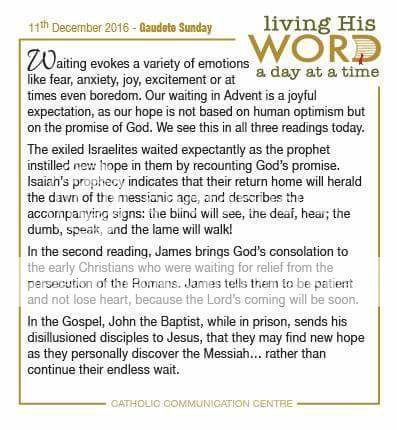
YE REJOICE: IT’S A CHRISTIAN IMPERATIVE! Gaudete Sunday commands us, Christians and Catholics, to rejoice. This Latin word, gaudete, is in the imperative mood, plural. It enjoins us to rejoice as a community. We should rejoice because we are now very close to Christmas. We light the third candle of the Advent wreath, whose color, pink or rose, symbolizes joy.

We will better understand the command to rejoice when we seriously take the Word of God.

The First Reading contains vocabularies that pertain to rejoicing: the dry land will exult; the steppe will rejoice with joyful song; the ransomed people will meet with joy and gladness. The desert will bloom with abundant flowers; the glory of Lebanon, the splendor of Carmel and Sharon (northern Israel), will be given the people; they will see the glory of God. The Lord is coming with vindication and salvation. He will heal those afflicted with illnesses. God will reverse the miserable fate of his people.
.
The Second Reading exhorts us to have the patience of a farmer who, after sowing, waits for the seeds to sprout and the plants to grow until it is time for harvest. Patience is an important ingredient to rejoicing. Devoid of patience, we can become rowdy, mindless, cranky, undisciplined, quarrelsome, critical, and intolerant.

In the Gospel, John the Baptist sends his disciples to Jesus to verify if he is the Christ. John has worked hard to prepare for the coming of the Messiah. Jesus sends the delegation back to him with the report: “The blind regain their sight, the lame walk, lepers are cleansed, the deaf hear, the dead are raised, and the poor have the good news proclaimed to them.” Yes, Jesus is the Messiah, the fulfillment of the Prophets and the Psalms.

Jesus makes his disciples realize how lucky they are. They have encountered John, whom Jesus considers the greatest among those born of women. But they can be greater than John, provided that they become least in God’s Kingdom.

This Sunday calls us to rejoice in our faith and celebrate God’s promises. It anticipates the coming of Jesus in his birth, in our present history, and in his glorious return. We rejoice because we believe Christ is here intervening in our history, giving us hope and liberating us from all forms of oppression, injustice, misery, and false values.

To us who live our faith, gaudete is no longer a command, but a spontaneous response to God’s call to participate in God’s divine life. We rejoice, celebrating our faith and the coming of Jesus who gives us joy.

SOURCE: “366 Days with the Lord 2016,” ST. PAULS Philippines, 7708 St. Paul Rd., SAV, Makati City (Phils.) http://www.ssp.ph/

khool
post Dec 11 2016, 08:15 AM

Getting Started
**
Junior Member
225 posts

Joined: Mar 2008


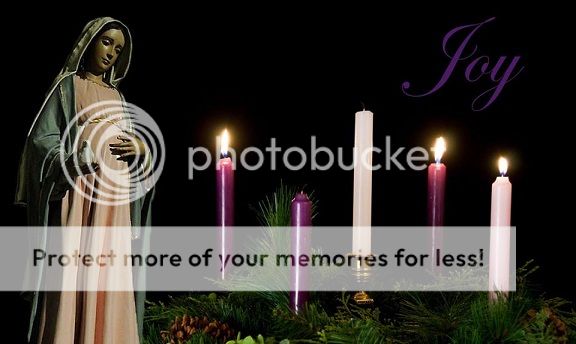
The third Sunday of Advent is known as “Gaudete Sunday.”

user posted image

It's pronounced with three syllables: gau-de-te.

The name "Gaudete Sunday" is taken from the words of the introit, entrance antiphon of the Mass, Gaudete in Domino semper, "rejoice in the Lord always."

This is a quotation from Philippians 4:4-5, Because of the more joyful tone of Gaudete Sunday, rose colored (pink) vestments may be used instead of the normal violet ones. Also, the rose colored Advent candle is lit.

khool
post Dec 11 2016, 08:19 AM

Getting Started
**
Junior Member
225 posts

Joined: Mar 2008


Amen!

user posted image

khool
post Dec 11 2016, 08:42 AM

Getting Started
**
Junior Member
225 posts

Joined: Mar 2008


Amen! Amen!!!

user posted image

shioks
post Dec 11 2016, 05:55 PM

On my way
****
Senior Member
627 posts

Joined: Jun 2009
Uncle Yeeck, what do you think of Liberation Theology advocated by Catholic Church in Latin America?
tinarhian
post Dec 12 2016, 01:18 AM

Enthusiast
*****
Senior Member
726 posts

Joined: Sep 2014
QUOTE(yeeck @ Dec 6 2016, 01:58 AM)
Birth control pills kills the fertilized egg.  nod.gif

How can you say the law is just there to protect the coward rapists? Which laws, may I ask? And how has this got to do with your favourite Talibans?  laugh.gif

Rapists should indeed be punished severely. But killing the innocent babies is not the way of God.
*
I think abortion should be allowed to those women who have been a rape victim or victim or incest. Unless you consider adoption as a temporary solution.

Really? You think Taliban laws protect women? You must been hiding in some Taliban caves. brows.gif

If its a due to unprotected sex then I understand the morality of it.

In some countries the rapists even marry the victim. How is that even legal? doh.gif

Plus the Catholics don't even believe in protection during sexual intercourse. No wonder so many unwanted pregnancies.

Then you conveniently blamed the women. haha..How convenient.

Its the Catholic way, you don't need to tell me that its not. Heck its either my way or the highway. Is that even a choice in the first place?

Then who help the poor mother? I get that abortion is not a shortcut but how is the consequences of the child's life? Even if the baby is not aborted, but baby dumping is increasing yearly due to unprotected sex, rapes, etc..

There's where the increase of generation of bitter youth with mixed emotion because of some idiot teenagers didn't have decency to use protection.
tinarhian
post Dec 12 2016, 01:32 AM

Enthusiast
*****
Senior Member
726 posts

Joined: Sep 2014
QUOTE(yeeck @ Dec 6 2016, 02:46 AM)
Jesus Christ’s Tomb Opened for First Time in 500 Years – See What is Inside

QUOTE
Also discovered, was a second grey marble slab previously unknown to the researchers, engraved with a cross they believe was carved in the 12th century by the Crusaders.
TSyeeck
post Dec 12 2016, 10:36 PM

Look at all my stars!!
*******
Senior Member
3,577 posts

Joined: Apr 2006


QUOTE(tinarhian @ Dec 12 2016, 01:18 AM)
I think abortion should be allowed to those women who have been a rape victim or victim or incest. Unless you consider adoption as a temporary solution.

Really? You think Taliban laws protect women? You must been hiding in some Taliban caves.  brows.gif

If its a due to unprotected sex then I understand the morality of it.

In some countries the rapists even marry the victim. How is that even legal?  doh.gif

Plus the Catholics don't even believe in protection during sexual intercourse. No wonder so many unwanted pregnancies.

Then you conveniently blamed the women. haha..How convenient.

Its the Catholic way, you don't need to tell me that its not. Heck its either my way or the highway. Is that even a choice in the first place?

Then who help the poor mother? I get that abortion is not a shortcut but how is the consequences of the child's life? Even if the baby is not aborted, but baby dumping is increasing yearly due to unprotected sex, rapes, etc..

There's where the increase of generation of bitter youth with mixed emotion because of some idiot teenagers didn't have decency to use protection.
*
Huh? Did I say Taliban laws protect women? You and your Taliban fetish...lol.

Having sex outside of marriage is wrong. Killing another life because of the first wrong is another wrong. That is the Catholic position. Adoption is definitely acceptable.
TSyeeck
post Dec 12 2016, 10:42 PM

Look at all my stars!!
*******
Senior Member
3,577 posts

Joined: Apr 2006


QUOTE(shioks @ Dec 11 2016, 05:55 PM)
Uncle Yeeck, what do you think of Liberation Theology advocated by Catholic Church in Latin America?
*
lib·er·a·tion the·ol·o·gy
noun
a movement in Christian theology, developed mainly by Latin American Roman Catholics, that emphasizes liberation from social, political, and economic oppression as an anticipation of ultimate salvation.

That definition itself shows how wrong it is. Ultimate salvation is deliverance from sin and its consequences (i.e. Hell)
Chrono-Trigger
post Dec 13 2016, 08:48 AM

BY SELF ONE IS DEFILED AND PURIFIED
*******
Senior Member
4,308 posts

Joined: Aug 2013
QUOTE(tinarhian @ Dec 12 2016, 01:18 AM)
I think abortion should be allowed to those women who have been a rape victim or victim or incest. Unless you consider adoption as a temporary solution.

Really? You think Taliban laws protect women? You must been hiding in some Taliban caves.  brows.gif

If its a due to unprotected sex then I understand the morality of it.

In some countries the rapists even marry the victim. How is that even legal?  doh.gif

Plus the Catholics don't even believe in protection during sexual intercourse. No wonder so many unwanted pregnancies.

Then you conveniently blamed the women. haha..How convenient.

Its the Catholic way, you don't need to tell me that its not. Heck its either my way or the highway. Is that even a choice in the first place?

Then who help the poor mother? I get that abortion is not a shortcut but how is the consequences of the child's life? Even if the baby is not aborted, but baby dumping is increasing yearly due to unprotected sex, rapes, etc..

There's where the increase of generation of bitter youth with mixed emotion because of some idiot teenagers didn't have decency to use protection.
*
sorry to chip in. I used to be in your position decades ago , pro-choice. However, my thinking has since changed.

I have met Catholic women with no contraception but managed to keep the desired family size. They have this one method of determining ovulation day, and some form of abstinence in the fertile days. They also took blood test to see the hormonal spikes.

As to whether OCP kills the fertilized eggs, that remains to be controversial. The pro-choice camp will say OCP works so well that it actually inhibits ovulation and thickens the cervical mucous (to prevent sperms from swimming up), that the perceived action of the endometrium thinning is negligible. (hence there is no chance for ovum to be fertilized, so there would be no conception to begin with).

The pro-life camps will tell you that there is a chance that the OCP fails to inhibit ovulation in some cases (1 in 20 or 30 cycles) , and that the ovum can still be fertilized when the woman is taking OCP.

For me, OCP is a very grey area - but personally I am bit uncomfortable with it.


TSyeeck
post Dec 14 2016, 02:06 AM

Look at all my stars!!
*******
Senior Member
3,577 posts

Joined: Apr 2006


After King Henry VIII broke ties with the Catholic Church because of a dispute over marriage, Catholics were treated very badly. Bishops were locked up. Monasteries were closed. Tens of thousands were executed in the bloody turmoil of the English Reformation. All of which raises an interesting point: If the Church wouldn’t change its doctrine for the king of England, what makes others think they can change it?

134 Pages « < 118 119 120 121 122 > » Top
Topic ClosedOptions
 

Change to:
| Lo-Fi Version
0.0325sec    0.17    6 queries    GZIP Disabled
Time is now: 7th December 2025 - 11:02 AM