


LYN Catholic Fellowship V01 (Group), For Catholics (Roman or Eastern)
LYN Catholic Fellowship V01 (Group), For Catholics (Roman or Eastern)
|
|
 Aug 26 2015, 09:05 PM Aug 26 2015, 09:05 PM
Return to original view | IPv6 | Post
#141
|
 
Junior Member
225 posts Joined: Mar 2008  
|
|
|
|
|
|
|
Aug 27 2015, 08:16 AM
Return to original view | IPv6 | Post
#142
|
|
Junior Member
225 posts Joined: Mar 2008
|
QUOTE(yeeck @ Aug 27 2015, 01:58 AM) Wonder when they plan to revoke the Church's tax exemption status too? |
|
|
Aug 27 2015, 11:07 AM
Return to original view | Post
#143
|
|
Junior Member
225 posts Joined: Mar 2008
|
QUOTE(de1929 @ Aug 27 2015, 09:38 AM) ah, do you mean the 501c3 ? just idle musing |
|
|
Aug 27 2015, 01:52 PM
Return to original view | Post
#144
|
|
Junior Member
225 posts Joined: Mar 2008
|
HHS Hiatus
The Little Sisters of the Poor don't have to cooperate with evil — yet by Ryan Fitzgerald • August 26, 2015 DENVER, August 26, 2015 (ChurchMilitant.com) - The Little Sisters of the Poor, a group of women religious battling the U.S. government over its right to religious freedom, will not have to cooperate with contraception coverage for its employees while the Supreme Court considers its case. The 10th Circuit U.S. Court of Appeals decided last month that the Little Sisters must sign off on free third-party coverage of contraceptives, sterilizations and abortifacients for their employees. This is required by the Health and Human Services' contraception mandate. Doing so, however, would violate their consciences as well as Catholic moral principles. The Supreme Court has allowed closely held, for-profit companies to be exempted from the law, but the Tenth Circuit court wouldn't let non-profits have the same exemption. It ruled that non-profits, because they have an option for third-party accommodations that for-profits don't, aren't substantially burdened in their religious exercise by the mandate. "Although we recognize and respect the sincerity of plaintiffs' beliefs and arguments," the federal appeals court stated weeks ago, "we conclude the accommodation scheme ... does not substantially burden their religious exercise." "The accommodation relieves plaintiffs from complying with the mandate and guarantees they will not have to provide, pay for, or facilitate contraceptive coverage," argued the judges. But the Sisters would nevertheless have to facilitate contraceptive coverage by signing the U.S. Department of Labor's EBSA Form 700, which simply hands over permission to the government to find a coverage provider. Thus, Sister Loraine Marie Maguire, Mother Provincial of the Little Sisters, said after the decision, "As Little Sisters of the Poor, we simply cannot choose between our care for the elderly poor and our faith." Friday, the Little Sisters won a temporary injunction on the court ruling while they appeal to the nation's highest court. This means they won't have to comply with the mandate or pay fines as they await a final decision. Source: http://www.churchmilitant.com/news/article...-little-sisters |
|
|
Aug 29 2015, 04:57 PM
Return to original view | IPv6 | Post
#145
|
|
Junior Member
225 posts Joined: Mar 2008
|
Guess who? ...
  |
|
|
Sep 3 2015, 02:47 PM
Return to original view | Post
#146
|
|
Junior Member
225 posts Joined: Mar 2008
|
 |
|
|
|
|
|
Sep 4 2015, 09:48 AM
Return to original view | Post
#147
|
|
Junior Member
225 posts Joined: Mar 2008
|
QUOTE(KVReninem @ Sep 4 2015, 12:41 AM) u gais here posting facts or a really catholic group? As far as I know, yes, this is a Catholic group ... bro Yeeck, is da 'boss here though ... hehehe! |
|
|
Sep 4 2015, 11:45 AM
Return to original view | Post
#148
|
|
Junior Member
225 posts Joined: Mar 2008
|
The Little Child
By Albert Bigelow Paine A SIMPLE-HEARTED child was He, And He was nothing more; In summer days, like you and me, He played about the door, Or gathered, where the father toiled. The shavings from the floor. Sometimes He lay upon the grass, The same as you and I, And saw the hawks above Him pass Like specks against the sky; Or, clinging to the gate, He watched The stranger passing by. A simple child, and yet, I think, The bird-folk must have known, The sparrow and the bobolink, And claimed Him for their own, They gathered round Him fearlessly When He was all alone. The lark, the linnet, and the dove, The chaffinch and the wren, They must have known His watchful love And given their worship then; They must have known and glorified The child who died for men. And when the sun at break of day Crept in upon His hair, I think it must have left a ray Of unseen glory there, A kiss of love on that little brow For the thorns that it must wear. Have a blessed Friday!!!  |
|
|
Sep 5 2015, 03:40 PM
Return to original view | IPv6 | Post
#149
|
|
Junior Member
225 posts Joined: Mar 2008
|
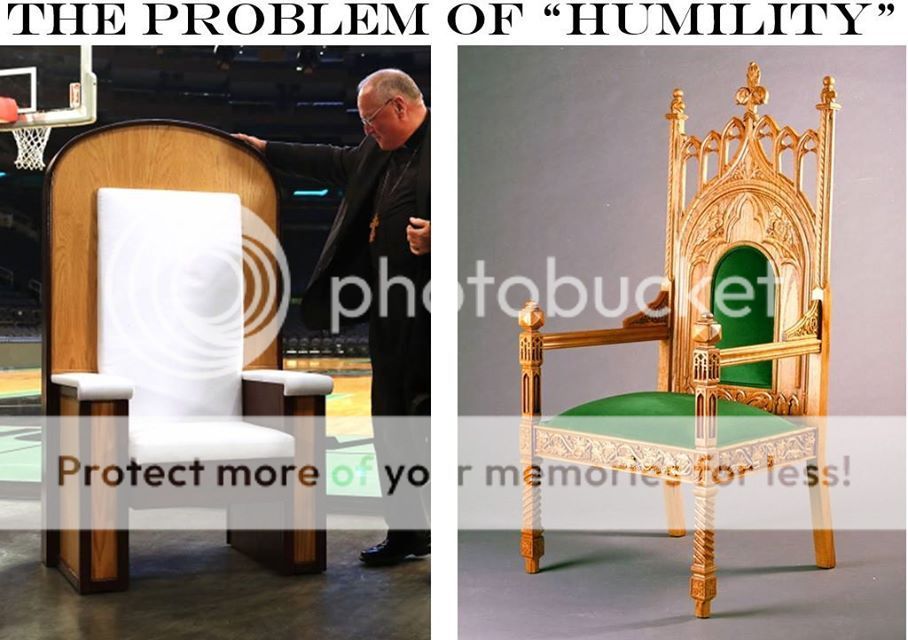 James Thomas More Griffin On the left is a "simple oak chair built by immigrant laborers and devoid of the ornate trappings of power" made for Pope Francis to sit on when he celebrates Mass at Madison Square Garden, New York during the upcoming papal visit to the United States. Sounds like a wonderful gesture of solidarity for a "people's pope", no? On the right is a splendid Gothic revival chair crafted for Pope John Paul II's visit to the United States in 1999 by an American master woodcarver. My friend Jacob, a woodcarver who makes furniture for Catholic churches, was taught his craft by the gentleman who made the chair on the right. His former teacher had to give up his trade in St. Louis, Missouri and move to California because there wasn't enough demand in the Church for his work. He now carves ornate cabinets and furniture for the wealthy, mainly for private homes, never to be seen or enjoyed by the general public. The fact that we deride beauty as vain or wasteful is one of many cancers in our church and society. By insisting upon plain, "humble" furnishings for our churches in the prosperous first world, on the contrary, we make a show of false humility, prideful in our shabbiness like a well-to-do family man who calls himself "middle class" for wearing board shorts to work and then frowns on a poorer man for wearing a suit. As Lord Grantham on Downton Abbey said when his heir was thinking of firing his valet in the name of living a simpler life: "We all have our parts to play, Matthew, and we must all be allowed to play them." Source: https://www.facebook.com/photo.php?fbid=101...90315611&type=1 |
|
|
Sep 6 2015, 06:09 PM
Return to original view | IPv6 | Post
#150
|
|
Junior Member
225 posts Joined: Mar 2008
|
 |
|
|
Sep 8 2015, 08:01 AM
Return to original view | IPv6 | Post
#151
|
|
Junior Member
225 posts Joined: Mar 2008
|
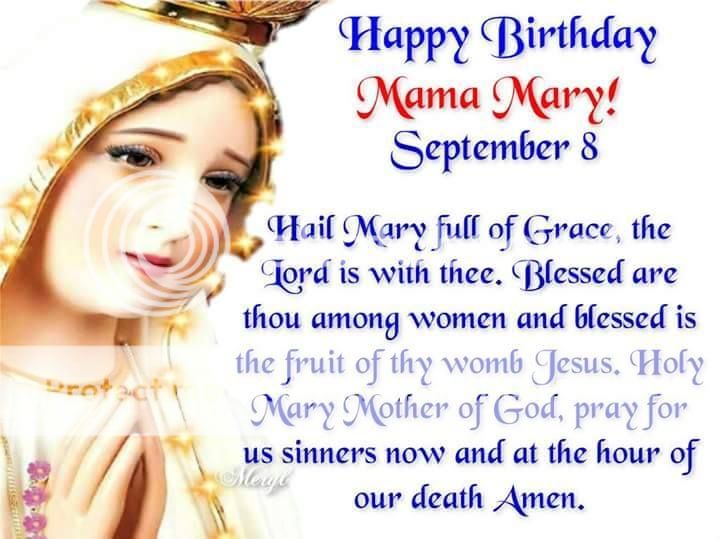
Hail Mary, Full of Grace ...
 |
|
|
Sep 8 2015, 01:41 PM
Return to original view | Post
#152
|
|
Junior Member
225 posts Joined: Mar 2008
|
|
|
|
Sep 10 2015, 02:12 PM
Return to original view | Post
#153
|
|
Junior Member
225 posts Joined: Mar 2008
|
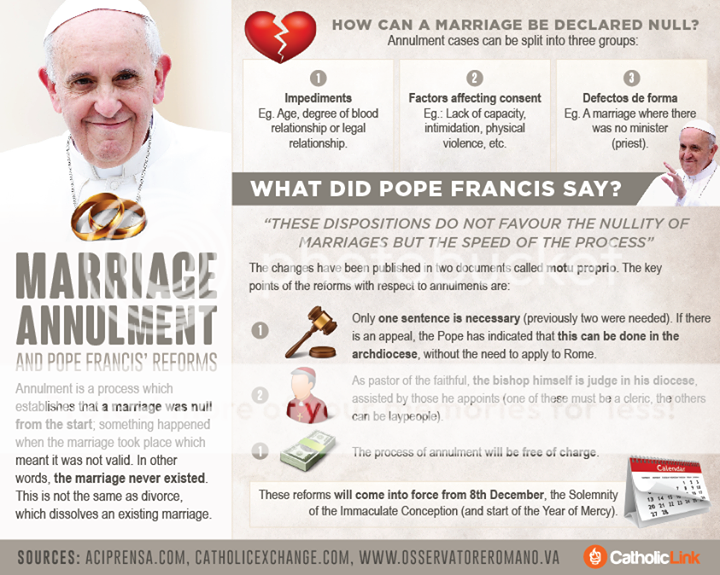
Interesting reform ...
 |
|
|
|
|
|
Sep 11 2015, 11:59 AM
Return to original view | Post
#154
|
|
Junior Member
225 posts Joined: Mar 2008
|
QUOTE(yeeck @ Sep 11 2015, 12:42 AM) Factors affecting consent? Hard to proof and believe these days. Yes, I have a friend who is marrying a divorcee from the Lutheran Church. So he has to go through a canonical and inquiry to obtain the annulment declaration. Details are P&C, so I cannot divulge but what I can say is this, the Church is scrutinizing every piece of information about the issue. Results will be know early next year, most likely. However, things do look up for him as his fiance and her kid have already been accepted into the Catholic Church and are now full fledged Catholics. Praise God! |
|
|
Sep 11 2015, 12:08 PM
Return to original view | Post
#155
|
|
Junior Member
225 posts Joined: Mar 2008
|
QUOTE(yeeck @ Sep 11 2015, 12:04 PM) That's a different story. I was concerned about the reason given "factors affecting consent". Unbelievable at this age. Yet to hear of anyone being forced into marriage. Even if the person claims that, there better be solid proof to back up that claim. That's what I meant bro, it DOES happen still. Forced marriages can and do happen, even in this day and age. Hard to believe ya?This post has been edited by khool: Sep 11 2015, 12:09 PM |
|
|
Sep 11 2015, 02:16 PM
Return to original view | Post
#156
|
|
Junior Member
225 posts Joined: Mar 2008
|
Marriage Annulment Grounds in the Catholic Church
Source: http://eaandfaith.blogspot.my/2006/03/marr...n-catholic.html There are very well defined canonical grounds for Marriage Annulment . Once these have been established marriage Annulment can proceed. It is important to understand the grounds for Marriage Annulment before making application, and if in doubt you should consult your local priest. Insufficient use of reason (Canon 1095, 10) You or your spouse did not know what was happening during the marriage ceremony because of insanity, mental illness, or a lack of consciousness. Grave lack of discretionary judgment concerning essential matrimonial rights and duties (Canon 1095, 20) You or your spouse was affected by some serious circumstances or factors that made you unable to judge or evaluate either the decision to marry or the ability to create a true marital relationship. Psychic-natured incapacity to assume marital obligations (Canon 1095, 30) You or your spouse, at the time of consent, was unable to fulfill the obligations of marriage because of a serious psychological disorder or other condition. Ignorance about the nature of marriage (Canon 1096, sec. 1) You or your spouse did not know that marriage is a permanent relationship between a man and a woman ordered toward the procreation of offspring by means of some sexual cooperation. Error of person (Canon 1097, sec. 1) Reasons for Marriage Annulment You or your spouse intended to marry a specific individual who was not the individual with whom marriage was celebrated. (For example, mail order brides; otherwise, this rarely occurs in the United States.) Error about a quality of a person (Canon 1097, sec. 2) You or your spouse intended to marry someone who either possessed or did not possess a certain quality, e.g., social status, marital status, education, religious conviction, freedom from disease, or arrest record. That quality must have been directly and principally intended. Fraud (Canon 1098) Reasons for Marriage Annulment You or your spouse was intentionally deceived about the presence or absence of a quality in the other. The reason for this deception was to obtain consent to marriage. Total willful exclusion of marriage (Canon 1101, sec. 2) You or your spouse did not intend to contract marriage as the law of the Catholic Church understands marriage. Rather, the ceremony was observed solely as a means of obtaining something other than marriage itself, e.g., to obtain legal status in the country or to legitimize a child. Willful exclusion of children (Canon 1101, sec. 2) You or your spouse married intending, either explicitly or implicitly, to deny the other's right to sexual acts open to procreation. Willful exclusion of marital fidelity (Canon 1101, 12) You or your spouse married intending, either explicitly or implicitly, not to remain faithful. Willful exclusion of marital permanence (Canon 1101, sec. 2) You or your spouse married intending, either explicitly or implicitly, not to create a permanent relationship, retaining an option to divorce. Future condition (Canon 1102, sec. 2) You or your spouse attached a future condition to your decision to marry, e.g., you will complete your education, your income will be at a certain level, you will remain in this area. Past condition (Canon 1102, sec. 2)R You or your spouse attached a past condition so your decision to marry and that condition did not exist; e.g., I will marry you provided that you have never been married before, I will marry you provided that you have graduated from college. Present condition (Canon 1102, sec. 2) You or your spouse attached a present condition to your decision to marry and that condition did not exist, e.g., I will marry you provided you don't have any debt. Force (Canon 1103) You or your spouse married because of an external physical or moral force that you could not resist. Fear (1103) You or your spouse chose to marry because of fear that was grave and inescapable and was caused by an outside source. Error regarding marital unity that determined the will (1099) You or your spouse married believing that marriage was not necessarily an exclusive relationship. Error regarding marital indissolubility that determined the will (Canon 1099) You or your spouse married believing that civil law had the power to dissolve marriage and that remarriage was acceptable after civil divorce. Error regarding marital sacramental dignity that determined the will (Canon 1099) You and your spouse married believing that marriage is not a religious or sacred relationship but merely a civil contract or arrangement. Lack of new consent during convalidation (Canons 1157,1160) After your civil marriage, you and your spouse participated in a Catholic ceremony and you or your spouse believed that (1) you were already married, (2) the Catholic ceremony was merely a blessing, and (3) the consent given during. the Catholic ceremony had no real effect. -------------------------------------------------------------------------------- Marriage Annulment in the Catholic Church Marriage Annulment: WHO CAN APPLY FOR AN ANNULMENT? Every person, whether a Catholic or not, has the right to ask the Catholic Church to investigate the status of his or her marriage. Should the Church decide that such a marriage were null, this would be quite distinct from a civil divorce; it would be a declaration by the Catholic Church that a particular union was not a valid marriage. Marriage Annulment: HOW CAN THE CHURCH DECLARE MARRIAGES NULL? There are many marital situations in which the tribunal can offer help. It may be that a couple entered a marriage with an impediment, such as a previous bond of marriage; or that their consent was invalid, because they lacked the necessary capacity, knowledge or will to consent to marriage; or that there was something wrong with the form of marriage used. Marriage Annulment: IS THERE ANY HOPE FOR ME ONCE I AM DIVORCED? It may be that a Catholic person is divorced or that a Catholic wishes to marry someone who is divorced. The tribunal is always available to investigate a claim of nullity in an instance such as this. In doing so, the judges of the tribunal do not apportion blame to one party or the other; they are only concerned with making a just judgement about whether or not the marriage was null, this does not have any effect on the legitimacy of any children born of the union. Marriage Annulment: HOW COULD I ENTER A NEW MARRIAGE? Once the tribunal has reached a decision of nullity, and if this is agreed by our appeal tribunal, the marriage is declared null and both parties to it are then free to marry. This is not Catholic divorce; it is marriage annulment, and it is one of the Catholic Church’s pastoral responses to those who find themselves in difficult marital situations. Marriage Annulment: WHAT IF I WAS MARRIED OUTSIDE THE CATHOLIC CHURCH? Catholics are bound to marry according to the Catholic form of marriage, unless they are dispensed. So if a Catholic has married in a non-Catholic Church, or in a register office, without this dispensation being given, the marriage is invalid. Both parties to such a union can be declared free to marry, enabling each of them to enter a new marriage. Marriage Annulment: WHAT SHOULD I DO TO START AN ANNULMENT PROCESS? First of all, speak to one of the priests or deacon in your parish, or perhaps to another priest or deacon known to you. He should be able to give you a preliminary enquiry form, in which you are asked to set out the principal facts concerning your marriage. It is the usual practice of the tribunal to require a couple to have obtained a divorce absolute decree before the annulment process begins. This post has been edited by khool: Sep 11 2015, 02:16 PM |
|
|
Sep 11 2015, 04:43 PM
Return to original view | Post
#157
|
|
Junior Member
225 posts Joined: Mar 2008
|
Archdiocese of Kuala Lumpur
The Universal Church is in need of priests to carry the Gospel of Christ to those who most need it and to minister to the flock of Christ for the salvation of souls. Our own archdiocese is no exception, and we appeal to all the faithful to pray for those discerning vocations that they may be guided by the Holy Spirit and moved by the love of Christ for His people. The Archdiocesan Web Development Team has put together a new website for the Officer for Vocations, with the hope that it will be a source of inspiration, advice, and guidance for all who feel the call to work in God's vineyard. Please feel free to share the vocations page with anyone that you know who is currently discerning a vocation and continue to pray that the Church will continue to be blessed by young men and women who choose to set aside all things to follow Christ and serve His people in the pattern of the Good Shepherd. https://vocations.archkl.org |
|
|
Sep 12 2015, 01:10 PM
Return to original view | IPv6 | Post
#158
|
|
Junior Member
225 posts Joined: Mar 2008
|
 |
|
|
Sep 13 2015, 07:33 AM
Return to original view | Post
#159
|
|
Junior Member
225 posts Joined: Mar 2008
|
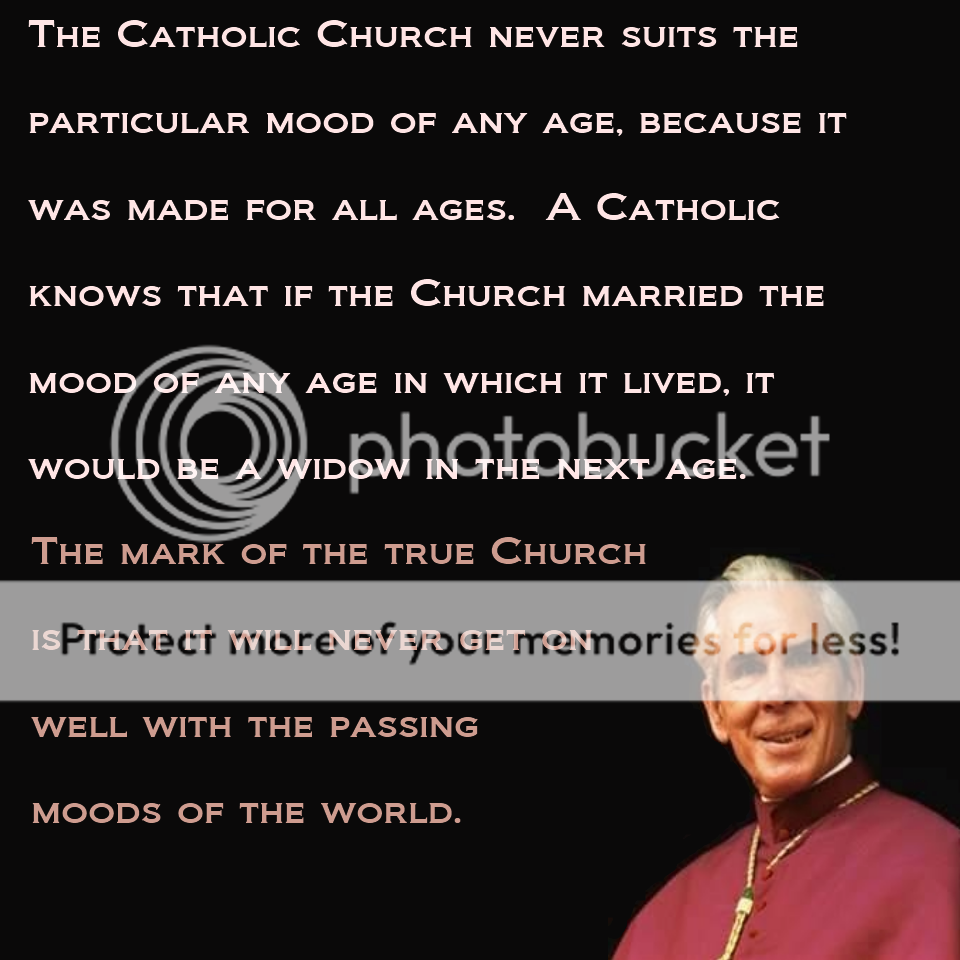
Amen!
 |
|
|
Sep 13 2015, 07:43 AM
Return to original view | IPv6 | Post
#160
|
|
Junior Member
225 posts Joined: Mar 2008
|
Under Mary's Holy Name: Victory in Vienna, September 12, 1683
Christopher Check (September 11, 2014) As Christian Europe tore at her own throat during the Thirty Years War (1618-1648) the Ottoman Turks missed a golden opportunity to strike their centuries-old enemy. Why? They were themselves absorbed with war in Persia. Moreover, they were beset by a turbulent period of harem intrigue and governed—or not—by a string of ineffectual and self-indulgent sultans, one of whom was deposed and two of whom were murdered. The last of these was Ibrahim I. He was deposed and murdered. Known as “the Debauched,” Ibrahim was famous for his vigorous and unusual harem enthusiams, although at one point he had the whole lot of them drowned in the Bosporus—280 ladies in all—when he discovered that he was not the only man enjoying their affections. A liaison one night, however, with a Russian concubine produced the son that would reverse Ottoman fortunes. Mehmed IV was what we would call today, an “outdoorsman.” He preferred hunting to war, but unlike his recent predecessors, he made decisions and stuck by them. Indeed, history remembers Mehmed for two decisions in particular. The first was to give control of the empire to the Koprulu family, which produced a series of Grand Viziers who restored internal order to the empire, recaptured many of the Aegean Islands from Venice, and extended the boundaries of the empire northward through battlefield victories in Transylvania and Poland. Best known and last of these Grand Viziers was Kara Mustafa Pasha. Kara Mustafa Pasha was the source of Mehmed’s other famous decision: in the summer of 1682 the Grand Vizier persuaded his Sultan to violate the Peace of Vasvár and lay siege to Vienna. A century-and-a-half had passed since Suleiman the Magnificent had tried and failed to take the fortress city on the Danube. Mehmed was determined not to fail, and more than that, he was convinced, like all Sultans before him, that the Ottomans were, as conquerors of Constantinople, the true heirs of the patrimony of the Roman Empire. The Hapsburgs in Vienna were impostors who needed to submit to the rule of Islam. By the autumn of 1682 the Ottoman Army had crossed the Bosporus and proceeded to Adrianople. There the sultan wintered his army, and as they trained for war, he read and reread the abundant accounts of earlier Turkish campaigns into Eastern Europe. Along the road-of-march to Belgrade (in Ottoman hands since 1521) bridges and roads were repaired. A draft or “ban” was proclaimed for auxiliaries throughout the empire and Arabs, Bosnians, Bulgars, Greeks, Macedonians, and Serbs poured into the White City to await the arrival of Mehmed’s force, led by his 12,000 janissaries. Among the sultan’s army were Protestant soldiers loyal to the Magyar Lutheran Imre Thököly who looked to the Islamic east to back his dubious claim to the throne of Hungary. Less detestable than Protestants allying themselves with Islam against Catholic Hapsburg rule, but considerably more savage and fearsome, were the Sultan’s mobile shock-action cavalry: the Tatars. Descendants of the bloody convergence of Sarmatians, Scythians, and Mongols, these natural horsemen were the stuff of nightmare. Like the African corsairs who raided the coastal fishing villages of Italy in the 16th century, the Tatars were the frontline of the Ottoman slave trade. Rape, pillage, plunder, and arson composed their modus operandi, tales of which made their way as far as France and England. To the villagers on the Christian Ottoman border in Hungary and Poland, however, the Tatars were no mere story to frighten ill-behaved children. They were a terrifying reality. To the Polish, Lithuanian, and Austrian soldiers who had faced them in battle, they were extraordinary archers capable of a rapid rate of fire and deadly accuracy from their short bows and all from the saddle of a galloping pony. In March of 1683, as the army left Adrianople amidst great fanfare, a sudden squall blew the Sultan’s turban from his head. All his men, from the highest-ranking officer to the lowliest conscript, recognized the bad omen. Superstitions aside, spring storms swelled rivers and the usual fords required pontoon bridges to cross. At Belgrade, Sultan Mehmed handed the Flag of the Prophet (a facsimile because the original had been captured by the Venetians at Lepanto a century before) to his Grand Vizier Kara Mustafa and with it command of the Ottoman host. Mehmed remained in Belgrade to hunt and play. The real ruler of the Ottoman Empire pressed north for Buda, sending his siege cannons on barges up the Danube. Buda had endured Turkish occupation since 1541—another conquest of Suleiman the Magnificent. The Church of Our Lady there to this day bears in one alcove the decorations of the building’s days as a mosque. Was it a misguided ecumenical gesture, or is it a reminder of what may come again to a West grown soft and inattentive? By the second half of June the Turkish army, now greater than 150,000 strong, had arrived in Buda. There the Grand Vizier announced to his war council his plan to take Vienna. “It is for thee to command and for us to serve,” answered the Governor of Damascus. Following the Danube west the Turks pressed on for Vienna, raiding and burning along the way. Leopold I, Holy Roman Emperor could no longer deny that Vienna was the Ottoman objective. The man who had guided his country through the Thirty Years War ruled an empire pinched between a France under the Sun King determined to expand eastward and the Ottoman Empire resurgent. The condition called for a less vacillating character than the emperor, who permitted himself to be talked into abandoning Vienna. Two men of sterner stuff he left behind: Count Ernst Rüdiger von Starhemberg to command the garrison in Vienna and Charles Sixte, Duke of Lorraine to command the Imperial Army in the field. It bears noting that the heroic figure for whom the Siege of Vienna is most remembered, John Sobieski, arrived in the eleventh hour. Both Starhemberg and Lorraine, severely outnumbered, acquitted themselves well throughout the two-month siege, masterfully resisting the Turk and prudently delaying a decisive engagement until the Polish and Saxon reinforcements could muster. The Turks arrived at the walls of Vienna on the 12th of July. On the 13th an emissary from the Grand Vizier rode to the city’s walls with an invitation to surrender the city and submit to Islamic rule. Starhemberg declined. On the 14th the Turks began to bombard the city’s walls. The walls of Vienna had been much improved since the medieval days when they were first constructed, paid for by Richard Lionheart’s ransom. By the 17th century, the city’s defenses included all the designs developed in Italy during the Renaissance: mutually supporting bastions and ravelins, scarp and counterscarp, glacis and curtain wall. Tightly packed earth faced with brick and gently sloped both absorbed and deflected the rounds from the Turkish bombards. But the walls were not everywhere strong, and the Turks located on the south side Vienna’s weak spot between two bastions that fronted the Imperial palace. Toward this point in the wall they began a process at which they were very good: the steady digging of parallel trenches to close on the city’s defenses followed by mining, the digging of underground galleries to be packed with explosives to tumble the walls from beneath. By August, the combination of mining and artillery fire had taken its toll of the city’s outer wall and seriously damaged the palace bastion. Musketball-to-arrow, pike-to-cutlass, and hand-to-hand encounters in the ditch and on the ramparts grew more frequent and more fierce. Viennese counterminers clashed with Turkish sappers in torchlit underground tunnels. Flamboyant and fearless, Starhemberg, a pistol in each hand, was ever in the thick of these contests, yet he knew that without relief the fighting would soon be street-to-street and house-to-house. In the plains and woods surrounding Vienna, Charles Sixte, with his small force of 10,000 horse and no infantry (critical for seizing and holding terrain) did his best to limit the depredations of the merciless Tatar raiders. Dozens of villages south of the Danube were put to the torch, their women raped and their men slaughtered. As grim as events appeared, hope was within sight. Four days after the start of the Turkish bombardment, John III Sobieski, King of Poland marshaled his army of nearly 40,000 in Warsaw and began the 435-mile march southwest toward Vienna. A similar force under John George III Elector of Saxony came southeast from Dresden. A third force came straight east from Munich under Maximilian II Emanuel, Elector of Bavaria. They united near Krems, some forty miles upriver from Vienna.  The Holy League, under command of Sobieski now began its difficult passage through the Wienerwald, known to us as the Vienna Woods, the 30-miles-long and 20-miles-wide expanse of thickly wooded foothills that dominate the terrain southwest of Vienna. Moving the artillery over steep slopes and rugged ground cut with ravines was particularly difficult, but by the 11th of September the Christian force had reached the Kahlenberg ridge. Looking down on the plain below they saw the countless brightly colored tents of the Ottoman host stretching north toward the city walls. Sobieski also saw that the south slope of the ridge was of the same difficult terrain as the rest of the Wienerwald and was crisscrossed with the high, stone walls of vineyards and farms. The descent to the plain below would be as painstaking as the climb, but also under attack from Janissary skirmishers. Before dawn, Sobieski assisted at Mass in the ruined Church of the Camaldolites, offered by Blessed Marco D’Viano. Gathering his force he commended their mission and their souls to the care of the Blessed Virgin. The descent began.  As the sun rose on the morning of 12 September, the Ottomans saw, according their own account, “a flood of black pitch flowing down the hill, smothering and incinerating everything that lay in its way.” Taking one ridge at a time, the Christians fought their way down the hill. Little could the commanders do but exhort their forces to press ahead in the confusion. The Saxons on the left of the Holy League line were the first to engage the forward deployed Ottomans, but by ten a.m. the whole Turkish army was arrayed for counterattack. For several hours the battle traded advantage, the Holy League ever closing on the city. By late afternoon, Sobieski’s army had reached the plain, and he was now positioned to exploit his greatest asset, the famed Winged Hussars. Drawing up these courageous cavalrymen, their feathered plumes streaming off their backs, he led them himself, lances couched in a full-tilt charge at the center of the Ottoman line. Shouting “Jezus Maria ratuj!” they charged and reformed, charged and reformed, charged and reformed. The Polish horsemen followed their intrepid king deeper and deeper into the army of Islam, smashing what remained of their resistance, setting the followers of Muhammad to flight, relieving the siege, and carrying the day. “We came, we saw, God conquered.” Sobieski wrote to Innocent XI. The Polish king—taking a privilege that ought to have gone to Emperor Leopold—entered the city feted with parade and feast. Writing to his wife, Sobieski described Vienna’s gratitude, “All the common people kissed my hands, my feet, my clothes, saying: ‘Ah, let us kiss so valiant a hand!’” The event was the last great Ottoman effort. Their borders receded. Within three years Buda was back in Christian hands. One year after Sobieski’s victory, Pope Innocent XI—also dearly remembered for his explicit condemnations of usury and of “mental reservation” (a sophistry regrettably invoked by some of today's pro-life activists)—extended the Feast of the Holy Name of Mary to the Universal Calendar of the Roman Rite to honor the great victory that Our Lady granted the Christian West. When it fell out of fashion three centuries later in 1969 to recall the heroics of Christian soldiers against the enemies of Jesus Christ, the feast was removed from the Liturgical Calendar. In 2002, however, Pope Saint John Paul II restored the Feast to the Universal Calendar. It is hard not to imagine that the Trade Tower attacks of the preceding year were to the fore of his thoughts when he did, but that we do not know. Source: Under Mary's Holy Name: Victory in Vienna, September 12, 1683 |
|
Topic ClosedOptions
|
| Change to: |  0.6070sec 0.6070sec
 0.33 0.33
 7 queries 7 queries
 GZIP Disabled GZIP Disabled
Time is now: 4th December 2025 - 04:57 AM |
 Quote
Quote