Welcome Guest ( Log In | Register )

Bump Topic Topic Closed RSS Feed
39 Pages « < 5 6 7 8 9 > » Bottom

Outline · [ Standard ] · Linear+

 LYN Catholic Fellowship V01 (Group), For Catholics (Roman or Eastern)

views
     
khool
post Aug 1 2015, 05:59 PM

Getting Started
**
Junior Member
225 posts

Joined: Mar 2008


Eighteenth Sunday in Ordinary Time
Lectionary: 113

user posted image

Reading 1 (Ex 16:2-4, 12-15)

The whole Israelite community grumbled against Moses and Aaron.
The Israelites said to them,
“Would that we had died at the LORD’s hand in the land of Egypt,
as we sat by our fleshpots and ate our fill of bread!
But you had to lead us into this desert
to make the whole community die of famine!”

Then the LORD said to Moses,
“I will now rain down bread from heaven for you.
Each day the people are to go out and gather their daily portion;
thus will I test them,
to see whether they follow my instructions or not.

“I have heard the grumbling of the Israelites.
Tell them: In the evening twilight you shall eat flesh,
and in the morning you shall have your fill of bread,
so that you may know that I, the LORD, am your God.”

In the evening quail came up and covered the camp.
In the morning a dew lay all about the camp,
and when the dew evaporated, there on the surface of the desert
were fine flakes like hoarfrost on the ground.
On seeing it, the Israelites asked one another, “What is this?”
for they did not know what it was.
But Moses told them,
“This is the bread that the LORD has given you to eat.”


Responsorial Psalm (Ps 78:3-4, 23-24, 25, 54)

R. (24b) The Lord gave them bread from heaven.
What we have heard and know,
and what our fathers have declared to us,
We will declare to the generation to come
the glorious deeds of the LORD and his strength
and the wonders that he wrought.
R. The Lord gave them bread from heaven.
He commanded the skies above
and opened the doors of heaven;
he rained manna upon them for food
and gave them heavenly bread.
R. The Lord gave them bread from heaven.
Man ate the bread of angels,
food he sent them in abundance.
And he brought them to his holy land,
to the mountains his right hand had won.
R. The Lord gave them bread from heaven.


Reading 2 (Eph 4:17, 20-24)

Brothers and sisters:
I declare and testify in the Lord
that you must no longer live as the Gentiles do,
in the futility of their minds;
that is not how you learned Christ,
assuming that you have heard of him and were taught in him,
as truth is in Jesus,
that you should put away the old self of your former way of life,
corrupted through deceitful desires,
and be renewed in the spirit of your minds,
and put on the new self,
created in God’s way in righteousness and holiness of truth.


Alleluia (Mt 4:4b)

R. Alleluia, alleluia.
One does not live on bread alone, but by every
word that comes forth from the mouth of God.
R. Alleluia, alleluia.


Gospel (Jn 6:24-35)

When the crowd saw that neither Jesus nor his disciples were there,
they themselves got into boats
and came to Capernaum looking for Jesus.
And when they found him across the sea they said to him,
“Rabbi, when did you get here?”
Jesus answered them and said,
“Amen, amen, I say to you,
you are looking for me not because you saw signs
but because you ate the loaves and were filled.
Do not work for food that perishes
but for the food that endures for eternal life,
which the Son of Man will give you.
For on him the Father, God, has set his seal.”
So they said to him,
“What can we do to accomplish the works of God?”
Jesus answered and said to them,
“This is the work of God, that you believe in the one he sent.”
So they said to him,
“What sign can you do, that we may see and believe in you?
What can you do?
Our ancestors ate manna in the desert, as it is written:
He gave them bread from heaven to eat.”
So Jesus said to them,
“Amen, amen, I say to you,
it was not Moses who gave the bread from heaven;
my Father gives you the true bread from heaven.
For the bread of God is that which comes down from heaven
and gives life to the world.”

So they said to him,
“Sir, give us this bread always.”
Jesus said to them,
“I am the bread of life;
whoever comes to me will never hunger,
and whoever believes in me will never thirst.”

khool
post Aug 2 2015, 07:45 AM

Getting Started
**
Junior Member
225 posts

Joined: Mar 2008


QUOTE(yeeck @ Aug 2 2015, 01:03 AM)
Indulgence of the Portiuncula
From 1 August Noon until 2 August Midnight, one can gain the Indulgence of the Portiuncula obtained from the Pope by Saint Francis
of Assisi for his chapel and extended later to the whole world. To receive the plenary indulgence, one must recite the Credo and Pater
Noster - under the usual conditions for obtaining a plenary indulgence - in any parish church, cathedral or minor basilica
*
All plenary indulgences?
khool
post Aug 3 2015, 09:51 AM

Getting Started
**
Junior Member
225 posts

Joined: Mar 2008


QUOTE(jiansheng12 @ Aug 2 2015, 09:56 PM)
Hi Yeeck, I use to go IC church for mass on Sunday evening.
I was baptize in Holy Spirit church and serving there.
Just curios you are from which parish ?
*
I was born in Penang, but live in Selangor ... hahahahaha! smile.gif

IC Church is very nice, and the priest there gives good homilies
khool
post Aug 3 2015, 10:06 AM

Getting Started
**
Junior Member
225 posts

Joined: Mar 2008


Bible Translations Guide

At Catholic Answers we are often asked which Bible version a person should choose. This is an important question about which Catholics need to be informed. Some have been given very little help about how to pick a Bible translation, but keeping in mind a few tips will make the decision much easier.

There are two general philosophies translators use when they do their work: formal or complete equivalence and dynamic equivalence. Formal equivalence translations try to give as literal a translation of the original text as possible. Translators using this philosophy try to stick close to the originals, even preserving much of the original word order.

Literal translations are an excellent resource for serious Bible study. Sometimes the meaning of a verse depends on subtle cues in the text; these cues are only preserved by literal translations.

The disadvantage of literal translations is that they are harder to read because more Hebrew and Greek style intrudes into the English text. Compare the following renderings of Leviticus 18:6-10 from the New American Standard Bible (NAS—a literal translation) and the New International Version (NIV—a dynamic translation):

The NAS reads: "None of you shall approach any blood relative of his to uncover nakedness. . . . You shall not uncover the nakedness of your father’s wife; it is your father’s nakedness. The nakedness of your sister, either your father’s daughter or your mother’s daughter, whether born at home or born outside, their nakedness you shall not uncover. The nakedness of your son’s daughter or your daughter’s daughter, their nakedness you shall not uncover; for their nakedness is yours."

The NIV reads: "No one is to approach any close relative to have sexual relations. . . . Do not have sexual relations with your father’s wife; that would dishonor your father. Do not have sexual relations with your sister, either your father’s daughter or your mother’s daughter, whether she was born in the same home or elsewhere. Do not have sexual relations with your son’s daughter or your daughter’s daughter; that would dishonor you."

Because literal translations can be difficult to read, many have produced more readable Bibles using the dynamic equivalence philosophy. According to this view, it does not matter whether the grammar and word order of the original is preserved in English so long as the meaning of the text is preserved. This frees up the translator to use better English style and word choice, producing more readable translations. In the above example, the dynamic equivalence translators were free to use the more readable expression "have sexual relations with" instead of being forced to reproduce the Hebrew idiom "uncover the nakedness of."

The disadvantage of dynamic translation is that there is a price to pay for readability. Dynamic translations lose precision because they omit subtle cues to the meaning of a passage that only literal translations preserve. They also run a greater risk of reading the translators’ doctrinal views into the text because of the greater liberty in how to render it.

For example, dynamic Protestant translations, such as the NIV, tend to translate the Greek word ergon and its derivatives as "work" when it reinforces Protestant doctrine but as something else (such as "deeds" or "doing") when it would serve Catholic doctrine.

The NIV renders Romans 4:2 "If, in fact, Abraham was justified by works (ergon), he had something to boast about—but not before God." This passage is used to support the Protestant doctrine of salvation by faith alone. But the NIV translates the erg- derivatives in Romans 2:6-7 differently: "God ‘will give to each person according to what he has done (erga).’ To those who by persistence in doing (ergou) good seek glory, honor and immortality, he will give eternal life."

If the erg- derivatives were translated consistently as "work" then it would be clear that the passage says God will judge "every person according to his works" and will give eternal life to those who seek immortality "by persistence in working good"—statements that support the Catholic view of salvation.

Even when there is no doctrinal agenda involved, it is difficult to do word studies in dynamic translations because of inconsistency in how words are rendered. Beyond this, the intent of the sacred author can be obscured.

Finding a Balance

Both literal and dynamic equivalence philosophies can be carried to extremes. One translation that carries literalism to a ludicrous extreme is the Concordant Version, which was translated by a man who had studied Greek and Hebrew for only a short time. He made a one-to-one rendering in which each word in the ancient originals was translated by one (and only one) word in English. This led to numerous absurdities. For example, compare how the Concordant Version of Genesis 1:20 compares with the NIV:

"And saying is God, ‘Roaming is the water with the roaming, living soul, and the flyer is flying over the earth on the face of the atmosphere of the heavens’" (Concordant Version).

"And God said, ‘Let the water teem with living creatures, and let birds fly above the earth across the expanse of the sky’" (NIV).

At the other extreme from absurdly literal translations are absurdly dynamic ones, such as the Cotton-Patch Version (CPV). This was translated from Greek in the 1960s by a man named Clarence Jordan, who decided not only to replace ancient ways of speaking with modern ones (like most dynamic translations) but to replace items of ancient culture with items of modern ones.

Compare the NIV rendering of Matthew 9:16-17 with what is found in the CPV:

"No one sews a patch of unshrunk cloth on an old garment, for the patch will pull away from the garment, making the tear worse. Neither do men pour new wine into old wineskins. If they do, the skins will burst, the wine will run out and the wineskins will be ruined. No, they pour new wine into new wineskins, and both are preserved" (NIV).

"Nobody ever uses new, unshrunk material to patch a dress that’s been washed. For in shrinking, it will pull the old material and make a tear. Nor do people put new tubes in old, bald tires. If they do, the tires will blow out, and the tubes will be ruined and the tires will be torn up. But they put new tubes in new tires and both give good mileage" (CPV).

Between the extremes of the Concordant Version and the Cotton-Patch Version is a spectrum of respectable translations that strike different balances between literal and dynamic equivalence.

Toward the literal end of the spectrum are translations such as the King James Version (KJV), the New King James Version (NKJV), the New American Standard (NAS), and the Douay-Rheims Version.

Next come slightly less literal translations, such as the Revised Standard Version (RSV), and the Confraternity Version.

Then there are mostly dynamic translations such as the New International Version (NIV) and the New American Bible (NAB).

And finally, toward the very dynamic end of the spectrum are translations such as the New Jerusalem Bible (NJB), the New English Bible (NEB), the Revised English Bible (REB), the Contemporary English Version (CEV), and the "Good News Bible," whose translation is called Today’s English Version (TEV).

One translation that is hard to place on the spectrum is the New Revised Standard Version (NRSV). The basic text of the NRSV is rendered literally, following the RSV, but it uses "gender inclusive language," which tries to translate the original text into a modern "gender neutral" cultural equivalent. When you read the NRSV you will often encounter "friends," "beloved," and "brothers and sisters," and then see a footnote stating "Gk brothers." The NRSV also shows a preference for using "God" and "Christ" when the original text says "he."

There is also a host of minor versions, most of which are dynamic equivalence translations. These include well-known ones, such as the Moffat, Philips, and Knox translations, and also unique, specialty versions such as the Jewish New Testament (JNT, translated by David Stern), which renders New Testament names and expressions with the Hebrew, Aramaic, or Yiddish equivalents.

Finally, there are a selection of paraphrases, which are not translations based on the original languages but are paraphrased versions of English translations. These tend toward the extreme dynamic end of the spectrum. The best known is the Living Bible (TLB), also known as "The Book."

The basic question you need to ask when selecting a Bible version is the purpose you are pursuing. If you simply want a Bible for ordinary reading, a moderate or dynamic version would suffice. This would enable you to read more of the text quickly and comprehend its basic meaning, though it would not give you the details of its meaning, and you would have to watch out more for the translators’ doctrinal views coloring the text.

What is the Best Bible?

If you intend to do serious Bible study, a literal translation is what you want. This will enable you to catch more of the detailed implications of the text, but at the price of readability. You have to worry less about the translators’ views coloring the text, though even very literal translations are not free from this entirely.

A second question you will need to ask yourself is whether you want an old or a modern translation. Older versions, such as the King James and the Douay-Rheims, can sound more dignified, authoritative, and inspiring. But they are much harder to read and understand because English has changed in the almost four hundred years since they were done.

One down side to using certain modern translations is that they do not use the traditional renderings of certain passages and phrases, and the reader may find this annoying. The "Good News Bible" or TEV is especially known for non-traditional renderings. For example, "the abomination of desolation" referred to in the book of Daniel and the Gospels is called "the awful horror," and the ark of the covenant is known as "the covenant box."

Some Protestants will tell you that the only acceptable version of the Bible is the King James. This position is known as King James-onlyism. Its advocates often make jokes such as, "If the King James Version was good enough for the apostle Paul, it is good enough for me," or, "My King James Version corrects your Greek text."

They commonly claim that the King James is based on the only perfect set of manuscripts we have (a false claim; there is no perfect set of manuscripts; and the ones used for the KJV were compiled by a Catholic, Erasmus), that it is the only translation that avoids modern, liberal renderings, and that its translators were extremely saintly and scholarly men. Since the King James is also known as "the Authorized Version" (AV), its advocates sometimes argue that it is the only version to ever have been "authorized." To this one may point out that it was only authorized in the Anglican church, which now uses other translations. For a still-in print critique of King James-onlyism, see D. A. Carson, The King James Version Debate, A Plea for Realism (Grand Rapids: Baker, 1979).

As amusing as King James-onlyism may sound, some people take it very seriously. There is even a Catholic equivalent, which we might call "Douay-Rheims-onlyism." The Douay-Rheims version, which predates the King James by a few years, (the complete KJV was published in 1611, but the complete Douay-Rheims in 1609) was the standard Bible for English-speaking Catholics until the twentieth century.

What many advocates of both King James-onlyism and Douay-Rheims-onlyism do not know is that neither Bible is the original issued in the 1600s. Over the last three centuries, numerous minor changes (for example, of spelling and grammar) have been made in the King James, with the result that most versions of the KJV currently on the market are significantly different from the original. This has led one publisher to recently re-issue the 1611 King James Version Bible.

The Douay-Rheims currently on the market is also not the original, 1609 version. It is technically called the "Douay-Challoner" version because it is a revision of the Douay-Rheims done in the mid-eighteenth century by Bishop Richard Challoner. He also consulted early Greek and Hebrew manuscripts, meaning that the Douay Bible currently on the market is not simply a translation of the Vulgate (which many of its advocates do not realize).

For most the question of whether to use an old or a modern translation is not so pointed, and once a decision has been reached on this question it is possible to select a particular Bible version with relative ease.

We recommend staying away from translations with unconventional renderings, such as the TEV, and suggest using the Revised Standard Version- Catholic Edition. This is a Church-approved version of the RSV that has a few, minor changes in the New Testament. It has been reissued by Ignatius Press under the title The Ignatius Bible (available from Catholic Answers in bothhardcover and paperback formats).

In the end, there may not be a need to select only one translation of the Bible to use. There is no reason why a Catholic cannot collect several versions of the Bible, aware of the strengths and weaknesses of each. It is often possible to get a better sense of what is being said in a passage by comparing several different translations.

So, which Bible is the best? Perhaps the best answer is this: The one you’ll read.

NIHIL OBSTAT: I have concluded that the materials
presented in this work are free of doctrinal or moral errors.
Bernadeane Carr, STL, Censor Librorum, August 10, 2004

IMPRIMATUR: In accord with 1983 CIC 827
permission to publish this work is hereby granted.
+Robert H. Brom, Bishop of San Diego, August 10, 2004


Source: http://www.catholic.com/tracts/bible-translations-guide

khool
post Aug 7 2015, 01:50 PM

Getting Started
**
Junior Member
225 posts

Joined: Mar 2008


The thoughts of a pro-choice woman, one who gave rise to Planned Parenthood. Pray that we do not see the likes of her ever again ...

BIRTH CONTROL OR ABORTION?
By Margaret Sanger

Family limitation will be practiced. No law has yet been framed that can prevent it. The church has been powerless and the champions of wornout moral creeds find themselves trying in vain to force all women to become mothers against their wills.

Abundant evidence of the futility of seeking to impose involuntary motherhood upon women is found in the size of the families of the rich, of the well-to-do and of the wage workers of larger earning capacity. The women of these classes long ago refused to be mere brood animals–-usually they prefer to be voluntary mothers, determining for themselves the number of children they shall have and when they shall have them. Family limitation for them is an accomplished fact.

It is also an accomplished fact with many of the wives of the less highly paid workers. But with the latter, as well as with some of their more fortunate sisters, family limitation takes a far more drastic and too often a terribly dangerous course. The awakened woman of today will not bear unwanted children. She will not bear more children than she can care for. And if she is denied the knowledge of the safe, harmless, scientific methods of Birth Control, she limits her family by means of abortion.

In the very nature of the case, it is impossible to get accurate figures upon the number of abortions performed annually in the United States. It is often said, however, that one in five pregnancies end in abortion. One estimate is that 150,000 occur in the United States each year and that 25,000 women die of the effects of such operations in every twelve months. Dr. William J. Robinson asserts that there are 1,000,000 abortions every year in this country and adds that the estimate is conservative. He quotes Justice John Proctor Clark as saying that there are at least 100,000 in the same length of time in New York City alone.

Dr. Max Hirsch, a famous authority quotes an opinion that there are 2,000,000 abortions in the United States every year!

"I believe" declares Dr. Hirsch, "that I may say without exaggeration that absolutely spontaneous or unprovoked abortions are extremely rare, that a vast majority--I should estimate it at 80 per cent--have a criminal origin."

"Our examinations have informed us that the largest number of abortions are performed on married women. This fact brings us to the conclusion that contraceptive measures among the upper classes and the practice of abortion among the lower class, are the real means employed to regulate the number of offspring."

The question, then, is not whether family limitation should be practised. It is being practised; it has long been practised and it will always be practised. The question now is whether it is to be attained by normal, scientific Birth Control methods or by the abnormal, often dangerous, surgical operation.

That is the question which the church, the state, the moralist and most of all, the woman herself, must face.

The knowledge of Birth Control methods may for a time be denied to the woman of the working class, but those who are responsible for denying it to her, and she herself, should understand clearly the dangers to which she is exposed by the dark age laws which force her into the hands of the abortionist. To understand the more clearly what these dangers are, and to realize the more fully how much better it would be to avoid them, it is first necessary that women should know something of the processes of conception, the prevention of which frees them of all risk of having to resort to abortion.

In every woman's ovaries there are imbedded millions of ovules or eggs. They are there in every female at birth and as the girl grows into womanhood, these ovules or eggs develop also. At a certain period or age, the ripest ovule leaves the nest or ovary and comes on down one of the tubes into the womb and passes out of the body. When this takes place, it is said that the girl is at the age of puberty, for the ovule is now ready for fertilization (or conception) by the male sperm.

About the same time that the ovule is ripening or developing, the womb is preparing to receive the fertilized ovum by a reinforced blood supply brought to its lining. To this lining the ovum will cling and gather its nourishment after fertilization takes place. If fertilization (conception) does not take place, the ovum passes on out of the body and the uterus throws off its surplus blood supply. This is called the menstrual period and occurs once a month or about every twenty-eight days.

In the male sexual organs, there are glands (testes) which secrete a fluid called the semen. In the semen is the lifegiving principle, the sperm.

When intercourse takes place (if no preventative is used) the semen is deposited in the woman's vagina. The ovule is not in the vagina, but is in the womb, further up, in safety, or perhaps in the tube on its way to the womb. As steel is attracted to the magnet, the sperm of the male starts on its way to seek the ovum. Several of these sperm cells start, but only one enters the ovum and is absorbed into it. This process is called fertilization, conception or impregnation. If no children are desired, the meeting of the male sperm and the ovum must be prevented. When scientific means are used to prevent this meeting, and thereby to limit families, one is said to practise Birth Control.

But if preventive means are not used and the sperm meets the ovum and development thus begins, any attempt at removing it or stopping its further growth is called abortion.

There is no doubt that women are apt to look upon abortion as of little consequence and to treat it accordingly. An abortion is as important a matter as a confinement and requires as much attention as the birth of a child at its full term.

"The immediate dangers of abortion," says Dr. J. Clifton Edgar, in his book "The Practice of Obstetrics," "are hemhorrage, retention of an adherent placenta, sepsis, tetanus, perforation of the uterus. They also cause sterility, anemia, malignant diseases, displacements, neurosis, and endometritis."

In plain, everyday language, in an abortion there is always a very serious risk to the health and often to the life of the patient.

It is only the women of wealth who can afford to give an abortion proper care and treatment both at the time of the operation and afterwards. These women often escape any serious consequences from its occurrence.

The women whose incomes are limited and who must continue at work before they have recovered from the effects of an abortion are the great army of sufferers. It is among such that the deaths due to abortion usually ensue. It is these, too, who are most often forced to resort to such operations.

If death does not result, the woman who has undergone an abortion is not therefore safe. The womb may not return to its natural size but remain large and heavy, tending to fall away from its natural position. Abortion often leaves the uterus in a condition to conceive easily again and unless prevention is strictly followed another pregnancy will surely occur. Frequent abortions tend to cause barrenness and serious, painful pelvic ailments. These and other conditions arising from such operations are quite likely to ruin a woman's general health.

While there are cases where even the law recognizes an abortion as justifiable if recommended by a physician, I assert that the hundreds of thousands of abortions performed in America each year are a disgrace to civilization.

I also assert that the responsibility for these abortions and the illness, misery and deaths that come in their train lies at the door of a government whose authority has been stretched beyond the limits of the people's intention and which, in its puritanical blindness, insists upon suffering and death from ignorance, rather than life and happiness from knowledge and prevention.

It needs no assertion of mine to call attention to the grim fact that the laws prohibiting the imparting of information concerning the preventing of conception are responsible for tens of thousands of deaths each year in this country and an untold amount of sickness and sorrow. The suffering and the death of these women is squarely upon the heads of the lawmakers and the puritanical, masculine-minded persons, who insist upon retaining the abominable legal restrictions.

Try as they will they cannot escape the truth, nor hide it under the cloak of stupid hypocrisy. If the laws against imparting knowledge of scientific Birth Control were repealed, the 1,000,000 or 2,000,000 women who undergo abortions in the United States each year would escape the agony of the surgeon's instruments and the long trail of disease, suffering and death which so often follows.

"He who would combat abortion" says Dr. Hirsch, "and at the same time combat contraceptive measures may be likened to the person who would fight contagious diseases and forbid disinfection. For contraceptive measures are important weapons in the fight against abortion.

"America has a law since 1873 *** which prohibits by criminal statute, the distribution and regulation of contraceptive measures. It follows, therefore *** that America stands at the head of all nations in the huge number of abortions."

There is the case in a nutshell. Family limitation will always be practised as it is now being practised–-either by Birth Control or by abortion. We know that. The one means health and happiness–-a stronger, better race. The other means disease, suffering, death.

When all is said and done, it is not the advocates of Birth Control, but the bitter, unthinkable conditions brought about by the blindness of church, state and society that puts up to all three the question: Birth Control or Abortion–-which shall it be?

Source: https://www.nyu.edu/projects/sanger/webedit...rDoc=232534.xml

This post has been edited by khool: Aug 7 2015, 01:51 PM
khool
post Aug 8 2015, 04:52 PM

Getting Started
**
Junior Member
225 posts

Joined: Mar 2008


Blessed Saturday to all Catholics! rclxms.gif rclxms.gif rclxms.gif

user posted image

khool
post Aug 8 2015, 10:38 PM

Getting Started
**
Junior Member
225 posts

Joined: Mar 2008


Nineteenth Sunday in Ordinary Time
Lectionary: 116

Reading 1 (1 Kgs 19:4-8)

Elijah went a day’s journey into the desert,
until he came to a broom tree and sat beneath it.
He prayed for death saying:
“This is enough, O LORD!
Take my life, for I am no better than my fathers.”
He lay down and fell asleep under the broom tree,
but then an angel touched him and ordered him to get up and eat.
Elijah looked and there at his head was a hearth cake
and a jug of water.
After he ate and drank, he lay down again,
but the angel of the LORD came back a second time,
touched him, and ordered,
“Get up and eat, else the journey will be too long for you!”
He got up, ate, and drank;
then strengthened by that food,
he walked forty days and forty nights to the mountain of God, Horeb.


Responsorial Psalm (Ps 34:2-3, 4-5, 6-7, 8-9)

R. Taste and see the goodness of the Lord.

I will bless the LORD at all times;
his praise shall be ever in my mouth.
Let my soul glory in the LORD;
the lowly will hear me and be glad.

R. Taste and see the goodness of the Lord.

Glorify the LORD with me,
Let us together extol his name.
I sought the LORD, and he answered me
And delivered me from all my fears.

R. Taste and see the goodness of the Lord.

Look to him that you may be radiant with joy.
And your faces may not blush with shame.
When the afflicted man called out, the LORD heard,
And from all his distress he saved him.

R. Taste and see the goodness of the Lord.

The angel of the LORD encamps
around those who fear him and delivers them.
Taste and see how good the LORD is;
blessed the man who takes refuge in him.

R. Taste and see the goodness of the Lord.


Reading 2 (Eph 4:30—5:2)

Brothers and sisters:
Do not grieve the Holy Spirit of God,
with which you were sealed for the day of redemption.
All bitterness, fury, anger, shouting, and reviling
must be removed from you, along with all malice.
And be kind to one another, compassionate,
forgiving one another as God has forgiven you in Christ.

So be imitators of God, as beloved children, and live in love,
as Christ loved us and handed himself over for us
as a sacrificial offering to God for a fragrant aroma.


Alleluia (Jn 6:51)

R. Alleluia, alleluia.

I am the living bread that came down from heaven, says the Lord;
whoever eats this bread will live forever.

R. Alleluia, alleluia.


Gospel (Jn 6:41-51)

The Jews murmured about Jesus because he said,
“I am the bread that came down from heaven, ”
and they said,
“Is this not Jesus, the son of Joseph?
Do we not know his father and mother?
Then how can he say,
‘I have come down from heaven’?”
Jesus answered and said to them,
“Stop murmuring among yourselves.
No one can come to me unless the Father who sent me draw him,
and I will raise him on the last day.
It is written in the prophets:
They shall all be taught by God.
Everyone who listens to my Father and learns from him comes to me.
Not that anyone has seen the Father
except the one who is from God;
he has seen the Father.
Amen, amen, I say to you,
whoever believes has eternal life.
I am the bread of life.
Your ancestors ate the manna in the desert, but they died;
this is the bread that comes down from heaven
so that one may eat it and not die.
I am the living bread that came down from heaven;
whoever eats this bread will live forever;
and the bread that I will give is my flesh for the life of the world.”

Source: http://www.usccb.org/bible/readings/080915.cfm

Blessed Sunday! biggrin.gif

khool
post Aug 10 2015, 03:59 PM

Getting Started
**
Junior Member
225 posts

Joined: Mar 2008


QUOTE(pehkay @ Aug 10 2015, 03:53 PM)
You might want to take anything from worldtruth.tv with a grain of salt. biggrin.gif
*
Never heard of this worldtruth.tv before, pehkay, have u?

This post has been edited by khool: Aug 10 2015, 04:00 PM
khool
post Aug 10 2015, 04:22 PM

Getting Started
**
Junior Member
225 posts

Joined: Mar 2008


Come to think of it, wasn't Satan originally one of the Seraphim? i.e. Angels of Music?


The Devil, the Fallen Angel
FR. WILLIAM SAUNDERS

The Catechism of the Catholic Church asserts, "Behind the disobedient voice, opposed to God, which makes them fall into death out of envy. Sacred Scripture and the Church's Tradition see in this being a fallen angel, called 'Satan' or the 'devil'' No. 391). Throughout Sacred Scripture, we find mention of Satin, the devil. The word Satan comes from the Hebrew verb satan meaning to oppose, to harass someone; so Satan would be the tempter, the one to make us trip and fall, the one to turn us from God. The word devil is derived from the Greek diabolos meaning an accuser, a slanderer. Other synonyms for Satan in Sacred Scripture are the Evil One, Beelzebub, the Accuser, the Tempter, the Great Dragon and the Ancient Serpent.

We believe that in the beginning, God created Satan as a good angel: The Lateran Council IV (1215) stated, "The devil and the other demons were indeed created naturally good by God, but they became evil by their own doing." These angels irrevocably chose through their free will to rebel against God and not to serve Him. For this rebellion, they were cast into hell. Sacred Scripture attests to this belief: Our Lord, speaking of the final judgment, said, "Then [the Son of Man] will say to those on His left: 'out of my sight, you condemned, into that everlasting fire prepared for the devil and his angels'" :(Mt 25:41). St. Peter wrote, "Did God spare even the angels who sinned? He did not! He held them captive in Tartarus [the term in Greek mythology to indicate the place of punishment in the underworld]â¦" (2 Pt 2:4). St. John added, "The man who sins belongs to the devil, because the devil is a sinner from the beginning" (1 Jn 3:8). In sum, God created the devil as good, God punished him for his sin, and God allows his present activity. The Catechism admits, "It is a great mystery that providence should permit diabolical activity, but 'we know that in everything God works for good with those who love him'" (No. 395).

Our Lord identified Satan in various ways. He called Satan the Prince of this World: Satan uses material things to distract us from God. He tempts us to adore the material, the sensual, and the powerful rather than to adores God. He lures us into a sense of false security of thinking we can build our own little kingdom here and now without any need of God.

Jesus referred to Satan as the Father of Lies: The devil perverts the truth, as he did with Eve. He fills our minds with doubts. He provides all the rationalizations why something is right even though our Lord and the Church teach it as wrong.

Satan is the Price of Darkness: He lurks about and is crafty. He fills us with the pessimistic thoughts, the bad thoughts, the hateful thoughts. He shows us all the hurts, frustration and troubles of this world and of our own lives hoping to lead us to despair.

Finally, Jesus called him the Murderer: The devil seeks to kill the grace of God in our soul, and then take our soul to hell.

Traditionally, the devil is known as Lucifer, meaning "light-bearer," one of the seraphim, the highest choir of angels who see and adore God directly. Given his sin, his activity and his identification by our Lord, it is little wonder that Christian art has depicted Satan as an ugly, horrible beast with horns who has lost all light and beauty. Even in the morality plays of the Middle Ages, Satan could appear in disguise, but was always recognized by his limp, a sign of his fall from heaven.

Nevertheless, we are confident that the power of God will always triumph over that of Satan; good, over evil; and love, over hatred. St. John reminds us, "It was to destroy the devil's works that the Son of God revealed Himself" (1 Jn 3:8).

We take the presence and power of Satan seriously. We continue to ask the candidates in our Baptismal liturgy, "Do you reject Satan? And all his works? And all his empty promises?" We must make the rejection every day. If Satan tempted our Lord in the desert, he surely will tempt us. He knows how we are weak and when we are vulnerable. St. Peter warned, "Stay sober and alert. Your opponent the devil is prowling like a roaring lion looking for someone to devour" (1 Pt 5:8). Moreover, when we do commit sin, we must sincerely repent of it and seek forgiveness, never allowing Satan to gain a foothold into our lives.

Archbishop Fulton Sheen provided us with a keen insight into Satan: "Do not mock the Gospels and say there is no Satan. Evil is too real in the world to say that. Do not say the idea of Satan is dead and gone. Satan never gains so many cohorts, as when, in his shrewdness, he spreads the rumor that he is long since dead. Do not reject the Gospel because it says the Savior was tempted. Satan always tempts the pure — the others are already his. Satan stations more devils on monastery walls than in dens of iniquity, for the latter offer no resistance. Do not say it is absurd that Satan should appear to our Lord, for Satan must always come close to the godly and the strong — the others succumb from a distance."

Source: http://www.catholiceducation.org/en/cultur...llen-angel.html

This post has been edited by khool: Aug 10 2015, 04:24 PM
khool
post Aug 11 2015, 08:53 AM

Getting Started
**
Junior Member
225 posts

Joined: Mar 2008


FYI to Catholics ...

user posted image

khool
post Aug 11 2015, 02:19 PM

Getting Started
**
Junior Member
225 posts

Joined: Mar 2008


For those who have children ... biggrin.gif

user posted image

khool
post Aug 14 2015, 01:50 PM

Getting Started
**
Junior Member
225 posts

Joined: Mar 2008


Grace


Grace, actual and sanctifying, is a spontaneous gift of God’s love and mercy to save mankind. Sanctifying grace transforms a sinner into a God’s son, is a permanent part of the soul as long as we do not commit a mortal sin, and we can recover the divine affiliation in the sacrament of Penance. Actual grace entails transient divine impulses due to salutary acts, in consideration of Christ’s merits, for union with God and spiritual growth.

Sanctifying grace is conferred by the valid reception of the sacraments:
QUOTE
• Sanctifying grace is communicated in Baptism, Penance, and Anointing of the Sick;
• Sanctifying grace is always increased when a sacrament is received in the state of grace;
• Actual grace is given by all the sacraments;
• The sacramental character is indelibly imprinted on the soul in Baptism, Confirmation, and the Priesthood;
• A distinctive sacramental grace is imparted by each sacrament, corresponding to their respective purpose in the supernatural life of the soul.
The seven sacraments are sacred, signs and instruments of grace, and special occasions of grace. Catholics can also increase sanctifying grace through prayer and acts of mercy, and must exercise vigilance over intentions and actions to prevent venial sins.

Source: https://meditationsoncatholicism.wordpress....13/01/12/grace/

This post has been edited by khool: Aug 14 2015, 01:52 PM
khool
post Aug 14 2015, 11:21 PM

Getting Started
**
Junior Member
225 posts

Joined: Mar 2008


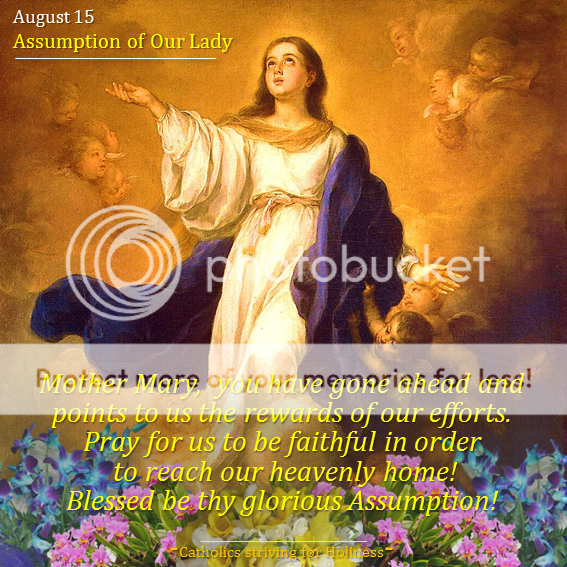
August 15: SOLEMNITY OF THE ASSUMPTION OF OUR LADY. Its Meaning and Consequences in Our Christian Life.
Posted by catholicsstrivingforholiness in Blessed Trinity, Dogma, Love, Love for Our Lady, Love of God, Self-giving, Solemnity, Virgin Mary

user posted image

Dear friends, Happy Solemnity of the Assumption of Our Lady! The entire Church −triumphant, pilgrim and suffering− rejoices on this great day when the Most Blessed Trinity rewards Our Mother, the Blessed Virgin Mary, glorifying her at the end of her life on earth. On this regard, I would like to center our reflection on the following ideas: (1) What is the dogma of the Assumption all about?; (2) What are the consequences of her Assumption for us, Christians?; (3) What was the path She took leading towards her final glorification?

WHAT IS THE DOGMA OF THE ASSUMPTION OF OUR LADY?

The dogma of the Assumption of Our Lady means that Our Lady was “taken up body and soul into heavenly glory” without suffering death, which is a consequence of original sin. The following words are taken from the Catechism of the Catholic Church, n. 966 which teaches and reiterates the dogma on the Assumption of Our Lady promulgated by Pius XII on November 1, 1950, in “Munificentissimus Deus” (1950).

QUOTE
The “Immaculate Virgin, preserved free from all stain of original sin, when the course of her earthly life was finished, WAS TAKEN UP BODY AND SOUL INTO HEAVENLY GLORY, AND EXALTED BY THE LORD AS QUEEN OVER ALL THINGS, SO THAT SHE MIGHT BE THE MORE FULLY CONFORMED TO HER SON, THE LORD OF LORDS AND CONQUEROR OF SIN AND DEATH

(Lumen gentium 59; cf. Pius XII, Munificentissimus Deus (1950): DS 3903; cf. Rev 19:16).”

Nevertheless, since the fifth century the Church has held implicitly the belief in the Assumption of the Blessed Mother, body and soul, into heaven. It can be deduced from the Liturgy, from pious documents and the writings of the Fathers and the Doctors of the Church.

From the Patristic and theological viewpoints, there are many sources which assert this Marian privilege, but the one stands out providing reasons of convenience are the following words taken from the St. John Damascene’s homily:

QUOTE
“It was fitting that she who in childbirth preserved intact her virginity should preserve without corruption her body after the conclusion of her earthly life. It was fitting that she who bore in her womb the creator become a babe should dwell in the divine mansion. It was fitting that the spouse of God be taken to the heavenly home. It was fitting that she who witnessed her Son on the cross, suffering in her heart then the pain she was spared in childbirth, should contemplate him seated at the right hand of the Father. It was fitting that the Mother of God come to possess what belongs to her Son and that she be honored as Mother and Servant of God by all creatures.”

(St. John Damascene, Homily 2 on the Dormition, 14 cited in Pius XII, op. cit).

CONSEQUENCES OF THE DOGMA OF THE ASSUMPTION:

1. OUR LADY’S ASSUMPTION AS THE ANTICIPATION OF THE GLORY OF ALL FAITHFUL CHRISTIANS

QUOTE
It is a great day for us as well for the “ASSUMPTION OF THE BLESSED VIRGIN IS A SINGULAR PARTICIPATION IN HER SON’S RESURRECTION” is also “AN ANTICIPATION OF THE RESURRECTION OF OTHER CHRISTIANS: In giving birth you kept your virginity; in your Dormition you did not leave the world, O Mother of God, but were joined to the source of Life. You conceived the living God and, by your prayers, will deliver our souls from death

(Catechism of the Catholic Church, n. 966).”

2. THE ASSUMPTION OF OUR LADY IS A SOURCE OF OUR JOYFUL HOPE THAT ONE DAY WE SHALL ALSO FOLLOW THE SAME DESTINY.

The exultant culmination of Our Lady’s life on earth with her glorification both in body and soul will be the final destiny and finale for all faithful Christians, her children, and confirms our hope of reaching heaven to contemplate the Blessed Trinity.

QUOTE
[/I]The feast of the Assumption of our Lady prompts us to acknowledge the basis for this joyful hope. Yes, we are still pilgrims, but our mother has gone on ahead, where she points to the reward of our efforts. She tells us that we can make it. And, if we are faithful, we will reach home.[/I]

(St. Josemaria, “Christ is Passing By,” n. 176)

HER FINAL GLORIFICATION: FRUIT OF HER TOTAL LOVE AND SELF-GIVING TO GOD

On the other hand, the blessed Virgin is not only our model, she is not only the help of Christians, SHE IS ABOVE ALL OUR MOTHER as well. In spite of the fact that She is now in heaven, she keeps on watching over her children with motherly love and care, interceding for each one of us so that we may arrive at our heavenly goal.

Nevertheless, we should not forget that Our Lady’s final glorification in her Assumption was the result of her TOTAL SELF-GIVING AND LOVE FOR GOD AND HIS WILL.

QUOTE
Let us then ask God through the intercession of Our Mother Mary so that we may also learn to imitate Her in her total love and  self-giving, without reserve, unafraid of the Cross and undaunted and generous to struggle daily against our self, for love of God and of others.

“O God, who looking on the lowliness of the Blessed Virgin Mary, raised her to such grace, that your Only Begotten Son was born of her according to the flesh, and that she was crowned this day with surpassing glory; grant through her prayers, that saved by the mystery of your redemption, we may merit to be exalted by you on high. Through Our Lord Jesus Christ.”


(Opening prayer, Mass of the Solemnity)
Source: http://catholicsstrivingforholiness.com/20...christian-life/

PHOTO SOURCE: Bartolomé Esteban Murillo, “La Asunción de la Virgen” in http://uploads2.wikiart.org/images/bartolo...virgin-1670.jpg (Modified: added flowers for love and in honor of Our Lady rclxm9.gif)

khool
post Aug 21 2015, 07:57 PM

Getting Started
**
Junior Member
225 posts

Joined: Mar 2008


Please pray for our clergy!!!

user posted image

Amen!
khool
post Aug 23 2015, 10:11 AM

Getting Started
**
Junior Member
225 posts

Joined: Mar 2008


user posted image
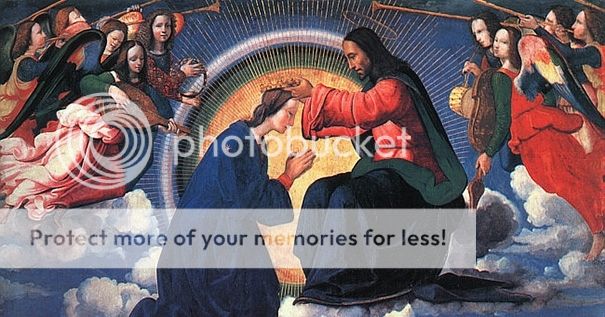
Ridolfo Ghirlandaio, "The Coronation of the Virgin with Six Saints" (1504)

On this Feast of the Queenship of Mary, perhaps we can re-crown Mary as our heavenly Queen, offering her the honor she deserves and recommitting ourselves to her as her royal subjects. Is there a church or Marian shrine near you? Why not stop in for a quick visit and greet your Queen? Make up a private crowning prayer and symbolically place the golden crown upon Mary’s holy head. You can even do this in the shrine of your heart. Jesus dwells there, and wherever he is, Mary is.
In return, Mary will give you gifts in abundance because it is her special day, and because you are special to her. You are not only her royal subject, but also you are her royal child and she cherishes you as such.
The gifts you receive may not be what you expect, but they will be exactly the ones God wants you to have, through Mary’s royal hands.

Source: http://www.ncregister.com/blog/mfenelon/ma...ominion-is-vast

khool
post Aug 24 2015, 01:45 PM

Getting Started
**
Junior Member
225 posts

Joined: Mar 2008


QUOTE(Ishin Shishi @ Aug 23 2015, 06:10 PM)
What are the fundamental differences between Protestantism and Catholicism, apart from the extra apocrypha books for Catholics? I heard that the position of Virgin Mary as saint is one dissimilarity too.

Also, what's the view of Catholics regarding the Inquisition?

Thank you in advance.
*
First off ...

The Inquisition

Sooner or later, any discussion of apologetics with Fundamentalists will address the Inquisition. To non-Catholics it is a scandal; to Catholics, an embarrassment; to both, a confusion. It is a handy stick for Catholic-bashing, simply because most Catholics seem at a loss for a sensible reply. This tract will set the record straight.

There have actually been several different inquisitions. The first was established in 1184 in southern France as a response to the Catharist heresy. This was known as the Medieval Inquisition, and it was phased out as Catharism disappeared.

Quite separate was the Roman Inquisition, begun in 1542. It was the least active and most benign of the three variations.

Separate again was the infamous Spanish Inquisition, started in 1478, a state institution used to identify conversos—Jews and Moors (Muslims) who pretended to convert to Christianity for purposes of political or social advantage and secretly practiced their former religion. More importantly, its job was also to clear the good names of many people who were falsely accused of being heretics. It was the Spanish Inquisition that, at least in the popular imagination, had the worst record of fulfilling these duties.

The various inquisitions stretched through the better part of a millennia, and can collectively be called "the Inquisition."

The Main Sources

Fundamentalists writing about the Inquisition rely on books by Henry C. Lea (1825–1909) and G. G. Coulton (1858–1947). Each man got most of the facts right, and each made progress in basic research, so proper credit should not be denied them. The problem is that they did not weigh facts well, because they harbored fierce animosity toward the Church—animosity that had little to do with the Inquisition itself.

The contrary problem has not been unknown. A few Catholic writers, particularly those less interested in digging for truth than in diffusing a criticism of the Church, have glossed over incontrovertible facts and tried to whitewash the Inquisition. This is as much a disservice to the truth as an exaggeration of the Inquisition’s bad points. These well-intentioned, but misguided, apologists are, in one respect, much like Lea, Coulton, and contemporary Fundamentalist writers. They fear, while the others hope, that the facts about the Inquisition might prove the illegitimacy of the Catholic Church.

Don’t Fear the Facts

But the facts fail to do that. The Church has nothing to fear from the truth. No account of foolishness, misguided zeal, or cruelty by Catholics can undo the divine foundation of the Church, though, admittedly, these things are stumbling blocks to Catholics and non-Catholics alike.

What must be g.asped is that the Church contains within itself all sorts of sinners and knaves, and some of them obtain positions of responsibility. Paul and Christ himself warned us that there would be a few ravenous wolves among Church leaders (Acts 20:29; Matt. 7:15).

Fundamentalists suffer from the mistaken notion that the Church includes only the elect. For them, sinners are outside the doors. Locate sinners, and you locate another place where the Church is not.

Thinking that Fundamentalists might have a point in their attacks on the Inquisition, Catholics tend to be defensive. This is the wrong attitude; rather, we should learn what really happened, understand events in light of the times, and then explain to anti-Catholics why the sorry tale does not prove what they think it proves.

Phony Statistics

Many Fundamentalists believe, for instance, that more people died under the Inquisition than in any war or plague; but in this they rely on phony "statistics" generated by one-upmanship among anti-Catholics, each of whom, it seems, tries to come up with the largest number of casualties.

But trying to straighten out such historical confusions can take one only so far. As Ronald Knox put it, we should be cautious, "lest we should wander interminably in a wilderness of comparative atrocity statistics." In fact, no one knows exactly how many people perished through the various Inquisitions. We can determine for certain, though, one thing about numbers given by Fundamentalists: They are far too large. One book popular with Fundamentalists claims that 95 million people died under the Inquisition.

The figure is so grotesquely off that one immediately doubts the writer’s sanity, or at least his g.asp of demographics. Not until modern times did the population of those countries where the Inquisitions existed approach 95 million.

Inquisitions did not exist in Northern Europe, Eastern Europe, Scandinavia, or England, being confined mainly to southern France, Italy, Spain, and a few parts of the Holy Roman Empire. The Inquisition could not have killed that many people because those parts of Europe did not have that many people to kill!

Furthermore, the plague, which killed a third of Europe’s population, is credited by historians with major changes in the social structure. The Inquisition is credited with few—precisely because the number of its victims was comparitively small. In fact, recent studies indicate that at most there were only a few thousand capital sentences carried out for heresy in Spain, and these were over the course of several centuries.

What’s the Point?

Ultimately, it may be a waste of time arguing about statistics. Instead, ask Fundamentalists just what they think the existence of the Inquisition demonstrates. They would not bring it up in the first place unless they thought it proves something about the Catholic Church. And what is that something? That Catholics are sinners? Guilty as charged. That at times people in positions of authority have used poor judgment? Ditto. That otherwise good Catholics, afire with zeal, sometimes lose their balance? All true, but such charges could be made even if the Inquisition had never existed and perhaps could be made of some Fundamentalists.

Fundamentalist writers claim the existence of the Inquisition proves the Catholic Church could not be the Church founded by our Lord. They use the Inquisition as a good—perhaps their best—bad example. They think this shows that the Catholic Church is illegitimate. At first blush it might seem so, but there is only so much mileage in a ploy like that; most people see at once that the argument is weak. One reason Fundamentalists talk about the Inquisition is that they take it as a personal attack, imagining it was established to eliminate (yes, you guessed it) the Fundamentalists themselves.

Not "Bible Christians"

They identify themselves with the Catharists (also known as the Albigensians), or perhaps it is better to say they identify the Catharists with themselves. They think the Catharists were twelfth-century Fundamentalists and that Catholics did to them what they would do to Fundamentalists today if they had the political strength they once had.

This is a fantasy. Fundamentalist writers take one point—that Catharists used a vernacular version of the Bible—and conclude from it that these people were "Bible Christians." In fact, theirs was a curious religion that apparently (no one knows for certain) came to France from what is now Bulgaria. Catharism was a blend of Gnosticism, which claimed to have access to a secret source of religious knowledge, and of Manichaeism, which said matter is evil. The Catharists believed in two gods: the "good" God of the New Testament, who sent Jesus to save our souls from being trapped in matter; and the "evil" God of the Old Testament, who created the material world in the first place. The Catharists’ beliefs entailed serious—truly civilization-destroying—social consequences.

Marriage was scorned because it legitimized sexual relations, which Catharists identified as the Original Sin. But fornication was permitted because it was temporary, secret, and was not generally approved of; while marriage was permanent, open, and publicly sanctioned.

The ramifications of such theories are not hard to imagine. In addition, ritualistic suicide was encouraged (those who would not take their own lives were frequently "helped" along), and Catharists refused to take oaths, which, in a feudal society, meant they opposed all governmental authority. Thus, Catharism was both a moral and a political danger.

Even Lea, so strongly opposed to the Catholic Church, admitted: "The cause of orthodoxy was the cause of progress and civilization. Had Catharism become dominant, or even had it been allowed to exist on equal terms, its influence could not have failed to become disastrous." Whatever else might be said about Catharism, it was certainly not the same as modern Fundamentalism, and Fundamentalist sympathy for this destructive belief system is sadly misplaced.

The Real Point

Many discussions about the Inquisition get bogged down in numbers and many Catholics fail to understand what Fundamentalists are really driving at. As a result, Catholics restrict themselves to secondary matters. Instead, they should force the Fundamentalists to say explicitly what they are trying to prove.

However, there is a certain utility—though a decidedly limited one—in demonstrating that the kinds and degrees of punishments inflicted by the Spanish Inquisition were similar to (actually, even lighter than) those meted out by secular courts. It is equally true that, despite what we consider the Spanish Inquisition’s lamentable procedures, many people preferred to have their cases tried by ecclesiastical courts because the secular courts had even fewer safeguards. In fact, historians have found records of people b.aspheming in secular courts of the period so they could have their case transferred to an ecclesiastical court, where they would get a better hearing.

The crucial thing for Catholics, once they have obtained some appreciation of the history of the Inquisition, is to explain how such an institution could have been associated with a divinely established Church and why it is not proper to conclude, from the existence of the Inquisition, that the Catholic Church is not the Church of Christ. This is the real point at issue, and this is where any discussion should focus.

To that end, it is helpful to point out that it is easy to see how those who led the Inquisitions could think their actions were justified. The Bible itself records instances where God commanded that formal, legal inquiries—that is, inquisitions—be carried out to expose secret believers in false religions. In Deuteronomy 17:2–5 God said: "If there is found among you, within any of your towns which the Lord your God gives you, a man or woman who does what is evil in the sight of the Lord your God, in transgressing his covenant, and has gone and served other gods and worshiped them, or the sun or the moon or any of the host of heaven, which I have forbidden, and it is told you and you hear of it; then you shall inquire diligently [note that phrase: "inquire diligently"], and if it is true and certain that such an abominable thing has been done in Israel, then you shall bring forth to your gates that man or woman who has done this evil thing, and you shall stone that man or woman to death with stones."

It is clear that there were some Israelites who posed as believers in and keepers of the covenant with Yahweh, while inwardly they did not believe and secretly practiced false religions, and even tried to spread them (cf. Deut. 13:6–11). To protect the kingdom from such hidden heresy, these secret practitioners of false religions had to be rooted out and expelled from the community. This directive from the Lord applied even to whole cities that turned away from the true religion (Deut. 13:12–18). Like Israel, medieval Europe was a society of Christian kingdoms that were formally consecrated to the Lord Jesus Christ. It is therefore quite understandable that these Catholics would read their Bibles and conclude that for the good of their Christian society they, like the Israelites before them, "must purge the evil from the midst of you" (Deut. 13:5, 17:7, 12). Paul repeats this principle in 1 Corinthians 5:13.

These same texts were interpreted similarly by the first Protestants, who also tried to root out and punish those they regarded as heretics. Luther and Calvin both endorsed the right of the state to protect society by purging false religion. In fact, Calvin not only banished from Geneva those who did not share his views, he permitted and in some cases ordered others to be executed for "heresy" (e.g. Jacques Gouet, tortured and beheaded in 1547; and Michael Servetus, burned at the stake in 1553). In England and Ireland, Reformers engaged in their own ruthless inquisitions and executions. Conservative estimates indicate that thousands of English and Irish Catholics were put to death—many by being hanged, drawn, and quartered—for practicing the Catholic faith and refusing to become Protestant. An even greater number were forced to flee to the Continent for their safety. We point this out to show that the situation was a two-way street; and both sides easily understood the Bible to require the use of penal sanctions to root out false religion from Christian society.

The fact that the Protestant Reformers also created inquisitions to root out Catholics and others who did not fall into line with the doctrines of the local Protestant sect shows that the existence of an inquisition does not prove that a movement is not of God. Protestants cannot make this claim against Catholics without having it backfire on themselves. Neither can Catholics make such a charge against Protestants. The truth of a particular system of belief must be decided on other grounds.


NIHIL OBSTAT: I have concluded that the materials
presented in this work are free of doctrinal or moral errors.
Bernadeane Carr, STL, Censor Librorum, August 10, 2004


IMPRIMATUR: In accord with 1983 CIC 827
permission to publish this work is hereby granted.
+Robert H. Brom, Bishop of San Diego, August 10, 2004


Source: http://www.catholic.com/tracts/the-inquisition

khool
post Aug 24 2015, 01:50 PM

Getting Started
**
Junior Member
225 posts

Joined: Mar 2008


QUOTE(Ishin Shishi @ Aug 23 2015, 06:10 PM)
What are the fundamental differences between Protestantism and Catholicism, apart from the extra apocrypha books for Catholics? I heard that the position of Virgin Mary as saint is one dissimilarity too.

Also, what's the view of Catholics regarding the Inquisition?

Thank you in advance.
*
Next,

Mother Mary

Fundamentalists are sometimes horrified when the Virgin Mary is referred to as the Mother of God. However, their reaction often rests upon a misapprehension of not only what this particular title of Mary signifies but also who Jesus was, and what their own theological forebears, the Protestant Reformers, had to say regarding this doctrine.

A woman is a man’s mother either if she carried him in her womb or if she was the woman contributing half of his genetic matter or both. Mary was the mother of Jesus in both of these senses; because she not only carried Jesus in her womb but also supplied all of the genetic matter for his human body, since it was through her—not Joseph—that Jesus "was descended from David according to the flesh" (Rom. 1:3).

Since Mary is Jesus’ mother, it must be concluded that she is also the Mother of God: If Mary is the mother of Jesus, and if Jesus is God, then Mary is the Mother of God. There is no way out of this logical syllogism, the valid form of which has been recognized by classical logicians since before the time of Christ.

Although Mary is the Mother of God, she is not his mother in the sense that she is older than God or the source of her Son’s divinity, for she is neither. Rather, we say that she is the Mother of God in the sense that she carried in her womb a divine person—Jesus Christ, God "in the flesh" (2 John 7, cf. John 1:14)—and in the sense that she contributed the genetic matter to the human form God took in Jesus Christ.

To avoid this conclusion, Fundamentalists often assert that Mary did not carry God in her womb, but only carried Christ’s human nature. This assertion reinvents a heresy from the fifth century known as Nestorianism, which runs aground on the fact that a mother does not merely carry the human nature of her child in her womb. Rather, she carries the person of her child. Women do not give birth to human natures; they give birth to persons. Mary thus carried and gave birth to the person of Jesus Christ, and the person she gave birth to was God.

The Nestorian claim that Mary did not give birth to the unified person of Jesus Christ attempts to separate Christ’s human nature from his divine nature, creating two separate and distinctpersons—one divine and one human—united in a loose affiliation. It is therefore a Christological heresy, which even the Protestant Reformers recognized. Both Martin Luther and John Calvin insisted on Mary’s divine maternity. In fact, it even appears that Nestorius himself may not have believed the heresy named after him. Further, the "Nestorian" church has now signed a joint declaration on Christology with the Catholic Church and recognizes Mary’s divine maternity, just as other Christians do.

Since denying that Mary is God’s mother implies doubt about Jesus’ divinity, it is clear why Christians (until recent times) have been unanimous in proclaiming Mary as Mother of God.

The Church Fathers, of course, agreed, and the following passages witness to their lively recognition of the sacred truth and great gift of divine maternity that was bestowed upon Mary, the humble handmaid of the Lord.

Et al ...

NIHIL OBSTAT: I have concluded that the materials
presented in this work are free of doctrinal or moral errors.
Bernadeane Carr, STL, Censor Librorum, August 10, 2004


IMPRIMATUR: In accord with 1983 CIC 827
permission to publish this work is hereby granted.
+Robert H. Brom, Bishop of San Diego, August 10, 2004


Source: http://www.catholic.com/tracts/mary-mother-of-god

khool
post Aug 26 2015, 12:53 PM

Getting Started
**
Junior Member
225 posts

Joined: Mar 2008


Little Li – China’s Precious Girl Martyr of the Eucharist

Every now and then, great people walk the earth; people who make a powerful contribution to humanity. These people come from all walks of life and, quite often, they reveal that their real gift was inspired by an experience they had of someone else, whose words or heroic deeds touched them so profoundly that their lives took on a direction they may not otherwise have chosen.

Such a person was the late great American Bishop, Archbishop Fulton Sheen, who is now on the way to becoming a saint of the Catholic Church. For the entire sixty years of his priesthood, Archbishop Sheen never failed to make a daily holy hour before Jesus in the Blessed Sacrament. His life, particularly his programme “Life is Worth Living” that featured on American Television each week, touched the lives of over thirty million Americans – Catholics, protestants and even many of those who professed to no Faith at all.

The Archbishop had been deeply inspired by the story of two heroic young girls, both of whom had a deep and profound love for Jesus in the Eucharist. One of these young girls is St.Therese of Lisieux, known as the Little Flower, whose story is told under Young Saints of the Eucharist on this website. Bishop Sheen wrote lovingly about Therese in a book called “A Treasured Love Story,” in which he refers to the little Chinese girl martyr.

When the Archbishop was interviewed on national television a few months before his death, he was asked: “ Bishop Sheen, you have inspired millions of people all over the world. Who inspired you? Was it a Pope?”

The answer took many by surprise. Bishop Sheen responded that it was not a Pope, a cardinal, another bishop, or even a priest or a nun. “The one who inspired me was a little Chinese girl.” Just imagine, a little girl whose love for Jesus in the Eucharist so impressed him, that Archbishop Sheen, when he was only a seminarian (that is, training to be a priest), promised God he would make a holy hour of prayer before Jesus in the Blessed Sacrament every day of his life.

The story of this brave little girl, Li, brings us back to the early 1950’s, to Communist China where God was not allowed to be mentioned and people who practised their belief in Him were either imprisoned, tortured or killed by the ruling political class who were all communists. Sr. Emmanuel wrote beautifully about her in the story she penned “The Amazing Story of Little Li,” in her book The Hidden Child, and here, slightly adapted is her account of what happened. Also included is some information from other translations, inserted to help understand the background to the martyrdom of Little Li.


The Tiny Steps of a Child

In a parochial school, children diligently recited their prayers. Their teacher, Sr. Euphrasia was pleased because two months ago, many of the children had received their First Holy Communion, and took it very seriously; from the bottom of their hearts. The children were used to eating rice morning, noon and evening so little 10 year old Li asked her why Jesus didn’t say “Give us this day our daily rice?” Sister smiled but she understood why this was difficult for them.

“Well, it’s that ‘bread’ means ‘Eucharist,’” answered Sister Euphrasia. She explained that we need rice for the body, but that in asking for daily bread we are really asking for Holy Communion . This is the food for the soul and this bread is the Bread of Life.

In May 1953, when Li made her First Communion, she had asked Jesus in her heart: “always give me that daily bread so that my soul can live and be healthy!” Since then Li, received Holy Communion every day, but she was aware that the Communists who didn’t believe in God would not like this and they could stop the Mass at any time. She asked Jesus to make sure this would never happen.

It did happen however!

She would never forget the day these men entered the classroom and screamed at the children demanding that they hand over any holy objects they had. The terrified children gave up their carefully hand-painted pictures of Jesus, Mary and the Saints. Then in a fit of anger, their Inspector pulled the Crucifix off the wall, threw it down on the ground and trampled on it screaming: “The New China will not tolerate these grotesque superstitions!”

Little Li, who loved her picture of the Good Shepherd so much, attempted to hide it in her blouse. It was the special image given to her for her First Holy Communion. But, a loud slap on her cheek sent her crashing to the floor. The Inspector called Li’s father and humiliated him before the children.

That same day, the police made a sweep of the village, and crammed all the inhabitants into the tiny Church. The Inspector ridiculed their beliefs and he told them they were tricked into believing that God is present in the tabernacle. The people watched with disbelief, as with a thundering voice, he ordered the soldiers to fire at the tabernacle. All together the people began to pray intensely because their Jesus was in the tabernacle.

In front of all them, he grabbed the ciborium and threw all the Sacred Hosts onto the tile floor. Stunned, the faithful turned their gaze away from this awful man and the sacrilegious act he had just carried out, all the time trying to hold back their tears. Little Li froze in horror.

Her innocent and righteous little heart bled for the Sacred Hosts strewn all over the ground. “Isn’t anyone going to help Jesus?” she wondered in amazement. The Captain continued his tirade of insults, interrupting his blasphemy only to let out his horrible laughter. Li wept silently.

“Now get out!” the inspector yelled. “And woe to anyone who returns to this den of superstition! He’ll answer to me!” Before they left, the Communists locked the priest in the large coal bunker in the church, where a small opening helped him to see through to the sanctuary where the Hosts lay strewn on the floor.

The church quickly emptied. When the communists left however, they did not pay any attention to the small girl who remained praying in the Church. It was Little Li. As well as Li, there were the angels who are always present around Jesus in the Blessed Sacrament to adore Him, and also there was Father Luke who observed, through the opening in his bunker, a beautiful, well dressed woman come into the church. She approached the little girl and comforted her, asking her if she would like to leave now with her. Li was very glad to do so and she broke into tears before they both left.

One month previously, foreseeing the takeover of the village, the parishioners had asked Father Luke, their priest from the Foreign Missions, to be careful. The soldiers appeared to have forgotten all about him when they left.

There was little the priest could do. However, feeling very upset at what had happened, there was still one thing he could do. He sank into prayers of atonement for the sacrileges committed against Jesus and suffered because he was not able to come to Jesus’ defence.

He prayed in anguish. “Stop this sacrilege! Lord Jesus!” Father hardly noticed the length of time he spent imprisoned. However, he did notice the arrival on the next day of the little girl who very silently came into the Church. Slowly, she made her way into the sanctuary and it was then that Father Luke saw her. He trembled: she could be killed at any moment! Unable to communicate with her, he could only watch and beg all the saints in Heaven to protect this child. He observed as she bowed for a moment and adored in silence, just as she had been taught to do in school.

Little Li stayed with Jesus in adoration for one whole hour, knowing that she was supposed to prepare her heart before receiving Him. Her hands joined together, she whispered a prayer to her Jesus who was so mistreated and abandoned. Father Luke never took his eyes off the young girl, and he continued to observe her as she lowered herself down on her knees, bent over, and with her tongue, took up one of the Hosts. She then remained there on her knees, eyes closed and in deep joy at having her Heavenly Friend within her.

Each second seemed an eternity to Father Luke. If only he could speak to her! However, his fear was gone when the young girl, with a gentle spring in her step, left the Church quietly and unnoticed.

Meanwhile, the Communists searched the entire village to rid it of anything holy, and this type of purging was going on right throughout the “New China.” The villagers stayed quietly and in fear in their bamboo homes and were terrified to venture out. Yet, every morning, Little Li slipped away to find her Living Bread in the church. Like on the first day, she repeated the same routine of spending one holy hour in adoration of her Friend Jesus. As before, she then took up one Host with her tongue and disappeared quietly. Father Luke, concerned for her safety, couldn’t understand why she didn’t take more than one. He knew exactly how many Hosts had been in the ciborium: there were thirty- two of them and surely she would be seen if she came in each of those days?

But, Li didn’t do that, as Sister had taught the children they could have only one Host per day and they were never to touch it except with the tongue. The little girl kept to all she had been taught because she knew just how precious the Host was: it was Jesus Himself really and truly present in it.

Father Luke was relieved when the last day came around. Today, Little Li would consume the last Host – her special Friend. At daybreak, she entered the church as usual and drew near to the altar. She knelt to the ground to pray very close to Jesus in the Sacred Host. Father Luke had to stifle a cry when a soldier suddenly appeared at the church door and aimed his gun at her. A single shot was heard, followed by laughter. The child immediately collapsed. Father Luke thought she was dead, but no! Grief stricken, he watched her struggle to crawl over to where the Host was, and could hardly believe his eyes when, in obvious pain, she put her tongue over the Sacred Host to receive her Jesus for the last time. She then drew her last breath and died: a true martyr’s death.

For a moment, the soldier simply looked as if trying to make sense of the terrible thing he just did. Then, he turned and rushed out of the church. However, it left the priest in a state of shock, but he knew what he must do next. The soldier returned and he released Father Luke and told him he was free to go. Without any hesitation, he rushed to the sanctuary to see the lifeless body of the little girl. As he knelt beside her, the soldier approached him and, by now saddened at what he saw he had done to a small child, said: “Sir, if in every town there was such a little girl, no soldier would ever fight for the Communists!”

Fortunately, Father Luke just had enough time to give little Li a decent burial. As he left the cemetery and walked along the road, a man approached and invited him into his car. He dropped him off at the border. The priest escaped death and was now free and, that is the very reason we know about the story of this beautiful young Chinese girl martyr today.

Little Li was dead, but not before she had ensured that Jesus would not be further desecrated. Though gone from this world, her memory still lives on as it did in the person of Archbishop Sheen, and in the countless millions of people worldwide that he, through her story, encouraged to pray a holy hour as often as possible before the Blessed Sacrament.

Archbishop Fulton Sheen knew that Little Li understood perfectly that he Blessed Sacrament is Jesus, Light of the world and the joy of all hearts. O how He longs for people to treat Him with respect and to pay due reverence to Him in the tabernacle when we go into our churches.


Material source:

1. Karl Maria Harrer: Die schonsten Eucharistischen Wunder, quoted in www.americaneedsfatima.ord/Articles/the-little-girl-who=inspired-fulton-sheens-holy-hour
1. Sister Emmanuel: The Amazing Story of Little Li taken from The Hidden Child of Medjugorje


Source: http://www.myfirstholycommunion.com/portfo...view/little-li/

khool
post Aug 26 2015, 12:57 PM

Getting Started
**
Junior Member
225 posts

Joined: Mar 2008


Having a hard time discovering God's Will? These 4 tips might help you rclxms.gif
Can you think of another one?

user posted image

To read more: http://www.contemplatio.us/4-keys-to-discerning-gods-will/

khool
post Aug 26 2015, 09:04 PM

Getting Started
**
Junior Member
225 posts

Joined: Mar 2008


Words to ponder before contemplating on missing Mass ...

user posted image


39 Pages « < 5 6 7 8 9 > » Top
Topic ClosedOptions
 

Change to:
| Lo-Fi Version
0.1316sec    0.41    7 queries    GZIP Disabled
Time is now: 3rd December 2025 - 05:58 PM