Another indian air force plane crash.. seems that their planes is falling left and right..
QUOTE
Air Force's Jaguar Fighter Jet Crashes in Haryana; Pilot Ejects Safely
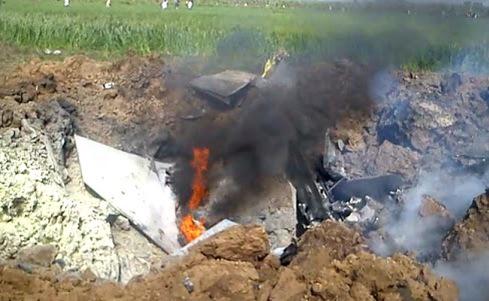
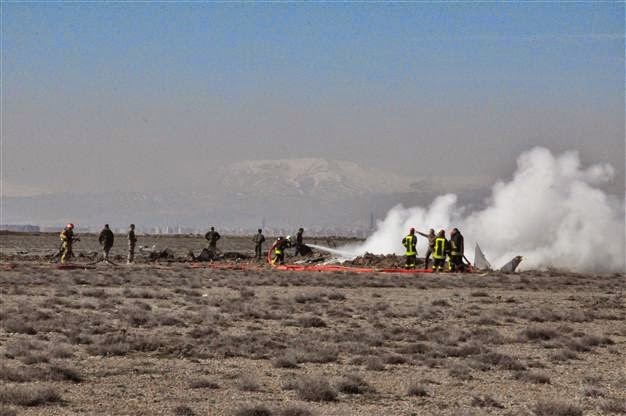
Chandigarh: A Jaguar fighter aircraft of the Indian Air Force crashed close to Shahbad town in Haryana's Kurukshetra district today, with the pilot ejecting safely.
"The fighter aircraft crashed in the fields. According to preliminary information, the pilot ejected from the plane before it fell in the fields. He was reported to have sustained injuries," Kurukshetra's Superintendent of Police, Simardeep Singh said.
An IAF spokesperson said the pilot gave a distress call before ejection.
The pilot is safe, the spokesperson said. The aircraft crashed near Landi village, close to Shahbad town in Kurukshetra, about 65 km from Chandigarh, at 1:15 pm.
The pilot had taken off from Ambala Air base in the afternoon, police said.
Mr Singh said that there were no immediate reports of any casualty on the ground where the plane fell.
He said besides police, the IAF personnel from Ambala have rushed to the spot.
A helicopter from Ambala has taken off to bring the pilot to the city.
Russia ready to transfer Sukhoi technologies to RI: Envoy
Bagus BT Saragih
The Jakarta Post, Jakarta | March 05 2015 | 9:38 PM
Russia reiterated its readiness on Thursday to comply with the transfer-of-technology scheme required by Indonesia should the latter opt to buy Russian-made Sukhoi Su-35 jet fighters to modernize its air force.
“I talked to Indonesian Defense Minister Ryamizard Ryacudu a couple of months ago. We are fully aware of Indonesian government regulations on transfer-of-technology and industrial-offset schemes,” Russian Ambassador to Indonesia Mikhail Galuzin told journalists at his residence in South Jakarta.
“We are ready and open for further discussion with our Indonesian partners on the feasibility of procuring Su-35s,” the 54-year-old diplomat added.
The statements came amid fierce competition from the world’s top jet fighter producers to supply replacements for the Indonesian Air Force’s (TNI-AU) ageing F-5 E/F Tiger IIs.
Last week, Spanish Ambassador to Indonesia Francisco José Viqueira Niel claimed that Eurofighter Typhoon jet fighters were the best choice for Indonesia to modernize its air force when it comes to technical capabilities and the transfer of technology.
The Eurofighter consortium involves four countries, namely Spain, Germany, Italy and the UK.
Another strong contender is the single-engine Swedish-built SAAB Gripen; the Flanker and Typhoon are both twin-engine jet fighters.
But Galuzin talked up Russia’s military aircraft technology, claiming it was among the best in the world.
This year, he added, Russia would host three international military events to showcase its advanced military technologies and capabilities.
In June, the Russian Defense Ministry will host the “ARMY-2015”, an international military technical forum. About a month later, St. Petersburg will exhibit the 2015 International Maritime Defence Show.
“In August, the MAKS 2015, or the 12th International Aviation and Space Salon, will be held in Moscow,” Galuzin said.
Currently, the TNI AU operates a mixed fleet of single-seater Su-27s and double-seater Su-30s in the 11th squadron based at Sultan Hasanuddin Air Force Base in Makassar, South Sulawesi.
In January, 2015, Indonesian Defense Ministry spokesperson Col. Djundan Eko Bintoro said that, during Galuzin’s meeting with Ryamizard, the envoy had also offered Kilo Class Type 636 submarines and Mi-17 helicopters to bolster the Indonesia’s maritime defense system. (nvn)(++++)
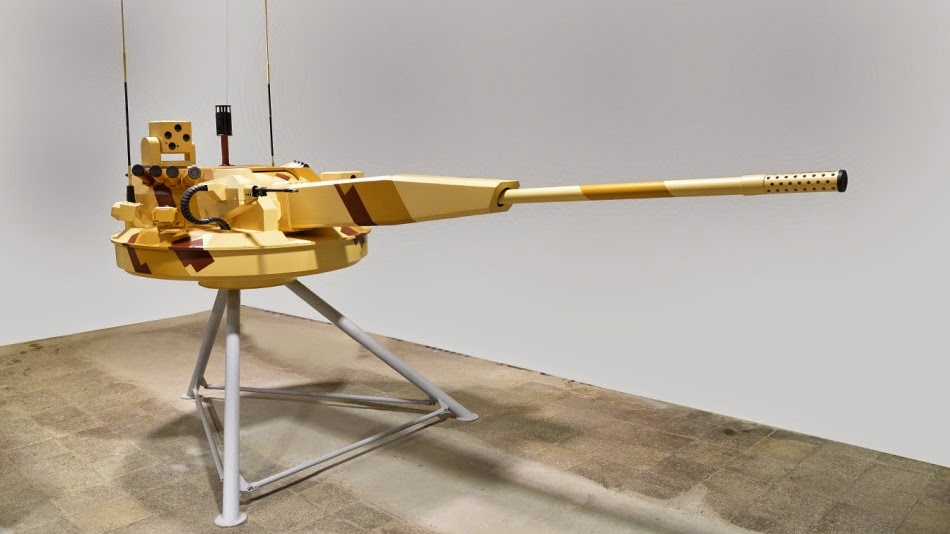
SABER is a medium caliber one man power operated turret that can be deployed on a wide range wheeled and tracked armored vehicles. SABER turret incorporates the latest technologies in turret drives, fire control, protection and lethality. The compact dimensions and light weight makes SABER a suitable choice for different types of armored vehicles.
SABER turret offers more than 60% larger internal volume than FNSS’s previous generation one man turret with less than 10% increase in outer envelope dimensions.
The main armament consists of an ATK 25mm M242 Enhanced Bushmaster 25mm dual-feed automatic cannon which is provided with 240 rounds (150+90) of ready-use ammunition.
A 7.62mm M240 machine gun is mounted coaxially with the M242 cannon on the left hand side of the turret and is provided with 600 ready use ammunition.
A bank of three 76mm grenade launchers is mounted on both sides of the turret towards the rear. These could also be replaced by grenade launchers of other calibers.
The digital fire control and sighting system includes a 3rd Generation long wave or mid wave thermal imager, a telescopic day optical channel, unity window for surveillance, an eye safe laser range finder with 8.000m range and ballistic computation capability.
The gunner is also provided with two up-look periscopes for all around vision.
The gun turret drive system is electrical and fully digital with two axis stabilization capability to ensure a high accuracy of fire on the move. The traverse and elevation drives have manual backup capability. Turret traverse is all-electric through 360 degrees, with weapon elevation from -8 to +48 degrees.
Turret shell is made of all-welded aluminum armor with add-on composite and steel armor providing ballistic protection to STANAG 4569 Level IV standard.
Members of the Malaysian armed forces, alongside Malaysian and U.S. government officials, observed a theater security cooperation event with the 31st Marine Expeditionary Unit in Sepanggar, Sabah, Malaysia Feb. 27.
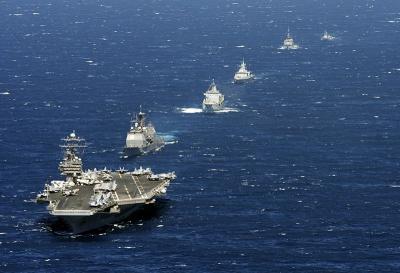
AIRCRAFT CARRIER AND PART OF ITS ESCORT “SUNK” BY FRENCH SUBMARINE DURING DRILLS OFF FLORIDA
If you thought aircraft carriers were invincible you were wrong.
On Mar. 4, the French Ministry of Defense released some interesting details, about the activity conducted by one of its nuclear-powered attack submarine (SNA) in the waters of the North Atlantic Ocean.
According to French MoD website (that is no longer online, even if you can still find a cached version of the article titled “Le SNA Saphir en entraînement avec l’US Navy au large de la Floride”), the Saphir submarine has recently taken part in a major exercise with the U.S. Navy off Florida.
The aim of the exercise was joint training with U.S. Carrier Strike Group 12 made by the aircraft carrier Theodore Roosevelt, several Ticonderoga or Arleigh Burke-class frigates and a type of submarine Los Angeles, ahead of their operational deployment.
The scenario of the drills saw some imaginary states assaulting American economic and territorial interests; threats faced by a naval force led by USS Theodore Roosevelt.
During the first phase of the exercise, the Saphir was integrated into the friendly force to support anti-submarine warfare (ASW) by cooperating with U.S. P-3C Orion P-8A Poseidon MPA (Maritime Patrol Aircraft): its role was to share all the underwater contacts with the other ASW assets.
In the second phase of the exercise, the Saphir was integrated with the enemy forces and its mission was to locate the aircraft carrier Theodore Roosevelt and its accompanying warships and prepare to attack the strike group.
While the fictious political situation deteriorated, the Saphir quietly slipped in the heart of the multi-billion-dollar aircraft carrier’s defensive screen, while avoiding detection by ASW assets.
On the morning of the last day, the order to attack was finally given, allowing the Saphir to pretend-sinking the USS Theodore Roosevelt and most of its escort.
Although we don’t really know many more details about the attack and its outcome, the scripted exercise its RoE (Rules of Engagement), the simulated sinking of a U.S. supercarrier proves the flattop’s underwater defenses are not impenetrable.
This is the reason why modern subs often train with aircraft carriers: they pose a significant threat to powerful Carrier Strike Groups.
Obviously, this was not the first time a submarine scored a simulated carrier kill with torpedo attacks.
For instance, in 2007 HMCS Corner Brook, a Canadian diesel-electric submarine “sunk” UK’s Illustrious during an exercise in the Atlantic.
DARPA taps tech to build sophisticated artificial limbs for wounded veterans
Restoring limbs to wounded service members Restoring hands, arms, feet, and legs to those wounded in the service of our country should be a national priority…and now, finally, it is, thanks to some very promising technological advances. Technology advances in area such as body armor and medical response have helped save many, many, wounded U.S. warfighters’ lives. However, many who survive are permanently wounded and today’s generation of warfighters has to contend with an unprecedented frequency of limb loss.
The Defense Advanced Research Projects Agency (DARPA) is committed to building highly sophisticated prostheses, giving wounded servicemembers and veterans naturally functioning limbs. The HAPTIX (Hand Proprioception and Touch Interfaces) project is working on creating a solution for amputees. This solution would be implanted and directly communicate with the nervous system and brain. This means that a person could think and the hand and arm would move intuitively and function just like a natural hand, complete with the dexterity and sense of touch.


 Military Thread V15, Gong Xi Fa Cai; Huat ah
  Mar 5 2015, 07:35 PM


 Quote
Quote








 0.0260sec
 0.30
0.30
 6 queries
 GZIP Disabled