Welcome Guest ( Log In | Register )

Bump Topic Topic Closed RSS Feed
13 Pages « < 7 8 9 10 11 > » Bottom

Outline · [ Standard ] · Linear+

> Military Thread V15, Gong Xi Fa Cai; Huat ah

views
     
BorneoAlliance
post Mar 1 2015, 07:02 PM

New Member
*
Newbie
0 posts

Joined: Dec 2014

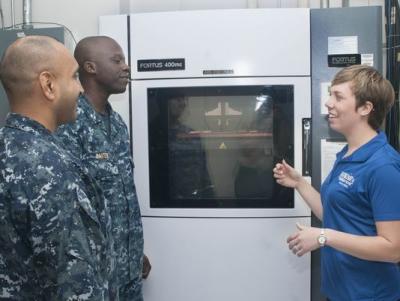
Sailors to harness high-tech at Norfolk 'Fab Lab'


NORFOLK, Va. — A new fabrication laboratory set to open in April will help East-coast sailors keep ships running, using cutting-edge technology. Laser and vinyl cutters, routers, and 3-D printers will be used to manufacture high-demand, low-supply parts on the spot.

Officials at Mid-Atlantic Regional Maintenance Center said the lab will harness the inventive power of deckplate sailors.

"If you go walk the deckplate right now, every crusty chief and department head is going to tell you that sailors today don't come with solutions, they just come with problems," said Lt. Todd Coursey, the Fab Lab's project officer. "Part of that is the culture. We are trying to reinvigorate the inquisitive, troubleshooting mind back into the petty officer."

Coursey, who prefers to call the lab funded by the Defense Advanced Research Projects Agency a "maker space," said the facility is geared toward sailors who have an idea that might make work easier or more efficient. Workshops will help sailors turn their ideas into a digital design, then use the tools on-hand to build prototypes that can be put to the test. Sailors will have the help of on-site engineers, who will add feedback and validate the concepts.

This is just one of many endeavors by Navy brass to build petty officer expertise and to find solutions at a time that spare parts are in short supply. Deep ship manpower cuts caused by the failed optimal manning initiative in the early 2000s also gutted intermediate maintenance centers and dramatically reduced the expertise among sailors. The Navy is working to boost that expertise once again and hopes, by launching the so-called "Fab Lab," to inspire deckplate solutions.

Intermediate maintenance activities like MARMC will provide an increasing amount of training, certification, and journeymen programs. As the "Fab Lab" starts up, officials will initially focus on the roughly 750 sailors assigned to MARMC and later will host workshops that teach use of various modeling tools, molding machines and millwork.

In addition to state-of-the-art machinery, sailors will have some cool tools at their disposal. The lab is stocked with resistors, capacitors and the like, and can build flexible circuit cards. It even has memory wire: Heat it beyond 900 degrees and you can form it into a desired shape. Cool it down and it is flexible once again. Hit it with an electrical charge and it reforms the original shape (yes, just like the Batman cape in the movie "Batman Begins").

DARPA is funding the $100,000 lab, which is based on the Massachusetts Institute of Technology's Center for Bits and Atoms. The effort is part of DARPA's Manufacturing Experimentation and Outreach Two, or MENTOR2 program, which aims to reduce logistics supply chain costs and improve parts availability.

http://www.navytimes.com/story/military/te...rfolk/24005331/


Attached thumbnail(s)
Attached Image
BorneoAlliance
post Mar 1 2015, 07:24 PM

New Member
*
Newbie
0 posts

Joined: Dec 2014

Downsizing of US-Phl TF to affect anti-terror drive
By Jaime Laude (The Philippine Star) | Updated March 1, 2015 - 12:00am


Philstar.com/File
MANILA, Philippines - The decision of the United States to downsize and eventually phase out its Joint Special Operations Task Force-Philippines (JSOTF-P) will have an adverse impact on the anti-terror drive in Mindanao, a senior military official said yesterday.

If the plan pushes through, local troops would have to rely on their own technical skills using available equipment in tracking down and immobilizing terrorists in the country, the officer who declined to be named said.

“Our anti-terror ISR (intelligence, surveillance, reconnaissance) operations will also be downgraded because almost always, we depend on our US counterparts through their hi-tech surveillance equipment that we don’t have for now, for real time information in monitoring movements and activities of local and foreign terrorists in Mindanao,” he said.

The JSOTF-P reportedly played a vital role in the killing of Malaysian terrorist Zulkifli bin Hir, alias Marwan, in Mamasapano, Maguindanao last Jan. 25 by Special Action Force commandos. An aircraft, believed to be a US surveillance drone, was reportedly hovering over Mamasapano on the day SAF launched its operations targeting Marwan. The US embassy said no American took part in the operation, which could have been a huge success had the commandos managed to leave without losing 44 men.

Under JSOTF-P, some 500 US soldiers are deployed across the country – mostly in Mindanao – on a rotation basis. JSOTF was organized in 2002. It is based in the Western Mindanao Command (Wesmincom) headquarters in Zamboanga City.

“They’re satisfied with what we’ve learned, thus the reduction (in US personnel),” Defense Secretary Voltaire Gazmin was quoted in media reports as saying, to explain the US decision. The US embassy said that from the beginning, the JSOTF had been intended only as a temporary security arrangement.

http://www.philstar.com/headlines/2015/03/...ti-terror-drive


Attached thumbnail(s)
Attached Image
BorneoAlliance
post Mar 1 2015, 10:42 PM

New Member
*
Newbie
0 posts

Joined: Dec 2014

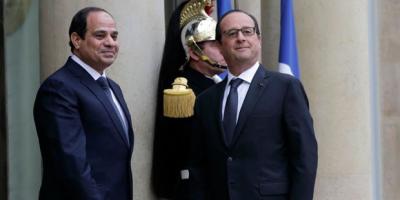
France loans Egypt 3.2B euros to help military equipments deal: Sisi

Mar. 01, 2015 14:32
France loans Egypt 3.2B euros to help military equipments deal: Sisi President Abdel Fatah Al-Sisi During His Last Visit To France - YOUM7
By THE CAIRO POST

CAIRO: President Abdel Fatah al-Sisi announced that the French government gave Egypt a loan of 3.2 billion Euros ($3.58 billion dollars) as a contribution in the latest military equipment deal signed between the two countries.

He added in an interview with Al-Arabia television channel Saturday night that many Gulf States supported Egypt during the past 4 years, as “we were going through difficult economic conditions affected by the revolutions.”

Sisi denied during the interview that all of the aid would only be for military forces, assuring that any talks about “not aiding the poor people in Egypt are completely ‘untrue.’”

French Defense Minister Jean-Yves Le Drian visited Egypt in February with other French officials to sign a deal on the sale of 24 Rafale fighter jets, a naval frigate and related military equipments.

The 5.9 billion euro deal was first planned during Sisi’s visit to France in November when he discussed ways to upgrade Egypt’s fleet of 18 French Mirage jets.

The deal was seen as essential step towards enhancing Egypt’s situation to confront ‘terrorist threats’ especially in N. Sinai and neighborhood countries that faces unrest including Libya and Yemen.

http://www.thecairopost.com/news/139544/ne...ments-deal-sisi


Attached thumbnail(s)
Attached Image
BorneoAlliance
post Mar 2 2015, 10:29 AM

New Member
*
Newbie
0 posts

Joined: Dec 2014

WORLD VIEW: REPORTS INDICATE EGYPT, ITALY, RUSSIA PLANNING MILITARY ACTION IN LIBYA


Various unconfirmed reports are emerging indicating that there may be joint international action planned in Libya as early as next week.

Egypt is already conducting air strikes against ISIS-linked targets in Derna, close to where Egyptian Coptics were massacred recently, as displayed in a gruesome video. Debka reports that Egypt’s president Abdel al-Fattah al-Sisi is planning further action in Libya, including more air strikes and possible ground troops, within a few days. According to the report, Egyptian commando and marine forces are preparing for sea landings to seize Derna and destroy the terrorist elements there. If this attack is actually launched, it will be the first time in modern times that an Arab country has sent ground forces into another Arab country.

Al-Jazeera television reports that the Italian navy is getting ready to carry off sophisticated military drills off the coast of Libya as early as Monday. Although Italy claims that it will be a regular exercise, there are many more vessels taking part in this year’s exercise than have in the past, which Italy explains by saying that they are testing out sophisticated new technologies.

There are several reasons why Italy is pursuing this show of force:

Italy considers the flood of migrants from Libya into Italy to be an existential threat to Italy itself, because there may be ISIS-trained terrorists smuggled in, along with the other migrants. Italy may be planning some kind of military action in Libya in conjunction with Egypt’s air strikes and other operations.
The GreenStream pipeline is a gas pipeline running underneath the Mediterranan Sea from Libya to Sicily. The pipeline is vital to economic relations between Italy and Libya. In recent months, there have been attacks by gunmen on oil installations in Libya, forcing some ports to shut down. The new show of naval force may be related to threats of attack or sabotage on the pipeline.
For over a year, Italy ran a search and rescue program called “Mare Nostrum” (“Our Sea”) that saved the lives of thousands of migrants attempting to travel from Libya to Italy. This program required Italian naval vessels near the Libyan coast. In November, the program ended and an EU program called Triton replaced it, but Triton restricts its operations to only 30 miles off the Italian coast. Triton has been considered unsatisfactory because many more migrants are drowning. Italy’s new show of naval force may be an attempt to restore a portion of the Mare Nostrum program.
Related to the last point, on Saturday there were large demonstrations in Rome by Italy’s anti-immigrant Northern League party for the government to do more to keep immigrants out. The naval show of force may help to mollify the protestors.
Some reports indicate that Russia has hinted at a willingness to participate in a naval blockade of Libya to prevent arm supplies from leaving Libya for other countries. Russia could play a role in this because it already has a naval fleet in the Mediterranean.

These are all unconfirmed reports of possible military action in Libya by Egypt, Italy and Russia. There are no reports of possible participation by Nato or the United States. Debka and Cairo Post

Egypt court declares Hamas to be a terrorist organization
Egypt on Saturday became the first Arab country to name Hamas as a terrorist organization. The U.S. and the European Union have named Hamas as a terror group. An EU court took Hamas off the list in December 2014, ruling that the designation was not based on solid legal evidence, but the EU is appealing the court’s decision.

According to a decision on Saturday from the Cairo Court for Urgent Matters:

It has been proven without any doubt that the movement has committed acts of sabotage, assassinations and the killing of innocent civilians and members of the armed forces and police in Egypt.

It has been also ascertained with documents that [Hamas] has carried out bombings that have taken lives and destroyed institutions and targeted civilians and the armed forces personnel. It has also been ascertained that this movement works for the interests of the terrorist Brotherhood organization [which Egypt has already declared to be a terrorist organization].

About a month ago, the same court declared Hamas’s military wing, Al-Qassam Brigades, to be a terrorist organization. Saturday’s ruling makes the political wing a terrorist organization as well.

A Hamas spokesman denied all the charges and said that the ruling was “dangerous”:

History has recorded Egypt’s support to national liberty movements in the Arab world and Africa, particularly in Palestine. … This ruling serves the Israeli occupation. It’s a politicized decision that constitutes the beginning of Egypt evading its role toward the Palestinian cause. This is a coup against history and an Egyptian abuse of the Palestinian cause and resistance, which fights on behalf of the Arab nation. We call on Egypt to reconsider this dangerous decision.

Al Jazeera and Al Ahram (Cairo) and CS Monitor and Al Resalah (Palestine)

Egypt and Turkey may try to create a ‘Sunni front’ with Saudi Arabia
By coincidence or by planning, the presidents of both Egypt and Turkey will be in Riyadh, Saudi Arabia, this week. Egypt’s Abdel al-Fattah al-Sisi and Turkey’s Recep Tayyip Erdogan will both be visiting King Salman bin Abdulaziz al Saud, the new king of Saudi Arabia, who has replaced King Abdullah, who died last month.

It is not known whether Erdogan will ever be in the same room as al-Sisi. The two have been bitter enemies ever since a coup by al-Sisi ousted Egypt’s elected president Mohamed Morsi and his Muslim Brotherhood government in 2013, and later declared MB to be a terrorist organization. Erdogan’s own political party, the AKP, is an Islamist party like the Muslim Brotherhood, and they had good relations while Morsi was in power.

There has been some speculation that King Salman is going to completely reverse King Abdullah’s policy on the Muslim Brotherhood. Saudi Arabia and United Arab Emirates (UAE) had branded MB as a terrorist organization, but some are wondering if Salman is going to shift from that policy. The Saudi foreign minister recently said that his government has “no problem with the Muslim Brotherhood; our problem is with a small group affiliated to the organization,” suggesting that shift is in the works.

Other problems make an Egypt-Turkey rapprochement unlikely: Erdogan vitriolicly hates Israel and supports Hamas. Al-Sisi vitriolicly hates Hamas and works closely with Israel on military matters, especially in North Sinai. It does n0t seem likely that any meeting, if one even occurs, will be pleasant.

If King Salman is able to pull off a miracle and mediate a new relationship between Egypt and Turkey, then it would appear to be the establishment of a new “Sunni front” in the Mideast, to oppose Iran, Hezbollah and the regime of Bashar al-Assad in Syria.

http://www.breitbart.com/national-security...ction-in-libya/


Attached thumbnail(s)
Attached Image
BorneoAlliance
post Mar 2 2015, 10:41 AM

New Member
*
Newbie
0 posts

Joined: Dec 2014

Canada Sends 125 Soldiers to East Europe for NATO Reassurance © AFP 2015/ PETRAS MALUKAS

Canadian government stated that Canada would send 125 Canadian Army soldiers to Eastern and Central Europe to support NATO reassurance operations.

MOSCOW (Sputnik) — Canada on Monday will send some 125 Canadian Army soldiers to Eastern and Central Europe to support NATO reassurance measures, a statement on Canadian government’s website said.

“The 3 RCR contingent is a part of 2 Canadian Mechanized Brigade Group (2 CMBG), based in Garrison Petawawa, ON. Operation REASSURANCE refers to the military activities undertaken by the Canadian Armed Forces to support NATO reassurance measures through the provision of military capabilities for training, exercises, demonstrations and assigned NATO tasks,” the statement reads.

Russia to Assess Consequences of NATO Buildup for National Security – Envoy
The statement does not specify, to which countries the soldiers will be sent to.

Over the last few months, NATO has boosted its military presence in Eastern Europe in connection with the crisis in eastern Ukraine. The alliance said the move was necessary to ensure its members' security.

Moscow has repeatedly expressed its concern about increased NATO military activities close to Russian borders.


Read more: http://sputniknews.com/military/20150302/1...l#ixzz3TByVxKRw


Attached thumbnail(s)
Attached Image
BorneoAlliance
post Mar 2 2015, 04:06 PM

New Member
*
Newbie
0 posts

Joined: Dec 2014

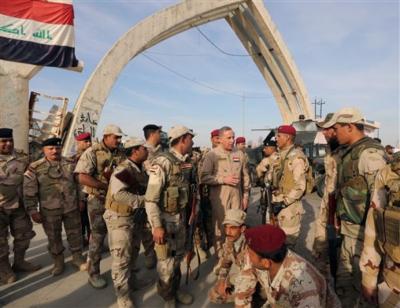
Iraq state TV: Operation to retake Tikrit begins

BAGHDAD — Iraq's state TV says government forces backed by allied Shiite and Sunni fighters have begun a large-scale military operation to recapture Saddam Hussein's hometown from the Islamic State extremist group.

Al-Iraqiya television said Monday that the forces were attacking the city of Tikrit, backed by artillery and airstrikes by Iraqi fighter jets. It said the militants were dislodged from some areas outside the city, but gave no details.

Hours ahead of the operation, Prime Minister Haider al-Abadi called on Sunni tribal fighters to abandon the extremist group, promising them a pardon.

Tikrit, some 130 kilometers (80 miles) north of Baghdad, fell into the hands of the Islamic State group last summer along with the country's second-largest city of Mosul and other areas in Sunni heartland.

http://www.stripes.com/news/middle-east/ir...begins-1.332251


Attached thumbnail(s)
Attached Image
BorneoAlliance
post Mar 2 2015, 06:48 PM

New Member
*
Newbie
0 posts

Joined: Dec 2014

US to supply missile warning systems to India


The United States will supply a missile approach warning system to India to help military aircraft in deploying counter-measures when an enemy missile is fired upon. PTI file photo
The United States will supply a missile approach warning system to India to help military aircraft in deploying counter-measures when an enemy missile is fired upon.

Developed by Alliant Techsystems Operations at Florida, the missile warning system for the Indian Air Force and Navy would come by around 2017. India is purchasing the system using the foreign military sales route.

The firm has received a $30 million contract from the US government to made these systems for the American armed forces as well as for India, Australia, Spain and Norway. The AN/AAR-47 (V) missile warning set comprises of electro-optic counter-measure sensors, counter-measure signal processors and counter-measure signal simulators.

The commercial contract was finalised within a month of the summit meeting between the US President Barak Obama and Prime Minister Narendra Modi.

New Delhi and Washington negotiated the texts of the Defence Framework Agreement between the two countries for the next 10 years as the existing framework signed by then defence minister Pranab Mukherjee and his counterpart Donald Rumsfeld expired in 2014. The new pact, which is yet to be signed, focuses on co-production.

The two countries identified four joint pathfinder military projects besides creating a working group to explore the possibility of using cutting edge American technologies for Indian Navy’s future aircraft carrier, whose design is still being worked out. A collaboration on jet engine technology is also in the offing.

The pathfinder projects are on mini-UAV, a proposed roll-on/roll-off mission modules for C-130 and other aircraft, mobile electric hybrid power sources and uniform integrated protection ensemble for the nuclear, biological, chemical (NBC) warfare environment.

“While these pathfinder projects have stand-alone value, we intend for them to serve as pathfinder or pilots for deeper levels of cooperation between our military. I envision a day when American and Indian engineers sit side-by-side – or at least virtually – producing cutting-edge designs to be produced in partnership,” Frank Kendall, US Under Secretary of Defence for acquisition, Technology and Logistics said.

Kendall, who is visiting India for the third time in five months, held talks with Indian officials to kick start the projects under the defence technology and trade initiatives between New Delhi and Washington.


Attached image(s)
Attached Image
BorneoAlliance
post Mar 2 2015, 07:52 PM

New Member
*
Newbie
0 posts

Joined: Dec 2014

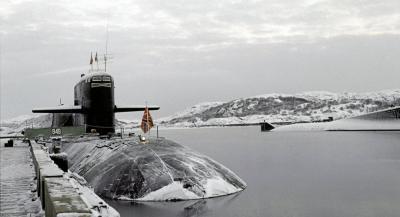
Submarine Warfare in Arctic: Russia Mastering New Underwater Tactics © Sputnik/ Yury Kaver

Russia’s Northern Fleet training new ways to use underwater weapons in the Arctic.
Commanders of Russia’s Northern Fleet are mastering new ways of using deadly underwater weapons in the High Arctic, the press service of the Northern Fleet reported.

North Pole expedition. A helipad on the NS 50 Let Pobedy Arktika-class nuclear-powered icebreaker.

© SPUTNIK/ ALEXEY FILIPPOV

Russian Marines to Prepare for Arctic Warfare in 2015: Northern Fleet
“During the meeting, special attention was paid to the issue of using torpedoes to make openings in the ice, so submarines could surface and fire missiles in the hard conditions of the High Arctic,” said the main statement during the meeting of Navy commanders at the training center in Gadzhievo.

Admiral Vladimir Korolev, the commander of the Northern Fleet, talked about the importance of using the combat experience of the older generation of Navy officers, while at the same time working to develop new techniques and tactics of underwater warfare. The Admiral also mentioned that the Russian navy is highly trained and its crews could carry out missions in any situation.

Боевое дежурство ЗРК С-400 Триумф

© SPUTNIK/ GRIGORY SISOEV

In December 2014, Russia unveiled a revised military doctrine that prioritizes the protection of national interests in the Arctic. The region, which has vast reserves of oil and gas, has been the focus of attention for four other Arctic nations: the United States, Canada, Norway and Denmark. Russian President Vladimir Putin said that although Russia does not plan to militarize the Arctic, it will take necessary steps to ensure its defense capabilities in the region.

In January, it was reported that the Northern Fleet increased its air defense by adding new S-400 Triumph air defense missile systems. The S-400 Triumph long- to medium-range surface-to-air missile system can hit any aerial targets, including aircraft, unmanned aerial vehicles (UAVs), and cruise and ballistic missiles at a distance of up to 400 kilometers (250 miles) and an altitude of up to 30 kilometers (18.6 miles).


Read more: http://sputniknews.com/military/20150302/1...l#ixzz3TEDE37Fi


Attached thumbnail(s)
Attached Image Attached Image
BorneoAlliance
post Mar 2 2015, 10:11 PM

New Member
*
Newbie
0 posts

Joined: Dec 2014

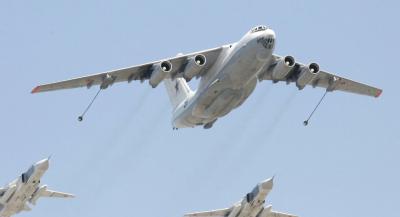
Russian Air Force to Receive New Aircraft Tanker in 2018 © Sputnik/ Aleksandr Yurev

The Il-78M-90A tanker is a version of the Il-76MD-90A aircraft. The new aircraft will be the main aerial tanker designed for refueling aircraft of long-range, front-line and special aviation.

© SPUTNIK/ ANTON DENISOV

Russian Air Force to Conduct Three Major Contests in 2015
The delivery of the new tanker aircraft Il-78M-90A to the Russian Air Force will begin in 2018, a defense industry source told RIA Novosti on Monday.

The Il-78M-90A will be the first air tanker to be fully produced in Russia. Earlier the Il-78 aircraft had been assembled by the Tashkent Chkalov Industrial Group in Uzbekistan.

"The delivery of the Il-78M-90A to the Russian Air Forces is expected to begin in 2018," the source said.

In February, United Aircraft Corporation began construction of an engineering prototype of the Il-78M-90A aircraft.

The Il-78M-90A is a version of the Il-76MD-90A aircraft. The new aircraft will be the main aerial tanker designed for refueling aircraft of long-range, front-line and special aviation.

The Il-78M-90A can refuel two front-line aviation aircraft (Su-27 or MiG-29-class) simultaneously with use of the fueling systems mounted on its wing. The tail fueling mechanism is used for refueling long-range and special aviation aircraft.

Read more: http://sputniknews.com/politics/20150302/1...l#ixzz3TEluBO8E


Attached thumbnail(s)
Attached Image
BorneoAlliance
post Mar 2 2015, 10:24 PM

New Member
*
Newbie
0 posts

Joined: Dec 2014

US military satellite explodes above Earth

A US military satellite exploded after detecting an unexplained “sudden spike in temperature”, sending dozens of chunks of debris tumbling into different orbits around Earth

A US military satellite exploded after detecting an unexplained “sudden spike in temperature”, sending dozens of chunks of debris tumbling into different orbits around Earth.

Civilian company CelesTrak was first to notice the explosion of the once-secret weather satellite and the US Air Force subsequently confirmed that it had been lost.

The satellite was an ageing component of the Defense Meteorological Satellite Program which the US military began developing the in the 1960s to help plan reconnaissance and surveillance missions. In 1972 the system was declassified, and data made available to civilian scientists.

The lost satellite was the 13th to be launched as part of DMSP, designated DMSP-F13, and had been in Earth orbit since 1995.

Air Force Space Command confirmed to SpaceNews.com that the “catastrophic event” came after “a sudden spike in temperature” was detected, followed by “an unrecoverable loss of attitude control”.

While operators were deciding how to “render the vehicle safe” they detected a debris cloud which indicated that the satellite had been destroyed.

The explosion has caused at least 43 pieces of debris to scatter into orbit, which are now being tracked by the US Air Force.

Air Force Col. John Giles, the Joint Space Operations Center’s director, told SpaceNews.com: “While the initial response is complete, JSpOC personnel will continue to assess this event to learn more about what happened and what it will mean for users within this orbit.”

Due to the age of DMSP-F13 it was no longer a critical part of the network, and the US government expects that its loss will cause only a “slight reduction” in real-time weather data.

Like all DMSP satellites it orbited the earth at an altitude of around 500 miles in a “sun-synchronous orbit” – meaning that they flew in a path taking in the north and south poles.

On each path around the earth, which took roughly 101 minutes, they would see a slightly different part of the planet. This would give each satellite a complete view of the entire planet’s surface twice a day.


http://www.telegraph.co.uk/technology/news...bove-Earth.html


Attached thumbnail(s)
Attached Image
BorneoAlliance
post Mar 2 2015, 10:44 PM

New Member
*
Newbie
0 posts

Joined: Dec 2014
Military & Defense More: Book Excerpt Islamic State Michael Weiss Syria

TAFRIKINOMICS: How ISIS funds its caliphate

In this excerpt from "ISIS: Inside the Army of Terror," co-authors Michael Weiss and Hassan Hassan explain how ISIS funds its nascent caliphate.

ISIS has married its authoritarian governance with a remarkably successful war economy.

FSA and Islamist groups that controlled oil fields in eastern Syria, for example, did dedicate some of the revenue to run schools and supply electricity, telecommunications, water, food, and other services.

Some villages and towns saw a decline in such services because ISIS distributed oil revenue to other towns under its control in Syria and Iraq, establishing its own pan-territorial patronage system.

As a result, in oil-rich areas, warlordism—a side effect of strictly localized rebel governance— dropped steadily.

ISIS also forced municipality personnel to work, unlike previous groups that had allowed Syrian state employees to continue to re- ceive their salaries (mostly from the regime) while they sat at home and did nothing, no doubt with attendant kickbacks. “The streets are cleaner now; 70 percent of the employees were not working, even though they received salaries,” said a former media activist with the FSA from Deir Ezzor.

“They cancelled the customary day off on Saturday; they’re supposed to make Thursday the day off instead.” Regulations and price control are another area in which ISIS’s governance proved successful. It banned fishermen from using dynamite and electricity to catch fish.

It also prohibited residents in the Jazira from using the chaos of war to stake new land claims, principally in the Syrian desert, where they had tried to build new homes or establish businesses, much to the chagrin of their neighbors. ISIS also limited the profit margins on oil by-products, ice, flour, and other essential commodities.

Before ISIS controlled eastern Syria, an oil well produced around thirty thousand barrels per day, and each barrel sold for two thousand Syrian pounds—eleven dollars at the current exchange rate. Local families that worked in refineries would make two hundred liras (a little more than one dollar) on each barrel they refined primitively. After ISIS took over, a barrel of oil became cheaper because it fixed the price of a liter of oil at fifty pounds (thirty cents).

ISIS also banned families from setting up refineries close to residences under the threat of confiscation, a policy that led some families to quit the oil business altogether. Collectively, price control and regulations balanced the decline in resources and services.

Subsidies from Gulf countries, where many of those who live in ISIS-controlled areas work, also helped some families afford electricity-generating engines and oil by-products.

“Those in the Gulf who used to send once a month now send twice a month because they understand the situation,” said the former FSA media activist. “Also, there is no big difference in value. In 2010 a kilo of chicken was 190 pounds [$1] and is now 470 [$2.60].”

Oil was a major revenue generator for ISIS until the coalition air strikes began. Before that, ISIS was thought to have earned mil- lions of dollars a month from oil in Syria and Iraq—$1 to 2 million a day. The revenue dropped significantly after the air strikes. But oil smuggling to neighboring countries such as Turkey and Jordan, and to other areas in Syria and Iraq, still makes significant revenue for ISIS.

iraq isis mapEnergy Policy Info

The sharp decline in oil production affected civilians more than it affected ISIS, which could still generate wealth from other sources, but it hampered ISIS’s ability to provide for the local communities, especially much-coveted materials such as gas cylinders. “I estimate that the impact of air strikes was 5 percent,” said the media activist, who still lives in Deir Ezzor. “They affected oil primarily. Food is plenty, and most of it comes from Turkey or Iraq. Borders are open; if you don’t like prices here, you go to Anbar. I see the situation as normal.”

ISIS’s oil market savvy has impressed and shocked many ob- servers, although Derek Harvey isn’t one of them. “I know for a fact that the Saddamists who were smuggling the oil in the ’90s, to evade UN sanctions, are now doing so for ISIS,” he said.

“People are saying that they’re selling it for thirty-five dollars a barrel. What we bombed recently is some of the local refineries. If you’re selling it at that price, it’s fifty to fifty-five dollars off the current market price. But here’s what happens: these middlemen are selling it, and there’s a kickback coming back in to ISIS’s senior leaders. They’re getting another twenty, twenty-five dollars a barrel in kickbacks, but that’s not on the books or being factored in by everybody. It’s going back into the kitty of financiers at the top of the pyramid. The ISIS fighters in Deir Ezzor would not be aware of that.”

isis oil before after Dept. of Defense/Amanda Macias/Business InsiderA photo showing an ISIS-controlled oil refinery that the US-led coalition bombed.

Locals in eastern Syria had learned to survive on remittances from the Gulf and local economies even before the uprising.

High oil prices led many to rely less on agricultural products since the energy had to be spent pumping water from the Euphrates or Tigress rivers to their farmlands many miles away.

After the war started, cheaper oil revived the Syrian agribusiness—smuggling and livestock trade markets began booming again.

When ISIS seized control of the Jazira, people were already buying their own oil for irrigation and electricity and didn’t need to rely on subsidized services.

Germany’s foreign intelligence agency,the Bundesnachrichten– dienst (BND), has cautioned against “overblown” speculation about ISIS’s high oil revenue because there is a tendency to discount the massive overhead and spending inside its territories.

But, as per Harvey, ISIS pockets most of this revenue, as it sometimes taxes residents for services supplied by the regime, such as electricity and telecommunication. Unlike Islamist groups that operated regime-established facilities for the local communities gratis, ISIS has developed a surcharge economy to replenish its own coffers.

ISIS also makes millions from zakat (different forms of Islamic alms payable to the state). Zakat is extracted from annual savings or capital assets (2.5 percent), gold (on values exceeding $4,500), livestock (two heads out of 100 heads owned by a farmer), dates, crops (10 percent if irrigated by rain or a nearby stream or river, and 5 percent if irrigation costs money), and profits (2.5 percent).

isis pplScreen grabISIS militants pose during a video.

ISIS also imposes annual taxes on non-Muslims living in its territories, especially Christians (4.25 grams of gold for the rich and half of that for moderate-income individuals). It makes money by stealing dressed up as civil penalties: it confiscates the properties of displaced or wanted individuals or as punishment for fighting ISIS.

This includes, of course, enormous stocks of weapons and ammunition as part of its community disarmament policies. While donations from foreign sponsors constitute a meager percentage of its treasury, deep-pocked individuals, whether foreign donors or members who have joined the group, still contribute to the group.

More significantly, ghanima (war spoils, which in ISIS’s definition encompasses robbery and theft) is one of the group’s largest and most valuable sources of income. ISIS seized millions of dollars worth of American and foreign military equipment after it forced three Iraqi divisions to flee in June 2014, and it has also seized large stockpiles of weapons as well as equipment, facilities, and cash from Syria’s regime and rebel groups.

isis tank syriaReutersMilitant Islamist fighters take part in a military parade along a street in northern Raqqa province on June 30, 2014

Artifacts are also lucrative for ISIS—one man interviewed in Turkey said trade in artifacts grew during ISIS rule,with one of his cousins smuggling into Turkey golden statues and coins found in Mari ancient ruins, eleven kilometers away from Albu Kamal.

Michael Weiss is the editor in chief of the Interpreter and a widely published journalist with a focus on developments in Syria, Turkey, and Russia. He is the co-author of "ISIS: Inside the Army of Terror." Follow him on Twitter: @michaeldweiss.

Republished with permission from ISIS: Inside the Army of Terror by Michael Weiss. Copyright © 2015 by Michael Weiss and Hassan Hassan. Reprinted by arrangement with Regan Arts. All rights reserved.


Read more: http://www.businessinsider.com/tafrikinomi...3#ixzz3TEuTxBZK


Attached thumbnail(s)
Attached Image Attached Image
BorneoAlliance
post Mar 3 2015, 09:55 AM

New Member
*
Newbie
0 posts

Joined: Dec 2014

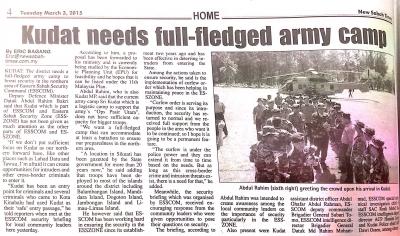
Kudat needs army camp


Attached thumbnail(s)
Attached Image
BorneoAlliance
post Mar 3 2015, 12:43 PM

New Member
*
Newbie
0 posts

Joined: Dec 2014


A supposed Afghan Special Forces soldier shoots two soda cans off of his buddy’s shoulders from 50 meters with an ACOG equipped M4.

While hitting a target that size from that distance isn’t overly impressive, it was still nice of the shooter not to put a hole or two in his friend.

The most impressive part, to me, was how the target man didn’t flinch at all. He may not be the sharpest tool in the shed, but he’s harder than woodpecker lips. ~Will


http://www.funker530.com/afghan-special-fo...ddys-shoulders/
BorneoAlliance
post Mar 3 2015, 12:55 PM

New Member
*
Newbie
0 posts

Joined: Dec 2014
New Report Finds China's Space Plans Threaten U.S. Military Ability

(Bloomberg) -- China is developing space technologies aimed at blocking U.S. military communications and destroying its ability to win conflicts, according to a report commissioned by a panel created by the U.S. Congress.

“China’s improving space capabilities have negative-sum consequences for U.S. military security,” the University of California Institute on Global Conflict and Cooperation said in the report. Its progress requires “the U.S. to prepare to confront an adversary possessing space and counter-space technologies.”

The report, released Monday in Washington, comes as Congress debates President Barack Obama’s request for a Defense Department budget increase of 7.7 percent to $534.3 billion and ways to align defense strategy and spending. The top U.S. intelligence official and the commander of the U.S. Strategic Command both warned last week that China’s space program threatens U.S. military communications.

The program is part of President Xi Jinping’s “China Dream” strategy of strengthening national power and reshaping the Asia-Pacific political environment into one in which its interests are given greater attention.
“China’s goal is to become a space power on par with the United States and to foster a space industry that is the equal of those in the United States, Europe, and Russia,” according to the report, which was prepared for the U.S.-China Economic and Security Review Commission.

http://www.bloomberg.com/news/articles/201...-ability-report

To contact the editors responsible for this story: Andrew Davis at abdavis@bloomberg.net Greg Ahlstrand, Larry Liebert


Attached thumbnail(s)
Attached Image
BorneoAlliance
post Mar 3 2015, 01:01 PM

New Member
*
Newbie
0 posts

Joined: Dec 2014

Iran Backs Iraq Military Campaign to Reclaim Tikrit From Islamic State

Iraq’s military, backed by some 20,000 volunteer fighters, have begun a campaign to recapture the birthplace of Saddam Hussein from Islamic State, also known as ISIS and ISIL. Mark Kelly reports. Image: AFP/Getty
By TAMER EL-GHOBASHY in Baghdad and JULIAN E. BARNES in Washington

Updated March 2, 2015 4:04 p.m. ET

Iran took a leading role in the Iraqi military’s largest offensive yet to reclaim territory from Islamic State, throwing drones, heavy weaponry and ground forces into the battle while the U.S. remained on the sidelines.

The operation that began Monday aims to retake Tikrit, best known as the hometown of Saddam Hussein, 80 miles north of the capital Baghdad. In addition to supplying drones, Iran’s powerful Revolutionary Guard force has fighters on the ground with Iraqi units, mostly operating artillery and rocket batteries, according to a U.S. military official. Iraqi Shiite militias closely allied with Iran are also heavily involved.

http://www.wsj.com/articles/iraqs-military...krit-1425287398


Attached thumbnail(s)
Attached Image
BorneoAlliance
post Mar 3 2015, 01:09 PM

New Member
*
Newbie
0 posts

Joined: Dec 2014

Next-gen stealth bomber is secret, but debate over cost is on the radar


WASHINGTON — The closest it's come to a public debut was a prime-time tease during a Super Bowl ad that showed its svelte outline veiled beneath a sheet, but revealed not a glimpse of the Pentagon's most mysterious plane.

Highly classified, the program is one of the Air Force's top priorities — and its most expensive. The service estimates it will cost $55 billion to build as many as 100 of what it calls the Long Range Strike Bomber, which is designed to fly deep into enemy territory undetected until the mushroom cloud begins to bloom.

http://www.stripes.com/news/us/next-gen-st...-radar-1.332341


Attached thumbnail(s)
Attached Image
BorneoAlliance
post Mar 3 2015, 03:45 PM

New Member
*
Newbie
0 posts

Joined: Dec 2014

General Atomics Drone System to Help Spain Amid New US Drone Policy © AP Photo/ Matt York, File

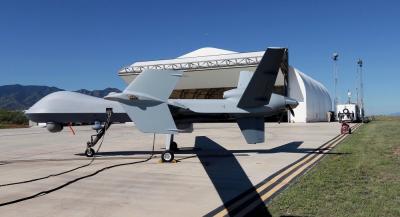
The US defense company General Atomics Aeronautical Systems and the Spanish engineering company SENER agreed to use the multi-mission Predator B drones to help Spain’s airborne surveillance and reconnaissance.
An MQ-1 Predator

Swedish Police Testing Drones As a Part of Law Enforcement Toolkit

WASHINGTON (Sputnik) — The US defense company General Atomics Aeronautical Systems (GA-ASI) and the Spanish engineering company SENER reached a teaming agreement to use the multi-mission Predator B drones to help Spain’s airborne surveillance and reconnaissance, General Atomics announced in a statement.

“GA-ASI is fully committed to working with Spanish industry [SENER], as we believe this program’s success requires local industry partnerships that provide collaborative innovation in enhancing the capabilities of Predator B for the Spanish government,” the statement, issued on Monday, said.

US Hides Civilian Casualties From Drone Strikes in Mid East- Anti-War Group
The Predator B drone will fly over one million hours and provide the Spanish government with situations awareness, safeguard borders and maritime approaches, support military missions globally and save lives in nature disaster-affected areas, the statement said.

However, the new US policy on selling drones requires recipient nations to abide by end-use guidelines before a sale or transfer is authorized, according to an earlier US Department of State statement. The deal between GA-ASI and SENER will have to follow the new guidelines put in place by the US Department of State.

GA-ASI is a designer and manufacturer of Remotely Piloted Aircraft (RPA) systems providing pilot training, support operations for RPA field operations, sensor payloads, software for intelligence surveillance and reconnaissance aircraft platforms, and the development of high-energy lasers, electro-optic sensors, and meta-material antennas, the statement said.

Read more: http://sputniknews.com/military/20150303/1...l#ixzz3TJ2WqxoW

This post has been edited by BorneoAlliance: Mar 3 2015, 03:46 PM


Attached thumbnail(s)
Attached Image
BorneoAlliance
post Mar 3 2015, 03:48 PM

New Member
*
Newbie
0 posts

Joined: Dec 2014
QUOTE(MrUbikeledek @ Mar 3 2015, 03:45 PM)
If we name a ship KD Dato Bahaman or KD Mat Kilau, will the British feel offended?
*
kD Laksamana hang Nadim the portuguese are not offended at all.
BorneoAlliance
post Mar 3 2015, 05:10 PM

New Member
*
Newbie
0 posts

Joined: Dec 2014

Second Mistral Built for Russia Begins Sea Trials in March


The Sevastopol, the second Mistral-class helicopter carrier built for Russia, is slated to begin sea trial in March, according to a representative of the French shipbuilding industry.

Russia Not Suing France Over Mistral Non-Delivery Yet

The second Mistral-class amphibious assault ship built for Russia will begin sea trials later in March, a representative of the French shipbuilding industry told RIA Novosti.

"The Sevastopol will begin trials as planned in March, with wharf employees on board. But if a decision is made on the Vladivostok (the first Mistral-class ship, which Russia hasn't yet received), and the crew from Russia comes to Saint-Nazaire, we will have to make a second sea trial, which will bring the wharf additional costs," the representative told the agency.

The delivery of two Mistral-class assault ships to Russia was agreed under a $1.5 billion deal between Russian state-run arms exporter Rosoboronexport and French shipbuilder DCNS, signed in 2011.


Read more: http://sputniknews.com/europe/20150303/101...l#ixzz3TJOtH66l


Attached thumbnail(s)
Attached Image
BorneoAlliance
post Mar 3 2015, 09:28 PM

New Member
*
Newbie
0 posts

Joined: Dec 2014

Russia Plans New Aircraft Carrier Amid Military Buildup

The Moscow TimesMar. 02 2015 19:52 Last edited 19:52

Russia will build a new aircraft carrier as part of the country's ongoing military buildup, navy Chief Admiral Viktor Chirkov confirmed on Monday.

"There will be an aircraft carrier in the navy. Work is being conducted by the relevant research organizations," Chirkov was quoted by the TASS news agency as saying. He did not give a timeline for the vessel's construction.

Russia only has one aircraft carrier in its navy — the Admiral Kuznetsov, which was commissioned in 1991. However, it is considered to be outdated and has suffered a number of technical failures that limit its practical use.

"The Russian navy needs an aircraft carrier that has tactical and technical characteristics for today and the future," Chirkov said.

Last October, navy deputy head Viktor Bursuk told news agency RIA Novosti that a new aircraft carrier should be launched after 2030.

Aircraft carriers are expensive. While American super-carriers can cost up to $13 billion, most modern carriers, such as those fielded by Britain or France, cost around $5 billion.

But they are vital to project power across the globe, enabling a country to launch air strikes against almost any target without having to use local air bases.

Russia is committing hundreds of billions of dollars to rearmament this decade, and the navy is pursuing a sweeping shipbuilding program through 2050. The revamp aims to restore the military might that Moscow lost with the fall of the Soviet Union, when large portions of the navy rusted away in port due to lack of funds to maintain and operate the vessels.

http://www.themoscowtimes.com/business/art...dup/516834.html

13 Pages « < 7 8 9 10 11 > » 
Bump Topic Topic ClosedOptions New Topic
 

Change to:
| Lo-Fi Version
0.0663sec    0.85    7 queries    GZIP Disabled
Time is now: 12th December 2025 - 04:02 PM