

Value Cost Averaging or Value Averaging:
Screenshot & Excel samples
https://forum.lowyat.net/index.php?act=ST&f...=3334901&st=89#
Fundsupermart.com v7, DIY unit trust investing
Fundsupermart.com v7, DIY unit trust investing
|
|
 Sep 2 2014, 04:37 PM Sep 2 2014, 04:37 PM
|
 
Elite
5,608 posts Joined: May 2011 From: Here, There, Everywhere  
|
Value Cost Averaging or Value Averaging:
Screenshot & Excel samples https://forum.lowyat.net/index.php?act=ST&f...=3334901&st=89# |
|
|
|
|
|
Sep 2 2014, 04:41 PM
|
 
Senior Member
2,032 posts Joined: Jan 2014 From: Sabah, Malaysia
|
QUOTE(wongmunkeong @ Sep 2 2014, 04:37 PM) Value Cost Averaging or Value Averaging: Downloaded Screenshot & Excel samples https://forum.lowyat.net/index.php?act=ST&f...=3334901&st=89#   THX! THX! |
|
|
Sep 2 2014, 05:25 PM
|

Senior Member
16,872 posts Joined: Jun 2011
|
FSM Fund Choice for September 2014!
http://www.fundsupermart.com.my/main/resea...?articleNo=4954 Aberdeen Islamic World Equity  |
|
|
Sep 2 2014, 05:37 PM
|
|
Senior Member
2,032 posts Joined: Jan 2014 From: Sabah, Malaysia
|
QUOTE(Pink Spider @ Sep 2 2014, 05:25 PM) FSM Fund Choice for September 2014! http://www.fundsupermart.com.my/main/resea...?articleNo=4954 Aberdeen Islamic World Equity Can be the next FSM analysis  |
|
|
Sep 2 2014, 05:39 PM
|
|
Senior Member
16,872 posts Joined: Jun 2011
|
QUOTE(woonsc @ Sep 2 2014, 05:37 PM) Can be the next FSM analysis |
|
|
Sep 2 2014, 05:56 PM
|

All Stars
52,874 posts Joined: Jan 2003
|
QUOTE(Pink Spider @ Sep 2 2014, 05:39 PM) Usually this is done by David83, dunno why today he so slowpoke I left office by 5pm and went to the gym.Just reached home and started to post here since you guys missed me so much! |
|
|
|
|
|
Sep 2 2014, 09:40 PM
|

All Stars
14,990 posts Joined: Jan 2003
|
QUOTE(wongmunkeong @ Sep 2 2014, 10:19 AM) Dude - not just yr opinion - statistical fact given long term data testing by some white paper folks Only applies if you are trading stocks directly.. funds are all over the place. If a fund manager is good, the value of the fund goes up. So what you are saying is, with VCA the better he gets, the less you are going to invest? er.. i'd have to dig it out if U guys want to read it - shared way earlier in PM or FSM or Mutual Fund thread (can't recall which - getting older & senile-er)   |
|
|
Sep 2 2014, 10:34 PM
|

Senior Member
4,726 posts Joined: Jul 2013 
|
QUOTE(woonsc @ Sep 2 2014, 04:11 PM) IS it allowed to like upload the book? pm me the book pls. i kinda have time nowValue Averaging: The Safe and Easy Strategy for Higher Investment Returns I found it online.. I just wanna share.. |
|
|
Sep 2 2014, 11:16 PM
|
|
Senior Member
2,032 posts Joined: Jan 2014 From: Sabah, Malaysia
|
QUOTE(adele123 @ Sep 2 2014, 10:34 PM) pm me the book pls. i kinda have time now DeletedThis post has been edited by woonsc: Sep 2 2014, 11:17 PM |
|
|
Sep 2 2014, 11:42 PM
|
|
Elite
5,608 posts Joined: May 2011 From: Here, There, Everywhere
|
QUOTE(wodenus @ Sep 2 2014, 09:40 PM) Only applies if you are trading stocks directly.. funds are all over the place. If a fund manager is good, the value of the fund goes up. So what you are saying is, with VCA the better he gets, the less you are going to invest? Please do have a read first - your Q was already answered in other's posts was well as the example Excel + screenshot |
|
|
Sep 3 2014, 03:20 AM
|
|
Junior Member
76 posts Joined: Sep 2011
|
QUOTE(woonsc @ Sep 2 2014, 11:16 PM) Deleted I'm also interested to read the book. Tried searching it online before but couldn't get it. Can pm me the link? |
|
|
Sep 3 2014, 04:42 AM
|
|
Senior Member
1,639 posts Joined: Nov 2010
|
QUOTE(wodenus @ Sep 2 2014, 09:40 PM) Only applies if you are trading stocks directly.. funds are all over the place. If a fund manager is good, the value of the fund goes up. So what you are saying is, with VCA the better he gets, the less you are going to invest? in a way, yes... invest less in a bull rally. In a market rally, fund manager no good, fund can also go up. But need to clarify that we're taking into account the value of the investment, not directly looking into the price level of the share or mutual fund, to determine the amount of additional re-investment. Thus, it can apply to both share and UT. Say, investing 1k each month over 10 months. DCA (Regardless of the total value of the investment, objective is to spend 10k.): 1st month 1k 2nd month 2k (cumulative total), 3rd month 3k, 4th month 4k,.... 10th month 10k. VA (Objective is to have an investment valued at 10k.): 1st month 1k 2nd month, top up to 2k. 3rd month, top up to 3k,.... 10th month, top up to 10k. So in market rally, need to invest less amount of $$$ to reach the desired investment value of $10k. |
|
|
Sep 3 2014, 07:14 AM
|
|
All Stars
14,990 posts Joined: Jan 2003
|
QUOTE(j.passing.by @ Sep 3 2014, 04:42 AM) in a way, yes... invest less in a bull rally. In a market rally, fund manager no good, fund can also go up. Okay now assume two fund managers, one which is good, and one which is not so good. Fund manager A loses money in a bull run, fund manager B makes money. So it would follow that fund A's value drops in a bull run, and fund B's value goes up. But need to clarify that we're taking into account the value of the investment, not directly looking into the price level of the share or mutual fund, to determine the amount of additional re-investment. Thus, it can apply to both share and UT. Say, investing 1k each month over 10 months. DCA (Regardless of the total value of the investment, objective is to spend 10k.): 1st month 1k 2nd month 2k (cumulative total), 3rd month 3k, 4th month 4k,.... 10th month 10k. VA (Objective is to have an investment valued at 10k.): 1st month 1k 2nd month, top up to 2k. 3rd month, top up to 3k,.... 10th month, top up to 10k. So in market rally, need to invest less amount of $$$ to reach the desired investment value of $10k. So now following VCA, you will be throwing more money at fund A and less money at fund B. If everyone does that, the funds which perform the worst, will have the most funding. Does that make sense to you? Now assume that there's a market downturn, and fund A loses even more money, while fund B, because of superior stock-picking skills, manage to make even more money. The result of this is.. fund B is again punished for being really good, while loser fund B gets even more money. Again, this makes no sense. The reason va works for individual stocks is that stocks can be overvalued. There's only one counter, and if it becomes overvalued, it becomes overvalued. It is not a fund. A fund has a cash component. Unless it is a passive index fund, it needs more money to chase more prospects. Suppose I told you this, that I want to make 10k profit only this month. So if you are my sales person, the more money you make for me, the less I am going to pay you. The day you make 10k, I am going to totally stop paying you. And somehow you think this is a good idea. This post has been edited by wodenus: Sep 3 2014, 08:32 AM |
|
|
|
|
|
Sep 3 2014, 08:32 AM
|
|
Senior Member
2,032 posts Joined: Jan 2014 From: Sabah, Malaysia
|
QUOTE(wodenus @ Sep 3 2014, 07:14 AM) Okay now assume two fund managers, one which is good, and one which is not so good. Fund manager A loses money in a bull run, fund manager B makes money. So it would follow that fund A's value drops in a bull run, and fund B's value goes up. Yeah right, we must evaluate our position in a fund time to time.. So now following VCA, you will be throwing more money at fund A and less money at fund B. If everyone does that, the funds which perform the worst, will have the most funding. Does that make sense to you? Now assume that there's a market downturn, and fund A loses even more money, while fund B, because of superior stock-picking skills, manage to make even more money. The result of this is.. fund B is again punished for being really good, while loser fund B gets even more money. Again, this makes no sense. The reason va works for individual stocks is that stocks can be overvalued. There's only one counter, and if it becomes overvalued, it becomes overvalued. It is not a fund. A fund has a cash component, unless it is a passive index fund, it needs more money to chase more prospects. Suppose I told you this, that I want to make 10k profit only this month. So if you are my sales person, the more money you make for me, the less I am going to pay you. The day you make 10k, I am going to totally stop paying you. And somehow you think this is a good idea. Value Averaging does not 100% success rate.. But definitely will allow you to Buy Low, Sell High.. Value Averaging Investing |
|
|
Sep 3 2014, 09:05 AM
|

Junior Member
247 posts Joined: Dec 2008
|
Someone can have a look here. It says Value Averaging: The Safe and Easy Strategy for Higher Investment Returns but I'm not responsible for the contents
 This post has been edited by wonglokat: Sep 3 2014, 09:06 AM |
|
|
Sep 3 2014, 09:44 AM
|
|
Elite
5,608 posts Joined: May 2011 From: Here, There, Everywhere
|
QUOTE(wodenus @ Sep 3 2014, 07:14 AM) Okay now assume two fund managers, one which is good, and one which is not so good. Fund manager A loses money in a bull run, fund manager B makes money. So it would follow that fund A's value drops in a bull run, and fund B's value goes up. Your method above hinges only on alpha generated by THE fund manager.So now following VCA, you will be throwing more money at fund A and less money at fund B. If everyone does that, the funds which perform the worst, will have the most funding. Does that make sense to you? Now assume that there's a market downturn, and fund A loses even more money, while fund B, because of superior stock-picking skills, manage to make even more money. The result of this is.. fund B is again punished for being really good, while loser fund B gets even more money. Again, this makes no sense. The reason va works for individual stocks is that stocks can be overvalued. There's only one counter, and if it becomes overvalued, it becomes overvalued. It is not a fund. A fund has a cash component. Unless it is a passive index fund, it needs more money to chase more prospects. Suppose I told you this, that I want to make 10k profit only this month. So if you are my sales person, the more money you make for me, the less I am going to pay you. The day you make 10k, I am going to totally stop paying you. And somehow you think this is a good idea. VCA, DCA & other mechanical "no fear / no greed" method is not hinging on THE fund manager but on the logic of buying more (whether units or value) when low, and not buying too much (or even selling/rebalancing) when high. If U choose to compare that way, might as well compare your method VS asset and sub-asset allocation right? Different roads to the same goals - gains. BTW, in reality - looking for THE fund manager(s) to generate superb alphas, how many is there + how much "one is willing to bet on that horse" VS using mechanical "no fear / no greed", one just plods along. Of course, why not marry them both? eg. 60% mechanical, 40% picking? just like some folks doing ETF / mutual funds AND stock picking (and/or trading). Reason: when trading or stock picking - usually one doesn't "sai lang" and go whole hog in. Position sizing is used to control exposure and pontential blow-ups VS potential returns). Just a thought  |
|
|
Sep 3 2014, 09:49 AM
|
|
Senior Member
16,872 posts Joined: Jun 2011
|
KLCI lausai
 |
|
|
Sep 3 2014, 10:05 AM
|
|
Senior Member
16,872 posts Joined: Jun 2011
|
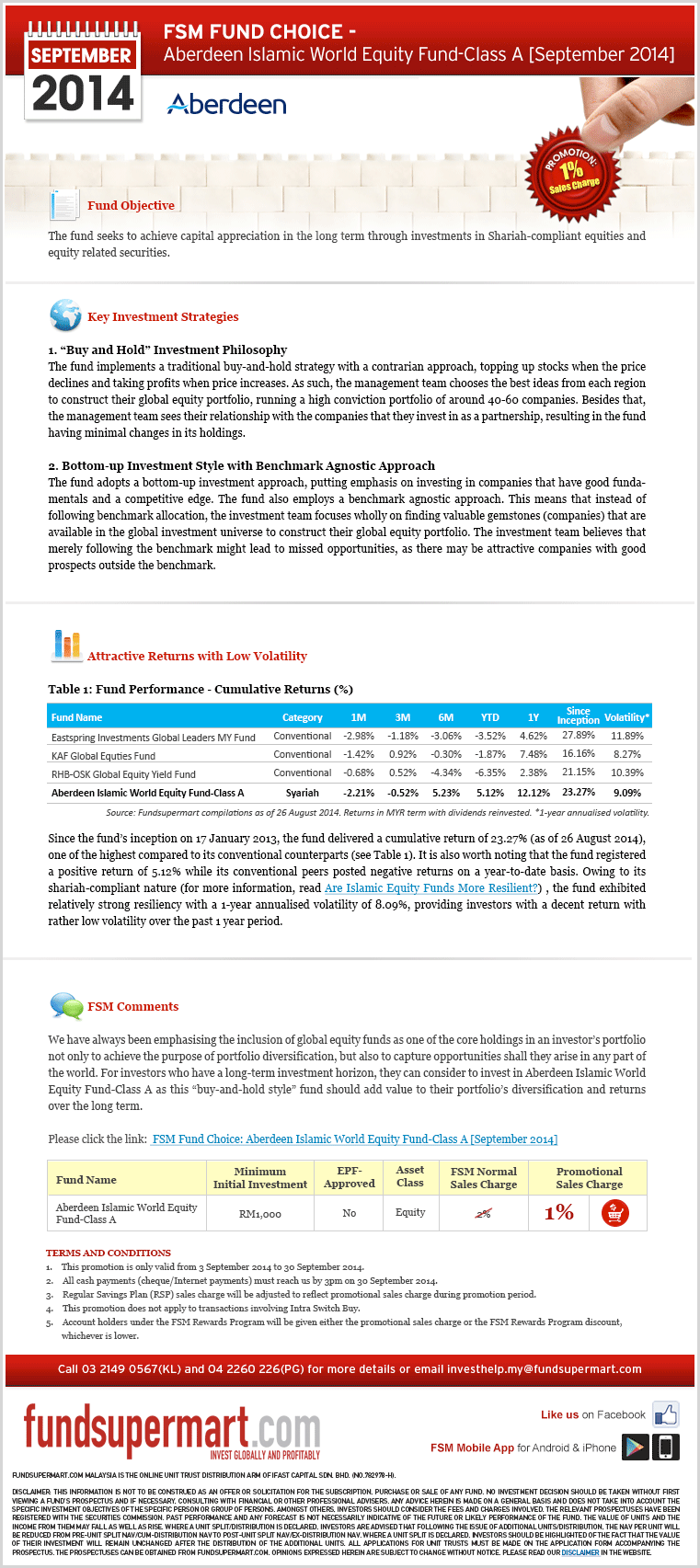 |
|
|
Sep 3 2014, 10:09 AM
|
|
Senior Member
2,032 posts Joined: Jan 2014 From: Sabah, Malaysia
|
QUOTE(Pink Spider @ Sep 3 2014, 10:05 AM) niceGonna RSP Rm100 in it |
|
|
Sep 3 2014, 10:14 AM
|
|
Senior Member
16,872 posts Joined: Jun 2011
|
QUOTE(woonsc @ Sep 3 2014, 10:09 AM) niceGonna RSP Rm100 in it Minimum RSP Investment RM 100 So unfair...force ppl to do RSP only  |
|
Topic ClosedOptions
|
| Change to: |  0.0285sec 0.0285sec
 0.65 0.65
 6 queries 6 queries
 GZIP Disabled GZIP Disabled
Time is now: 16th December 2025 - 01:24 PM |
 Quote
Quote